- Base Value(2026): 6.0 Bn
- Estimated Value(2026): 6.0 Bn
- Forecast Value (2036): 10.9 Bn
- CAGR (2026 - 2036): 6.2%
Automotive Fuel Accumulator Market Forecast and Outlook 2026 to 2036
In 2025, the automotive fuel accumulator market surpassed a valuation of USD 5.7 billion. Based on Fact.MR analysis, demand for automotive fuel accumulators is estimated to grow to USD 6.0 billion in 2026 and USD 10.9 billion by 2036. Fact.MR projects a CAGR of 6.2% during the forecast period.
Between 2026 and 2036, the automotive fuel accumulator market is projected to create an absolute dollar opportunity of USD 4.9 billion. This expansion reflects the essential role of fuel pressure management components across ICE and hybrid vehicle platforms, underpinned by both regulatory emissions compliance and the sustained global production of fuel-injected vehicles. Constraint comes from EV adoption pressure in mature markets, which moderates addressable volume growth without eliminating it.
As Koji Kobayashi, Executive Vice President of Denso Corporation, noted regarding fuel system component demand, 'Fuel management precision requirements are intensifying with every successive emissions regulation cycle, and our fuel system component portfolio is evolving accordingly to meet OEM specifications across combustion and hybrid platforms.' [1]
Country growth reflects vehicle production volumes, emissions regulation stringency, and aftermarket fleet size. China leads at 8.9% CAGR, supported by the world's largest vehicle production base and mandatory China 6b emissions standards. India follows at 8.2% driven by rapid motorization, Bharat Stage VI compliance requirements, and local OEM investment. Germany posts 7.5% as Tier 1 suppliers integrate accumulators into hybrid fuel systems ahead of Euro 7 deadlines. Brazil registers 6.8% supported by PROCONVE Phase 8 emissions compliance timelines. The United States posts 5.9% anchored by replacement aftermarket demand and CAFE standard-driven fuel system upgrades across new model platforms. The United Kingdom grows at 5.5% as residual ICE and hybrid fleet maintenance drives aftermarket procurement. Japan advances at 4.9% as a mature OEM production base sustains steady replacement demand against a backdrop of accelerating electrification.
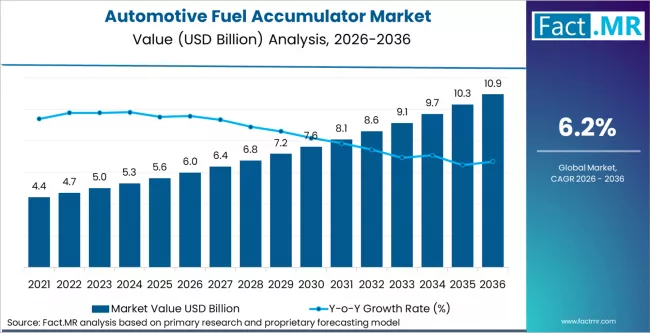
Automotive Fuel Accumulator Market Market Value Analysis | Source: Fact.MR
| Metric | Value |
|---|---|
| Estimated Value in 2026 | USD 6.0 billion |
| Forecast Value in 2036 | USD 10.9 billion |
| Forecast CAGR (2026 to 2036) | 6.2% |
Source: Fact.MR analysis. Updated Mar 2, 2026
Market Definition
Covers fuel accumulators used across the global automotive fuel supply chain, including components deployed in direct injection, port fuel injection, and hybrid fuel systems in passenger cars, light commercial vehicles, and heavy commercial vehicles. Includes OEM-supplied accumulators integrated during vehicle assembly and aftermarket replacements across the active global vehicle fleet.
Market Inclusions
Includes global and regional revenue forecasts (2026-2036) by sales channel and vehicle type. Covers OEM and aftermarket procurement across passenger cars, LCVs, and HCVs. Encompasses pricing dynamics, regulatory compliance cost analysis, and emissions standard adoption timelines by region.
Market Exclusions
Excludes fuel rails, fuel injectors, fuel pumps, and complete fuel system assemblies where fuel accumulators are not the primary component. Also excludes fuel accumulators used in non-automotive applications such as industrial equipment, marine engines, and aerospace fuel systems. Fully battery electric vehicle (BEV) fuel systems are excluded as they do not require conventional fuel accumulators.
Research Methodology
- Primary Research: Interviews were conducted with automotive Tier 1 fuel system engineers, OEM procurement specialists, independent aftermarket distributors, and emissions compliance consultants across North America, Europe, and Asia Pacific.
- Desk Research: Sources included OEM technical bulletins, national emissions regulatory databases, UN ECE vehicle production statistics, national automotive association reports, manufacturer investor presentations, and government fleet procurement records.
- Market Sizing and Forecasting: A hybrid model combined top-down vehicle production volume estimates with bottom-up average unit pricing data by sales channel and vehicle type. Regulatory compliance timelines and aftermarket fleet size estimates from primary interviews informed growth trajectory assumptions.
- Data Validation and Update Cycle: Outputs were validated against manufacturer revenue disclosures, OEM sourcing announcements, regulatory implementation records, and regional vehicle registration data. Forecasts are reviewed annually to reflect regulatory calendar updates and electrification penetration trends.
Summary
- Market Definition
- Automotive fuel accumulators are precision pressure-management components integrated into vehicle fuel delivery systems to dampen pressure pulsations, maintain consistent fuel rail pressure, and ensure stable fuel injection across combustion and hybrid powertrains.
- Demand Drivers
- Tightening global emissions standards including China 6b, Euro 7, and Bharat Stage VI are mandating higher injection precision, forcing OEMs to specify advanced fuel accumulators capable of sustaining tighter pressure tolerances across engine operating ranges.
- Sustained global vehicle production, particularly across Asia Pacific and Latin America, is generating high-volume OEM demand for fuel accumulators integrated directly into new fuel injection systems at point of manufacture.
- The expanding global aftermarket, supported by a large active fleet of fuel-injected ICE and hybrid vehicles, is creating structured replacement demand for fuel accumulators as original components exceed service life across vehicle segments.
- Key Segments Analyzed
- By Sales Channel: OEM dominates with 55.1% share, reflecting direct integration into new vehicle fuel systems at the point of manufacture, where OEM specification and certification requirements create captive supplier relationships.
- By Vehicle Type: Passenger Cars lead with 44.3% share due to the highest global production volumes, highest replacement frequency, and the broadest regulatory compliance exposure across major automotive markets.
- By Geography: Asia Pacific leads volume growth, with China and India contributing the highest CAGRs at 8.9% and 8.2% respectively, supported by massive OEM production capacity and binding emissions compliance deadlines.
- Analyst Opinion at FACT.MR
- Shambhu Nath Jha, Principal Consultant at Fact.MR, opines, 'CXOs will find this report essential for navigating the dual pressure of emissions-driven OEM specification upgrades and EV substitution risk. Premium high-pressure direct injection accumulators generate substantially higher revenue per unit than legacy port-injection equivalents, and aftermarket lifecycle revenue from the active ICE fleet provides durable revenue visibility through 2036.'
- Strategic Implications
- Manufacturers should accelerate development of high-pressure GDI-compatible accumulators. Direct injection platforms, which now account for the majority of new ICE and hybrid vehicle production globally, require higher-specification components where established suppliers can command premium pricing.
- Aftermarket distributors should prioritize fleet segmentation strategies in the U.S., UK, and Japan. Large, aging ICE vehicle fleets in these markets represent a predictable replacement demand pipeline that is largely insulated from near-term EV substitution risk.
- OEM suppliers should pursue long-term sourcing contracts with Chinese and Indian vehicle manufacturers. Emissions regulation enforcement timelines in both markets are creating forward demand visibility that justifies capacity investment and in-country supplier localization.
- Methodology
- Market sizing combined OEM vehicle production volume estimates by segment with average fuel accumulator unit pricing across channel and vehicle type tiers, validated through distributor sales data and manufacturer earnings disclosures.
- Emissions regulation adoption timelines and OEM compliance investment trends were benchmarked against national regulatory database records and OEM investor presentations from 2024 and 2025.
- Regional forecasts incorporated vehicle registration data, aftermarket fleet size estimates, national emissions compliance programme timelines, and primary interviews with Tier 1 fuel system suppliers and distributors.
Segmental Analysis
Automotive Fuel Accumulator Market Analysis by Sales Channel
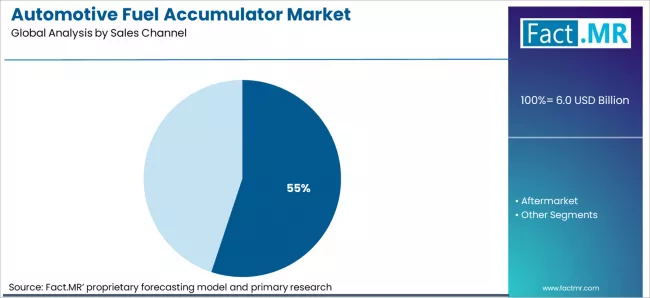
Automotive Fuel Accumulator Market Analysis By Sales Channel | Source: Fact.MR
Based on FACT.MR's automotive fuel accumulator market report, consumption via OEM channels is estimated to hold 55.1% share in 2026. OEM dominance reflects the integration of fuel accumulators as standard specified components during vehicle manufacturing, where OEM certification requirements and model-specific fuel pressure specifications create durable captive procurement relationships between vehicle manufacturers and approved Tier 1 suppliers.
- Bosch Rexroth and Continental OEM Integration Expansion: In March 2025, Continental AG disclosed in its FY2024 results presentation that its fuel management components division expanded OEM supply agreements with major Chinese vehicle manufacturers, reflecting growing demand for high-precision fuel system components under China 6b compliance timelines. This reinforces the structural dominance of OEM channels in the highest-growth regional markets. [2]
- Denso High-Pressure Fuel System Component Launch: In January 2025, Denso Corporation announced the commercial launch of its next-generation high-pressure fuel rail and accumulator components designed for GDI hybrid powertrains, targeting OEM supply to Toyota and Honda platform programs. The launch targets rising OEM specification requirements for accumulators capable of sustaining pressures above 350 bar in hybrid direct injection configurations. [3]
- Aftermarket Channel Growth Through E-Commerce Platforms: In 2024, leading aftermarket fuel system parts distributors including Robert Bosch GmbH's aftermarket division reported accelerating online channel adoption for fuel system replacement components across Europe and North America. This channel shift is reducing distribution cost per unit while expanding geographic reach into independent repair workshops, broadening addressable aftermarket volume. [4]
Automotive Fuel Accumulator Market Analysis by Vehicle Type
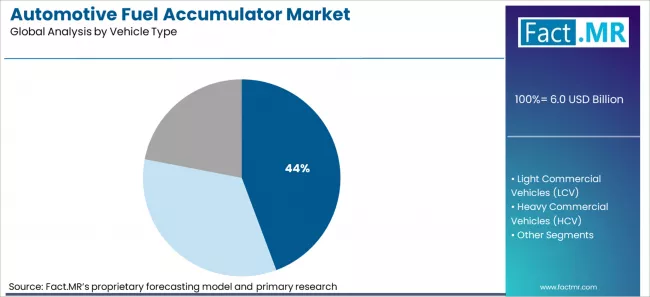
Automotive Fuel Accumulator Market Analysis By Vehicle Type | Source: Fact.MR
Based on FACT.MR's automotive fuel accumulator market report, consumption across Passenger Cars is estimated to hold 44.3% share in 2026. Passenger cars dominate because they represent the largest global vehicle production segment by unit volume, carry the broadest regulatory emissions compliance requirements, and generate the highest aftermarket replacement frequency.
- NOK Corporation Sealing Technology Investment: In 2024, NOK Corporation announced expanded production capacity for high-performance sealing components used in fuel accumulator assemblies targeting passenger car OEM programs in Japan and Southeast Asia. Sealing reliability at elevated pressures is a key differentiator for GDI accumulators, and NOK's capacity investment reflects sustained OEM demand momentum in this segment. [5]
- Freudenberg Sealing Technologies GDI Component Development: In early 2025, Freudenberg Sealing Technologies confirmed continued investment in sealing and membrane materials for high-pressure fuel accumulator applications, with specific focus on passenger car hybrid and plug-in hybrid programs across European OEM customers. The company cited Euro 7 preparation timelines as the primary driver of specification upgrades. [6]
- LCV Segment Expansion in Emerging Markets: In 2024 and 2025, vehicle manufacturers including Tata Motors and Mahindra expanded LCV production capacity in India to meet rising demand for fuel-efficient commercial vehicles compliant with BS VI norms. Expanding LCV platforms are generating incremental fuel accumulator demand in the light commercial segment, complementing the dominant passenger car share. [7]
Drivers, Restraints, and Opportunities
FACT.MR analysts observe that the automotive fuel accumulator market has historically tracked global ICE vehicle production volumes, with aftermarket demand providing a durable secondary growth layer. At its current valuation of USD 5.7 billion, the market reflects the ubiquity of fuel injection across the global vehicle fleet and the non-discretionary nature of fuel pressure management in both compliance-driven OEM programs and scheduled maintenance cycles.
The core tension in the market is the simultaneous pressure of electrification and emissions regulation. In mature markets including Western Europe, Japan, and parts of North America, BEV penetration is gradually reducing the addressable new vehicle OEM opportunity over the long forecast horizon. However, the transition is sufficiently gradual that the ICE and hybrid fleet sustains robust aftermarket demand well beyond 2036.
- Emissions Regulatory Compliance Mandates: China's GB18352.6 (China 6b) standard, fully in force since July 2023, requires all new passenger and commercial vehicles to meet particulate matter and NOx limits achievable only through precise fuel injection control. Compliance-driven OEM specification of high-precision fuel accumulators is sustaining structured volume and specification upgrade demand across the world's largest automotive market through the forecast period. [8]
- Euro 7 Preparatory Investment in European Supply Chains: The European Commission's Euro 7 regulation, finalized in 2024 with staged implementation beginning in 2025 for new type approvals, requires enhanced real-world emissions compliance across passenger cars and LCVs. European Tier 1 suppliers including Bosch and Continental have disclosed ongoing component-level investment in fuel management systems to support OEM Euro 7 readiness, directly sustaining demand for upgraded accumulator specifications in the European OEM channel.
- India Bharat Stage VI Aftermarket Demand Ramp: India's phased implementation of BS VI Phase 2 OBD norms, with full enforcement from April 2024, is creating incremental aftermarket demand as BS IV and early BS VI vehicles require fuel system servicing. The Indian aftermarket, served by both organized distributors and a large independent repair network, is growing at above-average rates relative to mature markets where regulatory-driven aftermarket transitions are already complete.
Regional Analysis
The automotive fuel accumulator market is analysed across North America, Latin America, Europe, East Asia, South Asia, Oceania, and Middle East & Africa across 40+ countries. The full report also offers market attractiveness analysis based on regional trends.
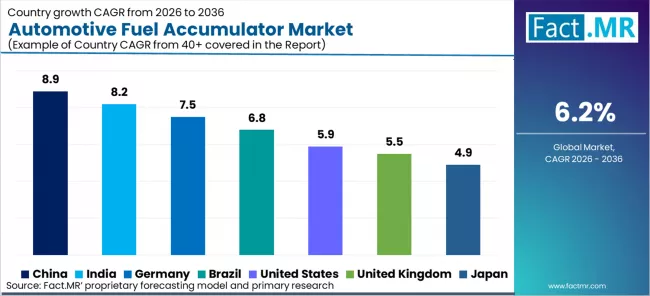
Automotive Fuel Accumulator Market Cagr Analysis By Country | Source: Fact.MR
| Country | CAGR (2026-2036) |
|---|---|
| China | 8.9% |
| India | 8.2% |
| Germany | 7.5% |
| Brazil | 6.8% |
| United States | 5.9% |
| United Kingdom | 5.5% |
| Japan | 4.9% |
Source: Fact.MR analysis. Updated Mar 2, 2026
Source: Fact.MR (FACT.MR) analysis, based on proprietary forecasting model and primary research
Asia Pacific Automotive Fuel Accumulator Market Analysis
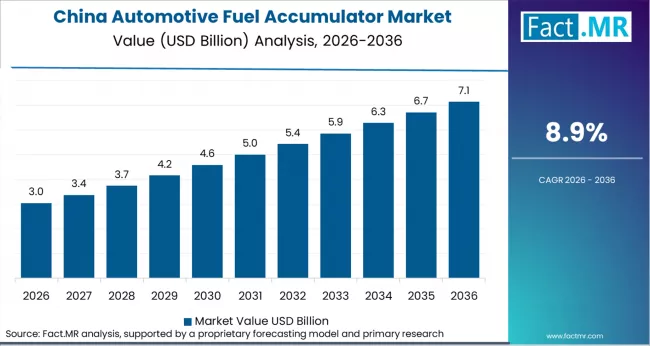
Automotive Fuel Accumulator Market Country Value Analysis | Source: Fact.MR
Asia Pacific is the fastest-growing and highest-volume region for automotive fuel accumulators, functioning as the global production epicenter for ICE and hybrid vehicles. China and India together represent the region's primary growth engines, driven by binding emissions regulations and sustained new vehicle production ramp.
- China: Demand for automotive fuel accumulators in China is projected to rise at an 8.9% CAGR through 2036. In 2024, SAIC Motor disclosed expansion of its domestic fuel system component supply base in partnership with local Tier 1 suppliers to meet escalating GDI accumulator demand across new passenger car programs. In January 2025, Great Wall Motor confirmed adoption of high-pressure direct injection systems across its HAVAL platform refresh, sustaining forward accumulator demand from one of China's leading SUV producers.
- India: Demand for automotive fuel accumulators in India is projected to grow at an 8.2% CAGR through 2036. In 2024, Maruti Suzuki India expanded domestic procurement of fuel injection components from approved Tier 1 suppliers as part of its localization strategy for BS VI-compliant platforms, creating additional supply chain demand for fuel system components.
FACT.MR's Asia Pacific analysis of the automotive fuel accumulator market covers China, Japan, South Korea, India, Australia and New Zealand, ASEAN, and Rest of Asia Pacific. Readers can find country-level CAGR projections, OEM procurement trends, emissions regulation adoption timelines, and aftermarket growth benchmarks by vehicle segment.
Europe Automotive Fuel Accumulator Market Analysis
Europe is the global regulatory laboratory for automotive emissions compliance, where Euro 7 preparatory investment and municipal clean air zone implementation are sustaining demand for precision fuel management components across ICE and hybrid platforms. The region's mature OEM base includes global Tier 1 fuel system leaders including Robert Bosch GmbH and Continental AG, both of which maintain integrated component supply relationships with
- Germany: Demand for automotive fuel accumulators in Germany is projected to rise at a 7.5% CAGR through 2036. In March 2025, Volkswagen Group disclosed in its annual report that fuel system component investment remained a priority across its thermal and hybrid model programs, with direct injection accumulators specified for new platform architectures across the Volkswagen, Audi, and SEAT model lines.
- United Kingdom: Demand for automotive fuel accumulators in the UK is projected to expand at a 5.5% CAGR through 2036. The UK's post-Brexit emissions framework, aligned to Euro 6d standards with independent regulatory update timelines, sustains OEM and aftermarket accumulator demand across passenger car and LCV segments. In 2024, the Society of Motor Manufacturers and Traders reported that hybrid vehicles accounted for a growing proportion of new UK car registrations, sustaining demand for fuel accumulators within hybrid fuel delivery subsystems.
FACT.MR's European analysis of the automotive fuel accumulator market covers Germany, France, the United Kingdom, Italy, Spain, the Netherlands, the Nordics, and Rest of Europe. Readers can find emissions compliance investment timelines, OEM sourcing trends, aftermarket channel analysis, and country-level CAGR projections by vehicle type.
North America Automotive Fuel Accumulator Market Analysis
North America represents a large, mature automotive fuel accumulator market anchored by a substantial active ICE and hybrid vehicle fleet and ongoing CAFE standard-driven OEM fuel efficiency investment. The United States generates the majority of regional revenue, with aftermarket replacement demand providing structural growth durability as new vehicle OEM volumes evolve.
- United States: Demand for automotive fuel accumulators in the U.S. is projected to rise at a 5.9% CAGR through 2036. The National Highway Traffic Safety Administration's revised CAFE standards, finalized in 2024, require automakers to achieve fleet-wide fuel economy improvements that sustain investment in precision fuel injection systems across ICE and hybrid platforms.
FACT.MR's North American analysis of the automotive fuel accumulator market covers the United States, Canada, and Mexico. Readers can find federal emissions regulation impacts, OEM production platform trends, aftermarket replacement cycle benchmarks, and country-level growth projections by sales channel.
Latin America Automotive Fuel Accumulator Market Analysis
Latin America is an emerging growth region for automotive fuel accumulators, driven by Brazil's PROCONVE emissions programme and expanding vehicle production across the region. Brazil's large domestic vehicle fleet and growing emissions compliance enforcement are generating increasing demand for fuel injection components from both OEM assembly programs and the aftermarket.
- Brazil: Demand for automotive fuel accumulators in Brazil is projected to rise at a 6.8% CAGR through 2036. Brazil's PROCONVE Phase 8 emissions programme, with full enforcement timelines extending through the forecast period, mandates fuel injection precision improvements across new vehicle categories that sustain structured OEM accumulator demand. In 2024, ANFAVEA, Brazil's national motor vehicle manufacturers association, reported sustained domestic vehicle production growth, with OEM fuel system component procurement sustaining Tier 1 supply chains.
FACT.MR's Latin American analysis of the automotive fuel accumulator market covers Brazil, Chile, Ecuador, and Rest of Latin America. Readers can find emissions programme enforcement timelines, OEM production volume trends, and aftermarket growth benchmarks by country.
Competitive Aligners for Market Players
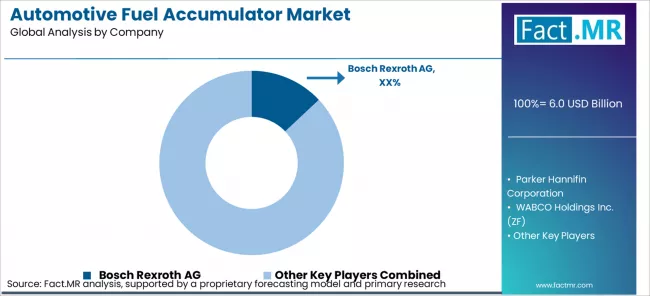
Automotive Fuel Accumulator Market Analysis By Company | Source: Fact.MR
The global automotive fuel accumulator market is moderately concentrated at the Tier 1 supplier level, with a small number of large integrated fuel system component manufacturers holding substantial OEM supply shares alongside a fragmented aftermarket distribution structure. Robert Bosch GmbH, Denso Corporation, and Continental AG collectively hold the largest OEM market positions, supported by long-standing integrated relationships with global vehicle manufacturers across their primary production regions. Parker Hannifin Corporation and WABCO Holdings (now part of ZF Group) maintain strong positions in commercial vehicle segments. The primary competitive variable at the OEM level is technical certification and model-specific engineering qualification, which creates significant switching costs and favours incumbent suppliers across multi-year vehicle program lifecycles.
Structural competitive advantages at the top of the market are held by suppliers with vertically integrated fuel system capabilities, captive materials engineering expertise for sealing and membrane components, and co-development relationships with major OEM engineering teams. Freudenberg Sealing Technologies and NOK Corporation maintain differentiated positions in high-precision sealing, which is a critical failure mode in GDI and high-pressure accumulator applications. Magneti Marelli, now operating under the Marelli brand, competes across fuel injection system assemblies with integrated accumulator content targeting European and Asian OEMs. These structural advantages translate into pricing resilience at the OEM supply tier, where per-unit margins are protected by specification lock-in rather than open competition.
In the aftermarket channel, buyer leverage is higher and competition is more price-sensitive, with independent brands competing for distribution shelf space alongside OEM-branded replacement components. This structural difference means aftermarket pricing is subject to greater margin compression than OEM supply, reinforcing the strategic priority of retaining and growing OEM program positions.
Recent Developments
- In February 2025, Denso Corporation announced expansion of its fuel management system component production at its Aichi Prefecture facility to support rising OEM demand for GDI accumulator assemblies across Toyota's next-generation hybrid platform programs.
- In November 2024, Continental AG completed integration of its fuel system components division into its restructured Automotive segment, consolidating high-pressure accumulator product development under a unified fuel management engineering centre in Regensburg, Germany.
Key Players
- Bosch Rexroth AG
- Parker Hannifin Corporation
- WABCO Holdings Inc. (ZF)
- Continental AG
- Denso Corporation
- NOK Corporation
- Freudenberg Sealing Technologies
- Magneti Marelli (Marelli)
Bibliography
- [1] Denso Corporation. (2025). Fiscal Year 2025 Investor Day Presentation: Fuel Management Systems Division. March 2025.
- [2] Continental AG. (2025). FY2024 Annual Report and Investor Presentation: Automotive Division Fuel Management Components. February 2025.
- [3] Denso Corporation. (2025). Press Release: Next-Generation High-Pressure Fuel Rail and Accumulator Launch for GDI Hybrid Programs. January 2025.
- [4] Robert Bosch GmbH. (2024). Automotive Aftermarket Division Annual Update: E-Commerce Channel Expansion. November 2024.
- [5] NOK Corporation. (2024). Investor Presentation: Sealing Technology Capacity Expansion for Automotive Fuel System Applications. September 2024.
- [6] Freudenberg Sealing Technologies. (2025). Technical Press Release: High-Pressure Sealing Materials for GDI Accumulator Applications. January 2025.
- [7] Tata Motors Limited / Mahindra & Mahindra Ltd. (2024). Annual Reports FY2024: Commercial Vehicle Production Capacity Expansion Disclosure.
- [8] Ministry of Ecology and Environment, People's Republic of China. (2023). GB18352.6 China 6b Emission Standard Enforcement Guidance.
This Report Addresses
- Strategic market intelligence covering OEM specification investment, GDI and hybrid accumulator product development, aftermarket channel dynamics, and pricing pressure across emerging and mature automotive markets.
- Market size and forecast: valued at USD 6.0 billion in 2026, projected to reach USD 10.9 billion by 2036 at a 6.2% CAGR, segmented by sales channel, vehicle type, and region.
- Growth opportunity mapping across high-pressure GDI accumulator segments, OEM hybrid platform supply chains, and aftermarket replacement demand in large ICE vehicle fleet markets.
- Segment and regional outlook with country-level CAGR for China (8.9%), India (8.2%), Germany (7.5%), Brazil (6.8%), United States (5.9%), United Kingdom (5.5%), and Japan (4.9%).
- Competitive strategy analysis of Bosch, Denso, Continental, Parker Hannifin, NOK, and Freudenberg, covering OEM supply positioning, product differentiation, certification advantage, and aftermarket channel strategies.
- Product and technology tracking including high-pressure GDI accumulators, hybrid fuel system components, sealing technology upgrades, and aftermarket e-commerce distribution innovation.
- Regulatory impact analysis covering China 6b, Euro 7, Bharat Stage VI Phase 2, CAFE standards, and PROCONVE Phase 8 and their direct implications for OEM and aftermarket fuel accumulator procurement.
- Report delivered in Excel datasets, PowerPoint summary, and detailed PDF supported by verified regulatory records, manufacturer disclosures, and primary research sources.
Segmentation
Scope of Report
| Items | Values |
|---|---|
| Quantitative Units | USD 6.0 billion (2026) to USD 10.9 billion (2036), at a CAGR of 6.2% |
| Market Definition | Automotive fuel accumulators are precision pressure-damping components integrated into vehicle fuel delivery systems to maintain consistent fuel rail pressure and suppress fuel pulsation across direct injection, port fuel injection, and hybrid powertrain configurations in passenger cars, light commercial vehicles, and heavy commercial vehicles. |
| Sales Channel Segmentation | OEM, Aftermarket |
| Vehicle Type Segmentation | Passenger Cars, Light Commercial Vehicles (LCV), Heavy Commercial Vehicles (HCV) |
| Application Coverage | Direct injection fuel systems, port fuel injection assemblies, GDI high-pressure fuel rails, hybrid powertrain fuel management, commercial vehicle fuel supply systems, aftermarket fuel system replacement components |
| Regions Covered | Asia Pacific, Europe, North America, Latin America, Middle East and Africa |
| Countries Covered | China, Japan, South Korea, Australia and New Zealand, India, ASEAN, Rest of Asia Pacific, Germany, United Kingdom, France, Italy, Spain, Netherlands, Nordics, Rest of Europe, United States, Canada, Mexico, Brazil, Chile, Ecuador, Rest of Latin America, Kingdom of Saudi Arabia, United Arab Emirates, South Africa, Turkey, Rest of Middle East and Africa |
| Key Companies Profiled | Bosch Rexroth AG, Parker Hannifin Corporation, WABCO Holdings Inc. (ZF), Continental AG, Denso Corporation, NOK Corporation, Freudenberg Sealing Technologies, Magneti Marelli (Marelli) |
| Forecast Period | 2026 to 2036 |
| Approach | A hybrid top-down and bottom-up modelling approach was applied. Top-down inputs included total addressable OEM vehicle production volumes by segment and region, emissions regulation compliance timelines, and aftermarket fleet size estimates. Bottom-up inputs incorporated average unit prices by sales channel and vehicle type, replacement cycle assumptions, and new platform specification upgrade rates from primary interviews with Tier 1 suppliers, OEM procurement teams, and aftermarket distributors. |
Source: Fact.MR analysis. Updated Mar 2, 2026
Automotive Fuel Accumulator Market by Segment
-
By Sales Channel :
- OEM
- Aftermarket
-
By Vehicle Type :
- Passenger Cars
- Light Commercial Vehicles (LCV)
- Heavy Commercial Vehicles (HCV)
-
By Region :
- North America
- United States
- Canada
- Mexico
- Europe
- Germany
- United Kingdom
- France
- Italy
- Spain
- Netherlands
- Nordics
- Rest of Europe
- Asia Pacific
- China
- Japan
- South Korea
- India
- Australia and New Zealand
- ASEAN
- Rest of Asia Pacific
- Latin America
- Brazil
- Chile
- Ecuador
- Rest of Latin America
- Middle East and Africa
- Kingdom of Saudi Arabia
- United Arab Emirates
- South Africa
- Turkey
- Rest of Middle East and Africa
- North America
Frequently Asked Questions
How large is the automotive fuel accumulator market in 2025?
What will the market size be in 2026?
What is the projected market size by 2036?
What is the expected CAGR for the forecast period 2026 to 2036?
Which sales channel is poised to lead the automotive fuel accumulator market?
Which vehicle type segment holds the largest share?
Which end-use segment commands the largest revenue share?
Which country shows the fastest growth rate?
How fast is the automotive fuel accumulator market expected to expand in India?
What is the forecast CAGR for Germany's automotive fuel accumulator market?
Who worked on this report


Preview the report firsthand - request a free sample
Free SampleGet the brochure for pricing and purchase details
Download PDF