- Base Value(2025): 2002.0 Mn
- Forecast Value (2035): 3261.0 Mn
- CAGR (2035): 7.4%
Slugging Ointments Market Outlook (2025 to 2035)
The global slugging ointments market is expected to reach USD 3,261.0 million by 2035, up from USD 2,002.0 million in 2025. During the forecast period 2025 to 2035, the industry is projected to expand at a CAGR of 5.0%.
The growing popularity of an intense hydration routine to counter transepidermal water loss, coupled with the viral effect of social media and beauty influencers, who demonstrate its efficacy, is driving the slugging ointment market growth. The rising supply of superior formulations, heightened with ceramides, squalene, and natural oils, has further gained momentum, which attracts ingredient-conscious consumers. All these have allowed more consumers to become interested, increasing the number of applications and expenditures on the products through more regular purchases in skincare categories.
2025-to-2035.webp "Us Slugging Ointments Industry Value(usd Million)2025 To 2035")
Us Slugging Ointments Industry Value(usd Million)2025 To 2035 | Source: Fact.MR
Quick Stats for Slugging Ointments Market
- Industry Value (2025): USD 2,002.0 Million
- Projected Value (2035): USD 3,261.0 Million
- Forecast CAGR (2025 to 2035): 5.0%
- Leading Segment (2025): Petroleum-Based Creams & Balms (42% Market Share)
- Fastest Growing Country (2025-2035): South Korea (6.0% CAGR)
- Top Key Players: Unilever, CeraVe, Beiersdorf, Future Wise, Vermont's Original LLC, and SkinCeuticals
What are the drivers of the slugging ointments market?
The growing trend of skin-intensive hydration among consumers is one of the motivators of the slugging ointment market. With more awareness of trans epidermal water loss and barrier repair, more individuals are now embracing occlusive ointments in retaining their skin moisture overnight, creating demand across the skincare sectors. This will be especially prominent among consumers with dry or sensitive skin conditions.
The other effect-producing component has been social media and influencers in the beauty industry popularizing the slugging trend. Viral content with sequences of movements and pre- and post-picture outcomes has quickly increased product awareness, motivating younger and older consumers to get in on the action. This marketing force has been converted to more product trials and repeat purchases.
Also, the increasing accessibility of special ointments developed to perform slugging has boosted market penetration. While traditional petroleum-based balms have been the default option, they have been supplemented with more natural formulas containing ceramides, squalene, and natural oils to appeal to buyers who prioritize product ingredients. This product innovation has diversified the consumer base and also extended its use to other aspects of skincare besides traditional skincare.
What are the regional trends of the slugging ointments market?
In the North American market, slugging ointments are performing well with the introduction of barrier-repair routines by skincare enthusiasts due to the recommendations of dermatologists and through social media means. The U.S. market enjoys the highest levels of consumption, with a variety of petroleum-based and enriched hybrid formulas widely dispersed.
In Europe, demand is on an upward trend, especially in western markets where consumers tend to crush on ointments containing natural and vegan-certified products. Regulatory focus on clean-label skincare also serves to support serendipitous innovation focused on a specific slugging formulation.
In the Asia-Pacific region, South Korea and Japan have been at the forefront in ensuring that slugging has become a global phenomenon, with K-beauty trends dominating the beauty industry. Stronger economies in broader markets like China and India are being driven by rapid urbanization and an increase in disposable income.
The Latin America market is emerging as people embrace the global trends of skincare. Slugging has found its way into the urban young generation largely due to the increasing e-commerce penetration and the impact of the international beauty brand.
What are the challenges and restraining factors of the slugging ointments market?
The challenge faced by the slugging ointment market is misconceptions by consumers about the practice. Slugging works well to increase hydration and skin barrier repair, but most people find that it can leave them with clogged pores or breakouts. This introduces reluctance in the first-time buyers, and education and dermatologist referral play a pivotal role in establishing long-term adoption.
A second threat will be the stiff competition presented by substitute skincare products with claims of providing similar moisturizing benefits yet, they do not feel as heavy as ointments. The more lightweight versions like serums, gels and creams, as well as overnight masks, will be attractive to consumers who do not like the greasy effect of slugging, and manufacturers will have to innovate the formula to add texture to ensure continued acceptance.
One of the restraints is having a reliance on petroleum-based formulations, which are drawing increased criticism as unsustainable and environmentally unfriendly. With an inclination towards the environment, the factors driving consumer behavior both synergistically and antagonistically towards brands that use mineral oil-based ointments are faced with limitations regarding growth potential. This sustainability issue is driving the market to reformulation and more environmentally friendly ingredient sourcing.
Country-Wise Insights
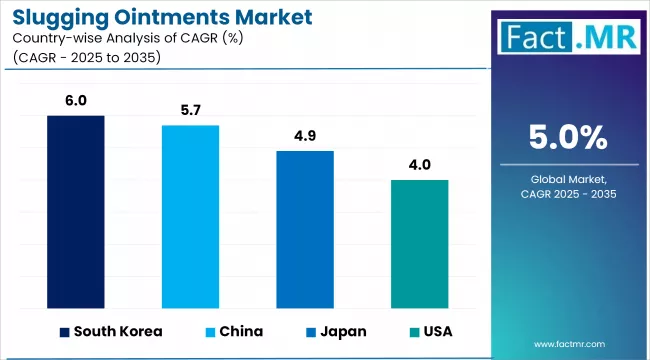
Slugging Ointments Market By Country | Source: Fact.MR
USA slugging ointments market surges with dermatology-backed routines and social media-driven skincare
The USA slugging ointments market is experiencing a rapid development due to recommendations by dermatologists, Instagram trends, and the preference for barrier-repair skincare. Slugging fits perfectly in the American vision of maintaining and repairing their skin through skin-beneficial hydration, moisture-retention, and anti-pollutant molecule locking. The rise in the understanding of transepidermal water loss has supported the use of ointments as one of the trusted solutions in day-to-day routine and in specialized treatment.
2025-to-2035.webp "Us Slugging Ointments Market Country Value(usd Million)2025 To 2035")
Us Slugging Ointments Market Country Value(usd Million)2025 To 2035 | Source: Fact.MR
Multinationals, research-based dermatology networks and the availability of advanced skincare labs have made New York and Los Angeles some of the fastest-moving cities. Both traditional labels and independent brands are producing both traditional petroleum-based balms as well as hybrid products carrying ceramides, squalene and plant-derived oils.
Japan slugging ointments market grows with minimalist beauty culture and advanced dermatology-driven skincare
The Japan slugging ointments market is increasing due to the skin barrier protection, ingredient refinement and minimalist routines. The Japanese consumers favor occlusion in a form of light, but highly performing, occlusives such as hybrid ointments enriched with ceramides, squalene, and rice-derived ingredients become increasingly demanded. The presence of dermatologist endorsements and the strong belief in science-based skincare that is well-established in the country gives the brand an additional credibility and information advantage.
The country is innovative because local pharmaceutical firms collaborate with research institutes and international brand names, especially in Tokyo and Osaka. Both the traditional brand names are coming up with formulations that are hydrating and yet still non-greasy on sensitive skin.
South Korea slugging ointments market accelerates with K-beauty exports and multifunctional skincare innovation
The South Korean skincare market is gaining speed because of the country's reputation as a pioneer in innovative beauty products and a strong propensity of the consumer base to new skincare regimens. Slugging is also becoming more of a skin-strengthening measure, with local consumers appreciating its protective benefits against pollution and the post-urban stress, along with seasonal dryness.
The presence of R&D centres in Seoul and Incheon is leading to the formulation of ointments blending traditional petroleum bases with marine actives, fermented extracts and probiotics blends.
Category-Wise Analysis
Petroleum-based creams & balms dominate slugging ointments with affordability and proven skin-barrier protection
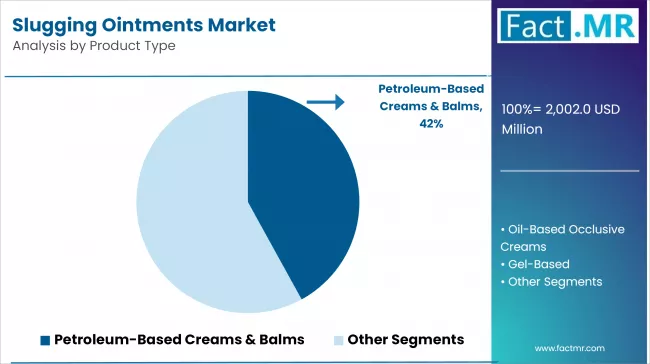
Slugging Ointments Market By Product Type | Source: Fact.MR
The petroleum-based creams and balms products currently form the biggest proportion of the slugging ointments market due to their convenience, accessibility, and the effectiveness of these products as a moisture barrier. Vaseline and Aquaphor are common household products that have well-known effects of preventing the transepidermal water loss, so they become a natural choice of consumers who start slugging.
This segment has an excellent consumer trust, which it has earned over decades, with formulations based on the reputation of petroleum jelly as a safe and effective occlusive. Nevertheless, due to changing consumer demands, brands are trying to come up with more enhanced versions that contain added ceramides, vitamin E, and botanical oils to conform to the demands of clean beauty.
Jars remain a preferred packaging format in slugging ointments for premium appeal and consumer convenience
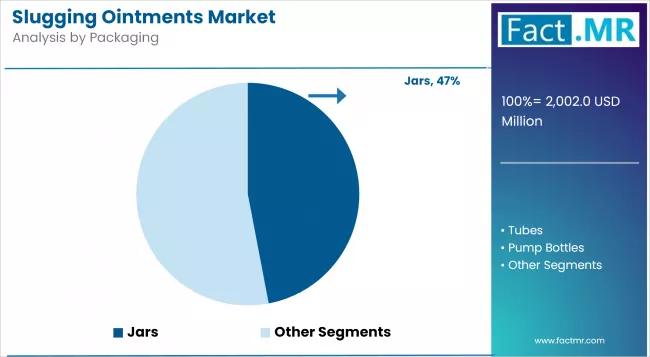
Slugging Ointments Market By Packaging | Source: Fact.MR
The jars segment is the market leader in slugging ointments with its high-construction aesthetics, reusability and thicker formulations. Members perceive that jars are used in the definition of luxurious skincare, hence the inclination to use them in selling petroleum-based ointments as well as hybrid balms with ceramide- or natural-based oil richness.
This packaging makes product accessibility easy to ensure even nighttime slugging can be carried out by applying copious amounts. Brands are also using jars to enhance their beauty, where glass and environmentally friendly jars are the options suitable with the sustainability-based consumer demand.
Petrolatum drives the slugging ointments market with proven occlusive strength and dermatologist-backed reliability
Petrolatum has its place as a pillar of the slugging ointments market and is regarded as one of the most effective in moisture-locking and repairing the skin barrier across the world. Its proven clinical substantiation and endorsement by dermatologists has made it the most cocooned with respect to preventing transepidermal water loss, making it ever reliable in terms of consumer dependence.
The affordability and wide availability of the ingredient in the mass-market brands such as Vaseline and Aquaphor also add to its domination. Despite its petrochemical nature, petrolatum remains the most popular product because of its high efficacy, safety, and compatibility with more sensitive skin.
Competitive Analysis
The slugging ointments market is moving forward to formulate hybrid products, which incorporate conventional occlusives into combinations with bioactive components like ceramides, peptides, and natural oils to satisfy customer demand to multitasking and clean label cosmetics. Competitiveness is now more associated with the capacity to demonstrate clinically proven benefits including long lasting hydration, barrier repair, and anti-aging effects as well as maintaining lightweight and suitable to multiple skin type formulations. Flexible packaging-including jars, tubes and eco-friendly options-are becoming an added established differentiator in the market.
The question facing manufacturers is how to balance the need to be innovative with the need to avoid undermining consumer safety and sensory preference, in other words how to ensure an ointment has the occlusive properties it needs without the greasy feel. Stability, neutrality, and concentration of all bioactive ingredients are important parameters in formulating, as far as the consumers are concerned.
Key players in the slugging ointments industry are Unilever, CeraVe, Beiersdorf, Future Wise, Vermont's Original LLC, SkinCeuticals, and others.
Recent Developments
- In May 2025, SkinCeuticals introduced several new products, the Hydra Balm, an occlusive moisturizing balm for very dry skin, alongside advanced offerings like A.G.E. Interrupter Ultra Serum and RGN-6 Regenerative Cream.
- In September 2024, Vaseline launched its new Vaseline Radiant X body care range in the US.
Fact.MR has provided detailed information about the price points of key manufacturers of Slugging Ointments Market positioned across regions, sales growth, production capacity, and speculative technological expansion, in the recently published report.
Methodology and Industry Tracking Approach
Global Slugging Ointments Market report is completed on the basis of a research conducted on a sample size of over 11,452 experts such as the dermatologist, cosmetic chemists, skincare formulation experts, sustainability experts and consumer behavior expert to get answers to questions through a series of in-depth interviews. Attendees were heads of R&D departments of skin care companies, product-innovation and packaging administrators, supply chain administrators, marketing planners, regulators, and also reps of upcoming pure-beauty and barrier-repair skin care organizations.
Methodology was a horizontal research study, in which the questions were structured and carried out over the period September 2024-July 2025 in order to obtain the multi-variate perspectives. Important types of formulation tested include the consistency and homogeneity of occlusive ointment formulations, skin safety of petroleum-based and combination creams in the long run, and the development and innovation via optimization of formulation texture, leading to a decrease in greasiness. It further touched on issues on sustainable packaging innovation, commercialization plan, changes in distribution channels between offline and online retailing, and regulation compliance in different parts of the world.
With Fact.MR has been monitoring consumer behavior, product efficacy, industry trends, and market opportunities since 2018. This report is becoming an authoritative source of information that stakeholders can rely on.
Segmentation
Segmentation of Slugging Ointments Market
-
By Product Type :
- Petroleum-Based Creams & Balms
- Oil-Based Occlusive Creams
- Gel-Based
- Hybrid Moisturizers (Water-in-Oil / Oil-in-Water)
- Stick Format / Solid Balms
-
By Packaging :
- Tubes
- Jars
- Pump Bottles
-
By Ingredient :
- Petrolatum
- Silicone-Based Occlusives
- Squalane
- Plant-Based Occlusives
-
By Region :
- North America
- Latin America
- Western Europe
- Eastern Europe
- East Asia
- South Asia & Pacific
- Middle East & Africa
Frequently Asked Questions
What was the slugging ointments market size reported by Fact.MR for 2025?
Who are the major players operating in the slugging ointments market?
What is the estimated valuation of the slugging ointments market in 2035?
What value CAGR did the slugging ointments market exhibit over the last five years?
Who worked on this report


Preview the report firsthand - request a free sample
Free SampleGet the brochure for pricing and purchase details
Download PDF