- Market Value (2025): USD 378.5 Mn
- Estimated Value (2026): USD 430 Mn
- Forecast Value (2036): USD 1539 Mn
- CAGR (2026-2036): 13.6%
What is the Bio-Based Liquid Crystal Polymers Market forecast to be worth by 2036?
USD 430 million in 2026 to USD 1,539 million by 2036, at 13.6% CAGR.
- The bio-based liquid crystal polymers market reached USD 378.5 million in 2025 as connector miniaturization and renewable-content qualification moved into procurement discussions.
- Demand is projected to increase from USD 430 million in 2026 to USD 1,539 million by 2036.
- The market is forecast to record 13.6% CAGR from 2026 to 2036 as electronics moulders and telecom module producers qualify lower-fossil LCP routes.
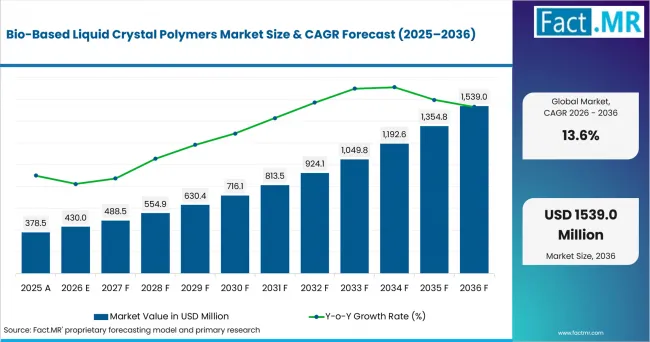
Bio Based Liquid Crystal Polymers Market Value Analysis | Source: Fact.MR
What are the defining numbers behind Bio-Based Liquid Crystal Polymers Market growth?
USD 1,109 million absolute opportunity by 2036, led by injection-moulding grades, connectors & sockets and electronics applications.
- Demand Drivers in the Market
- Connector manufacturers need thin-wall flow and low warpage so smaller sockets can pass dimensional checks during high-volume assembly.
- Antenna module producers require low dielectric loss because high-frequency signal paths leave little room for material drift.
- Medical device moulders use LCP when miniature parts need heat resistance and stable tolerances during repeated production runs.
- Procurement teams are expected to ask for renewable-content documentation as biomass-derived monomers and mass-balance claims move into engineering polymer tenders.
- Key Segments Analyzed
- By Grade: Injection-moulding grades are expected to hold 46.0% share in 2026 due to connector and socket qualification needs.
- By Application: Connectors & sockets are projected to account for 33.0% share in 2026 because miniaturized electronic assemblies depend on stable moulded geometry.
- By End-Use Industry: Electronics is anticipated to capture 41.0% share in 2026 as device makers place more value on heat-resistant precision materials.
- Analyst Opinion at Fact.MR
- Shambhu Nath Jha, Principal Consultant at Fact.MR, states, “Bio-based LCP is not a simple resin swap. Customers are expected to approve it only when renewable-content claims, thermal behavior and moulding performance stay aligned with existing part drawings. Suppliers that combine feedstock traceability with application testing are expected to carry more weight during qualification.”
- Strategic Implications
- Resin producers should document biomass content and chain-of-custody method before asking customers to qualify bio-based grades.
- Pricing teams should prepare resin-change cases carefully because Celanese Corporation announced LCP/PCT increases in February 2025 across Asia, Americas and EMEA.
- Electronics moulders should compare cycle time and reject rates against incumbent fossil-based LCP before shifting production lots.
- Telecom component teams should test dielectric stability early because antenna designs leave little tolerance for material variation.
Taiwan is forecast to post 15.6% CAGR through 2036 owing to electronics export depth and semiconductor-related assembly demand. South Korea is projected to record 15.2% CAGR as ICT exports and memory supply chains support precision polymer use. The United States is anticipated to advance at 14.3% CAGR due to domestic electronics orders and medical-device qualification. The Netherlands is estimated to hold 13.7% CAGR as semiconductor equipment controls raise documentation needs. Germany is forecast to record 13.2% CAGR through electrical and electronic manufacturing depth. Japan is projected to reach 13.0% CAGR as local resin producers and electronics component makers sustain LCP qualification work.
How does the Bio-Based Liquid Crystal Polymers Market break down by segment?
Injection-moulding grades lead Grade at 46.0%; connectors & sockets lead Application at 33.0%.
Which grade dominates?
Injection-moulding grades are projected to account for 46.0% share in 2026.
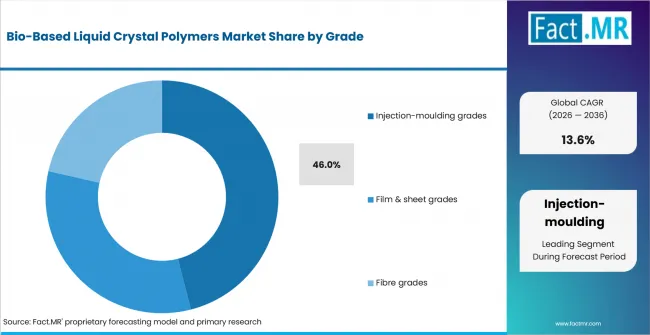
Bio Based Liquid Crystal Polymers Market Analysis By Grade | Source: Fact.MR
Injection-moulding grades lead because many LCP approvals begin with ultra-small connector bodies, sockets and insulating components. Moulding trials remain the first commercial proof point, as geometry and soldering conditions often determine approval before renewable-content claims are considered.
What leads the Application segment?
Connectors & sockets are expected to hold 33.0% share in 2026.
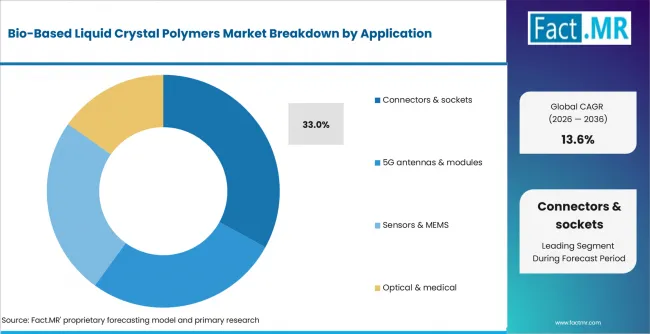
Bio Based Liquid Crystal Polymers Market Analysis By Application | Source: Fact.MR
Connectors & sockets lead the Application segment as device makers reduce spacing while requiring materials to withstand soldering heat and assembly pressure. Their qualification depends on dimensional stability, heat resistance and reliable insulation performance, making these components a major commercial entry point for liquid crystal polymer materials.
How does End-Use Industry shape demand?
Electronics is anticipated to lead with 41.0% share in 2026.
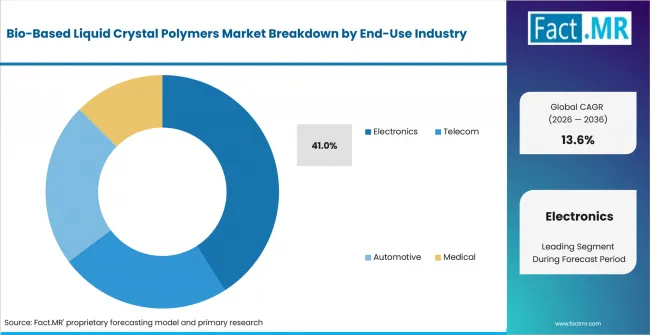
Bio Based Liquid Crystal Polymers Market Analysis By End Use Industry | Source: Fact.MR
Electronics leads the End-Use Industry segment because connectors, boards and device modules create the broadest qualification base for LCP materials. Demand is supported by miniaturization, high-temperature processing and precise electrical performance requirements across advanced electronic assemblies, where material consistency and processing reliability remain central to supplier approval.
What is accelerating Bio-Based Liquid Crystal Polymers Market adoption, and what is holding it back?
Connector miniaturization drives it; qualification risk restrains it.
Drivers Impact Analysis
| DRIVER | (~) % IMPACT ON CAGR | GEOGRAPHIC RELEVANCE | IMPACT TIMELINE |
|---|---|---|---|
| Connector miniaturization | +3.1% | Taiwan, Japan, South Korea | Short term (<= 2 years) |
| Renewable-content qualification | +2.7% | Japan, United States, Germany | Medium term (2-4 years) |
| High-frequency telecom modules | +2.2% | United States, Taiwan, Netherlands | Medium term (2-4 years) |
| Medical micro-moulding | +1.7% | United States, Japan, Germany | Long term (>= 4 years) |
| Fibre and film extension | +1.1% | Japan, South Korea, Europe | Long term (>= 4 years) |
Source: Fact.MR analysis. Updated Aug 17, 2026
- Connector miniaturization: Smaller socket designs are expected to raise the value of flow length, flatness and heat resistance. LCP grades fit this need when moulders need repeatable thin-wall filling.
- Renewable-content qualification: Bio-based grades are anticipated to gain attention when they keep the same processing window as fossil-based LCP. Procurement teams need chain-of-custody records that connect feedstock choice to resin lots. Application trials are expected to remain the main approval gate.
- Fibre extension: High-strength fiber forms are expected to widen LCP use beyond classic connector moulding. Fiber documentation helps when customers compare material history and end-use fit.
Opportunity Impact Analysis
| OPPORTUNITY | (~) % IMPACT ON CAGR | GEOGRAPHIC RELEVANCE | IMPACT TIMELINE |
|---|---|---|---|
| Mass-balance grade conversion | +1.6% | Japan, United States, Europe | Medium term (2-4 years) |
| Bio-monomer segregation | +1.3% | Japan and South Korea | Long term (>= 4 years) |
| Medical micro-part qualification | +0.9% | United States and Japan | Medium term (2-4 years) |
| Antenna substrate testing | +0.7% | Taiwan, Netherlands, Germany | Long term (>= 4 years) |
Source: Fact.MR analysis. Updated Aug 17, 2026
- Mass-balance grade conversion: Drop-in bio-based grades are expected to shorten approval work when chemistry and moulding behavior remain close to existing LCP grades. That route suits customers that need lower-fossil documentation without changing part geometry. Suppliers should keep certification evidence in the data package.
- Bio-monomer segregation: Segregated biomass routes are projected to appeal to customers that want clearer product-level biomass content. Resin makers need clean process evidence before they ask customers to convert from incumbent LCP grades. Customer certification is expected to decide commercialization speed.
- Medical micro-part qualification: Microneedles and miniature housings create opportunity where LCP flow behavior reduces tool-design risk. Medical product teams also need documentation and continuity of supply. Each device program has its own approval pathway.
Restraints Impact Analysis
| RESTRAINT | (~) % IMPACT ON CAGR | GEOGRAPHIC RELEVANCE | IMPACT TIMELINE |
|---|---|---|---|
| Qualification time | -1.4% | Global electronics supply chains | Short term (<= 2 years) |
| Feedstock documentation burden | -1.1% | Japan, Europe, United States | Medium term (2-4 years) |
| Price pressure | -0.9% | Connector moulders | Short term (<= 2 years) |
| Export-control sensitivity | -0.5% | Netherlands, Taiwan, South Korea | Long term (>= 4 years) |
Source: Fact.MR analysis. Updated Aug 17, 2026
- Qualification time: Bio-based LCP is constrained by the need to prove that moulded parts behave like incumbent grades. Connector customers compare warpage, flow length and soldering resistance before approving a material change. Small part failures can block wider conversion.
- Feedstock documentation burden: Certification adds work for resin producers and component customers. Each lot needs evidence that biomass or mass-balance claims match the resin sold to moulders. Documentation gaps can slow approvals even when moulding behavior is acceptable.
- Price pressure: Bio-based specialty grades are expected to face pushback when customers view renewable content as a cost add-on. Specialty resin programs require conversion costs and claim documentation before wider release. Pricing can slow substitution in connector programs.
- Export-control sensitivity: Semiconductor and electronics supply chains face tighter technology review in some countries. The Netherlands said that from April 1, 2025, more semiconductor manufacturing technologies would require national export authorization.
Which countries are scaling Bio-Based Liquid Crystal Polymers Market fastest?
- The country comparison spans 2.60 percentage points.
- Taiwan remains 0.41 percentage point above South Korea through electronic-component depth.
- South Korea remains 0.91 percentage point above the United States through ICT exports.
- The United States remains 0.60 percentage point above the Netherlands through electronics orders.
- The Netherlands remains 0.53 percentage point above Germany through equipment documentation.
- Germany remains 0.15 percentage point above Japan through electronics manufacturing scale.
Bio-Based Liquid Crystal Polymers Market is segmented into North America, Latin America, Europe, East Asia, South Asia and Pacific, and Middle East and Africa.
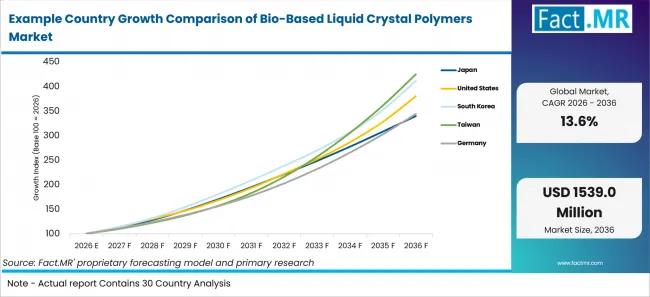
Example Country Growth Comparison Of Bio Based Liquid Crystal Polymers Market | Source: Fact.MR
| Country | CAGR (2026-2036) |
|---|---|
| Taiwan | 15.6% |
| South Korea | 15.2% |
| United States | 14.3% |
| Netherlands | 13.7% |
| Germany | 13.2% |
| Japan | 13.0% |
Source: Fact.MR analysis. Updated Aug 17, 2026
What supports Taiwan adoption?
15.6% CAGR through 2036, backed by electronic-component exports and semiconductor assembly demand.
Taiwanese electronic-component assemblers evaluate resin changes against connector yield, reflow heat and customer change-control rules. Taiwan is forecast to record 15.6% CAGR through 2036, supported by the Ministry of Finance’s February 2026 annual report showing US$222.9 billion in 2025 parts-of-electronic-product exports. Bio-based LCP grades are expected to move first through connector and socket programs where suppliers can prove heat resistance and biomass traceability.
How is South Korea scaling demand?
15.2% CAGR through 2036, driven by ICT exports and memory-linked component qualification.
Korean electronics manufacturers need LCP grades that hold fine-pitch geometry during soldering and assembly. South Korea is projected to record 15.2% CAGR through 2036, backed by MOTIR and MSIT’s January 2026 report that 2025 ICT exports reached USD 264.3 billion, up 12.4%. Bio-based LCP suppliers are expected to focus on memory-adjacent connectors and high-frequency components before broader display-linked demand improves.
What supports the United States outlook?
14.3% CAGR through 2036, supported by electronics orders and medical micro-moulding.
U.S. electronics and medical device teams are expected to approve bio-based LCP when process records match incumbent resin behavior. The United States is anticipated to reach 14.3% CAGR through 2036, supported by the Census Bureau’s July 2026 durable-goods release, where computer and electronic-product orders rose USD 0.9 billion to USD 31.1 billion in June 2026. Material suppliers are expected to win trials where thin-wall performance is documented alongside renewable-content claims.
What underpins Netherlands growth?
13.7% CAGR through 2036, shaped by semiconductor equipment controls and precision supply chains.
The Netherlands is expected to use bio-based LCP selectively where precision electronics programs require material documentation. The country is estimated to post 13.7% CAGR through 2036 after the Dutch government said in January 2025 that more semiconductor manufacturing technologies would require national export authorisation from April 1, 2025.
How is Germany developing demand?
13.2% CAGR through 2036, led by electrical manufacturing and high-performance polymer processing.
German electronics producers require high-temperature polymers that can pass part validation in electrical and automotive programs. Germany is forecast to record 13.2% CAGR through 2036, supported by GTAI’s 2026 industry profile reporting electronics-industry turnover of EUR 225 billion in 2025. Bio-based LCP suppliers are expected to compete through application data packages that reduce validation work for component manufacturers.
How does Japan perform?
13.0% CAGR through 2036, supported by resin know-how and electronics component production.
Japan pairs local resin know-how with component makers that already understand LCP approval requirements. Customer acceptance is expected to remain selective until bio-monomer routes prove long-term part stability and supply continuity.
Who leads the Bio-Based Liquid Crystal Polymers Market?
Celanese Corporation and Daicel Corporation — High Performance Polymers SBU as the providers with the most direct LCP coverage in the company set, while Sumitomo Chemical and Toray Industries, Inc. add Japan-linked application depth.
Celanese Corporation supports the market with Vectra and Zenite LCP, including medical-grade Vectra MT materials. Daicel Corporation — High Performance Polymers SBU contributes LAPEROS LCP and biomass-balanced LAPEROS bG-LCP. Sumitomo Chemical markets SUMIKASUPER™ LCP and announced in June 2025 that it had established mass-production technology for LCP using a monomer derived from biomass materials. Toray Industries, Inc. provides SIVERAS liquid crystal polyester resin and LCP fibre capability.
Which companies are the key providers?
Celanese Corporation and Daicel Corporation — High Performance Polymers SBU are key providers. Sumitomo Chemical and Toray Industries, Inc. are also profiled.
- Celanese Corporation
- Daicel Corporation — High Performance Polymers SBU
- Sumitomo Chemical
- Toray Industries, Inc.
Bibliography
- Government of the Netherlands. (2025, January 15). Klever: Export controls on advanced semiconductor manufacturing equipment to be tightened.
- Ministry of Finance, R.O.C. (2026, February 23). Annual external trade report in 2025.
- Ministry of Trade, Industry and Resources. (2026, January 15). ICT exports post record annual performance in 2025.
- Celanese Corporation. (2025, February 19). Celanese announces engineered materials price increases.
- Celanese Corporation. (2025, October 2). Celanese designing the future at K 2025.
- U.S. Census Bureau. (2026, July 27). Monthly advance report on durable goods manufacturers' shipments, inventories and orders.
This Report Addresses
- The report provides strategic intelligence on Bio-Based Liquid Crystal Polymers Market adoption across grade choices and precision applications that shape material qualification.
- Segment analysis covers injection-moulding grades and connectors & sockets as the share leaders within the 2026 market.
- Country outlook evaluates Taiwan and South Korea alongside the United States, Netherlands, Germany and Japan.
- Competitive analysis profiles Celanese Corporation and Daicel Corporation — High Performance Polymers SBU alongside Sumitomo Chemical and Toray Industries, Inc. complete the provider set.
- Scope context connects this analysis with liquid crystal polymer applications, high performance polymers, bio-based plastics and bioplastics adoption.
What does the Bio-Based Liquid Crystal Polymers Market cover?
The market covers LCP products where bio-based or biomass-balanced feedstock claims are tied to commercial engineering polymer use.
Coverage includes injection-moulding grades used in connectors and sockets. It also includes film, sheet and fibre grades where LCP performance supports electronic, telecom, automotive or medical applications. Adjacent specialty polymer categories and bio-based polyester references are used only for market-context interlinks.
What is included in the scope?
The scope includes bio-based LCP resins and forms used in high-heat precision applications.
It covers injection-moulding, film, sheet and fibre grades. Applications include connectors and sockets, 5G antennas and modules, sensors and MEMS, and optical and medical uses. Related automotive high-performance polymers and high temperature plastics are adjacent categories.
What is excluded from the scope?
General petroleum-based LCP demand is excluded unless directly compared with a bio-based replacement route.
Conventional plastics are excluded when they do not meet LCP performance thresholds. inorganic filler reinforced LCP and industrial plastic applications are referenced only to clarify scope boundaries.
How Was the Analysis Built?
The analysis draws on more than 120 sources, more than 35 company portfolios, more than 25 countries, and more than 20 industry interviews.
- Primary Research: Primary research includes discussions with resin producers, compounders, moulders, electronics manufacturers, device developers and procurement teams.
- Desk Research: Desk research covers government statistics, company releases, product literature, certification rules, trade data and regulatory publications.
- Market Sizing and Forecasting: Market estimates combine historical values, segment shares, country CAGRs, application signals, company participation and qualification barriers.
- Data Validation and Update Cycle: Findings are validated against company activity, electronics indicators, feedstock documentation and application adoption patterns.
Segmentation
What is the report’s scope and coverage?
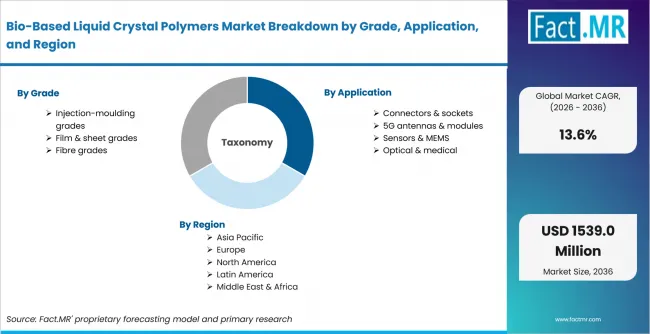
Bio Based Liquid Crystal Polymers Market Breakdown By Grade, Application, And Region | Source: Fact.MR
| Attribute | Details |
|---|---|
| Quantitative Units | USD million |
| Market Definition | Bio-based and biomass-balanced LCP resins, films and fibres used in high-heat, thin-wall, low-warpage and high-frequency precision applications |
| Grade | Injection-moulding grades; Film & sheet grades; Fibre grades |
| Application | Connectors & sockets; 5G antennas & modules; Sensors & MEMS; Optical & medical |
| End-Use Industry | Electronics; Telecom; Automotive; Medical |
| Regions Covered | North America; Latin America; Europe; East Asia; South Asia and Pacific; Middle East and Africa |
| Countries Covered | Taiwan; South Korea; United States; Netherlands; Germany; Japan |
| Key Companies Profiled | Celanese Corporation; Daicel Corporation — High Performance Polymers SBU; Sumitomo Chemical; Toray Industries, Inc. |
| Forecast Period | 2026 to 2036 |
| Approach | Hybrid top-down and bottom-up approach using LCP grade demand, connector applications, telecom module qualification, electronics production signals, bio-based feedstock documentation, country adoption patterns and company portfolio review |
Source: Fact.MR analysis. Updated Aug 17, 2026
How is the market segmented?
-
By Grade:
- Injection-moulding grades
- Film & sheet grades
- Fibre grades
-
By Application:
- Connectors & sockets
- 5G antennas & modules
- Sensors & MEMS
- Optical & medical
-
By End-Use Industry:
- Electronics
- Telecom
- Automotive
- Medical
-
By Region:
- North America
- Latin America
- Europe
- East Asia
- South Asia and Pacific
- Middle East and Africa
Frequently Asked Questions
How big is the bio-based liquid crystal polymers market in 2026?
What is the CAGR of the bio-based liquid crystal polymers market from 2026 to 2036?
Which grade leads the bio-based liquid crystal polymers market?
Which application leads the bio-based liquid crystal polymers market?
Who are the leading companies in the bio-based liquid crystal polymers market?
Who worked on this report


Preview the report firsthand - request a free sample
Free SampleGet the brochure for pricing and purchase details
Download PDF