- Base Value(2025): 11.5 Bn
- Estimated Value(2026): 12.4 Bn
- Forecast Value (2036): 27.6 Bn
- CAGR (2026 - 2036): 8.3%
Bio-based Malonic Acid Esters Market Forecast and Outlook By Fact.MR
In 2025, the bio-based malonic acid esters market was valued at USD 11.5 billion. Based on Fact.MR analysis, demand for bio-based malonic acid esters is estimated to grow to USD 12.4 billion in 2026 and USD 27.6 billion by 2036. FACT.MR projects a CAGR of 8.3% during the forecast period.
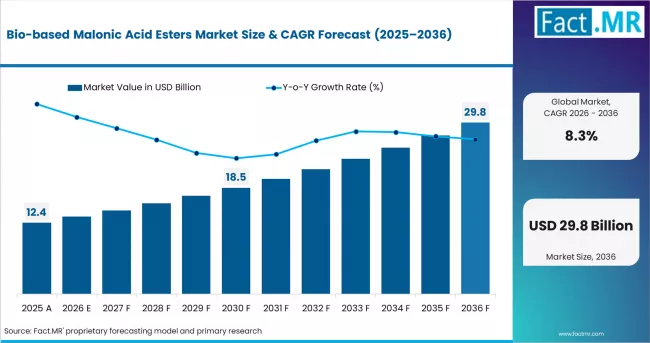
Bio Based Malonic Acid Esters Market Market Value Analysis | Source: Fact.MR
| Market Metric | Market Value |
|---|---|
| Estimated Value in 2026 | USD 12.4 billion |
| Forecast Value in 2036 | USD 27.6 billion |
| Forecast CAGR (2026 to 2036)B | 8.3% |
Source: Fact.MR analysis. Updated Apr 10, 2026
Summary of Bio-based Malonic Acid Esters Market
- Market Definition
- The market covers diethyl, dimethyl, dibutyl, and specialty malonate esters synthesised from sugarcane, corn, cassava, and biomass residue feedstocks supplying pharmaceutical API, agrochemical intermediate, flavour compound, and bio-based polymer applications globally.
- Demand Drivers
- China is scaling bio-based API intermediate manufacturing. Pharmaceutical producers are increasing bio-derived diethyl malonate procurement for domestic drug synthesis.
- USDA BioPreferred programme mandates are expanding bio-based chemical sourcing in U.S. federal procurement. Driving certified malonate ester demand from pharmaceutical and polymer buyers.
- EU Green Deal chemical substitution requirements are tightening. Driving bio-origin documentation demand from German and French pharmaceutical ingredient procurement programmes.
- Key Segments Analyzed
- By Product Type: Diethyl Malonate leads with 38% share in 2026. Widely used in pharmaceutical API and intermediate synthesis requiring high-purity, reactive ester functionality.
- By Source: Sugarcane leads with 40% share in 2026. Highest bio-based yield per hectare and lowest conversion cost supports dominant feedstock position for malonic acid production.
- By Application: Pharmaceuticals leads with 45% share in 2026. Driven by API synthesis demand for diethyl malonate as a core reactive intermediate in active ingredient chemistry.
- By Geography: China leads 9.5% CAGR. Driven by pharmaceutical API and agrochemical intermediate manufacturing scale-up and domestic bio-based chemistry investment.
- Analyst Opinion at FACT.MR
- Shambhu Nath Jha, Principal Consultant at Fact.MR, opines, CXOs will find bio-based malonate ester demand is not just a sustainability signal. It represents a structural procurement shift. Pharmaceutical and agrochemical buyers are making bio-origin certification mandatory.
- Strategic Implications
- Invest in sugarcane-derived malonic acid capacity with certified bio-based documentation to qualify for pharmaceutical and agrochemical procurement.
- Develop diethyl malonate grades with defined purity and ester specifications for API synthesis requiring chain-of-custody compliance.
- Establish feedstock agreements in Brazil, India, and the U.S. to secure supply and manage price volatility.
- Methodology
- Market sizing based on producer revenues and application-level volumes by ester type, validated with 2024–2025 financial and procurement data.
- Supported by USDA BioPreferred data, EU Green Deal reports, and India bio-based policy records.
- Forecasts include API demand trends, agrochemical adoption, and bio-based polymer procurement insights.
The market is projected to generate USD 15.2 billion in absolute opportunity between 2026 and 2036. Growth is strong and transformational. Demand is driven by pharmaceutical API synthesis and agrochemical intermediate sourcing. Bio-based polymer use in coatings and flavours is also expanding. However, bio-derived production costs remain higher than petroleum routes. Processing infrastructure is still limited outside Brazil and India.
Buyers are increasingly prioritising sustainability credentials. Pharmaceutical and agrochemical companies require bio-origin certification. Chain-of-custody documentation is becoming mandatory. Procurement teams in Germany and the United States are consolidating supplier bases. Preference is shifting toward certified bio-based producers with consistent purity standards.
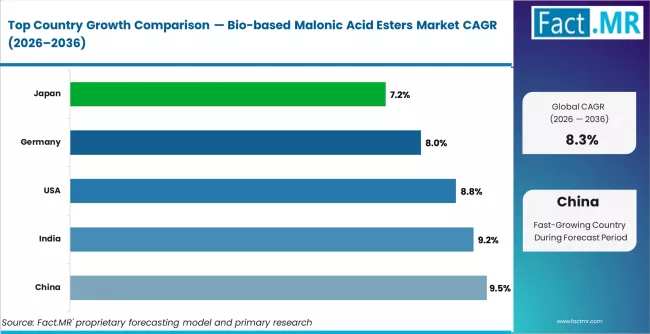
China leads growth at 9.5% CAGR through 2036. Expansion is driven by pharmaceutical and agrochemical manufacturing. India follows at 9.2% supported by policy incentives and feedstock availability. The United States records 8.8% driven by green chemistry adoption. Germany grows at 8.0% under EU regulatory pressure. Japan records 7.2% driven by sustainability requirements in pharma and flavours. European markets face constraints from high costs and regulatory complexity.
Segmental Analysis
Bio-based Malonic Acid Esters Market Analysis by Product Type
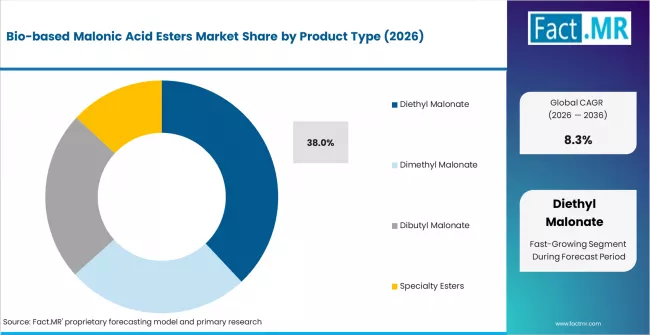
Bio Based Malonic Acid Esters Market Analysis By Product Type | Source: Fact.MR
Based on Fact.MR's bio-based malonic acid esters market report, diethyl malonate is estimated to hold 38% share in 2026. It dominates due to its critical role as the primary reactive intermediate in pharmaceutical API and agrochemical synthesis, where no bio-based alternative delivers equivalent nucleophilic reactivity at comparable purity and yield.
- BASF Investment: The company expanded bio-based ester capacity in 2024. Focus is on high-purity diethyl and dimethyl malonate. This supports pharma and agrochemical demand. [4]
- Genomatica Development: The company advanced bio-based malonic acid fermentation in 2025. Production uses corn-derived feedstock. Output meets pharmaceutical-grade purity requirements. [5]
- Product Demand Trend: Bio-based diethyl malonate demand increased in 2024. Growth reached 21% year-on-year in the U.S. Demand is driven by sustainability mandates. [6]
Bio-based Malonic Acid Esters Market Analysis by Source
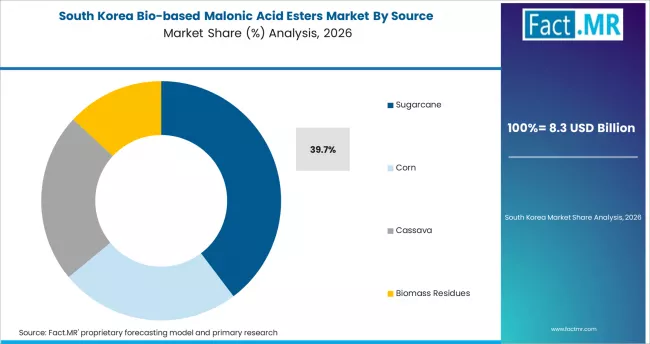
Bio Based Malonic Acid Esters Market South Korea Market Share Analysis By Source | Source: Fact.MR
Based on Fact.MR, sugarcane holds around 40% share in 2026. It dominates due to high sugar yield and low conversion cost. Established infrastructure in Brazil and India supports large-scale production.
- Cargill Expansion: The company invested in fermentation capacity in 2024. Focus is on sugarcane-based malonic acid production. This supports pharmaceutical and agrochemical supply.
- Novozymes Development: The company launched an improved enzyme platform in 2025. It increases yield efficiency in fermentation. This reduces production cost for ester intermediates.
- Source Demand Trend: Sugarcane-based chemical production increased in 2024. Growth reached 16% in Brazil. Demand is strongest from pharma and agrochemical buyers.
Drivers, Restraints, and Opportunities
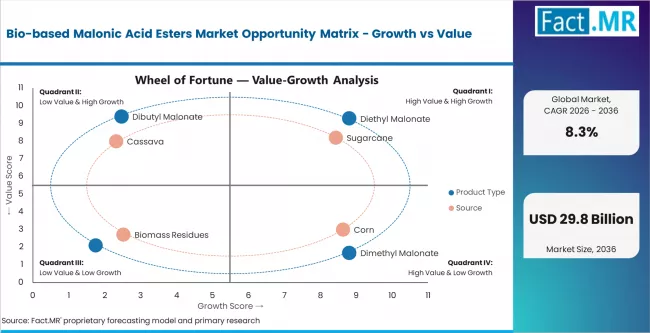
Bio Based Malonic Acid Esters Market Opportunity Matrix Growth Vs Value | Source: Fact.MR
FACT.MR notes the market is a high-growth specialty chemical segment. Growth is driven by pharmaceutical API demand and bio-based transition. Regulatory green chemistry mandates are accelerating this shift. Flavour and polymer applications remain smaller but are expanding.
The market shows a clear sourcing bifurcation. Petroleum-based esters dominate price-sensitive applications. Bio-based esters are gaining share in regulated segments. Buyers are paying 15–30% premiums for certified bio-origin inputs. This supports revenue growth beyond volume expansion. Procurement decisions are driven by compliance rather than cost.
- U.S. BioPreferred Mandate: The USDA expanded bio-based procurement categories in 2024. This includes reactive intermediates like malonate esters. It creates mandatory demand from government-linked buyers. This demand is regulation-driven, not voluntary. [3]
- EU Green Deal Chemistry: EU Chemicals Strategy guidance was updated in 2024. It requires progress on bio-based sourcing by 2026. Pharmaceutical and agrochemical companies are qualifying suppliers early. This is driving demand in Germany and France. [2]
- China API Manufacturing Growth: China approved new API manufacturing zones in 2024. Bio-based intermediates are prioritised under policy frameworks. Demand is rising in key provinces like Jiangsu and Zhejiang. Growth is driven by domestic manufacturing expansion. [1]
Regional Analysis
The bio-based malonic acid esters market is assessed across Asia Pacific, Europe, North America, Latin America, and Middle East and Africa, covering 40+ countries with distinct demand profiles shaped by pharmaceutical API manufacturing scale, agrochemical green chemistry adoption, bio-based feedstock availability, and regulatory sustainability frameworks. The full report offers market attractiveness analysis by region and country.
.webp "Top Country Growth Comparison Bio Based Malonic Acid Esters Market Cagr (2026 2036)")
Top Country Growth Comparison Bio Based Malonic Acid Esters Market Cagr (2026 2036) | Source: Fact.MR
| Country | CAGR (2026 to 2036) |
|---|---|
| China | 9.5% |
| India | 9.2% |
| United States | 8.8% |
| Germany | 8.0% |
| Japan | 7.2% |
Source: Fact.MR analysis. Updated Apr 10, 2026
Source: Fact.MR (FACT.MR) analysis, based on proprietary forecasting model and primary research
Bio Based Malonic Acid Esters Market Cagr Analysis By Country | Source: Fact.MR
Asia Pacific Bio-based Malonic Acid Esters Market Analysis
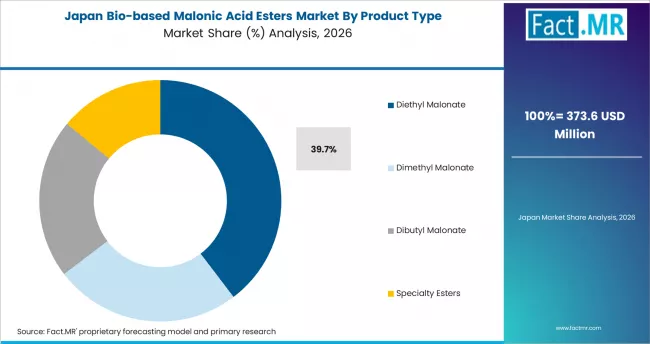
Bio Based Malonic Acid Esters Market Japan Market Share Analysis By Product Type | Source: Fact.MR
Asia Pacific is the fastest-growing and structurally important region. Growth is driven by pharmaceutical API expansion and bio-based chemical policy support. China and India anchor demand and supply dynamics. Cargill, Novozymes, and Divi's Laboratories play key roles across fermentation, feedstock processing, and API integration.
- China: Manufacturing scale and regulatory structuring are accelerating demand. Growth is projected at 9.5% CAGR through 2036. New API manufacturing zones are increasing procurement of bio-based intermediates. Updated certification standards are formalising supplier qualification pathways. Demand is driven by domestic pharmaceutical output and agrochemical production.
- India: Feedstock availability and policy incentives are strengthening supply capacity. Growth is projected at 9.2% CAGR through 2036. National bio-based chemical policy is supporting fermentation and ester production investments. Divi's Laboratories is expanding bio-based sourcing for export-oriented APIs. Growth is supply-side driven with strong domestic integration.
- Japan: High-specification demand and policy-driven sourcing define the market. Growth is projected at 7.2% CAGR through 2036. Green Innovation Strategy is pushing certified bio-based intermediate procurement. Mitsubishi Chemical Corporation is supplying pharmaceutical-grade esters with full documentation. Demand remains premium and compliance-focused.
FACT.MR covers China, India, Japan, South Korea, ASEAN, and ANZ. Includes API procurement trends, policy frameworks, and forecasts.
Europe Bio-based Malonic Acid Esters Market Analysis
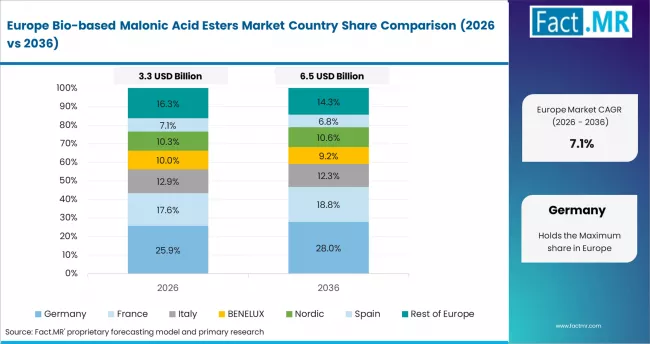
Bio Based Malonic Acid Esters Market Europe Country Market Share Analysis 2026 & 2036 | Source: Fact.MR
Europe is the global regulatory benchmark for bio-based chemistry. Demand is shaped by EU Green Deal and sustainability compliance requirements. Procurement is driven by documentation and substitution mandates. BASF and Mitsubishi Chemical Corporation maintain strong positions through certified supply.
- Germany: Regulatory enforcement and pharmaceutical demand are driving growth. Growth is projected at 8.0% CAGR through 2036. EU Chemicals Strategy is mandating bio-based substitution in intermediates. BASF expanded bio-based ester production in 2024. Demand is concentrated in pharmaceutical and agrochemical applications.
FACT.MR covers Germany, France, the UK, Italy, Spain, and Rest of Europe. Includes compliance data, sourcing trends, and forecasts.
North America Bio-based Malonic Acid Esters Market Analysis
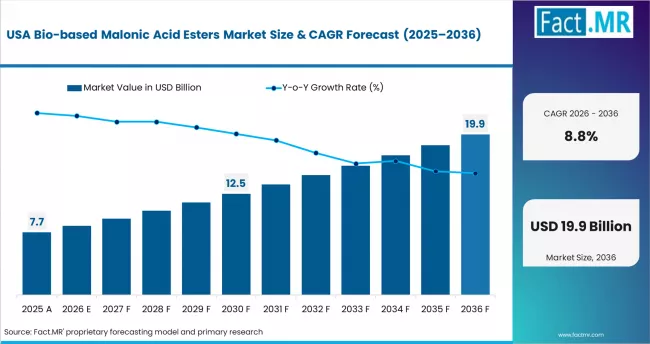
Bio Based Malonic Acid Esters Market Country Value Analysis | Source: Fact.MR
North America is a policy-accelerated and innovation-driven market. Growth is supported by federal procurement mandates and green chemistry adoption. Pharmaceutical and specialty chemical demand drives the market. Genomatica and Cargill anchor production and feedstock supply.
- United States: Mandate-driven procurement and sustainability frameworks are accelerating adoption. Growth is projected at 8.8% CAGR through 2036. USDA BioPreferred programme is expanding mandatory sourcing requirements. EPA Safer Choice is reinforcing certified supplier qualification. Demand is dominated by pharmaceutical and polymer applications requiring bio-based inputs.
FACT.MR covers the U.S., Canada, and Mexico. Includes regulatory data, procurement trends, and demand forecasts.
Competitive Aligners for Market Players
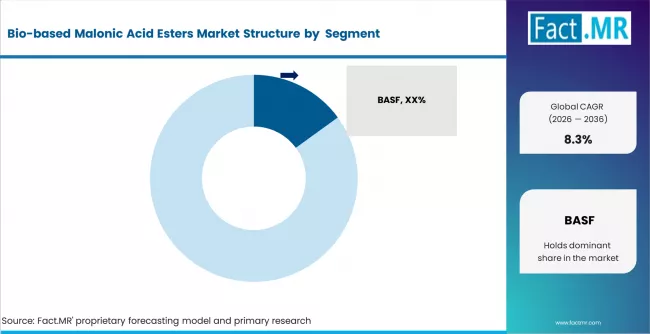
Bio Based Malonic Acid Esters Market Analysis By Company | Source: Fact.MR
The bio-based malonic acid esters market is still evolving. It sits between early and mid-stage commercialization. Production remains fragmented across multiple players. However, procurement is becoming more selective and concentrated. Only a few suppliers meet the strict requirements of pharmaceutical and agrochemical buyers. Companies such as BASF, Genomatica, and Cargill are positioned strongly due to certified bio-based content and scalable production capabilities.
Competitive advantage in this market is closely tied to integration. Companies that control both feedstock and processing have a clear edge. Cargill benefits from direct access to sugarcane and corn supply chains. This supports cost efficiency and production stability. Genomatica brings technological strength through its fermentation platform. This allows flexibility across feedstock’s and reduces dependency risks. BASF leverages its global distribution and strong relationships with pharmaceutical buyers. This helps convert production into long-term supply contracts more effectively.
On the demand side, buyers follow a cautious and structured approach. Pharmaceutical and agrochemical companies prefer dual sourcing. They typically qualify two suppliers for the same intermediate. This reduces supply chain risk while maintaining continuity. Once a specific ester grade is approved in a formulation, switching becomes difficult. Reformulation and regulatory revalidation take time and cost. This creates long-term supplier relationships. It also supports premium pricing for certified bio-based producers. Compared to petroleum-based alternatives, these suppliers benefit from stronger margins due to compliance and sustainability advantages.
Key Players
- BASF
- Mitsubishi Chemical Corporation
- Cargill
- Novozymes
- Genomatica
- Myriant Corporation
- BioAmber
Bibliography
- [1] National Development and Reform Commission, China. (2024). Pharmaceutical API Manufacturing Zone Expansion Approvals: Six New Bio-based Chemical Intermediate Procurement Priority Zones Including Diethyl Malonate Sourcing Under China 14th Five-Year Plan for Bio-Economy Development. 2024. ndrc.gov.cn
- [2] European Commission. (2024). Chemicals Strategy for Sustainability Implementation Guidance: Bio-based Intermediate Sourcing Progress Requirements for Pharmaceutical and Agrochemical Manufacturers Including Diethyl Malonate Priority Substitution Targets Under EU Green Deal Framework. 2024. ec.europa.eu/environment
- [3] United States Department of Agriculture. (2024). BioPreferred Programme Mandatory Procurement Category Expansion: Reactive Chemical Intermediates Including Bio-based Malonate Esters Added to Federal Purchasing Requirements for Government-Contracted Pharmaceutical and Chemical Manufacturers. 2024. biopreferred.usda.gov
- [4] BASF SE. (2024). Operations Update: Bio-based Specialty Ester Production Capacity Expansion at Ludwigshafen Chemical Complex Targeting Certified Bio-derived Diethyl and Dimethyl Malonate Supply to European Pharmaceutical and Agrochemical API Manufacturers Under EU Green Deal Procurement Requirements. 2024. basf.com/investor-relations
- [5] Genomatica. (2025). Technology Development Update: Commercial-Scale Bio-based Malonic Acid Fermentation Platform from Corn-Derived Feedstock with Pharmaceutical Intermediate Grade Purity Specifications for Diethyl Malonate Synthesis in North American API Manufacturing Markets. January 2025. genomatica.com
- [6] American Chemical Society Green Chemistry Institute. (2024). Bio-derived Diethyl Malonate Demand Report 2024: 21% Growth in Certified Bio-based Malonate Ester Procurement by U.S. Pharmaceutical API Manufacturers Driven by USDA BioPreferred Mandates and Corporate Sustainability Sourcing Commitments. 2024. acs.org/greenchemistry
This Report Addresses
- Strategic intelligence on bio-based malonic acid ester demand across pharmaceutical API synthesis, agrochemical intermediate sourcing, flavour compound procurement, and polymer and coatings applications globally.
- Market forecast from USD 12.4 billion in 2026 to USD 27.6 billion by 2036 at a CAGR of 8.3%.
- Growth opportunity mapping across China pharmaceutical API bio-sourcing, India bio-based chemical incentive capacity, U.S. BioPreferred mandate procurement, Germany EU Green Deal chemical substitution, and Japan pharmaceutical sustainability sourcing.
- Segment analysis by product type (diethyl, dimethyl, dibutyl, specialty), source (sugarcane, corn, cassava, biomass residues), and application (pharmaceuticals, agrochemicals, flavours, polymers).
- Regional outlook covering Asia Pacific pharmaceutical and bio-chemistry demand, North America mandate-led bio-based procurement, and Europe EU regulation-driven certified intermediate substitution.
- Competitive landscape of BASF, Mitsubishi Chemical, Cargill, Novozymes, Genomatica, Myriant, and BioAmber. Focus on bio-certification, feedstock integration, and application-specific grade positioning.
- Regulatory impact analysis covering USDA BioPreferred mandate expansion, EU Green Deal Chemicals Strategy CSS implementation, China NDRC bio-economy API zone approvals, and Japan Green Innovation Strategy pharmaceutical sourcing requirements.
Report delivery in PDF, Excel datasets, and presentation formats supported by primary interviews, producer revenue data, USDA bio-based programme statistics, and pharmaceutical and agrochemical procurement benchmarks.
Bio-based Malonic Acid Esters Market Definition
The market includes diethyl malonate, dimethyl malonate, dibutyl malonate, and specialty ester derivatives. These are produced from bio-based malonic acid. Feedstock sources include sugarcane, corn, cassava, and biomass residues. These inputs support sustainable chemical production.
Bio-based Malonic Acid Esters Market Inclusions
Includes global and regional forecasts from 2026 to 2036 by product type, source, and application. Covers diethyl, dimethyl, dibutyl, and specialty malonate esters across pharmaceutical, agrochemical, flavour, and polymer applications sold via direct industrial supply and specialty chemical distribution channels.
Bio-based Malonic Acid Esters Market Exclusions
Excludes petroleum-derived malonic acid esters without bio-based content certification. Omits finished pharmaceutical drug products and formulated agrochemical end products sold at consumer price. Also excludes bio-based succinic acid and itaconic acid esters not classified as malonate ester derivatives.
Bio-based Malonic Acid Esters Market Research Methodology
- Primary Research
- Interviews with bio-based malonate ester producers, pharmaceutical API procurement managers, agrochemical formulators, and specialty chemical distributors across Asia, North America, and Europe.
- Desk Research
- Analysis of BASF, Cargill, and Genomatica corporate disclosures, USDA BioPreferred programme data, EU Green Deal chemical substitution reports, and bio-based chemical trade statistics from 2024–2025.
- Market-Sizing and Forecasting
- Hybrid model integrating top-down estimates from bio-based chemical producer revenues with bottom-up application-level volume forecasts by ester type and end-use segment.
- Data Validation and Update Cycle
- Validated through producer revenue data, bio-based chemical certification records, pharmaceutical procurement benchmarks, and expert interviews with API synthesis and agrochemical sourcing managers.
Segmentation
Scope of Report
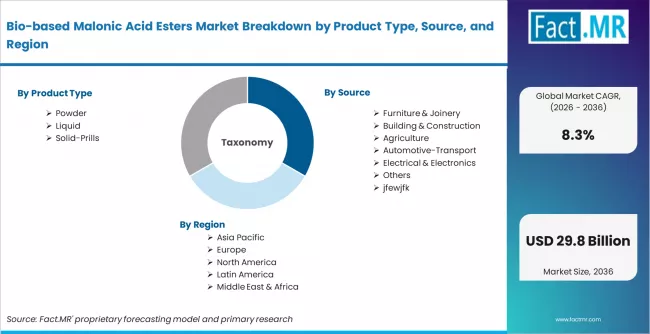
Bio Based Malonic Acid Esters Market Breakdown By Product Type Source And Region | Source: Fact.MR
| Attribute | Details |
|---|---|
| Quantitative Units | USD 12.4 billion (2026) to USD 27.6 billion (2036), at a CAGR of 8.3% |
| Market Definition | Bio-based diethyl, dimethyl, dibutyl, and specialty malonate esters synthesised from sugarcane, corn, cassava, and biomass residues for pharmaceutical API synthesis, agrochemical intermediates, flavour compounds, and bio-based polymer applications globally. |
| Product Type Segmentation | Diethyl Malonate, Dimethyl Malonate, Dibutyl Malonate, Specialty Esters |
| Source Segmentation | Sugarcane, Corn, Cassava, Biomass Residues |
| Application Segmentation | Pharmaceuticals, Agrochemicals, Flavours & Fragrances, Polymers & Coatings |
| Application Coverage | Pharmaceutical API intermediate synthesis, agrochemical active ingredient production, flavour compound manufacturing, bio-based polymer and coatings formulation, and certified bio-origin chemical intermediate supply. |
| Regions Covered | North America, Europe, Asia Pacific, Latin America, Middle East and Africa |
| Countries Covered | USA, Canada, Mexico, Germany, UK, France, Italy, Spain, Nordic, BENELUX, China, Japan, South Korea, India, ASEAN, Australia and New Zealand, Brazil, Argentina, Chile, Saudi Arabia, GCC, Turkey, South Africa, Rest of MEA |
| Key Companies Profiled | BASF, Mitsubishi Chemical Corporation, Cargill, Novozymes, Genomatica, Myriant Corporation, BioAmber |
| Forecast Period | 2026 to 2036 |
| Approach | Hybrid top-down and bottom-up model using bio-based malonate ester producer revenues, application-level volume forecasts by ester type and end use, average selling prices by bio-certification grade, pharmaceutical API procurement benchmarks, and primary interviews with API synthesis managers and bio-based chemical procurement teams. |
Source: Fact.MR analysis. Updated Apr 10, 2026
Bio-based Malonic Acid Esters Market by Segments
-
By Product Type:
- Diethyl Malonate
- Dimethyl Malonate
- Dibutyl Malonate
- Specialty Esters
-
By Source:
- Sugarcane
- Corn
- Cassava
- Biomass Residues
-
By Application:
- Pharmaceuticals
- Agrochemicals
- Flavours & Fragrances
- Polymers & Coatings
-
By Region:
- North America
- United States
- Canada
- Mexico
-
Latin America
- Brazil
- Mexico
- Argentina
- Chile
- Rest of Latin America
- Western Europe
- Germany
- United Kingdom
- France
- Italy
- Spain
- Nordic Countries
- BENELUX
- Rest of Western Europe
- Eastern Europe
- Russia
- Poland
- Hungary
- Balkan and Baltic
- Rest of Eastern Europe
- East Asia
- China
- Japan
- South Korea
- South Asia and Pacific
- India
- ASEAN
- Australia and New Zealand
- Rest of South Asia and Pacific
- Middle East and Africa
- Kingdom of Saudi Arabia
- Other GCC Countries
- Turkey
- South Africa
- Rest of Middle East and Africa
- North America
Frequently Asked Questions
How large is the global bio-based malonic acid esters market in 2025?
What will the market size be in 2026?
What is the projected market size by 2036?
What is the expected CAGR from 2026 to 2036?
Which product type segment is poised to lead the market?
Which source segment holds the largest share?
Which application segment holds the largest share?
Which country shows the fastest growth?
What is driving demand for bio-based malonic acid esters?
Why are bio-based esters preferred over petroleum-derived alternatives?
Which application dominates the market?
What is the key challenge in this market?
Who worked on this report


Preview the report firsthand - request a free sample
Free SampleGet the brochure for pricing and purchase details
Download PDF