Root-Architecting Seed Coating Chemistry Market
Root-Architecting Seed Coating Chemistry Market Size and Share Forecast Outlook 2026 to 2036
Root-architecting seed coating chemistry market is projected to grow from USD 0.4 billion in 2026 to USD 1.4 billion by 2036, at a CAGR of 14.1%. Auxin-Modulating Compounds will dominate with a 34.0% market share, while cereals & grains will lead the crop type segment with a 45.0% share.
Root-Architecting Seed Coating Chemistry Market Forecast and Outlook 2026 to 2036
The global root-architecting seed coating chemistry market is projected to reach USD 1.37 billion by 2036. The market is valued at USD 0.37 billion in 2026 and is set to rise at a CAGR of 14.1% during the assessment period. By chemistry type, auxin-modulating compounds hold a leading 34% share. The cereals & grains crop type segment represents a dominant 45% share, while the functional outcome of enhanced lateral root development accounts for 38% market share.
Key Takeaways from the Root-Architecting Seed Coating Chemistry Market
- Market Value for 2026: USD 0.37 Billion
- Market Value for 2036: USD 1.37 Billion
- Forecast CAGR (2026-2036): 14.1%
- Leading Chemistry Type Share (2026): Auxin-Modulating Compounds (34%)
- Leading Crop Type Share (2026): Cereals & Grains (45%)
- Leading Functional Outcome Share (2026): Enhanced Lateral Root Development (38%)
- Key Players in the Market: BASF SE, Bayer CropScience, Corteva Agriscience, Syngenta Group, Croda International
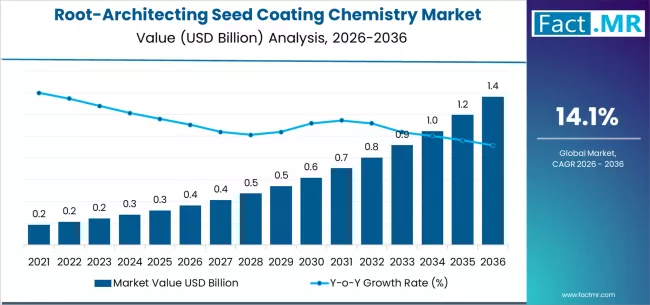
A central trend is the move beyond generic root promoters to precision chemistry that shapes specific root system architectures. Research is deepening into signal molecules and hormone precursors that can be triggered by specific soil conditions. The integration of these chemistries with microbial inoculants in a single coating aims to create a synergistic root zone environment for superior crop establishment and resource foraging.
Regulatory frameworks are adapting to accommodate these advanced biological and biochemical seed treatments, often under softer registration pathways than conventional pesticides. Policies promoting soil health, carbon sequestration, and input-use efficiency indirectly support the adoption of root-enhancing technologies by recognizing their role in building resilient and sustainable cropping systems.
Root-Architecting Seed Coating Chemistry Market
| Metric | Value |
|---|---|
| Market Value (2026) | USD 0.37 Billion |
| Market Forecast Value (2036) | USD 1.37 Billion |
| Forecast CAGR (2026-2036) | 14.1% |
Category
| Category | Segments |
|---|---|
| Chemistry Type | Auxin-Modulating Compounds, Root-Promoting Biostimulant Blends, Micronutrient-Chelate Architecting Systems, Signal-Molecule & Hormone Precursors, Others |
| Crop Type | Cereals & Grains, Oilseeds & Pulses, Vegetables, Forage & Specialty Crops, Others |
| Functional Outcome | Enhanced Lateral Root Development, Deeper Root Penetration, Improved Nutrient Uptake Efficiency, Drought & Lodging Resistance, Others |
| Region | North America, Latin America, Western Europe, Eastern Europe, East Asia, South Asia & Pacific, MEA |
Segmental Analysis
By Chemistry Type, Which Approach Offers Targeted Hormonal Control?
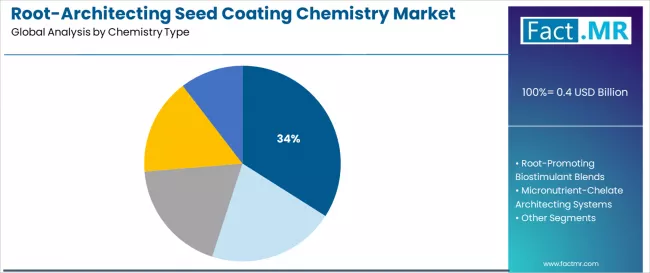
Auxin-modulating compounds lead the segment with a 34% share. These chemistries offer precise influence over the primary plant hormone governing root initiation and patterning. By fine-tuning auxin activity at the seed stage, these coatings can program the developing seedling for a more branched and efficient root system, directly addressing the need for better early-season resource capture in competitive or nutrient-poor environments.
By Crop Type, Where Does Root Architecture Directly Translate to Yield?
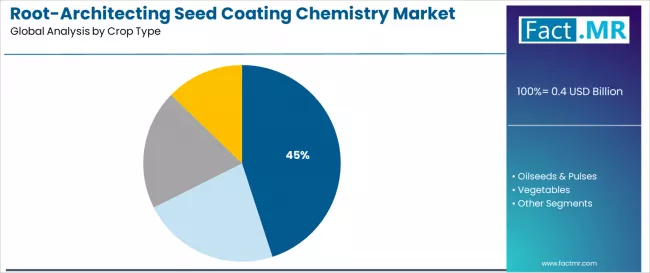
Cereals and grains command a 45% share. In these high-volume staple crops, even marginal improvements in root system efficiency for water and nutrient uptake can result in significant yield gains at scale. A better-architected root system also enhances drought resilience and reduces lodging. The economic impact is clear and measurable, driving strong demand from seed companies serving this sector.
By Functional Outcome, What is the Primary Agronomic Objective for Most Crops?
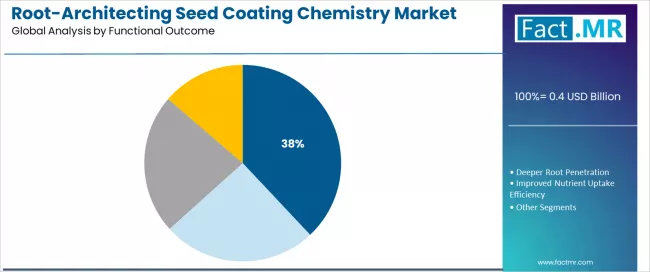
Enhanced lateral root development is the leading functional outcome at 38%. A dense, fibrous lateral root system is paramount for efficient scavenging of water and nutrients, particularly in the topsoil where resources are concentrated. This outcome directly supports stronger early growth, better weed competition, and improved stability, delivering visible benefits that justify the investment in specialized seed coatings.
What are the Drivers, Restraints, and Key Trends of the Root-Architecting Seed Coating Chemistry Market?
Market growth is propelled by the need to maximize crop productivity in the face of climate volatility and resource constraints. Deeper, more robust root systems are a universal strategy for improving drought tolerance and nutrient-use efficiency. The rising cost and environmental scrutiny of mineral fertilizers make root-enhancing seed treatments an attractive alternative for improving nutrient capture from the soil.
A significant restraint is the complexity of demonstrating consistent field-level yield benefits, which can be influenced by many interacting soil and weather factors. The higher cost of these advanced biological or biochemical coatings can be a barrier for broad-acre commodity crops. Regulatory clarity and claim substantiation for specific physiological outcomes also present challenges for market entrants.
Key trends include the convergence of chemistry and microbiology in seed coatings to holistically engineer the rhizosphere. The use of nanoscale delivery systems for precise release of root-signaling compounds is advancing. Data-driven approaches are emerging, linking soil type and historical field performance data to recommendations for specific root-architecture chemistries.
Analysis of the Root-Architecting Seed Coating Chemistry Market by Key Countries
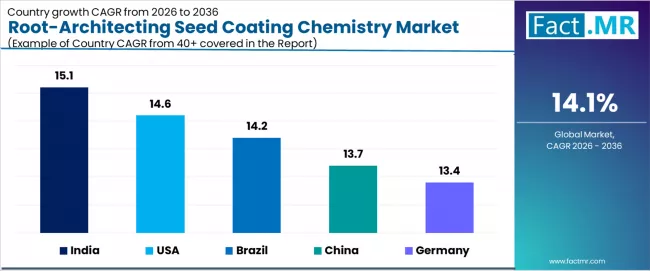
| Country | CAGR (2026-2036) |
|---|---|
| USA | 14.60% |
| India | 15.10% |
| Brazil | 14.20% |
| China | 13.70% |
| Germany | 13.40% |
How does the USA's Focus on Yield Maximization Underpin Demand?
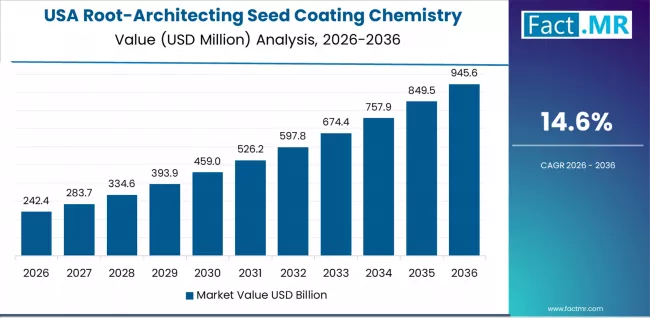
The USA exhibits a 14.60% CAGR, driven by the perpetual pursuit of higher yields in major row crops. Farmers and seed companies view root architecture as a key untapped frontier for genetic and input synergy. Coatings that promise to unlock a crop's full genetic potential by optimizing its underground interface with the soil resonate strongly in a market focused on pushing productivity ceilings, especially in variable or challenging field zones.
Why does India's need for Climate Resilience Drive the Highest Growth?
India leads with a 15.10% CAGR, directly linked to the critical need for drought resilience in a water-stressed agricultural system. The smallholder dependence on predictable monsoons makes technologies that enhance root foraging for moisture highly valuable. The government's push for sustainable intensification and soil health further supports adoption of seed-based solutions that build inherent crop resilience against abiotic stresses.
What Role Does Brazil's Acidic Soil Chemistry Play in Market Development?
Brazil's 14.20% growth is fueled by the need to overcome pervasive soil constraints, particularly aluminum toxicity and low phosphorus availability in the vast cerrado region. Root-architecting chemistries that promote deeper root growth away from toxic topsoil layers or enhance root hair development for phosphorus scavenging offer direct solutions. These coatings are seen as essential for protecting yield potential in Brazil's expansive soybean and corn fields.
How is China's Drive for Input Efficiency Shaping Adoption?
China's 13.70% growth aligns with national goals to reduce fertilizer overuse while maintaining output. Coatings that improve nutrient uptake efficiency directly support this policy aim. The large-scale, intensive farming systems are receptive to seed technologies that promise to lower per-unit production costs and environmental impact by making the existing soil nutrient pool more accessible to the crop.
What Factors Support Steady Adoption in Germany's Precision-Driven Agriculture?
Germany's 13.40% CAGR reflects a sophisticated market where farmers invest in technologies for marginal gains across all inputs. The focus on building soil health and organic matter creates an ideal environment for root-enhancing seed treatments. German farmers value coatings that improve early vigor and nutrient efficiency, viewing them as a strategic investment in the foundational health of their crops, particularly in organic or conservation systems.
Competitive Landscape of the Root-Architecting Seed Coating Chemistry Market
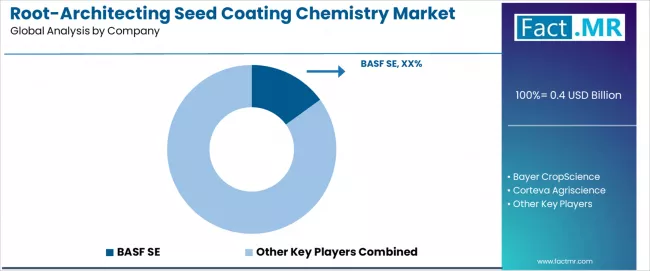
The market is characterized by competition between integrated life science companies and specialized biosolution developers. BASF SE, Bayer CropScience, Corteva Agriscience, and Syngenta Group compete by leveraging their deep plant physiology research and global seed treatment platforms to develop proprietary root-architecting formulations, often combining them with crop protection actives for a complete early-season package.
Specialty bioscience firms like Croda International compete through advanced biostimulant and green chemistry innovations, focusing on novel bioactive compounds and delivery systems. Competition hinges on generating robust multi-year field trial data that proves not just root growth changes, but final yield impacts. Securing partnerships with leading seed companies for co-development and exclusive distribution is a critical success factor in this technically nuanced market.
Key Players in the Root-Architecting Seed Coating Chemistry Market
- BASF SE
- Bayer CropScience
- Corteva Agriscience
- Syngenta Group
- Croda International
Scope of Report
| Items | Values |
|---|---|
| Quantitative Units | USD Billion |
| Chemistry Type | Auxin-Modulating Compounds, Root-Promoting Biostimulant Blends, Micronutrient-Chelate Architecting Systems, Signal-Molecule & Hormone Precursors, Others |
| Crop Type | Cereals & Grains, Oilseeds & Pulses, Vegetables, Forage & Specialty Crops, Others |
| Functional Outcome | Enhanced Lateral Root Development, Deeper Root Penetration, Improved Nutrient Uptake Efficiency, Drought & Lodging Resistance, Others |
| Key Countries | USA, India, Brazil, China, Germany |
| Key Companies | BASF SE, Bayer CropScience, Corteva Agriscience, Syngenta Group, Croda International |
| Additional Analysis | Analysis of soil type-chemistry interaction, root imaging and phenotyping data integration, synergy with soil-applied nutrients and herbicides, and long-term soil health impact assessments. |
Root-Architecting Seed Coating Chemistry Market by Segments
-
Chemistry Type :
- Auxin-Modulating Compounds
- Root-Promoting Biostimulant Blends
- Micronutrient-Chelate Architecting Systems
- Signal-Molecule & Hormone Precursors
- Others
-
Crop Type :
- Cereals & Grains
- Oilseeds & Pulses
- Vegetables
- Forage & Specialty Crops
- Others
-
Functional Outcome :
- Enhanced Lateral Root Development
- Deeper Root Penetration
- Improved Nutrient Uptake Efficiency
- Drought & Lodging Resistance
- Others
-
Region :
-
North America
- USA
- Canada
-
Latin America
- Brazil
- Mexico
- Argentina
- Rest of Latin America
-
Western Europe
- Germany
- UK
- France
- Spain
- Italy
- BENELUX
- Rest of Western Europe
-
Eastern Europe
- Czech Republic
- Poland
- Russia
- Rest of Eastern Europe
-
East Asia
- China
- Japan
- South Korea
- Rest of East Asia
-
South Asia & Pacific
- India
- Indonesia
- Australia
- Rest of South Asia & Pacific
-
MEA
- GCC Countries
- Turkiye
- Saudi Arabia
- Rest of MEA
-
Table of Content
- Executive Summary
- Global Market Outlook
- Demand to side Trends
- Supply to side Trends
- Technology Roadmap Analysis
- Analysis and Recommendations
- Market Overview
- Market Coverage / Taxonomy
- Market Definition / Scope / Limitations
- Market Background
- Market Dynamics
- Drivers
- Restraints
- Opportunity
- Trends
- Scenario Forecast
- Demand in Optimistic Scenario
- Demand in Likely Scenario
- Demand in Conservative Scenario
- Opportunity Map Analysis
- Product Life Cycle Analysis
- Supply Chain Analysis
- Investment Feasibility Matrix
- Value Chain Analysis
- PESTLE and Porter’s Analysis
- Regulatory Landscape
- Regional Parent Market Outlook
- Production and Consumption Statistics
- Import and Export Statistics
- Market Dynamics
- Global Market Analysis 2021 to 2025 and Forecast, 2026 to 2036
- Historical Market Size Value (USD Million) Analysis, 2021 to 2025
- Current and Future Market Size Value (USD Million) Projections, 2026 to 2036
- Y to o to Y Growth Trend Analysis
- Absolute $ Opportunity Analysis
- Global Market Pricing Analysis 2021 to 2025 and Forecast 2026 to 2036
- Global Market Analysis 2021 to 2025 and Forecast 2026 to 2036, By Chemistry Type
- Introduction / Key Findings
- Historical Market Size Value (USD Million) Analysis By Chemistry Type, 2021 to 2025
- Current and Future Market Size Value (USD Million) Analysis and Forecast By Chemistry Type, 2026 to 2036
- Auxin-Modulating Compounds
- Root-Promoting Biostimulant Blends
- Micronutrient-Chelate Architecting Systems
- Signal-Molecule & Hormone Precursors
- Others
- Auxin-Modulating Compounds
- Y to o to Y Growth Trend Analysis By Chemistry Type, 2021 to 2025
- Absolute $ Opportunity Analysis By Chemistry Type, 2026 to 2036
- Global Market Analysis 2021 to 2025 and Forecast 2026 to 2036, By Crop Type
- Introduction / Key Findings
- Historical Market Size Value (USD Million) Analysis By Crop Type, 2021 to 2025
- Current and Future Market Size Value (USD Million) Analysis and Forecast By Crop Type, 2026 to 2036
- Cereals & Grains
- Oilseeds & Pulses
- Vegetables
- Forage & Specialty Crops
- Cereals & Grains
- Y to o to Y Growth Trend Analysis By Crop Type, 2021 to 2025
- Absolute $ Opportunity Analysis By Crop Type, 2026 to 2036
- Global Market Analysis 2021 to 2025 and Forecast 2026 to 2036, By Functional Outcome
- Introduction / Key Findings
- Historical Market Size Value (USD Million) Analysis By Functional Outcome, 2021 to 2025
- Current and Future Market Size Value (USD Million) Analysis and Forecast By Functional Outcome, 2026 to 2036
- Enhanced Lateral Root Development
- Deeper Root Penetration
- Improved Nutrient Uptake Efficiency
- Drought & Lodging Resistance
- Enhanced Lateral Root Development
- Y to o to Y Growth Trend Analysis By Functional Outcome, 2021 to 2025
- Absolute $ Opportunity Analysis By Functional Outcome, 2026 to 2036
- Global Market Analysis 2021 to 2025 and Forecast 2026 to 2036, By Region
- Introduction
- Historical Market Size Value (USD Million) Analysis By Region, 2021 to 2025
- Current Market Size Value (USD Million) Analysis and Forecast By Region, 2026 to 2036
- North America
- Latin America
- Western Europe
- Eastern Europe
- East Asia
- South Asia and Pacific
- Middle East & Africa
- Market Attractiveness Analysis By Region
- North America Market Analysis 2021 to 2025 and Forecast 2026 to 2036, By Country
- Historical Market Size Value (USD Million) Trend Analysis By Market Taxonomy, 2021 to 2025
- Market Size Value (USD Million) Forecast By Market Taxonomy, 2026 to 2036
- By Country
- USA
- Canada
- Mexico
- By Chemistry Type
- By Crop Type
- By Functional Outcome
- By Country
- Market Attractiveness Analysis
- By Country
- By Chemistry Type
- By Crop Type
- By Functional Outcome
- Key Takeaways
- Latin America Market Analysis 2021 to 2025 and Forecast 2026 to 2036, By Country
- Historical Market Size Value (USD Million) Trend Analysis By Market Taxonomy, 2021 to 2025
- Market Size Value (USD Million) Forecast By Market Taxonomy, 2026 to 2036
- By Country
- Brazil
- Chile
- Rest of Latin America
- By Chemistry Type
- By Crop Type
- By Functional Outcome
- By Country
- Market Attractiveness Analysis
- By Country
- By Chemistry Type
- By Crop Type
- By Functional Outcome
- Key Takeaways
- Western Europe Market Analysis 2021 to 2025 and Forecast 2026 to 2036, By Country
- Historical Market Size Value (USD Million) Trend Analysis By Market Taxonomy, 2021 to 2025
- Market Size Value (USD Million) Forecast By Market Taxonomy, 2026 to 2036
- By Country
- Germany
- UK
- Italy
- Spain
- France
- Nordic
- BENELUX
- Rest of Western Europe
- By Chemistry Type
- By Crop Type
- By Functional Outcome
- By Country
- Market Attractiveness Analysis
- By Country
- By Chemistry Type
- By Crop Type
- By Functional Outcome
- Key Takeaways
- Eastern Europe Market Analysis 2021 to 2025 and Forecast 2026 to 2036, By Country
- Historical Market Size Value (USD Million) Trend Analysis By Market Taxonomy, 2021 to 2025
- Market Size Value (USD Million) Forecast By Market Taxonomy, 2026 to 2036
- By Country
- Russia
- Poland
- Hungary
- Balkan & Baltic
- Rest of Eastern Europe
- By Chemistry Type
- By Crop Type
- By Functional Outcome
- By Country
- Market Attractiveness Analysis
- By Country
- By Chemistry Type
- By Crop Type
- By Functional Outcome
- Key Takeaways
- East Asia Market Analysis 2021 to 2025 and Forecast 2026 to 2036, By Country
- Historical Market Size Value (USD Million) Trend Analysis By Market Taxonomy, 2021 to 2025
- Market Size Value (USD Million) Forecast By Market Taxonomy, 2026 to 2036
- By Country
- China
- Japan
- South Korea
- By Chemistry Type
- By Crop Type
- By Functional Outcome
- By Country
- Market Attractiveness Analysis
- By Country
- By Chemistry Type
- By Crop Type
- By Functional Outcome
- Key Takeaways
- South Asia and Pacific Market Analysis 2021 to 2025 and Forecast 2026 to 2036, By Country
- Historical Market Size Value (USD Million) Trend Analysis By Market Taxonomy, 2021 to 2025
- Market Size Value (USD Million) Forecast By Market Taxonomy, 2026 to 2036
- By Country
- India
- ASEAN
- Australia & New Zealand
- Rest of South Asia and Pacific
- By Chemistry Type
- By Crop Type
- By Functional Outcome
- By Country
- Market Attractiveness Analysis
- By Country
- By Chemistry Type
- By Crop Type
- By Functional Outcome
- Key Takeaways
- Middle East & Africa Market Analysis 2021 to 2025 and Forecast 2026 to 2036, By Country
- Historical Market Size Value (USD Million) Trend Analysis By Market Taxonomy, 2021 to 2025
- Market Size Value (USD Million) Forecast By Market Taxonomy, 2026 to 2036
- By Country
- Kingdom of Saudi Arabia
- Other GCC Countries
- Turkiye
- South Africa
- Other African Union
- Rest of Middle East & Africa
- By Chemistry Type
- By Crop Type
- By Functional Outcome
- By Country
- Market Attractiveness Analysis
- By Country
- By Chemistry Type
- By Crop Type
- By Functional Outcome
- Key Takeaways
- Key Countries Market Analysis
- USA
- Pricing Analysis
- Market Share Analysis, 2025
- By Chemistry Type
- By Crop Type
- By Functional Outcome
- Canada
- Pricing Analysis
- Market Share Analysis, 2025
- By Chemistry Type
- By Crop Type
- By Functional Outcome
- Mexico
- Pricing Analysis
- Market Share Analysis, 2025
- By Chemistry Type
- By Crop Type
- By Functional Outcome
- Brazil
- Pricing Analysis
- Market Share Analysis, 2025
- By Chemistry Type
- By Crop Type
- By Functional Outcome
- Chile
- Pricing Analysis
- Market Share Analysis, 2025
- By Chemistry Type
- By Crop Type
- By Functional Outcome
- Germany
- Pricing Analysis
- Market Share Analysis, 2025
- By Chemistry Type
- By Crop Type
- By Functional Outcome
- UK
- Pricing Analysis
- Market Share Analysis, 2025
- By Chemistry Type
- By Crop Type
- By Functional Outcome
- Italy
- Pricing Analysis
- Market Share Analysis, 2025
- By Chemistry Type
- By Crop Type
- By Functional Outcome
- Spain
- Pricing Analysis
- Market Share Analysis, 2025
- By Chemistry Type
- By Crop Type
- By Functional Outcome
- France
- Pricing Analysis
- Market Share Analysis, 2025
- By Chemistry Type
- By Crop Type
- By Functional Outcome
- India
- Pricing Analysis
- Market Share Analysis, 2025
- By Chemistry Type
- By Crop Type
- By Functional Outcome
- ASEAN
- Pricing Analysis
- Market Share Analysis, 2025
- By Chemistry Type
- By Crop Type
- By Functional Outcome
- Australia & New Zealand
- Pricing Analysis
- Market Share Analysis, 2025
- By Chemistry Type
- By Crop Type
- By Functional Outcome
- China
- Pricing Analysis
- Market Share Analysis, 2025
- By Chemistry Type
- By Crop Type
- By Functional Outcome
- Japan
- Pricing Analysis
- Market Share Analysis, 2025
- By Chemistry Type
- By Crop Type
- By Functional Outcome
- South Korea
- Pricing Analysis
- Market Share Analysis, 2025
- By Chemistry Type
- By Crop Type
- By Functional Outcome
- Russia
- Pricing Analysis
- Market Share Analysis, 2025
- By Chemistry Type
- By Crop Type
- By Functional Outcome
- Poland
- Pricing Analysis
- Market Share Analysis, 2025
- By Chemistry Type
- By Crop Type
- By Functional Outcome
- Hungary
- Pricing Analysis
- Market Share Analysis, 2025
- By Chemistry Type
- By Crop Type
- By Functional Outcome
- Kingdom of Saudi Arabia
- Pricing Analysis
- Market Share Analysis, 2025
- By Chemistry Type
- By Crop Type
- By Functional Outcome
- Turkiye
- Pricing Analysis
- Market Share Analysis, 2025
- By Chemistry Type
- By Crop Type
- By Functional Outcome
- South Africa
- Pricing Analysis
- Market Share Analysis, 2025
- By Chemistry Type
- By Crop Type
- By Functional Outcome
- USA
- Market Structure Analysis
- Competition Dashboard
- Competition Benchmarking
- Market Share Analysis of Top Players
- By Regional
- By Chemistry Type
- By Crop Type
- By Functional Outcome
- Competition Analysis
- Competition Deep Dive
- BASF SE
- Overview
- Product Portfolio
- Profitability by Market Segments (Product/Age /Sales Channel/Region)
- Sales Footprint
- Strategy Overview
- Marketing Strategy
- Product Strategy
- Channel Strategy
- Bayer CropScience
- Corteva Agriscience
- Syngenta Group
- Croda International
- Others
- BASF SE
- Competition Deep Dive
- Assumptions & Acronyms Used
- Research Methodology
List Of Table
- Table 1: Global Market Value (USD Million) Forecast by Region, 2021 to 2036
- Table 2: Global Market Value (USD Million) Forecast by Chemistry Type, 2021 to 2036
- Table 3: Global Market Value (USD Million) Forecast by Crop Type, 2021 to 2036
- Table 4: Global Market Value (USD Million) Forecast by Functional Outcome, 2021 to 2036
- Table 5: North America Market Value (USD Million) Forecast by Country, 2021 to 2036
- Table 6: North America Market Value (USD Million) Forecast by Chemistry Type, 2021 to 2036
- Table 7: North America Market Value (USD Million) Forecast by Crop Type, 2021 to 2036
- Table 8: North America Market Value (USD Million) Forecast by Functional Outcome, 2021 to 2036
- Table 9: Latin America Market Value (USD Million) Forecast by Country, 2021 to 2036
- Table 10: Latin America Market Value (USD Million) Forecast by Chemistry Type, 2021 to 2036
- Table 11: Latin America Market Value (USD Million) Forecast by Crop Type, 2021 to 2036
- Table 12: Latin America Market Value (USD Million) Forecast by Functional Outcome, 2021 to 2036
- Table 13: Western Europe Market Value (USD Million) Forecast by Country, 2021 to 2036
- Table 14: Western Europe Market Value (USD Million) Forecast by Chemistry Type, 2021 to 2036
- Table 15: Western Europe Market Value (USD Million) Forecast by Crop Type, 2021 to 2036
- Table 16: Western Europe Market Value (USD Million) Forecast by Functional Outcome, 2021 to 2036
- Table 17: Eastern Europe Market Value (USD Million) Forecast by Country, 2021 to 2036
- Table 18: Eastern Europe Market Value (USD Million) Forecast by Chemistry Type, 2021 to 2036
- Table 19: Eastern Europe Market Value (USD Million) Forecast by Crop Type, 2021 to 2036
- Table 20: Eastern Europe Market Value (USD Million) Forecast by Functional Outcome, 2021 to 2036
- Table 21: East Asia Market Value (USD Million) Forecast by Country, 2021 to 2036
- Table 22: East Asia Market Value (USD Million) Forecast by Chemistry Type, 2021 to 2036
- Table 23: East Asia Market Value (USD Million) Forecast by Crop Type, 2021 to 2036
- Table 24: East Asia Market Value (USD Million) Forecast by Functional Outcome, 2021 to 2036
- Table 25: South Asia and Pacific Market Value (USD Million) Forecast by Country, 2021 to 2036
- Table 26: South Asia and Pacific Market Value (USD Million) Forecast by Chemistry Type, 2021 to 2036
- Table 27: South Asia and Pacific Market Value (USD Million) Forecast by Crop Type, 2021 to 2036
- Table 28: South Asia and Pacific Market Value (USD Million) Forecast by Functional Outcome, 2021 to 2036
- Table 29: Middle East & Africa Market Value (USD Million) Forecast by Country, 2021 to 2036
- Table 30: Middle East & Africa Market Value (USD Million) Forecast by Chemistry Type, 2021 to 2036
- Table 31: Middle East & Africa Market Value (USD Million) Forecast by Crop Type, 2021 to 2036
- Table 32: Middle East & Africa Market Value (USD Million) Forecast by Functional Outcome, 2021 to 2036
List Of Figures
- Figure 1: Global Market Pricing Analysis
- Figure 2: Global Market Value (USD Million) Forecast 2021 to 2036
- Figure 3: Global Market Value Share and BPS Analysis by Chemistry Type, 2026 and 2036
- Figure 4: Global Market Y to o to Y Growth Comparison by Chemistry Type, 2026 to 2036
- Figure 5: Global Market Attractiveness Analysis by Chemistry Type
- Figure 6: Global Market Value Share and BPS Analysis by Crop Type, 2026 and 2036
- Figure 7: Global Market Y to o to Y Growth Comparison by Crop Type, 2026 to 2036
- Figure 8: Global Market Attractiveness Analysis by Crop Type
- Figure 9: Global Market Value Share and BPS Analysis by Functional Outcome, 2026 and 2036
- Figure 10: Global Market Y to o to Y Growth Comparison by Functional Outcome, 2026 to 2036
- Figure 11: Global Market Attractiveness Analysis by Functional Outcome
- Figure 12: Global Market Value (USD Million) Share and BPS Analysis by Region, 2026 and 2036
- Figure 13: Global Market Y to o to Y Growth Comparison by Region, 2026 to 2036
- Figure 14: Global Market Attractiveness Analysis by Region
- Figure 15: North America Market Incremental Dollar Opportunity, 2026 to 2036
- Figure 16: Latin America Market Incremental Dollar Opportunity, 2026 to 2036
- Figure 17: Western Europe Market Incremental Dollar Opportunity, 2026 to 2036
- Figure 18: Eastern Europe Market Incremental Dollar Opportunity, 2026 to 2036
- Figure 19: East Asia Market Incremental Dollar Opportunity, 2026 to 2036
- Figure 20: South Asia and Pacific Market Incremental Dollar Opportunity, 2026 to 2036
- Figure 21: Middle East & Africa Market Incremental Dollar Opportunity, 2026 to 2036
- Figure 22: North America Market Value Share and BPS Analysis by Country, 2026 and 2036
- Figure 23: North America Market Value Share and BPS Analysis by Chemistry Type, 2026 and 2036
- Figure 24: North America Market Y to o to Y Growth Comparison by Chemistry Type, 2026 to 2036
- Figure 25: North America Market Attractiveness Analysis by Chemistry Type
- Figure 26: North America Market Value Share and BPS Analysis by Crop Type, 2026 and 2036
- Figure 27: North America Market Y to o to Y Growth Comparison by Crop Type, 2026 to 2036
- Figure 28: North America Market Attractiveness Analysis by Crop Type
- Figure 29: North America Market Value Share and BPS Analysis by Functional Outcome, 2026 and 2036
- Figure 30: North America Market Y to o to Y Growth Comparison by Functional Outcome, 2026 to 2036
- Figure 31: North America Market Attractiveness Analysis by Functional Outcome
- Figure 32: Latin America Market Value Share and BPS Analysis by Country, 2026 and 2036
- Figure 33: Latin America Market Value Share and BPS Analysis by Chemistry Type, 2026 and 2036
- Figure 34: Latin America Market Y to o to Y Growth Comparison by Chemistry Type, 2026 to 2036
- Figure 35: Latin America Market Attractiveness Analysis by Chemistry Type
- Figure 36: Latin America Market Value Share and BPS Analysis by Crop Type, 2026 and 2036
- Figure 37: Latin America Market Y to o to Y Growth Comparison by Crop Type, 2026 to 2036
- Figure 38: Latin America Market Attractiveness Analysis by Crop Type
- Figure 39: Latin America Market Value Share and BPS Analysis by Functional Outcome, 2026 and 2036
- Figure 40: Latin America Market Y to o to Y Growth Comparison by Functional Outcome, 2026 to 2036
- Figure 41: Latin America Market Attractiveness Analysis by Functional Outcome
- Figure 42: Western Europe Market Value Share and BPS Analysis by Country, 2026 and 2036
- Figure 43: Western Europe Market Value Share and BPS Analysis by Chemistry Type, 2026 and 2036
- Figure 44: Western Europe Market Y to o to Y Growth Comparison by Chemistry Type, 2026 to 2036
- Figure 45: Western Europe Market Attractiveness Analysis by Chemistry Type
- Figure 46: Western Europe Market Value Share and BPS Analysis by Crop Type, 2026 and 2036
- Figure 47: Western Europe Market Y to o to Y Growth Comparison by Crop Type, 2026 to 2036
- Figure 48: Western Europe Market Attractiveness Analysis by Crop Type
- Figure 49: Western Europe Market Value Share and BPS Analysis by Functional Outcome, 2026 and 2036
- Figure 50: Western Europe Market Y to o to Y Growth Comparison by Functional Outcome, 2026 to 2036
- Figure 51: Western Europe Market Attractiveness Analysis by Functional Outcome
- Figure 52: Eastern Europe Market Value Share and BPS Analysis by Country, 2026 and 2036
- Figure 53: Eastern Europe Market Value Share and BPS Analysis by Chemistry Type, 2026 and 2036
- Figure 54: Eastern Europe Market Y to o to Y Growth Comparison by Chemistry Type, 2026 to 2036
- Figure 55: Eastern Europe Market Attractiveness Analysis by Chemistry Type
- Figure 56: Eastern Europe Market Value Share and BPS Analysis by Crop Type, 2026 and 2036
- Figure 57: Eastern Europe Market Y to o to Y Growth Comparison by Crop Type, 2026 to 2036
- Figure 58: Eastern Europe Market Attractiveness Analysis by Crop Type
- Figure 59: Eastern Europe Market Value Share and BPS Analysis by Functional Outcome, 2026 and 2036
- Figure 60: Eastern Europe Market Y to o to Y Growth Comparison by Functional Outcome, 2026 to 2036
- Figure 61: Eastern Europe Market Attractiveness Analysis by Functional Outcome
- Figure 62: East Asia Market Value Share and BPS Analysis by Country, 2026 and 2036
- Figure 63: East Asia Market Value Share and BPS Analysis by Chemistry Type, 2026 and 2036
- Figure 64: East Asia Market Y to o to Y Growth Comparison by Chemistry Type, 2026 to 2036
- Figure 65: East Asia Market Attractiveness Analysis by Chemistry Type
- Figure 66: East Asia Market Value Share and BPS Analysis by Crop Type, 2026 and 2036
- Figure 67: East Asia Market Y to o to Y Growth Comparison by Crop Type, 2026 to 2036
- Figure 68: East Asia Market Attractiveness Analysis by Crop Type
- Figure 69: East Asia Market Value Share and BPS Analysis by Functional Outcome, 2026 and 2036
- Figure 70: East Asia Market Y to o to Y Growth Comparison by Functional Outcome, 2026 to 2036
- Figure 71: East Asia Market Attractiveness Analysis by Functional Outcome
- Figure 72: South Asia and Pacific Market Value Share and BPS Analysis by Country, 2026 and 2036
- Figure 73: South Asia and Pacific Market Value Share and BPS Analysis by Chemistry Type, 2026 and 2036
- Figure 74: South Asia and Pacific Market Y to o to Y Growth Comparison by Chemistry Type, 2026 to 2036
- Figure 75: South Asia and Pacific Market Attractiveness Analysis by Chemistry Type
- Figure 76: South Asia and Pacific Market Value Share and BPS Analysis by Crop Type, 2026 and 2036
- Figure 77: South Asia and Pacific Market Y to o to Y Growth Comparison by Crop Type, 2026 to 2036
- Figure 78: South Asia and Pacific Market Attractiveness Analysis by Crop Type
- Figure 79: South Asia and Pacific Market Value Share and BPS Analysis by Functional Outcome, 2026 and 2036
- Figure 80: South Asia and Pacific Market Y to o to Y Growth Comparison by Functional Outcome, 2026 to 2036
- Figure 81: South Asia and Pacific Market Attractiveness Analysis by Functional Outcome
- Figure 82: Middle East & Africa Market Value Share and BPS Analysis by Country, 2026 and 2036
- Figure 83: Middle East & Africa Market Value Share and BPS Analysis by Chemistry Type, 2026 and 2036
- Figure 84: Middle East & Africa Market Y to o to Y Growth Comparison by Chemistry Type, 2026 to 2036
- Figure 85: Middle East & Africa Market Attractiveness Analysis by Chemistry Type
- Figure 86: Middle East & Africa Market Value Share and BPS Analysis by Crop Type, 2026 and 2036
- Figure 87: Middle East & Africa Market Y to o to Y Growth Comparison by Crop Type, 2026 to 2036
- Figure 88: Middle East & Africa Market Attractiveness Analysis by Crop Type
- Figure 89: Middle East & Africa Market Value Share and BPS Analysis by Functional Outcome, 2026 and 2036
- Figure 90: Middle East & Africa Market Y to o to Y Growth Comparison by Functional Outcome, 2026 to 2036
- Figure 91: Middle East & Africa Market Attractiveness Analysis by Functional Outcome
- Figure 92: Global Market - Tier Structure Analysis
- Figure 93: Global Market - Company Share Analysis
- FAQs -
How big is the root-architecting seed coating chemistry market in 2026?
The global root-architecting seed coating chemistry market is estimated to be valued at USD 0.4 billion in 2026.
What will be the size of root-architecting seed coating chemistry market in 2036?
The market size for the root-architecting seed coating chemistry market is projected to reach USD 1.4 billion by 2036.
How much will be the root-architecting seed coating chemistry market growth between 2026 and 2036?
The root-architecting seed coating chemistry market is expected to grow at a 14.1% CAGR between 2026 and 2036.
What are the key product types in the root-architecting seed coating chemistry market?
The key product types in root-architecting seed coating chemistry market are auxin-modulating compounds, root-promoting biostimulant blends, micronutrient-chelate architecting systems, signal-molecule & hormone precursors and others.
Which crop type segment to contribute significant share in the root-architecting seed coating chemistry market in 2026?
In terms of crop type, cereals & grains segment to command 45.0% share in the root-architecting seed coating chemistry market in 2026.