Bio-Enzymatic Odor Control Chemicals Market (2026 - 2036)

Bio-Enzymatic Odor Control Chemicals Market Size and Share Forecast Outlook 2026 to 2036

Core Findings

    Bio-Enzymatic Odor Control Chemicals Market Forecast and Outlook 2026 to 2036

    The bio-enzymatic odor control chemicals market is expected to grow from USD 1,068.2 million in 2026 to USD 2,599.3 million by 2036, at a 9.3% CAGR.

    Bio-Enzymatic Odor Control Chemicals Market Key Takeaways

    • Bio-Enzymatic Odor Control Chemicals Market Value (2026): USD 1,068.2 million
    • Bio-Enzymatic Odor Control Chemicals Market Forecast Value (2036): USD 2,599.3 million
    • Bio-Enzymatic Odor Control Chemicals Market Forecast CAGR 2026 to 2036: 9.3%
    • Leading Product Type by Demand Share: Enzyme-Based Odor Neutralizers (41.0%)
    • Key Growth Region: Asia Pacific
    • Key Market Participants: Ecolab, Diversey, Zep, Spartan Chemical, Betco, OdoBan
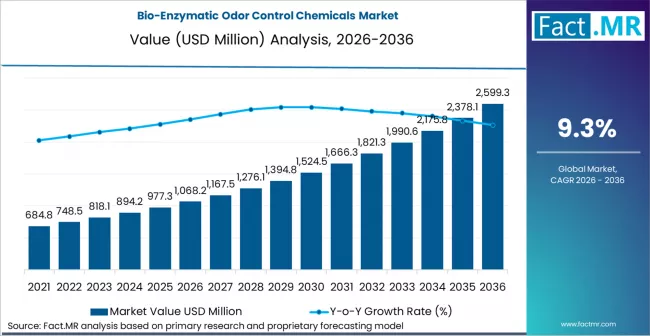
    Bio Enzymatic Odor Control Chemicals Market Market Value Analysis

    This growth is driven by the rising demand for sustainable and effective odor control solutions in industries like wastewater treatment, foodservice, and commercial facilities. Bio-enzymatic products work by breaking down organic compounds responsible for odors, offering long-lasting and eco-friendly alternatives to traditional chemical deodorizers.

    As industries seek to meet stricter environmental regulations, bio-enzymatic solutions are increasingly used in waste and drain management applications, where organic waste accumulation often leads to odors. These products are also preferred for their lower reliance on synthetic fragrances, making them ideal for sectors focused on health and hygiene. Asia Pacific is expected to lead market growth, driven by expanding industrial activities and stronger environmental regulations. The USA and Brazil are also significant markets, with rising investments in infrastructure and odor control compliance. Major companies like Ecolab, Diversey, Zep, and OdoBan are innovating with specialized enzyme blends to cater to specific odor types, further fueling market expansion.

    Bio-Enzymatic Odor Control Chemicals Market

    Metric Value
    Estimated Value in (2026E) USD 1,068.2 million
    Forecast Value in (2036F) USD 2,599.3 million
    Forecast CAGR (2026 to 2036) 9.3%

    Category

    Category Segments
    Product Type Enzyme-Based Odor Neutralizers; Microbial / Bacterial Odor Digesters; Bio-Active Drain & Grease Treatments; Other Bio-Based Deodorizers
    Application Area Waste & Drain Management; Industrial Odor Control; Restrooms & Public Hygiene; Hospitality & Facilities
    End-Use Sector Commercial Facilities; Municipal & Wastewater; Foodservice & Hospitality; Industrial
    Format Concentrates; RTU Sprays; Other Formats; Gels / Blocks
    Region North America; Europe; Asia Pacific; Latin America; Middle East & Africa

    Segmental Analysis

    What Is the Impact of Product Type on the Bio-Enzymatic Odor Control Chemicals Market?
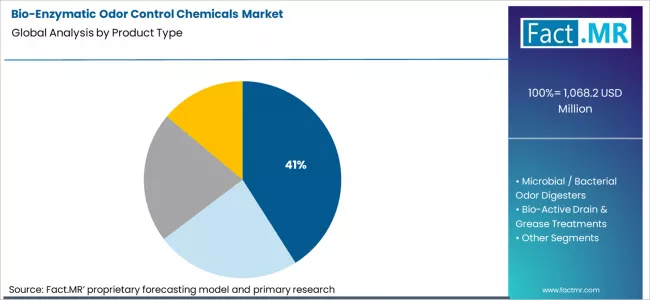
    Bio Enzymatic Odor Control Chemicals Market Analysis By Product Type

    In the bio-enzymatic odor control chemicals market, product type determines effectiveness in odor neutralization and compatibility with specific environments. Enzyme-based odor neutralizers lead with a 41.0% share due to their ability to break down organic compounds, including those responsible for odors, without merely masking the smell. These odor neutralizers work by catalyzing the breakdown of odor-causing molecules, making them particularly effective in settings like waste management, drains, and industrial environments. Their dominance is driven by growing demand for environmentally-friendly and non-toxic alternatives to traditional chemical deodorizers, aligning with sustainability trends across industries.

    How Does Application Area Influence Demand in the Bio-Enzymatic Odor Control Chemicals Market?
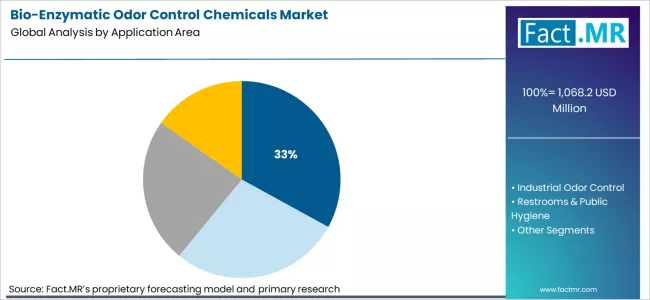
    Bio Enzymatic Odor Control Chemicals Market Analysis By Application Area

    The application area significantly impacts the demand for bio-enzymatic odor control chemicals, as different sectors require tailored solutions to manage odors effectively. Waste and drain management account for a 33.0% share, driven by the need for odor control in environments with organic waste accumulation. Bio-enzymatic products are highly effective in these applications as they target and break down the organic matter causing unpleasant odors, ensuring longer-lasting freshness and reducing the reliance on harsh chemicals. The widespread use of these products in wastewater treatment facilities, industrial drains, and septic systems continues to propel their market share.

    What are the Drivers, Restraints, and Key Trends in the Bio Enzymatic Odor Control Chemicals Market?

    Country Driver Restraint Trend
    USA Increasing demand for bio enzymatic odor neutralizers in industrial and wastewater applications. High product formulation costs and regulatory compliance. Shift towards eco friendly, enzyme based odor control chemicals.
    UK Growth in adoption within commercial facilities and public hygiene programs. Stricter chemical regulations increase compliance costs. Integration of bio enzymatic solutions into routine facility maintenance.
    Germany Preference for bio enzymatic odor control in municipal and wastewater services. Limited high capacity production infrastructure for advanced enzymes. Development of tailored enzyme blends for specific organic waste types.
    China Rapid industrial growth and expansion of waste management infrastructure. Uneven regional enforcement of environmental regulations. Adoption of bio enzymatic solutions in urban sanitation and industrial waste management.
    India Increasing use of bio enzymatic odor control in wastewater treatment operations. Infrastructure gaps and lower awareness of enzyme technologies. Trend towards combining traditional and enzymatic odor control in waste management.

    Analysis of the Bio-Enzymatic Odor Control Chemicals Market by Key Country
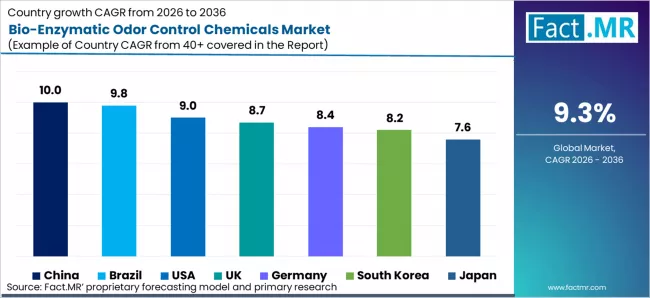
    Bio Enzymatic Odor Control Chemicals Market Cagr Analysis By Country

    Country CAGR (%)
    China 10.0%
    Brazil 9.8%
    USA 9.0%
    UK 8.7%
    Germany 8.4%
    South Korea 8.2%
    Japan 7.6%

    The report covers an in-depth analysis of 40+ countries; top-performing countries are highlighted below.

    What drives growth in China for bio enzymatic odor control chemicals?

    China is projected to grow at 10.0% CAGR, the fastest among key markets as environmental regulations tighten and urban wastewater infrastructure expands. The Ministry of Ecology and Environment has strengthened emissions and odor control standards for municipal and industrial facilities, elevating demand for biologically based odor management solutions that are safer for workers and surrounding communities. Domestic producers are scaling enzyme formulations tailored to large scale sewage treatment plants and food processing facilities, where odorous volatile organic compounds are persistent challenges.

    “In high growth urban centers, odorous emissions from wastewater and food waste facilities have become a public health focus, and bio enzymatic approaches offer a regulatory compatible solution,” explains Liu Wei, Product Director at a major Chinese specialty chemicals firm.

    China’s rapid industrialization and public investment in sanitation infrastructure sustain robust category growth.

    What fuels the rapid rise in Brazil?

    Brazil’s market is expected to grow at 9.8% CAGR, buoyed by expanding wastewater treatment capacity and increased focus on odor management at municipal and industrial scales. Brazilian environmental agencies increasingly enforce odor control measures at sewage facilities, abattoirs, food processing plants, and landfills. Bio enzymatic products are appealing because they break down organic odor precursors rather than merely masking scents.

    “In our climate and application environments, biological approaches are both effective and more sustainable over long operating cycles,” notes Marcos Silva, Technical Director at a Brazilian sanitation solutions provider.

    Strong urban growth and public pressure to improve community air quality are key demand drivers.

    How is the USA market evolving in the Bio Enzymatic Odor Control Chemicals sector?

    The USA market is forecast to grow at 9.0%, driven by heightened demand for environmentally sound odor control solutions across wastewater treatment, commercial sanitation, hospitality, and animal care sectors. Facilities managers increasingly specify bio enzymatic formulations because they accelerate organic matter breakdown, reduce nuisance odors, and improve operational hygiene without harsh chemicals. According to the Water Environment Federation, biological odor control products are gaining traction in sewage and industrial wastewater applications where traditional chemicals pose corrosion or safety concerns.

    “Bio enzymatic odor control has become a performance standard in systems where long term, non toxic odor mitigation is essential,” says Dr. Michelle Harris, Senior Environmental Engineer at a major U.S. wastewater authority.

    Despite ongoing innovation in enzyme stabilization and delivery systems, the sector still relies on established biological pathways to deliver consistent odor reduction, driving steady adoption among public utilities and commercial users alike.

    Why is the UK market critical for bio enzymatic odor control chemicals?

    The UK market is expanding at 8.7%, supported by stringent environmental and public health frameworks that prioritize odor control in civilian and industrial settings. Regulations from the Environment Agency guide wastewater and landfill operators toward solutions that minimize nuisance impacts on communities, and bio enzymatic products are increasingly favored for their lower chemical hazard profiles. According to the UK Water Industry Research (UKWIR), enzymatic odor control technologies are often specified in tender documents for treatment plant maintenance because they align with corporate sustainability and environmental management plans.

    “Enzymatic solutions help us meet odor reduction targets while reducing dependency on caustic or synthetic chemicals,” says Emma Roberts, Head of Operations at a UK utility.

    Procurement driven by community odor complaints and public sector environmental reporting bolsters adoption.

    What is driving expansion in Germany?

    Germany is projected to grow at 8.4% CAGR, supported by strong regulatory frameworks and a sophisticated wastewater sector that prioritizes environmental compliance and sustainable operations. The Federal Environment Agency has emphasized non toxic, biodegradable approaches for odor control, making bio enzymatic formulations attractive for both municipal and industrial applications. German operators in wastewater and waste management deploy enzymatic odor control to improve upstream biological treatment processes and reduce reliance on synthetic chemicals.

    “Bio enzymatic products help reduce persistent organic odorants in complex waste streams while meeting strict environmental standards,” says Dr. Petra Weber, Environmental Compliance Lead at a German utility.

    Demand is reinforced by ongoing investment in advanced biological wastewater treatment.

    How is South Korea shaping demand for bio enzymatic odor control chemicals?

    South Korea’s market is growing at 8.2% CAGR, supported by stringent air quality and wastewater regulations that increasingly favor biological treatment strategies. Industrial operators in sectors such as food processing, livestock facilities, and municipal sanitation use bio enzymatic odor control to mitigate emissions of sulfur compounds and ammonia without harsh chemicals. The Ministry of Environment’s emphasis on sustainable industrial processes incentivizes adoption of low impact odor control solutions.

    “We prioritize solutions that reduce odor and environmental impact while improving process efficiency,” says Hyun Soo Kim, Environmental Manager at a Korean wastewater treatment company.

    Export oriented manufacturing also specifies bio enzymatic solutions to meet global environmental standards.

    What fuels the gradual rise in Japan?

    Japan’s bio enzymatic odor control chemicals market is forecast to grow at 6.6% CAGR, reflecting steady adoption in sectors including wastewater treatment, food processing, and institutional sanitation. Japan’s Ministry of the Environment advocates for environmentally benign solutions to mitigate odor complaints and protect public health, particularly in densely populated urban areas. Operators emphasize formulations that deliver consistent odor reduction while maintaining compatibility with tight regulatory limits on emissions.

    “In applications where odor management is essential, biological formulations reduce nuisance compounds more effectively and safely than traditional chemical masking agents,” explains Hiroshi Tanaka, Senior Technical Specialist at a Japanese sanitation solutions firm.

    Conservative capital spending tempers explosive growth, but strong regulatory alignment and operational emphasis on sustainability sustain long term demand.

    What Strategic Moves Are Defining Competitive Landscape?
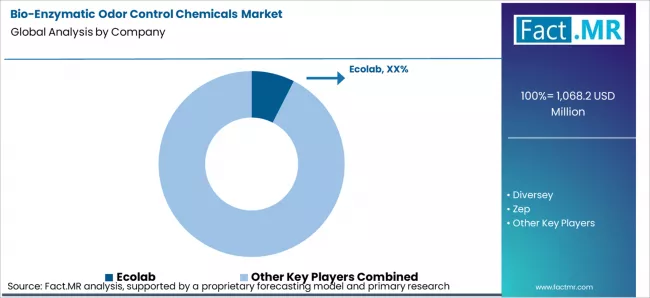
    Bio Enzymatic Odor Control Chemicals Market Analysis By Company

    The bio-enzymatic odor control chemicals market has transitioned from simple fragrance-based masking toward a sophisticated model of molecular degradation. Between 2020 and 2024 the industry prioritized the replacement of harsh chemical suppressants with microbial digesters to meet growing ESG mandates and higher indoor air quality standards. This early adoption phase established bio-enzymatics as the benchmark for high-traffic environments where eliminating the organic source of the odor is more effective than temporary masking. The previous reliance on general-purpose formulations often lacked the precision needed for specific industrial waste streams which limited the effectiveness of digestion in critical applications.

    Moving into 2026 and beyond the competitive landscape is being redefined by the race for molecular specificity and live bio-augmentation. Strategic focus is shifting from commodity enzyme blends toward specialized microbial strains that are engineered to activate only upon contact with specific odor-causing substrates. Ester Baiget the CEO of Novonesis highlights the transformative power of this biological approach in industrial settings.

    'We represent one to five percent of the cost of the products our customers produce but we are a big enabler of the value they generate. This is why we are outgrowing all the markets we serve.' - Ester Baiget, CEO of Novonesis

    Companies like Ecolab and Diversey are leveraging their scale to integrate these bio-active solutions into smart facility management systems that use real-time sensors to trigger precise dosing. The ingredient leaders like Novonesis are focusing on high-stability concentrates that reduce shipping footprints and enhance the durability of microbial cultures. This strategic pivot ensures they remain indispensable in a market that is moving away from reactive cleaning toward an autonomous and self-sustaining bio-remediation ecosystem.

    Key Players in the Bio-Enzymatic Odor Control Chemicals Market

    • Ecolab
    • Diversey
    • Zep
    • Spartan Chemical
    • Betco
    • OdoBan
    • Bio-Clean Products
    • Enzyme Solutions
    • Novozymes
    • Chr. Hansen

    Scope of the Report

    Items Values
    Quantitative Units USD million
    Product Type Enzyme-Based Odor Neutralizers; Microbial / Bacterial Odor Digesters; Bio-Active Drain & Grease Treatments; Other Bio-Based Deodorizers
    Application Area Waste & Drain Management; Industrial Odor Control; Restrooms & Public Hygiene; Hospitality & Facilities
    End-Use Sector Commercial Facilities; Municipal & Wastewater; Foodservice & Hospitality; Industrial
    Format Concentrates; RTU Sprays; Other Formats; Gels / Blocks
    Regions Covered Asia Pacific, Europe, North America, Latin America, Middle East & Africa
    Countries Covered China, Brazil, USA, UK, Germany, South Korea, Japan, and 40+ countries
    Key Companies Profiled Ecolab; Diversey; Zep; Spartan Chemical; Betco; OdoBan; Bio-Clean Products; Enzyme Solutions; Novozymes; Chr. Hansen
    Additional Attributes Dollar sales by product type, application area, and end-use sector; demand driven by increasing awareness of bio-based odor control solutions; shift toward sustainable, eco-friendly options in commercial, industrial, and municipal odor management; growing adoption of microbial odor digesters and bio-active treatments in wastewater and foodservice sectors; regulatory pressure for non-toxic, biodegradable formulations driving innovation in gel and RTU spray formats.

    Bio-Enzymatic Odor Control Chemicals Market Key Segment

    • Product Type :

      • Enzyme-Based Odor Neutralizers
      • Microbial / Bacterial Odor Digesters
      • Bio-Active Drain & Grease Treatments
      • Other Bio-Based Deodorizers
    • Application Area :

      • Waste & Drain Management
      • Industrial Odor Control
      • Restrooms & Public Hygiene
      • Hospitality & Facilities
    • End-Use Sector :

      • Commercial Facilities
      • Municipal & Wastewater
      • Foodservice & Hospitality
      • Industrial
    • Format :

      • Concentrates
      • RTU Sprays
      • Other Formats
      • Gels / Blocks
    • Region :

      • North America
        • USA
        • Canada
        • Mexico
      • Europe
        • Germany
        • UK
        • France
        • Italy
        • Spain
        • Nordic Countries
        • BENELUX
        • Rest of Europe
      • Asia Pacific
        • China
        • Japan
        • South Korea
        • India
        • Australia
        • Rest of Asia Pacific
      • Latin America
        • Brazil
        • Argentina
        • Rest of Latin America
      • Middle East and Africa
        • Kingdom of Saudi Arabia
        • United Arab Emirates
        • South Africa
        • Rest of Middle East and Africa
      • Other Regions
        • Oceania
        • Central Asia
        • Other Markets

    Bibliographies

    • U.S. Environmental Protection Agency. (2023). Technical fact sheet: Biological treatment technologies for odor control in wastewater systems. U.S. Environmental Protection Agency.
    • World Health Organization. (2023). Indoor air quality management and control of biological contaminants. World Health Organization.
    • European Environment Agency. (2023). Best available techniques for the management of odour emissions from waste and wastewater treatment. European Environment Agency.
    • International Organization for Standardization. (2023). ISO 16000-28: Indoor air-Determination of odour emissions from building products. ISO.
    • Ecolab. (2024). Enzymatic and biological odor control solutions for wastewater and commercial facilities. Ecolab technical documentation.
    • Novonesis. (2024). Industrial enzyme systems for odor-causing organic compound degradation. Novonesis technical white paper.

    Table of Content

    1. Executive Summary
      • Global Market Outlook
      • Demand to side Trends
      • Supply to side Trends
      • Technology Roadmap Analysis
      • Analysis and Recommendations
    2. Market Overview
      • Market Coverage / Taxonomy
      • Market Definition / Scope / Limitations
    3. Research Methodology
      • Chapter Orientation
      • Analytical Lens and Working Hypotheses
        • Market Sizing, Forecasting, and Opportunity Mapping
      • Research Design and Evidence Framework
        • Desk Research Programme (Secondary Evidence)
          • Company Annual and Sustainability Reports
          • Peer-reviewed Journals and Academic Literature
          • Corporate Websites, Product Literature, and Technical Notes
          • Earnings Decks and Investor Briefings
          • Statutory Filings and Regulatory Disclosures
          • Technical White Papers and Standards Notes
          • Trade Journals, Industry Magazines, and Analyst Briefs
          • Conference Proceedings, Webinars, and Seminar Materials
          • Government Statistics Portals and Public Data Releases
          • Press Releases and Reputable Media Coverage
          • Specialist Newsletters and Curated Briefings
          • Sector Databases and Reference Repositories
          • FMR Internal Proprietary Databases and Historical Market Datasets
          • Subscription Datasets and Paid Sources
          • Social Channels, Communities, and Digital Listening Inputs
          • Additional Desk Sources
        • Expert Input and Fieldwork (Primary Evidence)
          • Primary Modes
            • Qualitative Interviews and Expert Elicitation
            • Quantitative Surveys and Structured Data Capture
            • Blended Approach
          • Why Primary Evidence is Used
          • Focus Groups
          • Observational and In-context Research
          • Social and Community Interactions
        • Stakeholder Universe Engaged
          • C-suite Leaders
          • Board Members
          • Presidents and Vice Presidents
          • R&D and Innovation Heads
          • Technical Specialists
          • Domain Subject-matter Experts
          • Scientists
          • Physicians and Other Healthcare Professionals
        • Governance, Ethics, and Data Stewardship
          • Research Ethics
          • Data Integrity and Handling
      • Tooling, Models, and Reference Databases
    4. Data Engineering and Model Build
      • Data Acquisition and Ingestion
      • Cleaning, Normalisation, and Verification
      • Synthesis, Triangulation, and Analysis
    5. Quality Assurance and Audit Trail
    6. Market Background
      • Market Dynamics
        • Drivers
        • Restraints
        • Opportunity
        • Trends
      • Scenario Forecast
        • Demand in Optimistic Scenario
        • Demand in Likely Scenario
        • Demand in Conservative Scenario
      • Opportunity Map Analysis
      • Product Life Cycle Analysis
      • Supply Chain Analysis
      • Investment Feasibility Matrix
      • Value Chain Analysis
      • PESTLE and Porter’s Analysis
      • Regulatory Landscape
      • Regional Parent Market Outlook
      • Production and Consumption Statistics
      • Import and Export Statistics
    7. Global Market Analysis 2021 to 2025 and Forecast, 2026 to 2036
      • Historical Market Size Value (USD Million) Analysis, 2021 to 2025
      • Current and Future Market Size Value (USD Million) Projections, 2026 to 2036
        • Y to o to Y Growth Trend Analysis
        • Absolute $ Opportunity Analysis
    8. Global Market Pricing Analysis 2021 to 2025 and Forecast 2026 to 2036
    9. Global Market Analysis 2021 to 2025 and Forecast 2026 to 2036, By Product Type
      • Introduction / Key Findings
      • Historical Market Size Value (USD Million) Analysis By Product Type, 2021 to 2025
      • Current and Future Market Size Value (USD Million) Analysis and Forecast By Product Type, 2026 to 2036
        • Enzyme-Based Odor Neutralizers
        • Microbial / Bacterial Odor Digesters
        • Bio-Active Drain & Grease Treatments
        • Other Bio-Based Deodorizers
      • Y to o to Y Growth Trend Analysis By Product Type, 2021 to 2025
      • Absolute $ Opportunity Analysis By Product Type, 2026 to 2036
    10. Global Market Analysis 2021 to 2025 and Forecast 2026 to 2036, By Application Area
      • Introduction / Key Findings
      • Historical Market Size Value (USD Million) Analysis By Application Area, 2021 to 2025
      • Current and Future Market Size Value (USD Million) Analysis and Forecast By Application Area, 2026 to 2036
        • Waste & Drain Management
        • Industrial Odor Control
        • Restrooms & Public Hygiene
        • Hospitality & Facilities
      • Y to o to Y Growth Trend Analysis By Application Area, 2021 to 2025
      • Absolute $ Opportunity Analysis By Application Area, 2026 to 2036
    11. Global Market Analysis 2021 to 2025 and Forecast 2026 to 2036, By End-Use Sector
      • Introduction / Key Findings
      • Historical Market Size Value (USD Million) Analysis By End-Use Sector, 2021 to 2025
      • Current and Future Market Size Value (USD Million) Analysis and Forecast By End-Use Sector, 2026 to 2036
        • Commercial Facilities
        • Municipal & Wastewater
        • Foodservice & Hospitality
        • Industrial
      • Y to o to Y Growth Trend Analysis By End-Use Sector, 2021 to 2025
      • Absolute $ Opportunity Analysis By End-Use Sector, 2026 to 2036
    12. Global Market Analysis 2021 to 2025 and Forecast 2026 to 2036, By Format
      • Introduction / Key Findings
      • Historical Market Size Value (USD Million) Analysis By Format, 2021 to 2025
      • Current and Future Market Size Value (USD Million) Analysis and Forecast By Format, 2026 to 2036
        • Concentrates
        • RTU Sprays
        • Other Formats
        • Gels / Blocks
      • Y to o to Y Growth Trend Analysis By Format, 2021 to 2025
      • Absolute $ Opportunity Analysis By Format, 2026 to 2036
    13. Global Market Analysis 2021 to 2025 and Forecast 2026 to 2036, By Region
      • Introduction
      • Historical Market Size Value (USD Million) Analysis By Region, 2021 to 2025
      • Current Market Size Value (USD Million) Analysis and Forecast By Region, 2026 to 2036
        • North America
        • Latin America
        • Western Europe
        • Eastern Europe
        • East Asia
        • South Asia and Pacific
        • Middle East & Africa
      • Market Attractiveness Analysis By Region
    14. North America Market Analysis 2021 to 2025 and Forecast 2026 to 2036, By Country
      • Historical Market Size Value (USD Million) Trend Analysis By Market Taxonomy, 2021 to 2025
      • Market Size Value (USD Million) Forecast By Market Taxonomy, 2026 to 2036
        • By Country
          • USA
          • Canada
          • Mexico
        • By Product Type
        • By Application Area
        • By End-Use Sector
        • By Format
      • Market Attractiveness Analysis
        • By Country
        • By Product Type
        • By Application Area
        • By End-Use Sector
        • By Format
      • Key Takeaways
    15. Latin America Market Analysis 2021 to 2025 and Forecast 2026 to 2036, By Country
      • Historical Market Size Value (USD Million) Trend Analysis By Market Taxonomy, 2021 to 2025
      • Market Size Value (USD Million) Forecast By Market Taxonomy, 2026 to 2036
        • By Country
          • Brazil
          • Chile
          • Rest of Latin America
        • By Product Type
        • By Application Area
        • By End-Use Sector
        • By Format
      • Market Attractiveness Analysis
        • By Country
        • By Product Type
        • By Application Area
        • By End-Use Sector
        • By Format
      • Key Takeaways
    16. Western Europe Market Analysis 2021 to 2025 and Forecast 2026 to 2036, By Country
      • Historical Market Size Value (USD Million) Trend Analysis By Market Taxonomy, 2021 to 2025
      • Market Size Value (USD Million) Forecast By Market Taxonomy, 2026 to 2036
        • By Country
          • Germany
          • UK
          • Italy
          • Spain
          • France
          • Nordic
          • BENELUX
          • Rest of Western Europe
        • By Product Type
        • By Application Area
        • By End-Use Sector
        • By Format
      • Market Attractiveness Analysis
        • By Country
        • By Product Type
        • By Application Area
        • By End-Use Sector
        • By Format
      • Key Takeaways
    17. Eastern Europe Market Analysis 2021 to 2025 and Forecast 2026 to 2036, By Country
      • Historical Market Size Value (USD Million) Trend Analysis By Market Taxonomy, 2021 to 2025
      • Market Size Value (USD Million) Forecast By Market Taxonomy, 2026 to 2036
        • By Country
          • Russia
          • Poland
          • Hungary
          • Balkan & Baltic
          • Rest of Eastern Europe
        • By Product Type
        • By Application Area
        • By End-Use Sector
        • By Format
      • Market Attractiveness Analysis
        • By Country
        • By Product Type
        • By Application Area
        • By End-Use Sector
        • By Format
      • Key Takeaways
    18. East Asia Market Analysis 2021 to 2025 and Forecast 2026 to 2036, By Country
      • Historical Market Size Value (USD Million) Trend Analysis By Market Taxonomy, 2021 to 2025
      • Market Size Value (USD Million) Forecast By Market Taxonomy, 2026 to 2036
        • By Country
          • China
          • Japan
          • South Korea
        • By Product Type
        • By Application Area
        • By End-Use Sector
        • By Format
      • Market Attractiveness Analysis
        • By Country
        • By Product Type
        • By Application Area
        • By End-Use Sector
        • By Format
      • Key Takeaways
    19. South Asia and Pacific Market Analysis 2021 to 2025 and Forecast 2026 to 2036, By Country
      • Historical Market Size Value (USD Million) Trend Analysis By Market Taxonomy, 2021 to 2025
      • Market Size Value (USD Million) Forecast By Market Taxonomy, 2026 to 2036
        • By Country
          • India
          • ASEAN
          • Australia & New Zealand
          • Rest of South Asia and Pacific
        • By Product Type
        • By Application Area
        • By End-Use Sector
        • By Format
      • Market Attractiveness Analysis
        • By Country
        • By Product Type
        • By Application Area
        • By End-Use Sector
        • By Format
      • Key Takeaways
    20. Middle East & Africa Market Analysis 2021 to 2025 and Forecast 2026 to 2036, By Country
      • Historical Market Size Value (USD Million) Trend Analysis By Market Taxonomy, 2021 to 2025
      • Market Size Value (USD Million) Forecast By Market Taxonomy, 2026 to 2036
        • By Country
          • Kingdom of Saudi Arabia
          • Other GCC Countries
          • Turkiye
          • South Africa
          • Other African Union
          • Rest of Middle East & Africa
        • By Product Type
        • By Application Area
        • By End-Use Sector
        • By Format
      • Market Attractiveness Analysis
        • By Country
        • By Product Type
        • By Application Area
        • By End-Use Sector
        • By Format
      • Key Takeaways
    21. Key Countries Market Analysis
      • USA
        • Pricing Analysis
        • Market Share Analysis, 2025
          • By Product Type
          • By Application Area
          • By End-Use Sector
          • By Format
      • Canada
        • Pricing Analysis
        • Market Share Analysis, 2025
          • By Product Type
          • By Application Area
          • By End-Use Sector
          • By Format
      • Mexico
        • Pricing Analysis
        • Market Share Analysis, 2025
          • By Product Type
          • By Application Area
          • By End-Use Sector
          • By Format
      • Brazil
        • Pricing Analysis
        • Market Share Analysis, 2025
          • By Product Type
          • By Application Area
          • By End-Use Sector
          • By Format
      • Chile
        • Pricing Analysis
        • Market Share Analysis, 2025
          • By Product Type
          • By Application Area
          • By End-Use Sector
          • By Format
      • Germany
        • Pricing Analysis
        • Market Share Analysis, 2025
          • By Product Type
          • By Application Area
          • By End-Use Sector
          • By Format
      • UK
        • Pricing Analysis
        • Market Share Analysis, 2025
          • By Product Type
          • By Application Area
          • By End-Use Sector
          • By Format
      • Italy
        • Pricing Analysis
        • Market Share Analysis, 2025
          • By Product Type
          • By Application Area
          • By End-Use Sector
          • By Format
      • Spain
        • Pricing Analysis
        • Market Share Analysis, 2025
          • By Product Type
          • By Application Area
          • By End-Use Sector
          • By Format
      • France
        • Pricing Analysis
        • Market Share Analysis, 2025
          • By Product Type
          • By Application Area
          • By End-Use Sector
          • By Format
      • India
        • Pricing Analysis
        • Market Share Analysis, 2025
          • By Product Type
          • By Application Area
          • By End-Use Sector
          • By Format
      • ASEAN
        • Pricing Analysis
        • Market Share Analysis, 2025
          • By Product Type
          • By Application Area
          • By End-Use Sector
          • By Format
      • Australia & New Zealand
        • Pricing Analysis
        • Market Share Analysis, 2025
          • By Product Type
          • By Application Area
          • By End-Use Sector
          • By Format
      • China
        • Pricing Analysis
        • Market Share Analysis, 2025
          • By Product Type
          • By Application Area
          • By End-Use Sector
          • By Format
      • Japan
        • Pricing Analysis
        • Market Share Analysis, 2025
          • By Product Type
          • By Application Area
          • By End-Use Sector
          • By Format
      • South Korea
        • Pricing Analysis
        • Market Share Analysis, 2025
          • By Product Type
          • By Application Area
          • By End-Use Sector
          • By Format
      • Russia
        • Pricing Analysis
        • Market Share Analysis, 2025
          • By Product Type
          • By Application Area
          • By End-Use Sector
          • By Format
      • Poland
        • Pricing Analysis
        • Market Share Analysis, 2025
          • By Product Type
          • By Application Area
          • By End-Use Sector
          • By Format
      • Hungary
        • Pricing Analysis
        • Market Share Analysis, 2025
          • By Product Type
          • By Application Area
          • By End-Use Sector
          • By Format
      • Kingdom of Saudi Arabia
        • Pricing Analysis
        • Market Share Analysis, 2025
          • By Product Type
          • By Application Area
          • By End-Use Sector
          • By Format
      • Turkiye
        • Pricing Analysis
        • Market Share Analysis, 2025
          • By Product Type
          • By Application Area
          • By End-Use Sector
          • By Format
      • South Africa
        • Pricing Analysis
        • Market Share Analysis, 2025
          • By Product Type
          • By Application Area
          • By End-Use Sector
          • By Format
    22. Market Structure Analysis
      • Competition Dashboard
      • Competition Benchmarking
      • Market Share Analysis of Top Players
        • By Regional
        • By Product Type
        • By Application Area
        • By End-Use Sector
        • By Format
    23. Competition Analysis
      • Competition Deep Dive
        • Ecolab
          • Overview
          • Product Portfolio
          • Profitability by Market Segments (Product/Age /Sales Channel/Region)
          • Sales Footprint
          • Strategy Overview
            • Marketing Strategy
            • Product Strategy
            • Channel Strategy
        • Diversey
        • Zep
        • Spartan Chemical
        • Betco
        • OdoBan
        • Bio-Clean Products
        • Enzyme Solutions
        • Novozymes
        • Chr. Hansen
    24. Assumptions & Acronyms Used

    List Of Table

    • Table 1: Global Market Value (USD Million) Forecast by Region, 2021 to 2036
    • Table 2: Global Market Value (USD Million) Forecast by Product Type, 2021 to 2036
    • Table 3: Global Market Value (USD Million) Forecast by Application Area, 2021 to 2036
    • Table 4: Global Market Value (USD Million) Forecast by End-Use Sector, 2021 to 2036
    • Table 5: Global Market Value (USD Million) Forecast by Format, 2021 to 2036
    • Table 6: North America Market Value (USD Million) Forecast by Country, 2021 to 2036
    • Table 7: North America Market Value (USD Million) Forecast by Product Type, 2021 to 2036
    • Table 8: North America Market Value (USD Million) Forecast by Application Area, 2021 to 2036
    • Table 9: North America Market Value (USD Million) Forecast by End-Use Sector, 2021 to 2036
    • Table 10: North America Market Value (USD Million) Forecast by Format, 2021 to 2036
    • Table 11: Latin America Market Value (USD Million) Forecast by Country, 2021 to 2036
    • Table 12: Latin America Market Value (USD Million) Forecast by Product Type, 2021 to 2036
    • Table 13: Latin America Market Value (USD Million) Forecast by Application Area, 2021 to 2036
    • Table 14: Latin America Market Value (USD Million) Forecast by End-Use Sector, 2021 to 2036
    • Table 15: Latin America Market Value (USD Million) Forecast by Format, 2021 to 2036
    • Table 16: Western Europe Market Value (USD Million) Forecast by Country, 2021 to 2036
    • Table 17: Western Europe Market Value (USD Million) Forecast by Product Type, 2021 to 2036
    • Table 18: Western Europe Market Value (USD Million) Forecast by Application Area, 2021 to 2036
    • Table 19: Western Europe Market Value (USD Million) Forecast by End-Use Sector, 2021 to 2036
    • Table 20: Western Europe Market Value (USD Million) Forecast by Format, 2021 to 2036
    • Table 21: Eastern Europe Market Value (USD Million) Forecast by Country, 2021 to 2036
    • Table 22: Eastern Europe Market Value (USD Million) Forecast by Product Type, 2021 to 2036
    • Table 23: Eastern Europe Market Value (USD Million) Forecast by Application Area, 2021 to 2036
    • Table 24: Eastern Europe Market Value (USD Million) Forecast by End-Use Sector, 2021 to 2036
    • Table 25: Eastern Europe Market Value (USD Million) Forecast by Format, 2021 to 2036
    • Table 26: East Asia Market Value (USD Million) Forecast by Country, 2021 to 2036
    • Table 27: East Asia Market Value (USD Million) Forecast by Product Type, 2021 to 2036
    • Table 28: East Asia Market Value (USD Million) Forecast by Application Area, 2021 to 2036
    • Table 29: East Asia Market Value (USD Million) Forecast by End-Use Sector, 2021 to 2036
    • Table 30: East Asia Market Value (USD Million) Forecast by Format, 2021 to 2036
    • Table 31: South Asia and Pacific Market Value (USD Million) Forecast by Country, 2021 to 2036
    • Table 32: South Asia and Pacific Market Value (USD Million) Forecast by Product Type, 2021 to 2036
    • Table 33: South Asia and Pacific Market Value (USD Million) Forecast by Application Area, 2021 to 2036
    • Table 34: South Asia and Pacific Market Value (USD Million) Forecast by End-Use Sector, 2021 to 2036
    • Table 35: South Asia and Pacific Market Value (USD Million) Forecast by Format, 2021 to 2036
    • Table 36: Middle East & Africa Market Value (USD Million) Forecast by Country, 2021 to 2036
    • Table 37: Middle East & Africa Market Value (USD Million) Forecast by Product Type, 2021 to 2036
    • Table 38: Middle East & Africa Market Value (USD Million) Forecast by Application Area, 2021 to 2036
    • Table 39: Middle East & Africa Market Value (USD Million) Forecast by End-Use Sector, 2021 to 2036
    • Table 40: Middle East & Africa Market Value (USD Million) Forecast by Format, 2021 to 2036

    List Of Figures

    • Figure 1: Global Market Pricing Analysis
    • Figure 2: Global Market Value (USD Million) Forecast 2021 to 2036
    • Figure 3: Global Market Value Share and BPS Analysis by Product Type, 2026 and 2036
    • Figure 4: Global Market Y to o to Y Growth Comparison by Product Type, 2026 to 2036
    • Figure 5: Global Market Attractiveness Analysis by Product Type
    • Figure 6: Global Market Value Share and BPS Analysis by Application Area, 2026 and 2036
    • Figure 7: Global Market Y to o to Y Growth Comparison by Application Area, 2026 to 2036
    • Figure 8: Global Market Attractiveness Analysis by Application Area
    • Figure 9: Global Market Value Share and BPS Analysis by End-Use Sector, 2026 and 2036
    • Figure 10: Global Market Y to o to Y Growth Comparison by End-Use Sector, 2026 to 2036
    • Figure 11: Global Market Attractiveness Analysis by End-Use Sector
    • Figure 12: Global Market Value Share and BPS Analysis by Format, 2026 and 2036
    • Figure 13: Global Market Y to o to Y Growth Comparison by Format, 2026 to 2036
    • Figure 14: Global Market Attractiveness Analysis by Format
    • Figure 15: Global Market Value (USD Million) Share and BPS Analysis by Region, 2026 and 2036
    • Figure 16: Global Market Y to o to Y Growth Comparison by Region, 2026 to 2036
    • Figure 17: Global Market Attractiveness Analysis by Region
    • Figure 18: North America Market Incremental Dollar Opportunity, 2026 to 2036
    • Figure 19: Latin America Market Incremental Dollar Opportunity, 2026 to 2036
    • Figure 20: Western Europe Market Incremental Dollar Opportunity, 2026 to 2036
    • Figure 21: Eastern Europe Market Incremental Dollar Opportunity, 2026 to 2036
    • Figure 22: East Asia Market Incremental Dollar Opportunity, 2026 to 2036
    • Figure 23: South Asia and Pacific Market Incremental Dollar Opportunity, 2026 to 2036
    • Figure 24: Middle East & Africa Market Incremental Dollar Opportunity, 2026 to 2036
    • Figure 25: North America Market Value Share and BPS Analysis by Country, 2026 and 2036
    • Figure 26: North America Market Value Share and BPS Analysis by Product Type, 2026 and 2036
    • Figure 27: North America Market Y to o to Y Growth Comparison by Product Type, 2026 to 2036
    • Figure 28: North America Market Attractiveness Analysis by Product Type
    • Figure 29: North America Market Value Share and BPS Analysis by Application Area, 2026 and 2036
    • Figure 30: North America Market Y to o to Y Growth Comparison by Application Area, 2026 to 2036
    • Figure 31: North America Market Attractiveness Analysis by Application Area
    • Figure 32: North America Market Value Share and BPS Analysis by End-Use Sector, 2026 and 2036
    • Figure 33: North America Market Y to o to Y Growth Comparison by End-Use Sector, 2026 to 2036
    • Figure 34: North America Market Attractiveness Analysis by End-Use Sector
    • Figure 35: North America Market Value Share and BPS Analysis by Format, 2026 and 2036
    • Figure 36: North America Market Y to o to Y Growth Comparison by Format, 2026 to 2036
    • Figure 37: North America Market Attractiveness Analysis by Format
    • Figure 38: Latin America Market Value Share and BPS Analysis by Country, 2026 and 2036
    • Figure 39: Latin America Market Value Share and BPS Analysis by Product Type, 2026 and 2036
    • Figure 40: Latin America Market Y to o to Y Growth Comparison by Product Type, 2026 to 2036
    • Figure 41: Latin America Market Attractiveness Analysis by Product Type
    • Figure 42: Latin America Market Value Share and BPS Analysis by Application Area, 2026 and 2036
    • Figure 43: Latin America Market Y to o to Y Growth Comparison by Application Area, 2026 to 2036
    • Figure 44: Latin America Market Attractiveness Analysis by Application Area
    • Figure 45: Latin America Market Value Share and BPS Analysis by End-Use Sector, 2026 and 2036
    • Figure 46: Latin America Market Y to o to Y Growth Comparison by End-Use Sector, 2026 to 2036
    • Figure 47: Latin America Market Attractiveness Analysis by End-Use Sector
    • Figure 48: Latin America Market Value Share and BPS Analysis by Format, 2026 and 2036
    • Figure 49: Latin America Market Y to o to Y Growth Comparison by Format, 2026 to 2036
    • Figure 50: Latin America Market Attractiveness Analysis by Format
    • Figure 51: Western Europe Market Value Share and BPS Analysis by Country, 2026 and 2036
    • Figure 52: Western Europe Market Value Share and BPS Analysis by Product Type, 2026 and 2036
    • Figure 53: Western Europe Market Y to o to Y Growth Comparison by Product Type, 2026 to 2036
    • Figure 54: Western Europe Market Attractiveness Analysis by Product Type
    • Figure 55: Western Europe Market Value Share and BPS Analysis by Application Area, 2026 and 2036
    • Figure 56: Western Europe Market Y to o to Y Growth Comparison by Application Area, 2026 to 2036
    • Figure 57: Western Europe Market Attractiveness Analysis by Application Area
    • Figure 58: Western Europe Market Value Share and BPS Analysis by End-Use Sector, 2026 and 2036
    • Figure 59: Western Europe Market Y to o to Y Growth Comparison by End-Use Sector, 2026 to 2036
    • Figure 60: Western Europe Market Attractiveness Analysis by End-Use Sector
    • Figure 61: Western Europe Market Value Share and BPS Analysis by Format, 2026 and 2036
    • Figure 62: Western Europe Market Y to o to Y Growth Comparison by Format, 2026 to 2036
    • Figure 63: Western Europe Market Attractiveness Analysis by Format
    • Figure 64: Eastern Europe Market Value Share and BPS Analysis by Country, 2026 and 2036
    • Figure 65: Eastern Europe Market Value Share and BPS Analysis by Product Type, 2026 and 2036
    • Figure 66: Eastern Europe Market Y to o to Y Growth Comparison by Product Type, 2026 to 2036
    • Figure 67: Eastern Europe Market Attractiveness Analysis by Product Type
    • Figure 68: Eastern Europe Market Value Share and BPS Analysis by Application Area, 2026 and 2036
    • Figure 69: Eastern Europe Market Y to o to Y Growth Comparison by Application Area, 2026 to 2036
    • Figure 70: Eastern Europe Market Attractiveness Analysis by Application Area
    • Figure 71: Eastern Europe Market Value Share and BPS Analysis by End-Use Sector, 2026 and 2036
    • Figure 72: Eastern Europe Market Y to o to Y Growth Comparison by End-Use Sector, 2026 to 2036
    • Figure 73: Eastern Europe Market Attractiveness Analysis by End-Use Sector
    • Figure 74: Eastern Europe Market Value Share and BPS Analysis by Format, 2026 and 2036
    • Figure 75: Eastern Europe Market Y to o to Y Growth Comparison by Format, 2026 to 2036
    • Figure 76: Eastern Europe Market Attractiveness Analysis by Format
    • Figure 77: East Asia Market Value Share and BPS Analysis by Country, 2026 and 2036
    • Figure 78: East Asia Market Value Share and BPS Analysis by Product Type, 2026 and 2036
    • Figure 79: East Asia Market Y to o to Y Growth Comparison by Product Type, 2026 to 2036
    • Figure 80: East Asia Market Attractiveness Analysis by Product Type
    • Figure 81: East Asia Market Value Share and BPS Analysis by Application Area, 2026 and 2036
    • Figure 82: East Asia Market Y to o to Y Growth Comparison by Application Area, 2026 to 2036
    • Figure 83: East Asia Market Attractiveness Analysis by Application Area
    • Figure 84: East Asia Market Value Share and BPS Analysis by End-Use Sector, 2026 and 2036
    • Figure 85: East Asia Market Y to o to Y Growth Comparison by End-Use Sector, 2026 to 2036
    • Figure 86: East Asia Market Attractiveness Analysis by End-Use Sector
    • Figure 87: East Asia Market Value Share and BPS Analysis by Format, 2026 and 2036
    • Figure 88: East Asia Market Y to o to Y Growth Comparison by Format, 2026 to 2036
    • Figure 89: East Asia Market Attractiveness Analysis by Format
    • Figure 90: South Asia and Pacific Market Value Share and BPS Analysis by Country, 2026 and 2036
    • Figure 91: South Asia and Pacific Market Value Share and BPS Analysis by Product Type, 2026 and 2036
    • Figure 92: South Asia and Pacific Market Y to o to Y Growth Comparison by Product Type, 2026 to 2036
    • Figure 93: South Asia and Pacific Market Attractiveness Analysis by Product Type
    • Figure 94: South Asia and Pacific Market Value Share and BPS Analysis by Application Area, 2026 and 2036
    • Figure 95: South Asia and Pacific Market Y to o to Y Growth Comparison by Application Area, 2026 to 2036
    • Figure 96: South Asia and Pacific Market Attractiveness Analysis by Application Area
    • Figure 97: South Asia and Pacific Market Value Share and BPS Analysis by End-Use Sector, 2026 and 2036
    • Figure 98: South Asia and Pacific Market Y to o to Y Growth Comparison by End-Use Sector, 2026 to 2036
    • Figure 99: South Asia and Pacific Market Attractiveness Analysis by End-Use Sector
    • Figure 100: South Asia and Pacific Market Value Share and BPS Analysis by Format, 2026 and 2036
    • Figure 101: South Asia and Pacific Market Y to o to Y Growth Comparison by Format, 2026 to 2036
    • Figure 102: South Asia and Pacific Market Attractiveness Analysis by Format
    • Figure 103: Middle East & Africa Market Value Share and BPS Analysis by Country, 2026 and 2036
    • Figure 104: Middle East & Africa Market Value Share and BPS Analysis by Product Type, 2026 and 2036
    • Figure 105: Middle East & Africa Market Y to o to Y Growth Comparison by Product Type, 2026 to 2036
    • Figure 106: Middle East & Africa Market Attractiveness Analysis by Product Type
    • Figure 107: Middle East & Africa Market Value Share and BPS Analysis by Application Area, 2026 and 2036
    • Figure 108: Middle East & Africa Market Y to o to Y Growth Comparison by Application Area, 2026 to 2036
    • Figure 109: Middle East & Africa Market Attractiveness Analysis by Application Area
    • Figure 110: Middle East & Africa Market Value Share and BPS Analysis by End-Use Sector, 2026 and 2036
    • Figure 111: Middle East & Africa Market Y to o to Y Growth Comparison by End-Use Sector, 2026 to 2036
    • Figure 112: Middle East & Africa Market Attractiveness Analysis by End-Use Sector
    • Figure 113: Middle East & Africa Market Value Share and BPS Analysis by Format, 2026 and 2036
    • Figure 114: Middle East & Africa Market Y to o to Y Growth Comparison by Format, 2026 to 2036
    • Figure 115: Middle East & Africa Market Attractiveness Analysis by Format
    • Figure 116: Global Market - Tier Structure Analysis
    • Figure 117: Global Market - Company Share Analysis

    - FAQs -

    How big is the bio-enzymatic odor control chemicals market in 2026?

    The global bio-enzymatic odor control chemicals market is estimated to be valued at USD 1,068.2 million in 2026.

    What will be the size of bio-enzymatic odor control chemicals market in 2036?

    The market size for the bio-enzymatic odor control chemicals market is projected to reach USD 2,599.3 million by 2036.

    How much will be the bio-enzymatic odor control chemicals market growth between 2026 and 2036?

    The bio-enzymatic odor control chemicals market is expected to grow at a 9.3% CAGR between 2026 and 2036.

    What are the key product types in the bio-enzymatic odor control chemicals market?

    The key product types in bio-enzymatic odor control chemicals market are enzyme-based odor neutralizers, microbial / bacterial odor digesters, bio-active drain & grease treatments and other bio-based deodorizers.

    Which application area segment to contribute significant share in the bio-enzymatic odor control chemicals market in 2026?

    In terms of application area, waste & drain management segment to command 33.0% share in the bio-enzymatic odor control chemicals market in 2026.

    Bio-Enzymatic Odor Control Chemicals Market