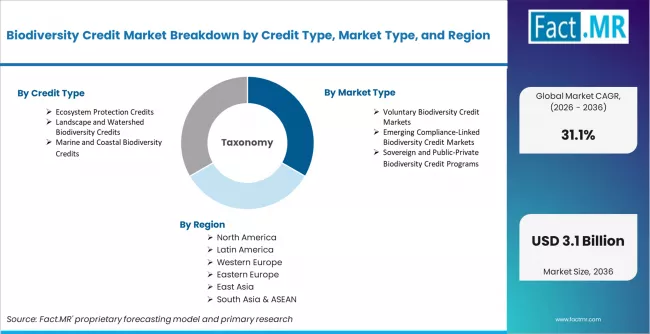
Biodiversity Credit Market Size, Share, Growth and Forecast (2026 - 2036)

The Biodiversity Credit Market is segmented by Credit Type (Species and Habitat Restoration Credits, Ecosystem Protection Credits, Landscape and Watershed Biodiversity Credits, Marine and Coastal Biodiversity Credits, Community and Indigenous Stewardship-Linked Credits, and Others), Market Type (Voluntary Biodiversity Credit Markets, Emerging Compliance-Linked Biodiversity Credit Markets, Sovereign and Public-Private Biodiversity Credit Programs, and Others), Buyer Type (Corporates, Financial Institutions, Philanthropic Buyers, Governments and Public Agencies, and Others), Application (Nature-Positive Corporate Action, Supply Chain and Landscape Restoration, Protected Area Finance, Community Conservation Incentives, and Others), End Use (Conservation Project Developers, Corporates with Nature Strategies, Investors and Intermediaries, Public Nature-Finance Programs, and Others), and Region. Forecast for 2026 to 2036.

Fact.MR analysis indicates that the biodiversity credit market is developing around measurable nature outcomes, integrity guardrails, and new conservation-finance pathways rather than simple offset-style transactions alone. The World Economic Forum states that biodiversity credits are a verifiable, quantifiable, and tradable financial instrument that rewards positive biodiversity outcomes.

Biodiversity Credit Market Forecast and Outlook By Fact.MR

  • The biodiversity credit market was valued at USD 0.09 billion in 2025.
  • According to Fact.MR, demand is projected to reach USD 0.1 billion in 2026 and expand to USD 1.8 billion by 2036, reflecting a CAGR of 31.1% during the forecast period.
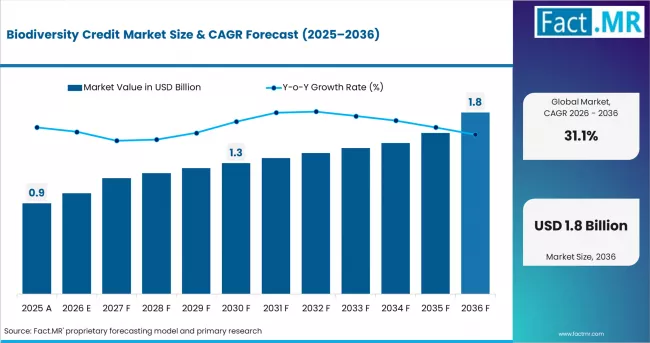
Biodiversity Credit Market Market Value Analysis

Metric Value
Estimated Value in 2026 USD 0.12 billion
Forecast Value in 2036 USD 1.8 billion
Forecast CAGR (2026 to 2036) 31.1%

Summary of Biodiversity Credit Market

  • Market Definition
    • The market includes tradable biodiversity units designed to reward measurable positive biodiversity outcomes.
  • Demand Drivers
    • High-integrity market design is progressing through new principles, strategic plans, and assessment frameworks.
    • Biodiversity credits are being positioned as a way to support selected biodiversity-finance and conservation targets.
    • Public and private interest in nature finance is increasing, which supports experimentation with biodiversity-credit models. [2]
  • Key Segments Analyzed
    • By Credit Type: Ecosystem Protection Credits are estimated to lead with approximately 30% share in 2026, supported by lower implementation complexity than full restoration-heavy models.
    • By Market Type: Voluntary Biodiversity Credit Markets are expected to hold approximately 58% share in 2026, driven by current market-stage structure.
    • By Buyer Type: Corporates are projected to account for approximately 33% share in 2026, supported by nature strategy and supply-chain interest.
    • By Application: Nature-Positive Corporate Action is expected to contribute approximately 29% share in 2026, backed by early private-sector engagement.
    • By Geography: India leads growth at 34.2% CAGR through 2036, supported by stronger natural-capital finance relevance.
  • Analyst Opinion at FACT.MR
    • Shambhu Nath Jha states, “Decision-makers should interpret this market as a measurable nature-finance category rather than a speculative environmental product niche. Buyers are not only paying for claims. They are paying for verifiable biodiversity outcomes, legitimacy, and long-term access to credible nature-positive financing mechanisms.”
  • Strategic Implications
    • Invest in project models that can demonstrate measurable biodiversity outcomes with transparent benefit-sharing.
    • Build technical sales capability around integrity, metrics, and governance rather than broad nature claims alone.
    • Position biodiversity credits where buyers want credible nature-positive finance linked to real ecological outcomes. [3]

The market is expected to generate an absolute opportunity of USD 1.6 billion between 2026 and 2036, indicating rapid expansion from a low base. Growth is being supported by rising interest in nature-positive finance, increasing focus on market integrity, and broader experimentation with outcome-based biodiversity financing models. Biodiversity Credit Alliance states in its 2025-2026 Strategic Plan that it is working to build a transparent and high-integrity global biodiversity credit ecosystem. World Economic Forum, the Biodiversity Credit Alliance, and International Advisory Panel on Biodiversity Credits have introduced high-level principles to guide market design and credibility. [1]

India is projected to lead with a CAGR of 34.2% through 2036, driven by growing natural-capital finance interest, biodiversity-rich landscapes, and stronger policy attention to nature finance. China follows at 32.4%, supported by large-scale ecological restoration potential and rising institutional attention to nature-positive finance. Brazil is expected to grow at 31.8%, underpinned by globally significant biodiversity assets and strong project-development potential. The United States records 28.6%, backed by corporate nature strategies and conservation-finance innovation. Germany grows at 27.4%, supported by stronger sustainability-finance participation and high-integrity market interest.

Segmental Analysis

Biodiversity Credit Market Analysis by Credit Type
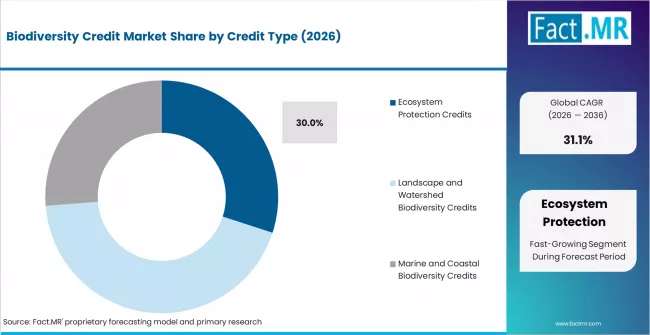
Biodiversity Credit Market Analysis By Credit Type

Ecosystem protection credits are estimated to hold approximately 30% share in 2026, as protection-oriented models can typically scale faster than restoration-heavy approaches and align more directly with biodiversity-rich regions that lack sufficient funding. Biodiversity Credit Alliance notes in its 2025 knowledge brief that biodiversity credits can help channel finance toward high-biodiversity but underfunded landscapes when governance structures and benefit-sharing mechanisms are clearly defined, reinforcing the commercial relevance of protection-focused credit models.

  • Ecosystem protection credits lead because they can align quickly with conservation finance needs.
  • Species and habitat restoration credits remain attractive where project developers can show visible ecological recovery.
  • Community and stewardship-linked credits gain relevance where Indigenous Peoples and local communities are central to long-term biodiversity outcomes.

Biodiversity Credit Market Analysis by Market Type
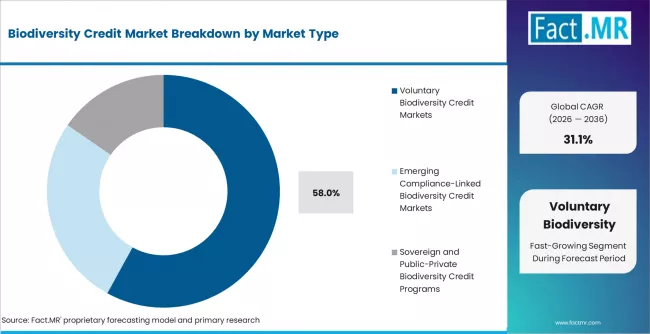
Biodiversity Credit Market Analysis By Market Type

Voluntary biodiversity credit markets continue to lead as the primary channel for early-stage development and experimentation across nature-based finance models. The segment is supported by active pilot programs, evolving methodologies, and principle-setting initiatives that shape how biodiversity outcomes are measured and traded. Voluntary biodiversity credit markets are expected to hold approximately 58% share in 2026. Biodiversity Credit Alliance distinguishes voluntary and compliance markets, indicating that voluntary frameworks currently serve as the main platform for innovation and early adoption in this space. [4]

  • Voluntary markets lead because they are the clearest path for early market development.
  • Compliance-linked markets remain important where governments may eventually shape more formal demand channels.
  • Sovereign and public-private structures gain relevance where biodiversity-rich countries seek new conservation finance tools.

Biodiversity Credit Market Analysis by Buyer Type
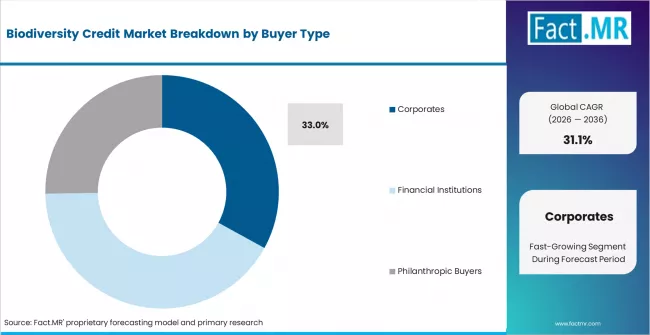
Biodiversity Credit Market Analysis By Buyer Type

Corporates are projected to account for approximately 33% share in 2026. They lead because private-sector nature strategies are one of the clearest early demand channels for biodiversity credits. The World Economic Forum’s nature-finance work frames biodiversity credits as part of a private-sector roadmap to finance and act on nature. [5]

  • Corporate buyers lead because early biodiversity credit demand is closely tied to nature strategy and supply-chain exposure.
  • Financial institutions remain attractive where biodiversity finance is developing into investable structures.
  • Governments and public agencies gain relevance where biodiversity finance gaps require blended-finance solutions.

Biodiversity Credit Market Analysis by Application
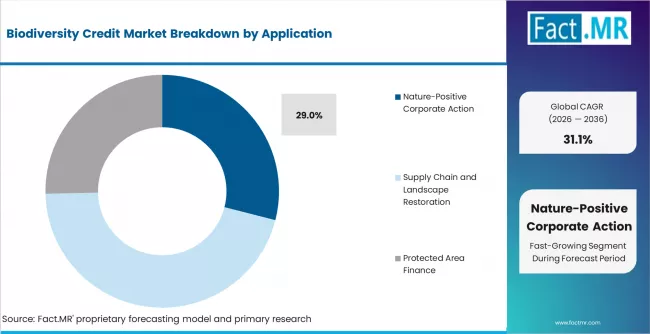
Biodiversity Credit Market Analysis By Application

Nature-Positive Corporate Action is expected to contribute approximately 29% share in 2026. This segment leads because businesses are among the first groups exploring biodiversity credits as a practical nature-finance instrument. The WEF’s biodiversity credits initiative directly frames credits as a tradable instrument that rewards positive biodiversity outcomes. The 2026 BCA metrics discussion paper also positions biodiversity credit metrics as a business imperative.

  • Nature-positive corporate action leads because early buyer interest is closely tied to private-sector nature strategies.
  • Protected-area finance remains important where biodiversity credits may support underfunded conservation landscapes.
  • Community conservation incentives gain relevance where benefit-sharing and local stewardship are central to project credibility.

Drivers, Restraints, and Opportunities
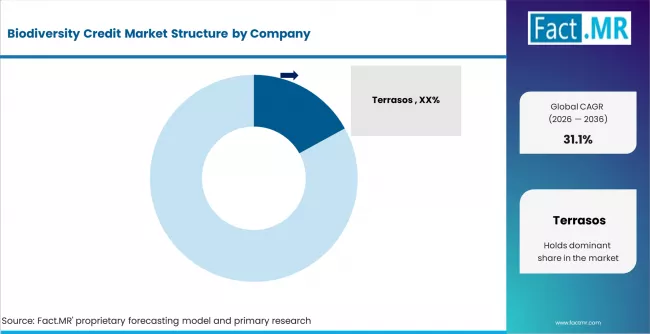
Biodiversity Credit Market Analysis By Company

The market is being shaped by the need to create new nature-finance flows while maintaining credibility and measurable impact. Demand is structurally anchored in persistent biodiversity-finance gaps and increasing focus on quantifiable nature outcomes. United Nations Development Programme highlights the need to transform financial flows to address biodiversity loss, while Biodiversity Credit Alliance continues to emphasize building a credible and scalable market framework.

The main restraint is integrity and market design complexity. Biodiversity outcomes are difficult to measure consistently, and the market still requires trusted metrics, governance models, benefit-sharing structures, and high-integrity verification frameworks. This is why recent high-level principles and emerging metrics guidance are central to market formation. As a result, suppliers and project developers must demonstrate that biodiversity credits deliver measurable ecological value rather than broad or unverified environmental claims, reinforcing the importance of transparency and scientific rigor in long-term market development.

  • High-integrity voluntary market growth remains the clearest opportunity where early buyers want measurable biodiversity outcomes.
  • Metrics-led project development creates stronger value where buyers need defensible biodiversity units.
  • Public-private biodiversity finance structures offer higher-value opportunity where countries want to mobilize nature finance at scale.

Regional Analysis

The market is assessed across North America, Europe, Asia Pacific, Latin America, and Middle East and Africa, covering 40+ countries with demand profiles shaped by biodiversity richness, policy experimentation, nature-finance capacity, and private-sector participation. The country growth rates below are model-based estimates.

Top Country Growth Comparison Biodiversity Credit Market Cagr (2026 2036)

Country CAGR (2026 to 2036)
India 34.2%
China 32.4%
Brazil 31.8%
United States 28.6%
Germany 27.4%

North America Biodiversity Credit Market Analysis
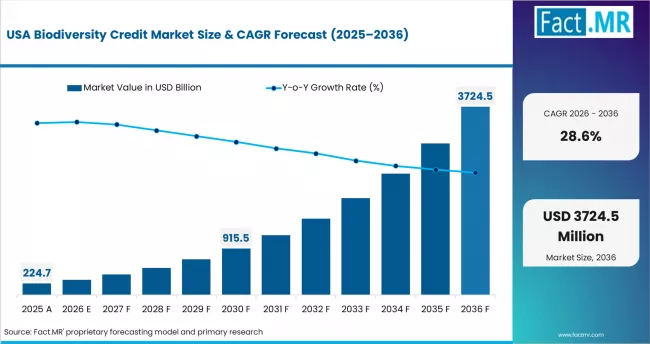
Biodiversity Credit Market Country Value Analysis

North America remains an important commercial region because it combines conservation-finance innovation, corporate sustainability participation, and growing investor interest in nature-linked financial instruments. Demand is strongest where biodiversity credits are integrated into broader ESG and nature-finance strategies rather than treated as standalone initiatives.

  • United States: Stronger corporate nature-strategy development and increasing alignment with sustainability frameworks support growth. The market is projected to expand at a CAGR of 28.6% from 2026 to 2036, driven by corporate participation, voluntary credit adoption, and evolving nature-related disclosure practices.

Europe Biodiversity Credit Market Analysis
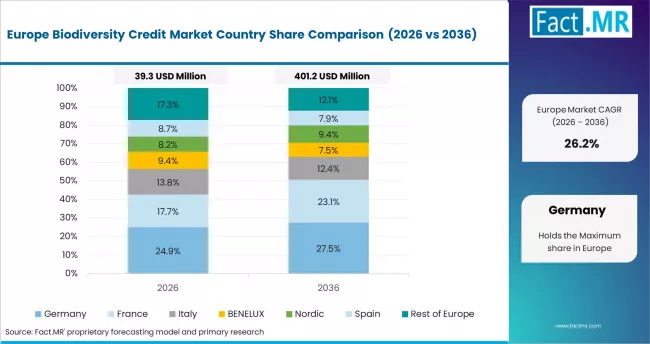
Biodiversity Credit Market Europe Country Market Share Analysis, 2026 & 2036

Europe remains a structurally advanced region where adoption is closely tied to sustainability-finance maturity, higher integrity expectations, and more formalized policy engagement around nature-positive economic models. The region plays a key role in shaping standards, governance frameworks, and credibility in biodiversity credit systems.

  • Germany: Strong policy engagement, corporate sustainability alignment, and financial-market participation support demand. The market is projected to grow at a CAGR of 27.4% during the study period, driven by increasing integration of biodiversity credits into corporate ESG strategies and sustainable finance initiatives. Germany’s role in advancing structured, integrity-focused approaches to nature finance strengthens its position within the European ecosystem.

Asia Pacific and Latin America Biodiversity Credit Market Analysis

Asia Pacific and Latin America offer the strongest long-term expansion potential because they combine biodiversity-rich landscapes, expanding public-private finance experimentation, and increasing interest in nature-linked development models. Adoption is accelerating as governments, NGOs, and private-sector participants explore scalable biodiversity credit frameworks.

  • India: Strong natural-capital potential and growing interest in nature-finance mechanisms support demand. The market is projected to grow at a CAGR of 34.2% over the assessment period, driven by biodiversity-rich ecosystems and increasing policy engagement.
  • China: Large-scale ecological restoration opportunities and ongoing policy experimentation support growth. The market is projected to expand at a CAGR of 32.4% by 2036, with increasing focus on integrating biodiversity outcomes into broader sustainability goals.
  • Brazil: Globally significant biodiversity assets and strong relevance in conservation finance support growth. The market is projected to grow at a CAGR of 31.8% through 2036, driven by ecosystem value and expanding participation in nature-based financial instruments.

Competitive Aligners for Market Players

Biodiversity Credit Market Analysis By Company

The market is moderately concentrated at the framework, methodology, and project-development level, while broader scaling remains dependent on buyers, standard-setters, and local project pipelines. Competitive strength comes from the ability to combine ecological credibility, clear metrics, transparent governance, and equitable benefit-sharing. Project developers and market intermediaries need more than a biodiversity narrative. They need a clear explanation of how credits are measured, governed, and aligned with high-integrity principles.

Competitive advantage is defined by metric credibility, stakeholder trust, governance quality, local participation, and alignment with emerging high-level principles. This competitive framing is an analytical view derived from current official framework materials rather than a published market-share table.

Key Players

  • Terrasos
  • CreditNature
  • Savimbo
  • ValueNature
  • RePlanet
  • Ekos
  • South Pole
  • Environment Bank

Bibliography

  • [1] World Economic Forum. Biodiversity credits initiative materials describing biodiversity credits as a verifiable, quantifiable, and tradable financial instrument rewarding positive biodiversity outcomes.
  • [2] UNDP. Biodiversity Credit Alliance materials describing the goal of building a credible and scalable biodiversity credit market with scrutiny from multiple stakeholders, including Indigenous Peoples and local communities.
  • [3] Biodiversity Credit Alliance. Strategic Plan 2025-2026 describing the aim to build a transparent, trustworthy, and high-integrity biodiversity credit market.
  • [4] Biodiversity Credit Alliance. 2025 knowledge brief on voluntary versus compliance biodiversity credit markets.
  • [5] World Economic Forum, Biodiversity Credit Alliance, and International Advisory Panel on Biodiversity Credits. High-Level Principles to Guide the Biodiversity Credit Market (2025).

This Report Addresses

  • Strategic intelligence on biodiversity credit demand across ecosystem protection, restoration, stewardship-linked finance, and nature-positive corporate action.
  • Market forecast from USD 0.12 billion in 2026 to USD 1.8 billion by 2036 at a CAGR of 31.1%.
  • Growth opportunity mapping across voluntary biodiversity markets, ecosystem protection credits, metrics-led project development, and public-private conservation-finance structures.
  • Segment analysis by credit type, market type, buyer type, application, and end use.
  • Regional outlook covering North America, Europe, Asia Pacific, Latin America, and Middle East and Africa.
  • Competitive analysis of framework participants, project developers, market intermediaries, and biodiversity-finance ecosystem builders.
  • Integrity and market-design analysis covering metrics, governance, benefit-sharing, stakeholder trust, and high-quality biodiversity outcomes.
  • Market interpretation built around biodiversity-finance gaps, emerging market guardrails, and broader public-private interest in measurable nature-positive finance.

Biodiversity Credit Market Definition

The market covers verified, quantifiable biodiversity credits and related issuance, transaction, and project-development systems used to finance positive biodiversity outcomes. It includes biodiversity outcome units generated through restoration, protection, stewardship, or ecological improvement activities under defined methodologies and market rules.

Biodiversity Credit Market Inclusions

Covers global and regional forecasts from 2026 to 2036. Includes voluntary biodiversity crediting activity, emerging compliance-linked biodiversity credit structures, project-development frameworks, biodiversity metrics and verification systems, and biodiversity-finance structures linked to measurable conservation outcomes.

Biodiversity Credit Market Exclusions

Excludes carbon credits where biodiversity outcomes are not the core unit being transacted, conventional biodiversity offsets designed only for local mitigation compliance without tradable-credit logic, philanthropic donations without measurable credit issuance, and broad ESG claims without biodiversity-credit transaction structures.

Biodiversity Credit Market Research Methodology

  • Primary Research:Interviews with conservation-finance specialists, project developers, nature-credit framework participants, corporate sustainability teams, biodiversity metric designers, and policy stakeholders.
  • Desk Research:Uses current official materials from the Biodiversity Credit Alliance, World Economic Forum, and UNDP, along with public guidance on principles, metrics, and market structure.
  • Market-Sizing and Forecasting:Hybrid model using market-framework maturity, project pipeline formation, nature-finance demand, corporate buyer development, and expected scaling of high-integrity biodiversity credit issuance.
  • Data Validation and Update Cycle:Validated using official strategic plans, principle frameworks, metrics discussion papers, and recurring checks on voluntary versus compliance market development.

Scope of Report

Biodiversity Credit Market Breakdown By Credit Type, Market Type, And Region

Attribute Details
Quantitative Units USD 0.1 billion (2026) to USD 1.8 billion (2036), at a CAGR of 31.1%
Market Definition Verified, quantifiable biodiversity credits and related issuance, transaction, and project-development systems used to finance positive biodiversity outcomes
Credit Type Segmentation Species and Habitat Restoration Credits, Ecosystem Protection Credits, Landscape and Watershed Biodiversity Credits, Marine and Coastal Biodiversity Credits, Community and Indigenous Stewardship-Linked Credits, Others
Market Type Segmentation Voluntary Biodiversity Credit Markets, Emerging Compliance-Linked Biodiversity Credit Markets, Sovereign and Public-Private Biodiversity Credit Programs, Others
Buyer Type Segmentation Corporates, Financial Institutions, Philanthropic Buyers, Governments and Public Agencies, Others
Application Segmentation Nature-Positive Corporate Action, Supply Chain and Landscape Restoration, Protected Area Finance, Community Conservation Incentives, Others
End Use Segmentation Conservation Project Developers, Corporates with Nature Strategies, Investors and Intermediaries, Public Nature-Finance Programs, Others
Regions Covered North America, Europe, Asia Pacific, Latin America, Middle East and Africa
Countries Covered United States, Germany, China, India, Brazil, Australia, and 40+ countries
Forecast Period 2026 to 2036
Approach Hybrid top-down and bottom-up model using framework maturity, project pipeline formation, buyer development, and primary interviews with conservation-finance and biodiversity market participants

Biodiversity Credit Market by Segments

  • By Credit Type:

    • Species and Habitat Restoration Credits
    • Ecosystem Protection Credits
    • Landscape and Watershed Biodiversity Credits
    • Marine and Coastal Biodiversity Credits
    • Community and Indigenous Stewardship-Linked Credits
    • Others
  • By Market Type:

    • Voluntary Biodiversity Credit Markets
    • Emerging Compliance-Linked Biodiversity Credit Markets
    • Sovereign and Public-Private Biodiversity Credit Programs
    • Others
  • By Buyer Type:

    • Corporates
    • Financial Institutions
    • Philanthropic Buyers
    • Governments and Public Agencies
    • Others
  • By Application:

    • Nature-Positive Corporate Action
    • Supply Chain and Landscape Restoration
    • Protected Area Finance
    • Community Conservation Incentives
    • Others
  • By End Use:

    • Conservation Project Developers
    • Corporates with Nature Strategies
    • Investors and Intermediaries
    • Public Nature-Finance Programs
    • Others
  • By Region:

    • North America
      • United States
      • Canada
      • Mexico
      • Latin America
    • Brazil
      • Argentina
      • Chile
      • Rest of Latin America
      • Western Europe
    • Germany
      • France
      • United Kingdom
      • Italy
      • Spain
      • Nordic Countries
      • BENELUX
      • Rest of Western Europe
    • Eastern Europe
      • Russia
      • Poland
      • Hungary
      • Balkan and Baltic
      • Rest of Eastern Europe
    • East Asia
      • China
      • Japan
      • South Korea
      • South Asia and Pacific
    • India
      • ASEAN
      • Australia and New Zealand
      • Rest of South Asia and Pacific
    • Middle East and Africa
      • Kingdom of Saudi Arabia
      • Other GCC Countries
      • Turkey
      • South Africa
      • Rest of Middle East and Africa

- Frequently Asked Questions -

How large is the global biodiversity credit market in 2025?

The global market was valued at USD 0.09 billion in 2025.

What will the market size be in 2026?

Demand is estimated to reach USD 0.1 billion in 2026.

What is the projected market size by 2036?

The market is projected to reach USD 1.8 billion by 2036, generating USD 1.6 billion in absolute opportunity over the forecast period.

What is the expected CAGR from 2026 to 2036?

Fact.MR projects a CAGR of 31.1% during the 2026 to 2036 period.

Which credit type is poised to lead the market?

Ecosystem Protection Credits are estimated to lead with approximately 30% share in 2026.

Which market type holds the largest share?

Voluntary Biodiversity Credit Markets are expected to hold approximately 58% share in 2026.

Which country shows the fastest growth?

India is projected to lead growth at 34.2% CAGR through 2036.

What is driving demand for biodiversity credits?

Demand is being driven by rising nature-finance interest, stronger integrity frameworks, and broader buyer interest in measurable biodiversity outcomes.

What is the key challenge in this market?

The main challenge is building trust through credible metrics, governance, and benefit-sharing while the market is still in an early stage of development.

Table of Content

  1. Executive Summary
    • Global Market Outlook
    • Demand to side Trends
    • Supply to side Trends
    • Technology Roadmap Analysis
    • Analysis and Recommendations
  2. Market Overview
    • Market Coverage / Taxonomy
    • Market Definition / Scope / Limitations
  3. Research Methodology
    • Chapter Orientation
    • Analytical Lens and Working Hypotheses
      • Market Structure, Signals, and Trend Drivers
      • Benchmarking and Cross-market Comparability
      • Market Sizing, Forecasting, and Opportunity Mapping
    • Research Design and Evidence Framework
      • Desk Research Programme (Secondary Evidence)
        • Company Annual and Sustainability Reports
        • Peer-reviewed Journals and Academic Literature
        • Corporate Websites, Product Literature, and Technical Notes
        • Earnings Decks and Investor Briefings
        • Statutory Filings and Regulatory Disclosures
        • Technical White Papers and Standards Notes
        • Trade Journals, Industry Magazines, and Analyst Briefs
        • Conference Proceedings, Webinars, and Seminar Materials
        • Government Statistics Portals and Public Data Releases
        • Press Releases and Reputable Media Coverage
        • Specialist Newsletters and Curated Briefings
        • Sector Databases and Reference Repositories
        • Fact.MR Internal Proprietary Databases and Historical Market Datasets
        • Subscription Datasets and Paid Sources
        • Social Channels, Communities, and Digital Listening Inputs
        • Additional Desk Sources
      • Expert Input and Fieldwork (Primary Evidence)
        • Primary Modes
          • Qualitative Interviews and Expert Elicitation
          • Quantitative Surveys and Structured Data Capture
          • Blended Approach
        • Why Primary Evidence is Used
        • Field Techniques
          • Interviews
          • Surveys
          • Focus Groups
          • Observational and In-context Research
          • Social and Community Interactions
        • Stakeholder Universe Engaged
          • C-suite Leaders
          • Board Members
          • Presidents and Vice Presidents
          • R&D and Innovation Heads
          • Technical Specialists
          • Domain Subject-matter Experts
          • Scientists
          • Physicians and Other Healthcare Professionals
        • Governance, Ethics, and Data Stewardship
          • Research Ethics
          • Data Integrity and Handling
      • Tooling, Models, and Reference Databases
    • Data Engineering and Model Build
      • Data Acquisition and Ingestion
      • Cleaning, Normalisation, and Verification
      • Synthesis, Triangulation, and Analysis
    • Quality Assurance and Audit Trail
  4. Market Background
    • Market Dynamics
      • Drivers
      • Restraints
      • Opportunity
      • Trends
    • Scenario Forecast
      • Demand in Optimistic Scenario
      • Demand in Likely Scenario
      • Demand in Conservative Scenario
    • Opportunity Map Analysis
    • Product Life Cycle Analysis
    • Supply Chain Analysis
    • Investment Feasibility Matrix
    • Value Chain Analysis
    • PESTLE and Porter’s Analysis
    • Regulatory Landscape
    • Regional Parent Market Outlook
    • Production and Consumption Statistics
    • Import and Export Statistics
  5. Global Market Analysis 2021 to 2025 and Forecast, 2026 to 2036
    • Historical Market Size Value (USD Million) Analysis, 2021 to 2025
    • Current and Future Market Size Value (USD Million) Projections, 2026 to 2036
      • Y to o to Y Growth Trend Analysis
      • Absolute $ Opportunity Analysis
  6. Global Market Pricing Analysis 2021 to 2025 and Forecast 2026 to 2036
  7. Global Market Analysis 2021 to 2025 and Forecast 2026 to 2036, By Credit Type
    • Introduction / Key Findings
    • Historical Market Size Value (USD Million) Analysis By Credit Type , 2021 to 2025
    • Current and Future Market Size Value (USD Million) Analysis and Forecast By Credit Type , 2026 to 2036
      • Ecosystem Protection Credits
      • Landscape and Watershed Biodiversity Credits
      • Marine and Coastal Biodiversity Credits
    • Y to o to Y Growth Trend Analysis By Credit Type , 2021 to 2025
    • Absolute $ Opportunity Analysis By Credit Type , 2026 to 2036
  8. Global Market Analysis 2021 to 2025 and Forecast 2026 to 2036, By Market Type
    • Introduction / Key Findings
    • Historical Market Size Value (USD Million) Analysis By Market Type, 2021 to 2025
    • Current and Future Market Size Value (USD Million) Analysis and Forecast By Market Type, 2026 to 2036
      • Voluntary Biodiversity Credit Markets
      • Emerging Compliance-Linked Biodiversity Credit Markets
      • Sovereign and Public-Private Biodiversity Credit Programs
    • Y to o to Y Growth Trend Analysis By Market Type, 2021 to 2025
    • Absolute $ Opportunity Analysis By Market Type, 2026 to 2036
  9. Global Market Analysis 2021 to 2025 and Forecast 2026 to 2036, By Buyer Type
    • Introduction / Key Findings
    • Historical Market Size Value (USD Million) Analysis By Buyer Type, 2021 to 2025
    • Current and Future Market Size Value (USD Million) Analysis and Forecast By Buyer Type, 2026 to 2036
      • Corporates
      • Financial Institutions
      • Philanthropic Buyers
    • Y to o to Y Growth Trend Analysis By Buyer Type, 2021 to 2025
    • Absolute $ Opportunity Analysis By Buyer Type, 2026 to 2036
  10. Global Market Analysis 2021 to 2025 and Forecast 2026 to 2036, By Application
    • Introduction / Key Findings
    • Historical Market Size Value (USD Million) Analysis By Application, 2021 to 2025
    • Current and Future Market Size Value (USD Million) Analysis and Forecast By Application, 2026 to 2036
      • Nature-Positive Corporate Action
      • Supply Chain and Landscape Restoration
      • Protected Area Finance
    • Y to o to Y Growth Trend Analysis By Application, 2021 to 2025
    • Absolute $ Opportunity Analysis By Application, 2026 to 2036
  11. Global Market Analysis 2021 to 2025 and Forecast 2026 to 2036, By Region
    • Introduction
    • Historical Market Size Value (USD Million) Analysis By Region, 2021 to 2025
    • Current Market Size Value (USD Million) Analysis and Forecast By Region, 2026 to 2036
      • North America
      • Latin America
      • Western Europe
      • Eastern Europe
      • East Asia
      • South Asia and Pacific
      • Middle East & Africa
    • Market Attractiveness Analysis By Region
  12. North America Market Analysis 2021 to 2025 and Forecast 2026 to 2036, By Country
    • Historical Market Size Value (USD Million) Trend Analysis By Market Taxonomy, 2021 to 2025
    • Market Size Value (USD Million) Forecast By Market Taxonomy, 2026 to 2036
      • By Country
        • USA
        • Canada
        • Mexico
      • By Credit Type
      • By Market Type
      • By Buyer Type
      • By Application
    • Market Attractiveness Analysis
      • By Country
      • By Credit Type
      • By Market Type
      • By Buyer Type
      • By Application
    • Key Takeaways
  13. Latin America Market Analysis 2021 to 2025 and Forecast 2026 to 2036, By Country
    • Historical Market Size Value (USD Million) Trend Analysis By Market Taxonomy, 2021 to 2025
    • Market Size Value (USD Million) Forecast By Market Taxonomy, 2026 to 2036
      • By Country
        • Brazil
        • Chile
        • Rest of Latin America
      • By Credit Type
      • By Market Type
      • By Buyer Type
      • By Application
    • Market Attractiveness Analysis
      • By Country
      • By Credit Type
      • By Market Type
      • By Buyer Type
      • By Application
    • Key Takeaways
  14. Western Europe Market Analysis 2021 to 2025 and Forecast 2026 to 2036, By Country
    • Historical Market Size Value (USD Million) Trend Analysis By Market Taxonomy, 2021 to 2025
    • Market Size Value (USD Million) Forecast By Market Taxonomy, 2026 to 2036
      • By Country
        • Germany
        • UK
        • Italy
        • Spain
        • France
        • Nordic
        • BENELUX
        • Rest of Western Europe
      • By Credit Type
      • By Market Type
      • By Buyer Type
      • By Application
    • Market Attractiveness Analysis
      • By Country
      • By Credit Type
      • By Market Type
      • By Buyer Type
      • By Application
    • Key Takeaways
  15. Eastern Europe Market Analysis 2021 to 2025 and Forecast 2026 to 2036, By Country
    • Historical Market Size Value (USD Million) Trend Analysis By Market Taxonomy, 2021 to 2025
    • Market Size Value (USD Million) Forecast By Market Taxonomy, 2026 to 2036
      • By Country
        • Russia
        • Poland
        • Hungary
        • Balkan & Baltic
        • Rest of Eastern Europe
      • By Credit Type
      • By Market Type
      • By Buyer Type
      • By Application
    • Market Attractiveness Analysis
      • By Country
      • By Credit Type
      • By Market Type
      • By Buyer Type
      • By Application
    • Key Takeaways
  16. East Asia Market Analysis 2021 to 2025 and Forecast 2026 to 2036, By Country
    • Historical Market Size Value (USD Million) Trend Analysis By Market Taxonomy, 2021 to 2025
    • Market Size Value (USD Million) Forecast By Market Taxonomy, 2026 to 2036
      • By Country
        • China
        • Japan
        • South Korea
      • By Credit Type
      • By Market Type
      • By Buyer Type
      • By Application
    • Market Attractiveness Analysis
      • By Country
      • By Credit Type
      • By Market Type
      • By Buyer Type
      • By Application
    • Key Takeaways
  17. South Asia and Pacific Market Analysis 2021 to 2025 and Forecast 2026 to 2036, By Country
    • Historical Market Size Value (USD Million) Trend Analysis By Market Taxonomy, 2021 to 2025
    • Market Size Value (USD Million) Forecast By Market Taxonomy, 2026 to 2036
      • By Country
        • India
        • ASEAN
        • Australia & New Zealand
        • Rest of South Asia and Pacific
      • By Credit Type
      • By Market Type
      • By Buyer Type
      • By Application
    • Market Attractiveness Analysis
      • By Country
      • By Credit Type
      • By Market Type
      • By Buyer Type
      • By Application
    • Key Takeaways
  18. Middle East & Africa Market Analysis 2021 to 2025 and Forecast 2026 to 2036, By Country
    • Historical Market Size Value (USD Million) Trend Analysis By Market Taxonomy, 2021 to 2025
    • Market Size Value (USD Million) Forecast By Market Taxonomy, 2026 to 2036
      • By Country
        • Kingdom of Saudi Arabia
        • Other GCC Countries
        • Turkiye
        • South Africa
        • Other African Union
        • Rest of Middle East & Africa
      • By Credit Type
      • By Market Type
      • By Buyer Type
      • By Application
    • Market Attractiveness Analysis
      • By Country
      • By Credit Type
      • By Market Type
      • By Buyer Type
      • By Application
    • Key Takeaways
  19. Key Countries Market Analysis
    • USA
      • Pricing Analysis
      • Market Share Analysis, 2025
        • By Credit Type
        • By Market Type
        • By Buyer Type
        • By Application
    • Canada
      • Pricing Analysis
      • Market Share Analysis, 2025
        • By Credit Type
        • By Market Type
        • By Buyer Type
        • By Application
    • Mexico
      • Pricing Analysis
      • Market Share Analysis, 2025
        • By Credit Type
        • By Market Type
        • By Buyer Type
        • By Application
    • Brazil
      • Pricing Analysis
      • Market Share Analysis, 2025
        • By Credit Type
        • By Market Type
        • By Buyer Type
        • By Application
    • Chile
      • Pricing Analysis
      • Market Share Analysis, 2025
        • By Credit Type
        • By Market Type
        • By Buyer Type
        • By Application
    • Germany
      • Pricing Analysis
      • Market Share Analysis, 2025
        • By Credit Type
        • By Market Type
        • By Buyer Type
        • By Application
    • UK
      • Pricing Analysis
      • Market Share Analysis, 2025
        • By Credit Type
        • By Market Type
        • By Buyer Type
        • By Application
    • Italy
      • Pricing Analysis
      • Market Share Analysis, 2025
        • By Credit Type
        • By Market Type
        • By Buyer Type
        • By Application
    • Spain
      • Pricing Analysis
      • Market Share Analysis, 2025
        • By Credit Type
        • By Market Type
        • By Buyer Type
        • By Application
    • France
      • Pricing Analysis
      • Market Share Analysis, 2025
        • By Credit Type
        • By Market Type
        • By Buyer Type
        • By Application
    • India
      • Pricing Analysis
      • Market Share Analysis, 2025
        • By Credit Type
        • By Market Type
        • By Buyer Type
        • By Application
    • ASEAN
      • Pricing Analysis
      • Market Share Analysis, 2025
        • By Credit Type
        • By Market Type
        • By Buyer Type
        • By Application
    • Australia & New Zealand
      • Pricing Analysis
      • Market Share Analysis, 2025
        • By Credit Type
        • By Market Type
        • By Buyer Type
        • By Application
    • China
      • Pricing Analysis
      • Market Share Analysis, 2025
        • By Credit Type
        • By Market Type
        • By Buyer Type
        • By Application
    • Japan
      • Pricing Analysis
      • Market Share Analysis, 2025
        • By Credit Type
        • By Market Type
        • By Buyer Type
        • By Application
    • South Korea
      • Pricing Analysis
      • Market Share Analysis, 2025
        • By Credit Type
        • By Market Type
        • By Buyer Type
        • By Application
    • Russia
      • Pricing Analysis
      • Market Share Analysis, 2025
        • By Credit Type
        • By Market Type
        • By Buyer Type
        • By Application
    • Poland
      • Pricing Analysis
      • Market Share Analysis, 2025
        • By Credit Type
        • By Market Type
        • By Buyer Type
        • By Application
    • Hungary
      • Pricing Analysis
      • Market Share Analysis, 2025
        • By Credit Type
        • By Market Type
        • By Buyer Type
        • By Application
    • Kingdom of Saudi Arabia
      • Pricing Analysis
      • Market Share Analysis, 2025
        • By Credit Type
        • By Market Type
        • By Buyer Type
        • By Application
    • Turkiye
      • Pricing Analysis
      • Market Share Analysis, 2025
        • By Credit Type
        • By Market Type
        • By Buyer Type
        • By Application
    • South Africa
      • Pricing Analysis
      • Market Share Analysis, 2025
        • By Credit Type
        • By Market Type
        • By Buyer Type
        • By Application
  20. Market Structure Analysis
    • Competition Dashboard
    • Competition Benchmarking
    • Market Share Analysis of Top Players
      • By Regional
      • By Credit Type
      • By Market Type
      • By Buyer Type
      • By Application
  21. Competition Analysis
    • Competition Deep Dive
      • Terrasos
        • Overview
        • Product Portfolio
        • Profitability by Market Segments (Product/Age /Sales Channel/Region)
        • Sales Footprint
        • Strategy Overview
          • Marketing Strategy
          • Product Strategy
          • Channel Strategy
      • CreditNature
      • Savimbo
      • ValueNature
      • RePlanet
      • Ekos
      • South Pole
  22. Assumptions & Acronyms Used

List Of Table

  • Table 1: Global Market Value (USD Million) Forecast by Region, 2021 to 2036
  • Table 2: Global Market Value (USD Million) Forecast by Credit Type, 2021 to 2036
  • Table 3: Global Market Value (USD Million) Forecast by Market Type, 2021 to 2036
  • Table 4: Global Market Value (USD Million) Forecast by Buyer Type, 2021 to 2036
  • Table 5: Global Market Value (USD Million) Forecast by Application, 2021 to 2036
  • Table 6: North America Market Value (USD Million) Forecast by Country, 2021 to 2036
  • Table 7: North America Market Value (USD Million) Forecast by Credit Type, 2021 to 2036
  • Table 8: North America Market Value (USD Million) Forecast by Market Type, 2021 to 2036
  • Table 9: North America Market Value (USD Million) Forecast by Buyer Type, 2021 to 2036
  • Table 10: North America Market Value (USD Million) Forecast by Application, 2021 to 2036
  • Table 11: Latin America Market Value (USD Million) Forecast by Country, 2021 to 2036
  • Table 12: Latin America Market Value (USD Million) Forecast by Credit Type, 2021 to 2036
  • Table 13: Latin America Market Value (USD Million) Forecast by Market Type, 2021 to 2036
  • Table 14: Latin America Market Value (USD Million) Forecast by Buyer Type, 2021 to 2036
  • Table 15: Latin America Market Value (USD Million) Forecast by Application, 2021 to 2036
  • Table 16: Western Europe Market Value (USD Million) Forecast by Country, 2021 to 2036
  • Table 17: Western Europe Market Value (USD Million) Forecast by Credit Type, 2021 to 2036
  • Table 18: Western Europe Market Value (USD Million) Forecast by Market Type, 2021 to 2036
  • Table 19: Western Europe Market Value (USD Million) Forecast by Buyer Type, 2021 to 2036
  • Table 20: Western Europe Market Value (USD Million) Forecast by Application, 2021 to 2036
  • Table 21: Eastern Europe Market Value (USD Million) Forecast by Country, 2021 to 2036
  • Table 22: Eastern Europe Market Value (USD Million) Forecast by Credit Type, 2021 to 2036
  • Table 23: Eastern Europe Market Value (USD Million) Forecast by Market Type, 2021 to 2036
  • Table 24: Eastern Europe Market Value (USD Million) Forecast by Buyer Type, 2021 to 2036
  • Table 25: Eastern Europe Market Value (USD Million) Forecast by Application, 2021 to 2036
  • Table 26: East Asia Market Value (USD Million) Forecast by Country, 2021 to 2036
  • Table 27: East Asia Market Value (USD Million) Forecast by Credit Type, 2021 to 2036
  • Table 28: East Asia Market Value (USD Million) Forecast by Market Type, 2021 to 2036
  • Table 29: East Asia Market Value (USD Million) Forecast by Buyer Type, 2021 to 2036
  • Table 30: East Asia Market Value (USD Million) Forecast by Application, 2021 to 2036
  • Table 31: South Asia and Pacific Market Value (USD Million) Forecast by Country, 2021 to 2036
  • Table 32: South Asia and Pacific Market Value (USD Million) Forecast by Credit Type, 2021 to 2036
  • Table 33: South Asia and Pacific Market Value (USD Million) Forecast by Market Type, 2021 to 2036
  • Table 34: South Asia and Pacific Market Value (USD Million) Forecast by Buyer Type, 2021 to 2036
  • Table 35: South Asia and Pacific Market Value (USD Million) Forecast by Application, 2021 to 2036
  • Table 36: Middle East & Africa Market Value (USD Million) Forecast by Country, 2021 to 2036
  • Table 37: Middle East & Africa Market Value (USD Million) Forecast by Credit Type, 2021 to 2036
  • Table 38: Middle East & Africa Market Value (USD Million) Forecast by Market Type, 2021 to 2036
  • Table 39: Middle East & Africa Market Value (USD Million) Forecast by Buyer Type, 2021 to 2036
  • Table 40: Middle East & Africa Market Value (USD Million) Forecast by Application, 2021 to 2036

List Of Figures

  • Figure 1: Global Market Pricing Analysis
  • Figure 2: Global Market Value (USD Million) Forecast 2021-2036
  • Figure 3: Global Market Value Share and BPS Analysis by Credit Type,2026 and 2036
  • Figure 4: Global Market Y-o-Y Growth Comparison by Credit Type,2026 to 2036
  • Figure 5: Global Market Attractiveness Analysis by Credit Type
  • Figure 6: Global Market Value Share and BPS Analysis by Market Type, 2026 and 2036
  • Figure 7: Global Market Y-o-Y Growth Comparison by Market Type, 2026 to 2036
  • Figure 8: Global Market Attractiveness Analysis by Market Type
  • Figure 9: Global Market Value Share and BPS Analysis by Buyer Type, 2026 and 2036
  • Figure 10: Global Market Y-o-Y Growth Comparison by Buyer Type, 2026 to 2036
  • Figure 11: Global Market Attractiveness Analysis by Buyer Type
  • Figure 12: Global Market Value Share and BPS Analysis by Application, 2026 and 2036
  • Figure 13: Global Market Y-o-Y Growth Comparison by Application, 2026 to 2036
  • Figure 14: Global Market Attractiveness Analysis by Application
  • Figure 15: Global Market Value (USD Million) Share and BPS Analysis by Region, 2026 and 2036
  • Figure 16: Global Market Y-o-Y Growth Comparison by Region, 2026 to 2036
  • Figure 17: Global Market Attractiveness Analysis by Region
  • Figure 18: North America Market Incremental Dollar Opportunity, 2026 to 2036
  • Figure 19: Latin America Market Incremental Dollar Opportunity, 2026 to 2036
  • Figure 20: Western Europe Market Incremental Dollar Opportunity, 2026 to 2036
  • Figure 21: Eastern Europe Market Incremental Dollar Opportunity, 2026 to 2036
  • Figure 22: East Asia Market Incremental Dollar Opportunity, 2026 to 2036
  • Figure 23: South Asia and Pacific Market Incremental Dollar Opportunity, 2026 to 2036
  • Figure 24: Middle East & Africa Market Incremental Dollar Opportunity, 2026 to 2036
  • Figure 25: North America Market Value Share and BPS Analysis by Country, 2026 and 2036
  • Figure 26: North America Market Value Share and BPS Analysis by Credit Type,2026 and 2036
  • Figure 27: North America Market Y-o-Y Growth Comparison by Credit Type,2026 to 2036
  • Figure 28: North America Market Attractiveness Analysis by Credit Type
  • Figure 29: North America Market Value Share and BPS Analysis by Market Type, 2026 and 2036
  • Figure 30: North America Market Y-o-Y Growth Comparison by Market Type, 2026 to 2036
  • Figure 31: North America Market Attractiveness Analysis by Market Type
  • Figure 32: North America Market Value Share and BPS Analysis by Buyer Type, 2026 and 2036
  • Figure 33: North America Market Y-o-Y Growth Comparison by Buyer Type, 2026 to 2036
  • Figure 34: North America Market Attractiveness Analysis by Buyer Type
  • Figure 35: North America Market Value Share and BPS Analysis by Application, 2026 and 2036
  • Figure 36: North America Market Y-o-Y Growth Comparison by Application, 2026 to 2036
  • Figure 37: North America Market Attractiveness Analysis by Application
  • Figure 38: Latin America Market Value Share and BPS Analysis by Country, 2026 and 2036
  • Figure 39: Latin America Market Value Share and BPS Analysis by Credit Type,2026 and 2036
  • Figure 40: Latin America Market Y-o-Y Growth Comparison by Credit Type,2026 to 2036
  • Figure 41: Latin America Market Attractiveness Analysis by Credit Type
  • Figure 42: Latin America Market Value Share and BPS Analysis by Market Type, 2026 and 2036
  • Figure 43: Latin America Market Y-o-Y Growth Comparison by Market Type, 2026 to 2036
  • Figure 44: Latin America Market Attractiveness Analysis by Market Type
  • Figure 45: Latin America Market Value Share and BPS Analysis by Buyer Type, 2026 and 2036
  • Figure 46: Latin America Market Y-o-Y Growth Comparison by Buyer Type, 2026 to 2036
  • Figure 47: Latin America Market Attractiveness Analysis by Buyer Type
  • Figure 48: Latin America Market Value Share and BPS Analysis by Application, 2026 and 2036
  • Figure 49: Latin America Market Y-o-Y Growth Comparison by Application, 2026 to 2036
  • Figure 50: Latin America Market Attractiveness Analysis by Application
  • Figure 51: Western Europe Market Value Share and BPS Analysis by Country, 2026 and 2036
  • Figure 52: Western Europe Market Value Share and BPS Analysis by Credit Type,2026 and 2036
  • Figure 53: Western Europe Market Y-o-Y Growth Comparison by Credit Type,2026 to 2036
  • Figure 54: Western Europe Market Attractiveness Analysis by Credit Type
  • Figure 55: Western Europe Market Value Share and BPS Analysis by Market Type, 2026 and 2036
  • Figure 56: Western Europe Market Y-o-Y Growth Comparison by Market Type, 2026 to 2036
  • Figure 57: Western Europe Market Attractiveness Analysis by Market Type
  • Figure 58: Western Europe Market Value Share and BPS Analysis by Buyer Type, 2026 and 2036
  • Figure 59: Western Europe Market Y-o-Y Growth Comparison by Buyer Type, 2026 to 2036
  • Figure 60: Western Europe Market Attractiveness Analysis by Buyer Type
  • Figure 61: Western Europe Market Value Share and BPS Analysis by Application, 2026 and 2036
  • Figure 62: Western Europe Market Y-o-Y Growth Comparison by Application, 2026 to 2036
  • Figure 63: Western Europe Market Attractiveness Analysis by Application
  • Figure 64: Eastern Europe Market Value Share and BPS Analysis by Country, 2026 and 2036
  • Figure 65: Eastern Europe Market Value Share and BPS Analysis by Credit Type,2026 and 2036
  • Figure 66: Eastern Europe Market Y-o-Y Growth Comparison by Credit Type,2026 to 2036
  • Figure 67: Eastern Europe Market Attractiveness Analysis by Credit Type
  • Figure 68: Eastern Europe Market Value Share and BPS Analysis by Market Type, 2026 and 2036
  • Figure 69: Eastern Europe Market Y-o-Y Growth Comparison by Market Type, 2026 to 2036
  • Figure 70: Eastern Europe Market Attractiveness Analysis by Market Type
  • Figure 71: Eastern Europe Market Value Share and BPS Analysis by Buyer Type, 2026 and 2036
  • Figure 72: Eastern Europe Market Y-o-Y Growth Comparison by Buyer Type, 2026 to 2036
  • Figure 73: Eastern Europe Market Attractiveness Analysis by Buyer Type
  • Figure 74: Eastern Europe Market Value Share and BPS Analysis by Application, 2026 and 2036
  • Figure 75: Eastern Europe Market Y-o-Y Growth Comparison by Application, 2026 to 2036
  • Figure 76: Eastern Europe Market Attractiveness Analysis by Application
  • Figure 77: East Asia Market Value Share and BPS Analysis by Country, 2026 and 2036
  • Figure 78: East Asia Market Value Share and BPS Analysis by Credit Type,2026 and 2036
  • Figure 79: East Asia Market Y-o-Y Growth Comparison by Credit Type,2026 to 2036
  • Figure 80: East Asia Market Attractiveness Analysis by Credit Type
  • Figure 81: East Asia Market Value Share and BPS Analysis by Market Type, 2026 and 2036
  • Figure 82: East Asia Market Y-o-Y Growth Comparison by Market Type, 2026 to 2036
  • Figure 83: East Asia Market Attractiveness Analysis by Market Type
  • Figure 84: East Asia Market Value Share and BPS Analysis by Buyer Type, 2026 and 2036
  • Figure 85: East Asia Market Y-o-Y Growth Comparison by Buyer Type, 2026 to 2036
  • Figure 86: East Asia Market Attractiveness Analysis by Buyer Type
  • Figure 87: East Asia Market Value Share and BPS Analysis by Application, 2026 and 2036
  • Figure 88: East Asia Market Y-o-Y Growth Comparison by Application, 2026 to 2036
  • Figure 89: East Asia Market Attractiveness Analysis by Application
  • Figure 90: South Asia and Pacific Market Value Share and BPS Analysis by Country, 2026 and 2036
  • Figure 91: South Asia and Pacific Market Value Share and BPS Analysis by Credit Type,2026 and 2036
  • Figure 92: South Asia and Pacific Market Y-o-Y Growth Comparison by Credit Type,2026 to 2036
  • Figure 93: South Asia and Pacific Market Attractiveness Analysis by Credit Type
  • Figure 94: South Asia and Pacific Market Value Share and BPS Analysis by Market Type, 2026 and 2036
  • Figure 95: South Asia and Pacific Market Y-o-Y Growth Comparison by Market Type, 2026 to 2036
  • Figure 96: South Asia and Pacific Market Attractiveness Analysis by Market Type
  • Figure 97: South Asia and Pacific Market Value Share and BPS Analysis by Buyer Type, 2026 and 2036
  • Figure 98: South Asia and Pacific Market Y-o-Y Growth Comparison by Buyer Type, 2026 to 2036
  • Figure 99: South Asia and Pacific Market Attractiveness Analysis by Buyer Type
  • Figure 100: South Asia and Pacific Market Value Share and BPS Analysis by Application, 2026 and 2036
  • Figure 101: South Asia and Pacific Market Y-o-Y Growth Comparison by Application, 2026 to 2036
  • Figure 102: South Asia and Pacific Market Attractiveness Analysis by Application
  • Figure 103: Middle East & Africa Market Value Share and BPS Analysis by Country, 2026 and 2036
  • Figure 104: Middle East & Africa Market Value Share and BPS Analysis by Credit Type,2026 and 2036
  • Figure 105: Middle East & Africa Market Y-o-Y Growth Comparison by Credit Type,2026 to 2036
  • Figure 106: Middle East & Africa Market Attractiveness Analysis by Credit Type
  • Figure 107: Middle East & Africa Market Value Share and BPS Analysis by Market Type, 2026 and 2036
  • Figure 108: Middle East & Africa Market Y-o-Y Growth Comparison by Market Type, 2026 to 2036
  • Figure 109: Middle East & Africa Market Attractiveness Analysis by Market Type
  • Figure 110: Middle East & Africa Market Value Share and BPS Analysis by Buyer Type, 2026 and 2036
  • Figure 111: Middle East & Africa Market Y-o-Y Growth Comparison by Buyer Type, 2026 to 2036
  • Figure 112: Middle East & Africa Market Attractiveness Analysis by Buyer Type
  • Figure 113: Middle East & Africa Market Value Share and BPS Analysis by Application, 2026 and 2036
  • Figure 114: Middle East & Africa Market Y-o-Y Growth Comparison by Application, 2026 to 2036
  • Figure 115: Middle East & Africa Market Attractiveness Analysis by Application
  • Figure 116: Global Market - Tier Structure Analysis
  • Figure 117: Global Market - Company Share Analysis

Biodiversity Credit Market