- Base Value(2025): 9.1 Bn
- Estimated Value(2026): 9.5 Bn
- Forecast Value (2036): 14.3 Bn
- CAGR (2026 - 2036): 4.2%
Blanket Market Forecast and Outlook 2026 to 2036
In 2025, the blanket market was valued at USD 9.1 billion. Based on Fact.MR analysis, the market is estimated to reach USD 9.5 billion in 2026 and USD 14.3 billion by 2036, expanding at a CAGR of 4.2% during the forecast period. Market progression reflects steady residential demand, growth in organized retail and e-commerce channels, and incremental premiumization in material and product features rather than rapid volume expansion.
The market adds approximately USD 5.2 billion in value over the forecast horizon, indicating sustained compounding supported by both replacement demand and household formation. Early period growth is driven by higher online penetration and broader availability of polyester and blended blankets at competitive price points. Mid period performance is shaped by gradual uptake of electric blankets and improved thermal performance products in colder regions. In later years, value growth increasingly reflects material differentiation, branded offerings, and commercial demand from hospitality and institutional buyers, where durability and lifecycle cost considerations influence procurement decisions.
China records the fastest expansion at 6.9% CAGR, supported by rising household incomes and large scale domestic manufacturing capacity. The United States follows at 5.4% driven by premium and electric blanket adoption through online and specialty retail. Germany posts 5.1% as colder climate demand and quality oriented purchasing support value growth. Japan grows at 4.3%, reflecting stable replacement demand and preference for lightweight, high quality textiles. Australia records 4.0%, aligned with steady residential consumption and seasonal buying patterns.
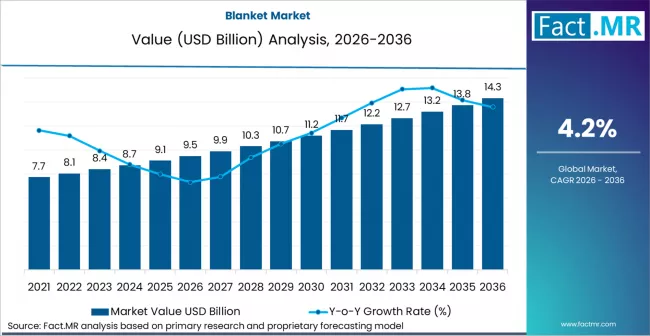
Blanket Market Market Value Analysis | Source: Fact.MR
Blanket Market Definition
The blanket market covers textile products designed to provide thermal comfort and insulation for personal and household use. Blankets are manufactured from natural fibers, synthetic fibers, or blended materials and are used for bedding, travel, healthcare, and emergency relief applications. These products are sold as finished consumer goods through retail, institutional, and contract supply channels. Product safety and material compliance in key markets are governed by textile flammability and consumer product safety regulations issued by the US Consumer Product Safety Commission and public health guidance bodies. [1]
Blanket Market Inclusions
The report covers global and regional market size estimates in volume and value terms with a forecast period from 2026 to 2036. Segmentation includes material type such as wool, cotton, polyester, and blended fabrics, product category including household and institutional blankets, and end use across residential, hospitality, healthcare, and relief supply sectors. The scope also includes regional demand patterns, pricing benchmarks, and international trade flows for finished textile goods.
Blanket Market Exclusions
The scope excludes electric blankets and heated bedding products that fall under separate electrical safety regulations. Quilts, comforters, duvets, and mattress pads are not included. Raw textile fibers, yarns, unfinished fabrics, and intermediate textile materials are excluded. Custom made artisanal blankets produced at non-commercial scale, prototype textile products, and laboratory testing materials are also outside the scope, along with retail services and logistics operations.
Blanket Market Research Methodology
- Primary Research: Primary research involved interviews with blanket manufacturers, textile mills, retail buyers, institutional procurement managers, and distributors supplying household and contract textile products.
- Desk Research: Desk research used consumer product safety regulations from the US Consumer Product Safety Commission, public health and usage guidance from the Centers for Disease Control and Prevention, national textile production statistics, customs trade data, and company annual reports and regulatory filings.
- Market Sizing and Forecasting: Market sizing applied a hybrid top down and bottom up model using household consumption data, institutional procurement volumes, and textile production output reported by national statistical offices.
- Data Validation and Update Cycle: Outputs were cross checked against trade statistics, production disclosures, consumer safety documentation, and public expenditure records, with updates applied when verified public data sources release revisions.
Summary of Blanket Market
- Market definition
- The blanket market covers finished textile products used for thermal comfort in residential, hospitality, healthcare, and institutional settings, manufactured from wool, cotton, polyester, or blended fibers and sold through organized retail and online channels.
- Market size and outlook
- Based on FACT.MR’s report, the market reached USD 9.1 billion in 2025 and is estimated at USD 9.5 billion in 2026, expanding to USD 14.3 billion by 2036 at a 4.2% CAGR.
- As per FACT.MR, growth reflects steady household replacement demand, expanding ecommerce penetration, and selective premiumization rather than volume-led expansion.
- Demand drivers
- FACT.MR analysts note that seasonal replacement cycles and household formation patterns anchor baseline demand, while colder climates support higher per-capita consumption.
- Consumer product safety and textile compliance requirements governed by shape material selection and product design.
- Based on FACT.MR’s report, organized retail and online channels improve availability and pricing transparency, supporting stable year-round sales.
- Key segment insights
- FACT.MR is of the opinion that wool blankets hold the leading material share due to durability and thermal regulation, resulting in longer replacement cycles.
- Electric blankets account for a smaller but higher-value segment, driven by localized heating use and safety oversight aligned with guidance on household product use.
- Regional patterns
- As per FACT.MR, China leads growth through rising household incomes and large-scale domestic manufacturing, while the United States shows strong uptake of premium and electric variants.
- FACT.MR analysts highlight that Europe and Japan remain replacement-led markets with preference for quality and lightweight materials.
- Analyst opinion
- Shambhu Nath Jha, Principal Consultant at Fact.MR, states that CXOs will find this report useful for understanding how household consumption cycles, material durability, and retail channel mix govern stable value growth in the blanket market.
- Strategic implications
- Based on Fact.MR’s report, suppliers benefit from balancing mass-market polyester offerings with durable wool and branded products.
- Fact.MR opines that pricing discipline and retail reach matter more than short-term fashion shifts in sustaining margins.
Segmental Analysis
Blanket Market Analysis by Product Type
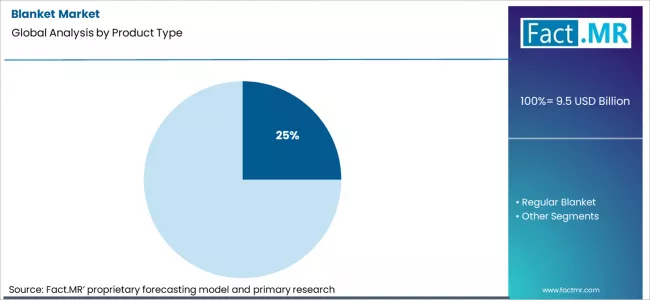
Blanket Market Analysis By Product Type | Source: Fact.MR
Based on Fact.MR analysis, consumption of electric blankets is estimated to hold 25% share of the global blanket market. Fact.MR analysts note that electric blankets are used for localized heating, allowing households to reduce dependence on room heating during colder months. As per Fact.MR, this product type addresses consumer needs for adjustable warmth, overnight comfort, and household energy cost control, particularly in regions experiencing winter temperature variation and rising residential heating expenses, where seasonal demand cycles influence purchasing behavior across colder climate households during peak winter periods globally.
- Product safety oversight: Electric blanket usage is governed by consumer product safety rules for household heating appliances.[2]
- Seasonal demand: Sales volumes for electric blankets rise sharply during winter months, aligning with short-term heating needs rather than year-round bedding replacement cycles.
- Energy substitution: Consumers often use electric blankets as a supplement to space heating, lowering room-level energy consumption during nighttime use.
Blanket Market Analysis by Material Type
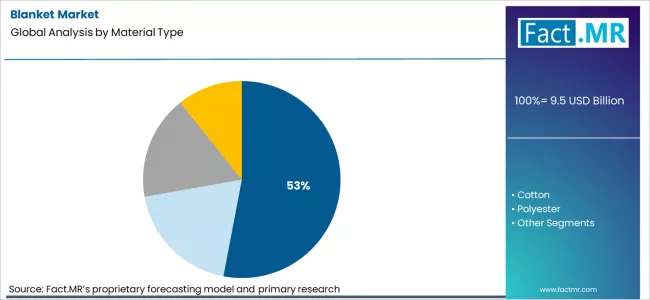
Blanket Market Analysis By Material Type | Source: Fact.MR
Based on Fact.MR analysis, consumption of wool blankets is estimated to hold 53% share of the global blanket market. Fact.MR opines that wool blankets are preferred due to their natural thermal insulation, moisture regulation, and durability across repeated use cycles. As per Fact.MR, this material type addresses consumer expectations for warmth retention and breathability in residential and hospitality settings, particularly in cooler regions with sustained seasonal demand, supported by long-established usage patterns and cold climate household consumption trends observed during winter months across multiple geographies worldwide.
- Material disclosure rules: Wool content and labeling in textile products are regulated under federal textile identification requirements.[3]
- Climate alignment: Wool blankets are commonly purchased in regions with prolonged cold seasons, where insulation performance outweighs lightweight material preference.
- Replacement cycle: Wool blankets exhibit longer replacement intervals due to fiber resilience and resistance to deformation during extended use.
Blankets Market Drivers, Restraints, And Opportunities
Fact.MR analysis indicates that the thermal blankets market exists as a functional insulation and protection segment across industrial, construction, logistics, and emergency response applications. As per Fact.MR assessment, thermal blankets are used to reduce heat loss, protect temperature-sensitive assets, and improve worker safety in environments exposed to extreme temperatures. Industrial and infrastructure usage is supported by energy efficiency and heat retention practices referenced in guidance from the U.S.
Department of Energy (DOE) on thermal insulation and heat management in industrial systems [4]. Fact.MR analysts observe that the current market scale is linked to steady demand from manufacturing facilities, power generation sites, and construction projects where temperature control and energy conservation are embedded into operating standards.
Fact.MR is of the opinion that the market is undergoing a transition between conventional fabric-based thermal blankets and higher-performance insulation blankets designed for specific temperature ranges and operational environments. Based on Fact.MR assessment, basic thermal blankets continue to account for large volume demand due to lower cost and broad usability, but growth is occurring in specialised variants that offer higher thermal resistance, flame retardancy, or durability under repeated exposure.
These advanced thermal blankets typically carry higher per-unit pricing because of material composition and compliance testing, which supports value growth even where shipment volumes increase at a measured pace. Fact.MR analysis suggests this balance between moderate volume expansion and improved unit economics defines near-term market movement.
- Energy efficiency practices: Fact.MR analysts note that industrial energy conservation guidance issued by the U.S. Department of Energy (DOE) supports adoption of thermal insulation solutions, including blankets, to reduce heat loss and improve process efficiency.
- Workplace safety requirements: Based on Fact.MR assessment, occupational safety frameworks from the U.S. Occupational Safety and Health Administration (OSHA) influence demand for thermal blankets used to protect workers and equipment in high-temperature or cold-exposure environments.[5]
- Asia Pacific industrial activity growth: Fact.MR opines that expanding manufacturing, infrastructure development, and cold-chain logistics activity in China, India, and Southeast Asia supports regional demand for thermal blankets used in industrial and construction settings.
Regional Analysis
Based on regional assessment, the blanket sector is analyzed across North America, Europe, East Asia, Oceania, and other key consumer markets, spanning more than 40 countries. Regional performance varies according to household consumption patterns, climate conditions, penetration of premium home textiles, and growth of organized retail and e-commerce channels. The analysis also presents a comparative market attractiveness evaluation grounded in region-specific demand trends.
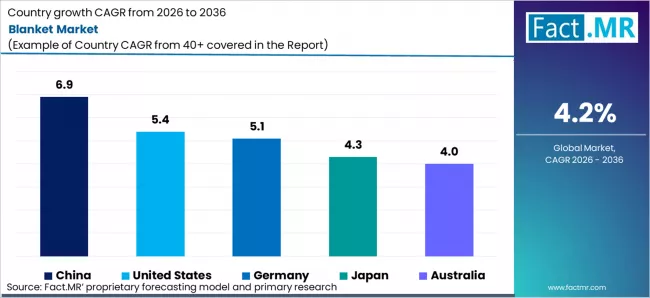
Blanket Market Cagr Analysis By Country | Source: Fact.MR
| Country | CAGR |
|---|---|
| China | 6.9% |
| United States | 5.4% |
| Germany | 5.1% |
| Japan | 4.3% |
| Australia | 4.0% |
Source: Fact.MR analysis. Updated Feb 20, 2026
Source: Fact.MR analysis, based on proprietary forecasting models and primary research.
Asia Pacific Blanket Market Analysis
Asia Pacific operates as a production and consumption driven blanket region supported by large populations varied climates and extensive textile manufacturing capacity. Demand reflects household purchasing cycles seasonal weather variation urban housing growth and strong penetration of organized retail and ecommerce channels. Regional supply is anchored by domestic manufacturers and export oriented factories serving both local markets and international buyers. Consumption spans mass market and mid-range segments across residential hospitality and institutional end use categories throughout the wider region.
- China: Demand for blankets in China is projected to rise at 6.9% CAGR through 2036. Consumption is supported by large scale domestic textile manufacturing, urban household demand, and organized retail distribution across home textile categories, as per Fact.MR.
- Japan: Demand for blankets in Japan is projected to rise at 4.3% CAGR through 2036. Usage is linked to household replacement cycles, seasonal demand patterns, and established retail channels supplying bedding and home textile products, according to Fact.MR.
Fact.MR’s analysis of the Blanket Market in Asia Pacific consists of country-wise assessment that includes China and Japan. Readers can find consumption trends, retail structure insights, and production-linked demand references.
North America Blanket Market Analysis
North America functions as a consumption led blanket region shaped by established housing stock seasonal climate patterns and high replacement purchasing frequency. Demand is driven by residential use hospitality applications gifting occasions and strong participation of organized retail and ecommerce platforms. Distribution is dominated by branded manufacturers private labels and importers supplying mass merchant’s specialty stores and online channels. Product differentiation focuses on material comfort thermal performance and pricing across household and commercial segments within mature consumer markets regionwide ecosystems.
- United States: Demand for blankets in the United States is projected to rise at 5.4% CAGR through 2036. Consumption is supported by residential housing demand, seasonal purchasing behavior, and strong penetration of organized retail and ecommerce channels, as per Fact.MR.
Fact.MR’s analysis of the Blanket Market in North America consists of country-wise assessment that includes the United States. Readers can find retail distribution insights and household consumption references.
Europe Blanket Market Analysis
Europe operates as a mature consumption oriented blanket region influenced by cooler climates established housing patterns and steady replacement demand. Consumption is centered on residential household’s hospitality properties and institutional facilities supported by dense retail networks. Demand is supplied through a mix of domestic producer’s regional trade and imports. Purchasing decisions emphasize material quality durability pricing and compliance with regional product standards across premium and mid-priced blanket categories serving diverse consumer preferences across Western and Northern European markets today.
- Germany: Demand for blankets in Germany is projected to rise at 5.1% CAGR through 2036. Consumption is driven by residential demand, organized retail penetration, and steady replacement purchasing within the home textiles segment, according to Fact.MR.
Fact.MR’s analysis of the Blanket Market in Europe consists of country-wise assessment that includes Germany. Readers can find household consumption patterns and retail structure references.
Oceania Blanket Market Analysis
Oceania functions as a stable consumption driven blanket region supported by residential housing demand seasonal temperature variation and hospitality sector requirements. Demand is primarily domestic with reliance on imports alongside limited regional manufacturing. Distribution is concentrated within organized retail chains specialty home furnishing stores and ecommerce platforms. Purchasing patterns reflect replacement cycles climate needs and product affordability across household accommodation and tourism related end use segments throughout Australia and New Zealand consumer markets and island economies broadly today regionwide overall.
- Australia: Demand for blankets in Australia is projected to rise at 4.0% CAGR through 2036. Consumption is supported by residential housing demand, seasonal purchasing behavior, and established home textile retail networks, as per Fact.MR.
Fact.MR’s analysis of the Blanket Market in Oceania consists of country-wise assessment that includes Australia. Readers can find retail distribution insights and household demand references.
Competitive Landscape of Blanket Market
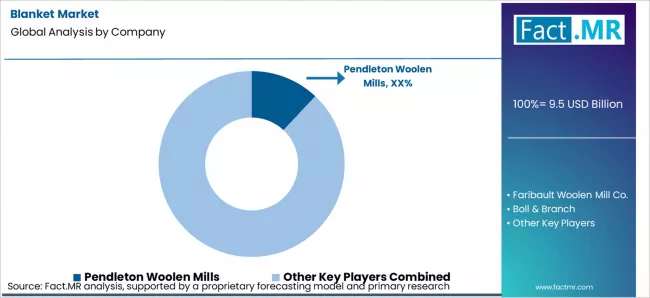
Blanket Market Analysis By Company | Source: Fact.MR
As per Fact.MR analysis, the global blanket market in 2026 is shaped by validated material performance, production scalability, and expanding consumer comfort preferences, which determine competitive advantage. Leading heritage players such as Pendleton Woolen Mills and Faribault Woolen Mill Co. are known for quality wool and cotton blankets that sustain demand in premium segments. Boll & Branch and Barefoot Dreams focus on organic, eco‑friendly materials with documented certifications, which strengthens brand trust among sustainability‑oriented consumers. Hudson’s Bay Company and American Textile Company leverage broad retail networks and high production capacity, which expands mass‑market reach and improves year‑round availability. Shanghai Easun Group and other large textile exporters in Asia benefit from integrated supply chains and cost‑efficient manufacturing, which supports competitive pricing and inventory continuity. Smaller specialist brands like Urbanara and Kanata Blanket Company emphasise design differentiation and heritage craftsmanship, which deepens niche segment penetration. Consumer demand for temperature‑regulating fabrics and sustainable materials drives product diversification, improving repeat purchase and reducing reliance on price competition. Market size continues to grow at mid‑single‑digit rates, reflecting rising home comfort and lifestyle spending.
Recent Industry Developments
- Jartoo: Aerospace Carbon Nanotube Launch
- In late 2024 and throughout 2025, Jartoo introduced the Apalos™ FlexHT, a revolutionary blanket utilizing carbon nanotube (CNT) film. This aerospace-grade technology replaces traditional wires with an ultra-thin film, providing instant, uniform warmth and a safe 24V low-voltage system. [6]
- Beurer GmbH: "Green Planet" Sustainable Series
- At IFA 2025, Beurer debuted the "Green Planet" range, signaling a shift toward sustainable lifestyle tech. These smart heating products utilize recycled materials for housings and renewable raw materials for fabrics, while featuring energy-saving sensors that automatically adjust heat levels for maximum efficiency. [7]
Key Players in Blanket Market
- Pendleton Woolen Mills
- Faribault Woolen Mill Co.
- Boll & Branch
- Barefoot Dreams
- Hudson’s Bay Company
- American Textile Company
- Shanghai Easun Group
- Urbanara
- Kanata Blanket Company
Bibliography
[1] U.S. Consumer Product Safety Commission. (2024). Regulations, laws, and standards for consumer textile products. U.S. Consumer Product Safety Commission; Centers for Disease Control and Prevention. (2024). Public health guidance related to household textile and bedding products. U.S. Department of Health & Human Services.
[2] U.S. Consumer Product Safety Commission. (2023). Electric blanket safety: Consumer guidance and risk prevention. U.S. Consumer Product Safety Commission.
[3] Federal Trade Commission. (2023). Textile Fiber Products Identification Act: Labeling and disclosure requirements. Federal Trade Commission.
[4] U.S. Department of Energy. (2024). Industrial efficiency and thermal insulation practices. Office of Energy Efficiency & Renewable Energy, U.S. Department of Energy.
[5] Occupational Safety and Health Administration. (2023). Occupational safety and health regulations applicable to thermal protection and insulation materials. U.S. Department of Labor.
[6] Jartoo. (2024). Apalos™ FlexHT carbon nanotube blanket technology: Product innovation overview. Jartoo Official Innovation & Technology Publications.
[7] Beurer GmbH. (2025). Beurer introduces the “Green Planet” sustainable heating and textile product range at IFA 2025. Beurer Group-Corporate Communications.
Segmentation
Scope of the Report
| Metric | Value |
|---|---|
| Quantitative Units | USD 9.5 billion (2026) to USD 14.3 billion (2036), at a CAGR of 4.2% |
| Market Definition | The blanket market covers textile products designed to provide thermal comfort and insulation for personal and household use. Blankets are manufactured from natural, synthetic, or blended fibers and are used across residential, hospitality, healthcare, and emergency relief applications. Product safety and material compliance are governed by US CPSC and CDC guidance. |
| Product Type Segmentation | Electric Blanket, Regular Blanket |
| Material Type Segmentation | Wool, Cotton, Polyester, Others |
| End User Segmentation | Commercial, Residential |
| Sales Channel Segmentation | Hypermarkets/Supermarkets, Specialty Stores, Multi Brand Stores, Independent Retailers, Online Retailers, Others |
| Regions Covered | Asia Pacific, Europe, North America, Latin America, Middle East & Africa, Oceania |
| Countries Covered | China, India, Japan, South Korea, Indonesia, Australia & New Zealand, ASEAN, Rest of Asia Pacific, Germany, Italy, France, United Kingdom, Spain, Benelux, Nordics, Central & Eastern Europe, Rest of Europe, United States, Canada, Mexico, Brazil, Argentina, Chile, Rest of Latin America, Kingdom of Saudi Arabia, United Arab Emirates, South Africa, Turkey, Rest of Middle East & Africa |
| Key Companies Profiled | Pendleton Woolen Mills, Faribault Woolen Mill Co., Boll & Branch, Barefoot Dreams, Hudson’s Bay Company, American Textile Company, Shanghai Easun Group, Urbanara, Kanata Blanket Company |
| Forecast Period | 2026 to 2036 |
| Approach | Hybrid top-down and bottom-up modeling validated through primary interviews with blanket manufacturers, textile mills, retail buyers, institutional procurement managers, and distributors. Market sizing supported by household consumption data, retail channel trends, seasonal replacement patterns, and production statistics. |
Source: Fact.MR analysis. Updated Feb 20, 2026
Blanket Market Analysis by Segments
-
By Product Type :
- Electric Blanket
- Regular Blanket
-
By Material Type :
- Wool
- Cotton
- Polyester
- Others
-
By End User :
- Commercial
- Residential
-
By Sales Channel :
- Hypermarkets/Supermarkets
- Specialty Stores
- Multi Brand Stores
- Independent Stores Retailers
- Online Retailers
- Others Sales Channel
-
Region :
- Asia Pacific
- India
- China
- Japan
- South Korea
- Indonesia
- Australia & New Zealand
- ASEAN
- Rest of Asia Pacific
- Europe
- Germany
- Italy
- France
- United Kingdom
- Spain
- Benelux
- Nordics
- Central & Eastern Europe
- Rest of Europe
- North America
- United States
- Canada
- Mexico
- Latin America
- Brazil
- Argentina
- Chile
- Rest of Latin America
- Middle East & Africa
- Kingdom of Saudi Arabia
- United Arab Emirates
- South Africa
- Turkey
- Rest of Middle East & Africa
- Asia Pacific
Frequently Asked Questions
How large is the blanket market in 2026?
What will the market size be by 2036?
What CAGR is expected for the blanket market during 2026–2036?
What was the market value in 2025?
How much absolute value will the market add over the forecast horizon?
What structural factors mainly govern demand in this market?
What is the key theme behind market progression in this forecast?
Which country is expected to grow the fastest through 2036?
What is the growth outlook for the United States?
How fast is Germany expected to grow?
What is Japan’s projected growth rate?
What is Australia’s projected growth rate?
Which phase drives early-period growth in the forecast window?
What shapes mid-period performance for the blanket market?
What supports later-period value growth?
What share do electric blankets hold in the global blanket market?
What makes electric blankets a distinct value driver?
What share do wool blankets hold by material type?
Why do wool blankets lead the material mix?
What is the main strategic lever for suppliers to sustain margins in this market?
Who worked on this report


Preview the report firsthand - request a free sample
Free SampleGet the brochure for pricing and purchase details
Download PDF