- Base Value(2025): 2.1 Bn
- Estimated Value(2026): 2.2 Bn
- Forecast Value (2036): 3.4 Bn
- CAGR (2026 - 2036): 4.5%
Body Armor Plates Market Forecast 2026 to 2036
In 2025, the body armor plates market was valued at USD 2.1 billion. Based on Fact MR analysis, demand for body armor plates is estimated to grow to USD 2.2 billion in 2026 and USD 3.4 billion by 2036. FMR projects a CAGR of 4.5% during the forecast period.
The absolute dollar growth from 2026 to 2036 is USD 1.2 billion. This growth is driven by increasing demand for personal protective equipment (PPE) across military, law enforcement, and civilian sectors. As security concerns grow and the need for defense technologies intensifies, body armor plates are becoming critical for safeguarding personnel in high-risk environments. However, challenges such as high costs, technological advancements in armor materials, and regulatory approvals could affect the pace of adoption in certain regions.
As Dan Erdberg, Chief Executive Officer of Safe Pro Group Inc., noted regarding innovation in ballistic protection and body armor plates, ‘We are excited to unveil our next-gen ballistic protective solutions at the SHOT Show, one of the industry’s most widely attended events where we have a great opportunity to engage with existing and prospective government customers who can access our GSA contract vehicle.’
India leads with a CAGR of 9.2%, driven by increasing defense investments and growing awareness about personal safety. China follows with 8.7%, supported by its rapidly expanding military and law enforcement sectors. Germany grows at 7.5%, benefiting from a strong demand for advanced protective equipment in Europe. The USA grows at 6.8%, driven by steady demand from military and law enforcement agencies. France shows growth at 7.1%, with increasing investment in protective technologies and defense systems.
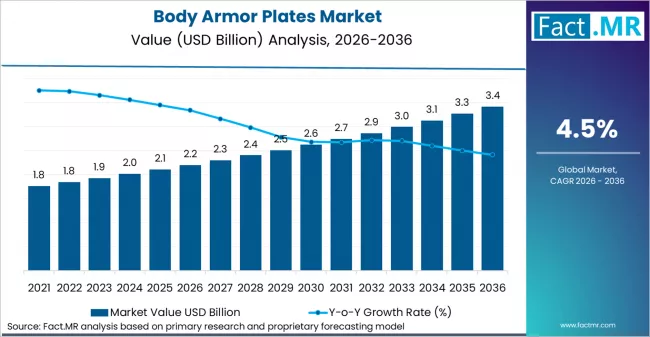
Body Armor Plates Market Market Value Analysis | Source: Fact.MR
Body Armor Plates Market
| Metric | Value |
|---|---|
| Estimated Value in (2026E) | USD 2.2 billion |
| Forecast Value in (2036F) | USD 3.4 billion |
| Forecast CAGR (2026 to 2036) | 4.5% |
Source: Fact.MR analysis. Updated Mar 4, 2026
Body Armor Plates Market Definition
The Body Armor Plates Market involves the production and sale of protective ballistic plates used in personal armor systems to shield wearers from bullets, fragmentation, and other high‑impact threats.
Market Inclusions
This report covers global and regional market sizes for body armor plates over a defined forecast period, including plate types (ceramic, polyethylene, steel), protection levels (NIJ standards), end‑use segments (military, law enforcement, civilian), and sales channels.
Market Exclusions
The scope excludes complete armor vests without separate plate data, soft armor not classified as rigid plates, and unrelated personal protective equipment such as helmets or shields.
Research Methodology
- Primary Research: Interviews were conducted with armor manufacturers, defense procurement specialists, and law enforcement buyers.
- Desk Research: Data was sourced from defense and security reports, industry publications, and trade association data.
- Market‑Sizing and Forecasting: A hybrid model combining top‑down protection equipment demand forecasts with bottom‑up shipment and revenue data was used.
- Data Validation and Update Cycle: Findings were validated through expert review and aligned with recent production, adoption, and trade figures.
Summary of the Body Armor Plates Market
- Market Definition
- The Body Armor Plates Market involves the production and sale of protective ballistic plates used in personal armor systems to shield wearers from bullets, fragmentation, and other high-impact threats. These plates are primarily used in military, law enforcement, and civilian applications to provide enhanced protection in high-risk environments.
- Demand Drivers
- Rising Security Concerns: Growing geopolitical tensions and increasing security threats globally are driving the demand for high-performance protective gear, particularly in military and law enforcement sectors.
- Technological Advancements in Armor Materials: Innovations in lightweight, durable materials like UHMWPE (Ultra-High Molecular Weight Polyethylene) and composite ceramics are enhancing the performance of body armor plates, making them more effective and comfortable for use.
- Expanding Military and Law Enforcement Budgets: As defense spending increases and law enforcement agencies enhance their protective measures, the demand for advanced body armor plates, especially Level IV plates, continues to grow.
- Key Segments Analyzed
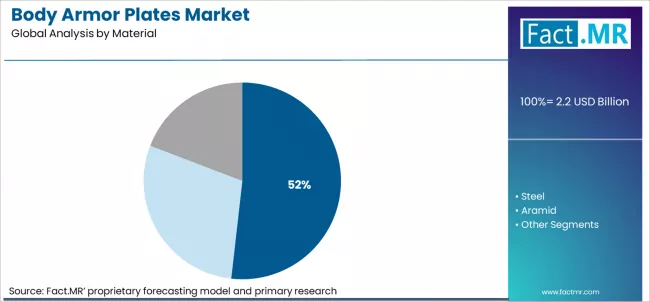
- Material: Ultra-High Molecular Weight Polyethylene (UHMWPE) is projected to dominate the material segment, accounting for 51.8% of the market share by 2026. Its lightweight and high-strength properties make it ideal for body armor.
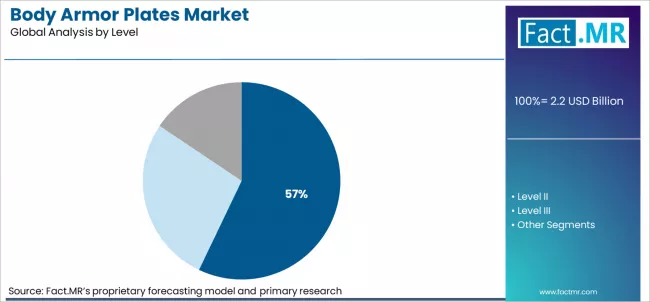
- Level: Level IV body armor plates, providing the highest protection against armor-piercing ammunition, are expected to capture 57.1% of the market share in 2026. These plates are crucial for military and law enforcement personnel operating in high-risk zones.
- Geography: The market is expected to see significant growth in India, with a leading CAGR of 9.2%, supported by increasing defense investments and security concerns. China and Germany are also major contributors, with steady growth driven by military modernization and law enforcement demand.
- Analyst Opinion at Fact MR
- Shambhu Nath Jha, Principal Consultant at Fact MR, emphasized the importance of innovation in the body armor plates market, stating, "With global security concerns on the rise, body armor plates, particularly Level IV, will remain an essential component in the protection of military, law enforcement, and high-risk personnel."
- Strategic Implications/Executive Takeaways
- Increasing Need for Advanced Protection: Companies should prioritize the development of advanced, lightweight body armor materials to meet rising demand for high-protection gear in military and law enforcement sectors.
- Investing in Technological Innovations: Innovations in material science, especially hybrid composites and ceramics, should be a focus for companies seeking to enhance product performance and differentiate themselves in the market.
- Regional Expansion: Targeting emerging markets like India, where defense spending and security concerns are growing, offers significant opportunities for expanding market share.
- Methodology
- Primary Research: Interviews with armor manufacturers, defense procurement specialists, and law enforcement buyers.
- Desk Research: Data from defense and security reports, industry publications, and trade associations.
- Market Sizing & Forecasting: A hybrid model combining top-down protection equipment demand forecasts with bottom-up shipment and revenue data was used to estimate market growth.
Segmental Analysis
Body Armor Plates Market Analysis by Material
Body Armor Plates Market Analysis By Material | Source: Fact.MR
- Market Overview: Ultra-High Molecular Weight Polyethylene (UHMWPE) is expected to capture 51.8% of the body armor plates market by 2026. UHMWPE is widely used in body armor plates due to its high strength, lightweight nature, and durability, making it an ideal material for protective armor in both military and law enforcement applications.
- Demand Drivers:
- Lightweight and High Protection: UHMWPE provides superior protection while being significantly lighter than traditional materials like steel. This is particularly important for enhancing mobility and comfort for wearers, especially in military and tactical operations where weight is a crucial factor.
- Durability and Performance: UHMWPE’s resistance to abrasion, impact, and fatigue makes it a long-lasting material for body armor plates. This durability ensures that the plates provide consistent protection over extended periods, even in challenging environments.
- Cost-Effectiveness Compared to Alternatives: Although UHMWPE may come at a higher initial cost compared to materials like steel, its lightweight and durable properties offer long-term cost savings in terms of comfort, wearability, and protection, driving its growing use in the body armor industry.
Body Armor Plates Market Analysis by Level
Body Armor Plates Market Analysis By Level | Source: Fact.MR
- Market Overview: Level IV is projected to account for 57.1% of the market share by 2026. Level IV body armor plates provide the highest level of protection against armor-piercing rounds, making them the preferred choice for military, law enforcement, and high-risk security personnel.
- Demand Drivers:
- Protection Against High-Caliber Threats: Level IV plates are designed to stop high-caliber, armor-piercing ammunition, providing enhanced protection for personnel in combat situations. The increasing threats from advanced weaponry and rising security concerns globally contribute to the demand for Level IV protection.
- Adoption in Military and Law Enforcement: Military personnel, tactical units, and law enforcement officers in high-risk zones require the maximum protection available. As threats continue to evolve, the demand for Level IV body armor, particularly in areas with heightened risk, remains strong.
- Technological Advancements in Armor Materials: The development of advanced composite materials and ceramics used in Level IV armor plates is increasing their effectiveness and performance, which is driving their adoption in both military and civilian applications.
Body Armor Plates Market Drivers, Restraints, and Opportunities
FMR analysts observe that the body armor plates market is a growth‑aligned, threat‑response segment driven by rising security concerns across military, law enforcement, and civilian sectors. Historically, soft armor and basic protective gear met limited ballistic threats; as threat profiles expand and regulatory safety standards evolve, structural demand has emerged for rigid armor plates that offer higher ballistic resistance and multi‑hit performance. The 2026 valuation reflects this reality, with adoption tied to defense procurement cycles, public safety spending, and protective equipment standards rather than discretionary use.
While basic protection solutions remain in cost‑sensitive applications, advanced armor plates (ceramic, UHMWPE, hybrid composites) are gaining share because they deliver enhanced performance against higher‑velocity projectiles and multi‑threat scenarios. These higher‑value products carry elevated per‑unit pricing, contributing to net market growth even as unit volumes align with procurement and replacement cycles. The market exists at its current size because evolving threat environments and performance standards continue to require certified, high‑performance armor solutions in operational use.
- Threat‑Driven Demand: Rising global security concerns and expanded operational theaters drive uptake of high‑ballistic‑rated plates over basic soft protections.
- Regulatory & Safety Standards: Ballistic resistance standards (e.g., NIJ Level criteria) push adoption of certified plate systems that meet defined protection thresholds.
- Regional Security Dynamics: In North America and Europe, strong defense and law enforcement procurement sustain higher demand for advanced armor plates compared with regions with lower defense spending.
Regional Analysis
The market analysis covers key global regions, including South Asia, East Asia, Western Europe, and North America. It is segmented geographically, with specific market dynamics for each region. The full report provides a detailed market attractiveness analysis.
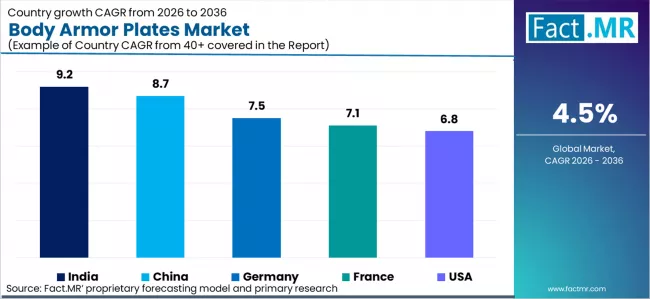
Body Armor Plates Market Cagr Analysis By Country | Source: Fact.MR
| Country | CAGR (2026-2036) |
|---|---|
| India | 9.2% |
| China | 8.7% |
| Germany | 7.5% |
| USA | 6.8% |
| France | 7.1% |
Source: Fact.MR analysis. Updated Mar 4, 2026
Source: Fact MR (FMR) analysis, based on proprietary forecasting model and primary research.
South Asia:
In South Asia, India leads the demand for body armor plates, driven by increasing defense investments, growing security concerns, and rising adoption of advanced personal protective equipment.
- India: Demand for body armor plates in India is projected to rise at 9.2% CAGR through 2036. India’s expanding defense budget, growing demand for personal protection gear, and rising geopolitical concerns contribute to strong market growth.
East Asia:
In East Asia, China is a significant market for body armor plates, supported by the country’s increasing defense spending, large military, and focus on advanced defense technologies.
- China: Demand for body armor plates in China is projected to rise at 8.7% CAGR through 2036. China’s growing defense expenditure, emphasis on modernizing military equipment, and rising demand for protective gear in law enforcement and defense continue to fuel market growth.
Western Europe:
In Western Europe, Germany and France are key markets for body armor plates, driven by increasing defense budgets, rising security threats, and growing investments in military and law enforcement sectors.
- Germany: Demand for body armor plates in Germany is projected to rise at 7.5% CAGR through 2036. Germany’s strong defense sector, growing demand for protective gear in law enforcement, and expansion of military forces continue to support market growth.
- France: Demand for body armor plates in France is projected to rise at 7.1% CAGR through 2036. France’s increasing focus on national security and growing investments in defense technologies contribute to steady demand for body armor plates.
North America:
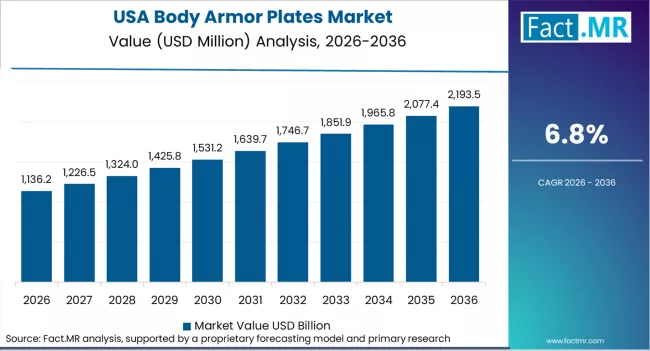
Body Armor Plates Market Country Value Analysis | Source: Fact.MR
In North America, the USA remains a major market for body armor plates, driven by a large military budget, high demand for personal protective equipment, and rising security concerns.
- USA: Demand for body armor plates in the U.S. is projected to rise at 6.8% CAGR through 2036. The USA’s extensive defense budget, demand for military-grade personal protection gear, and growing security threats continue to drive the market for body armor plates.
Fact MR's analysis of the Body Armor Plates Market in South Asia, East Asia, Western Europe, and North America consists of country-wise assessments that include India, China, Germany, France, and the USA. Readers can find detailed trends, regulatory updates, and company-specific investments shaping the market’s growth in these countries.
Competitive Landscape
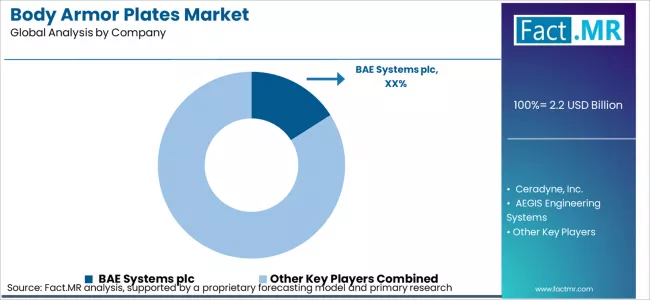
Body Armor Plates Market Analysis By Company | Source: Fact.MR
The Body Armor Plates Market is driven by key players such as BAE Systems plc, Ceradyne, Inc., and Armored Republic, LLC, which lead the development of advanced protective gear for military and law enforcement applications. Companies like Point Blank Enterprises, Inc. and Safariland, LLC offer a wide range of armor products tailored for personal protection. MKU Limited and Plasan Sasa Ltd. are notable suppliers of high-performance body armor in defense markets. Honeywell International Inc. and DuPont de Nemours, Inc. contribute significantly with the development of specialized materials such as Kevlar and Twaron. Smaller but important players like Bluewater Defense Inc., Survival Armor, Inc., and Sarkar Defense Solutions support the market with region-specific offerings. The market continues to expand with innovations in lightweight materials and enhanced ballistic resistance, ensuring protection across military, law enforcement, and civilian sectors.
Recent Industry Developments
- Shift to NIJ 0101.07 Compliance: As of early 2026, major manufacturers are racing to certify their portfolios under the NIJ 0101.07 standard. This new framework eliminates "Level IIIA" for hard plates, replacing it with a more rigorous testing protocol that better reflects modern high-velocity rifle threats.
- Rheinmetall Modular Armor System Launch: At the Enforce Tac 2026 trade fair in February, Rheinmetall unveiled a new modular military body armor system. The system features a unique "interchangeable" core where soft ballistic panels (VPAM BSW Level 3) can be instantly upgraded with hard inserts up to VPAM BSW Level 9, providing protection against armor-piercing rounds and explosives.
- Slate Solutions "DTX" and "PCX" Lightweight Platforms: During SHOT Show 2026, Slate Solutions provided exclusive "sneak peeks" at their upcoming DTX and PCX platforms. These systems represent the 2026 trend of "scalable minimalism," focusing on ultra-lightweight carriers that reduce the physical burden on law enforcement during extended patrols without sacrificing plate coverage.
Key Players of the Body Armor Plates Market
- BAE Systems plc
- Ceradyne, Inc.
- AEGIS Engineering Systems
- Armored Republic, LLC
- Ballistic Body Armour Pty. Ltd.
- Bluewater Defense Inc.
- Craig International Ballistics Pty. Ltd.
- Point Blank Enterprises, Inc.
- Safariland, LLC
- Armor Express, Inc.
- Survival Armor, Inc.
- TenCate Advanced Armor
- MKU Limited
- Plasan Sasa Ltd.
- Honeywell International Inc.
- DuPont de Nemours, Inc.
- Galls, LLC
- U.S. Armor Corporation
- Pacific Safety Products, Inc.
- Sarkar Defense Solutions
Report Scope
| Metric | Value |
|---|---|
| Quantitative Units | USD 2.2 billion (2026) to USD 3.4 billion (2036), at a CAGR of 4.5% |
| Market Definition | The Body Armor Plates Market includes the development, manufacturing, and use of armor plates designed for personal protection in defense and law enforcement applications. |
| By Material | Ultra-High Molecular Weight Polyethylene (UHMWPE), Steel, Aramid, Composite Ceramic, Others (Titanium, Composite Materials) |
| By Level | Level II, Level III, Level IV |
| By Application | Defense, Law Enforcement Protection |
| Regions Covered | North America, Latin America, Europe, East Asia, South Asia, Oceania, Middle East and Africa |
| Countries Covered | United States, Canada, Mexico, Brazil, Argentina, Germany, France, United Kingdom, Italy, Spain, China, India, Japan, South Korea, Indonesia, Australia, and 40+ countries |
| Key Companies Profiled | BAE Systems plc, Ceradyne, Inc., AEGIS Engineering Systems, Armored Republic, LLC, Ballistic Body Armour Pty. Ltd., Bluewater Defense Inc., Craig International Ballistics Pty. Ltd., Point Blank Enterprises, Inc., Safariland, LLC, Armor Express, Inc., Survival Armor, Inc., TenCate Advanced Armor, MKU Limited, Plasan Sasa Ltd., Honeywell International Inc., DuPont de Nemours, Inc., Galls, LLC, U.S. Armor Corporation, Pacific Safety Products, Inc., Sarkar Defense Solutions |
| Forecast Period | 2026 to 2036 |
| Approach | Hybrid top-down and bottom-up market modeling validated through primary interviews with manufacturers and supported by trade data benchmarking and market research. |
Source: Fact.MR analysis. Updated Mar 4, 2026
Bibliographies
- BAE Systems plc. (2023). Body armor plates and ballistic protection solutions for defense and law enforcement applications. BAE Systems plc.
- Ceradyne, Inc. (2023). Ceramic-based body armor plate technologies and protective solutions. Ceradyne, Inc.
- MKU Limited. (2023). Advanced body armor solutions for military and security forces. MKU Limited.
- Plasan Sasa Ltd. (2023). Ballistic protection and body armor plate systems for high-risk operational environments. Plasan Sasa Ltd.
- Point Blank Enterprises, Inc. (2023). Body armor plates for military, law enforcement, and tactical applications. Point Blank Enterprises, Inc.
- Police1. (2025/2026, December). Slate Solutions presents “DTX” and “PCX” lightweight armor platforms at SHOT Show 2026 [Industry coverage]. Police1.
- Rheinmetall. (2026, February 23). Rheinmetall unveils modular body armor system at Enforce Tac 2026 [Press release]. Rheinmetall AG.
- Safe-Pro USA. (2026, January). NIJ 0101.07 certification-ready body armor plates showcased at SHOT Show 2026 [Corporate update]. Safe-Pro USA.
This report addresses:
- Market intelligence enabling comprehensive assessment of leading countries and product segments across the Body Armor Plates Market globally.
- Market volume (sales units) estimates and 10-year revenue forecasts from 2026 to 2036, validated through manufacturer shipment data, channel partner surveys, and country-level demand modeling.
- Growth opportunity mapping across material types (UHMWPE, Steel, Aramid, Composite Ceramic, and Others), protection levels (Level II, Level III, Level IV), applications (Defense, Law Enforcement Protection).
- Segment and regional revenue forecasts by material type, protection level, application, and geography across 40+ countries.
- Competition strategy analysis covering dealer network structure, recent developments, product portfolio, USPs, and market share analysis.
- Product and regulatory compliance tracking aligned with ballistic protection standards, defense procurement requirements, and safety certifications.
- Regulatory impact analysis addressing ballistic resistance standards (e.g., NIJ Level criteria), government procurement regulations, and defense and security guidelines across key markets.
- Report delivery in PDF, Excel, PowerPoint, and interactive dashboard formats for executive, procurement, and operational planning use.
Segmentation
Body Armor Plates Market Analysis by Segments
-
Material :
- Ultra-High Molecular Weight Polyethylene (UHMWPE)
- Standalone UHMWPE
- Hybrid UHMWPE-Ceramic
- Steel
- AR500 Steel
- AR550 Steel
- Other Alloys
- Aramid
- Kevlar
- Twaron
- Other Aramid
- Composite Ceramic
- Alumina Ceramic
- Silicon Carbide
- Boron Carbide
- Others (Titanium, Composite Materials)
- Ultra-High Molecular Weight Polyethylene (UHMWPE)
-
Level :
- Level II
- Level IIA
- Level II
- Level III
- Level III
- Level III+
- Level IV
- Level II
-
Application :
- Defense
- Army/Infantry
- Special Operations Forces
- Navy/Marines
- Air Force
- Law Enforcement Protection
- Police Tactical Units
- SWAT Teams
- Federal Law Enforcement
- Private Security
- Defense
-
Region :
- North America
- United States
- Canada
- Mexico
- Latin America
- Brazil
- Argentina
- Chile
- Colombia
- Rest of Latin America
- Europe
- Germany
- France
- United Kingdom
- Italy
- Spain
- Russia
- Nordic
- Benelux
- Rest of Europe
- East Asia
- China
- Japan
- South Korea
- South Asia & Pacific
- India
- Australia
- New Zealand
- Rest of South Asia & Pacific
- Middle East & Africa
- Saudi Arabia
- UAE
- Turkey
- South Africa
- Rest of Middle East & Africa
- North America
Frequently Asked Questions
How large is the demand for Body Armor Plates in the global market in 2026?
What will be the market size of Body Armor Plates in the global market by 2036?
What is the expected demand growth for Body Armor Plates in the global market between 2026 and 2036?
Which level of body armor plates is expected to dominate the market?
Which region is expected to show the highest growth rate for Body Armor Plates?
How significant is the growth outlook for China in this market?
What is the growth outlook for the United States in the Body Armor Plates market?
What is the growth forecast for Germany in the Body Armor Plates market?
What is the growth forecast for France in the Body Armor Plates market?
Which company is identified as a leading player in the Body Armor Plates market?
What are Body Armor Plates used for?
What does the Body Armor Plates market include in this report?
How is the market forecast developed in this report?
What is meant by the Body Armor Plates market in this report?
Who worked on this report


Preview the report firsthand - request a free sample
Free SampleGet the brochure for pricing and purchase details
Download PDF