- Market Value (2025): USD 312.1 Mn
- Estimated Value (2026): USD 328.6 Mn
- Forecast Value (2036): USD 550.7 Mn
- CAGR (2026-2036): 5.3%
What is the Bolt Extractor Set Market forecast to be worth by 2036?
USD 328.6 million in 2026 to USD 550.7 million by 2036 at 5.3% CAGR.
- The bolt extractor set market reached USD 312.1 million in 2025 as service centers and workshops replaced worn damaged-fastener tools.
- Demand is projected to increase from USD 328.6 million in 2026 to USD 550.7 million by 2036.
- The market is forecast to record 5.3% CAGR from 2026 to 2036 owing to automotive repair work and planned extractor-kit replacement.
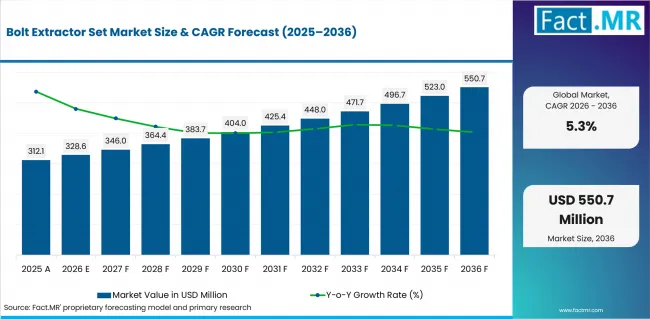
Bolt Extractor Set Market Value Analysis | Source: Fact.MR
What are the defining numbers behind Bolt Extractor Set Market growth?
USD 222.1 million absolute opportunity by 2036.
- Demand Drivers in the Market
- Spiral flute designs are expected to lead replacement purchases because they bite into rounded heads during controlled reverse turning.
- Automotive repair work is projected to support extractor demand when seized fasteners delay engine service and brake repair.
- Industrial maintenance users are anticipated to keep extractor sets near repair benches to reduce delays during machine service.
- Key Segments Analyzed
- By Product Type: Spiral Flute Bolt Extractor Sets are projected to hold 38.6% share in 2026 because reverse-flute gripping fits common damaged-fastener jobs.
- By Application: Automotive Repair is expected to hold 32.1% share in 2026 since service bays face repeated fastener-removal needs.
- By End User: Automotive Service Centers are anticipated to hold 30.9% share in 2026 because organized workshops replace worn kits more regularly.
- By Distribution Channel: Offline Retail is estimated to hold 31.7% share in 2026 as buyers prefer to check kit contents in person.
- By Material: Chrome Molybdenum Steel is forecast to hold 37.9% share in 2026 since impact resistance shapes professional tool selection.
- Analyst Opinion at Fact.MR
- Shambhu Nath Jha, Sr. Consultant at Fact.MR, opines, “Bolt extractor set demand is expected to depend on grip reliability during damaged-fastener removal. Manufacturers need to explain flute geometry and material hardness. Clear drive compatibility and replacement support are expected to make buyer approval easier.”
- Strategic Implications
- Tool manufacturers are expected to position extractor sets as job-specific additions to mechanical hand tools ranges.
- Providers are expected to support service-center demand by placing extractor kits near portable tools used for routine bay work.
- Distributors are expected to separate professional workshop kits from light DIY assortments.
Germany is projected at 6.9% CAGR from 2026 to 2036, supported by professional workshop quality expectations. Brazil is expected to record 6.4% CAGR through distributor reach. Mexico is anticipated to reach 3.7% CAGR through repair-network expansion. The USA is estimated at 5.9% CAGR due to mature service-center replacement. Canada is forecast at 4.2% CAGR through steady professional tool renewal. The UK is projected to post 5.3% CAGR through selective workshop purchases. Japan is expected to record 4.8% CAGR through quality-led replacement behavior.
How does the Bolt Extractor Set Market break down by segment?
Spiral Flute Bolt Extractor Sets are expected to lead Product Type at 38.6% share. Automotive Repair is projected to lead Application at 32.1% share in 2026.
Which product type dominates?
Spiral Flute Bolt Extractor Sets are projected to account for 38.6% share in 2026.
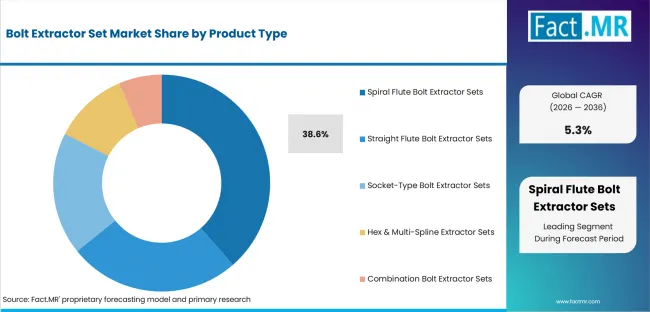
Bolt Extractor Set Market Analysis By Product Type | Source: Fact.MR
Spiral flute kits lead where rounded fasteners still require controlled reverse torque. Their value comes from the way the flute cuts into the damaged head during removal. Left-hand spiral and deep-grip options remain useful when recess depth or fastener condition changes the job.
Why does Automotive Repair lead Application?
Automotive Repair is expected to account for 32.1% share in 2026.
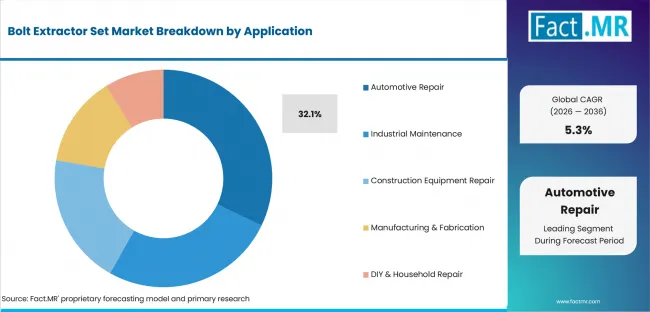
Bolt Extractor Set Market Analysis By Application | Source: Fact.MR
Automotive repair leads because seized bolts appear during engine service and brake repair. Suspension work creates damaged-fastener situations that mechanics cannot ignore. Industrial and construction repair remain secondary uses where tool access and durability shape order timing.
What supports Automotive Service Centers within End User?
Automotive Service Centers are anticipated to hold 30.9% share in 2026.
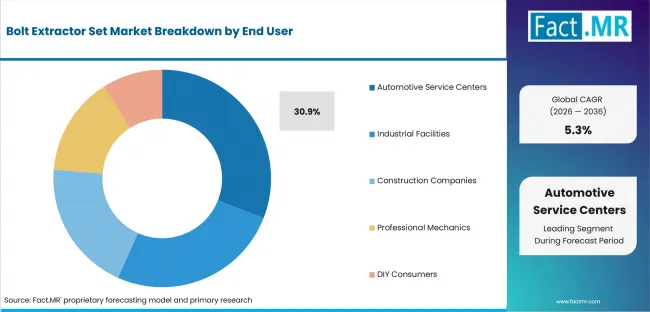
Bolt Extractor Set Market Analysis By End User | Source: Fact.MR
Service centers lead where a damaged fastener can slow bay turnaround. These customers tend to replace worn tools before extractor failure creates more labor time. Independent workshops and industrial facilities remain important where repair users keep kits for repeat jobs.
Why does Offline Retail lead Distribution Channel?
Offline Retail is estimated to hold 31.7% share in 2026.
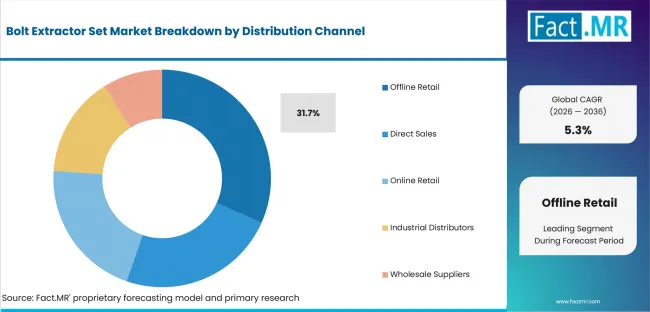
Bolt Extractor Set Market Analysis By Distribution Channel | Source: Fact.MR
Offline retail leads when customers want to compare extractor shape and drive size before purchase. Store staff can guide fitment when buyers are unsure about fastener diameter. Direct sales and online retail remain relevant for planned replacement orders.
What supports Chrome Molybdenum Steel within Material?
Chrome Molybdenum Steel is forecast to hold 37.9% share in 2026.
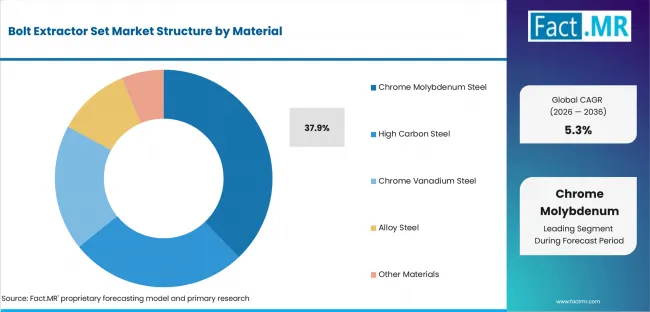
Bolt Extractor Set Market Analysis By Material | Source: Fact.MR
Chrome molybdenum steel leads where extractor sets face high torque during damaged-fastener removal. Buyers value material strength when the tool must bite without snapping. Heat treated alloy and impact grade steel retain demand where price and tool life expectations differ.
What is accelerating Bolt Extractor Set Market adoption, and what is holding it back?
Demand is expected to be driven by workshop replacement cycles and damaged-fastener repair needs. Adoption is expected to be held back by price sensitivity and weak durability proof.
Drivers Impact Analysis
| DRIVER | (~) % IMPACT ON CAGR | GEOGRAPHIC RELEVANCE | IMPACT TIMELINE |
|---|---|---|---|
| Spiral flute extractor replacement | +1.4% | Germany, USA, Canada | Short term (<= 2 years) |
| Automotive repair tool demand | +1.2% | Brazil, Mexico, USA | Short term (<= 2 years) |
| Industrial maintenance readiness | +0.9% | Germany, UK, Japan | Medium term (2-4 years) |
| Offline retail availability | +0.7% | Brazil, Mexico, Canada | Medium term (2-4 years) |
| Material-performance comparison | +0.5% | Germany and Japan | Long term (>= 4 years) |
Source: Fact.MR analysis. Updated Jul 30, 2026
- Spiral flute extractor replacement: Mechanics are expected to replace worn tools when cutting edges lose grip during reverse torque.
- Automotive repair tool demand: Service-center purchases are anticipated to rise when extractor sets reduce engine-service delays.
- Industrial maintenance readiness: Factory users are projected to keep extractor kits near repair benches to reduce equipment service delays.
Opportunity Impact Analysis
| OPPORTUNITY | (~) % IMPACT ON CAGR | GEOGRAPHIC RELEVANCE | IMPACT TIMELINE |
|---|---|---|---|
| Professional master kits | +0.8% | Germany, USA, UK | Medium term (2-4 years) |
| Automotive service-center assortments | +0.7% | Brazil and Mexico | Medium term (2-4 years) |
| Material-labeled replacement packs | +0.5% | Canada and Japan | Medium term (2-4 years) |
| Channel training and fitment guides | +0.4% | Offline retail markets | Long term (>= 4 years) |
Source: Fact.MR analysis. Updated Jul 30, 2026
- Professional master kits: Larger assortments are expected to gain attention where service centers already purchase automotive test equipment and bay tools.
- Automotive service-center assortments: Repair-led channels tied to aftermarket automotive parts can support grouped extractor kits.
- Material-labeled replacement packs: Manufacturers that separate steel grades are expected to make kit comparison easier for professional customers.
Restraints Impact Analysis
| RESTRAINT | (~) % IMPACT ON CAGR | GEOGRAPHIC RELEVANCE | IMPACT TIMELINE |
|---|---|---|---|
| Price sensitivity in small workshops | -0.8% | Brazil, Mexico, Canada | Short term (<= 2 years) |
| Weak durability documentation | -0.6% | Global | Short term (<= 2 years) |
| Wrong-size purchases and returns | -0.4% | Offline retail and online channels | Medium term (2-4 years) |
| Slow replacement outside professional use | -0.3% | DIY-heavy channels | Long term (>= 4 years) |
Source: Fact.MR analysis. Updated Jul 30, 2026
- Price sensitivity in small workshops: Smaller garages are expected to delay premium kits when low-cost extractors appear adequate.
- Weak durability documentation: Customers are expected to question higher prices when hardness and impact-use limits are unclear.
- Wrong-size purchases and returns: Returns are likely to rise when customers cannot match extractor size to fastener diameter.
Which countries are scaling Bolt Extractor Set Market fastest?
- Germany leads the market as workshops prioritize durable tools and reliable fastener removal. Brazil also grows strongly through distributor support and easier access to replacement kits.
- Mexico stays near the global average, backed by repair networks and industrial maintenance. The USA and Canada show steady replacement demand, supported by mature tool ownership and service access.
- The UK remains selective as buyers compare price and durability. Japan records the slowest growth because purchasing decisions focus on quality and long-term tool performance.
- Comparable CAGRs therefore reflect different market-entry conditions across these countries. Demand timing depends on service-center density and distributor coverage. Product quality proof remains the common condition behind faster conversion.
The full report provides country-level CAGR analysis across North America; Latin America; Europe; East Asia; South Asia and Pacific; and the Middle East and Africa.
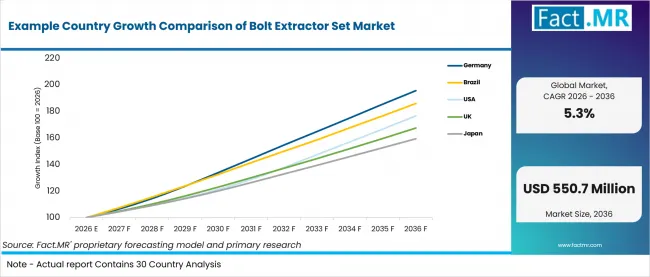
Example Country Growth Comparison Of Bolt Extractor Set Market | Source: Fact.MR
| Country | CAGR (2026-2036) |
|---|---|
| Germany | 6.9% |
| Brazil | 6.4% |
| Mexico | 3.7% |
| USA | 5.9% |
| Canada | 4.2% |
| UK | 5.3% |
| Japan | 4.8% |
Source: Fact.MR analysis. Updated Jul 30, 2026
What supports Germany adoption?
6.9% CAGR, supported by workshop quality standards and industrial repair discipline.
Germany’s growth reflects service-center demand for predictable grip and controlled reverse torque. Professional users are expected to choose kits that keep their bite through repeated repairs.
How is Brazil scaling demand?
6.4% CAGR, driven by distributor reach and automotive repair availability.
Brazil’s growth is tied to retail networks that help smaller workshops access replacement kits. Repair users are expected to value availability when a seized fastener stops routine service.
What is driving Mexico’s growth from 2026 to 2036?
3.7% CAGR, backed by automotive repair networks and industrial maintenance needs.
Mexico is expected to value kits that fit common automotive fasteners and repeated shop use. The market benefits when repair counters stock extractor sizes that match frequent service jobs.
How does the USA perform?
5.9% CAGR, led by replacement demand in service centers and retail channels.
The USA market is shaped by mature workshop ownership and wide retail availability. Growth is expected to come from replacement of worn kits more than first-time adoption.
What supports Canada’s growth?
4.2% CAGR, supported by service coverage and professional replacement cycles.
Canada’s growth reflects steady replacement demand across geographically spread workshops. Service access matters because repair users need tools that are available without long wait times.
What is shaping UK demand?
5.3% CAGR, driven by selective workshop purchases and value comparison.
The UK market is expected to grow through careful professional replacement. Customers are likely to compare durability and case contents before upgrading.
How does Japan perform?
4.8% CAGR, supported by quality-led replacement and disciplined tool purchasing.
Japan’s growth reflects customers that value finish and tool life before replacement. Buyers are expected to approve kits after comparing material quality and grip reliability.
Who leads the Bolt Extractor Set Market?
Snap-on Incorporated and Stanley Black & Decker show clear relevance through professional tool portfolios and workshop access.
Apex Tool Group strengthen the mechanic-tool segment, while Wiha Werkzeuge GmbH and GEDORE Werkzeugfabrik GmbH & Co. KG add European hand-tool expertise. Snap-on serves professional workshops through extractor sets and related bay tools. Stanley Black & Decker supports broad retail and repair demand.
From 2026 to 2036, competition will depend on extractor grip, steel quality, drive compatibility, case design, product availability and warranty support across professional maintenance and automotive repair channels.
Which companies are the key providers?
Key companies include Snap-on Incorporated; Apex Tool Group; Stanley Black & Decker; Wiha Werkzeuge GmbH; and GEDORE Werkzeugfabrik GmbH & Co. KG.
- Snap-on Incorporated
- Apex Tool Group
- Stanley Black & Decker
- Wiha Werkzeuge GmbH
- GEDORE Werkzeugfabrik GmbH & Co. KG
Bibliography
- Statistics Canada. (2026, March 17). Repair and maintenance services subsector, 2024.
- KNIPEX-Werk C. Gustav Putsch KG. (2024, February 29). New in the app stores: The KNIPEX pliers finder for professionals.
- Stanley Black & Decker, Inc. (2024, April 5). Meet the showstopping new products from Mac Tools.
- Snap-on Incorporated. (2024, July 10). Repair guidance feature added to Snap-on Pass Thru Assistant.
This Report Answers
- The report provides strategic intelligence on the Bolt Extractor Set Market across Product Type and Application choices that shape damaged-fastener repair demand.
- Segment analysis covers Spiral Flute Bolt Extractor Sets and Automotive Repair as the share leaders within the 2026 market.
- Country outlook evaluates Germany and Brazil alongside Mexico and the USA. Canada and the UK complete the growth comparison with Japan.
- Competitive analysis profiles Snap-on Incorporated and Apex Tool Group alongside Stanley Black & Decker. Wiha Werkzeuge GmbH complete the provider set with GEDORE Werkzeugfabrik GmbH & Co. KG.
- Channel assessment covers Offline Retail and industrial tool stores. Direct sales and online retail complete the route-to-market view alongside distributor support.
What does the Bolt Extractor Set Market cover?
Bolt extractor sets are used to remove damaged fasteners when standard sockets and wrenches no longer grip safely.
The Bolt Extractor Set Market covers extractor kits used in automotive repair and industrial maintenance. Coverage extends to construction equipment service and fabrication work. Household repair is included when the product is sold as a bolt or screw extraction set. The market includes product types and materials. It covers end users and channels that affect how users buy replacement kits.
What is included in the scope?
Bolt extractor sets are used across automotive service centers and independent workshops. Industrial facilities and fleet maintenance providers are included. DIY consumers are included when they buy extraction kits for repair jobs.
The scope includes Product Type and Application alongside End User. Distribution Channel and Material complete the structure. Coverage spans spiral flute extractors and left-hand spiral extractors. Socket-type extractors and multi-spline sets are included when they are sold for damaged fastener removal. Chrome molybdenum steel and other alloy materials are covered when material strength affects tool selection.
What is excluded from the scope?
Unrelated hand tools and general workshop equipment remain outside the scope of this market.
The scope excludes standard sockets and drill bits when they are not sold as extractor sets. Wrenches and pliers are excluded under the same rule. Diagnostic equipment and repair labor are excluded. Broad company revenue is excluded unless the product line is clearly tied to bolt or screw extraction.
How Was the Analysis Built?
The analysis draws on 120+ sources, 35+ company portfolios, 25+ countries, and more than 20 industry interviews.
- Primary Research: Primary research includes discussions with manufacturers, service providers, technology developers, distributors, end users, procurement teams, and subject-matter experts. These conversations examine purchasing priorities, product adoption, operational challenges, approval requirements, competitive positioning, and the factors that influence wider market acceptance.
- Desk Research: Desk research covers government statistics, regulatory publications, company filings, trade data, technical studies, industry associations, standards, public policy, and other authoritative sources. Every source used in the analysis is documented in the bibliography.
- Market Sizing and Forecasting: Market estimates combine historical performance, demand indicators, pricing and volume trends, segment shares, company participation, country-level growth, adoption patterns, investment activity, and barriers to market expansion.
- Data Validation and Update Cycle: Findings are validated by comparing primary interviews with public data, company activity, regulatory changes, trade patterns, and industry developments. Regular updates review new product launches, capacity changes, partnerships, approvals, procurement trends, and shifts in commercial adoption.
Segmentation
What is the report’s scope and coverage?
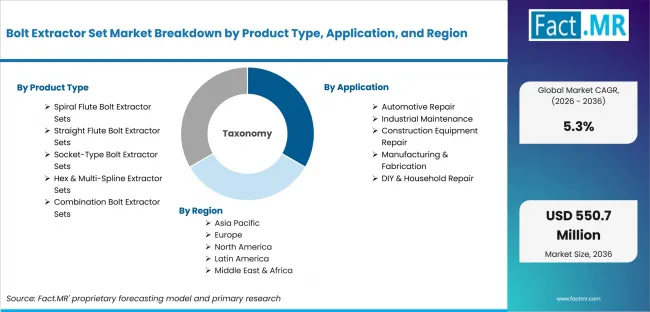
Bolt Extractor Set Market Breakdown By Product Type, Application, And Region | Source: Fact.MR
| Attribute | Details |
|---|---|
| Quantitative Units | USD 328.6 million in 2026 to USD 550.7 million by 2036, at a 5.3% CAGR. |
| Market Definition | Bolt extractor sets used to remove damaged, rounded, rusted, or broken fasteners during repair and maintenance. |
| Product Type | Spiral Flute Bolt Extractor Sets; Left-Hand Spiral Extractors; Deep Grip Spiral Extractors; Straight Flute Bolt Extractor Sets; Square Flute Extractors; Straight Multi-Flute Extractors; Socket-Type Bolt Extractor Sets; Impact Socket Extractors; Thin Wall Socket Extractors; Hex & Multi-Spline Extractor Sets; Hex Drive Extractors; Multi-Spline Extractors; Combination Bolt Extractor Sets; Mixed Extractor Kits; Professional Master Kits |
| Application | Automotive Repair; Engine Maintenance; Suspension & Brake Repair; Industrial Maintenance; Machinery Repair; Equipment Servicing; Construction Equipment Repair; Heavy Equipment Maintenance; Structural Steel Repair; Manufacturing & Fabrication; Production Line Maintenance; Metal Fabrication; DIY & Household Repair; Home Garage Repairs; General Maintenance |
| End User | Automotive Service Centers; Independent Workshops; Authorized Service Centers; Industrial Facilities; Manufacturing Plants; Process Industries; Construction Companies; Heavy Equipment Contractors; Infrastructure Contractors; Professional Mechanics; Mobile Mechanics; Fleet Maintenance Providers; DIY Consumers; Hobbyists; Home Users |
| Distribution Channel | Offline Retail; Industrial Tool Stores; Hardware Retail Chains; Direct Sales; OEM Supply Contracts; Business-to-Business Sales; Online Retail; E-commerce Marketplaces; Manufacturer Websites; Industrial Distributors; Authorized Dealers; Regional Distributors; Wholesale Suppliers; Bulk Tool Suppliers; Import & Export Traders |
| Material | Chrome Molybdenum Steel; Heat Treated Alloy Steel; Impact Grade Steel; High Carbon Steel; Drop Forged Steel; Hardened Steel; Chrome Vanadium Steel; Polished Finish; Black Oxide Finish; Alloy Steel; Precision Machined Alloy; Corrosion Resistant Alloy; Other Materials; Titanium Coated Steel; Specialty Tool Steel |
| Regions Covered | North America; Latin America; Europe; East Asia; South Asia and Pacific; Middle East and Africa |
| Countries Covered | Germany; Brazil; Mexico; USA; Canada; UK; Japan |
| Key Companies Profiled | Snap-on Incorporated; Apex Tool Group; Stanley Black & Decker; Wiha Werkzeuge GmbH; GEDORE Werkzeugfabrik GmbH & Co. KG |
| Forecast Period | 2026 to 2036 |
| Approach | Hybrid top-down and bottom-up approach using workshop demand indicators; segment mix; country growth; channel activity; replacement cycles; company portfolio review; and public evidence. |
Source: Fact.MR analysis. Updated Jul 30, 2026
How is the market segmented?
-
By Product Type:
- Spiral Flute Bolt Extractor Sets
- Left-Hand Spiral Extractors
- Deep Grip Spiral Extractors
- Straight Flute Bolt Extractor Sets
- Square Flute Extractors
-
By Application:
- Automotive Repair
- Engine Maintenance
- Suspension & Brake Repair
- Industrial Maintenance
- Machinery Repair
-
By End User:
- Automotive Service Centers
- Independent Workshops
- Authorized Service Centers
- Industrial Facilities
- Manufacturing Plants
-
By Distribution Channel:
- Offline Retail
- Industrial Tool Stores
- Hardware Retail Chains
- Direct Sales
- OEM Supply Contracts
-
By Material:
- Chrome Molybdenum Steel
- Heat Treated Alloy Steel
- Impact Grade Steel
- High Carbon Steel
- Drop Forged Steel
-
By Region:
- North America
- Latin America
- Europe
- East Asia
- South Asia and Pacific
- Middle East and Africa
Frequently Asked Questions
Which Product Type leads the market?
Which Application leads the market?
Which End User leads the market?
Which Distribution Channel leads the market?
Which Material leads the market?
Which country records the highest listed CAGR?
What is the primary driver in this market?
What is the main restraint?
Why do automotive service centers lead demand?
Who worked on this report


Preview the report firsthand - request a free sample
Free SampleGet the brochure for pricing and purchase details
Download PDF