- Base Value(2026): 811.0 Mn
- Estimated Value(2026): 811.0 Mn
- Forecast Value (2036): 1235.6 Mn
- CAGR (2026 - 2036): 4.3%
Bolt Insertion Machine Market Forecast and Outlook 2026 to 2036
The global bolt insertion machine market is expected to grow from USD 811 million in 2026 to approximately USD 1,235.6 million by 2036, reflecting a CAGR of 4.3%.
Key Takeaways from Bolt Insertion Machine Market
- Bolt Insertion Machine Market Value 2026: USD 811 million
- Bolt Insertion Machine Market Forecast Value 2036: USD 1,235.6 million
- Bolt Insertion Machine Market Forecast CAGR: 4.3%
- Leading Fastener Type Segment: Nuts (PEM or clinching) 38%
- Key Growth Regions: U.S., Germany, Japan, South Korea, China, Europe
- Prominent Players: PennEngineering (PEMSERTER), BalTec, Haeger (Stanley), Orbitform, TOX Pressotechnik, SPIROL
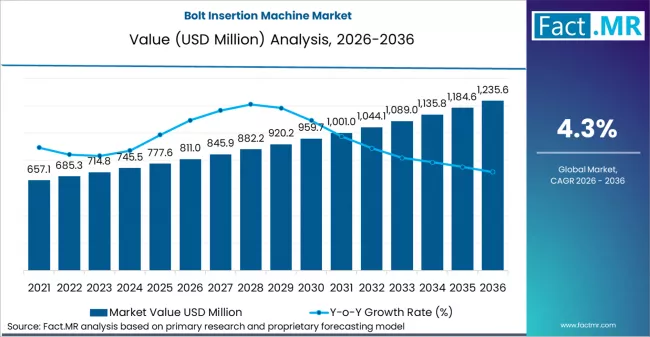
Bolt Insertion Machine Market Market Value Analysis | Source: Fact.MR
Nuts (PEM or clinching) dominate the fastener type segment due to their reliability and ease of insertion in electronics and sheet metal applications. Machines with ≤30 kN capacity lead the segment, while higher-force machines are used in automotive, appliance, and general fabrication applications.
Electronics and sheet metal remain the largest end-use segment, followed by automotive tiering, appliances, and general fabrication. Hydraulic actuation is the most common, with pneumatic, servo-electric, and manual systems used for specialized or lower-volume operations. North America, particularly the U.S., shows strong adoption, with Japan, South Korea, Europe, and China maintaining steady demand. Suppliers focus on precision, repeatability, and flexibility to meet the diverse needs of modern assembly lines.
Bolt Insertion Machine Market
| Metric | Value |
|---|---|
| Estimated Value in (2026E) | USD 811 million |
| Forecast Value in (2036F) | USD 1,235.6 million |
| Forecast CAGR (2026 to 2036) | 4.3% |
Source: Fact.MR analysis. Updated Jan 24, 2026
Category
| Category | Segments |
|---|---|
| Fastener Type | Nuts PEM or Clinching; Inserts or Studs; Self-Clinching Standoffs; Other Specialty |
| Force or Capacity | ≤30 kN; 31-80 kN; 81-150 kN; >150 kN; Other |
| End Use | Electronics or Sheet Metal; Automotive Tiering; Appliances or White Goods; General Fabrication; Other |
| Actuation | Hydraulic; Pneumatic; Servo-Electric; Manual or Bench; Other |
| Region | North America; Europe; Asia Pacific; Latin America; Middle East & Africa |
Source: Fact.MR analysis. Updated Jan 24, 2026
Segmental Analysis
By Fastener Type, Which Segment Holds the Dominant Share in the Bolt Insertion Machine Market?
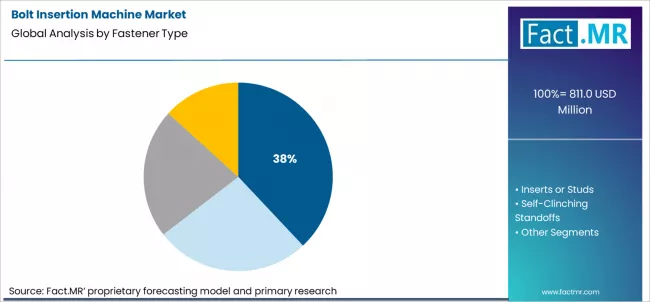
Bolt Insertion Machine Market Analysis By Fastener Type | Source: Fact.MR
In terms of fastener type, nuts including PEM and clinching variants account for a 38.0% share, making this the leading segment within the bolt insertion machine market. Manufacturers rely on these fasteners due to their widespread use in sheet metal assemblies and electronic enclosures.
- Nut insertion machines support consistent fastening strength across thin gauge materials.
- High repeatability requirements across production lines sustain demand for this fastener category.
By Force or Capacity, Which Segment Accounts for the Largest Share in the Bolt Insertion Machine Market?
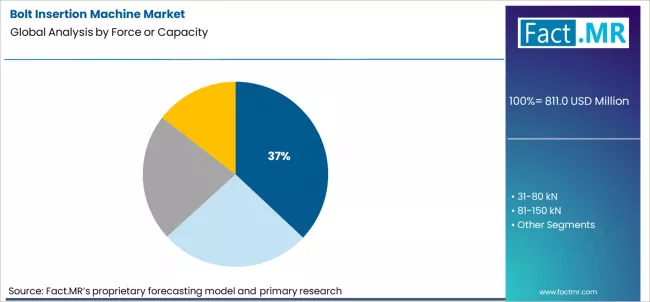
Bolt Insertion Machine Market Analysis By Force Or Capacity | Source: Fact.MR
Machines operating at or below 30 kN represent a 37.0% share, positioning this capacity range as the most commonly used. Lower force systems align with applications involving lightweight metals and precision components.
- ≤30 kN machines are widely deployed in electronics and light fabrication environments.
- Ease of operation and lower equipment complexity support broad adoption across production facilities.
By End Use, Which Segment Leads Demand in the Bolt Insertion Machine Market?
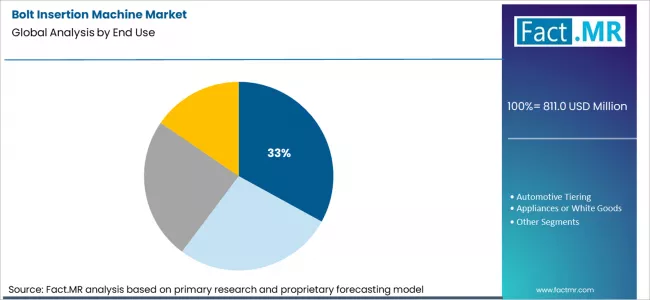
Bolt Insertion Machine Market Analysis By End Use | Source: Fact.MR
Electronics and sheet metal applications hold a 33.0% share, establishing this segment as the primary end use category. High component density and fastening accuracy requirements drive equipment utilization in this area.
- Bolt insertion machines support secure fastening across compact assemblies.
- Demand reflects continuous production of panels, housings, and enclosures.
By Actuation, Which Segment Maintains the Highest Share in the Bolt Insertion Machine Market?
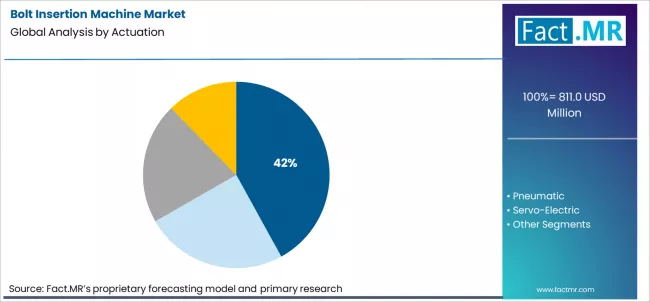
Bolt Insertion Machine Market Analysis By Actuation | Source: Fact.MR
Hydraulic systems account for a 42.0% share, making them the most widely adopted actuation type. These systems deliver stable force control across repeated insertion cycles.
- Hydraulic actuation supports consistent insertion depth and fastening integrity.
- Preference reflects suitability for medium to high volume industrial operations.
What are the Drivers, Restraints, and Key Trends of the Bolt Insertion Machine Market?
- Drivers: Manufacturers in electronics, automotive, and sheet metal fabrication rely on bolt and insert insertion machines to achieve consistent fastening quality without welding or secondary operations, driving demand for equipment that delivers controlled force, repeatability, and clean integration into modern production lines.
- Restraint: Selecting the right insertion force and machine configuration can be challenging as part thickness, material type, and fastener design vary widely, often requiring careful setup, operator training, and process validation to avoid part damage or weak joints.
- Trend 1: Servo electric and mid force insertion machines are gaining popularity as manufacturers look for better process control, real time monitoring, and easier adjustment when working with self clinching nuts, studs, and standoffs across mixed production runs.
- Trend 2: End users are increasingly adopting semi automated and automated insertion systems that integrate with assembly cells, allowing higher throughput, improved quality tracking, and reduced dependence on manual bench operations in high volume manufacturing environments.
Analysis of the Bolt Insertion Machine Market by Key Country
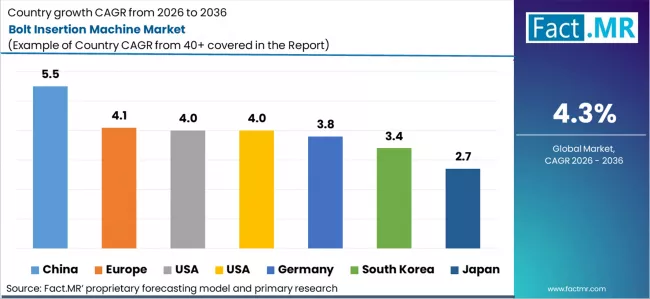
Bolt Insertion Machine Market Cagr Analysis By Country | Source: Fact.MR
| Country | CAGR |
|---|---|
| China | 5.5% |
| Brazil | 5.1% |
| Europe | 4.1% |
| U.S. | 4.0% |
| U.K. | 4.0% |
| Germany | 3.8% |
| South Korea | 3.4% |
| Japan | 2.7% |
Source: Fact.MR analysis. Updated Jan 24, 2026
The report covers an in depth analysis of 8 countries; higher growth markets are highlighted below.
What Is Driving Growth of Bolt Insertion Machines in China?
China leads growth at 5.5%, driven by large scale production of sheet metal components for electronics, appliances, and automotive assemblies. Bolt insertion machines are widely used for self clinching nuts and studs across high volume lines. Buyers focus on higher force capacity, stable cycle times, and compatibility with automated manufacturing cells.
- High volume sheet metal production supports machine demand.
- Automation compatibility influences equipment selection.
How Is Brazil Emerging as a High-Growth Market for Bolt Insertion Equipment?
Brazil is projected to grow at 5.1%, supported by expansion of appliance manufacturing and general fabrication activities. Hydraulic and pneumatic bolt insertion machines are commonly adopted due to flexibility across varied force requirements. Purchasing decisions emphasize robustness and ease of maintenance rather than advanced control features.
- Appliance and fabrication sectors sustain equipment demand.
- Hydraulic systems suit varied production needs.
What Is Supporting Market Expansion Across Europe?
Europe is expected to expand at 4.1%, driven by steady demand from automotive tier suppliers and white goods manufacturers. Servo electric bolt insertion machines are favored for precise force control and repeatability. Buyers prioritize equipment accuracy, energy efficiency, and integration with automated assembly lines.
- Automotive tiering supports consistent machine demand.
- Precision force control favors servo electric systems.
What Defines Market Conditions in the U.S.?
The U.S. market is forecast to grow at 4.0%, shaped by continued use of bolt insertion equipment in electronics, sheet metal fabrication, and industrial assembly. Machines are selected for reliability and broad fastener compatibility. Replacement demand plays a significant role in sustaining market activity.
- Electronics and fabrication applications support baseline demand.
- Replacement cycles drive steady equipment purchases.
How Is the U.K. Positioned in the Bolt Insertion Machine Market?
The U.K. is projected to grow at 4.0%, supported by general fabrication and appliance assembly operations. Bolt insertion machines are used for self clinching fasteners across medium volume production. Buyers value compact machine footprints and flexible setup for varied job runs.
- Medium volume manufacturing supports steady adoption.
- Flexible setup requirements influence machine choice.
What Role Does Germany Play in Market Development?
Germany is expected to grow at 3.8%, reflecting strong emphasis on process accuracy and quality control. Bolt insertion machines with higher force ranges are used in precision fabrication environments. Demand follows capital investment cycles in automotive and industrial machinery sectors.
- Precision manufacturing sustains demand for high specification machines.
- Investment cycles shape purchasing behavior.
How Is South Korea Contributing to Market Growth?
South Korea is forecast to grow at 3.4%, driven by electronics and automotive component manufacturing. Pneumatic and servo electric machines are used to support consistent insertion quality. Buyers focus on throughput stability and compatibility with automated production systems.
- Electronics manufacturing supports machine demand.
- Automation readiness influences equipment upgrades.
What Factors Shape Market Development in Japan?
Japan is expected to register a CAGR of 2.7%, reflecting mature manufacturing operations and long equipment lifecycles. Bolt insertion machines remain in service across electronics and appliance assembly lines. Demand remains steady as production systems are already optimized for efficiency and reliability.
- Mature manufacturing sustains baseline equipment demand.
- Long service life limits rapid market expansion.
Competitive Landscape of the Bolt Insertion Machine Market
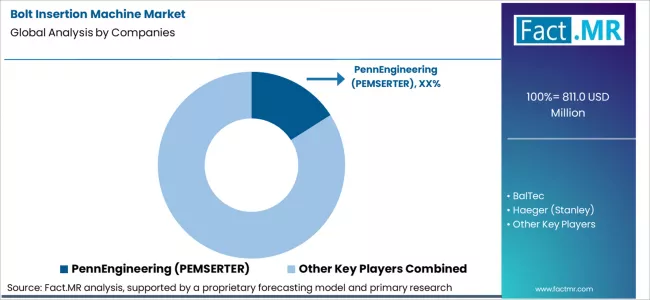
Bolt Insertion Machine Market Analysis By Company | Source: Fact.MR
The bolt insertion machine market supports manufacturers that rely on secure, repeatable fastening in high-volume and precision-driven production environments. These machines are widely used to install nuts, inserts, studs, and self-clinching fasteners into sheet metal and thin-walled components, where consistency and joint integrity are critical. Buyers in this market focus on insertion accuracy, force control, cycle time, and ease of integration into existing production lines. Competition is shaped by how reliably machines handle different fastener types and material thicknesses without damaging parts.
Manufacturers differentiate through force capacity range, actuation technology, and automation readiness. Hydraulic systems dominate higher-force applications where deep insertion and thick materials are involved, while pneumatic and servo-electric machines are preferred for electronics, appliances, and automotive tier suppliers that value speed, precision, and energy efficiency. Manual and bench-top units remain relevant for low-volume fabrication and prototyping. Suppliers that offer programmable force monitoring, error detection, and inline integration gain an advantage as manufacturers push for higher quality control and reduced rework.
Market players include PennEngineering, BalTec, Haeger, Orbitform, TOX Pressotechnik, BalTec-AG, Promess, Gage Bilt, SPIROL, and Böllhoff Rivnut. Established brands lead in automation and force control, while specialized suppliers compete through flexibility, customization, and application-specific expertise.
Key Players in the Bolt Insertion Machine Market
- PennEngineering
- BalTec
- Haeger
- Orbitform
- TOX Pressotechnik
- BalTec-AG
- Promess
- Gage Bilt
- SPIROL
- Böllhoff Rivnut
Bibliography
- United Nations Industrial Development Organization. (2024). Fastening, joining, and metal assembly technologies in modern manufacturing. Vienna, Austria: UNIDO.
- International Trade Centre. (2024). Global trade patterns and industrial demand for metal fastening and assembly equipment. Geneva, Switzerland: ITC.
- Organisation for Economic Co-operation and Development. (2024). Automation, precision assembly, and industrial equipment adoption trends. Paris, France: OECD.
- U.S. Department of Commerce, International Trade Administration. (2024). Industrial fastening systems, assembly machinery, and advanced manufacturing overview. Washington, DC: ITA.
- World Intellectual Property Organization. (2025). Technological developments in fastening, clinching, and automated assembly systems. Geneva, Switzerland: WIPO.
Segmentation
Scope of the Report
| Items | Values |
|---|---|
| Quantitative Units 2026 | USD 811 Million |
| Fastener Type | Nuts including PEM or clinching nuts, Inserts or studs, Self-clinching standoffs, Specialty fastening elements |
| Force or Capacity | ≤30 kN insertion systems, 31-80 kN insertion systems, 81-150 kN insertion systems, >150 kN high-force systems |
| End Use | Electronics and sheet metal fabrication, Automotive tier suppliers, Appliances and white goods manufacturing, General fabrication |
| Actuation | Hydraulic actuation systems, Pneumatic actuation systems, Servo-electric actuation systems, Manual or bench-mounted systems |
| Regions Covered | North America, Europe, Asia Pacific, Latin America, Middle East & Africa |
| Countries Covered | U.S., Japan, South Korea, Germany, China, U.K., Brazil |
| Key Companies Profiled | PennEngineering, BalTec, Haeger, Orbitform, TOX Pressotechnik, BalTec AG, Promess, Gage Bilt, SPIROL, Böllhoff |
| Additional Attributes | Dollar revenue by bolt insertion fastener type, force or capacity range, end-use sector, and actuation method; regional demand trends; precision and repeatability requirements for clinching operations; increasing adoption of servo-electric presses; integration with automated production cells; quality monitoring and force-displacement control capabilities |
Source: Fact.MR analysis. Updated Jan 24, 2026
Bolt Insertion Machine Market Segments
-
Fastener Type:
- Nuts PEM or Clinching
- Inserts or Studs
- Self Clinching Standoffs
- Other Specialty
-
Force or Capacity:
- Up to 30 kN
- 31 to 80 kN
- 81 to 150 kN
- Above 150 kN
-
End Use:
- Electronics or Sheet Metal
- Automotive Tiering
- Appliances or White Goods
- General Fabrication
-
Actuation:
- Hydraulic
- Pneumatic
- Servo Electric
- Manual or Bench
-
Region:
- North America
- U.S.
- Canada
- Mexico
- Europe
- Germany
- Italy
- UK
- France
- Spain
- Netherlands
- Switzerland
- Rest of Europe
- Asia Pacific
- Japan
- Australia
- South Korea
- China
- India
- Rest of Asia Pacific
- Latin America
- Brazil
- Argentina
- Rest of Latin America
- Middle East and Africa
- United Arab Emirates
- South Africa
- Rest of Middle East and Africa
- North America
Frequently Asked Questions
How big is the bolt insertion machine market in 2026?
What will be the size of bolt insertion machine market in 2036?
How much will be the bolt insertion machine market growth between 2026 and 2036?
What are the key product types in the bolt insertion machine market?
Which force or capacity segment to contribute significant share in the bolt insertion machine market in 2026?
Who worked on this report


Preview the report firsthand - request a free sample
Free SampleGet the brochure for pricing and purchase details
Download PDF