- Market Value (2025): USD 125.7 Mn
- Estimated Value (2026): USD 140.0 Mn
- Forecast Value (2036): USD 410.0 Mn
- CAGR (2026-2036): 11.3%
What is the Busbar Insulation Compounds Market forecast to be worth by 2036?
USD 140.0 million in 2026 to USD 410.0 million by 2036 at 11.3% CAGR
- The Busbar Insulation Compounds Market crossed a valuation of USD 125.7 million in 2025, supported by demand for compact power-distribution equipment and fire-safe electrical insulation.
- Demand is projected to increase from USD 140.0 million in 2026 to USD 410.0 million by 2036.
- The market is forecast to record an 11.3% CAGR from 2026 to 2036 as busbar manufacturers adopt low-smoke, flame-retardant, and heat-resistant compounds across data centers, electric vehicles, switchgear, and rail power systems.
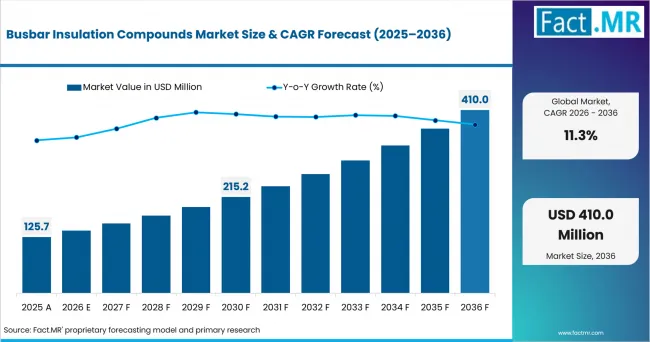
Busbar Insulation Compounds Market Market Value Analysis | Source: Fact.MR
What are the defining numbers behind Busbar Insulation Compounds Market growth?
USD 270.0 million absolute opportunity by 2036, led by LSZH polyolefin and Data centers alongside Low smoke performance.
- Demand Drivers in the Market
- Busbar manufacturers need compounds that preserve dielectric separation as higher electrical loads move through compact power-distribution equipment.
- Data center operators need low-smoke and flame-retardant insulation around busways, switchboards, and power-distribution units installed in enclosed spaces.
- Electric-vehicle component makers need insulation that withstands vibration, repeated heat cycles, and restricted assembly space without cracking or shifting.
- Switchgear manufacturers need materials with reliable arc resistance, thermal endurance, and flame behavior before approving them for repeated production.
- Electrical equipment companies need extruded sleeves, molded parts, powder coatings, and heat-shrink forms that provide controlled thickness across different busbar shapes.
- Key Segments Analyzed
- By Material: LSZH polyolefin is estimated to hold 36% share in 2026, supported by demand for low-smoke and halogen-free insulation in enclosed electrical spaces.
- By Application: Data centers are projected to account for 29% share in 2026 owing to compact power distribution, high uptime requirements, and limited equipment space.
- By Performance: Low smoke is anticipated to capture 35% share in 2026 due to fire-safety and visibility requirements across enclosed power rooms and vehicle assemblies.
- By End User: Busbar manufacturers are forecast to represent 41% share in 2026 because they control compound selection, insulation thickness, processing method, and final assembly tolerances.
- By Form: Extruded sleeve is expected to hold 29% share in 2026, driven by continuous coverage and controlled wall thickness across straight and moderately shaped conductors.
- Analyst Opinion at Fact.MR
- Shambhu Nath Jha, Senior Analyst at Fact.MR, states, “Busbar insulation selection is becoming an application problem that extends beyond basic dielectric separation. Adoption is expected to favor compound producers that prove low-smoke behavior, thermal endurance, and processing stability under actual extrusion, molding, or coating conditions. Technical teams need to connect electrical test results with insulation thickness, conductor geometry, and final equipment fit before regular production begins.”
- Strategic Implications
- Compound manufacturers need to validate dielectric strength, low-smoke behavior, and thermal endurance under the processing conditions used by busbar producers.
- Busbar manufacturers need to compare insulation thickness and conductor fit before replacing an approved compound across compact power-distribution assemblies.
- Electric-vehicle component makers need separate testing for vibration, repeated heat cycles, and molded-part geometry because electrical results alone do not confirm production fit.
- Switchgear and data center equipment companies need traceable fire-performance records and processing guidance before approving a material for repeated use.
Germany is anticipated to advance at a 13.0% CAGR from 2026 to 2036 owing to demand from switchgear, industrial power systems, data infrastructure, and electric-vehicle components. Brazil is estimated to record an 11.9% CAGR through 2036, supported by power upgrades, industrial facilities, transport systems, and new data infrastructure. The United States is forecast to post a 10.8% CAGR from 2026 to 2036, driven by data center investment, grid equipment replacement, electric-vehicle platforms, and industrial electrification.
How does the Busbar Insulation Compounds Market break down by segment?
LSZH Polyolefin leads at 36% by Material, while Data Centers lead at 29% by Application in 2026.
Which Material dominates?
LSZH Polyolefin holds 36% share in 2026.
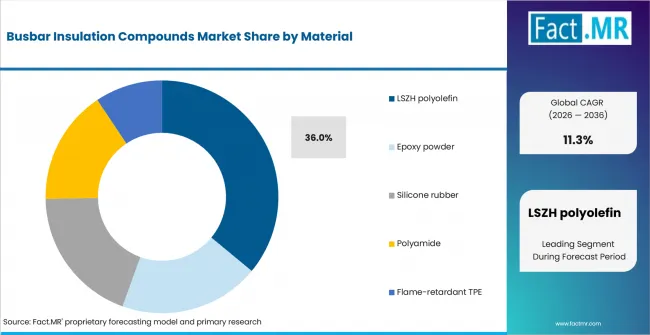
Busbar Insulation Compounds Market Analysis By Material | Source: Fact.MR
LSZH Polyolefin is estimated to hold 36% share in 2026, supported by demand for low-smoke and halogen-free insulation in enclosed electrical spaces. Epoxy Powder follows where manufacturers need a thin coating that bonds closely to complex busbar shapes. Silicone Rubber serves flexible components exposed to repeated heat, while Polyamide supports rigid molded parts that require dimensional control. Flame-retardant TPE fits applications that need flexibility alongside controlled fire behavior.
What leads the Application segment?
Data Centers account for 29% share in 2026.
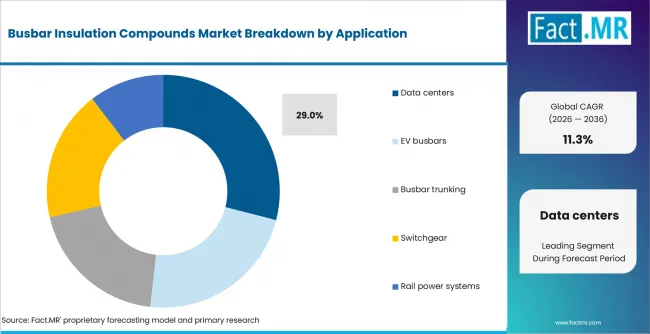
Busbar Insulation Compounds Market Analysis By Application | Source: Fact.MR
Data Centers are projected to account for 29% share in 2026 as dense power distribution, high uptime requirements, and limited equipment space place greater importance on insulation quality. Busbar Trunking uses insulation to separate conductors and protect joints across modular power-distribution systems. EV Busbars require stable performance under vibration and thermal cycling, while Switchgear places more weight on arc exposure and phase clearance. Rail Power Systems need insulation that supports long operating periods and regular service access.
How does Performance shape demand?
Low Smoke leads with 35% share in 2026.
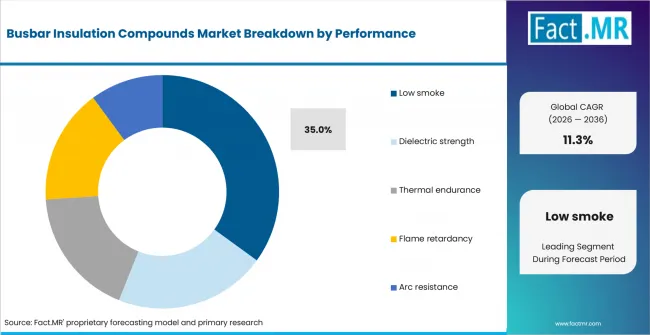
Busbar Insulation Compounds Market Analysis By Performance | Source: Fact.MR
Low Smoke is estimated to hold 35% share in 2026 because smoke density affects evacuation, equipment access, and inspection after an incident in enclosed facilities. Dielectric Strength remains important where conductors operate close together and electrical separation needs to remain stable. Arc Resistance supports switchgear exposed to possible switching faults. Thermal Endurance is checked against normal busbar operating temperatures, while Flame Retardancy is reviewed against the fire-safety requirements of the finished electrical equipment.
Where is End User demand strongest?
Busbar Manufacturers hold 41% share in 2026.
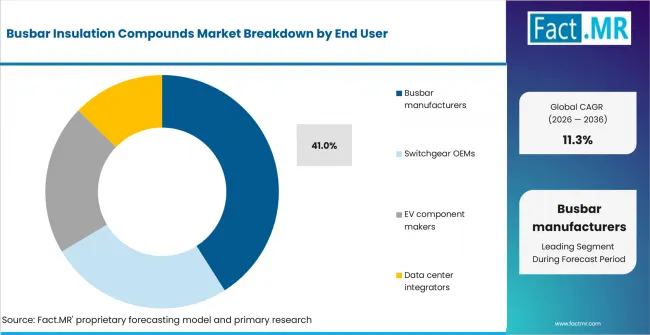
Busbar Insulation Compounds Market Analysis By End User | Source: Fact.MR
Busbar Manufacturers are forecast to hold 41% share in 2026 as they select compounds while conductor geometry, insulation thickness, production methods, and assembly tolerances are being fixed. Switchgear OEMs focus on cabinet fit, phase clearances, and service conditions around breakers and connection points. EV Component Makers evaluate insulation against platform dimensions and repeated heat exposure. Data Center Integrators place greater weight on maintenance access and traceable fire-performance records.
What supports Form adoption?
Extruded Sleeve accounts for 29% share in 2026.
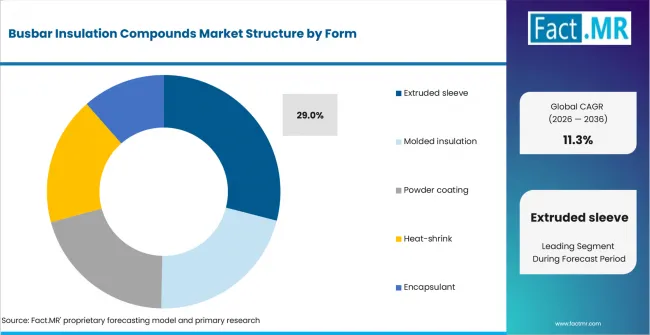
Busbar Insulation Compounds Market Analysis By Form | Source: Fact.MR
Extruded Sleeve is anticipated to hold 29% share in 2026 because it provides continuous coverage and controlled thickness across straight or moderately shaped conductors. Molded Insulation fits complex parts that need stable coverage around joints and terminals. Encapsulant supports local sealing around sensors and connection points, while Powder Coating forms a thin bonded layer over the conductor. Heat-shrink is suitable when insulation needs to be installed after the main busbar has already been fabricated.
What is accelerating Busbar Insulation Compounds Market adoption and what is holding it back?
Electrical-load growth supports adoption while qualification cost and process fit restrain rapid material changes
Drivers Impact Analysis
| DRIVER | (~) % IMPACT ON CAGR | GEOGRAPHIC RELEVANCE | IMPACT TIMELINE |
|---|---|---|---|
| Electrical-load growth in compact power systems | +0.8% | China and export manufacturing centers | Medium term (2-4 years) |
| Low-smoke and flame-behavior requirements | +0.6% | Europe and North America | Short term (<= 2 years) |
| Data center busbar approval programs | +0.5% | Asia Pacific | Medium term (2-4 years) |
| Application support near busbar manufacturers | +0.4% | Global | Long term (>= 4 years) |
Source: Fact.MR analysis. Updated Jul 16, 2026
- Electrical-load growth in compact power systems: Higher current density is expected to increase the value of insulation that maintains spacing and heat resistance without enlarging the busbar assembly.
- Low-smoke and flame-behavior requirements: Enclosed electrical rooms are projected to support materials that limit smoke and flame spread during a fault or nearby fire.
- Data center busbar approval programs: Repeat projects are anticipated to favor grades that pass electrical and thermal checks. Installation performance then needs to remain consistent across standardized power-distribution designs.
- Application support near busbar manufacturers: Local technical support is expected to shorten troubleshooting when a compound affects extrusion or coating. Molding behavior and final dimensional control require separate checks.
Opportunity Impact Analysis
| OPPORTUNITY | (~) % IMPACT ON CAGR | GEOGRAPHIC RELEVANCE | IMPACT TIMELINE |
|---|---|---|---|
| Grades tuned for Data center busbars | +0.5% | Global | Medium term (2-4 years) |
| Application labs for Data centers | +0.4% | Asia Pacific and Europe | Short term (<= 2 years) |
| Fire and electrical test documentation | +0.4% | Europe and United Kingdom | Medium term (2-4 years) |
| Local trials with electrical equipment makers | +0.3% | India and Brazil | Long term (>= 4 years) |
Source: Fact.MR analysis. Updated Jul 16, 2026
- Grades tuned for Data center busbars: Data center busbars need compounds that combine low-smoke behavior, dielectric strength, and controlled insulation thickness within compact power-distribution systems. Adoption is expected to expand where grades maintain stable performance across standardized busway and switchboard designs.
- Application labs for Data centers: Regional application laboratories help manufacturers compare extrusion, molding, or coating behavior before a full production trial. Testing support is projected to shorten qualification work by checking insulation thickness, heat resistance, and electrical performance under data center operating conditions.
- Fire and electrical test documentation: Data center integrators and electrical equipment companies need traceable records covering smoke generation, flame behavior, dielectric strength, and thermal endurance. Clear documentation is anticipated to support faster technical review across Europe and the United Kingdom.
- Local trials with electrical equipment makers: Trials with local switchgear, busbar, and power-distribution equipment manufacturers help compound suppliers adjust processing temperature, adhesion, wall thickness, and conductor fit. Demand is forecast to strengthen in India and Brazil where on-site testing reduces scale-up problems before regular production.
Restraints Impact Analysis
| RESTRAINT | (~) % IMPACT ON CAGR | GEOGRAPHIC RELEVANCE | IMPACT TIMELINE |
|---|---|---|---|
| Qualification cost | -0.4% | Global manufacturers | Medium term (2-4 years) |
| Insulation-thickness limits in data centers | -0.3% | Global | Short term (<= 2 years) |
| Documentation burden | -0.3% | Europe and North America | Medium term (2-4 years) |
| Scale-up risk | -0.2% | High-volume plants | Long term (>= 4 years) |
Source: Fact.MR analysis. Updated Jul 16, 2026
- Qualification cost: Busbar compounds require electrical, thermal, fire-performance, and processing checks before approval. Material changes are expected to remain slow because failed sleeve, coating, or molding trials can increase scrap, rework, and testing costs for manufacturers worldwide.
- Insulation-thickness limits in data centers: Compact busways and switchboards leave limited space around conductors, joints, and connection points. Adoption is anticipated to face delays when a new compound changes wall thickness, cabinet clearance, phase spacing, or final assembly geometry.
- Documentation burden: Manufacturers in Europe and North America need traceable records covering material composition, dielectric strength, smoke behavior, flame resistance, thermal endurance, and test conditions. Incomplete or inconsistent documentation is projected to extend customer review and delay qualification.
- Scale-up risk: A compound that performs well during laboratory testing may behave differently on high-volume extrusion, powder-coating, or molding lines. Commercial approval is forecast to slow when production trials reveal unstable thickness, weak adhesion, cracking, longer cycle times, or inconsistent electrical performance.
Which countries are scaling Busbar Insulation Compounds Market fastest?
Germany 13.0%, Brazil 11.9%, United States 10.8%
.webp "Top Country Growth Comparison Busbar Insulation Compounds Market Cagr (2026 2036)")
Top Country Growth Comparison Busbar Insulation Compounds Market Cagr (2026 2036) | Source: Fact.MR
| COUNTRY | CAGR |
|---|---|
| Germany | 13.0% |
| Brazil | 11.9% |
| United States | 10.8% |
Source: Fact.MR analysis. Updated Jul 16, 2026
What supports the Germany outlook?
13.0% CAGR, owing to switchgear production and documented fire-performance requirements.
Germany has an established base across switchgear, industrial power systems, rail equipment, data infrastructure, and electric-vehicle components. The market is anticipated to post a 13.0% CAGR through 2036 as manufacturers place greater weight on dielectric performance, flame behavior, and precise assembly tolerances. Material approval also depends on consistent test support and processing records during production transfer.
How is Brazil developing Busbar Insulation Compounds demand?
11.9% CAGR, supported by power upgrades and expanding industrial infrastructure.
Brazil is increasing investment in power-distribution systems, industrial facilities, transport equipment, and data infrastructure, widening the use of insulated busbars. The market is estimated to expand at an 11.9% CAGR from 2026 to 2036 as electrical-equipment manufacturers seek practical application support and dependable compound supply. Local trials help compare material cost with coating yield, installation time, and rework risk.
What underpins United States growth?
10.8% CAGR, driven by data center expansion and grid-equipment replacement.
The United States has strong demand from data centers, grid equipment, electric-vehicle platforms, and industrial electrification projects that require higher-performing busbar insulation. The market is forecast to grow at a 10.8% CAGR through 2036 as engineering teams compare dielectric strength, thermal endurance, smoke generation, and flame behavior before approving new grades. Repeatable testing supports the move from qualification trials to regular production.
Who leads the Busbar Insulation Compounds Market?
Borealis and SABIC lead through halogen-free and flame-retardant polymer platforms, while Avient and HEXPOL strengthen engineered compound and processing capabilities.
Borealis supports busbar insulation development through polyolefin materials designed for halogen-free and flame-retardant electrical applications. SABIC adds a broad engineering thermoplastics and polyolefin portfolio suited to busbar systems and electrical equipment. Avient contributes low-smoke engineered formulations and application support across electrical and transportation components. These companies compete on dielectric performance, flame behavior, processing stability, and the ability to maintain controlled insulation thickness during extrusion, molding, or coating.
HEXPOL brings thermoplastic and thermoset compounding experience relevant to flexible and molded electrical insulation. Dow contributes silicone and polymer technologies for applications exposed to repeated heat, while Saint-Gobain adds engineered sleeves, films, and shaped insulation components where precise conductor fit is required. Competition through 2036 is expected to depend on consistent product quality, clear test documentation, regional production access, and technical support during customer qualification.
Which companies are the key providers?
Borealis and Avient are key providers. SABIC and Dow are also profiled. HEXPOL and Saint-Gobain complete the company set.
- Borealis
- Avient
- SABIC
- Dow
- HEXPOL
- Saint-Gobain
Bibliography
- International Energy Agency. (2025, April). Energy and AI: Energy demand from AI. International Energy Agency.
- Avient Corporation. (2025, February). Avient expands flame retardant solutions portfolio for wire and cable with ECCOH XL 8054. Avient Corporation.
- SABIC. (2025, August). SABIC’s new LNP THERMOCOMP compound helps boost EVCU safety and protection. SABIC.
- HEXPOL AB. (2025, February). HEXPOL acquires 80 percent of the shares in Kabkom Kimya Sanayi ve Ticaret Anonim Sirketi. HEXPOL AB.
- Borealis AG. (2025). Borealis launches flame-retardant sheathing solution for safety-critical power cables. Borealis AG.
This Report Addresses
- The report provides strategic intelligence on Busbar Insulation Compounds across Material and Application choices that shape electrical insulation design and production.
- Segment analysis covers LSZH Polyolefin and Data Centers as the share leaders within the 2026 market structure.
- Regional outlook evaluates US, Germany, France, UK and 30+ countries.
- Competitive analysis profiles Borealis and Avient alongside SABIC and Dow, followed by HEXPOL and Saint-Gobain.
- Performance assessment covers Low Smoke, Dielectric Strength, Thermal Endurance, Flame Retardancy, and Arc Resistance across electrical systems with different safety and operating requirements.
- Use-case assessment covers Busbar Trunking and EV Busbars alongside Data Centers, Switchgear, and Rail Power Systems.
What does the Busbar Insulation Compounds Market cover?
LSZH polyolefin, Epoxy powder, Silicone rubber, Polyamide, and Flame-retardant TPE systems used to insulate busbars and related power-distribution components.
The market covers compounds designed to preserve dielectric separation and provide controlled fire, smoke, and heat performance around busbar conductors. Coverage includes materials processed as Extruded sleeve, Molded insulation, Powder coating, Heat-shrink, or Encapsulant.
The market differs from broad commodity polymer supply because commercial value comes from a defined electrical-insulation function and application support. Unmodified parent resins used in unrelated products remain outside the market boundary.
What is included in the scope?
Insulation compounds used in busbar systems and related electrical power-distribution components across industrial production environments.
The scope includes Material, Application, Performance, End User, and Form segments. It covers Data centers, EV busbars, Switchgear, Busbar trunking, and Rail power systems where compound selection affects dielectric separation, thermal endurance, smoke behavior, or production fit.
What is excluded from the scope?
Unmodified commodity polymers and finished electrical equipment sold without a separately defined busbar insulation compound are outside the scope.
The scope excludes cable insulation revenue when the material is not formulated or sold for busbar use. Finished switchgear, busway systems, and electric-vehicle assemblies are treated as downstream applications instead of market revenue.
How was the analysis built?
120+ sources, 40+ company portfolios, 25+ countries, 20+ interviews.
- Primary Research
- Primary research includes interviews with compound manufacturers, busbar producers, electrical-equipment makers, distributors, and application specialists. It also includes input from engineers, procurement managers, production teams, and technical staff involved in insulation approval, material qualification, and production transfer.
- Desk Research
- Desk research reviews official electricity and manufacturing statistics, electrical-safety guidance, insulation compound portfolios, company announcements, and technical publications. Product catalogs, fire-performance documents, processing guidance, and electrical-equipment industry reports are also evaluated to assess demand conditions and company participation.
- Market-Sizing and Forecasting
- Forecasting uses electrical-equipment activity, busbar production, material adoption, application-specific demand, processing-form preferences, and qualification cycles. Forecast also consider data center development, electric-vehicle busbar use, switchgear production, rail power systems, segment shares, country growth rates.
- Data Validation and Update Cycle
- Forecasts are validated through company checks and industry interviews that test assumptions on compound demand, processing fit, material adoption, and application qualification. Portfolio review, regional demand assessment, and feedback from busbar and electrical-equipment manufacturers help confirm market direction, while ongoing reviews of technical standards and company developments support forecast updates.
Segmentation
What is the report’s scope and coverage?
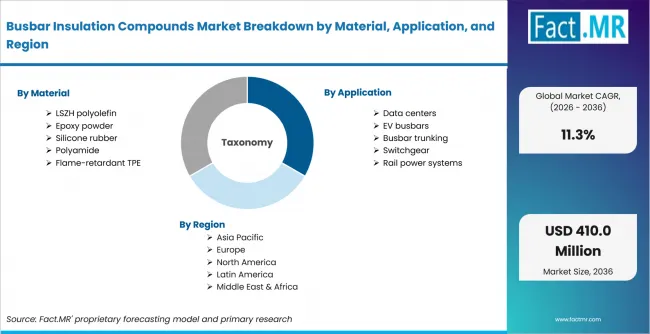
Busbar Insulation Compounds Market Breakdown By Material, Application, And Region | Source: Fact.MR
| Attribute | Details |
|---|---|
| Quantitative Units | USD million in 2026 to USD million by 2036 at CAGR |
| Market Definition | Low-smoke, halogen-free, fire-safe, dielectric, heat-resistant, and arc-resistant insulation compounds used in busbar systems and electrical power-distribution components |
| Material | LSZH polyolefin; Epoxy powder; Silicone rubber; Polyamide; Flame-retardant TPE |
| Application | Busbar trunking; EV busbars; Data centers; Switchgear; Rail power systems |
| Performance | Low smoke; Dielectric strength; Thermal endurance; Flame retardancy; Arc resistance |
| End User | Busbar manufacturers; Switchgear OEMs; EV component makers; Data center integrators |
| Form | Extruded sleeve; Molded insulation; Powder coating; Heat-shrink; Encapsulant |
| Regions Covered | North America; Europe; Asia Pacific; Central & South America; Middle East & Africa |
| Countries Covered | Germany; Brazil; United States |
| Key Companies Profiled | Borealis; Avient; SABIC; Dow; HEXPOL; Saint-Gobain |
| Forecast Period | 2026 to 2036 |
| Approach | Hybrid top-down and bottom-up review using electrical-equipment activity, application fit, material adoption, segment shares, country growth, and company validation |
Source: Fact.MR analysis. Updated Jul 16, 2026
How is the market segmented?
-
By Material
- LSZH polyolefin
- Epoxy powder
- Silicone rubber
- Polyamide
- Flame-retardant TPE
-
By Application
- Busbar trunking
- EV busbars
- Data centers
- Switchgear
- Rail power systems
-
By Performance
- Low smoke
- Dielectric strength
- Thermal endurance
- Flame retardancy
- Arc resistance
-
By End User
- Busbar manufacturers
- Switchgear OEMs
- EV component makers
- Data center integrators
-
By Form
- Extruded sleeve
- Molded insulation
- Powder coating
- Heat-shrink
- Encapsulant
-
By Region
- North America
- United States
- Canada
- Europe
- Germany
- United Kingdom
- France
- Italy
- Spain
- Asia Pacific
- Japan
- South Korea
- Australia
- Central & South America
- Brazil
- Argentina
- Mexico
- Chile
- Middle East & Africa
- UAE
- Saudi Arabia
- South Africa
- North America
Frequently Asked Questions
Which Material leads the Busbar Insulation Compounds Market?
Which Application leads the Busbar Insulation Compounds Market?
Which Performance category leads the Busbar Insulation Compounds Market?
Which End User leads the Busbar Insulation Compounds Market?
Which Form leads the Busbar Insulation Compounds Market?
What is the primary driver in the Busbar Insulation Compounds Market?
What is the main restraint in the Busbar Insulation Compounds Market?
Who worked on this report


Preview the report firsthand - request a free sample
Free SampleGet the brochure for pricing and purchase details
Download PDF