Carbon Capture and Sequestration Market (2026 - 2036)
Carbon Capture and Sequestration Market is segmented by Capture Source (Chemicals, Natural Gas Processing, Power Generation, Fertilizers Production, and Others) and End-Use (Enhanced Oil Recovery, Dedicated Storage & Treatment), and Region. Forecast for 2026 to 2036.
Core Findings
Carbon Capture and Sequestration Market Forecast 2026 to 2036
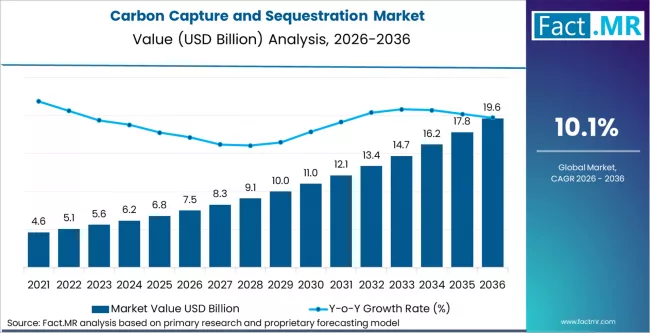
In 2025, the carbon capture and sequestration (CCS) market was valued at USD 7 billion. Based on Fact MR's analysis, demand for CCS technologies is estimated to grow to USD 7.5 billion in 2026 and USD 15.2 billion by 2036. FMR projects a CAGR of 10.1% during the forecast period.
The absolute dollar growth from 2026 to 2036 is USD 7.7 billion. This growth is driven by increasing global efforts to combat climate change, reduce carbon emissions, and implement sustainable energy practices. The market benefits from technological advancements in carbon capture systems, growing regulatory pressures on industries to reduce emissions, and expanding government support for clean energy initiatives. However, challenges such as high capital costs, infrastructure development, and policy uncertainty may impact the growth trajectory in some regions.
As Adrian Corless, Chief Executive Officer of CarbonCapture, noted regarding scaling direct air capture technology for carbon sequestration, ‘This is exactly what has to happen-this alignment with large industrial partners who have the capacity, the access to capital, the skills to actually scale DAC to a meaningful level.’
South Korea leads with a CAGR of 22.6%, driven by its ambitious climate goals and heavy investments in carbon capture technologies. The UK follows with a 21.8% CAGR, supported by strong regulatory frameworks and government incentives for clean energy projects. Japan grows at 21.4%, benefiting from advanced technology adoption and its focus on achieving net-zero emissions. China shows a 21.0% CAGR, reflecting its strong push for carbon reduction technologies in response to increasing industrial emissions. The USA grows at 20.4%, with significant investments in carbon capture projects and a focus on clean energy technologies.
Carbon Capture and Sequestration Market Definition
The carbon capture and sequestration market involves the deployment and sale of technologies that capture carbon dioxide (CO₂) from industrial or energy‑related sources and permanently store it underground or in stable geological formations to reduce atmospheric emissions.
Market Inclusions
This report covers global and regional market sizes for carbon capture and sequestration, including capture technologies, transportation infrastructure, storage solutions, and end‑use applications over a defined forecast period.
Market Exclusions
The scope excludes carbon offset credits, general emissions trading systems, and unrelated environmental services not directly linked to capture or sequestration technologies.
Research Methodology
- Primary Research: Interviews were conducted with technology developers, project operators, and energy sector stakeholders.
- Desk Research: Data was sourced from industry reports, government publications, and trade association data.
- Market‑Sizing and Forecasting: A hybrid model combining top‑down energy and emissions forecasts with bottom‑up project and technology deployment data was used.
- Data Validation and Update Cycle: Findings were validated through expert review and aligned with recent project, production, and storage statistics.
Summary of the Carbon Capture and Sequestration Market
- Market Definition
- The carbon capture and sequestration (CCS) market involves technologies that capture carbon dioxide (CO₂) from industrial and energy-related sources, then transport and store it underground or in stable geological formations to reduce CO₂ emissions and mitigate climate change.
- Demand Drivers
- Climate Change Mitigation: Global efforts to reduce CO₂ emissions, alongside regulatory pressures to comply with decarbonization goals, are key drivers of CCS adoption across sectors like power generation, chemicals, and oil extraction.
- Enhanced Oil Recovery (EOR): EOR remains the largest and most profitable end-use of captured CO₂, as it boosts oil production from mature reservoirs while also sequestering CO₂ underground.
- Technological Advancements: Continued innovation in carbon capture systems has made the technology more cost-effective and scalable, which is essential for widespread adoption.
- Key Segments Analyzed
- Capture Source: Chemicals are expected to lead the segment with 36.7% market share by 2026. The chemical sector is a significant emitter of CO₂, particularly in ammonia and methanol production, making it a crucial area for CCS implementation.
- End-Use: Enhanced Oil Recovery (EOR) is forecast to capture 60.3% of the market share by 2026. The injection of CO₂ into oil reservoirs to increase oil extraction is the most widely adopted and economically viable method for carbon sequestration.
- Analyst Opinion at Fact MR
- "CCS is becoming an increasingly critical technology for industries facing strict emissions regulations and decarbonization targets. The rapid development of large-scale CCS projects, particularly in the oil and gas industry, is poised to accelerate market growth."-Shambhu Nath Jha, Principal Consultant at Fact MR.
- Strategic Implications/Executive Takeaways
- Focus on EOR and Dedicated Storage: Continue to develop and scale EOR projects that combine oil production with carbon sequestration, as these offer both financial and environmental benefits.
- Increase Policy Advocacy: Governments should provide more incentives and regulatory support to stimulate the development of infrastructure and technology for CO₂ transport and storage.
- Technological Innovation: Companies should prioritize R&D in improving the efficiency and reducing the cost of capture and storage methods to make CCS more feasible for industries worldwide.
- Methodology
- Primary research through interviews with industry experts, project operators, and energy stakeholders.
- Desk research based on government publications, industry reports, and trade association data.
Segmental Analysis
Carbon Capture and Sequestration Market Analysis by Capture Source
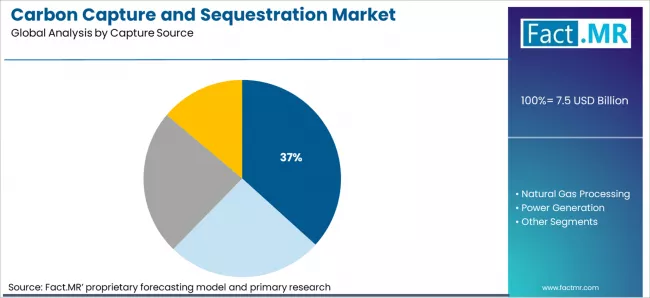
- Market Overview: Chemicals are projected to hold 36.7% of the carbon capture and sequestration market by 2026. The chemical industry is one of the major contributors to carbon emissions, particularly in processes like ammonia and ethylene production, making it a key sector for implementing carbon capture technologies.
- Demand Drivers:
- High Emission Intensity in Chemical Manufacturing: The chemical industry is responsible for significant CO₂ emissions, especially from processes that involve combustion and the production of chemicals like ammonia and methanol. Carbon capture technologies offer an effective solution for mitigating these emissions and meeting environmental regulations.
- Regulatory Pressure and Sustainability Goals: As countries and industries increasingly focus on reducing their carbon footprints, the chemical sector is under pressure to adopt carbon capture and sequestration (CCS) technologies to comply with stricter emissions regulations.
- Technological Advancements in Carbon Capture: Innovations in carbon capture technologies are making it more feasible and cost-effective for the chemical industry to adopt these solutions, further boosting the demand for carbon capture from this sector.
Carbon Capture and Sequestration Market Analysis by End-Use
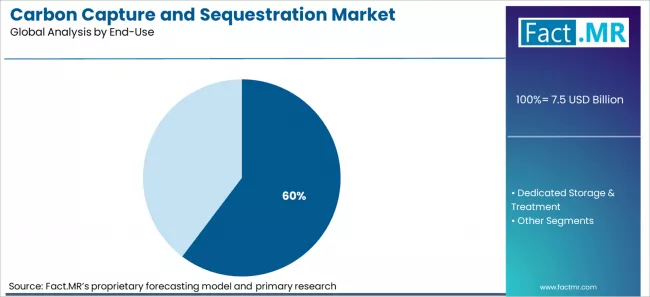
- Market Overview: Enhanced oil recovery (EOR) is expected to capture 60.3% of the market share by 2026. EOR is the largest and most widely utilized end-use application of carbon capture and sequestration. In this process, captured CO₂ is injected into oil reservoirs to increase the amount of crude oil that can be extracted, thereby enhancing oil production.
- Demand Drivers:
- Increasing Oil Production Efficiency: EOR helps maximize the extraction of oil from mature fields, making it a key application for capturing and utilizing CO₂. As oil companies seek to increase production from existing reserves, the use of CO₂ for enhanced oil recovery is becoming more prevalent.
- Economic Viability of EOR Projects: The rising price of oil and the economic benefits of using captured CO₂ for oil recovery are driving the growth of this application. EOR provides a commercial incentive for capturing and utilizing CO₂, helping offset the costs of carbon capture technologies.
- Integration with Carbon Sequestration Goals: EOR provides a way to not only enhance oil recovery but also permanently sequester CO₂ underground, supporting both energy production and climate change mitigation efforts. This dual benefit makes EOR a highly attractive application for carbon capture initiatives.
Carbon Capture and Sequestration Market Drivers, Restraints, and Opportunities
FMR analysts observe that the carbon capture and sequestration (CCS) market is growing due to regulatory pressures and global decarbonization goals. As industries like power generation, cement, and petrochemicals face stricter climate targets, demand for CCS technologies to capture and store CO₂ is increasing. The 2026 market valuation reflects expansion driven by government policies, carbon pricing, and incentives promoting emission reductions in hard‑to‑decarbonize sectors.
While enhanced oil recovery remains significant, the focus is shifting toward dedicated storage infrastructure that decouples growth from oil markets. Advanced CCS projects command higher investment, contributing to market value growth even as adoption scales with regional policy support.
- Regulatory Pressure: Carbon pricing and net‑zero targets drive demand for CCS solutions to meet emission reduction commitments.
- Industrial Decarbonization: Sectors like cement and steel increasingly deploy CCS as alternative emissions reductions methods are insufficient.
- Regional Policy Support: North America and Europe lead in CCS deployment due to strong incentives and storage infrastructure, while Asia‑Pacific follows with emerging frameworks.
Regional Analysis
The market analysis covers key global regions, including East Asia, Western Europe, North America, and South Korea. It is segmented geographically, with specific market dynamics for each region. The full report provides a detailed market attractiveness analysis.
| Country | CAGR (%) |
|---|---|
| South Korea | 22.6% |
| United Kingdom | 21.8% |
| Japan | 21.4% |
| China | 21.0% |
| USA | 20.4% |
Source: Fact MR (FMR) analysis, based on proprietary forecasting model and primary research.
East Asia:
In East Asia, South Korea and China are at the forefront of the carbon capture and sequestration market, driven by government investments and environmental regulations.
- South Korea: Demand for carbon capture and sequestration in South Korea is projected to rise at 22.6% CAGR through 2036. South Korea’s strong governmental support for carbon reduction initiatives and advancements in clean energy technologies continue to drive rapid growth in the market.
- Japan: Demand for carbon capture and sequestration in Japan is projected to rise at 21.4% CAGR through 2036. Japan’s commitment to reducing carbon emissions and ongoing investments in carbon capture technologies contribute to steady market growth.
Western Europe:
In Western Europe, the United Kingdom leads demand for carbon capture and sequestration, with a strong regulatory framework and aggressive sustainability targets driving growth.
- United Kingdom: Demand for carbon capture and sequestration in the UK is projected to rise at 21.8% CAGR through 2036. The UK’s strong climate action plans and public and private sector investments in sustainable technologies continue to push forward market growth.
East Asia:
In China, the carbon capture and sequestration market is rapidly growing, supported by government policies and increased industrial emissions reduction efforts.
- China: Demand for carbon capture and sequestration in China is projected to rise at 21.0% CAGR through 2036. China’s large-scale carbon reduction projects and emphasis on cleaner industrial practices contribute to significant market growth.
North America:
In North America, the USA continues to see increasing demand for carbon capture and sequestration, fueled by federal initiatives and private sector investments in carbon management technologies.
- USA: Demand for carbon capture and sequestration in the U.S. is projected to rise at 20.4% CAGR through 2036. Government incentives and advancements in the energy sector continue to drive the adoption of carbon capture solutions in the country.
Fact MR's analysis of the Carbon Capture and Sequestration Market in East Asia, Western Europe, North America, and South Korea consists of country-wise assessments that include South Korea, the United Kingdom, Japan, China, and the USA. Readers can find detailed trends, regulatory updates, and company-specific investments shaping the market’s growth in these countries.
How Are Key Players Competing in the Carbon Capture and Sequestration Market?

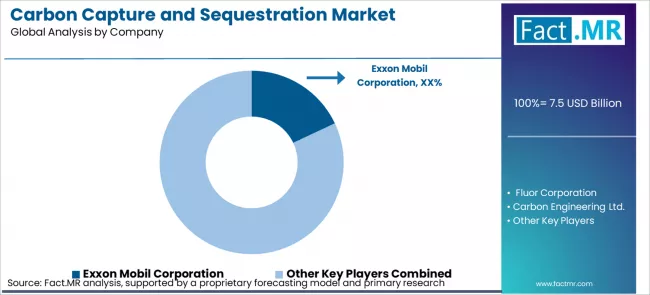
In the carbon capture and sequestration (CCS) market, Exxon Mobil Corporation and Shell plc lead the charge with extensive global portfolios and partnerships focused on large-scale CCS projects. Fluor Corporation and Aker Solutions ASA stand out by providing engineering, procurement, and construction expertise for CCS infrastructure, enabling efficient capture and storage processes. Carbon Engineering Ltd. offers unique direct air capture (DAC) technologies that capture CO2 directly from the atmosphere, positioning itself as a pioneer in the sector. ADNOC Group and Equinor ASA leverage their strong upstream capabilities to support CCS projects, with ADNOC focusing on enhanced oil recovery.
China National Petroleum Corporation (CNPC) and BP p.l.c. focus on large-scale industrial applications and low-carbon technologies, driving international expansion. Linde plc and TotalEnergies SE advance through innovation in CO2 transport and sequestration methods. NRG Energy, Inc. and Dakota Gasification Company explore sustainable solutions to reduce industrial emissions while developing long-term sequestration strategies. This competitive landscape highlights key advancements and regional strategies toward achieving climate goals and reducing CO2 emissions across various sectors.
Recent Industry Developments
- EU Carbon Removal Certification Framework (Regulatory)
- On February 3, 2026, the European Commission adopted the first voluntary certification methodologies under the Carbon Removal Certification Framework (CRCF). This landmark regulation establishes the world's first comprehensive standard for permanent carbon removals, specifically covering Direct Air Capture (DACCS), Bioenergy with CCS (BioCCS), and Biochar.
- U.S. IRS Section 45Q "Safe Harbor" (Regulatory)
- On December 19, 2025, the U.S. Treasury and IRS released Notice 2026-1, establishing a critical "safe harbor" for taxpayers claiming the Section 45Q carbon capture tax credit. This was a direct response to the EPA's proposed repeal of "Subpart RR" reporting obligations.
- India’s ₹20,000 Crore CCUS Outlay (Corporate/Strategic)
- In the Union Budget 2026-27 (announced February 1, 2026), the Government of India allocated ₹20,000 crore (~$2.4 billion) over the next five years specifically for Carbon Capture, Utilisation, and Storage (CCUS).
Key Players of the Carbon Capture and Sequestration Market
- Exxon Mobil Corporation
- Fluor Corporation
- Carbon Engineering Ltd.
- ADNOC Group (Abu Dhabi National Oil Company)
- Equinor ASA
- China National Petroleum Corporation (CNPC)
- Dakota Gasification Company
- Shell plc
- BP p.l.c.
- Chevron Corporation
- Linde plc
- TotalEnergies SE
- Aker Solutions ASA
- NRG Energy, Inc.
Report Scope
| Metric | Value |
|---|---|
| Quantitative Units | USD 7.5 billion (2026) to USD 15.2 billion (2036), at a CAGR of 10.1% |
| Market Definition | The Carbon Capture and Sequestration Market involves technologies used to capture and store carbon emissions from various sources, primarily to mitigate climate change by preventing CO2 from entering the atmosphere. |
| By Capture Source | Chemicals, Natural Gas Processing, Power Generation, Fertilizers Production, Others |
| By End-Use | Enhanced Oil Recovery, Dedicated Storage & Treatment |
| Regions Covered | North America, Latin America, Europe, East Asia, South Asia, Oceania, Middle East and Africa |
| Countries Covered | United States, Canada, Mexico, Brazil, Argentina, Germany, France, United Kingdom, Italy, Spain, China, India, Japan, South Korea, Indonesia, Australia, and 40+ countries |
| Key Companies Profiled | Exxon Mobil Corporation, Fluor Corporation, Carbon Engineering Ltd., ADNOC Group (Abu Dhabi National Oil Company), Equinor ASA, China National Petroleum Corporation (CNPC), Dakota Gasification Company, Shell plc, BP p.l.c., Chevron Corporation, Linde plc, TotalEnergies SE, Aker Solutions ASA, NRG Energy, Inc. |
| Forecast Period | 2026 to 2036 |
| Approach | Hybrid top-down and bottom-up market modeling validated through primary interviews with manufacturers and supported by trade data benchmarking and market research. |
Carbon Capture and Sequestration Market Key Segments
-
Capture Source
- Chemicals
- Natural Gas Processing
- Power Generation
- Fertilizers Production
- Others
-
End-Use
- Enhanced Oil Recovery
- Dedicated Storage & Treatment
-
Region
- North America
- USA
- Canada
- Mexico
- Europe
- Germany
- UK
- France
- Italy
- Spain
- Nordic Countries
- BENELUX
- Rest of Europe
- Asia Pacific
- China
- Japan
- South Korea
- India
- Australia
- Rest of Asia Pacific
- Latin America
- Brazil
- Argentina
- Rest of Latin America
- Middle East and Africa
- Kingdom of Saudi Arabia
- United Arab Emirates
- South Africa
- Rest of Middle East and Africa
- Other Regions
- Oceania
- Central Asia
- Other Markets
- North America

Bibliographies
- Global CCS Institute. (2024). The role of carbon capture and storage in climate change mitigation: Global status and outlook. Global CCS Institute.
- International Energy Agency. (2024). Carbon capture, utilization and storage (CCUS): Technology status, policy frameworks, and deployment pathways. International Energy Agency.
- Massachusetts Institute of Technology Energy Initiative. (2023). Advances in carbon capture and sequestration technologies and deployment pathways. MIT Energy Initiative.
- European Commission. (2026, February 3). Commission implementing act adopting the first voluntary certification methodologies under the Carbon Removal Certification Framework (CRCF). European Commission.
- Internal Revenue Service. (2025, December 19). Notice 2026-1: Section 45Q carbon oxide sequestration credit-Safe harbor for qualified carbon capture equipment. U.S. Department of the Treasury.
- Government of India, Ministry of Finance. (2026). Union Budget 2026-27: Allocations and policy measures for carbon capture, utilization, and storage (CCUS). Government of India.
- Exxon Mobil Corporation. (2024). Carbon capture and storage project portfolio and low-carbon solutions strategy. Exxon Mobil Corporation.
This report addresses:
- Market intelligence enabling comprehensive assessment of leading countries and product segments across the Carbon Capture and Sequestration Market globally.
- Market volume (sales units) estimates and 10-year revenue forecasts from 2026 to 2036, validated through manufacturer shipment data, channel partner surveys, and country-level demand modeling.
- Growth opportunity mapping across capture sources (Chemicals, Natural Gas Processing, Power Generation, Fertilizers Production, and Others), end-use applications (Enhanced Oil Recovery, Dedicated Storage & Treatment), and regions.
- Segment and regional revenue forecasts by capture source, end-use, and geography across 40+ countries.
- Competition strategy analysis covering dealer network structure, recent developments, product portfolio, USPs, and market share analysis.
- Product and regulatory compliance tracking aligned with global carbon reduction policies, emissions regulations, and energy transition frameworks.
- Regulatory impact analysis addressing carbon pricing, net-zero targets, and policy incentives driving CCS technology adoption across key markets.
- Report delivery in PDF, Excel, PowerPoint, and interactive dashboard formats for executive, procurement, and operational planning use.
Table of Content
- Executive Summary
- Global Market Outlook
- Demand to side Trends
- Supply to side Trends
- Technology Roadmap Analysis
- Analysis and Recommendations
- Market Overview
- Market Coverage / Taxonomy
- Market Definition / Scope / Limitations
- Research Methodology
- Chapter Orientation
- Analytical Lens and Working Hypotheses
- Market Structure, Signals, and Trend Drivers
- Benchmarking and Cross-market Comparability
- Market Sizing, Forecasting, and Opportunity Mapping
- Research Design and Evidence Framework
- Desk Research Programme (Secondary Evidence)
- Company Annual and Sustainability Reports
- Peer-reviewed Journals and Academic Literature
- Corporate Websites, Product Literature, and Technical Notes
- Earnings Decks and Investor Briefings
- Statutory Filings and Regulatory Disclosures
- Technical White Papers and Standards Notes
- Trade Journals, Industry Magazines, and Analyst Briefs
- Conference Proceedings, Webinars, and Seminar Materials
- Government Statistics Portals and Public Data Releases
- Press Releases and Reputable Media Coverage
- Specialist Newsletters and Curated Briefings
- Sector Databases and Reference Repositories
- FMR Internal Proprietary Databases and Historical Market Datasets
- Subscription Datasets and Paid Sources
- Social Channels, Communities, and Digital Listening Inputs
- Additional Desk Sources
- Expert Input and Fieldwork (Primary Evidence)
- Primary Modes
- Qualitative Interviews and Expert Elicitation
- Quantitative Surveys and Structured Data Capture
- Blended Approach
- Why Primary Evidence is Used
- Field Techniques
- Interviews
- Surveys
- Focus Groups
- Observational and In-context Research
- Social and Community Interactions
- Stakeholder Universe Engaged
- C-suite Leaders
- Board Members
- Presidents and Vice Presidents
- R&D and Innovation Heads
- Technical Specialists
- Domain Subject-matter Experts
- Scientists
- Physicians and Other Healthcare Professionals
- Governance, Ethics, and Data Stewardship
- Research Ethics
- Data Integrity and Handling
- Primary Modes
- Tooling, Models, and Reference Databases
- Desk Research Programme (Secondary Evidence)
- Data Engineering and Model Build
- Data Acquisition and Ingestion
- Cleaning, Normalisation, and Verification
- Synthesis, Triangulation, and Analysis
- Quality Assurance and Audit Trail
- Market Background
- Market Dynamics
- Drivers
- Restraints
- Opportunity
- Trends
- Scenario Forecast
- Demand in Optimistic Scenario
- Demand in Likely Scenario
- Demand in Conservative Scenario
- Opportunity Map Analysis
- Product Life Cycle Analysis
- Supply Chain Analysis
- Investment Feasibility Matrix
- Value Chain Analysis
- PESTLE and Porter’s Analysis
- Regulatory Landscape
- Regional Parent Market Outlook
- Production and Consumption Statistics
- Import and Export Statistics
- Market Dynamics
- Global Market Analysis 2021 to 2025 and Forecast, 2026 to 2036
- Historical Market Size Value (USD Million) Analysis, 2021 to 2025
- Current and Future Market Size Value (USD Million) Projections, 2026 to 2036
- Y to o to Y Growth Trend Analysis
- Absolute $ Opportunity Analysis
- Global Market Pricing Analysis 2021 to 2025 and Forecast 2026 to 2036
- Global Market Analysis 2021 to 2025 and Forecast 2026 to 2036, By Capture Source
- Introduction / Key Findings
- Historical Market Size Value (USD Million) Analysis By Capture Source , 2021 to 2025
- Current and Future Market Size Value (USD Million) Analysis and Forecast By Capture Source , 2026 to 2036
- Chemicals
- Natural Gas Processing
- Power Generation
- Fertilizers Production
- Chemicals
- Y to o to Y Growth Trend Analysis By Capture Source , 2021 to 2025
- Absolute $ Opportunity Analysis By Capture Source , 2026 to 2036
- Global Market Analysis 2021 to 2025 and Forecast 2026 to 2036, By End-Use
- Introduction / Key Findings
- Historical Market Size Value (USD Million) Analysis By End-Use, 2021 to 2025
- Current and Future Market Size Value (USD Million) Analysis and Forecast By End-Use, 2026 to 2036
- Enhanced Oil Recovery
- Dedicated Storage & Treatment
- Enhanced Oil Recovery
- Y to o to Y Growth Trend Analysis By End-Use, 2021 to 2025
- Absolute $ Opportunity Analysis By End-Use, 2026 to 2036
- Global Market Analysis 2021 to 2025 and Forecast 2026 to 2036, By Region
- Introduction
- Historical Market Size Value (USD Million) Analysis By Region, 2021 to 2025
- Current Market Size Value (USD Million) Analysis and Forecast By Region, 2026 to 2036
- North America
- Latin America
- Western Europe
- Eastern Europe
- East Asia
- South Asia and Pacific
- Middle East & Africa
- Market Attractiveness Analysis By Region
- North America Market Analysis 2021 to 2025 and Forecast 2026 to 2036, By Country
- Historical Market Size Value (USD Million) Trend Analysis By Market Taxonomy, 2021 to 2025
- Market Size Value (USD Million) Forecast By Market Taxonomy, 2026 to 2036
- By Country
- USA
- Canada
- Mexico
- By Capture Source
- By End-Use
- By Country
- Market Attractiveness Analysis
- By Country
- By Capture Source
- By End-Use
- Key Takeaways
- Latin America Market Analysis 2021 to 2025 and Forecast 2026 to 2036, By Country
- Historical Market Size Value (USD Million) Trend Analysis By Market Taxonomy, 2021 to 2025
- Market Size Value (USD Million) Forecast By Market Taxonomy, 2026 to 2036
- By Country
- Brazil
- Chile
- Rest of Latin America
- By Capture Source
- By End-Use
- By Country
- Market Attractiveness Analysis
- By Country
- By Capture Source
- By End-Use
- Key Takeaways
- Western Europe Market Analysis 2021 to 2025 and Forecast 2026 to 2036, By Country
- Historical Market Size Value (USD Million) Trend Analysis By Market Taxonomy, 2021 to 2025
- Market Size Value (USD Million) Forecast By Market Taxonomy, 2026 to 2036
- By Country
- Germany
- UK
- Italy
- Spain
- France
- Nordic
- BENELUX
- Rest of Western Europe
- By Capture Source
- By End-Use
- By Country
- Market Attractiveness Analysis
- By Country
- By Capture Source
- By End-Use
- Key Takeaways
- Eastern Europe Market Analysis 2021 to 2025 and Forecast 2026 to 2036, By Country
- Historical Market Size Value (USD Million) Trend Analysis By Market Taxonomy, 2021 to 2025
- Market Size Value (USD Million) Forecast By Market Taxonomy, 2026 to 2036
- By Country
- Russia
- Poland
- Hungary
- Balkan & Baltic
- Rest of Eastern Europe
- By Capture Source
- By End-Use
- By Country
- Market Attractiveness Analysis
- By Country
- By Capture Source
- By End-Use
- Key Takeaways
- East Asia Market Analysis 2021 to 2025 and Forecast 2026 to 2036, By Country
- Historical Market Size Value (USD Million) Trend Analysis By Market Taxonomy, 2021 to 2025
- Market Size Value (USD Million) Forecast By Market Taxonomy, 2026 to 2036
- By Country
- China
- Japan
- South Korea
- By Capture Source
- By End-Use
- By Country
- Market Attractiveness Analysis
- By Country
- By Capture Source
- By End-Use
- Key Takeaways
- South Asia and Pacific Market Analysis 2021 to 2025 and Forecast 2026 to 2036, By Country
- Historical Market Size Value (USD Million) Trend Analysis By Market Taxonomy, 2021 to 2025
- Market Size Value (USD Million) Forecast By Market Taxonomy, 2026 to 2036
- By Country
- India
- ASEAN
- Australia & New Zealand
- Rest of South Asia and Pacific
- By Capture Source
- By End-Use
- By Country
- Market Attractiveness Analysis
- By Country
- By Capture Source
- By End-Use
- Key Takeaways
- Middle East & Africa Market Analysis 2021 to 2025 and Forecast 2026 to 2036, By Country
- Historical Market Size Value (USD Million) Trend Analysis By Market Taxonomy, 2021 to 2025
- Market Size Value (USD Million) Forecast By Market Taxonomy, 2026 to 2036
- By Country
- Kingdom of Saudi Arabia
- Other GCC Countries
- Turkiye
- South Africa
- Other African Union
- Rest of Middle East & Africa
- By Capture Source
- By End-Use
- By Country
- Market Attractiveness Analysis
- By Country
- By Capture Source
- By End-Use
- Key Takeaways
- Key Countries Market Analysis
- USA
- Pricing Analysis
- Market Share Analysis, 2025
- By Capture Source
- By End-Use
- Canada
- Pricing Analysis
- Market Share Analysis, 2025
- By Capture Source
- By End-Use
- Mexico
- Pricing Analysis
- Market Share Analysis, 2025
- By Capture Source
- By End-Use
- Brazil
- Pricing Analysis
- Market Share Analysis, 2025
- By Capture Source
- By End-Use
- Chile
- Pricing Analysis
- Market Share Analysis, 2025
- By Capture Source
- By End-Use
- Germany
- Pricing Analysis
- Market Share Analysis, 2025
- By Capture Source
- By End-Use
- UK
- Pricing Analysis
- Market Share Analysis, 2025
- By Capture Source
- By End-Use
- Italy
- Pricing Analysis
- Market Share Analysis, 2025
- By Capture Source
- By End-Use
- Spain
- Pricing Analysis
- Market Share Analysis, 2025
- By Capture Source
- By End-Use
- France
- Pricing Analysis
- Market Share Analysis, 2025
- By Capture Source
- By End-Use
- India
- Pricing Analysis
- Market Share Analysis, 2025
- By Capture Source
- By End-Use
- ASEAN
- Pricing Analysis
- Market Share Analysis, 2025
- By Capture Source
- By End-Use
- Australia & New Zealand
- Pricing Analysis
- Market Share Analysis, 2025
- By Capture Source
- By End-Use
- China
- Pricing Analysis
- Market Share Analysis, 2025
- By Capture Source
- By End-Use
- Japan
- Pricing Analysis
- Market Share Analysis, 2025
- By Capture Source
- By End-Use
- South Korea
- Pricing Analysis
- Market Share Analysis, 2025
- By Capture Source
- By End-Use
- Russia
- Pricing Analysis
- Market Share Analysis, 2025
- By Capture Source
- By End-Use
- Poland
- Pricing Analysis
- Market Share Analysis, 2025
- By Capture Source
- By End-Use
- Hungary
- Pricing Analysis
- Market Share Analysis, 2025
- By Capture Source
- By End-Use
- Kingdom of Saudi Arabia
- Pricing Analysis
- Market Share Analysis, 2025
- By Capture Source
- By End-Use
- Turkiye
- Pricing Analysis
- Market Share Analysis, 2025
- By Capture Source
- By End-Use
- South Africa
- Pricing Analysis
- Market Share Analysis, 2025
- By Capture Source
- By End-Use
- USA
- Market Structure Analysis
- Competition Dashboard
- Competition Benchmarking
- Market Share Analysis of Top Players
- By Regional
- By Capture Source
- By End-Use
- Competition Analysis
- Competition Deep Dive
- Exxon Mobil Corporation
- Overview
- Product Portfolio
- Profitability by Market Segments (Product/Age /Sales Channel/Region)
- Sales Footprint
- Strategy Overview
- Marketing Strategy
- Product Strategy
- Channel Strategy
- Fluor Corporation
- Carbon Engineering Ltd.
- ADNOC Group (Abu Dhabi National Oil Company)
- Equinor ASA
- China National Petroleum Corporation (CNPC)
- Dakota Gasification Company
- Exxon Mobil Corporation
- Competition Deep Dive
- Assumptions & Acronyms Used
List Of Table
- Table 1: Global Market Value (USD Million) Forecast by Region, 2021 to 2036
- Table 2: Global Market Value (USD Million) Forecast by Capture Source, 2021 to 2036
- Table 3: Global Market Value (USD Million) Forecast by End-Use, 2021 to 2036
- Table 4: North America Market Value (USD Million) Forecast by Country, 2021 to 2036
- Table 5: North America Market Value (USD Million) Forecast by Capture Source, 2021 to 2036
- Table 6: North America Market Value (USD Million) Forecast by End-Use, 2021 to 2036
- Table 7: Latin America Market Value (USD Million) Forecast by Country, 2021 to 2036
- Table 8: Latin America Market Value (USD Million) Forecast by Capture Source, 2021 to 2036
- Table 9: Latin America Market Value (USD Million) Forecast by End-Use, 2021 to 2036
- Table 10: Western Europe Market Value (USD Million) Forecast by Country, 2021 to 2036
- Table 11: Western Europe Market Value (USD Million) Forecast by Capture Source, 2021 to 2036
- Table 12: Western Europe Market Value (USD Million) Forecast by End-Use, 2021 to 2036
- Table 13: Eastern Europe Market Value (USD Million) Forecast by Country, 2021 to 2036
- Table 14: Eastern Europe Market Value (USD Million) Forecast by Capture Source, 2021 to 2036
- Table 15: Eastern Europe Market Value (USD Million) Forecast by End-Use, 2021 to 2036
- Table 16: East Asia Market Value (USD Million) Forecast by Country, 2021 to 2036
- Table 17: East Asia Market Value (USD Million) Forecast by Capture Source, 2021 to 2036
- Table 18: East Asia Market Value (USD Million) Forecast by End-Use, 2021 to 2036
- Table 19: South Asia and Pacific Market Value (USD Million) Forecast by Country, 2021 to 2036
- Table 20: South Asia and Pacific Market Value (USD Million) Forecast by Capture Source, 2021 to 2036
- Table 21: South Asia and Pacific Market Value (USD Million) Forecast by End-Use, 2021 to 2036
- Table 22: Middle East & Africa Market Value (USD Million) Forecast by Country, 2021 to 2036
- Table 23: Middle East & Africa Market Value (USD Million) Forecast by Capture Source, 2021 to 2036
- Table 24: Middle East & Africa Market Value (USD Million) Forecast by End-Use, 2021 to 2036
List Of Figures
- Figure 1: Global Market Pricing Analysis
- Figure 2: Global Market Value (USD Million) Forecast 2021-2036
- Figure 3: Global Market Value Share and BPS Analysis by Capture Source, 2026 and 2036
- Figure 4: Global Market Y to o to Y Growth Comparison by Capture Source,2026 to 2036
- Figure 5: Global Market Attractiveness Analysis by Capture Source
- Figure 6: Global Market Value Share and BPS Analysis by End-Use, 2026 and 2036
- Figure 7: Global Market Y to o to Y Growth Comparison by End-Use, 2026 to 2036
- Figure 8: Global Market Attractiveness Analysis by End-Use
- Figure 9: Global Market Value (USD Million) Share and BPS Analysis by Region, 2026 and 2036
- Figure 10: Global Market Y to o to Y Growth Comparison by Region, 2026 to 2036
- Figure 11: Global Market Attractiveness Analysis by Region
- Figure 12: North America Market Incremental Dollar Opportunity, 2026 to 2036
- Figure 13: Latin America Market Incremental Dollar Opportunity, 2026 to 2036
- Figure 14: Western Europe Market Incremental Dollar Opportunity, 2026 to 2036
- Figure 15: Eastern Europe Market Incremental Dollar Opportunity, 2026 to 2036
- Figure 16: East Asia Market Incremental Dollar Opportunity, 2026 to 2036
- Figure 17: South Asia and Pacific Market Incremental Dollar Opportunity, 2026 to 2036
- Figure 18: Middle East & Africa Market Incremental Dollar Opportunity, 2026 to 2036
- Figure 19: North America Market Value Share and BPS Analysis by Country, 2026 and 2036
- Figure 20: North America Market Value Share and BPS Analysis by Capture Source, 2026 and 2036
- Figure 21: North America Market Y to o to Y Growth Comparison by Capture Source,2026 to 2036
- Figure 22: North America Market Attractiveness Analysis by Capture Source
- Figure 23: North America Market Value Share and BPS Analysis by End-Use, 2026 and 2036
- Figure 24: North America Market Y to o to Y Growth Comparison by End-Use, 2026 to 2036
- Figure 25: North America Market Attractiveness Analysis by End-Use
- Figure 26: Latin America Market Value Share and BPS Analysis by Country, 2026 and 2036
- Figure 27: Latin America Market Value Share and BPS Analysis by Capture Source, 2026 and 2036
- Figure 28: Latin America Market Y to o to Y Growth Comparison by Capture Source,2026 to 2036
- Figure 29: Latin America Market Attractiveness Analysis by Capture Source
- Figure 30: Latin America Market Value Share and BPS Analysis by End-Use, 2026 and 2036
- Figure 31: Latin America Market Y to o to Y Growth Comparison by End-Use, 2026 to 2036
- Figure 32: Latin America Market Attractiveness Analysis by End-Use
- Figure 33: Western Europe Market Value Share and BPS Analysis by Country, 2026 and 2036
- Figure 34: Western Europe Market Value Share and BPS Analysis by Capture Source, 2026 and 2036
- Figure 35: Western Europe Market Y to o to Y Growth Comparison by Capture Source,2026 to 2036
- Figure 36: Western Europe Market Attractiveness Analysis by Capture Source
- Figure 37: Western Europe Market Value Share and BPS Analysis by End-Use, 2026 and 2036
- Figure 38: Western Europe Market Y to o to Y Growth Comparison by End-Use, 2026 to 2036
- Figure 39: Western Europe Market Attractiveness Analysis by End-Use
- Figure 40: Eastern Europe Market Value Share and BPS Analysis by Country, 2026 and 2036
- Figure 41: Eastern Europe Market Value Share and BPS Analysis by Capture Source, 2026 and 2036
- Figure 42: Eastern Europe Market Y to o to Y Growth Comparison by Capture Source,2026 to 2036
- Figure 43: Eastern Europe Market Attractiveness Analysis by Capture Source
- Figure 44: Eastern Europe Market Value Share and BPS Analysis by End-Use, 2026 and 2036
- Figure 45: Eastern Europe Market Y to o to Y Growth Comparison by End-Use, 2026 to 2036
- Figure 46: Eastern Europe Market Attractiveness Analysis by End-Use
- Figure 47: East Asia Market Value Share and BPS Analysis by Country, 2026 and 2036
- Figure 48: East Asia Market Value Share and BPS Analysis by Capture Source, 2026 and 2036
- Figure 49: East Asia Market Y to o to Y Growth Comparison by Capture Source,2026 to 2036
- Figure 50: East Asia Market Attractiveness Analysis by Capture Source
- Figure 51: East Asia Market Value Share and BPS Analysis by End-Use, 2026 and 2036
- Figure 52: East Asia Market Y to o to Y Growth Comparison by End-Use, 2026 to 2036
- Figure 53: East Asia Market Attractiveness Analysis by End-Use
- Figure 54: South Asia and Pacific Market Value Share and BPS Analysis by Country, 2026 and 2036
- Figure 55: South Asia and Pacific Market Value Share and BPS Analysis by Capture Source, 2026 and 2036
- Figure 56: South Asia and Pacific Market Y to o to Y Growth Comparison by Capture Source,2026 to 2036
- Figure 57: South Asia and Pacific Market Attractiveness Analysis by Capture Source
- Figure 58: South Asia and Pacific Market Value Share and BPS Analysis by End-Use, 2026 and 2036
- Figure 59: South Asia and Pacific Market Y to o to Y Growth Comparison by End-Use, 2026 to 2036
- Figure 60: South Asia and Pacific Market Attractiveness Analysis by End-Use
- Figure 61: Middle East & Africa Market Value Share and BPS Analysis by Country, 2026 and 2036
- Figure 62: Middle East & Africa Market Value Share and BPS Analysis by Capture Source, 2026 and 2036
- Figure 63: Middle East & Africa Market Y to o to Y Growth Comparison by Capture Source,2026 to 2036
- Figure 64: Middle East & Africa Market Attractiveness Analysis by Capture Source
- Figure 65: Middle East & Africa Market Value Share and BPS Analysis by End-Use, 2026 and 2036
- Figure 66: Middle East & Africa Market Y to o to Y Growth Comparison by End-Use, 2026 to 2036
- Figure 67: Middle East & Africa Market Attractiveness Analysis by End-Use
- Figure 68: Global Market - Tier Structure Analysis
- Figure 69: Global Market - Company Share Analysis
- FAQs -
How large is the demand for Carbon Capture and Sequestration in the global market in 2026?
Demand for Carbon Capture and Sequestration in the global market is estimated to be valued at USD 7.5 billion in 2026.
What will be the market size of Carbon Capture and Sequestration in the global market by 2036?
The market size for Carbon Capture and Sequestration is projected to reach USD 15.2 billion by 2036.
What is the expected demand growth for Carbon Capture and Sequestration in the global market between 2026 and 2036?
Demand for Carbon Capture and Sequestration in the global market is expected to grow at a CAGR of 10.1% between 2026 and 2036.
Which end-use sector is expected to dominate the market?
Enhanced Oil Recovery (EOR) is expected to dominate the market, accounting for 60.3% of the market share in 2026, due to the increasing demand for CO₂ injection techniques to enhance oil recovery and extend the life of oil fields.
Which region is expected to show the highest growth rate for Carbon Capture and Sequestration?
South Korea is projected to show the highest regional CAGR at 22.6% during the forecast period, driven by the country's strong commitment to carbon reduction and advancements in carbon capture technologies.
How significant is the growth outlook for the United Kingdom in this market?
The United Kingdom is expected to grow at a CAGR of 21.8%, reflecting significant investments in carbon capture and storage infrastructure, as well as strong governmental support for reducing carbon emissions and meeting climate goals.
What is the growth outlook for Japan in the Carbon Capture and Sequestration market?
Japan is expected to grow at a CAGR of 21.4%, driven by the country's ongoing efforts to achieve carbon neutrality and its focus on utilizing carbon capture technologies for both enhanced oil recovery and industrial emissions reduction.
What is the growth forecast for China in the Carbon Capture and Sequestration market?
China is expected to grow at a CAGR of 21.0%, supported by government policies promoting sustainable energy practices and reducing carbon emissions, as well as the country's large-scale industrial carbon capture projects.
What is the growth forecast for the United States in the Carbon Capture and Sequestration market?
The United States is anticipated to grow at a CAGR of 20.4% from 2026 to 2036, driven by continued investment in carbon capture technologies for both enhanced oil recovery and large-scale industrial applications, along with supportive government policies.
Which company is identified as a leading player in the Carbon Capture and Sequestration market?
Exxon Mobil Corporation is recognized as a leading player in this market, providing innovative carbon capture technologies and solutions, particularly in enhanced oil recovery projects, as well as large-scale carbon storage initiatives.
What is Carbon Capture and Sequestration?
Carbon Capture and Sequestration (CCS) refers to the process of capturing carbon dioxide emissions from industrial sources and power plants, transporting them, and storing them underground to prevent CO₂ from entering the atmosphere and contributing to global warming.
What does the Carbon Capture and Sequestration market include in this report?
The market scope includes various CCS technologies, with a focus on Enhanced Oil Recovery (EOR), where captured CO₂ is injected into oil fields to boost production and permanently sequester the CO₂ underground.
How is the market forecast developed in this report?
The forecast is developed using historical data on carbon capture adoption, trends in enhanced oil recovery projects, and insights from key industry players involved in the development and deployment of carbon capture technologies.
What is meant by the Carbon Capture and Sequestration market in this report?
The market refers to the global production, trade, and consumption of carbon capture and storage solutions, particularly those applied to enhanced oil recovery projects, as well as other sectors aiming to reduce their carbon footprint.