- Base Value(2025): 1.3 Bn
- Estimated Value(2026): 1.4 Bn
- Forecast Value (2036): 2.9 Bn
- CAGR (2026 - 2036): 7.7%
Carbon Fiber-Reinforced Carbon Market Forecast and Outlook By Fact.MR
The carbon fiber-reinforced carbon market was valued at USD 1.3 billion in 2025. The market is projected to reach USD 1.4 billion in 2026 and USD 2.9 billion by 2036, expanding at a CAGR of 7.7% between 2026-2036. Brake discs are expected to lead product type with a 33.1% share in 2026. PAN-based manufacturing is projected to remain the leading manufacturing route with a 52.6% share in 2026. Aerospace and defense is expected to lead end-user demand with a 39.4% share in 2026.
Key Drivers
- High-temperature demand: End users need materials that retain mechanical stability under extreme thermal stress.
- Lightweight performance: Aerospace and premium mobility applications value mass reduction without sacrificing strength.
- Process durability: Furnace and semiconductor-related uses require components that survive harsh process environments.
Key Segments Analyzed in the Report
- Product type: brake discs, aerospace structural parts, furnace components, medical and industrial parts, and others
- Workflow: PAN-based, pitch-based, hybrid, and others
- End user: aerospace and defense, automotive, industrial furnaces, semiconductor and solar, and others
- Region: North America, Latin America, Europe, Asia Pacific, and Middle East and Africa
Analyst Opinion
Shambu Nath Jha, Principal Consultant at Fact.MR says, "This market pays for performance under heat, not for material novelty. The winning suppliers are the ones that can deliver repeatable carbon-carbon quality into applications where failure is not tolerated."
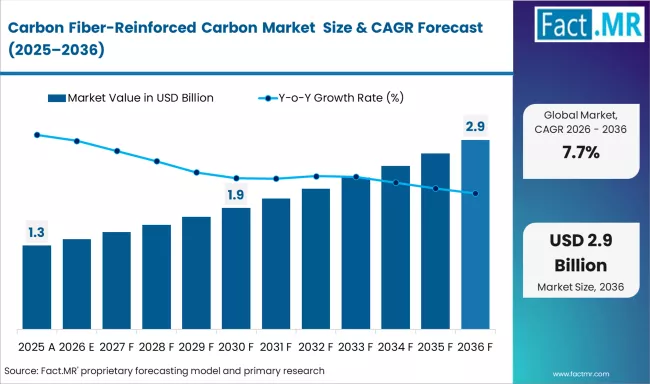
Carbon Fiber Reinforced Carbon Market Market Value Analysis | Source: Fact.MR
Carbon Fiber-Reinforced Carbon Market Definition
The carbon fiber-reinforced carbon market includes carbon-carbon composite materials made by reinforcing carbon matrices with carbon fibers for use in severe thermal and mechanical environments. It covers brake discs, aerospace parts, furnace components, semiconductor-process materials, and related engineered forms produced through PAN-based, pitch-based, and hybrid routes. These products serve aircraft systems, racing and premium automotive programs, thermal-processing equipment, and industrial applications requiring low weight and high temperature resistance.
Carbon Fiber-Reinforced Carbon Market Inclusions
- Carbon-carbon composite materials and parts sold for high-temperature engineered applications
- Revenue generated from brake, aerospace, furnace, and industrial carbon-carbon components
- Demand across North America, Latin America, Europe, Asia Pacific, and Middle East and Africa
Carbon Fiber-Reinforced Carbon Market Exclusions
- Standard CFRP parts that do not use carbon-carbon architecture
- Finished aircraft and vehicle sales
- Graphite products without reinforced carbon-composite structure, except as an adjacent benchmark
Carbon Fiber-Reinforced Carbon Market Research Methodology
This study evaluates the carbon fiber-reinforced carbon market across product type, manufacturing route, end use industry, and region, with 2025 as the base year and forecasts extending from 2026 to 2036. Market value is expressed in USD billion. The assessment incorporates company reports, carbon-material strategy disclosures, aerospace-material positioning, and industrial advanced-material references from major suppliers. Triangulation aligns end-use demand intensity, thermal-performance requirements, supplier capability, and value per component to produce the market estimates.
Key Drivers, Restraints, and Trends in Carbon Fiber-Reinforced Carbon Market
- Drivers: Demand rises where metal alternatives fail under extreme heat, friction, or repeated thermal cycling. Aerospace and defense remain major demand centers because low weight and thermal resistance both matter. Brake applications also support the market in aircraft and high-performance mobility where heat management is a hard engineering problem. Mersen continues to include carbon-carbon composites inside its advanced materials range for severe environments, while Toray keeps signaling long-term expansion in carbon fiber and composite demand tied to decarbonization and advanced mobility.
- Restraints: Manufacturing is capital intensive and slow because densification and quality control are demanding. End-use qualification takes time, especially in aerospace. The market also faces a narrow buyer base compared with broader composite categories. Unit pricing is high, which limits adoption to applications where the performance case is strong. Capacity discipline matters because oversupply can damage margins in advanced carbon materials.
- Trends: Suppliers are concentrating on higher-value niches instead of chasing volume at any cost. SGL Carbon’s 2025 reporting shows weak demand in some carbon-fiber end markets, which reinforces the importance of selective positioning. At the same time, advanced materials tied to semiconductors, thermal systems, and specialty industrial use remain attractive. The market is moving toward application specificity and tighter customer alignment.
Segmental Analysis
Carbon Fiber-Reinforced Carbon Market Analysis by Product Type
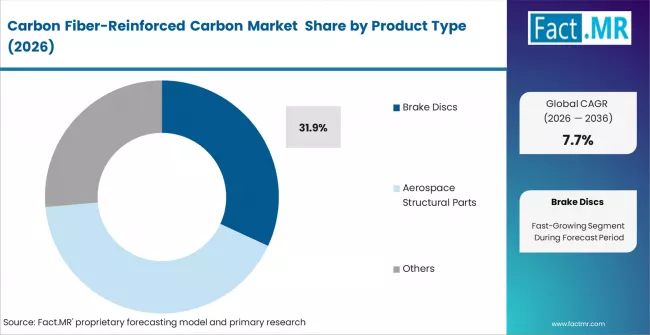
Carbon Fiber Reinforced Carbon Market Analysis By Product Type | Source: Fact.MR
Brake discs is set to hold 31.9% share in 2026 as they convert carbon-carbon’s thermal resilience into a clear performance outcome under repeated high-friction duty cycles. That use case has long qualification histories and high value per component, which keeps it commercially important. The segment also benefits from the concentration of demand in aircraft braking and premium performance systems. Mersen’s advanced-material framing around high-temperature applications supports the logic behind brake-led value capture.
Carbon Fiber-Reinforced Carbon Market Analysis by Workflow
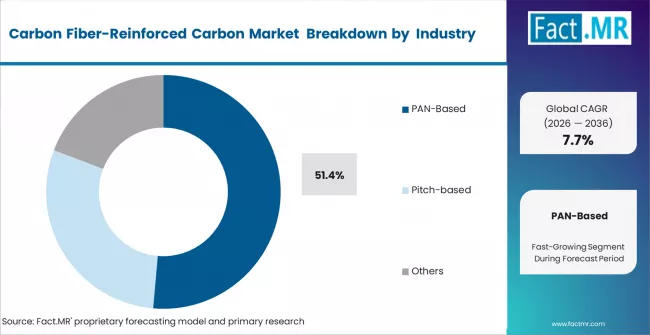
Carbon Fiber Reinforced Carbon Market Analysis By Workflow | Source: Fact.MR
PAN-based manufacturing is likely to hold 51.4% share in 2026 as PAN-derived carbon fibers remain more broadly commercialized and easier to scale across advanced composite supply chains. They solve the need for dependable reinforcement input in a market where process repeatability matters as much as end performance. Toray’s continuing investment and projected carbon-fiber demand growth support the commercial weight of PAN-based routes.
Competitive Aligners for Market Players
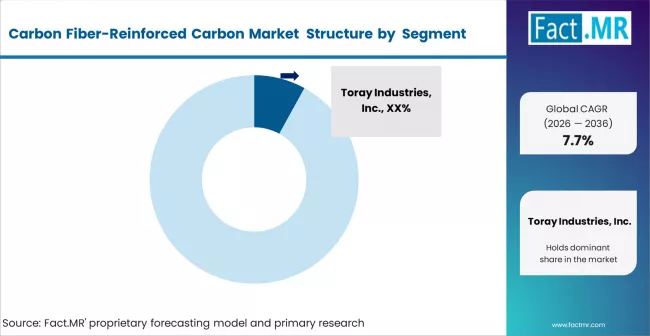
Carbon Fiber Reinforced Carbon Market Analysis By Company | Source: Fact.MR
Toray remains a key player as its position is supported by more than carbon fiber scale. Its broader composite strategy, process expertise, and deep engagement with performance-critical industries give it relevance where customers value technical assurance over low-cost volume. Mersen is relevant for a different but equally important reason. Its advanced-materials positioning keeps carbon-carbon composites connected to high-temperature industrial use cases where functional performance determines asset reliability, maintenance cycles, and operating safety. SGL Carbon’s recent reporting reinforces another structural truth: selective end-market exposure matters. Advanced carbon materials can serve multiple industries, but not all of those industries generate the same margin quality, resilience, or strategic value. Companies that spread themselves too broadly may participate in volume without building pricing power. By contrast, firms that concentrate on premium applications where thermal performance is mission-critical are better positioned to defend margins, justify qualification effort, and build deeper customer dependence. In such markets, discipline in choosing the right applications can be as important as excellence in manufacturing.
Key Players in Carbon Fiber-Reinforced Carbon Market
- Toray Industries, Inc.
- SGL Carbon SE
- Mersen S.A.
- Teijin Limited
- Mitsubishi Chemical Group Corporation
- Nippon Carbon Co., Ltd.
- Toyo Tanso Co., Ltd.
- Tokai Carbon Co., Ltd.
- Schunk Carbon Technology
- Kureha Corporation
Strategic Outlook by Fact.MR on Carbon Fiber-Reinforced Carbon Market
The market is shifting toward fewer, higher-value application pockets where carbon-carbon earns its place through extreme-performance reliability. Through 2036, demand will be shaped by aerospace recovery, specialty industrial thermal applications, and supplier ability to control process economics. Companies with application depth, tight quality systems, and disciplined exposure to premium segments will lead the market.
Bibliography
- Toray Industries, Inc. 2024. TORAY Report 2024.
- Mersen. 2025. Carbon/Carbon Composite Products.
- Mersen. 2025. Carbon Insulation.
- SGL Carbon SE. 2025. Quarterly Statement as of March 31, 2025.
- SGL Carbon SE. 2025. Report on the First Half Year 2025.
- SGL Carbon SE. 2025. Statement on the First Nine Months 2025.
Segmentation
Scope of report
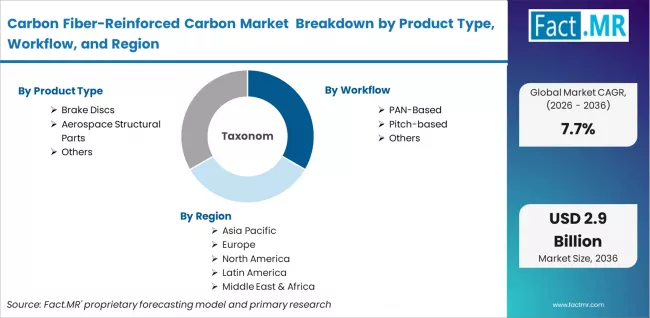
Carbon Fiber Reinforced Carbon Market Breakdown By Product Type, Workflow, And Region | Source: Fact.MR
| Attribute | Details |
|---|---|
| Market | Carbon Fiber-Reinforced Carbon Market |
| Base Year | 2025 |
| Historical Period | 2021 to 2025 |
| Forecast Period | 2026 to 2036 |
| Market Size in 2025 | USD 1.3 billion |
| Estimated Market Size in 2026 | USD 1.4 billion |
| Projected Market Size in 2036 | USD 2.9 billion |
| CAGR | 7.7% from 2026 to 2036 |
| Unit | USD billion |
| Product Type Segments | Brake Discs, Aerospace Structural Parts, Furnace Components, Medical and Industrial Parts, Others |
| Manufacturing Route Segments | PAN-based, Pitch-based, Hybrid, Others |
| End Use Industry Segments | Aerospace and Defense, Automotive, Industrial Furnaces, Semiconductor and Solar, Others |
| Regions Covered | North America, Latin America, Europe, Asia Pacific, Middle East and Africa |
| Key Companies Covered | Toray Industries, Inc.; SGL Carbon SE; Mersen S.A.; Teijin Limited; Mitsubishi Chemical Group Corporation; Nippon Carbon Co., Ltd.; Toyo Tanso Co., Ltd.; Tokai Carbon Co., Ltd.; Schunk Carbon Technology; Kureha Corporation |
Source: Fact.MR analysis. Updated Mar 16, 2026
Frequently Asked Questions
What is the projected size of the Carbon Fiber-Reinforced Carbon Market by 2036?
What is the CAGR of the Carbon Fiber-Reinforced Carbon Market from 2026 to 2036?
Which product type leads the Carbon Fiber-Reinforced Carbon Market in 2026?
Which manufacturing route dominates the Carbon Fiber-Reinforced Carbon Market?
Which end-use industry leads the Carbon Fiber-Reinforced Carbon Market in 2026?
What is driving growth in the Carbon Fiber-Reinforced Carbon Market?
Who worked on this report


Preview the report firsthand - request a free sample
Free SampleGet the brochure for pricing and purchase details
Download PDF