- Market Value (2025): USD 17.4 Bn
- Estimated Value (2026): USD 19.0 Bn
- Forecast Value (2036): USD 45.8 Bn
- CAGR (2026-2036): 9.2%
What is the Cell Based Assays Market forecast to be worth by 2036?
USD 19.0 billion in 2026 to USD 45.8 billion by 2036 at 9.2% CAGR.
USD 26.8 billion absolute opportunity is expected by 2036.
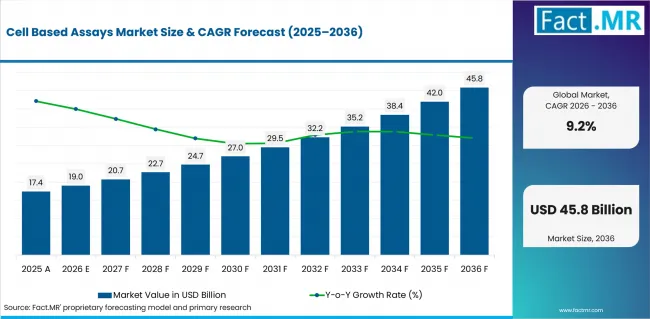
Cell Based Assays Market Value Analysis | Source: Fact.MR
- Demand Drivers in the Market
- Viability and cytotoxicity testing is expected to remain the first purchase trigger.
- Reagents and consumables are projected to lead product spending. Labs replace these items often, so simple formats that fit existing readers are easier to approve.
- Drug discovery programs are anticipated to use more live-cell evidence before lead-stage decisions.
- Key Segments Analyzed
- By Assay Type: Viability & Cytotoxicity Assays is projected to hold 40.2% share in 2026 because users first need to confirm live-cell response.
- By Product: Reagents & Consumables is expected to hold 38.7% share in 2026 as repeated testing creates steady replacement demand.
- By Application: Drug Discovery & Development is anticipated to capture 32.7% share in 2026 since assay evidence supports compound review.
- By End User: Pharmaceutical & Biotechnology Companies is estimated to represent 35.8% share in 2026 due to frequent discovery and validation work.
- By Technology: 2D Cell-based Assays is forecast to hold 51.5% share in 2026 because customers already understand its handling and readout steps.
- Analyst Opinion at Fact.MR
- Shambhu Nath Jha, Senior Analyst at Fact.MR, states, “In the cell based assays market the practical test is whether viability and cytotoxicity assays solve a workflow problem without creating a second review burden. Customers are expected to favor providers that connect assay claims with operating evidence instead of catalog breadth.”
- Strategic Implications
- Laboratory operators should prioritize assay formats that give repeatable cell-health evidence before workflow expansion.
- Product providers can improve customer confidence by pairing reagents, consumables and readers with simple validation support.
- Investors should separate broad life-science spending from workflows that lower development uncertainty.
Canada is projected at 7.3%; France is projected at 8.3%; South Korea is projected at 6.5%; USA is projected at 12.0%; UK is projected at 10.1%; Germany is projected at 11.1%; Japan is projected at 9.2% during 2026 to 2036.
How does the Cell Based Assays Market break down by segment?
Viability & Cytotoxicity Assays is expected to lead Assay Type at 40.2% share in 2026. Reagents & Consumables is projected to lead Product at 38.7% share in 2026.
Which assay type dominates?
Viability & Cytotoxicity Assays is projected to account for 40.2% share in 2026.
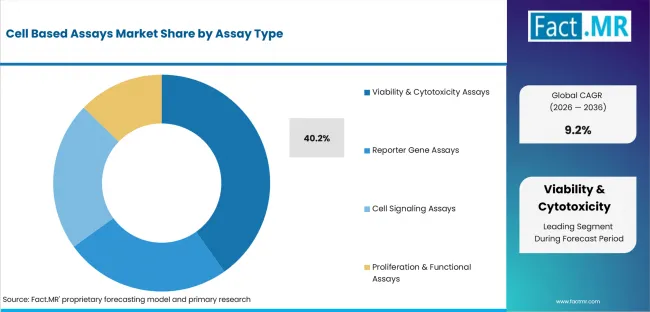
Cell Based Assays Market Analysis By Assay Type | Source: Fact.MR
Users favor viability and cytotoxicity assays because they reveal how cells respond before deeper drug testing begins. Cell Viability Assays offer a simpler health check, while Cytotoxicity Assays help laboratories identify and explain treatment-related cell damage.
What leads the Product segment?
Reagents & Consumables is expected to hold 38.7% share in 2026.
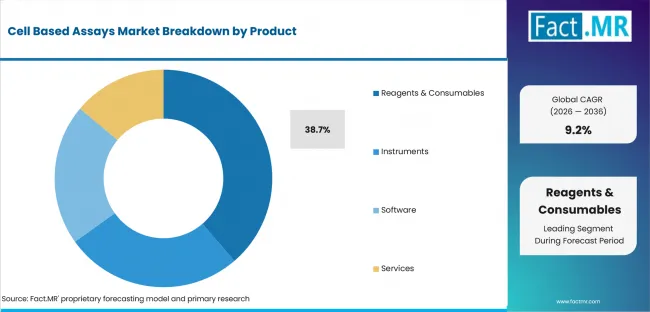
Cell Based Assays Market Analysis By Product | Source: Fact.MR
Frequent testing keeps demand for fresh plates, dyes and detection materials high. Assay Kits provide a more standardized testing route. Cell line development also supports purchases by helping laboratories reduce variation and maintain more consistent assay performance.
How does Application shape demand?
Drug Discovery & Development is anticipated to capture 32.7% share in 2026.
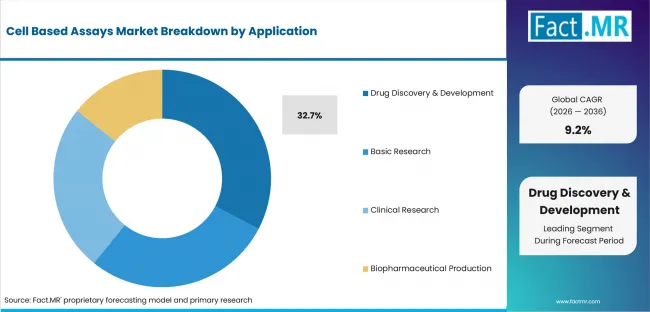
Cell Based Assays Market Analysis By Application | Source: Fact.MR
Assay results guide early decisions on whether a drug candidate should advance. High-throughput Screening supports the testing of large compound libraries. Lead Optimization and Toxicity Testing become more valuable when dose-response findings clarify both performance and safety.
What supports Pharmaceutical & Biotechnology Companies within End User?
Pharmaceutical & Biotechnology Companies is estimated to represent 35.8% share in 2026.
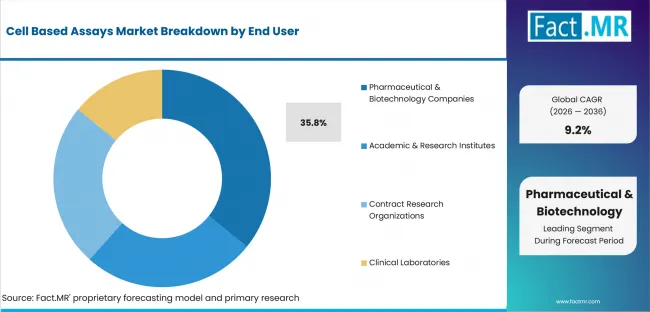
Cell Based Assays Market Analysis By End User | Source: Fact.MR
These companies generate steady demand through frequent discovery, screening and validation work. Biotechnology firms often use assays for more specialized research programs. Immunofluorescence assays add value when teams need imaging evidence alongside cell viability results.
What supports 2D Cell-based Assays within Technology?
2D Cell-based Assays is forecast to hold 51.5% share in 2026.
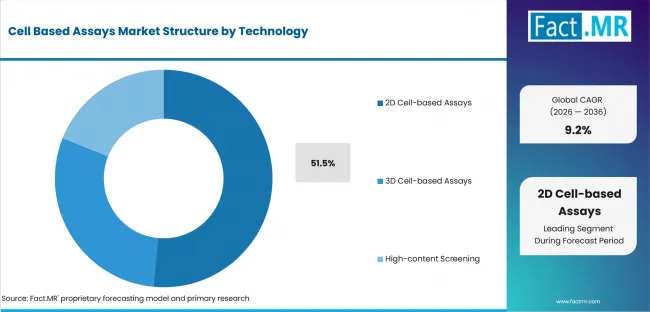
Cell Based Assays Market Analysis By Technology | Source: Fact.MR
Familiar handling and plating methods keep 2D cell-based assays widely used. Adherent Cell Assays remain suitable where cell attachment influences result quality. Flow cytometry becomes relevant when researchers require more detailed information at the individual-cell level.
What is accelerating Cell Based Assays Market adoption, and what is holding it back?
Demand is expected to grow through assay validation, regular consumables use and drug screening. Adoption may be limited by workflow differences, high costs and lengthy performance checks.
Drivers Impact Analysis
| DRIVER | QUALITATIVE RELEVANCE | GEOGRAPHIC RELEVANCE | IMPACT TIMELINE |
|---|---|---|---|
| Viability and cytotoxicity validation | High | Canada, France, USA | Short term (<= 2 years) |
| Reagents and consumables replenishment | High | North America and Europe | Short term (<= 2 years) |
| Drug discovery screening demand | High | USA, South Korea, Japan | Medium term (2-4 years) |
| Cell therapy development controls | Moderate | Canada, UK, Germany | Medium term (2-4 years) |
| 2D workflow familiarity | Selective | Established research markets | Long term (>= 4 years) |
Source: Fact.MR analysis. Updated Jul 29, 2026
- Viability and cytotoxicity validation: Laboratories are expected to place more weight on assays that explain cell health before deeper screening begins. This driver matters most when routine methods must be easy to repeat.
- Reagents and consumables replenishment: Recurring test work is projected to keep product replacement steady across high-use labs. Demand improves when reagents fit existing workflows without added protocol work.
- Drug discovery screening demand: Screening programs are anticipated to use cell-based results earlier in compound review. This gives assays more budget attention when they reduce uncertainty before lead optimization.
Opportunity Impact Analysis
| OPPORTUNITY | QUALITATIVE RELEVANCE | GEOGRAPHIC RELEVANCE | IMPACT TIMELINE |
|---|---|---|---|
| Validated consumables bundles | High | Canada and France | Medium term (2-4 years) |
| High-content workflow packages | Moderate | South Korea, Japan, USA | Medium term (2-4 years) |
| CRO assay support services | Moderate | USA, UK, Germany | Long term (>= 4 years) |
| Cell therapy assay transfer | Selective | Canada, South Korea, Japan | Long term (>= 4 years) |
Source: Fact.MR analysis. Updated Jul 29, 2026
- Validated consumables bundles: Providers are expected to package reagents, plates and detection materials around a defined workflow. Bundles help customers reduce sourcing steps and keep validation evidence together.
- High-content workflow packages: Imaging and plate-based workflows are projected to create openings where customers need richer evidence than one endpoint. This route works best when reagents and readouts are sold together.
- CRO assay support services: Outsourced assay support is anticipated to grow where smaller companies lack internal testing capacity. CROs convert demand when their methods are clear enough for sponsor review.
Restraints Impact Analysis
| RESTRAINT | QUALITATIVE RELEVANCE | GEOGRAPHIC RELEVANCE | IMPACT TIMELINE |
|---|---|---|---|
| Assay variability across cell types | High | Global | Short term (<= 2 years) |
| Consumables price pressure | Moderate | France, UK, Germany | Medium term (2-4 years) |
| Instrument validation burden | Selective | USA, Canada, Japan | Medium term (2-4 years) |
| Data interpretation gaps | Selective | CRO and clinical lab networks | Long term (>= 4 years) |
Source: Fact.MR analysis. Updated Jul 29, 2026
- Assay variability across cell types: Different cell lines and primary cells can respond differently to the same reagent. This restraint raises method-development time before a lab accepts the assay for routine use.
- Consumables price pressure: Reagent and plate costs are expected to affect repeat ordering where budgets are reviewed tightly. Customers may delay broader rollout when per-test economics are not clear.
- Instrument validation burden: Readers and imaging systems need documented performance before users rely on results. Validation work slows purchases when customers must prove compatibility with existing protocols.
Which countries are scaling Cell Based Assays Market fastest?
The country comparison shows a clear upper group and a more compact middle group. Canada leads because service reach and laboratory access are central to assay purchase decisions. France follows through recurring consumables demand. South Korea benefits from biopharma screening and translational research workflows.
- Canada shows the fastest listed position because broad laboratory networks need dependable assay support over large service areas.
- France follows through reagent and consumables demand where customers value standard formats and simple reorder pathways.
- South Korea holds a stronger middle position as biopharma users expand screening and cell-health testing.
- The USA remains a large installed-base market where discovery programs create steady assay replacement demand.
- The UK and Germany remain close because both markets place weight on documentation and method fit before routine use.
- Japan rounds out the group through careful workflow adoption and demand for proven methods.
Comparable CAGRs can still create different entry conditions across these countries. Deployment timing depends on service depth, validation support and how easily customers can fit assays into existing workflows.
The full report provides country-level CAGR analysis across the profiled regions. Coverage includes North America; Latin America; Europe; East Asia; South Asia and Oceania; and the Middle East and Africa.
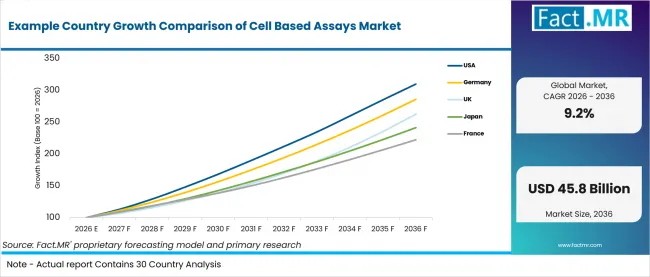
Example Country Growth Comparison Of Cell Based Assays Market | Source: Fact.MR
| Country | CAGR (2026-2036) |
|---|---|
| Canada | 7.3% |
| France | 8.3% |
| South Korea | 6.5% |
| USA | 12.0% |
| UK | 10.1% |
| Germany | 11.1% |
| Japan | 9.2% |
Source: Fact.MR analysis. Updated Jul 29, 2026
What supports Canada adoption?
7.3% CAGR, supported by service reach and dispersed laboratory demand.
Canada’s growth reflects a market where customers need assay support across hospital network labs and research centers. Providers with dependable consumables supply are expected to gain stronger order confidence.
How is France scaling demand?
8.3% CAGR, driven by reagent workflow depth and compliance-led purchasing.
France is expected to scale through laboratories that value standard kits, controlled consumables and clear product documents. The purchase case becomes stronger when assay materials fit existing research and testing workflows.
What is driving South Korea?
6.5% CAGR, backed by biopharma research and translational workflow use.
South Korea’s demand is expected to rise as pharmaceutical and biotechnology companies expand cell-based screening. Assay providers gain attention when they show clear use in drug discovery and cell-health testing.
How does the USA support steady demand?
12.0% CAGR, supported by established discovery activi ty and assay infrastructure.
The USA remains a large demand center because pharmaceutical and biotechnology companies already use cell-based assays in discovery and validation work. Growth is expected to depend on workflow upgrades.
What supports the UK outlook?
10.1% CAGR, shaped by research networks and clinical translation demand.
The UK market is expected to benefit from research programs that need dependable cell-health and cytotoxicity evidence. Providers gain value when assays support both early screening and later validation.
How is Germany positioned?
11.1% CAGR, supported by quality-focused laboratory demand and process discipline.
Germany is expected to scale through laboratories that place weight on documentation, repeatability and product reliability. Assay providers must show that methods remain stable before customer workflows change.
What is shaping Japan?
9.2% CAGR, guided by established research use and careful workflow adoption.
Japan is expected to remain a steady market because users often favor proven assay methods and dependable technical support. Demand comes from laboratories that need repeatable readouts before adopting new platforms.
Who leads the Cell Based Assays Market?
Thermo Fisher Scientific Inc. and Danaher Corporation show the direct relevance, while Merck KGaA broadens the reagent and assay supply base.
Thermo Fisher Scientific supports the market with cell viability and cytotoxicity products. Danaher adds assay and imaging capabilities, while Merck KGaA and Bio-Rad Laboratories provide reagents and readers. PerkinElmer, Agilent Technologies and Promega expand cell-health testing options. Competition will depend on proven workflows, technical support and validated kits linked with cell sorting and live-cell analysis to retain repeat customer accounts.
Which companies are the key providers?
Key companies include Thermo Fisher Scientific Inc.; Danaher Corporation; Merck KGaA; Bio-Rad Laboratories; Revvity, Inc.; Agilent Technologies; and Promega Corporation.
- Thermo Fisher Scientific Inc.
- Danaher Corporation
- Merck KGaA
- Bio-Rad Laboratories
- Revvity, Inc.
- Agilent Technologies
- Promega Corporation
Bibliography
- U.S. Food and Drug Administration. (2024, January). Q5A(R2) viral safety evaluation of biotechnology products derived from cell lines of human or animal origin: Guidance for industry.
- U.S. Food and Drug Administration. (2024, April). Safety testing of human allogeneic cells expanded for use in cell-based medical products: Draft guidance for industry.
- National Institutes of Health. (2024, April 18). NIH researchers develop AI tool with potential to more precisely match cancer drugs to patients.
- Agilent Technologies, Inc. (2024, February 8). Agilent wins two Scientists’ Choice Awards for drug discovery and development products.
This Report Answers
- The report provides strategic intelligence on the Cell Based Assays Market across Assay Type and Product choices that shape live-cell testing workflows.
- Segment analysis covers Viability & Cytotoxicity Assays and Reagents & Consumables as the share leaders within the 2026 market.
- Country outlook evaluates Canada and France alongside South Korea and the USA. The UK, Germany and Japan complete the growth comparison across profiled markets.
- Competitive analysis profiles Thermo Fisher Scientific Inc. and Danaher Corporation alongside Merck KGaA and Bio-Rad Laboratories. Revvity, Inc., Agilent Technologies and Promega Corporation complete the provider set.
- Technology assessment covers 2D Cell-based Assays and 3D Cell-based Assays. High-content Screening completes the technology view alongside cell characterization.
What does the Cell Based Assays Market cover?
Cell based assays measure living-cell response under defined laboratory conditions.
The cell based assays market covers products and services used for viability and cytotoxicity readouts. Coverage extends to assay reagents and related systems. Drug discovery and biopharmaceutical production are included where live-cell evidence supports a real workflow decision.
What is included in the scope?
Cell based assays are used across pharmaceutical companies and biotechnology companies. Research institutes, CROs and clinical laboratories are also included.
The scope includes Assay Type; Product; Application; End User; and Technology. Coverage spans viability and cytotoxicity testing along with reporter gene assays. Cell signaling assays and functional assays are included when they support live-cell readout workflows. Regional coverage follows the countries and regions listed in the scope table.
What is excluded from the scope?
General laboratory products and unrelated testing services remain outside the scope of this market.
The scope excludes products that do not support cell-based readouts. Standalone molecular tests are excluded when no live-cell response is measured. General reagent spending is excluded unless it supports assay execution. Broad biopharma revenue is excluded when it cannot be tied to assay products or services.
How Was the Analysis Built?
The analysis draws on 120+ sources, 35+ company portfolios, 25+ countries, and more than 20 industry interviews.
- Primary Research: Primary research includes discussions with manufacturers, service providers, technology developers, distributors, end users, procurement teams, and subject-matter experts. These conversations examine purchasing priorities, product adoption, operational challenges, approval requirements, competitive positioning, and the factors that influence wider market acceptance.
- Desk Research: Desk research covers government statistics, regulatory publications, company filings, trade data, technical studies, industry associations, standards, public policy, and other authoritative sources. Every source used in the analysis is documented in the bibliography.
- Market Sizing and Forecasting: Market estimates combine historical performance, demand indicators, pricing and volume trends, segment shares, company participation, country-level growth, adoption patterns, investment activity, and barriers to market expansion.
- Data Validation and Update Cycle: Findings are validated by comparing primary interviews with public data, company activity, regulatory changes, trade patterns, and industry developments. Regular updates review new product launches, capacity changes, partnerships, approvals, procurement trends, and shifts in commercial adoption.
Segmentation
What is the report’s scope and coverage?
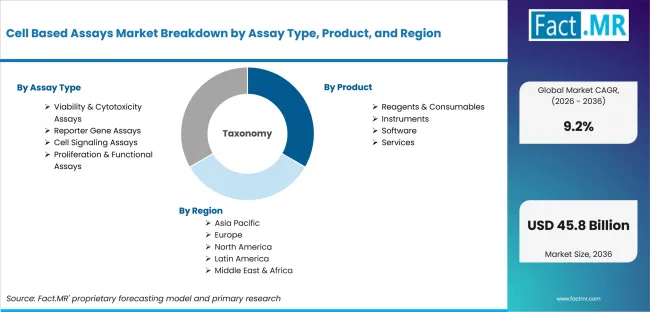
Cell Based Assays Market Breakdown By Assay Type, Product, And Region | Source: Fact.MR
| Attribute | Details |
|---|---|
| Quantitative Units | USD billion in 2026 to USD billion by 2036 at CAGR |
| Market Definition | Live-cell assay systems and related products used to measure viability; cytotoxicity; drug response; and cell-level biological activity in research and testing workflows |
| Assay Type | Viability & Cytotoxicity Assays; Cell Viability Assays; Cytotoxicity Assays; Apoptosis Assays; Reporter Gene Assays; Cell Signaling Assays; Proliferation & Functional Assays |
| Product | Reagents & Consumables; Instruments; Software; Services |
| Application | Drug Discovery & Development; Basic Research; Clinical Research; Biopharmaceutical Production |
| End User | Pharmaceutical & Biotechnology Companies; Academic & Research Institutes; Contract Research Organizations; Clinical Laboratories |
| Technology | 2D Cell-based Assays; 3D Cell-based Assays; High-content Screening |
| Regions Covered | North America; Latin America; Europe; East Asia; South Asia and Oceania; Middle East and Africa |
| Countries Covered | Canada; France; South Korea; USA; UK; Germany; Japan |
| Key Companies Profiled | Thermo Fisher Scientific Inc.; Danaher Corporation; Merck KGaA; Bio-Rad Laboratories; Revvity, Inc.; Agilent Technologies; Promega Corporation |
| Forecast Period | 2026 to 2036 |
| Approach | Hybrid top-down and bottom-up approach using assay workflow demand; reagent and consumables use; discovery screening activity; end-user adoption patterns; country growth reasoning; product portfolio review; customer validation burden; service access; and company participation |
Source: Fact.MR analysis. Updated Jul 29, 2026
How is the market segmented?
-
By Assay Type:
- Viability & Cytotoxicity Assays
- Cell Viability Assays
- Cytotoxicity Assays
- Apoptosis Assays
- Reporter Gene Assays
- Luciferase Reporter Assays
- Fluorescent Reporter Assays
- Beta-galactosidase Reporter Assays
- Cell Signaling Assays
- GPCR Assays
- Kinase Assays
- Second Messenger Assays
- Proliferation & Functional Assays
- Cell Proliferation Assays
- Cell Migration Assays
- Cell Invasion Assays
-
By Product:
- Reagents & Consumables
- Assay Kits
- Cell Culture Media
- Detection Reagents
- Instruments
- Microplate Readers
- High-content Screening Systems
- Flow Cytometers
- Software
- Data Analysis Software
- Image Analysis Software
- Laboratory Information Management Systems
- Services
- Assay Development Services
- Screening Services
- Data Interpretation Services
-
By Application:
- Drug Discovery & Development
- High-throughput Screening
- Lead Optimization
- Toxicity Testing
- Basic Research
- Cell Biology Research
- Gene Function Studies
- Signal Transduction Research
- Clinical Research
- Biomarker Discovery
- Personalized Medicine Research
- Translational Research
- Biopharmaceutical Production
- Cell Line Development
- Process Optimization
- Quality Control Testing
-
By End User:
- Pharmaceutical & Biotechnology Companies
- Pharmaceutical Companies
- Biotechnology Companies
- Cell Therapy Developers
- Academic & Research Institutes
- Universities
- Government Research Centers
- Non-profit Research Institutes
- Contract Research Organizations
- Preclinical CROs
- Discovery CROs
- Bioanalytical CROs
- Clinical Laboratories
- Hospital Laboratories
- Reference Laboratories
- Diagnostic Laboratories
-
By Technology:
- 2D Cell-based Assays
- Adherent Cell Assays
- Suspension Cell Assays
- Primary Cell Assays
- 3D Cell-based Assays
- Spheroid Models
- Organoid Models
- Hydrogel-based Models
- High-content Screening
- Automated Imaging
- AI-assisted Image Analysis
- Multiparametric Analysis
-
By Region:
- North America
- Latin America
- Europe
- East Asia
- South Asia and Oceania
- Middle East and Africa
Frequently Asked Questions
Which Assay Type leads the market?
Which Product category leads the market?
Which Application leads the market?
Which End User leads the market?
Which Technology leads the market?
Which country records the highest listed CAGR?
What is the primary driver in this market?
What is the main restraint?
Why do Reagents & Consumables lead demand?
Who worked on this report


Preview the report firsthand - request a free sample
Free SampleGet the brochure for pricing and purchase details
Download PDF