- Market Value (2025): USD 14.9 Bn
- Estimated Value (2026): USD 15.5 Bn
- Forecast Value (2036): USD 24.0 Bn
- CAGR (2026-2036): 4.4%
What is the Laxatives Market forecast to be worth by 2036?
USD 15.5 billion in 2026 to USD 24.0 billion by 2036 at a 4.4% CAGR.
- As per Fact.MR analysis, the laxatives market is estimated to reach USD 14.9 billion in 2025.
- Demand will increase from USD 15.5 billion in 2026 to USD 24.0 billion by 2036.
- The laxatives market will record a 4.4% CAGR from 2026 to 2036.
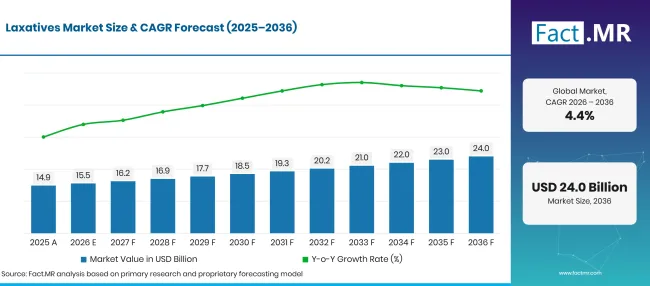
Factmr Laxatives Market Forecast Global | Source: Fact.MR
| Year | Basis | Market value (USD Billion) |
|---|---|---|
| 2025 | Estimate | 14.9 |
| 2026 | Estimate | 15.5 |
| 2036 | Forecast | 24.0 |
| CAGR 2026 to 2036 | Forecast period | 4.4% |
Source: Fact.MR analysis. Updated Oct 16, 2026
What are the defining numbers behind Laxatives Market growth?
An absolute market opportunity of USD 8.5 billion is projected between 2026 and 2036.
- Demand Drivers in the Market
- The laxatives market is witnessing sustained demand as healthcare providers and consumers are prioritizing effective constipation management. An expanding range of osmotic, bulk-forming, stimulant, and stool-softening formulations is supporting treatment selection based on individual patient requirements and professional recommendations [1, 2].
- Ageing populations will continue influencing healthcare demand, creating a relevant opportunity for products serving geriatric patients [3]. Meanwhile, retail pharmacies will remain a key distribution channel, supported by their accessibility, while hospital and online pharmacies will continue expanding product access across eligible patient groups.
- Oral formulations, including tablets, capsules, liquids, and powders, are maintaining a strong market position due to their availability and convenience. These factors will continue shaping product preferences, distribution strategies, and market expansion through 2036.
- Key Segments Analyzed
- By Product Type: Osmotic Laxatives are projected to command 34.2% of the market in 2026.
- By Route of Administration: Oral administration is forecast to constitute 78.4% of the market in 2026, supported by the availability of oral formulations across major laxative types.
- By Distribution Channel: Retail Pharmacies are anticipated to contribute 48.7% of the market in 2026, reflecting their role in providing access to non-prescription and prescribed products.
- By Patient Age Group: Adults are estimated to make up 53.6% of the market in 2026.
- Analyst Opinion at Fact.MR
- Shambhu Nath Jha, Principal Consultant at Fact.MR, states, “The laxatives market will continue expanding as manufacturers focus on accessible formulations and evolving constipation management needs. Osmotic laxatives and oral products will remain key priorities, supported by their leading positions in the market. Companies will increasingly emphasize product quality, formulation suitability, and evidence-based product communication to strengthen market positioning. Suppliers that combine reliable product portfolios with broad pharmacy distribution and patient-focused solutions will be better positioned to capitalize on emerging opportunities through 2036.”
- Strategic Implications
- Osmotic laxative manufacturers must prioritize product quality, formulation suitability, and clear usage instructions to strengthen their position in the leading product segment.
- Oral formulation producers will benefit from maintaining a diversified portfolio of tablets, capsules, liquids, and powders to address varying patient requirements.
- Retail pharmacy distributors need to ensure product availability, accurate information, and appropriate pharmacist guidance to support informed purchasing decisions.
- Online pharmacy operators must maintain reliable fulfilment processes and comply with applicable medicine-sale regulations.
Japan will lead at 5.2% CAGR, followed by the United States at 4.7% as demand for constipation management continues. Germany will record 4.3%, while the United Kingdom will post 3.7%. Brazil will register 3.1%, reflecting comparatively moderate market growth.
How does the Laxatives Market break down by segment?
Osmotic Laxatives will lead Product Type at 34.2%; Oral administration will dominate Route of Administration at 78.4%; Retail Pharmacies will command Distribution Channel at 48.7%; Adults will constitute the largest Patient Age Group at 53.6%.
Which Product Type dominates?
Osmotic Laxatives are forecast to account for 34.2% of the market in 2026.
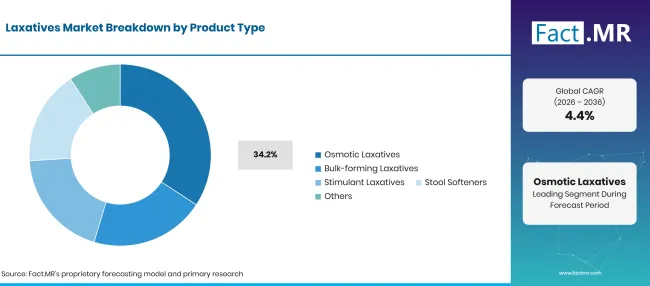
Factmr Laxatives Market Breakdown Product Type | Source: Fact.MR
| Product Type | Share (2026) |
|---|---|
| Osmotic Laxatives (Leading segment) | 34.2% |
| Other segments combined | 65.8% |
| Total | 100.0% |
Source: Fact.MR analysis. Updated Oct 16, 2026
Osmotic laxatives are positioned to lead the product category, supported by their established role in constipation management. These formulations draw water into the bowel, helping soften stools and facilitate bowel movements. Their market position will be shaped by ongoing demand for constipation treatments and the availability of formulations suited to different patient requirements. Bulk-forming laxatives will continue addressing treatment needs associated with increasing stool bulk, while stimulant laxatives will serve patients requiring stimulation of intestinal activity. Stool softeners and other formulations will cater to additional treatment requirements, with product selection guided by symptoms, patient suitability, and professional recommendations.
What supports Oral administration within Route of Administration?
Oral administration is set to command 78.4% of the market in 2026.
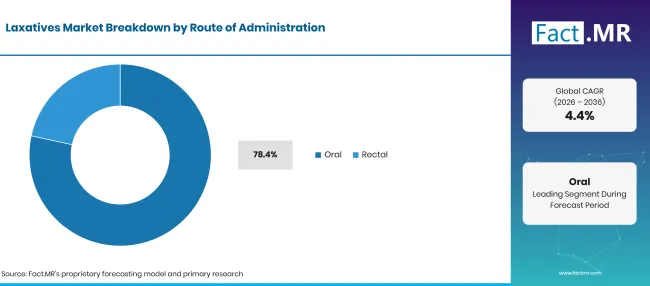
Factmr Laxatives Market Breakdown Route Of Administration | Source: Fact.MR
| Route of Administration | Share (2026) |
|---|---|
| Oral (Leading segment) | 78.4% |
| Other segments combined | 21.6% |
| Total | 100.0% |
Source: Fact.MR analysis. Updated Oct 16, 2026
Oral administration maintains a leading position through the broad availability of tablets, capsules, liquids, and powders across multiple laxative categories. These dosage forms accommodate varying patient preferences and treatment requirements, reinforcing the commercial importance of oral formulations in constipation management. Rectal laxatives will continue catering to patients requiring alternative administration methods. Their use will remain dependent on clinical circumstances, product suitability, and professional guidance.
What leads the Distribution Channel segment?
Retail Pharmacies are forecast to command 48.7% of the market in 2026.
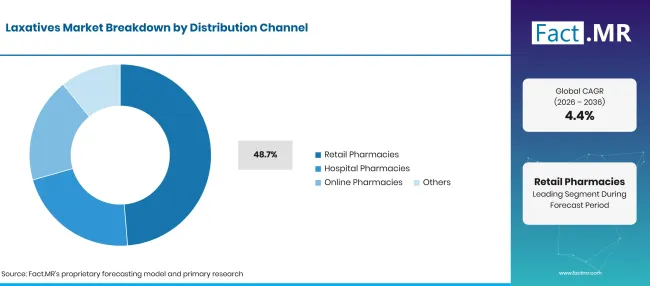
Factmr Laxatives Market Breakdown Distribution Channel | Source: Fact.MR
| Distribution Channel | Share (2026) |
|---|---|
| Retail Pharmacies (Leading segment) | 48.7% |
| Other segments combined | 51.3% |
| Total | 100.0% |
Source: Fact.MR analysis. Updated Oct 16, 2026
Retail pharmacies maintain a central role in laxative distribution by providing access to non-prescription and prescribed products. Product availability, pharmacist guidance, and access to established brands will continue influencing purchasing decisions and channel performance. Hospital pharmacies will remain important for medication provision in institutional healthcare settings, while online pharmacies will broaden purchasing options for eligible products. Other distribution channels will contribute to market access in line with local healthcare systems and applicable regulations.
How does Patient Age Group shape demand?
Adults are set to constitute 53.6% of the market in 2026.
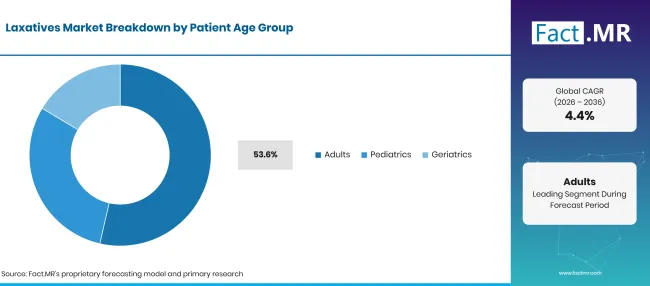
Factmr Laxatives Market Breakdown Patient Age Group | Source: Fact.MR
| Patient Age Group | Share (2026) |
|---|---|
| Adults (Leading segment) | 53.6% |
| Other segments combined | 46.4% |
| Total | 100.0% |
Source: Fact.MR analysis. Updated Oct 16, 2026
Adults retain the leading position in the patient age group segmentation, reflecting the importance of constipation management within adult healthcare. Market demand will continue to be influenced by individual health conditions, lifestyle factors, medication use, and treatment preferences. Paediatric laxatives will cater to children requiring age-appropriate constipation management, while the geriatric segment will remain relevant to the healthcare needs of older adults. Formulation suitability, dosage accuracy, and professional guidance will remain essential considerations across both patient groups.
What is accelerating Laxatives Market adoption, and what is holding it back?
Drivers Impact Analysis
| Driver | (~) % Impact on CAGR | Geographic Relevance | Impact Timeline |
|---|---|---|---|
| Ageing population and rising prevalence of chronic constipation | +1.4% | Global | Medium term (2-4 years) |
| Wider OTC availability and growing self-medication | +0.9% | Global | Short term (≤ 2 years) |
| Opioid-induced constipation and polypharmacy in chronic care | +0.7% | North America, Western Europe, Japan | Medium term (2-4 years) |
| Sedentary lifestyles, low dietary fibre intake and digestive health awareness | +0.6% | South Asia & Pacific, East Asia, Latin America | Long term (≥ 4 years) |
Source: Fact.MR analysis. Updated Oct 16, 2026
Opportunity Impact Analysis
| Opportunity | (~) % Impact on CAGR | Geographic Relevance | Impact Timeline |
|---|---|---|---|
| Convenient formats such as gummies, effervescent powders and sachets | +0.6% | Global | Medium term (2-4 years) |
| Novel prescription therapies for chronic idiopathic constipation and IBS-C | +0.5% | North America, Western Europe, Japan | Long term (≥ 4 years) |
| Growth of e-pharmacy and direct-to-consumer channels | +0.5% | Global | Short term (≤ 2 years) |
Source: Fact.MR analysis. Updated Oct 16, 2026
Restraints Impact Analysis
| Restraint | (~) % Impact on CAGR | Geographic Relevance | Impact Timeline |
|---|---|---|---|
| Safety concerns over prolonged stimulant laxative use and dependence | -0.5% | Global | Short term (≤ 2 years) |
| Competition from probiotics, fibre supplements and dietary alternatives | -0.4% | Global | Medium term (2-4 years) |
| Generic price erosion and reimbursement limits | -0.2% | North America, Western Europe | Long term (≥ 4 years) |
Source: Fact.MR analysis. Updated Oct 16, 2026
Which countries are scaling the Laxatives Market through 2036?
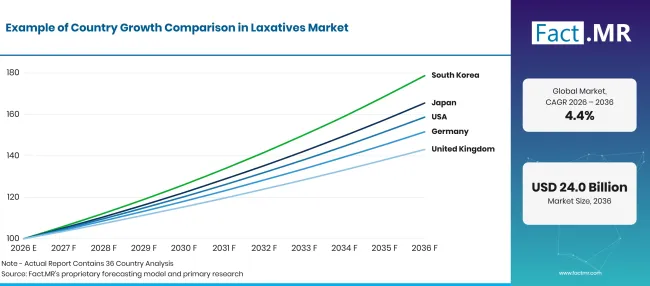
Factmr Laxatives Market Growth Index | Source: Fact.MR
| Country | CAGR (2026–2036) |
|---|---|
| Japan | 5.2% |
| United States | 4.7% |
| Germany | 4.3% |
| United Kingdom | 3.7% |
| Brazil | 3.1% |
Source: Fact.MR analysis. Updated Oct 16, 2026
What supports Japan adoption?
5.2% CAGR, shaped by local product preferences, pharmacy access, and demographic trends.
Japan’s position makes it the fastest-growing country in this forecast comparison. Market participants should evaluate local product preferences, pharmacy access, regulatory requirements, and demographic trends when planning distribution and product portfolios.
How is the United States scaling demand?
4.7% CAGR, placing the United States second in the country forecast.
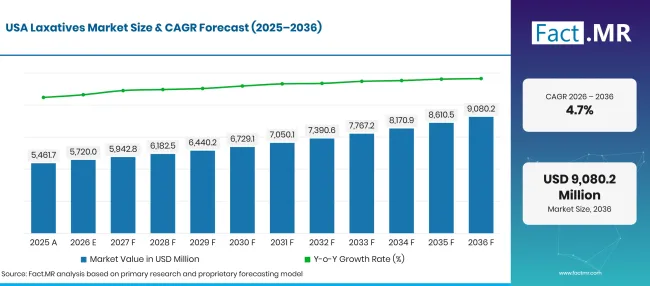
Factmr Laxatives Market Forecast Usa | Source: Fact.MR
Manufacturers and distributors can assess opportunities across retail pharmacies, hospital pharmacies, and online pharmacies. Product availability, consumer information, and compliance with applicable labelling and safety requirements remain important considerations. The figures do not identify the share of market growth attributable to individual distribution channels.
What supports Germany adoption?
4.3% CAGR, placing Germany third among the five countries.
Germany represents a growth market in the forecast. Companies evaluating expansion should consider the requirements of the local pharmaceutical market, product authorisation, distribution arrangements, and patient access. No country-specific sales or demand drivers were to support a more detailed quantitative explanation.
How is the United Kingdom developing demand?
3.7% CAGR, reflecting moderate projected growth in the forecast.
Retail pharmacies, hospital pharmacies, and online channels are relevant routes to market. Suppliers should align product information and distribution practices with applicable UK requirements and account for differences between prescription and non-prescription products where relevant.
What is supporting Brazil’s adoption?
3.1% CAGR, the lowest forecast growth rate among the five countries listed.
Brazil remains part of the market’s projected expansion, although its reported CAGR is below those of Japan, the United States, Germany, and the United Kingdom. Businesses assessing this market should evaluate local regulatory requirements, pharmacy distribution, pricing, and product availability before making investment decisions.
Who leads the Laxatives Market?
Competition spans established consumer healthcare brands and pharmaceutical companies with digestive health portfolios. Bayer markets Dulcolax laxative products, Abbott offers Duphalac, Procter & Gamble sells Metamucil fibre supplements, and Norgine provides Movicol and Normacol. Prestige Consumer Healthcare offers Fleet enemas and suppositories, alongside Pedia-Lax for children.
Opella focuses on self-care and digestive health, while Perrigo supplies private-label gastrointestinal products. Bausch Health maintains a broad gastrointestinal portfolio, while Haleon operate across wider healthcare categories. Competitive positioning will depend on brand strength, formulation diversity, distribution reach, and regulatory compliance.
Which companies are the key providers?
Key companies in the Laxatives Market include Bayer AG, Opella Healthcare, Abbott Laboratories, Procter & Gamble Co., Bausch Health Companies, Haleon plc, Norgine, Perrigo, and Prestige Consumer Healthcare.
- Bayer AG
- Opella Healthcare
- Abbott Laboratories
- Procter & Gamble Co.
- Bausch Health Companies
- Haleon plc
- Norgine
- Perrigo
- Prestige Consumer Healthcare
This Report Answers
- The report outlines the projected size and growth rate of the laxatives market from 2026 to 2036.
- Segment analysis identifies the leading product type, route of administration, distribution channel, and patient age group based on the 2026 market shares.
- Country analysis compares the forecast growth rates for Germany, Brazil, the United States, the United Kingdom, and Japan.
- Competitive analysis lists the key companies identified in the researched market.
- Market driver and restraint analysis reviews factors that may influence demand, product access, and responsible use.
- Scope analysis defines the product categories, routes, distribution channels, patient groups, and countries covered in the report.
What does the Laxatives Market cover?
The Laxatives Market covers products used to relieve constipation and make bowel movements easier. Laxatives work through different mechanisms, including increasing stool bulk, drawing water into the bowel, stimulating bowel movement, or softening stools [2].
The assessment covers osmotic laxatives, bulk-forming laxatives, stimulant laxatives, stool softeners, and other laxative products. It also considers oral and rectal routes of administration, different distribution channels, and adult, paediatric, and geriatric patient groups.
What is included in the scope?
The scope includes laxative products used for constipation management across the defined product categories, routes of administration, distribution channels, and patient age groups. It covers osmotic laxatives, bulk-forming laxatives, stimulant laxatives, stool softeners, and other laxative products.
Oral and rectal formulations are included, alongside sales through retail pharmacies, hospital pharmacies, online pharmacies, and other distribution channels. The assessment covers adult, paediatric, and geriatric patient groups, the countries with growth forecasts, and the ten identified companies.
What is excluded from the scope?
The scope excludes gastrointestinal medicines not classified as laxatives, including unrelated digestive health products. Products used for other therapeutic purposes are excluded unless explicitly classified within the defined laxative categories.
How Was the Analysis Built?
The analysis draws on 120+ sources, 35+ company portfolios, 25+ countries, and more than 20 industry interviews.
- Primary Research: Primary research includes discussions with manufacturers, service providers, technology developers, distributors, end users, and subject-matter experts. These conversations examine purchasing priorities, product adoption, operational challenges, approval requirements, competitive positioning, and the factors that influence wider market acceptance.
- Desk Research: Desk research covers government statistics, regulatory publications, company filings, trade data, technical studies, industry associations, standards, public policy, and other authoritative sources. Every source used in the analysis is documented in the bibliography.
- Market Sizing and Forecasting: Market estimates combine historical performance, demand indicators, pricing and volume trends, segment shares, company participation, country-level growth, adoption patterns, investment activity, and barriers to market expansion.
- Data Validation and Update Cycle: Findings are validated by comparing primary interviews with public data, company activity, regulatory changes, trade patterns, and industry developments. Regular updates review new product launches, capacity changes, partnerships, approvals, and shifts in commercial adoption.
Segmentation
What is the report’s scope and coverage?
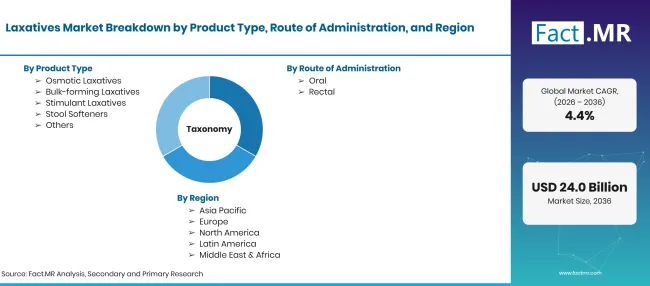
Factmr Laxatives Market Taxonomy | Source: Fact.MR
| Attribute | Details |
|---|---|
| Quantitative Units | USD billion; market value from USD 15.5 billion in 2026 to USD 24.0 billion in 2036, at a CAGR of 4.4% |
| Market Definition | Medicines and products used to relieve constipation and facilitate bowel movements, classified by product type, administration route, distribution channel, and patient age group |
| Product Type | Osmotic Laxatives; Bulk-forming Laxatives; Stimulant Laxatives; Stool Softeners; Others |
| Route of Administration | Oral; Rectal |
| Distribution Channel | Retail Pharmacies; Hospital Pharmacies; Online Pharmacies; Others |
| Patient Age Group | Adults; Pediatrics; Geriatrics |
| Regions Covered | North America; Latin America; Europe; East Asia; South Asia & Pacific; Middle East & Africa |
| Countries Covered | Germany; Brazil; United States; United Kingdom; Japan |
| Key Companies Profiled | Bayer AG; Opella Healthcare; Abbott Laboratories; Procter & Gamble Co.; Bausch Health Companies; Haleon plc; Norgine; Perrigo; Prestige Consumer Healthcare |
| Forecast Period | 2026 to 2036 |
| Approach | Market assessment based on the market values, forecast CAGR, segment shares, country growth rates, and company list, supplemented by public health information on constipation and laxative categories |
Source: Fact.MR analysis. Updated Oct 16, 2026
How is the market segmented?
-
By Product Type
- Osmotic Laxatives
- Bulk-forming Laxatives
- Stimulant Laxatives
- Stool Softeners
- Others
-
By Route of Administration
- Oral
- Rectal
-
By Distribution Channel
- Retail Pharmacies
- Hospital Pharmacies
- Online Pharmacies
- Others
-
By Patient Age Group
- Adults
- Pediatrics
- Geriatrics
-
By Region
- North America
- Latin America
- Europe
- East Asia
- South Asia & Pacific
- Middle East & Africa
Bibliography
- [1] National Institute of Diabetes and Digestive and Kidney Diseases. (2018, May). Symptoms & causes of constipation. U.S. Department of Health and Human Services.
- [2] National Health Service. (2026, April 30). Laxatives.
- [3] World Health Organization. (2025, October 1). Ageing and health.
Frequently Asked Questions
How big is the Laxatives Market in 2026?
What is the CAGR of the Laxatives Market from 2026 to 2036?
Which product type leads the Laxatives Market?
Which route of administration leads the Laxatives Market?
Which distribution channel leads the Laxatives Market?
Which patient age group leads the Laxatives Market?
Which country will grow the fastest in the Laxatives Market?
Who are the main companies in the Laxatives Market?
Who worked on this report


Preview the report firsthand - request a free sample
Free SampleGet the brochure for pricing and purchase details
Download PDF