- Market Value (2025): USD 1.35 Bn
- Estimated Value (2026): USD 1.41 Bn
- Forecast Value (2036): USD 2.12 Bn
- CAGR (2026-2036): 4.2%
What is the Tapentadol Market forecast to be worth by 2036?
USD 1.41 billion in 2026 to USD 2.12 billion by 2036, at a 4.16% CAGR.
- As per Fact.MR analysis, the tapentadol market reached USD 1.35 billion in 2025.
- Demand will increase from USD 1.41 billion in 2026 to USD 2.12 billion in 2036.
- The market is forecast to grow at 4.2% CAGR from 2026 to 2036. Sales will expand through appropriate acute and persistent-pain treatment, with prescribing restrictions and competing therapies keeping growth measured.
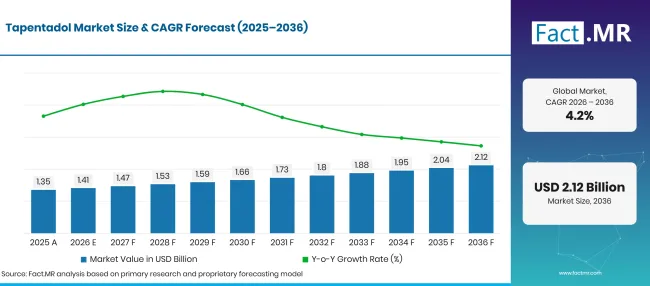
Factmr Tapentadol Market Forecast Global | Source: Fact.MR
| Year | Basis | Market Value (USD billion) |
|---|---|---|
| 2025 | Actual | 1.35 |
| 2026 | Estimate | 1.41 |
| 2036 | Forecast | 2.12 |
| CAGR 2026 to 2036 | Forecast period | 4.2% |
Source: Fact.MR analysis. Updated Oct 16, 2026
What are the defining numbers behind Tapentadol Market growth?
USD 0.71 billion absolute opportunity between 2026 and 2036.
- Demand Drivers in the Market
- The immediate-release formulation serves severe acute pain when alternative treatments are inadequate. This gives suppliers a defined place within opioid medicines, but demand follows individual prescribing decisions rather than the entire population reporting pain. Hospitals and dispensing partners need the correct product available when it is selected. [4]
- Extended-release treatment creates a different replenishment pattern from acute-care prescribing. Its label covers severe persistent pain requiring an opioid when alternatives are inadequate, including specified diabetic peripheral neuropathic pain. Commercial planning therefore needs separate product forecasts and clear strength identification for the two release formats. [3]
- A locally established product range makes procurement more practical. Grünenthal’s German professional-information catalogue lists several tapentadol presentations. For pharmacy buyers, a clear authorised range reduces uncertainty about the product being ordered. Consistent fulfilment can protect an existing account without requiring wider or inappropriate prescribing. [5]
- Specialist pain services can support a relatively concentrated customer base. Japanese hospital research has examined tapentadol in patients with cancer pain, illustrating one specific treatment setting. The sales opportunity rests on accepted local indications and clinician experience. A small clinical study cannot establish national prescription volumes, but it helps identify the type of service where product evaluation occurs. [6]
- Key Segments Analyzed
- By Product Type: Extended Release contributes 58.3% of 2026 sales, ahead of Immediate Release at 41.7%. The two formats address different treatment durations.
- By Application: Pain Management accounts for 64.8% in 2026. Neuropathic Pain is tracked separately at 28.4%, with Others at 6.8%.
- By Distribution Channel: Hospital Pharmacies hold 46.2% of 2026 revenue. Retail and permitted online dispensing account for the remaining channel sales.
- Analyst Opinion at Fact.MR
- Shambhu Nath Jha, Lead Consultant, Fact.MR says, “This is a formulary and supply business, not a mass-consumer analgesic opportunity. A supplier’s position depends on where its product is authorised, how it is paid for and whether pharmacies can obtain the required presentation. Growth should come from serving appropriate prescriptions reliably rather than broadening use beyond accepted clinical practice.”
- Strategic Implications
- Build account plans around the product actually listed by the purchaser. Competition across pain management drugs includes treatments with different benefits and risks. A tapentadol offer needs a clear place in that comparison, supported by the approved label rather than a general claim of superior pain relief. [4] [3]
- Treat medicine-interaction information as part of the commercial service. The MHRA has warned about seizures and reports of serotonin syndrome with certain concomitant medicines. Accurate professional information and pharmacovigilance support are particularly important when customers manage patients receiving several treatments. [7]
- Design fulfilment around controlled-substance obligations. Traceable product movement and lawful prescription processing matter more than making a medicine easy to buy through an unrestricted channel. Brazil’s controlled-substance records document tapentadol’s inclusion, illustrating why a distribution plan must be checked country by country. [1]
- Prepare for a changing alternative-treatment mix. FDA’s 2026 draft guidance addresses development of non-opioid medicines for chronic pain. It does not establish a new approved substitute, but it signals an active development field. Suppliers should follow those alternatives and the treatment settings in which customers may reassess opioid use. [8]
Germany has the fastest projected country growth, followed by the United Kingdom. U.S. demand is tied to established labelled products, while access conditions require closer attention in Brazil. Japan’s outlook is more closely connected to specialist treatment practice than broad retail analgesic purchasing.
How does the Tapentadol Market break down by segment?
Extended Release 58.3%; Pain Management 64.8%; Hospital Pharmacies 46.2% in 2026.
Which Product Type segment leads demand?
The Extended Release segment holds 58.3% share in 2026.
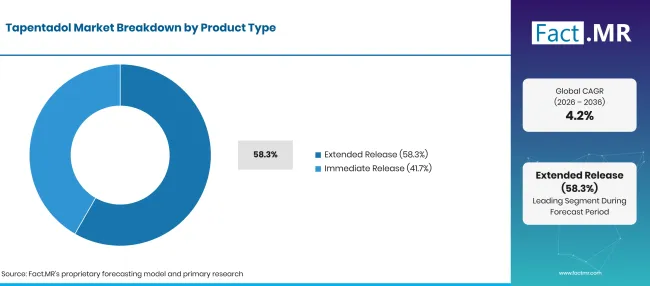
Factmr Tapentadol Market Breakdown Product Type | Source: Fact.MR
| Product Type | Share (2026) |
|---|---|
| Extended Release (Leading segment) | 58.3% |
| Immediate Release | 41.7% |
| Total | 100.0% |
Source: Fact.MR analysis. Updated Oct 16, 2026
Extended-release products lead revenue, while immediate-release products retain an important acute-pain role. Buyers should manage them as separate formulations with distinct product codes and prescribing information. Release behaviour is part of the medicine’s clinical specification; a shared active ingredient does not make the two presentations interchangeable. [3] [4]
Which Application segment leads demand?
The Pain Management segment holds 64.8% share in 2026.
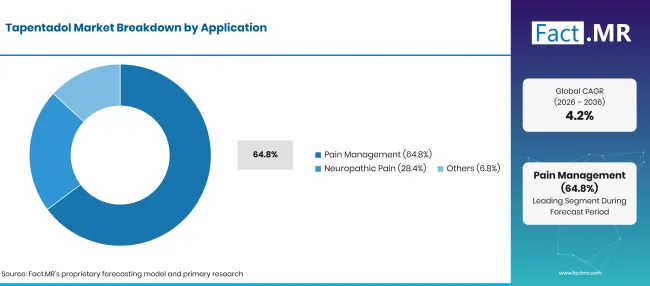
Factmr Tapentadol Market Breakdown Application | Source: Fact.MR
| Application | Share (2026) |
|---|---|
| Pain Management (Leading segment) | 64.8% |
| Neuropathic Pain | 28.4% |
| Others | 6.8% |
| Total | 100.0% |
Source: Fact.MR analysis. Updated Oct 16, 2026
The neuropathic pain category is separated from the broader Pain Management group to avoid overlap. The latter covers other pain indications within the market boundary. Nucynta ER’s U.S. label identifies a specific diabetic peripheral neuropathic pain indication, which should not be extended to every neuropathic condition or assumed to apply in all countries. [3]
Which Distribution Channel segment leads demand?
The Hospital Pharmacies segment holds 46.2% share in 2026.
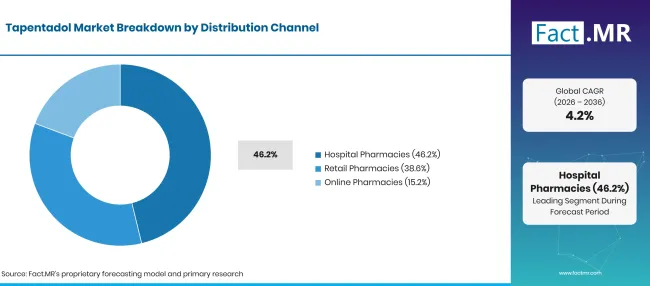
Factmr Tapentadol Market Breakdown Distribution Channel | Source: Fact.MR
| Distribution Channel | Share (2026) |
|---|---|
| Hospital Pharmacies (Leading segment) | 46.2% |
| Retail Pharmacies | 38.6% |
| Online Pharmacies | 15.2% |
| Total | 100.0% |
Source: Fact.MR analysis. Updated Oct 16, 2026
Hospital pharmacies represent the largest dispensing category because institutional treatment and procurement bring demand together. Retail pharmacies fulfil suitable outpatient prescriptions. Online Pharmacies denotes lawful dispensing where local rules permit it, not unrestricted internet sales. Each channel remains subject to the relevant prescription and controlled-medicine requirements. [4] [1]
What is accelerating Tapentadol Market adoption, and what is holding it back?
The balance is between continuity of appropriate treatment and tighter scrutiny of opioid use. Suppliers can improve product availability and account service, but cannot remove clinical selection as the main limit on demand. WHO identifies dependence and overdose as material opioid risks, making responsible access a condition of sustainable market participation. [9]
Drivers Impact Analysis
| DRIVER | (~) % IMPACT ON CAGR | GEOGRAPHIC RELEVANCE | IMPACT TIMELINE |
|---|---|---|---|
| Appropriate extended-release replenishment | +0.9% | Authorised persistent-pain markets | Short term (up to 2 years) |
| Selected acute-pain prescribing | +0.6% | Hospital and outpatient channels | Short term (up to 2 years) |
| Established local product portfolios | +0.4% | Germany and other authorised markets | Medium term (2 to 4 years) |
| Specialist pain-service access | +0.5% | Japan, Europe, United States | Medium term (2 to 4 years) |
| Reliable controlled-medicine supply | +0.3% | Regulated dispensing markets | Short term (up to 2 years) |
Source: Fact.MR analysis. Updated Oct 16, 2026
Opportunity Impact Analysis
| OPPORTUNITY | (~) % IMPACT ON CAGR | GEOGRAPHIC RELEVANCE | IMPACT TIMELINE |
|---|---|---|---|
| Formulation-specific pharmacy contracts | +0.5% | Institutional buyers | Medium term (2 to 4 years) |
| Improved authorised distribution coverage | +0.6% | Selected underserved channels | Medium term (2 to 4 years) |
| Consistent presentation availability | +0.3% | Existing prescription markets | Short term (up to 2 years) |
| Professional information and safety support | +0.4% | Specialist treatment networks | Medium term (2 to 4 years) |
Source: Fact.MR analysis. Updated Oct 16, 2026
Restraints Impact Analysis
| RESTRAINT | (~) % IMPACT ON CAGR | GEOGRAPHIC RELEVANCE | IMPACT TIMELINE |
|---|---|---|---|
| Opioid safety and prescribing restrictions | -1.1% | Global | Short term (up to 2 years) |
| Non-opioid and competing pain therapies | -0.8% | Europe, United States, Japan | Long term (4 years or more) |
| Country-specific access and reimbursement | -0.6% | Selected national markets | Medium term (2 to 4 years) |
| Price pressure within authorised portfolios | -0.4% | Competitive procurement channels | Medium term (2 to 4 years) |
Source: Fact.MR analysis. Updated Oct 16, 2026
Which countries are scaling the Tapentadol Market through 2036?
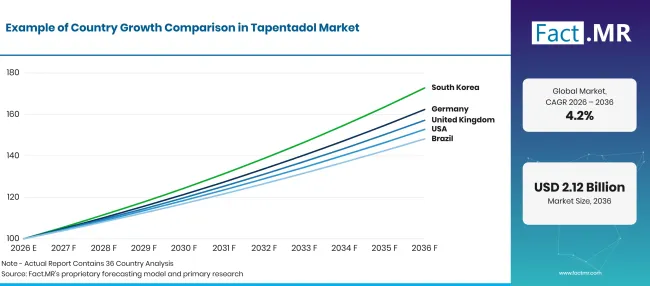
Factmr Tapentadol Market Growth Index | Source: Fact.MR
| Country | CAGR (2026 to 2036) |
|---|---|
| Germany | 4.9% |
| Brazil | 4.0% |
| United States | 4.3% |
| United Kingdom | 4.6% |
| Japan | 3.3% |
Source: Fact.MR analysis. Updated Oct 16, 2026
Why does Germany have the strongest country outlook?
4.9% CAGR. A visible range of authorised presentations supports formulation-specific purchasing.
Grünenthal’s German catalogue includes Palexia and other tapentadol product information. The practical opportunity is to serve pharmacies and specialist prescribers with the presentation already used in their treatment pathway. Buyers can compare continuity of supply and the professional support behind the product. Market expansion is more likely to come through these established channels than through consumer-facing promotion. [5]
What conditions matter for expansion in Brazil?
4.0% CAGR. Controlled-medicine access determines which distribution opportunities are viable.
Anvisa’s official control-list history records tapentadol’s addition to List A1 in 2014. Suppliers need to establish the authorisation and dispensing conditions for the product they intend to supply. Local partnerships can be valuable where they provide compliant access to pharmacies and institutional purchasers. The forecast does not imply that every international formulation is already available through Brazilian channels. [1]
How does the United States differ commercially?
4.3% CAGR. Product rights and formulation-specific competition shape account access.
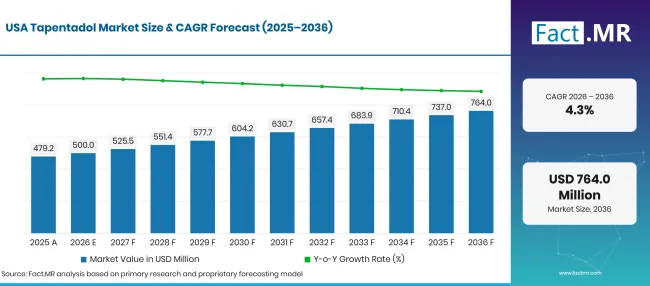
Factmr Tapentadol Market Forecast Usa | Source: Fact.MR
Collegium announced the acquisition of U.S. rights to the Nucynta franchise in 2020. This illustrates why competitive mapping must follow the territorial rights holder rather than the company historically associated with development. Contracts and product support are organised around the current authorised offer. For a prospective entrant, the immediate task is to establish its own approval and channel position rather than assume access to the same brand accounts. [2]
What constrains and supports the United Kingdom?
4.6% CAGR. Prescriber support has value where medicines require careful interaction review.
The MHRA’s tapentadol safety communication draws attention to seizure risk and serotonin-syndrome reports when certain medicines are used together. Suppliers serving UK clinicians need accurate product information and a dependable route for safety reporting. Such support can strengthen professional confidence in an appropriate prescription. It does not justify presenting tapentadol as free from the risks associated with opioid treatment. [7]
Where is Japan’s most credible commercial opportunity?
3.3% CAGR. Specialist treatment settings provide a more useful customer focus than broad pain prevalence.
A Japanese hospital study published in 2020 evaluated tapentadol pharmacokinetics and clinical experience in cancer patients with pain. Its limited patient group is useful evidence of specialist evaluation, not a national market measure. Product companies should focus on authorised access and the needs of the treatment institutions they can actually serve. Regional clinical experience is more commercially informative than assuming that all cancer-pain treatment involves this medicine. [6]
Who leads the Tapentadol Market?
Tapentadol competition is organised by formulation and territorial commercial rights. Collegium’s Nucynta franchise provides a documented U.S. example, while Grünenthal’s German information catalogue covers Palexia and other presentations. A global company ranking that overlooks those differences can misidentify the organisation supplying a particular pharmacy. [2] [5]
The broader comparison includes originator, branded and generic pharmaceutical businesses. Participation must be established for a current tapentadol product in the relevant country. Companies can compete on price and availability only after meeting the regulatory and supply requirements of that market. Historical brand association alone is insufficient evidence of a present leading share.
Which companies are the key providers?
Collegium and Grünenthal provide documented territorial product examples. The companies below form the wider pharmaceutical comparison set; inclusion does not establish current tapentadol supply in every country.
- Janssen Pharmaceuticals
- Grünenthal GmbH
- Mallinckrodt Pharmaceuticals
- Purdue Pharma
- Teva Pharmaceutical Industries
- Sun Pharmaceutical
- Viatris Inc.
- Zydus Lifesciences Ltd.
- Lupin
- Aurobindo Pharma
Bibliography
- [1] Agência Nacional de Vigilância Sanitária. (n.d.). Lista de substâncias sujeitas a controle especial no Brasil.
- [2] Collegium Pharmaceutical, Inc. (2020, February 6). Collegium to acquire U.S. rights to Nucynta franchise.
- [3] Collegium Pharmaceutical, Inc. (2025a, December 30). Nucynta ER: Tapentadol hydrochloride tablet, film coated, extended release [Prescribing information]. DailyMed.
- [4] Collegium Pharmaceutical, Inc. (2025b, December 30). Nucynta: Tapentadol hydrochloride tablet, film coated [Prescribing information]. DailyMed.
- [5] Grünenthal GmbH. (n.d.). Fachinformationen & Pflichttexte.
- [6] Homma, M., Kokubun, H., Okuwaki, K., Katada, C., Hayashi, N., Kanai, A., Koizumi, W., & Atsuda, K. (2020). Pharmacokinetic analysis, analgesic effects, and adverse effects of tapentadol in cancer patients with pain. Biological and Pharmaceutical Bulletin, 43(6), 1000–1006.
- [7] Medicines and Healthcare products Regulatory Agency. (2019, January 9). Tapentadol (Palexia): Risk of seizures and reports of serotonin syndrome when co-administered with other medicines. [8] U.S. Food and Drug Administration. (2026, May). Development of non-opioid analgesics for chronic pain [Draft guidance for industry].
- [9] World Health Organization. (2025, August 29). Opioid overdose.
This Report Answers
- How do immediate-release and extended-release products differ commercially?
- Which pain uses belong within the separately identified neuropathic category?
- How do product rights and local authorisation change the supplier comparison?
- What limits online dispensing of a controlled prescription medicine?
- Where can better availability support growth without encouraging inappropriate prescribing?
What does the Tapentadol Market cover?
The market covers sales of finished tapentadol medicines. Product type distinguishes immediate-release from extended-release formulations. The application split separates neuropathic pain from the other pain-management uses counted in this report.
What is included in the scope?
Authorised tapentadol products supplied through hospital, retail and legally permitted online pharmacies are included. Product revenue is counted once at the medicine-sale level, with the formulation and dispensing categories providing separate views of that revenue.
What is excluded from the scope?
Other opioids, non-opioid analgesics and pain-management service fees are excluded. Illegal internet sales and unapproved supply are outside the market boundary. Research spending, prescribing consultations and the value of separately supplied rescue medicines are not added to tapentadol revenue.
How Was the Analysis Built?
The analysis draws on 120+ sources, 35+ company portfolios, 25+ countries, and more than 20 industry interviews.
- Primary Research: Primary research includes discussions with manufacturers, service providers, technology developers, distributors, end users, and subject-matter experts. These conversations examine purchasing priorities, product adoption, operational challenges, approval requirements, competitive positioning, and the factors that influence wider market acceptance.
- Desk Research: Desk research covers government statistics, regulatory publications, company filings, trade data, technical studies, industry associations, standards, public policy, and other authoritative sources. Every source used in the analysis is documented in the bibliography.
- Market Sizing and Forecasting: Market estimates combine historical performance, demand indicators, pricing and volume trends, segment shares, company participation, country-level growth, adoption patterns, investment activity, and barriers to market expansion.
- Data Validation and Update Cycle: Findings are validated by comparing primary interviews with public data, company activity, regulatory changes, trade patterns, and industry developments. Regular updates review new product launches, capacity changes, partnerships, approvals, and shifts in commercial adoption.
Segmentation
What is the report’s scope and coverage?
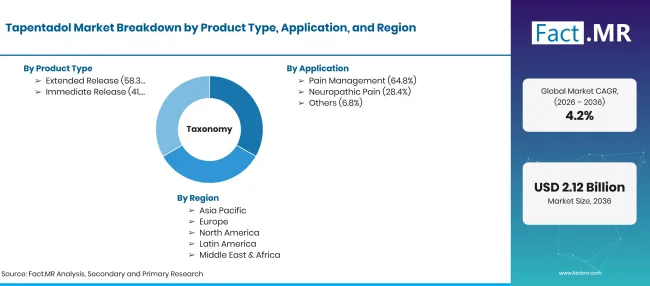
Factmr Tapentadol Market Taxonomy | Source: Fact.MR
| Attribute | Details |
|---|---|
| Quantitative Units | USD billion |
| Market Definition | Finished tapentadol medicines supplied through authorised prescription channels, classified by release formulation, pain application and dispensing channel. |
| Product Type | Extended Release; Immediate Release |
| Application | Pain Management; Neuropathic Pain; Others |
| Distribution Channel | Hospital Pharmacies; Retail Pharmacies; Online Pharmacies |
| Regions Covered | North America; Latin America; Western Europe; Eastern Europe; East Asia; South Asia & Pacific; Middle East & Africa |
| Countries Covered | Germany; Brazil; United States; United Kingdom; Japan |
| Companies Profiled | Janssen Pharmaceuticals; Grünenthal GmbH; Mallinckrodt Pharmaceuticals; Purdue Pharma; Teva Pharmaceutical Industries; Sun Pharmaceutical; Viatris Inc.; Zydus Lifesciences Ltd.; Lupin; Aurobindo Pharma |
| Forecast Period | 2026 to 2036 |
| Approach | Formulation-level review, official prescribing information, territorial product rights, controlled-medicine access and specialist treatment evidence. |
Source: Fact.MR analysis. Updated Oct 16, 2026
How is the market segmented?
-
By Product Type:
- Extended Release
- Immediate Release
-
By Application:
- Pain Management
- Neuropathic Pain
- Others
-
By Distribution Channel:
- Hospital Pharmacies
- Retail Pharmacies
- Online Pharmacies
-
By Region:
- North America
- Latin America
- Western Europe
- Eastern Europe
- East Asia
- South Asia & Pacific
- Middle East & Africa
Frequently Asked Questions
How big is the tapentadol market in 2026?
What is the CAGR from 2026 to 2036?
Which product type segment leads?
Which application segment leads?
Does tapentadol have the same approved use in every country?
Who worked on this report


Preview the report firsthand - request a free sample
Free SampleGet the brochure for pricing and purchase details
Download PDF