- Base Value(2025): 0.4 Bn
- Forecast Value (2036): 2.5 Bn
- CAGR (2036): 17.5%
What is the cell therapy cryobags market forecast to be worth by 2036?
USD 0.5 billion in 2026 to USD 2.5 billion by 2036 at 17.5% CAGR.
- The Cell Therapy Cryobags Market was valued at USD 0.4 billion in 2025.
- The market is estimated at USD 0.5 billion in 2026.
- It is projected to reach USD 2.5 billion by 2036.
- The market is forecast to expand at 17.5% CAGR during the forecast period as commercial cell therapy production, stem cell banking and regenerative medicine continue expanding.
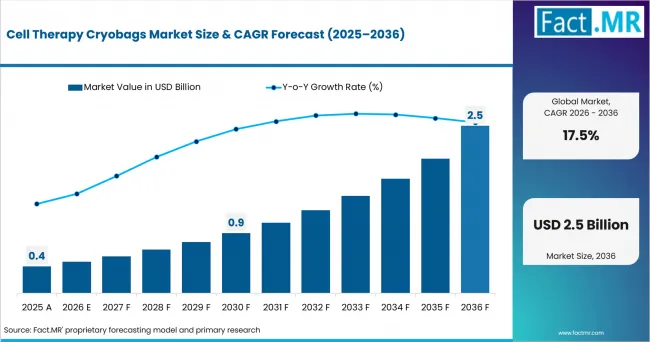
Cell Therapy Cryobags Market Market Value Analysis | Source: Fact.MR
What are the defining numbers behind cell therapy cryobag growth?
USD 2.0 billion absolute opportunity by 2036 led by the United States and Germany.
- Demand Drivers in the Market
- Cell therapy manufacturing continues expanding worldwide.
- Commercial CAR-T production is increasing.
- Biobanks continue expanding cryogenic storage capacity.
- Regenerative medicine attracts higher investment.
- Key Segments Analyzed
- By Bag Volume: 50-250 ml is expected to hold 34.0% share in 2026 because it supports most commercial cell therapy processes.
- By Material: EVA is projected to account for 37.0% share in 2026 because it provides excellent flexibility at cryogenic temperatures.
- By Cell Type: CAR-T Cells are expected to hold 32.0% share in 2026 because commercial therapy production continues increasing.
- By End User: Cell Therapy Developers are projected to account for 39.0% share in 2026 because they remain the largest users of cryogenic storage products.
- By Geography: The United States is projected to record 18.2% CAGR through 2036.
- Analyst Opinion at Fact.MR
- Shambhu Nath Jha, Senior Analyst at Fact.MR, states, "Cell therapy cryobags have become essential for advanced biologic manufacturing. High-performance cryogenic storage systems help preserve cell quality throughout manufacturing and transportation. Growing commercialization of cell therapies will continue supporting long-term market growth."
- Strategic Implications
- Expand production of cryogenic storage bags.
- Develop materials with higher cryogenic durability.
- Strengthen partnerships with cell therapy developers.
- Invest in advanced cryopreservation technologies.
Cell therapy cryobags are sterile storage bags designed for cryogenic preservation of therapeutic cells. They help maintain cell integrity during freezing, storage and transportation under controlled conditions.
The United States is projected to record 18.2% CAGR through 2036 because cell therapy manufacturing continues expanding. Germany is expected to grow at 17.8% CAGR due to strong regenerative medicine research. China is forecast to expand at 17.2% CAGR as biotechnology investment increases. Japan is projected to register 16.9% CAGR through 2036 because advanced cell therapy research continues growing. South Korea is expected to grow at 16.5% CAGR through 2036 due to increasing investment in cell and gene therapy manufacturing.
How does the cell therapy cryobags market break down by segment?
50-250 ml leads at 34.0%. Cell Therapy Developers lead at 39.0%.
Which bag volume dominates?
50-250 ml holds 34.0% share in 2026.
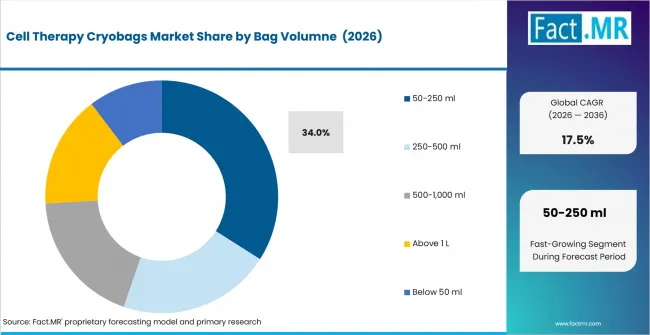
Cell Therapy Cryobags Market Analysis By Bag Volumne | Source: Fact.MR
The 50-250 ml segment leads because it matches the storage needs of most commercial cell therapy products. It supports efficient freezing and safe transportation. Manufacturers prefer this volume because it improves handling during production. It also reduces product loss during cryogenic storage. Demand remains strong across commercial therapy facilities. BioLife Solutions introduced the CellSeal® CryoCase™ at the ISCT 2024 conference. The company stated that CryoCase was developed for cell and gene therapy primary packaging and designed to replace cryopreservation bags with a fracture-resistant rigid container for manual and closed-system automated workflows. [1]
Which material dominates?
EVA accounts for 37.0% share in 2026.
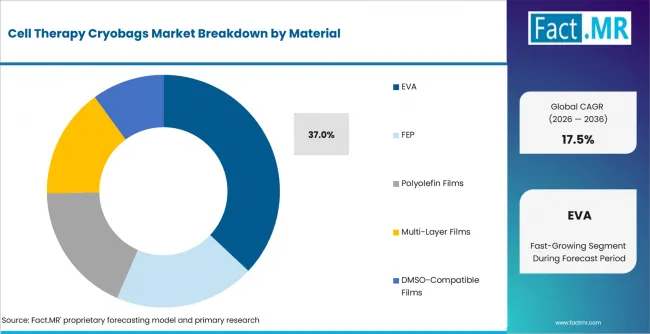
Cell Therapy Cryobags Market Analysis By Material | Source: Fact.MR
EVA leads because it remains flexible at ultra-low temperatures. It also provides excellent resistance to cracking during freezing. Manufacturers choose EVA because it protects valuable cell products. It also supports long-term cryogenic storage. Demand continues increasing across regulated manufacturing facilities. Cryoport and Gulf Coast Regional Blood Center announced a strategic alliance to provide manufacture-ready cryopreserved allogeneic leukopaks for cellular therapy research and manufacturing. Cryopreserved leukopaks support the cell therapy cryopreservation supply chain, but the cited Cryoport-GCRBC alliance does not directly announce a cryobag product. Keep this as adjacent cold-chain evidence only. [2]
Which cell type dominates?
CAR-T Cells lead with 32.0% share in 2026.
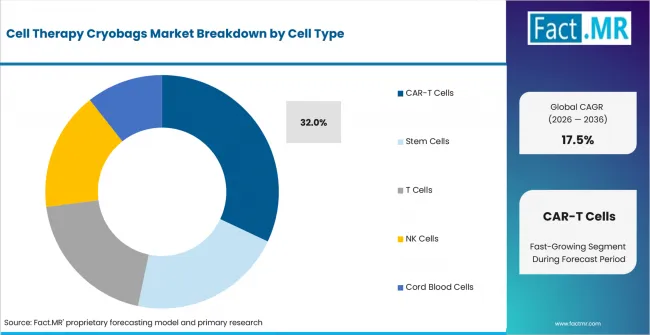
Cell Therapy Cryobags Market Analysis By Cell Type | Source: Fact.MR
CAR-T cells lead because commercial therapies continue expanding worldwide. Every treatment requires secure cryogenic preservation. Cryobags help maintain cell viability during storage. They also support transportation between manufacturing sites and treatment centers. Commercial approvals continue supporting market demand. OrganaBio announced the opening of a new PBMC (Peripheral Blood Mononuclear Cell) processing laboratory in Hayward, California. The facility expands the company's capabilities for collection, processing, cryopreservation, storage, and distribution of cellular materials used in cell and gene therapy development and manufacturing. [3]
Which end user dominates?
Cell Therapy Developers hold 39.0% share in 2026.
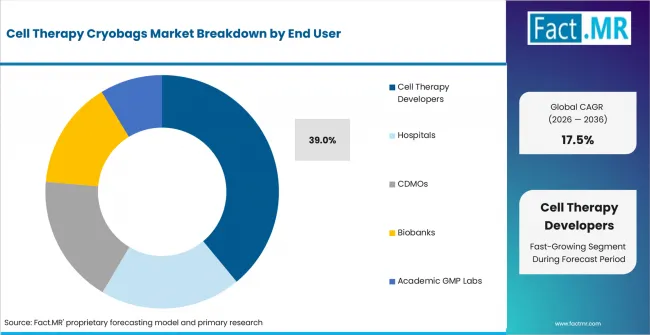
Cell Therapy Cryobags Market Analysis By End User | Source: Fact.MR
Cell therapy developers remain the largest users because they require cryogenic storage throughout manufacturing. Cryobags support processing from production to final delivery. Companies continue expanding commercial manufacturing capacity. This increases demand for validated cryogenic storage products. Large production facilities remain the primary buyers.
What is accelerating cell therapy cryobag demand and what is holding it back?
Cell therapy commercialization drives demand while validation costs restrain adoption.
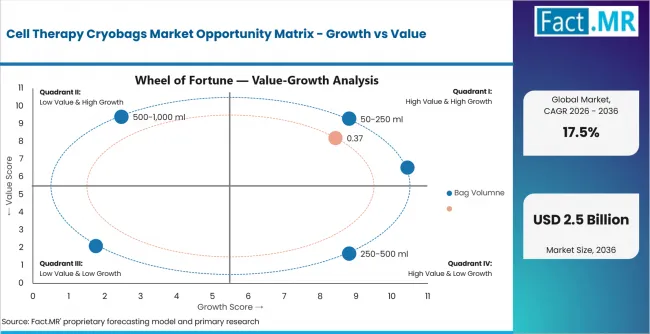
Cell Therapy Cryobags Market Opportunity Matrix Growth Vs Value | Source: Fact.MR
The primary growth driver is expanding commercial cell therapy production. Manufacturers continue increasing investment in advanced cryopreservation technologies. Stem cell research also creates strong demand. Growth in regenerative medicine continues supporting wider adoption. BioLife Solutions received the INTERPHEX 2026 Biotech Innovation Award for CellSeal® CryoCase™, a rigid cryogenic containment system for frozen biologic materials. Use this as adjacent containment evidence, not direct cryobag evidence. The company stated that CryoCase was designed to address containment challenges and container failures associated with frozen biologic materials. [4]
Biobanks are expanding cryogenic storage capacity. This further strengthens market demand. The primary restraint is higher product cost. Cryogenic storage products require specialized materials and manufacturing processes. Product validation also increases development time. Smaller organizations may delay investment because of budget limitations.
Where do the biggest cell therapy cryobag opportunities sit?
- Commercial Cell Therapy: Commercial manufacturing continues expanding across major biotechnology companies. This creates strong demand for cryogenic storage products.
- Stem Cell Banking: Stem cell banks continue increasing storage capacity. High-performance cryobags remain essential for long-term preservation.
- Biobanks: Biobanks continue expanding cryogenic infrastructure. Growing sample collections support steady product demand.
- CDMO Facilities: Contract manufacturers continue increasing cell therapy production. Validated cryobags support commercial manufacturing operations.
Which countries are scaling cell therapy cryobag adoption fastest?
United States 18.2%, Germany 17.8%, China 17.2%, Japan 16.9%, South Korea 16.5%.
Based on regional analysis, the cell therapy cryobags market is segmented into North America, Western Europe, Asia Pacific, Latin America, and Middle East and Africa.
.webp "Top Country Growth Comparison Cell Therapy Cryobags Market Cagr (2026 2036)")
Top Country Growth Comparison Cell Therapy Cryobags Market Cagr (2026 2036) | Source: Fact.MR
| Country | CAGR (2026-2036) |
|---|---|
| United States | 18.2% |
| Germany | 17.8% |
| China | 17.2% |
| Japan | 16.9% |
| South Korea | 16.5% |
Source: Fact.MR analysis. Updated Jun 26, 2026
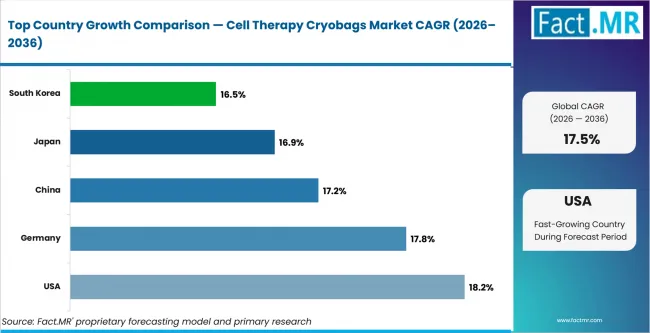
Cell Therapy Cryobags Market Cagr Analysis By Country | Source: Fact.MR
Why is the United States leading the cell therapy cryobags market?
18.2% CAGR, supported by commercial cell therapy manufacturing
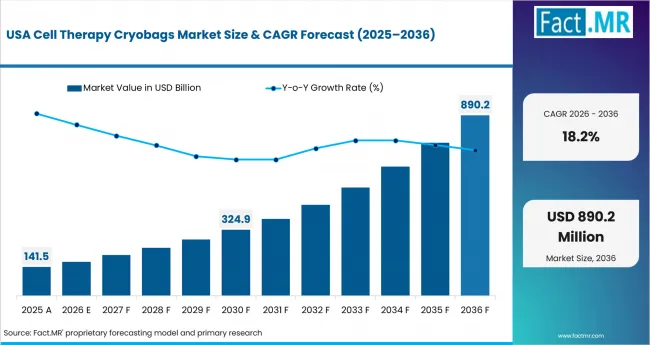
Cell Therapy Cryobags Market Country Value Analysis | Source: Fact.MR
The United States is projected to record 18.2% CAGR through 2036 because commercial cell therapy manufacturing continues expanding. Companies are increasing investment in advanced cryopreservation systems. CAR-T therapy production is also rising. Biobanks continue expanding cryogenic storage capacity. The country leads demand for cell therapy manufacturing.
What is driving growth in Germany?
17.8% CAGR, driven by regenerative medicine research
Germany is expected to post 17.8% CAGR by 2036 because regenerative medicine research continues expanding. Companies are investing in advanced cell processing technologies. Demand for cryogenic storage products is increasing. CDMOs are also expanding commercial manufacturing capacity. Germany remains a leading European biotechnology hub.
How is China expanding adoption?
17.2% CAGR, supported by biotechnology investment
China is forecast to advance at 17.2% CAGR through 2036 because biotechnology investment continues increasing. Cell therapy manufacturers are expanding commercial production facilities. Demand for cryogenic storage products is rising. Growth in regenerative medicine also supports market expansion. The country remains an important market for cryopreservation products.
Why is Japan becoming a strong market?
16.9% CAGR, supported by cell therapy innovation
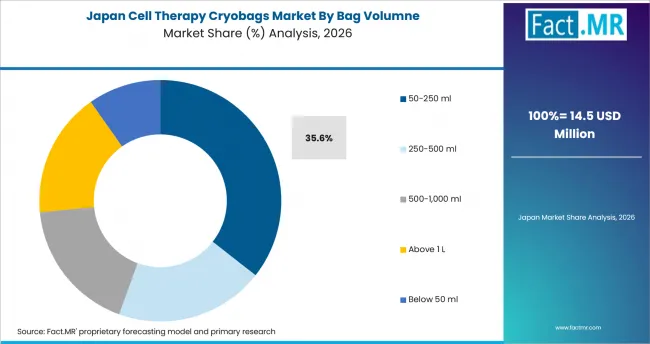
Cell Therapy Cryobags Market Japan Market Share Analysis By Bag Volumne | Source: Fact.MR
Japan is projected to register 16.9% CAGR through 2036 because advanced cell therapy research continues growing. Companies are increasing investment in regenerative medicine. Commercial manufacturing capacity continues expanding. Cryogenic storage demand is also increasing across research organizations. The country remains a leader in regenerative medicine innovation.
What supports market growth in South Korea?
16.5% CAGR, driven by biologics investment
South Korea is expected to grow at 16.5% CAGR because biotechnology investment continues expanding. Cell therapy developers are increasing commercial manufacturing capacity. Biobanks continue strengthening cryogenic storage infrastructure. Government support also encourages advanced therapy development. The country continues strengthening its global biotechnology position.
Who leads the cell therapy cryobags landscape?
Charter Medical, OriGen Biomedical, and Miltenyi Biotec lead through cryogenic storage expertise and cell therapy manufacturing capabilities.
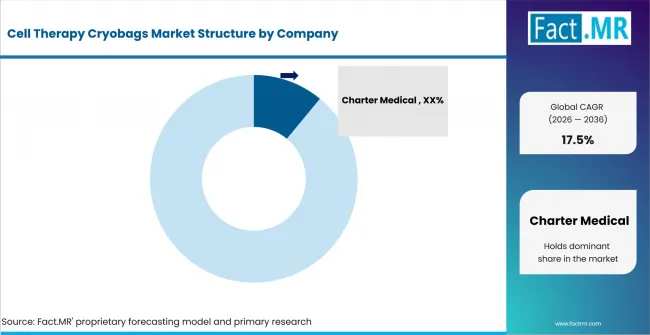
Cell Therapy Cryobags Market Analysis By Company | Source: Fact.MR
The market remains moderately consolidated. Competition focuses on cryogenic durability and product integrity. Manufacturers continue improving bag materials to protect sensitive cell products during freezing and transportation. They are also developing films that withstand repeated freezing and thawing cycles while maintaining seal strength and flexibility.
Cell therapy developers account for the largest share of demand. CDMOs and biobanks continue increasing purchases as commercial manufacturing expands. Growing clinical trials and higher approval rates for advanced cell therapies are also supporting demand for reliable cryogenic storage products.
CAR-T cell preservation remains the largest application. Stem cell storage also generates steady demand across research laboratories and clinical manufacturing facilities. Expansion of regenerative medicine programs is creating additional opportunities for cryobag suppliers. Companies offering validated cryogenic storage systems and dependable technical support are expected to strengthen their market position.
Which companies are the key players?
Charter Medical, OriGen Biomedical, Miltenyi Biotec
- Charter Medical
- OriGen Biomedical
- Miltenyi Biotec
- Corning
- Saint-Gobain Life Sciences
Bibliography
- [1] BioLife Solutions, Inc. (2024, May 29). BioLife Solutions introduces the CellSeal® CryoCase™ at International Society for Cell & Gene Therapy’s ISCT conference in Vancouver. PR Newswire.
- [2] Cryoport, Inc. (2024, October 22). Cryoport and Gulf Coast Regional Blood Center launch strategic alliance to enhance cellular therapy services. Cryoport, Inc.
- [3] OrganaBio. (2025, December 15). OrganaBio expands to the San Francisco Bay Area with new PBMC processing laboratory in Hayward, California. Business Wire.
- [4] BioLife Solutions, Inc. (2026, April 21). BioLife Solutions wins INTERPHEX 2026 Biotech Innovation Award for CellSeal® CryoCase™. PR Newswire.
This Report Addresses
- Strategic intelligence on cell therapy cryogenic storage technologies.
- Segment analysis covering bag volumes and cryogenic materials.
- Assessment of cell types and end-user demand.
- Regional outlook covering the United States and Germany.
- Analysis of China, Japan, and South Korea.
- Competitive assessment of leading cryogenic storage suppliers.
- Evaluation of cell therapy manufacturing trends.
- Analysis of regenerative medicine and biobank expansion.
- Primary interviews and supplier benchmarking.
- Assessment of opportunities across commercial cryopreservation applications.
What does the cell therapy cryobags market cover?
Cryogenic storage bags used for therapeutic cell preservation.
The market covers sterile cryobags designed for freezing, storage and transportation of therapeutic cells used in regenerative medicine and advanced biologic therapies.
What is included in the scope?
Cryogenic bags for cell therapy manufacturing and storage.
The scope includes bags designed for CAR-T cells, stem cells, T cells, NK cells and cord blood cells.
What is excluded from the scope?
General laboratory storage bags and blood collection bags.
The scope excludes conventional medical storage bags, blood donation bags and non-cryogenic laboratory containers.
How was the analysis built?
100+ sources, 30+ company assessments, 25+ countries and industry interviews.
- Primary Research: Interviews with cell therapy manufacturers, cryogenic storage specialists and laboratory professionals.
- Desk Research: Analysis of cell therapy manufacturing, cryopreservation trends and regenerative medicine investments.
- Market Sizing and Forecasting: Estimates based on cell therapy production, cryogenic storage demand and commercial manufacturing capacity.
- Data Validation and Update Cycle: Forecasts validated through supplier benchmarking and industry interviews.
Segmentation
What is the report's scope and coverage?
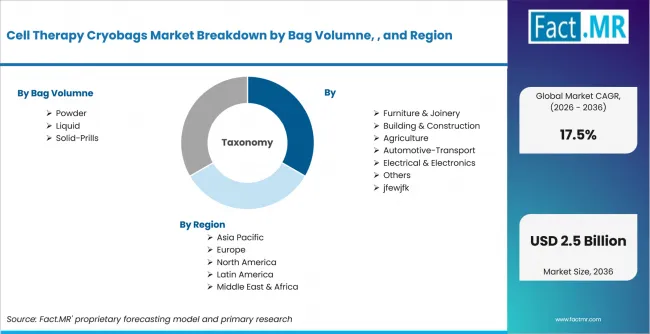
Cell Therapy Cryobags Market Breakdown By Bag Volumne, , And Region | Source: Fact.MR
| Attribute | Details |
|---|---|
| Quantitative Units | USD Billion in 2026 to USD Billion by 2036 at CAGR |
| Market Definition | Cryogenic storage bags designed for cell therapy manufacturing and preservation |
| Bag Volumes Covered | Below 50 ml, 50-250 ml, 250-500 ml, 500-1,000 ml, Above 1 L |
| Materials Covered | EVA, FEP, Polyolefin Films, Multi-Layer Films, DMSO-Compatible Films |
| Cell Types Covered | CAR-T Cells, Stem Cells, T Cells, NK Cells, Cord Blood Cells |
| End Users Covered | Cell Therapy Developers, Hospitals, CDMOs, Biobanks, Academic GMP Labs |
| Regions Covered | North America, Western Europe, Asia Pacific, Latin America, Middle East & Africa |
| Key Countries Covered | United States, Germany, China, Japan, South Korea |
| Companies Covered | Charter Medical, OriGen Biomedical, Miltenyi Biotec, Corning, Saint-Gobain Life Sciences |
| Forecast Period | 2026 to 2036 |
| Research Approach | Hybrid top-down and bottom-up methodology using cell therapy manufacturing, cryogenic storage demand and regenerative medicine analysis |
Source: Fact.MR analysis. Updated Jun 26, 2026
How is the market segmented?
-
By Bag Volume
- Below 50 ml
- 50-250 ml
- 250-500 ml
- 500-1,000 ml
- Above 1 L
-
By Material
- EVA
- FEP
- Polyolefin Films
- Multi-Layer Films
- DMSO-Compatible Films
-
By Cell Type
- CAR-T Cells
- Stem Cells
- T Cells
- NK Cells
- Cord Blood Cells
-
By End User
- Cell Therapy Developers
- Hospitals
- CDMOs
- Biobanks
- Academic GMP Labs
-
Region:
- North America
- United States
- Canada
- Europe
- Germany
- United Kingdom
- France
- Italy
- Spain
- Asia Pacific
- China
- Japan
- South Korea
- India
- Singapore
- Latin America
- Brazil
- Mexico
- Argentina
- Middle East & Africa
- GCC Countries
- South Africa
- Israel
- North America
Frequently Asked Questions
Which bag volume leads the market?
Which material accounts for the largest share?
What is driving demand for cell therapy cryobags?
Which country is growing the fastest?
What is the primary challenge facing the market?
Which end user accounts for the largest share?
What opportunities exist for suppliers?
Why are manufacturers adopting advanced cryobags?
Which cell type generates the highest demand?
Who worked on this report


Preview the report firsthand - request a free sample
Free SampleGet the brochure for pricing and purchase details
Download PDF