- Base Value(2025): 528 Mn
- Estimated Value(2026): 545 Mn
- Forecast Value (2036): 1070 Mn
- CAGR (2026 - 2036): 7.0%
Chlorogenic Acid Market Size, Share and Forecast and Outlook By FACT.MR
In 2025, the chlorogenic acid market was valued at USD 528 million. Fact MR analysis indicates demand for chlorogenic acid is expected to reach USD 545 million in 2026 and USD 1,070 million by 2036. FMR estimates the market will expand at a CAGR of 7.0% across the forecast period.
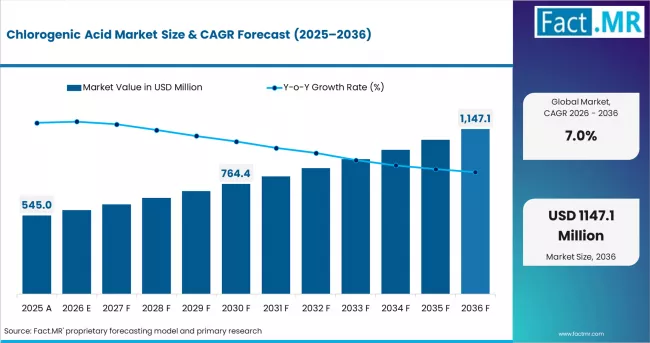
Chlorogenic Acid Market Market Value Analysis | Source: Fact.MR
Chlorogenic Acid Market
| Metric | Details |
|---|---|
| Industry Size (2026E) | USD 545 million |
| Industry Value (2036F) | USD 1,070 million |
| CAGR (2026 to 2036) | 7.0% |
Source: Fact.MR analysis. Updated Apr 25, 2026
Summary of the Chlorogenic Acid Market
- Market Definition
- The chlorogenic acid market comprises production, extraction, and commercialization of chlorogenic acid, a polyphenolic compound formed from caffeic acid and quinic acid. The ingredient is widely used as an antioxidant bioactive across nutraceuticals, functional beverages, pharmaceuticals, cosmetics, and animal nutrition formulations due to its oxidative stability characteristics and compatibility with plant-derived ingredient positioning.
- Demand Drivers
- Increasing incorporation of plant-derived polyphenols across dietary supplements targeting metabolic and cardiovascular health positioning.
- Expansion of functional beverage formulations utilizing botanical antioxidants supporting ingredient differentiation strategies.
- Rising demand for standardized botanical extracts with consistent bioactive concentration supporting clinical formulation requirements.
- Growth in cosmetic formulations utilizing antioxidant compounds supporting oxidative stability and skin formulation performance.
- Increasing preference for plant-derived ingredients replacing synthetic additives across nutraceutical and functional food manufacturing.
- Expansion of botanical extract processing capacity supporting scalable production of standardized phenolic compounds.
- Key Segments Analyzed
- Source: Green coffee bean extract accounts for 71.4% share reflecting high natural chlorogenic acid concentration and stable supply chain availability.
- Form: Powder form holds 64.8% share supported by compatibility with capsules, tablets, dry blends, and functional food premixes.
- Application: Dietary supplements represent primary application segment supported by demand for antioxidant and metabolic health formulations.
- Geography: India and China demonstrate strongest growth supported by botanical extraction infrastructure expansion, while the USA and Germany reflect mature nutraceutical consumption environments.
- Analyst Opinion at Fact MR
- Shambhu Nath Jha, Principal Consultant, Fact MR, states, "Chlorogenic acid represents a specification-driven botanical polyphenol segment positioned within the broader functional bioactive ingredient ecosystem. Demand expansion reflects increasing standardization of plant-derived compounds with validated phenolic content supporting formulation consistency across nutraceutical and functional food manufacturing. Market participants are prioritizing extraction efficiency optimization and phytochemical stability control to maintain reproducible active compound concentration across commercial ingredient batches through 2036."
- Strategic Implications
- Strengthen botanical sourcing capability supporting consistent chlorogenic acid concentration across green coffee bean extraction processes.
- Improve purification efficiency supporting high-purity polyphenol grades aligned with nutraceutical formulation requirements.
- Expand powder format production supporting compatibility with capsule, tablet, and powdered beverage applications.
- Enhance analytical testing capability supporting phytochemical standardization and batch traceability requirements.
- Develop formulation compatibility supporting integration across functional beverages, dietary supplements, and cosmetic antioxidant systems.
- Improve supply chain resilience mitigating agricultural variability affecting botanical raw material availability.
- Methodology
- Developed using primary interviews with botanical extract manufacturers, nutraceutical ingredient suppliers, and formulation specialists.
- Supported through analysis of scientific journals, regulatory ingredient databases, and technical literature covering polyphenol extraction processes.
- Market estimation applied hybrid modeling combining bottom-up supplier revenue analysis with top-down evaluation of nutraceutical ingredient demand.
- Data validated through triangulation using supplier disclosures, phytochemical composition studies, and expert consultation inputs.
- Periodic updates incorporate developments in botanical extraction technologies, regulatory frameworks governing health claims, and demand shifts across plant-derived bioactive ingredients.
A CAGR of 7.0%, with market value increasing from USD 545 million to USD 1,070 million, indicates a steady upward growth curve supported by incorporation in nutraceuticals, functional beverages, and metabolic health formulations. Expansion is driven by demand for plant-derived bioactives, while moderated by raw material supply variability, extraction cost intensity, and regulatory scrutiny around health benefit claims.
India records the fastest growth at 8.2%, supported by increasing use of plant-derived antioxidant ingredients in nutraceutical formulations. China follows at 7.8%, driven by expanding production of botanical extracts for functional food and beverage applications. The USA at 7.1% and the United Kingdom at 7.0% represent relatively mature markets where demand is largely replacement-driven due to stable consumption of standardized dietary supplement ingredients. Germany at 6.9% shows the slowest growth, reflecting established market penetration across polyphenol-based ingredient formulations. A structural constraint across mature markets is strict labeling and health claim compliance requirements, which limits rapid commercialization of new extract formats.
Segmental Analysis
Chlorogenic Acid Market Analysis by Source
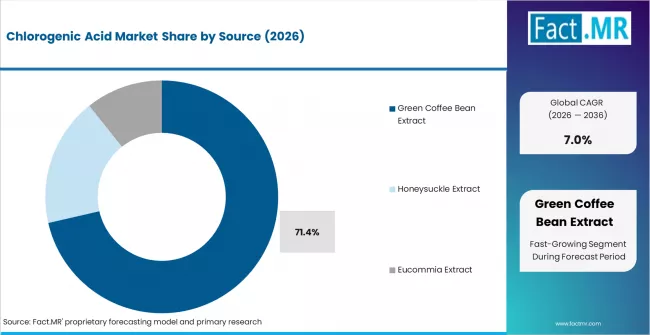
Chlorogenic Acid Market Analysis By Source | Source: Fact.MR
- Market Overview: Green coffee bean extract is projected to hold 71.4% share of the chlorogenic acid market in 2026. Dominance reflects high natural concentration of chlorogenic acid in unroasted coffee beans, enabling efficient extraction yields suitable for nutraceutical, food ingredient, and dietary supplement formulations requiring standardized polyphenol content. Supply chain structures prioritize green coffee sourcing to maintain consistent phytochemical composition across production batches.
- Demand Drivers:
- High Active Compound Yield: Green coffee beans provide concentrated chlorogenic acid levels, supporting cost-efficient extraction processes for standardized ingredient manufacturing.
- Nutraceutical Ingredient Demand: Supplement manufacturers utilize plant-derived extracts aligned with formulation requirements for antioxidant-focused product positioning across health-oriented product categories.
- Raw Material Availability: Global coffee cultivation enables stable availability of green coffee feedstock supporting large-scale chlorogenic acid extraction operations.
Chlorogenic Acid Market Analysis by Form
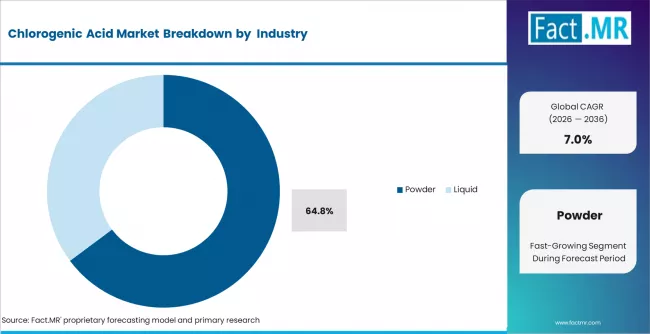
Chlorogenic Acid Market Analysis By Form | Source: Fact.MR
- Market Overview: Powder form is estimated to account for 64.8% share in 2026, supported by its compatibility with tablet compression, capsule filling, and dry blend functional food formulations requiring stable ingredient handling characteristics. Powder formats enable controlled dosing accuracy across nutraceutical and food processing environments.
- Demand Drivers:
- Formulation Versatility: Powder chlorogenic acid supports integration across dietary supplements, powdered beverages, and functional food premixes requiring homogeneous dispersion characteristics.
- Storage Stability: Powder formats demonstrate longer shelf stability and reduced degradation risk compared to liquid extract formats under standard storage conditions.
- Processing Efficiency: Ingredient manufacturers utilize powdered chlorogenic acid to enable consistent metering and batch reproducibility across large-scale nutraceutical production systems.
Key Dynamics
Chlorogenic Acid Market Drivers, Restraints, and Opportunities
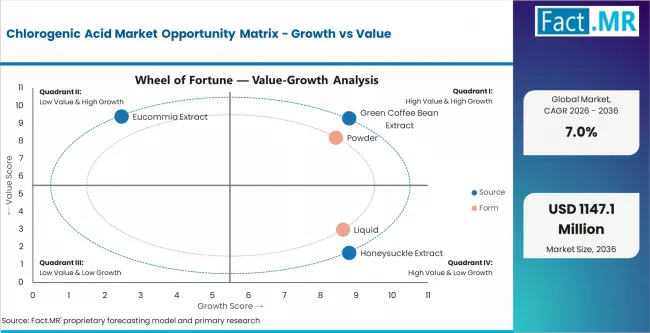
Chlorogenic Acid Market Opportunity Matrix Growth Vs Value | Source: Fact.MR
Fact MR analysis indicates the market reflects a steadily expanding botanical bioactive ingredient segment shaped by structural growth in nutraceuticals, functional beverages, and preventive healthcare formulations. Market size exists because chlorogenic acid, primarily derived from green coffee beans and medicinal plants, provides antioxidant and metabolic regulatory properties used in weight management, cardiovascular support, and glucose regulation products. Historical demand has expanded alongside consumer preference for plant-derived actives replacing synthetic additives in dietary supplements and functional foods, creating a stable mid-growth specialty ingredient market.
Current dynamics show declining reliance on generic botanical extracts lacking standardized bioactive concentration, while high-purity chlorogenic acid formulations command higher per-unit pricing due to extraction complexity and quality verification requirements. Demand growth is strongest in supplements and functional beverages targeting metabolic health positioning, while supply economics remain influenced by agricultural raw material variability and processing yield efficiency. Market structure reflects a gradual shift toward standardized, clinically positioned plant polyphenols where improved bioavailability supports premium ingredient pricing despite moderate volume expansion.
- Preventive Health Positioning: Increasing integration of plant polyphenols into nutraceuticals is driven by consumer demand for antioxidant ingredients linked to metabolic and cardiovascular health support.
- Asia Raw Material Base: China and India dominate production due to availability of green coffee beans and herbal extract processing infrastructure supporting large-scale supply economics.
- Extraction Cost Premium: High-purity grades require advanced extraction and purification technologies, increasing ingredient cost per kilogram while improving formulation consistency for supplements and functional foods.
Regional Analysis
The chlorogenic acid market is assessed across Asia Pacific, Europe, and North America, segmented by country-level demand for botanical antioxidants used in nutraceuticals, functional beverages, dietary supplements, and cosmetic formulations. Geographic variation reflects plant extract processing capacity, preventive health consumption trends, and regulatory positioning for botanical ingredients. The full report offers market attractiveness analysis.
.webp "Top Country Growth Comparison Chlorogenic Acid Market Cagr (2026 2036)")
Top Country Growth Comparison Chlorogenic Acid Market Cagr (2026 2036) | Source: Fact.MR
CAGR Table
| Country | CAGR (2026–2036) |
|---|---|
| India | 8.2% |
| China | 7.8% |
| USA | 7.1% |
| UK | 7.0% |
| Germany | 6.9% |
Source: Fact.MR analysis. Updated Apr 25, 2026
Source: Fact MR analysis, based on proprietary forecasting model and primary research
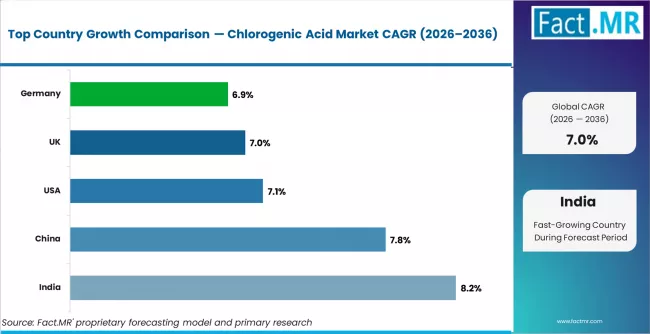
Chlorogenic Acid Market Cagr Analysis By Country | Source: Fact.MR
Asia Pacific
Asia Pacific functions as the botanical extract production hub supported by availability of plant raw materials and expanding nutraceutical ingredient processing capacity. Naturex SA strengthens plant-derived antioxidant formulation expertise. Sabinsa Corporation expands botanical extract production capability. Zhejiang CONBA Pharmaceutical Co., Ltd. supports chlorogenic acid processing scale.
- India: India is projected to record 8.2% CAGR in chlorogenic acid through 2036. National AYUSH Mission expansion framework (Ministry of AYUSH, March 2023) supports botanical ingredient adoption in preventive health products. Sabinsa Corporation expanded plant extract production infrastructure (July 2023).
- China: China is expected to observe 7.8% CAGR in chlorogenic acid through 2036. Healthy China initiative update (National Health Commission, January 2023) promotes plant-based nutraceutical ingredient utilization. Zhejiang CONBA Pharmaceutical Co., Ltd. expanded botanical extract processing capacity (May 2023).
North America
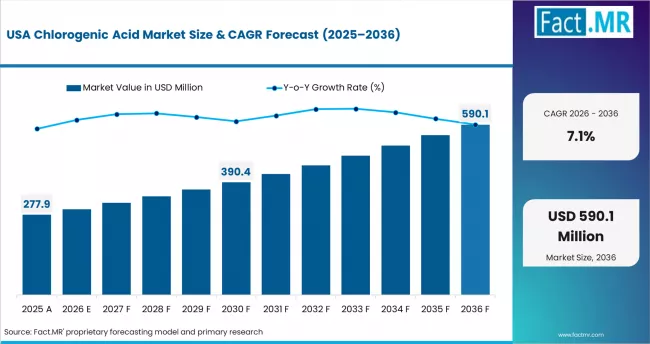
Chlorogenic Acid Market Country Value Analysis | Source: Fact.MR
North America operates as the functional nutraceutical commercialization center supported by strong dietary supplement consumption and demand for plant-derived antioxidant ingredients. Naturex SA strengthens botanical ingredient formulation capability. ADM expands plant extract ingredient portfolio depth. Cargill Incorporated supports functional ingredient distribution networks.
- USA: The USA is forecast to grow at 7.1% CAGR in chlorogenic acid through 2036. FDA dietary supplement guidance update (April 2023) supports botanical ingredient usage compliance. ADM expanded plant-derived antioxidant ingredient application development (June 2023).
Europe
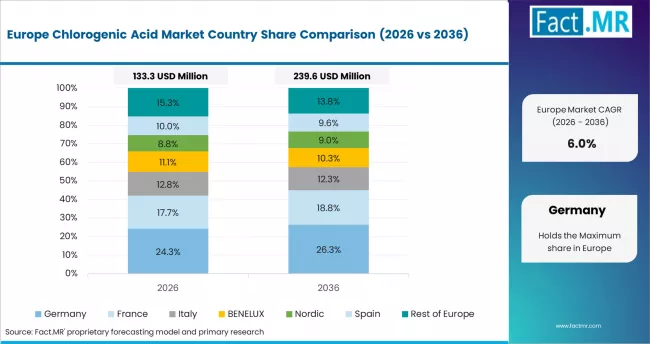
Chlorogenic Acid Market Europe Country Market Share Analysis, 2026 & 2036 | Source: Fact.MR
Europe functions as the botanical ingredient regulatory laboratory supported by structured novel food approval pathways and increasing demand for plant-based functional compounds. Naturex SA strengthens antioxidant ingredient development capability. Indena S.p.A. expands botanical extraction expertise. Martin Bauer Group supports plant ingredient supply continuity.
- UK: The UK is anticipated to expand at 7.0% CAGR in chlorogenic acid through 2036. UK novel foods regulatory framework update (Food Standards Agency, February 2023) supports botanical ingredient approval pathways. Indena S.p.A. expanded plant extract formulation research capability (April 2023).
- Germany: Germany is projected to register 6.9% CAGR in chlorogenic acid through 2036. EU botanical ingredient safety evaluation framework (European Food Safety Authority, ongoing) supports plant-derived compound approval processes. Martin Bauer Group expanded botanical extract production capability (March 2023).
Fact MR's analysis of chlorogenic acid market in global regions consists of country-wise assessment that includes India, China, USA, UK, and Germany. Readers can find botanical extract demand patterns, nutraceutical formulation developments, regulatory positioning frameworks, and competitive ingredient innovation insights.
Competitive Landscape
What is the Competitive Structure of the Chlorogenic Acid Market?
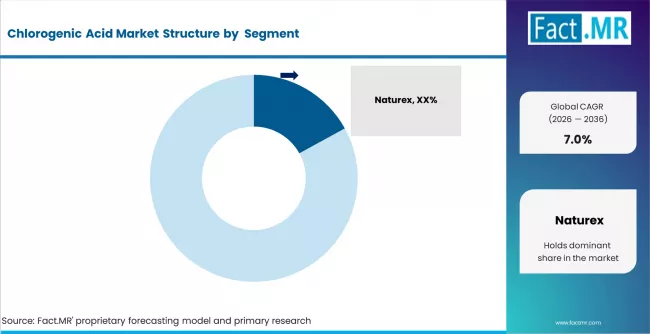
Chlorogenic Acid Market Analysis By Company | Source: Fact.MR
The Chlorogenic Acid Market reflects a moderately fragmented competitive structure, supported by botanical extract manufacturers and nutraceutical ingredient suppliers with specialization in plant-derived polyphenols. Key companies including Naturex, EUROMED SA, Sabinsa Corporation, Applied Food Sciences, Zhejiang Skyherb, Nutragreen Biotechnology, and Chenguang Biotech collectively account for approximately 50–60% of global supply, particularly in dietary supplements and functional food applications. Competitive positioning is primarily determined by extract purity, standardization consistency, traceability of botanical sources, and compliance with food safety regulations. Extraction efficiency and control over phenolic compound stability influence supplier differentiation, while regional producers contribute cost-competitive supply across standardized chlorogenic acid concentrations.
Structural advantages are observed among companies maintaining integrated botanical sourcing networks and validated extraction processes ensuring consistent polyphenol content. Sabinsa Corporation and Naturex benefit from established nutraceutical ingredient portfolios supported by long-term relationships with dietary supplement manufacturers. Buyers typically manage supplier dependency through multi-source procurement strategies and analytical validation of chlorogenic acid concentration across batches. Procurement decisions often consider regulatory documentation, stability performance, and consistency of phytochemical profiles aligned with formulation requirements. Pricing power remains relatively balanced, though suppliers retain moderate leverage where standardized extract quality and reliable botanical sourcing support consistent ingredient performance in functional product development.
Key Players of the Chlorogenic Acid Market
- Naturex
- EUROMED SA
- Applied Food Sciences
- Sabinsa Corporation
- Nanjing Zelang
- Zhejiang Skyherb
- Indfrag
- Cymbio Pharma
- Nutragreen Biotechnology
- Chenguang Biotech
Bibliographies
- [1] Ministry of AYUSH (India). (2023, December 27). Year-End Review: National AYUSH Mission expansion.
- [2] National Health Commission (China). (2023, July 19). Healthy China Initiative development conference.
- [3] U.S. Food and Drug Administration. (2023, August 16). Dietary supplement program guidance update.
- [4] Food Standards Agency (UK). (2023). Novel foods regulatory framework update.
- [5] European Food Safety Authority. (2023, September). Botanical ingredient safety evaluation framework.
- [6] Sabinsa Corporation. (2023). Plant extract production infrastructure expansion.
- [7] Zhejiang CONBA Pharmaceutical Co., Ltd. (2023, September). Botanical extract processing capacity expansion.
- [8] ADM. (2023). Plant-derived antioxidant ingredient application development.
- [9] Indena S.p.A. (2023). Plant extract formulation research capability expansion.
- [10] Martin Bauer Group. (2023). Botanical extract production capability expansion.
This Report Addresses
- Market size estimation and revenue forecasts from 2026 to 2036, supported by validated botanical extraction capacity benchmarks and demand indicators across nutraceutical and functional ingredient applications.
- Growth opportunity mapping across green coffee bean extract, honeysuckle extract, eucommia extract, synthetic chlorogenic acid, and other botanical sources aligned with standardized polyphenol concentration requirements.
- Segment and regional revenue forecasts covering powder and liquid chlorogenic acid formulations used in dietary supplements, functional beverages, pharmaceutical preparations, cosmetic ingredients, and animal nutrition applications.
- Competition strategy assessment including benchmarking of polyphenol purity levels, extraction yield efficiency, phytochemical stability, and traceability of botanical raw material supply chains.
- Regulatory impact analysis covering nutraceutical ingredient compliance frameworks, food safety approval pathways, and health claim substantiation requirements influencing commercialization of plant-derived bioactive compounds.
- Market report delivery in PDF, Excel, PPT, and structured data formats designed for nutraceutical formulators, botanical extract manufacturers, functional food developers, and procurement teams.
- Supply chain vulnerability assessments identifying concentration risks in green coffee bean sourcing regions, botanical extraction infrastructure, and high-purity polyphenol processing capacity supporting standardized chlorogenic acid production.
Chlorogenic Acid Market Definition
The chlorogenic acid market refers to the production and commercial supply of chlorogenic acid, a naturally occurring polyphenol formed from caffeic acid and quinic acid. It functions primarily as an antioxidant ingredient used in nutraceuticals, functional foods, pharmaceuticals, and cosmetics to support oxidative stability, metabolic health formulations, and preservative performance.
Chlorogenic Acid Market Inclusions
The report covers global and regional market size, historical demand trends, and forecast outlook across the defined study period. It includes segmentation by product form such as powder and liquid extracts, application in nutraceuticals, pharmaceuticals, food additives, and cosmetics, and end users including supplement manufacturers and ingredient suppliers. Pricing and trade flow analysis are included.
Chlorogenic Acid Market Exclusions
The scope excludes finished dietary supplements, beverages, and cosmetic products containing chlorogenic acid as an ingredient. It does not cover other polyphenols such as ferulic acid or caffeic acid unless present within chlorogenic acid extracts. Raw botanical materials such as green coffee beans are excluded unless standardized for chlorogenic acid content.
Chlorogenic Acid Market Research Methodology
- Primary Research: Interviews were conducted with nutraceutical ingredient manufacturers, botanical extract suppliers, pharmaceutical formulators, and procurement specialists involved in polyphenol ingredient sourcing.
- Desk Research: Scientific journals, regulatory ingredient databases, company technical literature, and trade publications were reviewed to identify historical demand patterns and functional application trends.
- Market-Sizing and Forecasting: A hybrid model combining bottom-up supplier revenue analysis and top-down evaluation of demand for antioxidant ingredients across nutraceutical and functional food sectors was applied.
- Data Validation and Update Cycle: Outputs were cross-verified using technical publications, supplier product specifications, and expert consultation. Updates incorporate regulatory developments, formulation trends, and changes in demand for plant-derived bioactive compounds.
Segmentation
Report Scope
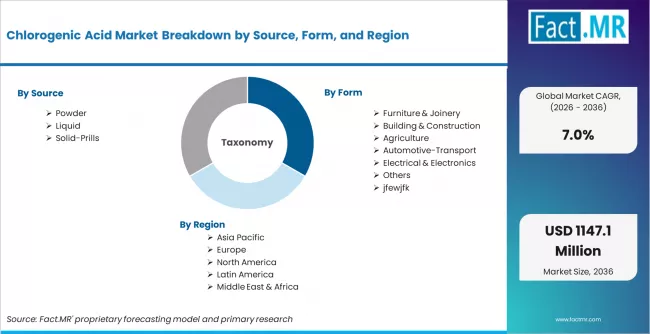
Chlorogenic Acid Market Breakdown By Source, Form, And Region | Source: Fact.MR
| Metric | Value |
|---|---|
| Quantitative Units | USD 545 million (2026) to USD 1,070 million (2036), at a CAGR of 7.0% |
| Market Definition | The chlorogenic acid market includes production, extraction, and commercialization of polyphenolic compounds derived from botanical sources and synthetic processes used for antioxidant, metabolic health, and functional ingredient applications. Chlorogenic acid is utilized across nutraceutical formulations, functional foods, pharmaceutical preparations, cosmetic products, and animal nutrition systems due to its bioactive properties and formulation compatibility. |
| Source Segmentation | Green coffee bean extract, Honeysuckle extract, Eucommia extract, Synthetic chlorogenic acid, Other botanical extracts |
| Form Segmentation | Powder, Liquid |
| Application Segmentation | Dietary supplements, Food & beverages, Pharmaceuticals, Cosmetics, Animal feed |
| Distribution Channel Segmentation | Direct sales, Online retail, Distributors & wholesalers |
| Regions Covered | North America, Latin America, Europe, East Asia, South Asia, Oceania, Middle East and Africa |
| Countries Covered | United States, Canada, Mexico, Brazil, Argentina, Germany, France, United Kingdom, Italy, Spain, China, India, Japan, South Korea, Indonesia, Australia, and 40+ countries |
| Key Companies Profiled | Naturex, EUROMED SA, Applied Food Sciences, Sabinsa Corporation, Nanjing Zelang, Zhejiang Skyherb, Indfrag, Cymbio Pharma, Nutragreen Biotechnology, Chenguang Biotech |
| Forecast Period | 2026 to 2036 |
| Approach | Hybrid top-down and bottom-up market estimation validated through primary interviews with botanical extract manufacturers, nutraceutical ingredient suppliers, pharmaceutical formulation specialists, and functional food producers, supported by trade flow benchmarking, raw material supply assessment, and evaluation of adoption trends across bioactive ingredient applications |
Source: Fact.MR analysis. Updated Apr 25, 2026
Chlorogenic Acid Market Key Segments
-
Source:
- Green Coffee Bean Extract
- Honeysuckle Extract
- Eucommia Extract
- Synthetic Chlorogenic Acid
- Other Botanical Extracts
-
Form:
- Powder
- Liquid
-
Application:
- Dietary Supplements
- Food and Beverages
- Pharmaceuticals
- Cosmetics
- Animal Feed
-
Distribution Channel:
- Direct Sales
- Online Retail
- Distributors and Wholesalers
-
Region:
- North America
- USA
- Canada
- Mexico
- Europe
- Germany
- UK
- France
- Italy
- Spain
- Nordic Countries
- BENELUX
- Rest of Europe
- Asia Pacific
- China
- Japan
- South Korea
- India
- Australia
- Rest of Asia Pacific
- Latin America
- Brazil
- Argentina
- Rest of Latin America
- Middle East and Africa
- Kingdom of Saudi Arabia
- United Arab Emirates
- South Africa
- Rest of Middle East and Africa
- Other Regions
- Oceania
- Central Asia
- Other Markets
- North America
Frequently Asked Questions
How large is the demand for Chlorogenic Acid in the global market in 2026?
What will be the market size of Chlorogenic Acid in the global market by 2036?
What is the expected demand growth for Chlorogenic Acid in the global market between 2026 and 2036?
Which Source is poised to lead global demand by 2026?
What is Driving Chlorogenic Acid Demand in India?
What is the India Growth Outlook in this Report?
What is Driving Chlorogenic Acid Demand in China?
What is the China Growth Outlook in this Report?
What is Driving Chlorogenic Acid Demand in the United States?
What is the United States Growth Outlook in this Report?
What is Driving Chlorogenic Acid Demand in the United Kingdom?
What is the United Kingdom Growth Outlook in this Report?
What is Driving Chlorogenic Acid Demand in Germany?
What is the Germany Growth Outlook in this Report?
Which Companies are Identified as Leading Participants in the Chlorogenic Acid Market?
What is Chlorogenic Acid and What is It Mainly Used For?
What does Chlorogenic Acid Market Mean in this Report?
What is Included in the Scope of this Chlorogenic Acid Market Report?
What is Excluded from the Scope of this Report?
What does Market Forecast Mean on this Page?
How is the Chlorogenic Acid Market Forecast Developed in this Report?
What does Data Validation Approach Mean in this Report?
Who worked on this report


Preview the report firsthand - request a free sample
Free SampleGet the brochure for pricing and purchase details
Download PDF