- Market Value (2025): USD 806.0 Mn
- Estimated Value (2026): USD 893.0 Mn
- Forecast Value (2036): USD 2490.3 Mn
- CAGR (2026-2036): 10.8%
What is the Clean Mouthfeel Lubricants Market forecast to be worth by 2036?
USD 893.0 million in 2026 to USD 2,490.3 million by 2036 at a 10.8% CAGR.
- The Clean mouthfeel systems Market reached USD 806.0 million in 2025.
- Demand is set to increase from USD 893.0 million in 2026 to USD 2,490.3 million by 2036.
- The market is forecast to record 10.8% CAGR from 2026 to 2036 as food teams use friction-control inputs to restore smoothness in foods and drinks after mix changes.
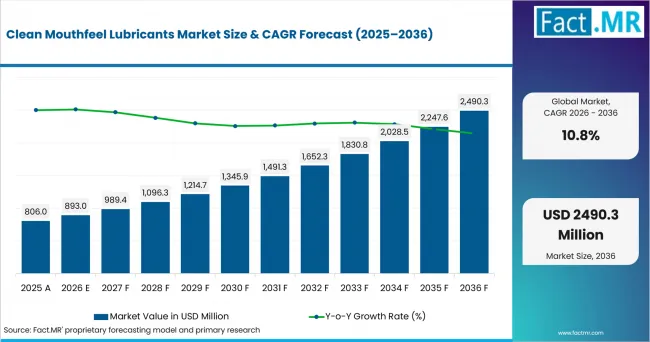
Clean Mouthfeel Lubricants Market Value Analysis | Source: Fact.MR
What are the defining numbers behind Clean Mouthfeel Lubricants Market growth?
An absolute opportunity of USD 1,597.3 million is expected between 2026 and 2036.
- Demand Drivers in the Market
- Beverage teams need smooth flow and low oral drag when added protein or lower sugar changes thickness and finish. In June 2026, USDA Economic Research Service reported U.S. food spending of USD 2.51 trillion in 2025.
- Dairy-alternative brands need mouthfeel systems that work with plant proteins, which can create dryness or a rough finish. Small smoothing particles and protein-lipid systems can reduce drag while keeping the intended protein profile.
- Clinical health teams need high protein levels without a chalky or drying finish. Small protein particles can help because smoothness depends on particle size, hydration, and how proteins behave with saliva during drinking.
- Lower-fat food makers need body and smoothness after fat is removed from a mix. Food inputs that replace part of fat’s physical role can support calorie cut while keeping a fuller and more pleasant feel.
- Clean-label teams need inputs that improve feel and still fit short or familiar input lists. Protein-based and fermentation-based options are therefore being assessed where smoothness must be rebuilt after a mix change.
- Key Segments Analyzed
- By Lubricating Ingredient: Whey microgels are expected to hold 35.0% share in 2026 owing to small hydrated protein particles that can support smoothness and a fat-like feel.
- By Oral Tribology Function: Friction reduction is projected to account for 36.0% share in 2026 because lowering oral drag is the main performance goal for this ingredient class.
- By Product Matrix: Beverages are anticipated to capture 32.0% share in 2026 since roughness and dryness plus changes in thickness or coating can be noticed quickly while drinking.
- By Label Position: Clean label is estimated to represent 28.0% share in 2026 as brands seek familiar ingredient systems that preserve taste and mouthfeel after nutrition-led recipe changes.
- Analyst Opinion at Fact.MR
- Fact.MR Principal Consultant Shambhu Nath Jha states, “The market issue is the loss of smoothness that appears when fat or sugar is reduced or protein content rises. Demand is set to favor systems that improve smoothness without making mixes harder to process. Firms should pair clear friction data with taste tests and simple mix guidance.”
- Strategic Implications
- Food input developers should link friction measurements with trained taste panels so customers can connect test results with creamy feel and smoothness. ONS said in July 2026 that food represented 22.9% of UK manufacturers’ product sales in 2025.
- Protein firms should control particle size and hydration because clumping can turn a smooth protein system into a dry or gritty product. Clear process guidance helps food teams keep the intended feel from pilot batches to full scale.
- Product teams should test the same lubricant in drinks and dairy alternatives. The same checks should cover dressings, desserts, and clinical health products. Oral friction can change from one food base to another, so each use needs its own taste-and-feel and process checks.
- Clean-label firms should explain input origin and how it is made in plain terms so brands can judge label fit. The same records should show whether a system supports low-calorie and fat-cut claims as well as natural-source and allergen-aware positions.
Japan is forecast at 11.5% CAGR through 2036. The USA is projected at 11.2%, followed by the UK at 10.9%. Germany is estimated at 10.5%, while France is forecast at 10.2%. The spread reflects differences in food plants and protein use, while dairy work and mix-change needs add further variation.
How does the Clean Mouthfeel Lubricants Market break down by segment?
Whey microgels lead Lubricating Ingredient at 35.0%; Friction reduction leads Oral Tribology Function at 36.0%.
Which Lubricating Ingredient leads?
Whey microgels are expected to hold 35.0% share in 2026.
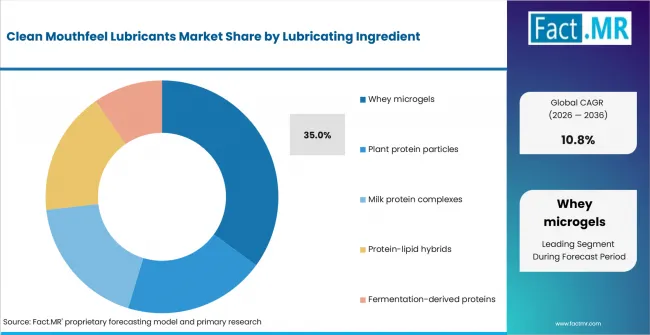
Clean Mouthfeel Lubricants Market Analysis By Lubricating Ingredient | Source: Fact.MR
Whey microgels are expected to lead because small hydrated protein particles can create a smooth and fat-like feel. Plant protein particles serve dairy-free foods, while milk protein complexes suit dairy and health products.
Arla Foods Ingredients markets microparticulated whey protein systems for protein enrichment while maintaining smooth texture and creamy mouthfeel. These solutions are particularly suited to protein-enriched dairy products that are low in fat and require appealing texture and creaminess.
What leads the Oral Tribology Function segment?
Friction reduction is projected to account for 36.0% share in 2026.
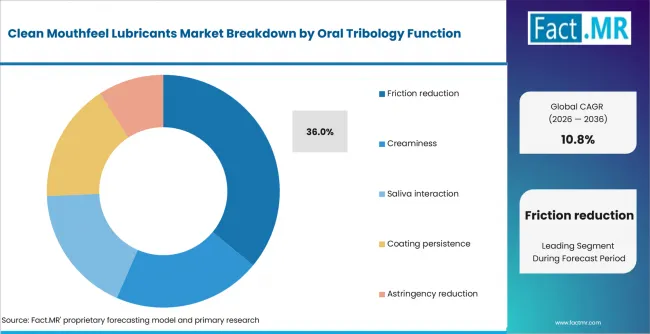
Clean Mouthfeel Lubricants Market Analysis By Oral Tribology Function | Source: Fact.MR
Friction reduction is expected to lead because oral drag directly affects smoothness during eating and drinking. A creamy feel covers a wider set of taste-and-feel cues, while saliva interaction affects hydrated proteins. Coating persistence matters when a product leaves a film after swallowing. Related sensory additives can work beside smoothing systems when flavor and mouthfeel need to be balanced together.
Ingredion links its texture solutions with creaminess and smoothness in finished foods and beverages. IFF supplies hydrocolloids and texturants for dairy and beverage applications, including low-sugar and plant-based formulations where creaminess and mouthfeel are important formulation goals.
How does Product Matrix shape demand?
Beverages are anticipated to capture 32.0% share in 2026.
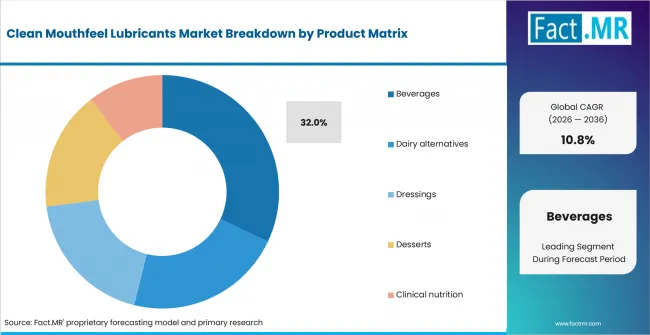
Clean Mouthfeel Lubricants Market Analysis By Product Matrix | Source: Fact.MR
drinks are set to lead because roughness and drying are easy to notice in liquids. Dairy alternatives follow where plant proteins can create graininess or a dry finish. Dressings need smooth flow with stable emulsions, while desserts rely on creamy feel and coating. Clinical health products also need high nutrient density with an acceptable drinking feel.
Cargill offers modified starch systems for dairy drinks that provide body, mouthfeel and creaminess, including options that support reduced-fat formulations. IFF supplies beverage texturants for sugar-reduced and plant-based formulations, helping maintain smoothness, mouthfeel, viscosity and suspension stability.
What supports Clean Label within Label Position?
Clean label is estimated to represent 28.0% share in 2026.
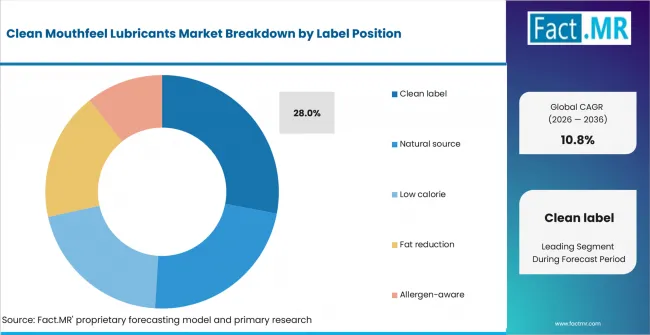
Clean Mouthfeel Lubricants Market Analysis By Label Position | Source: Fact.MR
Clean label is expected to lead because food teams judge mouthfeel and label wording together. Natural-source positioning follows for brands that focus on input origin. Low-calorie and fat-cut claims often require texture recovery, while allergen-aware products narrow the choice of protein systems.
Kerry states that its Tastesense™ Mouthfeel platform can restore body, mouthfeel and a velvety sensory experience in nutritionally optimised foods. The approach is relevant to lower-fat formulations, where reducing fat can alter texture, body and mouthfeel.
What is accelerating Clean Mouthfeel Lubricants Market adoption, and what is holding it back?
Reformulation-driven loss of lubrication accelerates use; matrix-specific performance and taste-and-feel validation restrain it.
Drivers Impact Analysis
| DRIVER | (~) % IMPACT ON CAGR | GEOGRAPHIC RELEVANCE | IMPACT TIMELINE |
|---|---|---|---|
| Reduced-fat and reduced-sugar reformulation | +1.5% | North America, Europe | Short term (<= 2 years) |
| Protein fortification and plant-protein use | +1.2% | Global | Medium term (2-4 years) |
| Clean-label texture design | +0.9% | Europe, North America | Medium term (2-4 years) |
| Oral-tribology testing in product development | +0.7% | Japan, Europe, USA | Long term (>= 4 years) |
Opportunity Impact Analysis
| OPPORTUNITY | (~) % IMPACT ON CAGR | GEOGRAPHIC RELEVANCE | IMPACT TIMELINE |
|---|---|---|---|
| Whey and milk-protein microgels | +1.0% | USA, Europe, Japan | Short term (<= 2 years) |
| Plant-protein lubrication systems | +0.8% | UK, USA, Europe | Medium term (2-4 years) |
| Clinical-nutrition mouthfeel design | +0.6% | Japan, Europe | Long term (>= 4 years) |
Restraints Impact Analysis
| RESTRAINT | (~) % IMPACT ON CAGR | GEOGRAPHIC RELEVANCE | IMPACT TIMELINE |
|---|---|---|---|
| Performance changes by food matrix | -0.6% | Global | Short term (<= 2 years) |
| Protein aggregation and astringency risk | -0.4% | Global | Medium term (2-4 years) |
| Label and allergen constraints | -0.3% | Europe, North America | Long term (>= 4 years) |
Which countries are scaling the Clean Mouthfeel Lubricants Market through 2036?
- The displayed country range spans 1.3 points from Japan at 11.5% CAGR to France at 10.2%.
- Japan remains 0.3 point above the USA as protein-rich foods and careful taste design help smoother foods and drinks.
- The USA remains 0.3 point above the UK, supported by a large food-plant work base and frequent mix changes.
- The UK stays 0.4 point above Germany as plant-protein use expands the need for better mouthfeel in plant-based foods and drinks.
- Germany remains 0.3 point above France as prepared foods and dairy products create steady work on texture and smoothness.
Similar CAGRs can still produce different entry conditions because protein preferences and dairy use vary by country. Label goals and food-plant work scale create further differences. Full coverage spans all major global regions.
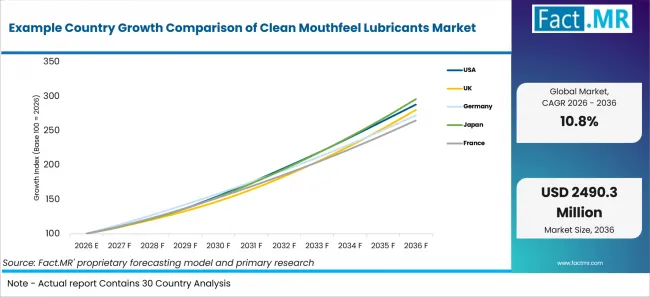
Example Country Growth Comparison Of Clean Mouthfeel Lubricants Market | Source: Fact.MR
| Country | CAGR (2026-2036) |
|---|---|
| Japan | 11.5% |
| United States | 11.2% |
| United Kingdom | 10.9% |
| Germany | 10.5% |
| France | 10.2% |
What supports Japan adoption?
11.5% CAGR, supported by food formulation demand and pressure to preserve sensory quality in protein-rich products.
Japan’s food base covers protein-rich drinks and dairy products where mouthfeel remains a clear quality test. Japan’s Statistics Bureau reported that average monthly consumption expenditure per two-or-more-person household was 314,001 yen in 2025. This broad consumer market gives food teams room to test whey microgels, milk protein complexes, and plant protein particles in products that need a smoother finish.
What supports USA adoption?
11.2% CAGR, backed by the scale of food manufacturing and reformulation activity.
The USA has a large food-plant work base that can support the scale-up of specialized mouthfeel systems. The U.S. Census Bureau reported an estimated USD 1,054.3 billion in value of shipments for U.S. food manufacturing in the 2024 survey year. This output base gives food input firms access to drinks, dairy products, desserts, dressings, and health uses where friction control can improve eating quality.
What supports United Kingdom adoption?
10.9% CAGR, led by food manufacturing depth and plant-protein formulation activity.
The United Kingdom combines established food plants with active work on plant-based foods and mix updates. Defra reported that 58% of UK domestic food consumption in 2025 came from UK production, based on unprocessed value at farm gate. Local manufacturing gives food teams a practical base for testing plant protein inputs and other mouthfeel systems for UK consumers.
What supports Germany adoption?
10.5% CAGR, driven by processed-food production and texture-focused reformulation.
Germany has a large prepared-food base where consistency and eating quality remain visible product goals. Destatis said in January 2026 that Germany produced 1.7 million tonnes of ready meals in 2024. This output creates many mix settings for smooth sauces, creamy fillings, and dairy-style foods where oral friction can affect consumer acceptance.
What supports France adoption?
10.2% CAGR, shaped by dairy processing and product-development work.
France has a mature dairy and formulated-food base that supports work on creamy and smooth mouthfeel. Agreste said in June 2026 that French cow-milk collection rose 1.2% year on year in April 2026. Active dairy plant work gives firms room to position whey microgels and milk protein complexes in drinks, desserts, and health products that need a smoother finish.
Who leads the Clean Mouthfeel Lubricants Market?
Kerry is active through its Tastesense™ Mouthfeel and related taste-modulation solutions designed to restore body and mouthfeel in nutritionally optimised foods. Ingredion provides texture systems through its Texture Equation℠ framework, which combines consumer insights, technical expertise and ingredient solutions. At IFT FIRST 2025 in July 2025, Ingredion showcased prototypes linking texture with health-focused formulation goals, including protein-enriched and reduced-sugar concepts.
Cargill supplies stabilizers and texturants for dairy, plant-based and protein beverages, addressing body, mouthfeel, smoothness and physical stability. IFF provides hydrocolloids, stabilizers and texturants for protein and other beverage applications, with solutions designed to control viscosity, prevent separation and improve creaminess and mouthfeel.
Roquette adds plant-protein capabilities through its NUTRALYS® portfolio, including pea- and wheat-protein ingredients for beverages, plant-based foods and nutritional applications. Arla Foods Ingredients contributes whey-protein expertise through products such as Nutrilac® ProteinBoost, which supports protein enrichment while maintaining smooth texture, creamy mouthfeel and processing stability.
Across these supplier portfolios, product development addresses texture, mouthfeel, stability, protein enrichment and compatibility with different food and beverage formulations. Suppliers also provide formulation and application support to help manufacturers select and optimize ingredient systems for specific products.
Which companies are the key providers?
Key firms include Kerry Group, Ingredion, Cargill, IFF, Roquette, and Arla Foods Ingredients.
- Kerry Group
- Ingredion
- Cargill
- IFF
- Roquette
- Arla Foods inputs
Bibliography
- Zeballos, E., & Sinclair, W. (2026, June 11). Total U.S. food spending reached $2.51 trillion in 2025. U.S. Department of Agriculture, Economic Research Service.
- Office for National Statistics. (2026, July 24). UK manufacturers’ sales by product: 2025.
- U.S. Department of Agriculture, National Agricultural Statistics Service. (2026, April 24). Dairy products 2025 summary.
- Statistics Bureau of Japan. (2026, February 6). 2025 yearly average.
- U.S. Census Bureau. (2026, September 3). Census Bureau releases new Annual Integrated Economic Survey data.
- Department for Environment, Food & Rural Affairs. (2026, September 3). Chapter 14: The food chain. In Agriculture in the United Kingdom 2025.
- Statistisches Bundesamt (Destatis). (2026, January 14). Produktion von Fertiggerichten binnen fünf Jahren mengenmäßig um 25,6 % gestiegen [Production of ready meals increased by 25.6% in volume within five years].
- Touati-Houari, N. (2026, June 12). Lait. Avril 2026 : la collecte de lait toujours en hausse sur un an. Agreste.
- Ingredion. (2025, July 22). Ingredion at IFT FIRST 2025 — Connecting texture, health and innovation.
- Roquette. (2025, June 17). Roquette grows NUTRALYS® plant protein portfolio with addition of new textured wheat and pea proteins.
- Arla Foods Ingredients. (2025, November 11). Arla Foods Ingredients showcases innovation expertise with new high-protein concepts.
This Report Addresses
- The report defines clean mouthfeel lubricants and separates direct oral-friction control from general thickening or flavor work.
- Segment analysis covers the main lubricating ingredient and oral tribology function. It also covers product matrix and label position in the same assessment.
- Country analysis covers Japan and the USA as well as the UK. Germany and France are included with one current official statistic in each country narrative.
- Competitive analysis profiles Kerry Group and Ingredion along with Cargill and IFF. Roquette and Arla Foods Ingredients are included without company-share figures.
- Application analysis covers smoothness and creaminess along with coating and saliva interaction. It also covers dry-feel control after recipe changes.
What does the Clean Mouthfeel Lubricants Market cover?
The market covers food ingredients and systems whose stated role includes lower oral friction or direct recovery of smooth mouthfeel. It overlaps with broader whey protein concentrates when whey proteins are processed or formulated to create a smoother and more fat-like feel.
The assessment also touches alternative hydrocolloids when they support a smoother finished product alongside protein-based lubricants. The defining boundary is direct mouthfeel or friction control rather than general thickening alone.
What is included in the scope?
The scope includes whey microgels and plant protein particles along with milk protein complexes. Protein-lipid hybrids and fermentation-derived proteins are included when they reduce oral friction. Covered uses include drinks and dairy alternatives as well as dressings, desserts and clinical nutrition products across the listed label positions.
Included products must have a clear role in friction reduction or creaminess and saliva interaction. Coating control and dry-feel reduction are included as well. Products can be sold as single ingredients or as systems designed for a defined food base and process route.
What is excluded from the scope?
The scope excludes conventional fats and oils sold only as basic food ingredients. General thickeners and stabilizers fall outside the scope.
The same applies to emulsifiers and flavors as well as sweeteners and protein ingredients unless oral-friction control is part of their stated market role.
How Was the Analysis Built?
The analysis draws on 120+ sources, 35+ company portfolios, 25+ countries, and more than 20 industry interviews.
- Primary Research: Primary research includes discussions with manufacturers, service providers, technology developers, distributors, end users, and subject-matter experts. These conversations examine purchasing priorities, product adoption, operational challenges, approval requirements, competitive positioning, and the factors that influence wider market acceptance.
- Desk Research: Desk research covers government statistics, regulatory publications, company filings, trade data, technical studies, industry associations, standards, public policy, and other authoritative sources. Every source used in the analysis is documented in the bibliography.
- Market Sizing and Forecasting: Market estimates combine historical performance, demand indicators, pricing and volume trends, segment shares, company participation, country-level growth, adoption patterns, investment activity, and barriers to market expansion.
- Data Validation and Update Cycle: Findings are validated by comparing primary interviews with public data, company activity, regulatory changes, trade patterns, and industry developments. Regular updates review new product launches, capacity changes, partnerships, approvals, and shifts in commercial adoption.
What is the report’s scope and coverage?
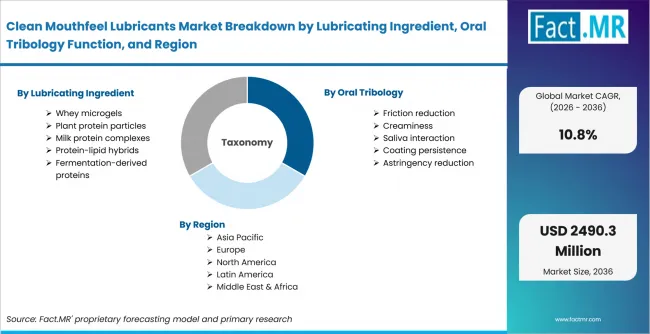
Clean Mouthfeel Lubricants Market Breakdown By Lubricating Ingredient, Oral Tribology Function, And Region | Source: Fact.MR
| Attribute | Details |
|---|---|
| Quantitative Units | USD million in 2026 to USD million by 2036 at a CAGR |
| Market Definition | Functional food ingredients and ingredient systems used to reduce oral friction, improve creaminess, manage saliva interaction, support coating persistence, or reduce astringency in formulated foods and beverages. |
| Lubricating Ingredient | Whey microgels; Plant protein particles; Milk protein complexes; Protein-lipid hybrids; Fermentation-derived proteins |
| Oral Tribology Function | Friction reduction; Creaminess; Saliva interaction; Coating persistence; Astringency reduction |
| Product Matrix | Beverages; Dairy alternatives; Dressings; Desserts; Clinical nutrition |
| Label Position | Clean label; Natural source; Low calorie; Fat reduction; Allergen-aware |
| Regions Covered | North America; Latin America; Western Europe; Eastern Europe; East Asia; South Asia & Pacific; Middle East & Africa |
| Countries Covered | United States; United Kingdom; Germany; Japan; France |
| Key Companies Profiled | Kerry Group; Ingredion; Cargill; IFF; Roquette; Arla Foods Ingredients |
| Forecast Period | 2026 to 2036 |
| Approach | Hybrid top-down and bottom-up approach using formulation demand, food-processing indicators, oral-tribology function, application mix, country evidence, and provider portfolio review. |
How is the market segmented?
-
By Lubricating Ingredient
- Whey microgels
- Plant protein particles
- Milk protein complexes
- Protein-lipid hybrids
- Fermentation-derived proteins
-
By Oral Tribology Function
- Friction reduction
- Creaminess
- Saliva interaction
- Coating persistence
- Astringency reduction
-
By Product Matrix
- Beverages
- Dairy alternatives
- Dressings
- Desserts
- Clinical nutrition
-
By Label Position
- Clean label
- Natural source
- Low calorie
- Fat reduction
- Allergen-aware
-
By Region
- North America
- Latin America
- Western Europe
- Eastern Europe
- East Asia
- South Asia & Pacific
- Middle East & Africa