- Market Value (2025): USD 400.0 Mn
- Estimated Value (2026): USD 500.0 Mn
- Forecast Value (2036): USD 800.0 Mn
- CAGR (2026-2036): 6.0%
What is the Cleft Lip Surgery Market forecast to be worth by 2036?
USD 500.0 million in 2026 to USD 800.0 million by 2036 at 6.0% CAGR.
- The cleft lip surgery market reached USD 400.0 million in 2025 as hospitals and specialty craniofacial centers prioritized early repair pathways.
- Demand is projected to increase from USD 500.0 million in 2026 to USD 800.0 million by 2036.
- The market is forecast to record 6.0% CAGR from 2026 to 2036 with infant treatment pathways and hospital-led care coordination supporting adoption.
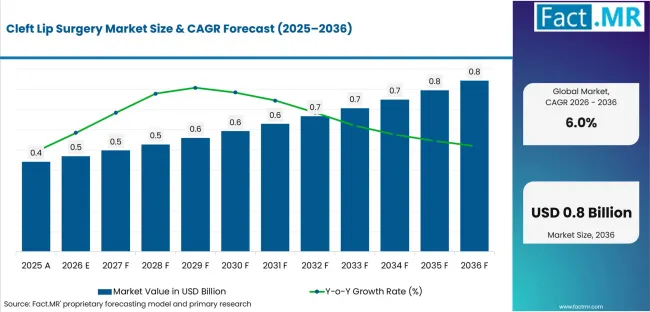
Cleft Lip Surgery Market 3 | Source: Fact.MR
What are the defining numbers behind Cleft Lip Surgery Market growth?
USD 371.7 million absolute opportunity is expected by 2036.
- Demand Drivers in the Market
- Primary repair demand is expected to remain concentrated in hospitals where surgeons need predictable instruments before operating on infants.
- Infant treatment pathways are projected to keep procedure planning tight. Repair timing depends on clinical readiness and feeding support before surgery.
- Hospital procurement groups are expected to favor providers that connect devices and surgical support with the full cleft care pathway.
- Key Segments Analyzed
- By Surgery Type: Primary Cleft Lip Repair is expected to hold 40.1% share in 2026 because it remains the first commercial reference point for procedure volume and equipment use.
- By Patient Age Group: Infants are projected to account for 41.6% share in 2026 as most care pathways begin with early diagnosis and surgical review.
- By Procedure: Conventional Surgery is anticipated to capture 45.1% share in 2026 since established repair methods remain easier for hospitals to plan and train.
- By End User: Hospitals are estimated to represent 41.4% share in 2026 due to anesthesia support and post-operative monitoring requirements.
- By Treatment Stage: Primary Treatment is forecast to hold 39.9% share in 2026 as initial repair sets the starting point for later speech and dental care.
- Analyst Opinion at Fact.MR
- Shambhu Nath Jha, Sr. Consultant at Fact.MR, opines, “Cleft lip surgery demand is expected to depend on support around the first repair decision. Hospitals need procedure readiness and after-care clarity before product selection turns into recurring demand.”
- Strategic Implications
- Hospitals can standardize instrument trays around primary cleft lip repair before expanding procedure capacity.
- Device providers need to connect surgical instruments with planning, wound closure and post-operative support.
- Investors may compare markets through specialist access, hospital coverage and reimbursement conditions. The USA offers the strongest listed growth, while Germany and the UK depend more on documentation, service depth and pediatric surgical capacity.
USA is projected at 7.8% CAGR during 2026 to 2036. Germany is expected to reach 7.1% CAGR. UK is forecast at 6.4% CAGR. France is anticipated to record 5.6% CAGR. Japan is projected at 4.9% CAGR, while Canada is projected at 4.2% CAGR over the same period.
How does the Cleft Lip Surgery Market break down by segment?
Primary Cleft Lip Repair is expected to lead Surgery Type at 40.1% share. Infants are projected to lead Patient Age Group at 41.6% share in 2026.
Which surgery type dominates?
Primary Cleft Lip Repair is projected to account for 40.1% share in 2026.
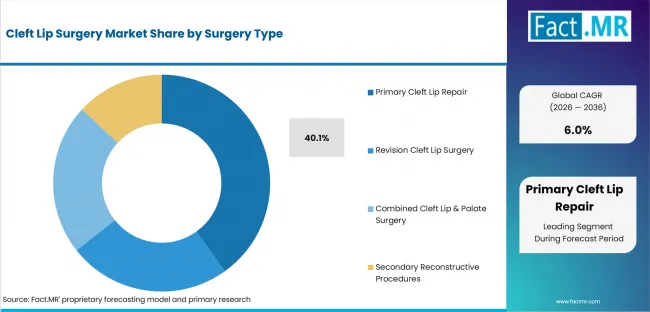
Cleft Lip Surgery Market Analysis By Surgery Type | Source: Fact.MR
Primary repair leads because it is the first surgical decision after diagnosis and care planning. Unilateral and bilateral repair remain important where anatomy changes operating time and after-care needs. Complete repair and revision procedures add demand when nasal correction or later facial growth review is required.
Why do Infants lead Patient Age Group?
Infants are expected to account for 41.6% share in 2026.
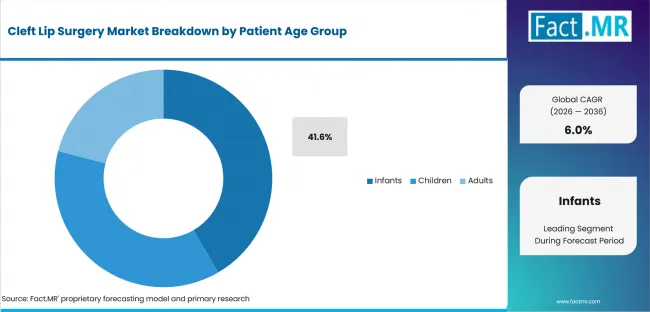
Cleft Lip Surgery Market Analysis By Patient Age Group | Source: Fact.MR
Infants lead because cleft care usually begins early and requires pediatric assessment before repair. The 0-3 Months and 3-6 Months groups define the highest planning intensity. Children and adults support later demand through revision surgery and cosmetic reconstruction.
What leads the Procedure segment?
Conventional Surgery is anticipated to account for 45.1% share in 2026.
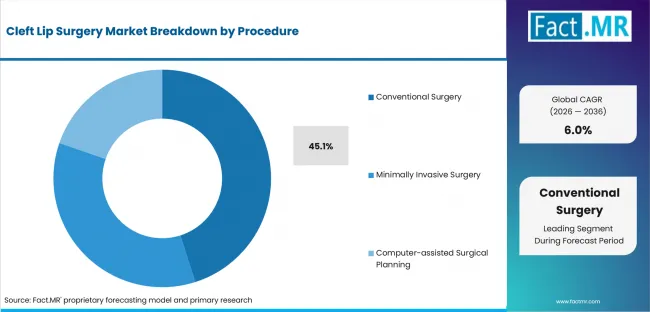
Cleft Lip Surgery Market Analysis By Procedure | Source: Fact.MR
Conventional surgery remains the main route because it is familiar to cleft surgeons and operating rooms. Millard Rotation-advancement and Tennison-Randall techniques remain important when anatomy guides method selection.
How do Hospitals shape End User demand?
Hospitals are estimated to account for 41.4% share in 2026.
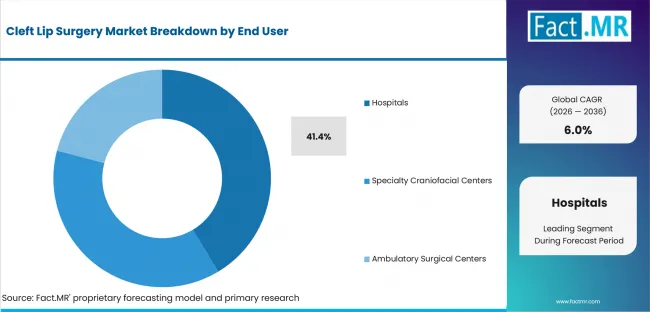
Cleft Lip Surgery Market Analysis By End User | Source: Fact.MR
Hospitals lead because cleft repair needs anesthesia capacity and pediatric monitoring. Pediatric hospitals and tertiary care hospitals remain important for complex repair or syndromic cases. ENT surgical devices matter only where ear or airway support intersects with cleft care.
What supports Primary Treatment within Treatment Stage?
Primary Treatment is forecast to hold 39.9% share in 2026.
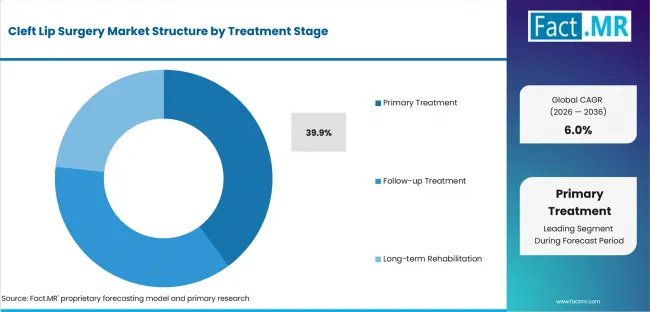
Cleft Lip Surgery Market Analysis By Treatment Stage | Source: Fact.MR
Primary treatment leads because the first repair sets the clinical pathway for later care. Initial surgical repair and pre-surgical orthopedics shape early demand. Follow-up treatment and orthodontic management extend the lifetime value of cleft care programs.
What is accelerating Cleft Lip Surgery Market adoption, and what is holding it back?
Adoption is expected to grow through standard repair methods and hospital-led care. Growth may be limited by reimbursement pressure and a shortage of specialists.
Drivers Impact Analysis
| DRIVER | (~) % IMPACT ON CAGR | GEOGRAPHIC RELEVANCE | IMPACT TIMELINE |
|---|---|---|---|
| Primary repair procedure standardization | +1.6% | Canada, USA | Short term (<= 2 years) |
| Infants treatment pathway concentration | +1.2% | USA, Canada | Short term (<= 2 years) |
| Hospital and cleft center workflow depth | +0.9% | Canada, Japan, UK | Medium term (2-4 years) |
| Multidisciplinary follow-up requirements | +0.7% | UK, Germany, France | Medium term (2-4 years) |
| Surgical planning and instrument standardization | +0.5% | Canada, Japan, Europe | Long term (>= 4 years) |
Source: Fact.MR analysis. Updated Jul 30, 2026
- Primary repair procedure standardization: Hospitals are expected to value repeatable repair protocols that reduce preparation uncertainty before infant surgery.
- Infants treatment pathway concentration: Infant care is projected to keep demand close to pediatric assessment and family counseling pathways.
- Hospital and cleft center workflow depth: Hospitals with craniofacial coordination are expected to convert demand faster because service responsibility is clearer.
Opportunity Impact Analysis
| OPPORTUNITY | (~) % IMPACT ON CAGR | GEOGRAPHIC RELEVANCE | IMPACT TIMELINE |
|---|---|---|---|
| Infant repair workflow packages | +1.1% | Canada and USA | Medium term (2-4 years) |
| Cleft center service partnerships | +0.9% | USA and Europe | Medium term (2-4 years) |
| Planning support for complex repair | +0.7% | Japan and Germany | Medium term (2-4 years) |
| Follow-up treatment integration | +0.5% | France, UK, Canada | Long term (>= 4 years) |
Source: Fact.MR analysis. Updated Jul 30, 2026
- Infant repair workflow packages: Providers are expected to gain more interest when they combine instruments and post-operative guidance.
- Cleft center service partnerships: Specialist centers are projected to create openings for training and recurring product use.
- Planning support for complex repair: Complex cases are anticipated to need clearer anatomical review before method selection.
Restraints Impact Analysis
| RESTRAINT | (~) % IMPACT ON CAGR | GEOGRAPHIC RELEVANCE | IMPACT TIMELINE |
|---|---|---|---|
| Reimbursement and procedure-cost pressure | -1.1% | Canada, USA, Europe | Short term (<= 2 years) |
| Pediatric specialist availability | -0.8% | Rural and underserved areas | Short term (<= 2 years) |
| Care coordination burden | -0.6% | Hospitals and cleft centers | Medium term (2-4 years) |
| Revision and follow-up complexity | -0.4% | Mature care systems | Long term (>= 4 years) |
Source: Fact.MR analysis. Updated Jul 30, 2026
- Reimbursement and procedure-cost pressure: Procedure approval can slow when hospitals cannot connect device selection with a clear payment route.
- Pediatric specialist availability: Primary repair requires surgeons and anesthesia support that are not evenly available across every care setting.
- Revision and follow-up complexity: Later procedures create planning burden when speech or facial-growth needs change over time.
Which countries are scaling Cleft Lip Surgery Market fastest?
The country comparison is led by the USA at 7.8% CAGR, followed by Germany at 7.1% and the UK at 6.4%. France, Japan and Canada grow at lower listed rates.
- The USA leads through hospital network depth, documentation readiness and pediatric surgical capacity.
- Germany and the UK grow steadily as validation and cost reviews guide adoption.
- France follows through specialist care networks, although longer purchasing reviews may slow procedure uptake across hospitals.
- Japan and Canada remain important, but their listed CAGRs are below the USA, Germany, UK and France in this comparison.
The full report provides country-level CAGR analysis across North America; Latin America; Europe; East Asia; South Asia and Pacific; and the Middle East and Africa.
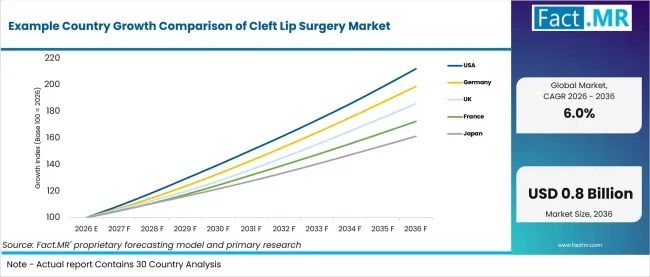
Example Country Growth Comparison Of Cleft Lip Surgery Market | Source: Fact.MR
| Country | CAGR (2026-2036) |
|---|---|
| Canada | 4.2% |
| USA | 7.8% |
| Japan | 4.9% |
| UK | 6.4% |
| Germany | 7.1% |
| France | 5.6% |
Source: Fact.MR analysis. Updated Jul 30, 2026
What supports Canada adoption?
4.2% CAGR, supported by service coverage and primary repair access.
Canada’s growth reflects a market where providers must serve families across wide geographies without weakening procedure coordination. Primary Cleft Lip Repair demand is expected to strengthen where hospitals and referral networks reduce travel burden.
How is USA demand developing?
7.8% CAGR, driven by documentation needs and hospital network depth.
USA demand is shaped by the need to connect infant surgery with payer review and hospital protocols. Procedure adoption is expected to move faster where providers help hospitals document clinical fit.
What is shaping Japan’s outlook through 2036?
4.9% CAGR, backed by procedural discipline and specialist care quality.
Japan’s growth is tied to hospital confidence in established surgical methods and careful planning for complex repair. Conventional Surgery remains important because clinical users value reliable technique selection.
How does UK perform?
6.4% CAGR, led by structured care pathways and cost review discipline.
UK demand reflects a mature care system where providers must show how products fit referral pathways and service accountability. Hospitals are expected to compare procedure value with speech and dental needs.
What supports Germany’s growth?
7.1% CAGR, supported by evidence review and surgical quality expectations.
Germany’s growth is shaped by institutional scrutiny around performance and long-term care outcomes. Hospitals and specialty centers are expected to reward products that support consistent procedure quality.
How is France scaling demand?
5.6% CAGR, backed by specialist networks and compliance-led purchasing.
France’s growth reflects a market where channel partners and hospitals value clear positioning around primary repair and follow-up treatment. Demand is expected to move through providers that support procedure planning and training discipline.
Who leads the Cleft Lip Surgery Market?
Stryker Corporation and Zimmer Biomet show the clearest relevance, while KLS Martin Group strengthens the surgical instrument landscape.
Stryker, Zimmer Biomet and KLS Martin support the market through craniofacial fixation, reconstructive systems and specialized surgical instruments. Medtronic and Johnson & Johnson MedTech add operating-room technologies, while B. Braun strengthen soft-tissue repair and wound care.
From 2026 to 2036, competition will depend on instrument reliability, training, procedure planning and post-operative support. Providers covering primary repair and follow-up care may gain stronger hospital demand.
Which companies are the key providers?
Key companies include Stryker Corporation; Zimmer Biomet; KLS Martin Group; Johnson & Johnson MedTech; and B. Braun SE.
- Stryker Corporation
- Zimmer Biomet
- KLS Martin Group
- Johnson & Johnson MedTech
- B. Braun SE
Bibliography
- Centers for Disease Control and Prevention. (2024, November 19). Specific birth defects and other health conditions.
- World Health Organization. (2025, March 17). Oral health.
- National Library of Medicine. (2025, May 11). Conventional versus modified pre-surgical naso-alveolar molding treatment in cleft lip and palate infants (ClinicalTrials.gov Identifier NCT06494098).
- Johnson & Johnson. (2024, February 12). Orthopaedic experts identify best practices for wound closure and dressing management in total knee and total hip arthroplasty.
- Stryker Corporation. (2024, September 25). Stryker launches 1788, its next generation of advanced surgical camera in India, elevating surgical visualization across specialties.
This Report Answers
- The report provides strategic intelligence on the Cleft Lip Surgery Market across Surgery Type and Patient Age Group choices that shape primary repair demand.
- Segment analysis covers Primary Cleft Lip Repair and Infants as the share leaders within the 2026 market structure.
- Country outlook evaluates the USA and Germany alongside the UK and France. Japan and Canada complete the listed CAGR comparison.
- Competitive analysis profiles Stryker Corporation and Zimmer Biomet alongside KLS Martin Group. Johnson & Johnson MedTech and B. Braun SE complete the provider set.
- Treatment-stage assessment covers Primary Treatment and Initial Surgical Repair alongside pre-surgical orthopedics, follow-up care and long-term rehabilitation.
What does the Cleft Lip Surgery Market cover?
Cleft Lip Surgery covers surgical repair and instrument use connected with cleft lip correction.
The Cleft Lip Surgery Market covers primary repair and unilateral repair. Bilateral repair and revision procedures are included when they support cleft lip correction. Coverage extends to surgical instruments and hospital procedure workflows. The market includes hospitals and specialty craniofacial centers where procedures are directly tied to cleft lip correction.
What is included in the scope?
Cleft lip surgery activity is included when it directly supports primary repair, revision care or follow-up treatment.
The scope includes Surgery Type and Patient Age Group alongside Procedure. End User and Treatment Stage are included because care pathways affect provider selection. It covers Primary Cleft Lip Repair and Unilateral Cleft Lip Repair. Bilateral and Complete Cleft Lip Repair are included where these support cleft lip corrections.
What is excluded from the scope?
General surgery spending and unrelated cosmetic procedures remain outside the scope of this market.
The scope excludes hospital infrastructure that is not directly tied to cleft lip repair. Unrelated dental and ENT procedures are excluded when they do not support cleft lip correction or follow-up treatment. Company revenue without a clear connection to cleft repair products or service support is not counted.
How Was the Analysis Built?
The analysis draws on 120+ sources and 35+ company portfolios. It covers 25+ countries and more than 20 industry interviews.
- Primary Research: Primary research includes discussions with manufacturers and service providers. It also covers technology developers and distributors. These conversations examine purchasing priorities and product adoption. They also review operating challenges and approval requirements.
- Desk Research: Desk research covers public health sources and regulatory publications. It also reviews company filings and technical literature. Industry associations and standards are used where they directly support the analysis.
- Market Sizing and Forecasting: Market estimates combine historical performance and demand indicators. Pricing and procedure trends are reviewed with segment shares and company participation. Country growth and service access are then tested against barriers to market expansion.
- Data Validation and Update Cycle: Findings are validated by comparing primary interviews with public data. Company activity and regulatory changes are reviewed during the same cycle. Regular updates examine product launches and approvals as commercial adoption changes.
Segmentation
What is the report's scope and coverage?
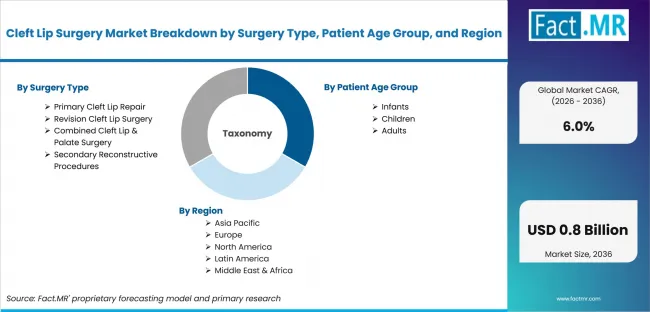
Cleft Lip Surgery Market 2 | Source: Fact.MR
| Attribute | Details |
|---|---|
| Quantitative Units | USD 500.0 million in 2026 to USD 800.0 million by 2036, at a 6.0% CAGR. |
| Market Definition | Cleft lip surgery covers surgical repair, instrument use, planning support and care delivery directly tied to cleft lip correction. |
| Surgery Type | Primary Cleft Lip Repair; Unilateral Cleft Lip Repair; Bilateral Cleft Lip Repair; Complete Cleft Lip Repair; Revision Cleft Lip Surgery; Scar Revision Surgery; Nasal Revision Surgery; Lip Reconstruction Surgery; Combined Cleft Lip & Palate Surgery; Single-stage Repair; Multi-stage Repair; Comprehensive Reconstruction; Secondary Reconstructive Procedures; Alveolar Bone Grafting; Rhinoplasty; Soft Tissue Reconstruction |
| Patient Age Group | Infants; 0-3 Months; 3-6 Months; 6-12 Months; Children; 1-5 Years; 6-12 Years; Adolescents; Adults; Primary Adult Repair; Revision Surgery; Cosmetic Reconstruction |
| Procedure | Conventional Surgery; Millard Rotation-advancement Technique; Tennison-Randall Technique; Triangular Flap Repair; Minimally Invasive Surgery; Endoscopic-assisted Surgery; Laser-assisted Procedures; Microsurgical Techniques; Computer-assisted Surgical Planning; 3D Surgical Planning; Virtual Surgical Simulation; Patient-specific Surgical Guides |
| End User | Hospitals; Pediatric Hospitals; General Hospitals; Tertiary Care Hospitals; Specialty Craniofacial Centers; Cleft Care Centers; Plastic Surgery Centers; Reconstructive Surgery Clinics; Ambulatory Surgical Centers; Day Surgery Centers; Outpatient Surgical Centers; Specialty Surgical Facilities |
| Treatment Stage | Primary Treatment; Initial Surgical Repair; Pre-surgical Orthopedics; Newborn Intervention; Follow-up Treatment; Post-operative Care; Speech Therapy Support; Wound Management; Long-term Rehabilitation; Facial Growth Monitoring; Orthodontic Management; Multidisciplinary Care |
| Regions Covered | North America; Latin America; Europe; East Asia; South Asia and Pacific; Middle East and Africa |
| Countries Covered | Canada; USA; Japan; UK; Germany; France |
| Key Companies Profiled | Stryker Corporation; Zimmer Biomet; KLS Martin Group; Johnson & Johnson MedTech; B. Braun SE |
| Forecast Period | 2026 to 2036 |
| Approach | Hybrid top-down and bottom-up approach using procedure demand; hospital care pathways; cleft center activity; primary repair planning; surgical instrument use; patient age group demand; treatment-stage patterns; country adoption signals and company portfolio review |
Source: Fact.MR analysis. Updated Jul 30, 2026
How is the market segmented?
-
By Surgery Type:
- Primary Cleft Lip Repair
- Unilateral Cleft Lip Repair
- Bilateral Cleft Lip Repair
- Complete Cleft Lip Repair
- Revision Cleft Lip Surgery
- Scar Revision Surgery
- Nasal Revision Surgery
- Lip Reconstruction Surgery
- Combined Cleft Lip & Palate Surgery
- Single-stage Repair
- Multi-stage Repair
- Comprehensive Reconstruction
- Secondary Reconstructive Procedures
- Alveolar Bone Grafting
- Rhinoplasty
- Soft Tissue Reconstruction
- Primary Cleft Lip Repair
-
By Patient Age Group:
- Infants
- 0-3 Months
- 3-6 Months
- 6-12 Months
- Children
- 1-5 Years
- 6-12 Years
- Adolescents
- Adults
- Primary Adult Repair
- Revision Surgery
- Cosmetic Reconstruction
- Infants
-
By Procedure:
- Conventional Surgery
- Millard Rotation-advancement Technique
- Tennison-Randall Technique
- Triangular Flap Repair
- Minimally Invasive Surgery
- Endoscopic-assisted Surgery
- Laser-assisted Procedures
- Microsurgical Techniques
- Computer-assisted Surgical Planning
- 3D Surgical Planning
- Virtual Surgical Simulation
- Patient-specific Surgical Guides
- Conventional Surgery
-
By End User:
- Hospitals
- Pediatric Hospitals
- General Hospitals
- Tertiary Care Hospitals
- Specialty Craniofacial Centers
- Cleft Care Centers
- Plastic Surgery Centers
- Reconstructive Surgery Clinics
- Ambulatory Surgical Centers
- Day Surgery Centers
- Outpatient Surgical Centers
- Specialty Surgical Facilities
- Hospitals
-
By Treatment Stage:
- Primary Treatment
- Initial Surgical Repair
- Pre-surgical Orthopedics
- Newborn Intervention
- Follow-up Treatment
- Post-operative Care
- Speech Therapy Support
- Wound Management
- Long-term Rehabilitation
- Facial Growth Monitoring
- Orthodontic Management
- Multidisciplinary Care
- Primary Treatment
-
By Region:
- North America
- Latin America
- Europe
- East Asia
- South Asia and Pacific
- Middle East and Africa
Frequently Asked Questions
Which Surgery Type leads the market?
Which Patient Age Group leads the market?
Which Procedure leads the market?
Which End User leads the market?
Which Treatment Stage leads the market?
Which country records the highest listed CAGR?
What is the primary driver in this market?
What is the main restraint?
Why do Infants lead demand?
Who worked on this report


Preview the report firsthand - request a free sample
Free SampleGet the brochure for pricing and purchase details
Download PDF