- Market Value (2025): USD 2.7 Bn
- Estimated Value (2026): USD 3.2 Bn
- Forecast Value (2036): USD 16.5 Bn
- CAGR (2026-2036): 17.8%
What is the Commercial Small Launch Rockets Market forecast to be worth by 2036?
USD 3.2 billion in 2026 to USD 16.5 billion by 2036, at a 17.8% CAGR.
- The market is valued at USD 2.7 billion in 2025.
- Demand is projected to increase from USD 3.2 billion in 2026 to USD 16.5 billion by 2036.
- The market is forecast to record a 17.8% CAGR from 2026 to 2036 as dedicated small-satellite launch demand and institutional procurement expand the commercial launch base.
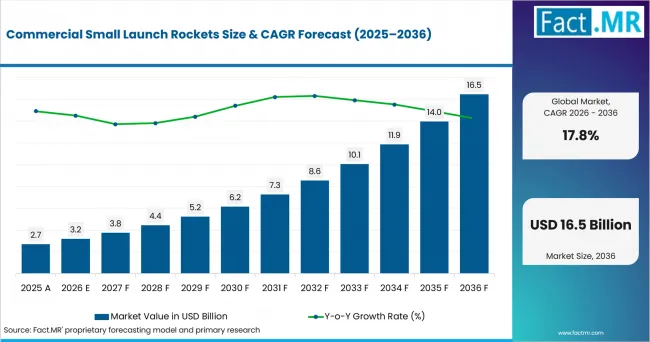
Commercial Small Launch Rockets Value Analysis | Source: Fact.MR
What are the defining numbers behind Commercial Small Launch Rockets Market growth?
USD 13.3 billion absolute opportunity is expected between 2026 and 2036, with 100-300 kg payloads, LOX / kerosene propulsion, dedicated smallsat missions and commercial constellation customers forming the largest categories in 2026.
- Demand Drivers in the Market
- Dedicated missions are gaining relevance where customers need control over orbital destination and launch timing rather than accepting the constraints of a secondary rideshare payload.
- NASA continues to buy dedicated and rideshare launch services for risk-tolerant science and technology payloads through its VADR framework, supporting a commercial route to orbit for smaller missions.
- ESA is moving from launcher development support toward becoming a customer of new commercial launch services through the European Launcher Challenge, creating a clearer path from vehicle development to service procurement.
- Government and defence customers are increasing the value of responsive launch models where mission timing, payload integration and assured access matter more than maximum vehicle capacity.
- Higher launch activity is making airspace integration a practical operating issue. UNOOSA and ICAO identify the need for stronger coordination as launch and re-entry operations become more frequent.
- Key Segments Analyzed
- By Payload to LEO: 100-300 kg is expected to hold 29% share in 2026, followed closely by 301-600 kg at 27%.
- By Propulsion: LOX / kerosene is projected to account for 41% share in 2026, while LOX / methane represents 27%.
- By Launch Model: Dedicated smallsat missions are anticipated to capture 46% share in 2026, reflecting demand for schedule and orbit control.
- By Customer: Commercial constellation operators are estimated to represent 34% share in 2026, ahead of defence / government customers at 27%.
- Analyst Opinion at Fact.MR
- Shambhu Nath Jha, Senior Consultant, Fact.MR.The central commercial test is whether an operator can convert vehicle capability into a repeatable service without losing schedule discipline. Small-launch providers need to prove that payload integration and launch operations can be executed consistently across multiple missions.
- Strategic Implications
- Launch providers should design integration processes around the 100-300 kg and 301-600 kg payload bands, where the combined demand concentration is strongest.
- Propulsion choices should be evaluated against mission performance and ground-operating complexity rather than thrust performance alone.
- Spaceport access and range coordination should be secured early because launch infrastructure can become a constraint even when the vehicle is technically ready.
- Customers should compare dedicated and rideshare options by required orbit and launch window, since the lower-cost option can still create mission delay or deployment trade-offs.
The five country growth rates remain tightly grouped from 17.4% to 18.9% through 2036. The USA is supported by government launch procurement, Germany by institutional backing for private launch systems, Spain by public innovation support, the UK by launch licensing and spaceport development, and France by launch-range infrastructure at the Guiana Space Centre.
How does the Commercial Small Launch Rockets Market break down by segment?
100-300 kg leads Payload to LEO at 18%; LOX / kerosene leads Propulsion at 41%; Dedicated smallsat leads Launch Model at 46%; Commercial constellation customers lead at 34%.
Which Payload to LEO class dominates?
100-300 kg payloads account for 18% share in 2026.
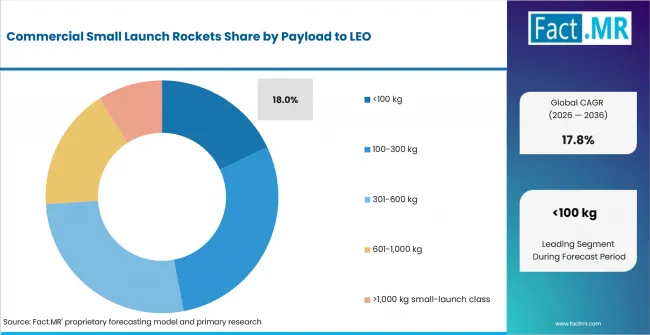
Commercial Small Launch Rockets Analysis By Payload To Leo | Source: Fact.MR
The 100-300 kg class leads because it sits inside a practical range for dedicated small-satellite missions while preserving meaningful payload capability. The 301-600 kg band follows at 27%, showing that demand is concentrated across the middle of the small-launch payload spectrum rather than at the very lowest mass class.
Payloads below 100 kg represent 18% share, while 601-1,000 kg accounts for 17%. The >1,000 kg small-launch class represents 9%. Public programs in the USA and Europe continue to create flight opportunities for smaller spacecraft, which expands the adjacent need for qualification and pre-flight satellite testing before launch.
What leads the Propulsion segment?
LOX / kerosene represents 41% share in 2026.
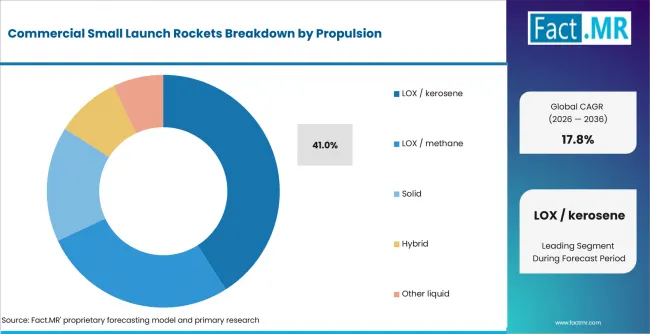
Commercial Small Launch Rockets Analysis By Propulsion | Source: Fact.MR
LOX / kerosene leads the propulsion mix because it combines established liquid-propulsion engineering with a well-understood launch-operations base. LOX / methane follows at 27%, reflecting growing interest in newer liquid-propulsion architectures where operators are designing vehicles for repeatable commercial service.
Solid propulsion accounts for 16%, hybrid systems 9%, and other liquid propulsion 7%. Spain's small-satellite launcher initiative explicitly includes advanced propulsion concepts and low-emission options within its technology scope. Related development in green propellants shows how propulsion choices are broadening beyond conventional performance metrics.
How does Launch Model shape demand?
Dedicated smallsat launch accounts for 46% share in 2026.
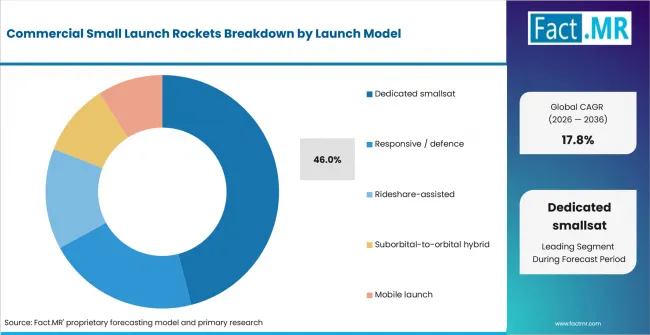
Commercial Small Launch Rockets Analysis By Launch Model | Source: Fact.MR
Dedicated smallsat missions lead because they give customers greater control over launch timing and orbital placement. Responsive / defence missions represent 21%, while rideshare-assisted launches account for 14%. Suborbital-to-orbital hybrid models hold 10%, and mobile launch represents 9%.
NASA's VADR framework covers both dedicated and rideshare services, which illustrates why the two models coexist. ESA's European Launcher Challenge adds a separate institutional route by supporting new commercial launch services that must demonstrate orbital capability and then scale operational delivery.
What supports Commercial constellation demand within Customer?
Commercial constellation operators represent 34% share in 2026.
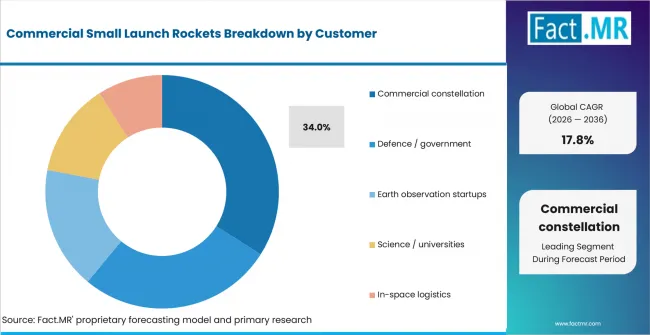
Commercial Small Launch Rockets Analysis By Customer | Source: Fact.MR
Constellation customers lead because repeated spacecraft deployment creates an ongoing need for launch access rather than a single mission event. ITU filing and coordination procedures for non-GSO networks add a regulatory layer that customers have to manage alongside spacecraft deployment. That demand links launch activity with the broader satellite communication and satellite internet ecosystems.
Defence / government customers account for 27%, followed by Earth observation startups at 17%. Science / universities represent 13%, while in-space logistics accounts for 9%. NASA's science and technology payload programs support the public and research side of the market, while the expansion of Earth observation applications provides a commercial demand base for new satellite missions.
What is accelerating Commercial Small Launch Rockets Market adoption, and what is holding it back?
Dedicated access and institutional launch procurement support adoption; schedule execution, airspace integration and licensing complexity restrain it.
Drivers Impact Analysis
| DRIVER (~) | % IMPACT ON CAGR | GEOGRAPHIC RELEVANCE | IMPACT TIMELINE |
|---|---|---|---|
| Dedicated access for small satellites | +3.4% | Global | Short term (<= 2 years) |
| European commercial launch procurement | +2.5% | Europe | Short term (<= 2 years) |
| Responsive government launch demand | +1.8% | USA, Europe | Medium term (2-4 years) |
| Spaceport access and launch infrastructure | +1.2% | Europe | Medium term (2-4 years) |
Source: Fact.MR analysis. Updated Sep 15, 2026
- Dedicated access is the strongest demand driver because smaller payload operators can value mission control more than raw launcher capacity. NASA's VADR structure shows how a public customer can procure dedicated and rideshare services from commercial providers for smaller science and technology payloads.
- European procurement is also moving closer to operational service. ESA's European Launcher Challenge is designed to expand launch-service supply and make ESA a customer of privately led launch services. The successful Spectrum orbital mission in September 2026 gives this transition a current operational reference point.
- Responsive demand broadens the addressable customer base beyond commercial constellations. Government and defence users can place a premium on mission timing, while national space agencies are building the institutional and infrastructure conditions needed for more commercial launches.
Opportunity Impact Analysis
| OPPORTUNITY (~) | % IMPACT ON CAGR | GEOGRAPHIC RELEVANCE | IMPACT TIMELINE |
|---|---|---|---|
| Operational dedicated-launch capacity | +2.2% | Global | Short term (<= 2 years) |
| 100-600 kg payload specialization | +1.6% | Global | Short term (<= 2 years) |
| Responsive and mobile mission models | +1.1% | USA, Europe | Medium term (2-4 years) |
| Commercial access from European spaceports | +0.9% | Europe | Medium term (2-4 years) |
Source: Fact.MR analysis. Updated Sep 15, 2026
- Operational dedicated-launch capacity is the clearest opportunity because customer demand becomes commercially meaningful only when vehicles move from development into repeatable service. The strongest payload concentration sits between 100 kg and 600 kg, giving providers a defined range around which vehicle capability and integration processes can be optimized.
- Responsive and mobile launch models create a second path for growth where customers need shorter mission lead times or alternative launch locations. The UK's LaunchUK program and licensing framework provide a route for commercial spaceflight from domestic spaceports, while France is opening the Guiana Space Centre to private micro- and mini-launchers.
- European spaceports can also reduce the distance between vehicle development and operating infrastructure. CNES is adapting the ELM-Diamant area for multiple commercial launcher operators, giving smaller vehicles access to established range and safety systems.
Restraints Impact Analysis
| RESTRAINT (~) | % IMPACT ON CAGR | GEOGRAPHIC RELEVANCE | IMPACT TIMELINE |
|---|---|---|---|
| Schedule and mission-readiness risk | -2.0% | Global | Short term (<= 2 years) |
| Airspace integration requirements | -1.4% | Global | Short term (<= 2 years) |
| Licensing and range coordination | -1.1% | USA, Europe | Medium term (2-4 years) |
| Customer spectrum and filing dependencies | -0.7% | Global | Medium term (2-4 years) |
Source: Fact.MR analysis. Updated Sep 15, 2026
- Schedule risk remains a commercial constraint because launch customers need the vehicle, payload and range to be ready at the same time. ESA's commercial-launch framework places explicit weight on business case, engineering quality, resources, schedule and compliance, which makes execution discipline part of market competitiveness.
- Airspace integration becomes harder as launch frequency rises. UNOOSA and ICAO identify the growing need to move beyond ad hoc closures toward more coordinated treatment of space transportation operations within shared airspace. A launch provider therefore needs operational coordination capability in addition to a flight-ready vehicle.
- Licensing and range coordination can extend mission preparation, particularly where new spaceports and new operators are entering service. Customer-side spectrum filings also matter for constellation missions because ITU procedures govern how non-GSO networks are published, coordinated and recorded.
Which countries are scaling the Commercial Small Launch Rockets Market through 2036?
- The country outlook spans 1.5 percentage points across the 2026 to 2036 CAGR range, so the rates should be read as a tight cluster rather than a leadership ranking.
- USA is forecast at 18.6% CAGR, supported by commercial launch procurement for public science and technology missions.
- Germany is forecast at 17.4% CAGR, with institutional backing focused on moving privately developed launch systems into orbital service.
- Spain is forecast at 17.8% CAGR as public innovation programs support domestic small-launch capability and related space technologies.
- UK is forecast at 18.2% CAGR as LaunchUK combines launch-market development with licensing and spaceport regulation.
- France is forecast at 18.9% CAGR as CNES expands multi-launcher infrastructure at the Guiana Space Centre for private micro- and mini-launchers.
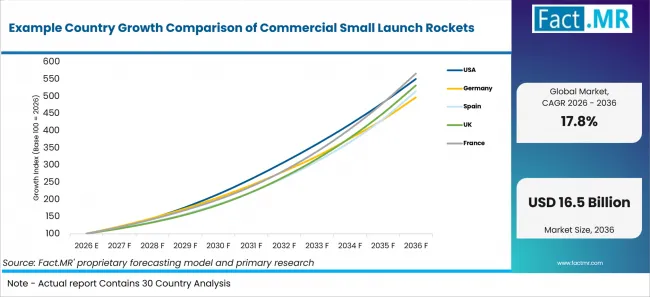
Example Country Growth Comparison Of Commercial Small Launch Rockets | Source: Fact.MR
| Country | CAGR (2026-2036) |
|---|---|
| USA | 18.6% |
| Germany | 17.4% |
| Spain | 17.8% |
| UK | 18.2% |
| France | 18.9% |
Source: Fact.MR analysis. Updated Sep 15, 2026
What supports USA adoption?
18.6% CAGR through 2036, supported by government launch procurement and a broad commercial launch supplier base.
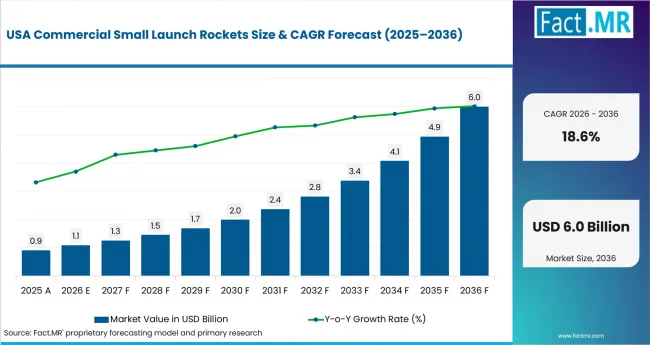
Commercial Small Launch Rockets Country Value Analysis | Source: Fact.MR
NASA's VADR contract provides a direct demand mechanism by buying dedicated and rideshare launch services for risk-tolerant agency and agency-sponsored payloads. The framework gives smaller missions a commercial path to orbit while allowing NASA to add new provider capabilities over time.
The U.S. market also benefits from a large government and defence customer base. GAO work on national-security space launch and satellite acquisition shows why schedule visibility, infrastructure use and cost discipline remain important as commercial providers take a larger role in public missions.
How is Germany scaling demand?
17.4% CAGR through 2036, supported by institutional backing for privately developed launch systems.
Germany's mechanism is visible in the support provided by the German Space Agency at DLR to private launch development. In September 2026, DLR reported the successful Spectrum orbital mission carrying five small satellites and one experiment, turning institutional support into a demonstrated launch-service milestone.
Germany therefore offers a market path based on technology maturation and institutional customer support rather than on a single demand mandate. The next challenge is repeated service delivery across commercial and public missions.
What supports Spain adoption?
17.8% CAGR through 2036, supported by public innovation programs for domestic small-launch capability.
CDTI's small-satellite launcher initiative is designed around a prototype capable of placing small satellites into low Earth orbit and is aligned with Spain's Aerospace PERTE. The program also identifies advanced propulsion, stage reuse and payload-accommodation technologies as part of the development scope.
This creates a domestic industrial mechanism that supports vehicle development and the surrounding supplier base. Spain's growth case therefore depends on converting public technology support into repeatable commercial launch operations.
How does the UK perform?
18.2% CAGR through 2036, shaped by launch-market development, licensing and spaceport readiness.
LaunchUK is the UK's commercial spaceflight program and is paired with guidance for launch, return and spaceport operations. That structure matters because a small-launch market needs both vehicle providers and a regulatory route to operate from domestic sites.
The UK Space Agency is also supporting wider space-technology capability, which can strengthen the customer and supplier base around launch. Commercial growth will depend on moving licensed projects into a regular operating cadence.
What supports France adoption?
18.9% CAGR through 2036, supported by multi-launcher infrastructure at the Guiana Space Centre.
CNES is adapting the ELM-Diamant complex to host private micro- and mini-launchers alongside Europe's established launch systems. The site gives new operators access to an existing spaceport environment with range safety and launch-support infrastructure.
France therefore has an infrastructure-led route to market expansion. The commercial effect depends on how quickly new operators can move through site preparation and qualification into repeatable launch service from the Guiana Space Centre.
Who Leads the Commercial Small Launch Rockets Market?
The commercial small launch rockets market includes established launch providers and newer entrants progressing through vehicle development and service ramp-up. Key participants include Rocket Lab, Firefly Aerospace, Isar Aerospace, PLD Space, Orbex, and HyImpulse.
Competitive positioning is shaped by demonstrated mission reliability, payload integration capability, launch frequency, vehicle readiness and access to launch infrastructure. Supplier strength can vary by payload class, launch geography and mission requirement, which makes competitive standing dependent on operational maturity and customer access rather than a single market-wide ranking.
Which Companies Are the Key Providers?
Key companies operating in the commercial small launch rockets market include:
- Rocket Lab
- Firefly Aerospace
- Isar Aerospace
- PLD Space
- Orbex
- HyImpuls
Bibliography
- National Aeronautics and Space Administration. VADR (Venture-Class Acquisition of Dedicated and Rideshare) Launch Services. Page updated July 30, 2025.
- U.S. Government Accountability Office. Missile Warning Satellites: Space Development Agency Should Be More Realistic and Transparent About Risks to Capability Delivery. January 28, 2026; revised February 2, 2026.
- German Aerospace Center (DLR). First orbital flight of the SPECTRUM commercial launch vehicle from Germany. September 6, 2026.
- CDTI Innovation. Small Satellite Launcher initiative. Current program page accessed September 15, 2026.
- UK Space Agency. Spaceflight from the UK, including LaunchUK and spaceflight legislation guidance. Updated May 8, 2026.
- Centre national d'études spatiales (CNES). ELM-Diamant launch complex: space history in the making. September 18, 2025.
- European Space Agency. European Launcher Challenge. Updated March 12, 2026; first implementation contracts announced August 27, 2026.
- United Nations Office for Outer Space Affairs. Challenges and Opportunities of Airspace Integration for Space Transportation Operations. June 2026.
- International Telecommunication Union, Radiocommunication Bureau. Small Satellites Support and Non-GSO regulatory procedures. Accessed September 15, 2026.
This Report Answers
- The report explains commercial small-launch demand across payload class, propulsion, launch model and customer group.
- Segment analysis identifies 100-300 kg payloads, LOX / kerosene propulsion, dedicated smallsat launch and commercial constellation customers as the largest categories in 2026.
- Country analysis examines the USA, Germany, Spain, UK and France through 2036 without treating the narrow CAGR range as a country leadership ranking.
- Competitive analysis covers Rocket Lab, Firefly Aerospace, Isar Aerospace, PLD Space, Orbex and HyImpulse.
- Regulatory analysis considers launch licensing, airspace integration and spectrum procedures that affect mission execution.
- Scope analysis separates commercial small-launch rockets from larger launch-vehicle markets and from satellite manufacturing itself.
What does the Commercial Small Launch Rockets Market cover?
Commercial launch vehicles and services focused on placing smaller payloads into orbit through dedicated or responsive mission models.
The Commercial Small Launch Rockets Market covers commercially operated launch vehicles serving payload classes from below 100 kg through the >1,000 kg small-launch category used in this assessment. The market includes liquid, solid and hybrid propulsion systems when they are part of a qualifying commercial small-launch vehicle.
The market boundary is defined by the launch service and vehicle class rather than by the spacecraft application. Commercial constellations, government missions, Earth observation spacecraft, university payloads and in-space logistics can all fall within the customer base when they purchase qualifying launch capacity.
What is included in the scope?
Dedicated and responsive commercial launch services for small payloads, together with the propulsion and operating models used to deliver those missions.
The scope includes dedicated smallsat launch, responsive / defence missions, rideshare-assisted models, suborbital-to-orbital hybrid models and mobile launch. Propulsion coverage includes LOX / kerosene, LOX / methane, solid, hybrid and other liquid systems.
Country analysis covers the USA, Germany, Spain, UK and France for the forecast comparison. Public launch programs, licensing conditions, spaceport access and customer-side spectrum procedures are considered where they affect commercial launch demand or mission execution.
What is excluded from the scope?
Large launch vehicles outside the small-launch class, standalone satellites and downstream space services are outside the direct market boundary.
Satellite manufacturing is excluded unless discussed as a source of launch demand. Satellite communication, Earth observation and in-space logistics are customer applications rather than launch-vehicle revenue categories.
Spaceport infrastructure, range systems, launch insurance and ground-support equipment are also excluded as standalone markets. They are discussed only where they affect the ability of a commercial small-launch provider to operate.
How Was the Analysis Built?
The analysis evaluates the 2026 to 2036 market outlook using the defined payload, propulsion, launch-model and customer segments together with the five countries covered in the forecast.
The assessment considers public launch procurement, national launcher programs, spaceport access, licensing frameworks, airspace integration and customer-side spectrum procedures that can affect the pace of commercial deployment.
Market sizing is tested against segment mix and country growth within the defined small-launch boundary. Program and regulatory evidence is used to evaluate whether the demand mechanisms described in the outlook are consistent with current launch-sector developments.
Segmentation
What is the report’s scope and coverage?
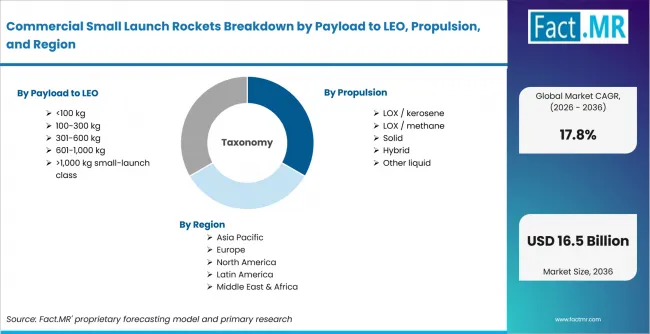
Commercial Small Launch Rockets Breakdown By Payload To Leo, Propulsion, And Region | Source: Fact.MR
| Attribute | Details |
|---|---|
| Quantitative Units | USD Billion |
| Market Definition | Commercial small launch rockets used to place smaller payloads into orbit through dedicated, responsive, rideshare-assisted, hybrid or mobile launch models. |
| Payload to LEO | <100 kg; 100-300 kg; 301-600 kg; 601-1,000 kg; >1,000 kg small-launch class |
| Propulsion | LOX / kerosene; LOX / methane; Solid; Hybrid; Other liquid |
| Launch Model | Dedicated smallsat; Responsive / defence; Rideshare-assisted; Suborbital-to-orbital hybrid; Mobile launch |
| Customer | Commercial constellation; Defence / government; Earth observation startups; Science / universities; In-space logistics |
| Regions Covered | North America; Latin America; Western Europe; Eastern Europe; East Asia; South Asia & Pacific; Middle East & Africa |
| Countries Covered | USA; Germany; Spain; UK; France |
| Key Companies Covered | Rocket Lab; Firefly Aerospace; Isar Aerospace; PLD Space; Orbex; HyImpulse |
| Forecast Period | 2026 to 2036 |
| Approach | Market sizing by payload class, propulsion, launch model and customer group, supported by country-level launch-program and regulatory evidence. |
Source: Fact.MR analysis. Updated Sep 15, 2026
How is the market segmented?
-
By Payload to LEO
- <100 kg
- 100-300 kg
- 301-600 kg
- 601-1,000 kg
- >1,000 kg small-launch class
-
By Propulsion
- LOX / kerosene
- LOX / methane
- Solid
- Hybrid
- Other liquid
-
By Launch Model
- Dedicated smallsat
- Responsive / defence
- Rideshare-assisted
- Suborbital-to-orbital hybrid
- Mobile launch
-
By Customer
- Commercial constellation
- Defence / government
- Earth observation startups
- Science / universities
- In-space logistics
-
By Region
- North America
- Latin America
- Western Europe
- Eastern Europe
- East Asia
- South Asia & Pacific
- Middle East & Africa
Frequently Asked Questions
How big is the commercial small launch rockets market in 2026?
What is the CAGR of the commercial small launch rockets market from 2026 to 2036?
Which Payload to LEO class leads the commercial small launch rockets market?
Which propulsion type leads the commercial small launch rockets market?
Which launch model leads the commercial small launch rockets market?
Which customer group leads the commercial small launch rockets market?
How tightly grouped are the listed country growth rates?
Which companies are included in the market assessment?
Who worked on this report


Preview the report firsthand - request a free sample
Free SampleGet the brochure for pricing and purchase details
Download PDF