Computer Vision Sports Analytics Market Size, Share, Growth and Forecast (2026 - 2036)
The Computer Vision Sports Analytics Market is segmented by Tracking Mode, by Sport, by Use Case, by Customer Type, by Deployment Model, by Data Output, by Feed Source, and Region. Forecast for 2026 to 2036.
What is the computer vision sports analytics market forecast to be worth by 2036?
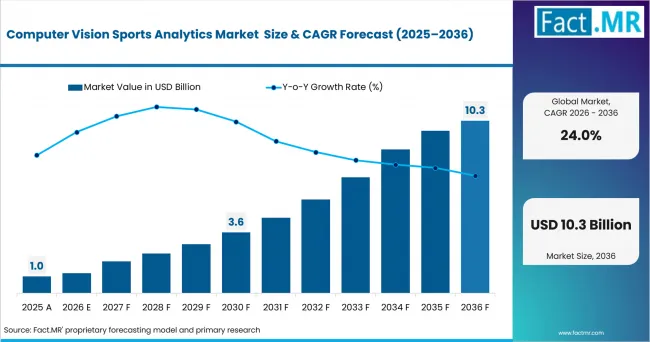
USD 1.2 billion in 2026 to USD 10.3 billion by 2036, at 24.0% CAGR.
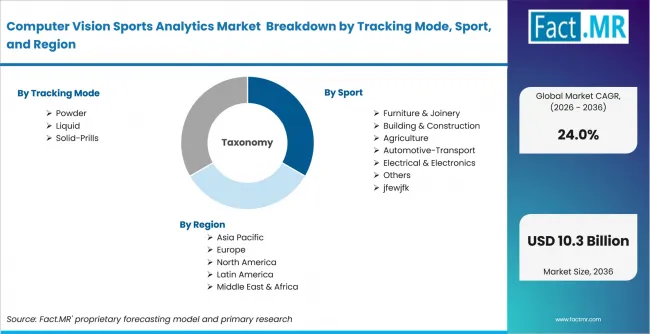
- The computer vision sports analytics market crossed a valuation of USD 1.0 billion in 2025. Demand is expected to increase from USD 1.2 billion in 2026 to USD 10.3 billion by 2036.
- The market is forecast to record 24.0% CAGR from 2026 to 2036 as clubs, leagues and broadcasters use camera-based tracking for performance review, recruitment, officiating and broadcast graphics.
- Cloud platforms and broadcast-feed analytics are also improving because multiple users inside a club can work from the same data layer. Larger contracts should move toward vendors that combine tracking accuracy, workflow integration and clear data-rights terms.
- Video-based software and data feeds that convert sports footage into player, ball and event data form the core of this market. The Federation Internationale de Football Association and Hawk-Eye formed Football Technology Centre AG in November 2024 to develop automated on-pitch event detection.
- This supports demand for computer vision systems that can turn optical feeds into repeatable performance, officiating and media outputs.
What are the defining numbers behind computer vision sports analytics growth?
USD 9.1 billion absolute opportunity by 2036. The United States, the United Kingdom and Germany lead the country view.
- Demand Drivers in the Market
- Professional teams need repeatable tracking data because coaches compare player spacing, load and tactical execution after every match.
- Broadcasters are licensing optical data because replay graphics and augmented feeds need player coordinates in near real time.
- Leagues are standardizing venue data because officiating support and performance analytics now share the same camera base.
- Academies are using markerless video because scouting teams can analyze young players without issuing wearable devices.
- Key Segments Analyzed
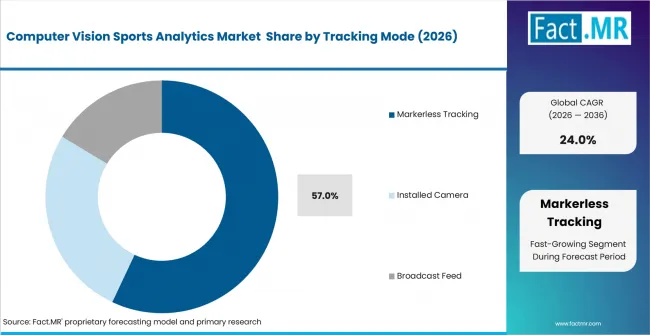
- By Tracking Mode: Markerless Tracking is expected to account for 57.0% of the market share in 2026, as clubs can convert existing broadcast or tactical video into usable player data.
- By Data Output: Player Tracking is projected to capture 45.0% of revenue in 2026, supported by match analysis workflows that start with player location and speed.
- By Deployment Model: Cloud Platform is estimated to hold 42.0% share in 2026 because multi-team users need shared access across coaching, recruitment and media teams.
- By Feed Source: Broadcast Video is forecast to secure 41.0% share in 2026 because it lowers setup effort for leagues and academy buyers.
- By Customer Type: Professional Clubs are likely to represent 39.0% of the market in 2026, reflecting budget ownership for performance review and recruitment data.
- By Sport: Football is anticipated to contribute 36.0% of total market revenue in 2026, owing to global league coverage and high demand for tactical movement data.
- By Use Case: Team Performance is expected to account for 34.0% share in 2026 because coaching staffs use tracking outputs before they pay for broader media or betting applications.
- By Geography: The United States is expected to record a CAGR of 28.2% through 2036, supported by professional-league scale and college sports depth.
- Analyst Opinion
- Shambhu Nath Jha, Principal Analyst at Fact.MR states, "Computer vision analytics is becoming the shared evidence layer for coaches, broadcasters and league data sellers. I would watch which vendors can make one match feed useful for coaching, media and recruitment teams inside a club."
- Strategic Implications
- Tracking vendors should make broadcast-feed ingestion easy before asking clubs to fund new camera installations.
- Clubs need clear data rights terms before sharing player tracking outputs with commercial partners.
- Leagues should standardize optical data formats because team, media and officiating users need the same base feed.
- Vendors serving academies should price per team because smaller buyers need flexible access before committing to stadium installs.
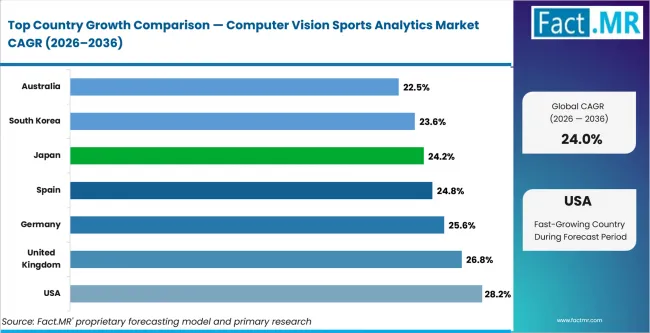
The United States is projected to record 28.2% CAGR through 2036 as professional-league scale and college sports depth support faster adoption. The United Kingdom is expected to expand at 26.8% CAGR because football media rights and league-level tracking standards support optical analytics. Germany is forecast to grow at 25.6% CAGR as club infrastructure and organized sport participation support structured team development. Spain is expected to advance at 24.8% CAGR as federation scale and league data products support football analytics adoption. Japan is projected to rise at 24.2% CAGR as professional baseball and structured school sport demand support repeatable video review. South Korea is forecast to expand at 23.6% CAGR as sports industry revenue and broadcast-heavy professional leagues support performance and fan-content analytics. Australia is expected to record 22.5% CAGR as paid participation and multi-sport club demand support analytics tools for professional teams and pathway programs.
How does the computer vision sports analytics market break down by segment?
Markerless Tracking leads at 57.0%. Player Tracking follows with 45.0% share in 2026.
Which tracking mode accounts for the largest share?
Markerless Tracking holds 57.0% share in 2026.
![]()
Markerless Tracking is expected to hold 57.0% share in 2026 because clubs can analyze match video without asking players to wear devices. The same buyer logic connects with sports analytics platforms that convert event data into coaching decisions.
SkillCorner states that its football coverage generates more than 1.2 million data points per game. That scale supports team review because coaches can compare spacing, pressure and off-ball movement after every match.
Which sport accounts for the largest share?
Football holds 36.0% share in 2026.
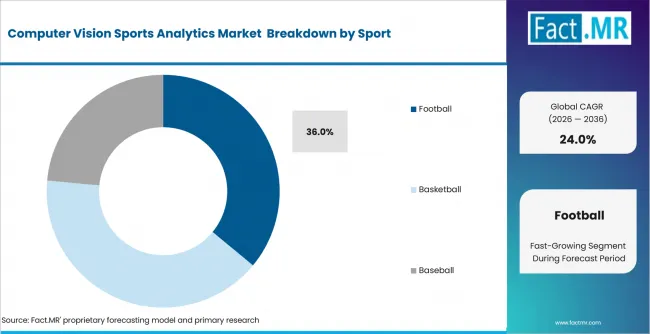
Football is projected to hold 36.0% share in 2026 because leagues and clubs already buy event feeds and tactical video. Optical tracking also connects with connected sports equipment when teams compare match behavior with training tools.
Stats Perform states that Opta Vision is available across more than 80 competitions. This makes football the most repeatable starting point for markerless tracking revenue.
Which use case accounts for the largest share?
Team Performance holds 34.0% share in 2026.
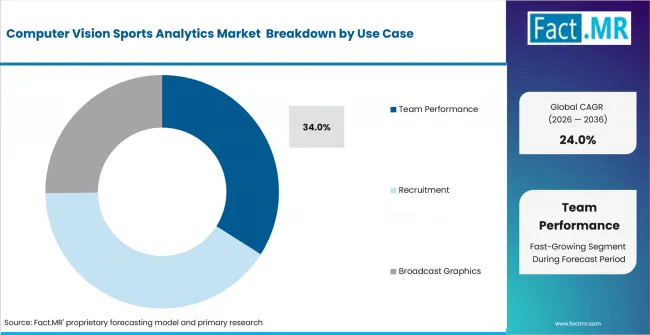
Team Performance is estimated to account for 34.0% share in 2026 because coaching staffs pay first for metrics that change training plans. Clubs move toward predictive analytics software after tracking quality becomes trusted across games.
Use-case growth is linked to workflow depth. Recruitment teams need position-specific evidence while medical teams need movement patterns that show workload change.
Which customer type accounts for the largest share?
Professional Clubs hold 39.0% share in 2026.
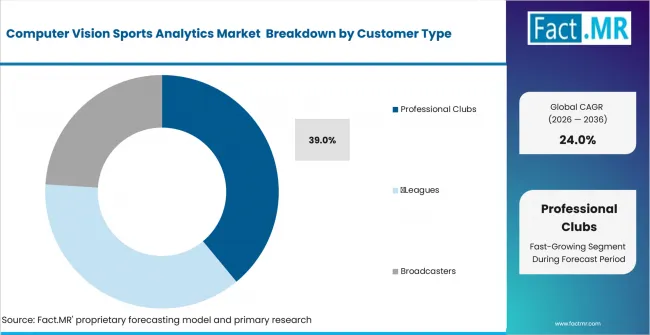
Professional Clubs are likely to hold 39.0% share in 2026 because they control coaching and recruitment budgets. They also combine match tracking with wearable AI tools when training-ground signals need to be compared with game footage.
Academies follow the same path at lower contract values. Their purchases depend on feed coverage, player database depth and simple analyst workflows.
Which deployment model accounts for the largest share?
Cloud Platform holds 42.0% share in 2026.
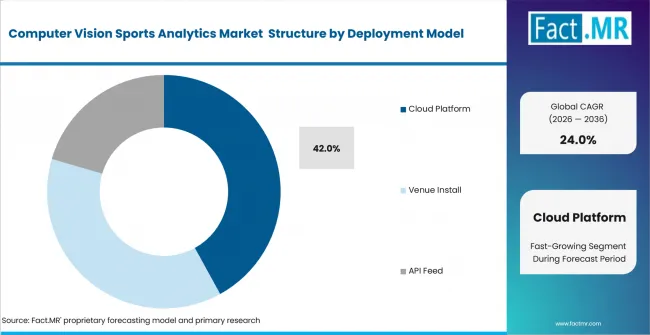
Cloud Platform is forecast to account for 42.0% share in 2026 because clubs need shared access for coaches, scouts and video analysts. Some stadium deployments rely on edge analytics when replay graphics need lower latency.
Cloud delivery also helps leagues distribute the same data layer to several clubs. Licensed platforms are expected to gain share when larger clubs build internal analytics teams.
Which data output accounts for the largest share?
Player Tracking holds 45.0% share in 2026.
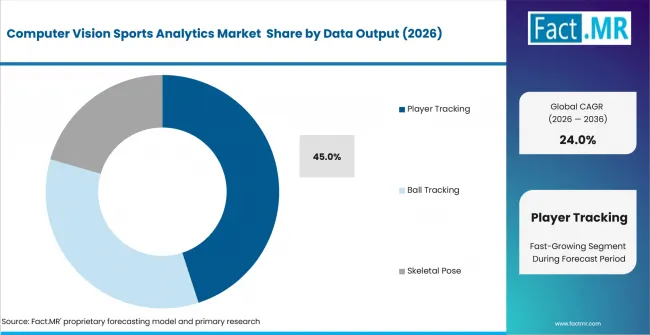
Player Tracking is expected to hold 45.0% share in 2026 because location and speed form the base layer for most team workflows. Skeletal pose outputs draw on 3D machine vision methods when vendors estimate body points from camera feeds.
Hawk-Eye described SkeleTRACK as a system that captures 29 key points on each player. That detail supports richer analysis for stride, posture and off-ball positioning.
Which feed source accounts for the largest share?
Broadcast Video holds 41.0% share in 2026.
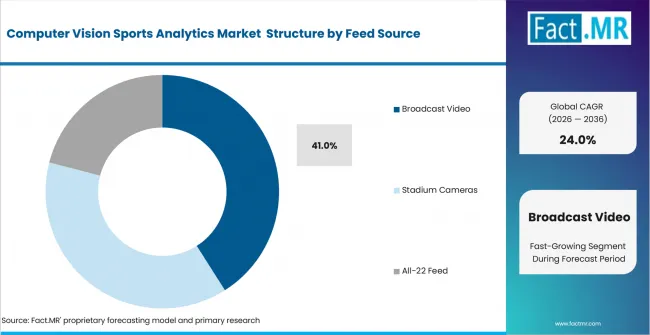
Broadcast Video is anticipated to account for 41.0% share in 2026 because it reduces the need for venue-by-venue camera projects. The same signal path places sports footage inside video sensor use cases when software treats each frame as a measurement source.
All-22 and tactical feeds receive buyer review because they show the full formation. They are useful for American football, rugby and full-pitch football analysis.
What is accelerating computer vision sports analytics demand, and what is holding it back?
League data licensing and camera-only tracking support demand. Data rights and feed quality restrain wider use.
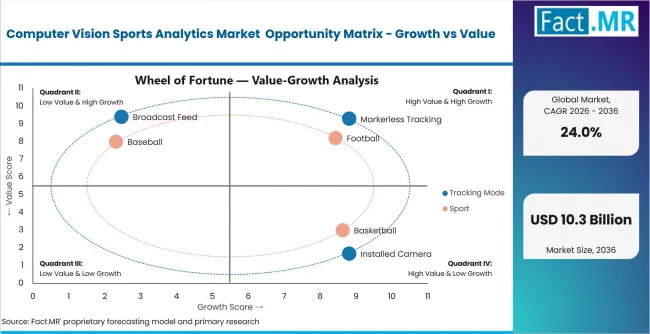
Professional sport is shifting from manual video review toward repeatable coordinate data. Coaches need the same match to be searchable by player, location and action. Computer vision systems make that possible when event data and tracking data are synchronized.
Officiating programs are raising buyer confidence because the same camera base can support review workflows. Major League Baseball approved the Automated Ball-Strike Challenge System for the 2026 season in September 2025. The official release stated that the system uses 12 Hawk-Eye cameras inside each ballpark.
Expansion is constrained by rights ownership and input quality. Clubs need to know who can commercialize player tracking data. Vendors also need stable camera angles because incomplete footage can reduce confidence in speed, distance and tactical metrics.
Cost can limit academy demand even when software is useful. Smaller teams need lighter packages, seasonal pricing and fewer analyst-seat charges before they convert from trial use to paid contracts.
Where do the biggest computer vision sports analytics opportunities sit?
Broadcast-to-performance data, academy scouting and officiating-compatible analytics create the clearest opportunities.
- Broadcast-to-Performance Data:
- Providers can connect club and media workflows when the same feed supports tactical review, replay graphics and video management software integration.
- Academy Scouting:
- Vendors can price lighter packages for youth academies that need searchable player movement data without stadium hardware.
- Officiating-Compatible Analytics:
- League contracts can expand when camera placement and tracking software are specified together. The same procurement logic is visible in robot vision systems where hardware and analytics must work as one workflow.
Which countries are scaling computer vision sports analytics fastest?
United States 28.2% CAGR, United Kingdom 26.8% CAGR, Germany 25.6% CAGR, Spain 24.8% CAGR, Japan 24.2% CAGR, South Korea 23.6% CAGR, Australia 22.5% CAGR.
Based on regional analysis, the computer vision sports analytics market is segmented into North America and Europe. East Asia and Australia are also covered. The country view is led by professional league density, media rights value and club analytics maturity.
.webp)
| Country | CAGR |
|---|---|
| United States | 28.2% |
| United Kingdom | 26.8% |
| Germany | 25.6% |
| Spain | 24.8% |
| Japan | 24.2% |
| South Korea | 23.6% |
| Australia | 22.5% |

What supports the United States outlook?
28.2% CAGR, supported by professional-league scale and college sports depth.
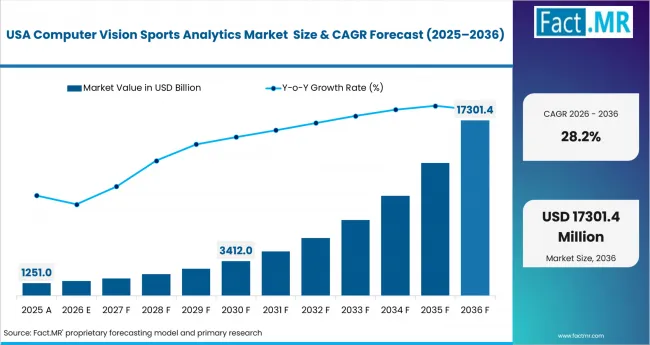
The United States has the deepest buyer base because professional teams, college programs and media partners all use video workflows. The National Collegiate Athletic Association reported 554,298 student-athletes for the 2024-25 academic year. This creates a large performance-analysis base for vendors that can price by team and sport.
Why does the United Kingdom matter?
26.8% CAGR, driven by football media rights and league-level tracking standards.
The United Kingdom is shaped by football clubs that already use event feeds, tactical video and officiating review tools. Sport England reported that 30.9 million adults met physical activity guidelines in its 2024-25 survey. The country offers a compact path from elite sport to academies because clubs compare analytics tools across coaching, recruitment and broadcast teams.
What powers Germany's position?
25.6% CAGR, attributable to club infrastructure and organized sport participation.
Germany has a large organized sport base and a club system that supports structured team development. The German Olympic Sports Confederation reported 29.3 million memberships in organized sport as of January 2025. Suppliers that support football and indoor team sports can use club networks to move from elite use into development programs.
Why is Spain an important football analytics buyer?
24.8% CAGR, backed by federation scale and league data products.
Spain combines elite football visibility with a broad federation system. The Higher Sports Council reported 4.32 million federated sports licenses in 2024. This gives analytics providers a route into professional clubs, semi-professional programs and youth development pathways.
How is Japan using sports video intelligence?
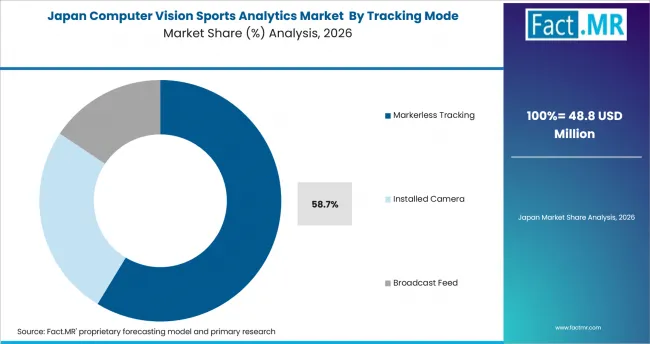
24.2% CAGR, driven by professional baseball and structured school sport demand.
![]()
Japan's demand is supported by professional baseball, football and school sport programs that value repeatable video review. The Japan Sports Agency reported that 52.5% of adults aged 20 years and above participated in sport at least once a week in fiscal 2024. Vendors need Japanese-language workflows and clear evidence for coaching use before broader club rollout.
What makes South Korea commercially relevant?
23.6% CAGR, led by sports industry revenue and broadcast-heavy professional leagues.
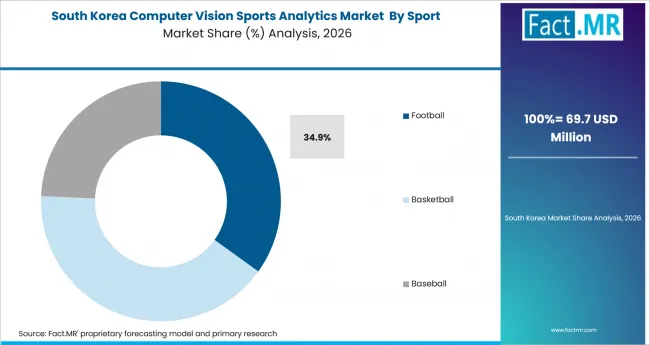
South Korea has a sports economy where media, clubs and technology suppliers work closely around professional leagues. The Ministry of Culture, Sports and Tourism of the Republic of Korea reported that sports industry revenue reached KRW 84.7 trillion in 2024. This supports analytics products that help teams turn match video into performance and fan-content assets.
How does Australia create a test market role?
22.5% CAGR, backed by paid participation and multi-sport club demand.
Australia has a broad participation base across football codes, cricket and basketball. The Australian Sports Commission reported that 52% of Australians aged 15 years and above paid to participate in sport or physical activity in 2025. This supports analytics demand from professional teams and pathway programs that need better player assessment with limited budgets.
Who leads the computer vision sports analytics landscape?
Genius Sports, Stats Perform and Hawk-Eye lead through installed league coverage. SkillCorner and Track160 add markerless feed options.
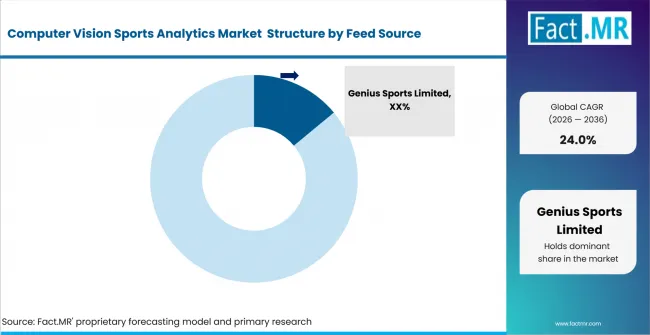
Competition is split between league-data platforms, optical-tracking specialists and video-workflow vendors. Genius Sports has strong positioning through Second Spectrum deployments and GeniusIQ league contracts. Stats Perform competes through Opta Vision and event-data depth. Hawk-Eye connects tracking, officiating and broadcast visualization through Sony-owned sports technology assets.
Buyer selection usually starts with coverage, accuracy and workflow fit. Venue buyers also compare tracking cameras with connected camera systems when they need installed capture for broadcast and officiating use.
SkillCorner competes through markerless data from broadcast and tactical feeds. The company states that it covers more than 30,000 games per season. Track160 and Sportlogiq focus on lower-friction video analysis where teams need outputs without heavy stadium projects.
Providers that combine three capabilities should be better placed through 2036. They need proven league coverage, clean integration with existing video tools and clear data-rights terms. Vendors without these pieces can win trials. Larger contracts are expected to favor suppliers that serve coaching teams, media teams and league users from one data layer.
Which companies are the key players?
Genius Sports, Stats Perform and Hawk-Eye are key players. SkillCorner, Track160 and Hudl are also profiled. Sportlogiq completes the company set.
- Genius Sports Limited
- Stats Perform Group Limited
- Hawk-Eye Innovations Limited
- SkillCorner SAS
- Track160 Ltd.
- Hudl / Agile Sports Technologies, Inc.
- Sportlogiq Inc.
Bibliography
- [1] Australian Sports Commission. (2025). Cost: Direct financial and time. Australian Sports Commission Clearinghouse for Sport.
- [2] Consejo Superior de Deportes. (2025, July). Licencias y clubes 2024. Higher Sports Council.
- [3] Fédération Internationale de Football Association. (2026, February). Semi-automated offside technology testing criteria. FIFA.
- [4] Fédération Internationale de Football Association. (2024, November 5). FIFA and Hawk-Eye Innovations establish joint venture to further develop football technologies. FIFA.
- [5] Genius Sports Limited. (2024, March). Women’s National Basketball Association and Genius Sports bring Second Spectrum data tracking to every arena. Genius Sports Limited.
- [6] Genius Sports Limited. (2024, August). Genius Sports launches GeniusIQ. Genius Sports Limited.
- [7] Genius Sports Limited. (2026, March). Genius Sports and Pac-12 announce partnership. Genius Sports Limited.
- [8] Genius Sports Limited. (2026, April). Swiss Football League selects Genius Sports. Genius Sports Limited.
- [9] Genius Sports Limited. (2026, May). Liga MX selects Genius Sports. Genius Sports Limited.
- [10] Hawk-Eye Innovations Limited. (2025, March 5). Making sport fairer with accurate event detection: The future of officiating via skeletal tracking. Hawk-Eye Innovations Limited.
- [11] Hawk-Eye Innovations Limited. (2025, September 25). Hawk-Eye and Sports Interactive team up to power Football Manager’s new era. Hawk-Eye Innovations Limited.
- [12] Japan Sports Agency. (2025, March). Survey on the implementation status of sports in fiscal 2024. Ministry of Education, Culture, Sports, Science and Technology.
- [13] Major League Baseball. (2025, September). MLB announces ABS Challenge System coming to the Major Leagues beginning in the 2026 season. Major League Baseball.
- [14] Ministry of Culture, Sports and Tourism of the Republic of Korea. (2026, January 12). Sports industry revenue reaches record high of KRW 84.7 trillion in 2024. Ministry of Culture, Sports and Tourism of the Republic of Korea.
- [15] National Collegiate Athletic Association. (2025, September). A record number of NCAA student-athletes participated in 2024-25. NCAA.
- [16] National Federation of State High School Associations. (2025, September). High school sports participation tops 8.2 million in 2024-25. NFHS.
- [17] Premier League. (2025, August). How semi-automated offside technology is helping referees. Premier League.
- [18] SkillCorner SAS. (2025, March). Global data coverage. SkillCorner SAS.
- [19] SkillCorner SAS. (2025, April). United Football League chooses SkillCorner for football tracking data. SkillCorner SAS.
- [20] SkillCorner SAS. (2025, December). SkillCorner announces growth investment. SkillCorner SAS.
- [21] Sport England. (2026, April). England is getting more active but not everyone is benefiting. Sport England.
- [22] Stats Perform Group Limited. (2024, January). Palmeiras uses Opta Vision for high-performance analysis. Stats Perform Group Limited.
- [23] Stats Perform Group Limited. (2024, August). PAOK FC signs long-term agreement for Opta Vision. Stats Perform Group Limited.
- [24] German Olympic Sports Confederation. (2025, January). Inventory survey. German Olympic Sports Confederation.
This Report Addresses
Strategic intelligence on computer vision sports analytics across tracking mode, sport, use case and customer type.
- Segment analysis covering Markerless Tracking, Player Tracking, Cloud Platform, Broadcast Video and Professional Clubs.
- Regional outlook covering the United States, United Kingdom, Germany, Spain, Japan, South Korea and Australia.
- Competitive analysis of Genius Sports, Stats Perform, Hawk-Eye, SkillCorner, Track160, Hudl and Sportlogiq.
- Technology assessment covering markerless tracking, installed cameras, broadcast feeds, skeletal pose and event fusion.
- Buyer assessment covering professional clubs, leagues, broadcasters, academies and betting operators.
- Source-led market sizing using provider portfolios, official sports data, league deployments and company disclosures.
What does the computer vision sports analytics market cover?
Software and data feeds that convert sports video into player, ball and event data.
The computer vision sports analytics market covers paid products that extract player tracking, ball tracking and event context from video. It includes markerless tracking from broadcast feeds and fixed venue cameras. It also covers skeletal pose data and tactical metrics. Recruitment feeds and broadcast graphics are included when they depend on optical tracking.
What is included in the scope?
Markerless tracking, video-based performance data and analytics service delivery are included.
The scope includes team performance analytics for football, basketball and baseball. Cricket and tennis use cases are also covered. League data feeds, broadcaster graphics tools and academy scouting platforms are included. Managed analyst services and application programming interface feeds are covered when the paid product depends on computer vision outputs.
What is excluded from the scope?
Wearable-only tracking, ordinary video storage and sports betting odds are excluded.
The scope excludes wearable devices when the device produces the main tracking signal. It excludes camera hardware sold without analytics software. Ordinary video management, fan engagement apps and betting models are excluded unless the paid product uses computer vision to create player or ball data.
How was the analysis built?
30+ public sources and 20+ league, company or sports body pages were checked. No commercial market research figures were used for the sizing anchor.
- Primary Research:
- Interviews covered sports analytics vendors, team buyers and league data users. Broadcast technology buyers and academy software users were also included.
- Desk Research:
- Desk research reviewed official league pages, national sports bodies and company newsrooms.
- Market-Sizing and Forecasting:
- Forecasting used team counts, league coverage and provider deployment evidence. Venue software pricing and annual subscription assumptions supported the model.
- Data Validation and Update Cycle:
- Estimates were checked against Hawk-Eye SkeleTRACK evidence, Stats Perform Opta Vision coverage and Genius Sports league deployments. SkillCorner coverage disclosures were also reviewed.
What is the report's scope and coverage?
![]()
| Attribute | Details |
|---|---|
| Quantitative Units | USD Billion in 2026 to USD Billion by 2036 at CAGR |
| Market Definition | Video-based software, data feeds and services that convert sports footage into player tracking, ball tracking, skeletal pose and event analytics. |
| Tracking Mode | Markerless Tracking, Installed Camera, Broadcast Feed, Wearable Hybrid, Ball Tracking |
| Sport | Football, Basketball, Baseball, Tennis, Cricket, Rugby |
| Use Case | Team Performance, Recruitment, Broadcast Graphics, Officiating Support, Injury Risk |
| Customer Type | Professional Clubs, Leagues, Broadcasters, Academies, Betting Operators |
| Deployment Model | Cloud Platform, Venue Install, Managed Service, API Feed, Analyst Workbench |
| Data Output | Player Tracking, Ball Tracking, Skeletal Pose, Event Fusion, Tactical Metrics |
| Feed Source | Broadcast Video, Stadium Cameras, Tactical Video, All-22 Feed, Multi-Camera |
| Regions Covered | North America, Europe, East Asia, South Asia and Pacific, Latin America, Middle East and Africa |
| Countries Covered | United States, United Kingdom, Germany, Spain, Japan, South Korea and Australia |
| Key Companies Profiled | Genius Sports, Stats Perform, Hawk-Eye, SkillCorner, Track160, Hudl and Sportlogiq |
| Forecast Period | 2026 to 2036 |
| Approach | Hybrid top-down and bottom-up approach using provider coverage, team counts, contract assumptions and official sports data |
How is the market segmented?
-
By Tracking Mode:
- Markerless Tracking
- Installed Camera
- Broadcast Feed
- Wearable Hybrid
- Ball Tracking
-
By Sport:
- Football
- Basketball
- Baseball
- Tennis
- Cricket
- Rugby
-
By Use Case:
- Team Performance
- Recruitment
- Broadcast Graphics
- Officiating Support
- Injury Risk
-
By Customer Type:
- Professional Clubs
- Leagues
- Broadcasters
- Academies
- Betting Operators
-
By Deployment Model:
- Cloud Platform
- Venue Install
- Managed Service
- API Feed
- Analyst Workbench
-
By Data Output:
- Player Tracking
- Ball Tracking
- Skeletal Pose
- Event Fusion
- Tactical Metrics
-
By Feed Source:
- Broadcast Video
- Stadium Cameras
- Tactical Video
- All-22 Feed
- Multi-Camera
-
By Region:
- North America
- United States
- Canada
- Mexico
- Latin America
- Brazil
- Argentina
- Rest of Latin America
- Europe
- United Kingdom
- Germany
- Spain
- France
- Italy
- Rest of Europe
- Asia Pacific
- Japan
- South Korea
- China
- India
- ASEAN
- Australia
- Middle East and Africa
- Gulf Cooperation Council Countries
- South Africa
- United Arab Emirates
- Rest of Middle East and Africa
- North America
- Frequently Asked Questions -
How large is the Computer Vision Sports Analytics Market expected to be in the near term?
The market is expanding as clubs, leagues, and broadcasters adopt camera based tracking as a core data source.
What is the long term outlook for the Computer Vision Sports Analytics Market?
The outlook remains strong as video derived tracking data becomes standard across performance, media, and officiating workflows.
How fast is the Computer Vision Sports Analytics Market expected to grow?
Growth is driven by market less tracking adoption, league level data licensing, and shared use of broadcast video feeds.
Which regions show strong adoption of computer vision sports analytics?
North America, Western Europe, and East Asia show strong adoption driven by professional league concentration.
Which countries are key markets for computer vision sports analytics?
The United States, United Kingdom, Germany, Spain, Japan, South Korea, and Australia are key markets.
What supports the United States market position?
Professional league scale and deep college sports infrastructure support widespread analytics adoption.
Why is the United Kingdom an important market?
Football media rights and league wide tracking standards support consistent optical analytics use.
Where do future opportunities in this market lie?
Opportunities lie in broadcast to performance data reuse, academy level analytics, and officiating compatible tracking.
Table of Content
- Key Takeaways
- Market Size and CAGR
- Top Growth Driver
- Fastest Growing Segment
- Leading Region
- Key Companies
- Emerging Opportunities
- Executive Summary
- Global Market Outlook
- Demand-side Trends
- Supply-side Trends
- Technology Roadmap Analysis
- Analysis and Recommendations
- Analyst Perspective (What is happening? Why now? What should investors know?)
- Key Questions Answered
- How large is the market?
- What is the CAGR?
- What are key trends?
- Which region dominates?
- Who are the leaders?
- Market Overview
- Market Coverage / Taxonomy
- Market Definition / Scope / Limitations
- Research Methodology
- Chapter Orientation
- Analytical Lens and Working Hypotheses
- Market Structure, Signals, and Trend Drivers
- Benchmarking and Cross-market Comparability
- Market Sizing, Forecasting, and Opportunity Mapping
- Research Design and Evidence Framework
- Desk Research Programme (Secondary Evidence)
- Expert Input and Fieldwork (Primary Evidence)
- Tooling, Models, and Reference Databases
- Data Engineering and Model Build
- Quality Assurance and Audit Trail
- Market Background
- Market Dynamics (Drivers, Restraints, Opportunity, Trends)
- Scenario Forecast (Optimistic, Likely, Conservative)
- Impact Analysis
- AI Impact
- Sustainability Impact
- Regulatory Impact
- Technology Impact
- Consumer / Buyer Analysis
- Purchase Drivers
- Adoption Barriers
- Buyer Journey
- Opportunity Map Analysis
- Product Life Cycle Analysis
- Supply Chain Analysis
- Investment Feasibility Matrix
- Value Chain Analysis
- PESTLE and Porter's Analysis
- Regulatory Landscape
- Regional Parent Market Outlook
- Production and Consumption Statistics
- Import and Export Statistics
- Global Market Analysis and Forecast, 2021 to 2036
- Historical Market Size Value (USD Million) Analysis, 2021 to 2025
- Current and Future Market Size Value (USD Million) Projections, 2026 to 2036
- Y-o-Y Growth Trend Analysis
- Absolute $ Opportunity Analysis
- Global Market Pricing Analysis, 2021 to 2036
- Global Market Analysis and Forecast, By Tracking Mode, 2021 to 2036
- Introduction / Key Findings
- Historical Market Size Value (USD Million) Analysis By Tracking Mode, 2021 to 2025
- Current and Future Market Size Value (USD Million) Analysis and Forecast By Tracking Mode, 2026 to 2036
- Markerless Tracking
- Installed Camera
- Broadcast Feed
- Markerless Tracking
- Y-o-Y Growth Trend Analysis By Tracking Mode, 2021 to 2025
- Absolute $ Opportunity Analysis By Tracking Mode, 2026 to 2036
- Global Market Analysis and Forecast, By Sport, 2021 to 2036
- Introduction / Key Findings
- Historical Market Size Value (USD Million) Analysis By Sport, 2021 to 2025
- Current and Future Market Size Value (USD Million) Analysis and Forecast By Sport, 2026 to 2036
- Football
- Basketball
- Baseball
- Football
- Y-o-Y Growth Trend Analysis By Sport, 2021 to 2025
- Absolute $ Opportunity Analysis By Sport, 2026 to 2036
- Global Market Analysis and Forecast, By Use Case, 2021 to 2036
- Introduction / Key Findings
- Historical Market Size Value (USD Million) Analysis By Use Case, 2021 to 2025
- Current and Future Market Size Value (USD Million) Analysis and Forecast By Use Case, 2026 to 2036
- Team Performance
- Recruitment
- Broadcast Graphics
- Team Performance
- Y-o-Y Growth Trend Analysis By Use Case, 2021 to 2025
- Absolute $ Opportunity Analysis By Use Case, 2026 to 2036
- Global Market Analysis and Forecast, By Customer Type, 2021 to 2036
- Introduction / Key Findings
- Historical Market Size Value (USD Million) Analysis By Customer Type, 2021 to 2025
- Current and Future Market Size Value (USD Million) Analysis and Forecast By Customer Type, 2026 to 2036
- Professional Clubs
- Leagues
- Broadcasters
- Professional Clubs
- Y-o-Y Growth Trend Analysis By Customer Type, 2021 to 2025
- Absolute $ Opportunity Analysis By Customer Type, 2026 to 2036
- Global Market Analysis and Forecast, By Deployment Model, 2021 to 2036
- Introduction / Key Findings
- Historical Market Size Value (USD Million) Analysis By Deployment Model, 2021 to 2025
- Current and Future Market Size Value (USD Million) Analysis and Forecast By Deployment Model, 2026 to 2036
- Cloud Platform
- Venue Install
- API Feed
- Cloud Platform
- Y-o-Y Growth Trend Analysis By Deployment Model, 2021 to 2025
- Absolute $ Opportunity Analysis By Deployment Model, 2026 to 2036
- Global Market Analysis and Forecast, By Data Output
- Introduction / Key Findings
- Historical Market Size Value (USD Million) Analysis By Data Output, 2021 to 2025
- Current and Future Market Size Value (USD Million) Analysis and Forecast By Data Output, 2026 to 2036
- Player Tracking
- Ball Tracking
- Skeletal Pose
- Player Tracking
- Y-o-Y Growth Trend Analysis By Data Output, 2021 to 2025
- Absolute $ Opportunity Analysis By Data Output, 2026 to 2036
- Global Market Analysis and Forecast, By Feed Source
- Introduction / Key Findings
- Historical Market Size Value (USD Million) Analysis By Feed Source, 2021 to 2025
- Current and Future Market Size Value (USD Million) Analysis and Forecast By Feed Source, 2026 to 2036
- Broadcast Video
- Stadium Cameras
- All-22 Feed
- Broadcast Video
- Y-o-Y Growth Trend Analysis By Feed Source, 2021 to 2025
- Absolute $ Opportunity Analysis By Feed Source, 2026 to 2036
- Global Market Analysis and Forecast, By Region, 2021 to 2036
- Introduction
- Historical Market Size Value (USD Million) Analysis By Region, 2021 to 2025
- Current Market Size Value (USD Million) Analysis and Forecast By Region, 2026 to 2036
- North America
- Latin America
- Western Europe
- Eastern Europe
- East Asia
- South Asia and Pacific
- Middle East & Africa
- Market Attractiveness Analysis By Region
- North America Market Analysis and Forecast, By Country, 2021 to 2036
- Historical Market Size Value (USD Million) Trend Analysis By Market Taxonomy, 2021 to 2025
- Market Size Value (USD Million) Forecast By Market Taxonomy, 2026 to 2036
- By Country
- USA
- Canada
- Mexico
- By Tracking Mode
- By Sport
- By Use Case
- By Customer Type
- By Deployment Model
- By Data Output
- By Feed Source
- By Country
- Market Attractiveness Analysis
- By Country
- By Tracking Mode
- By Sport
- By Use Case
- By Customer Type
- By Deployment Model
- By Data Output
- By Feed Source
- Key Takeaways
- Latin America Market Analysis and Forecast, By Country
- Historical Market Size Value (USD Million) Trend Analysis By Market Taxonomy, 2021 to 2025
- Market Size Value (USD Million) Forecast By Market Taxonomy, 2026 to 2036
- By Country
- Brazil
- Chile
- Rest of Latin America
- By Tracking Mode
- By Sport
- By Use Case
- By Customer Type
- By Deployment Model
- By Data Output
- By Feed Source
- By Country
- Market Attractiveness Analysis
- By Country
- By Tracking Mode
- By Sport
- By Use Case
- By Customer Type
- By Deployment Model
- By Data Output
- By Feed Source
- Key Takeaways
- Western Europe Market Analysis and Forecast, By Country
- Historical Market Size Value (USD Million) Trend Analysis By Market Taxonomy, 2021 to 2025
- Market Size Value (USD Million) Forecast By Market Taxonomy, 2026 to 2036
- By Country
- Germany
- UK
- Italy
- Spain
- France
- Nordic
- BENELUX
- Rest of Western Europe
- By Tracking Mode
- By Sport
- By Use Case
- By Customer Type
- By Deployment Model
- By Data Output
- By Feed Source
- By Country
- Market Attractiveness Analysis
- By Country
- By Tracking Mode
- By Sport
- By Use Case
- By Customer Type
- By Deployment Model
- By Data Output
- By Feed Source
- Key Takeaways
- Eastern Europe Market Analysis and Forecast, By Country
- Historical Market Size Value (USD Million) Trend Analysis By Market Taxonomy, 2021 to 2025
- Market Size Value (USD Million) Forecast By Market Taxonomy, 2026 to 2036
- By Country
- Russia
- Poland
- Hungary
- Balkan & Baltic
- Rest of Eastern Europe
- By Tracking Mode
- By Sport
- By Use Case
- By Customer Type
- By Deployment Model
- By Data Output
- By Feed Source
- By Country
- Market Attractiveness Analysis
- By Country
- By Tracking Mode
- By Sport
- By Use Case
- By Customer Type
- By Deployment Model
- By Data Output
- By Feed Source
- Key Takeaways
- East Asia Market Analysis and Forecast, By Country
- Historical Market Size Value (USD Million) Trend Analysis By Market Taxonomy, 2021 to 2025
- Market Size Value (USD Million) Forecast By Market Taxonomy, 2026 to 2036
- By Country
- China
- Japan
- South Korea
- By Tracking Mode
- By Sport
- By Use Case
- By Customer Type
- By Deployment Model
- By Data Output
- By Feed Source
- By Country
- Market Attractiveness Analysis
- By Country
- By Tracking Mode
- By Sport
- By Use Case
- By Customer Type
- By Deployment Model
- By Data Output
- By Feed Source
- Key Takeaways
- South Asia and Pacific Market Analysis and Forecast, By Country
- Historical Market Size Value (USD Million) Trend Analysis By Market Taxonomy, 2021 to 2025
- Market Size Value (USD Million) Forecast By Market Taxonomy, 2026 to 2036
- By Country
- India
- ASEAN
- Australia & New Zealand
- Rest of South Asia and Pacific
- By Tracking Mode
- By Sport
- By Use Case
- By Customer Type
- By Deployment Model
- By Data Output
- By Feed Source
- By Country
- Market Attractiveness Analysis
- By Country
- By Tracking Mode
- By Sport
- By Use Case
- By Customer Type
- By Deployment Model
- By Data Output
- By Feed Source
- Key Takeaways
- Middle East & Africa Market Analysis and Forecast, By Country
- Historical Market Size Value (USD Million) Trend Analysis By Market Taxonomy, 2021 to 2025
- Market Size Value (USD Million) Forecast By Market Taxonomy, 2026 to 2036
- By Country
- Kingdom of Saudi Arabia
- Other GCC Countries
- Turkiye
- South Africa
- Other African Union
- Rest of Middle East & Africa
- By Tracking Mode
- By Sport
- By Use Case
- By Customer Type
- By Deployment Model
- By Data Output
- By Feed Source
- By Country
- Market Attractiveness Analysis
- By Country
- By Tracking Mode
- By Sport
- By Use Case
- By Customer Type
- By Deployment Model
- By Data Output
- By Feed Source
- Key Takeaways
- Key Countries Market Analysis
- USA
- Pricing Analysis
- Market Share Analysis, 2025
- By Tracking Mode
- By Sport
- By Use Case
- By Customer Type
- By Deployment Model
- By Data Output
- By Feed Source
- Canada
- Pricing Analysis
- Market Share Analysis, 2025
- By Tracking Mode
- By Sport
- By Use Case
- By Customer Type
- By Deployment Model
- By Data Output
- By Feed Source
- Mexico
- Pricing Analysis
- Market Share Analysis, 2025
- By Tracking Mode
- By Sport
- By Use Case
- By Customer Type
- By Deployment Model
- By Data Output
- By Feed Source
- Brazil
- Pricing Analysis
- Market Share Analysis, 2025
- By Tracking Mode
- By Sport
- By Use Case
- By Customer Type
- By Deployment Model
- By Data Output
- By Feed Source
- Chile
- Pricing Analysis
- Market Share Analysis, 2025
- By Tracking Mode
- By Sport
- By Use Case
- By Customer Type
- By Deployment Model
- By Data Output
- By Feed Source
- Germany
- Pricing Analysis
- Market Share Analysis, 2025
- By Tracking Mode
- By Sport
- By Use Case
- By Customer Type
- By Deployment Model
- By Data Output
- By Feed Source
- UK
- Pricing Analysis
- Market Share Analysis, 2025
- By Tracking Mode
- By Sport
- By Use Case
- By Customer Type
- By Deployment Model
- By Data Output
- By Feed Source
- Italy
- Pricing Analysis
- Market Share Analysis, 2025
- By Tracking Mode
- By Sport
- By Use Case
- By Customer Type
- By Deployment Model
- By Data Output
- By Feed Source
- Spain
- Pricing Analysis
- Market Share Analysis, 2025
- By Tracking Mode
- By Sport
- By Use Case
- By Customer Type
- By Deployment Model
- By Data Output
- By Feed Source
- France
- Pricing Analysis
- Market Share Analysis, 2025
- By Tracking Mode
- By Sport
- By Use Case
- By Customer Type
- By Deployment Model
- By Data Output
- By Feed Source
- India
- Pricing Analysis
- Market Share Analysis, 2025
- By Tracking Mode
- By Sport
- By Use Case
- By Customer Type
- By Deployment Model
- By Data Output
- By Feed Source
- ASEAN
- Pricing Analysis
- Market Share Analysis, 2025
- By Tracking Mode
- By Sport
- By Use Case
- By Customer Type
- By Deployment Model
- By Data Output
- By Feed Source
- Australia & New Zealand
- Pricing Analysis
- Market Share Analysis, 2025
- By Tracking Mode
- By Sport
- By Use Case
- By Customer Type
- By Deployment Model
- By Data Output
- By Feed Source
- China
- Pricing Analysis
- Market Share Analysis, 2025
- By Tracking Mode
- By Sport
- By Use Case
- By Customer Type
- By Deployment Model
- By Data Output
- By Feed Source
- Japan
- Pricing Analysis
- Market Share Analysis, 2025
- By Tracking Mode
- By Sport
- By Use Case
- By Customer Type
- By Deployment Model
- By Data Output
- By Feed Source
- South Korea
- Pricing Analysis
- Market Share Analysis, 2025
- By Tracking Mode
- By Sport
- By Use Case
- By Customer Type
- By Deployment Model
- By Data Output
- By Feed Source
- Russia
- Pricing Analysis
- Market Share Analysis, 2025
- By Tracking Mode
- By Sport
- By Use Case
- By Customer Type
- By Deployment Model
- By Data Output
- By Feed Source
- Poland
- Pricing Analysis
- Market Share Analysis, 2025
- By Tracking Mode
- By Sport
- By Use Case
- By Customer Type
- By Deployment Model
- By Data Output
- By Feed Source
- Hungary
- Pricing Analysis
- Market Share Analysis, 2025
- By Tracking Mode
- By Sport
- By Use Case
- By Customer Type
- By Deployment Model
- By Data Output
- By Feed Source
- Kingdom of Saudi Arabia
- Pricing Analysis
- Market Share Analysis, 2025
- By Tracking Mode
- By Sport
- By Use Case
- By Customer Type
- By Deployment Model
- By Data Output
- By Feed Source
- Turkiye
- Pricing Analysis
- Market Share Analysis, 2025
- By Tracking Mode
- By Sport
- By Use Case
- By Customer Type
- By Deployment Model
- By Data Output
- By Feed Source
- South Africa
- Pricing Analysis
- Market Share Analysis, 2025
- By Tracking Mode
- By Sport
- By Use Case
- By Customer Type
- By Deployment Model
- By Data Output
- By Feed Source
- USA
- Market Structure Analysis
- Competition Dashboard
- Competition Benchmarking
- Market Share Analysis of Top Players
- By Regional
- By Tracking Mode
- By Sport
- By Use Case
- By Customer Type
- By Deployment Model
- By Data Output
- By Feed Source
- Emerging Startups
- Innovation Benchmarking
- Competition Analysis
- Competition Deep Dive
- Genius Sports Limited
- Overview
- Product Portfolio
- Profitability by Market Segments (Product/Age /Sales Channel/Region)
- Sales Footprint
- Strategy Overview
- Marketing Strategy
- Product Strategy
- Channel Strategy
- Stats Perform Group Limited
- Hawk-Eye Innovations Limited
- SkillCorner SAS
- Track160 Ltd.
- Hudl / Agile Sports Technologies, Inc.
- Genius Sports Limited
- Competition Deep Dive
- Case Studies
- Success Stories
- Recent Developments
- Assumptions & Acronyms Used
List Of Table
- Table 1: Global Market Value (USD Million) Forecast by Region, 2026-2036
- Table 2: Global Market Value (USD Million) Forecast by Tracking Mode, 2026-2036
- Table 3: Global Market Value (USD Million) Forecast by Sport, 2026-2036
- Table 4: Global Market Value (USD Million) Forecast by Use Case, 2026-2036
- Table 5: Global Market Value (USD Million) Forecast by Customer Type, 2026-2036
- Table 6: Global Market Value (USD Million) Forecast by Deployment Model, 2026-2036
- Table 7: Global Market Value (USD Million) Forecast by Data Output, 2026-2036
- Table 8: Global Market Value (USD Million) Forecast by Feed Source, 2026-2036
- Table 9: Global Market rma_anu Forecast by Feed Source, 2026-2036
- Table 10: North America Market Value (USD Million) Forecast by Country, 2026-2036
- Table 11: North America Market Value (USD Million) Forecast by Tracking Mode, 2026-2036
- Table 12: North America Market Value (USD Million) Forecast by Sport, 2026-2036
- Table 13: North America Market Value (USD Million) Forecast by Use Case, 2026-2036
- Table 14: North America Market Value (USD Million) Forecast by Customer Type, 2026-2036
- Table 15: North America Market Value (USD Million) Forecast by Deployment Model, 2026-2036
- Table 16: North America Market Value (USD Million) Forecast by Data Output, 2026-2036
- Table 17: North America Market Value (USD Million) Forecast by Feed Source, 2026-2036
- Table 18: Latin America Market Value (USD Million) Forecast by Country, 2026-2036
- Table 19: Latin America Market Value (USD Million) Forecast by Tracking Mode, 2026-2036
- Table 20: Latin America Market Value (USD Million) Forecast by Sport, 2026-2036
- Table 21: Latin America Market Value (USD Million) Forecast by Use Case, 2026-2036
- Table 22: Latin America Market Value (USD Million) Forecast by Customer Type, 2026-2036
- Table 23: Latin America Market Value (USD Million) Forecast by Deployment Model, 2026-2036
- Table 24: Latin America Market Value (USD Million) Forecast by Data Output, 2026-2036
- Table 25: Latin America Market Value (USD Million) Forecast by Feed Source, 2026-2036
- Table 26: Western Europe Market Value (USD Million) Forecast by Country, 2026-2036
- Table 27: Western Europe Market Value (USD Million) Forecast by Tracking Mode, 2026-2036
- Table 28: Western Europe Market Value (USD Million) Forecast by Sport, 2026-2036
- Table 29: Western Europe Market Value (USD Million) Forecast by Use Case, 2026-2036
- Table 30: Western Europe Market Value (USD Million) Forecast by Customer Type, 2026-2036
- Table 31: Western Europe Market Value (USD Million) Forecast by Deployment Model, 2026-2036
- Table 32: Western Europe Market Value (USD Million) Forecast by Data Output, 2026-2036
- Table 33: Western Europe Market Value (USD Million) Forecast by Feed Source, 2026-2036
- Table 34: Eastern Europe Market Value (USD Million) Forecast by Country, 2026-2036
- Table 35: Eastern Europe Market Value (USD Million) Forecast by Tracking Mode, 2026-2036
- Table 36: Eastern Europe Market Value (USD Million) Forecast by Sport, 2026-2036
- Table 37: Eastern Europe Market Value (USD Million) Forecast by Use Case, 2026-2036
- Table 38: Eastern Europe Market Value (USD Million) Forecast by Customer Type, 2026-2036
- Table 39: Eastern Europe Market Value (USD Million) Forecast by Deployment Model, 2026-2036
- Table 40: Eastern Europe Market Value (USD Million) Forecast by Data Output, 2026-2036
- Table 41: Eastern Europe Market Value (USD Million) Forecast by Feed Source, 2026-2036
- Table 42: East Asia Market Value (USD Million) Forecast by Country, 2026-2036
- Table 43: East Asia Market Value (USD Million) Forecast by Tracking Mode, 2026-2036
- Table 44: East Asia Market Value (USD Million) Forecast by Sport, 2026-2036
- Table 45: East Asia Market Value (USD Million) Forecast by Use Case, 2026-2036
- Table 46: East Asia Market Value (USD Million) Forecast by Customer Type, 2026-2036
- Table 47: East Asia Market Value (USD Million) Forecast by Deployment Model, 2026-2036
- Table 48: East Asia Market Value (USD Million) Forecast by Data Output, 2026-2036
- Table 49: East Asia Market Value (USD Million) Forecast by Feed Source, 2026-2036
- Table 50: South Asia and Pacific Market Value (USD Million) Forecast by Country, 2026-2036
- Table 51: South Asia and Pacific Market Value (USD Million) Forecast by Tracking Mode, 2026-2036
- Table 52: South Asia and Pacific Market Value (USD Million) Forecast by Sport, 2026-2036
- Table 53: South Asia and Pacific Market Value (USD Million) Forecast by Use Case, 2026-2036
- Table 54: South Asia and Pacific Market Value (USD Million) Forecast by Customer Type, 2026-2036
- Table 55: South Asia and Pacific Market Value (USD Million) Forecast by Deployment Model, 2026-2036
- Table 56: South Asia and Pacific Market Value (USD Million) Forecast by Data Output, 2026-2036
- Table 57: South Asia and Pacific Market Value (USD Million) Forecast by Feed Source, 2026-2036
- Table 58: Middle East & Africa Market Value (USD Million) Forecast by Country, 2026-2036
- Table 59: Middle East & Africa Market Value (USD Million) Forecast by Tracking Mode, 2026-2036
- Table 60: Middle East & Africa Market Value (USD Million) Forecast by Sport, 2026-2036
- Table 61: Middle East & Africa Market Value (USD Million) Forecast by Use Case, 2026-2036
- Table 62: Middle East & Africa Market Value (USD Million) Forecast by Customer Type, 2026-2036
- Table 63: Middle East & Africa Market Value (USD Million) Forecast by Deployment Model, 2026-2036
- Table 64: Middle East & Africa Market Value (USD Million) Forecast by Data Output, 2026-2036
- Table 65: Middle East & Africa Market Value (USD Million) Forecast by Feed Source, 2026-2036
List Of Figures
- Figure 1: Global Market Pricing Analysis
- Figure 2: Global Market Value (USD Million) Forecast 2021-2036
- Figure 3: Global Market Value Share and BPS Analysis by Tracking Mode, 2026 and 2036
- Figure 4: Global Market Y-o-Y Growth Comparison by Tracking Mode, 2026-2036
- Figure 5: Global Market Attractiveness Analysis by Tracking Mode
- Figure 6: Global Market Value Share and BPS Analysis by Sport, 2026 and 2036
- Figure 7: Global Market Y-o-Y Growth Comparison by Sport, 2026-2036
- Figure 8: Global Market Attractiveness Analysis by Sport
- Figure 9: Global Market Value Share and BPS Analysis by Use Case, 2026 and 2036
- Figure 10: Global Market Y-o-Y Growth Comparison by Use Case, 2026-2036
- Figure 11: Global Market Attractiveness Analysis by Use Case
- Figure 12: Global Market Value Share and BPS Analysis by Customer Type, 2026 and 2036
- Figure 13: Global Market Y-o-Y Growth Comparison by Customer Type, 2026-2036
- Figure 14: Global Market Attractiveness Analysis by Customer Type
- Figure 15: Global Market Value Share and BPS Analysis by Deployment Model, 2026 and 2036
- Figure 16: Global Market Y-o-Y Growth Comparison by Deployment Model, 2026-2036
- Figure 17: Global Market Attractiveness Analysis by Deployment Model
- Figure 18: Global Market Value Share and BPS Analysis by Data Output, 2026 and 2036
- Figure 19: Global Market Y-o-Y Growth Comparison by Data Output, 2026-2036
- Figure 20: Global Market Attractiveness Analysis by Data Output
- Figure 21: Global Market Value Share and BPS Analysis by Feed Source, 2026 and 2036
- Figure 22: Global Market Y-o-Y Growth Comparison by Feed Source, 2026-2036
- Figure 23: Global Market Attractiveness Analysis by Feed Source
- Figure 24: Global Market Value (USD Million) Share and BPS Analysis by Region, 2026 and 2036
- Figure 25: Global Market Y-o-Y Growth Comparison by Region, 2026-2036
- Figure 26: Global Market Attractiveness Analysis by Region
- Figure 27: North America Market Incremental Dollar Opportunity, 2026-2036
- Figure 28: Latin America Market Incremental Dollar Opportunity, 2026-2036
- Figure 29: Western Europe Market Incremental Dollar Opportunity, 2026-2036
- Figure 30: Eastern Europe Market Incremental Dollar Opportunity, 2026-2036
- Figure 31: East Asia Market Incremental Dollar Opportunity, 2026-2036
- Figure 32: South Asia and Pacific Market Incremental Dollar Opportunity, 2026-2036
- Figure 33: Middle East & Africa Market Incremental Dollar Opportunity, 2026-2036
- Figure 34: North America Market Value Share and BPS Analysis by Country, 2026 and 2036
- Figure 35: North America Market Value Share and BPS Analysis by Tracking Mode, 2026 and 2036
- Figure 36: North America Market Y-o-Y Growth Comparison by Tracking Mode, 2026-2036
- Figure 37: North America Market Attractiveness Analysis by Tracking Mode
- Figure 38: North America Market Value Share and BPS Analysis by Sport, 2026 and 2036
- Figure 39: North America Market Y-o-Y Growth Comparison by Sport, 2026-2036
- Figure 40: North America Market Attractiveness Analysis by Sport
- Figure 41: North America Market Value Share and BPS Analysis by Use Case, 2026 and 2036
- Figure 42: North America Market Y-o-Y Growth Comparison by Use Case, 2026-2036
- Figure 43: North America Market Attractiveness Analysis by Use Case
- Figure 44: North America Market Value Share and BPS Analysis by Customer Type, 2026 and 2036
- Figure 45: North America Market Y-o-Y Growth Comparison by Customer Type, 2026-2036
- Figure 46: North America Market Attractiveness Analysis by Customer Type
- Figure 47: North America Market Value Share and BPS Analysis by Deployment Model, 2026 and 2036
- Figure 48: North America Market Y-o-Y Growth Comparison by Deployment Model, 2026-2036
- Figure 49: North America Market Attractiveness Analysis by Deployment Model
- Figure 50: North America Market Value Share and BPS Analysis by Data Output, 2026 and 2036
- Figure 51: North America Market Y-o-Y Growth Comparison by Data Output, 2026-2036
- Figure 52: North America Market Attractiveness Analysis by Data Output
- Figure 53: North America Market Value Share and BPS Analysis by Feed Source, 2026 and 2036
- Figure 54: North America Market Y-o-Y Growth Comparison by Feed Source, 2026-2036
- Figure 55: North America Market Attractiveness Analysis by Feed Source
- Figure 56: Latin America Market Value Share and BPS Analysis by Country, 2026 and 2036
- Figure 57: Latin America Market Value Share and BPS Analysis by Tracking Mode, 2026 and 2036
- Figure 58: Latin America Market Y-o-Y Growth Comparison by Tracking Mode, 2026-2036
- Figure 59: Latin America Market Attractiveness Analysis by Tracking Mode
- Figure 60: Latin America Market Value Share and BPS Analysis by Sport, 2026 and 2036
- Figure 61: Latin America Market Y-o-Y Growth Comparison by Sport, 2026-2036
- Figure 62: Latin America Market Attractiveness Analysis by Sport
- Figure 63: Latin America Market Value Share and BPS Analysis by Use Case, 2026 and 2036
- Figure 64: Latin America Market Y-o-Y Growth Comparison by Use Case, 2026-2036
- Figure 65: Latin America Market Attractiveness Analysis by Use Case
- Figure 66: Latin America Market Value Share and BPS Analysis by Customer Type, 2026 and 2036
- Figure 67: Latin America Market Y-o-Y Growth Comparison by Customer Type, 2026-2036
- Figure 68: Latin America Market Attractiveness Analysis by Customer Type
- Figure 69: Latin America Market Value Share and BPS Analysis by Deployment Model, 2026 and 2036
- Figure 70: Latin America Market Y-o-Y Growth Comparison by Deployment Model, 2026-2036
- Figure 71: Latin America Market Attractiveness Analysis by Deployment Model
- Figure 72: Latin America Market Value Share and BPS Analysis by Data Output, 2026 and 2036
- Figure 73: Latin America Market Y-o-Y Growth Comparison by Data Output, 2026-2036
- Figure 74: Latin America Market Attractiveness Analysis by Data Output
- Figure 75: Latin America Market Value Share and BPS Analysis by Feed Source, 2026 and 2036
- Figure 76: Latin America Market Y-o-Y Growth Comparison by Feed Source, 2026-2036
- Figure 77: Latin America Market Attractiveness Analysis by Feed Source
- Figure 78: Western Europe Market Value Share and BPS Analysis by Country, 2026 and 2036
- Figure 79: Western Europe Market Value Share and BPS Analysis by Tracking Mode, 2026 and 2036
- Figure 80: Western Europe Market Y-o-Y Growth Comparison by Tracking Mode, 2026-2036
- Figure 81: Western Europe Market Attractiveness Analysis by Tracking Mode
- Figure 82: Western Europe Market Value Share and BPS Analysis by Sport, 2026 and 2036
- Figure 83: Western Europe Market Y-o-Y Growth Comparison by Sport, 2026-2036
- Figure 84: Western Europe Market Attractiveness Analysis by Sport
- Figure 85: Western Europe Market Value Share and BPS Analysis by Use Case, 2026 and 2036
- Figure 86: Western Europe Market Y-o-Y Growth Comparison by Use Case, 2026-2036
- Figure 87: Western Europe Market Attractiveness Analysis by Use Case
- Figure 88: Western Europe Market Value Share and BPS Analysis by Customer Type, 2026 and 2036
- Figure 89: Western Europe Market Y-o-Y Growth Comparison by Customer Type, 2026-2036
- Figure 90: Western Europe Market Attractiveness Analysis by Customer Type
- Figure 91: Western Europe Market Value Share and BPS Analysis by Deployment Model, 2026 and 2036
- Figure 92: Western Europe Market Y-o-Y Growth Comparison by Deployment Model, 2026-2036
- Figure 93: Western Europe Market Attractiveness Analysis by Deployment Model
- Figure 94: Western Europe Market Value Share and BPS Analysis by Data Output, 2026 and 2036
- Figure 95: Western Europe Market Y-o-Y Growth Comparison by Data Output, 2026-2036
- Figure 96: Western Europe Market Attractiveness Analysis by Data Output
- Figure 97: Western Europe Market Value Share and BPS Analysis by Feed Source, 2026 and 2036
- Figure 98: Western Europe Market Y-o-Y Growth Comparison by Feed Source, 2026-2036
- Figure 99: Western Europe Market Attractiveness Analysis by Feed Source
- Figure 100: Eastern Europe Market Value Share and BPS Analysis by Country, 2026 and 2036
- Figure 101: Eastern Europe Market Value Share and BPS Analysis by Tracking Mode, 2026 and 2036
- Figure 102: Eastern Europe Market Y-o-Y Growth Comparison by Tracking Mode, 2026-2036
- Figure 103: Eastern Europe Market Attractiveness Analysis by Tracking Mode
- Figure 104: Eastern Europe Market Value Share and BPS Analysis by Sport, 2026 and 2036
- Figure 105: Eastern Europe Market Y-o-Y Growth Comparison by Sport, 2026-2036
- Figure 106: Eastern Europe Market Attractiveness Analysis by Sport
- Figure 107: Eastern Europe Market Value Share and BPS Analysis by Use Case, 2026 and 2036
- Figure 108: Eastern Europe Market Y-o-Y Growth Comparison by Use Case, 2026-2036
- Figure 109: Eastern Europe Market Attractiveness Analysis by Use Case
- Figure 110: Eastern Europe Market Value Share and BPS Analysis by Customer Type, 2026 and 2036
- Figure 111: Eastern Europe Market Y-o-Y Growth Comparison by Customer Type, 2026-2036
- Figure 112: Eastern Europe Market Attractiveness Analysis by Customer Type
- Figure 113: Eastern Europe Market Value Share and BPS Analysis by Deployment Model, 2026 and 2036
- Figure 114: Eastern Europe Market Y-o-Y Growth Comparison by Deployment Model, 2026-2036
- Figure 115: Eastern Europe Market Attractiveness Analysis by Deployment Model
- Figure 116: Eastern Europe Market Value Share and BPS Analysis by Data Output, 2026 and 2036
- Figure 117: Eastern Europe Market Y-o-Y Growth Comparison by Data Output, 2026-2036
- Figure 118: Eastern Europe Market Attractiveness Analysis by Data Output
- Figure 119: Eastern Europe Market Value Share and BPS Analysis by Feed Source, 2026 and 2036
- Figure 120: Eastern Europe Market Y-o-Y Growth Comparison by Feed Source, 2026-2036
- Figure 121: Eastern Europe Market Attractiveness Analysis by Feed Source
- Figure 122: East Asia Market Value Share and BPS Analysis by Country, 2026 and 2036
- Figure 123: East Asia Market Value Share and BPS Analysis by Tracking Mode, 2026 and 2036
- Figure 124: East Asia Market Y-o-Y Growth Comparison by Tracking Mode, 2026-2036
- Figure 125: East Asia Market Attractiveness Analysis by Tracking Mode
- Figure 126: East Asia Market Value Share and BPS Analysis by Sport, 2026 and 2036
- Figure 127: East Asia Market Y-o-Y Growth Comparison by Sport, 2026-2036
- Figure 128: East Asia Market Attractiveness Analysis by Sport
- Figure 129: East Asia Market Value Share and BPS Analysis by Use Case, 2026 and 2036
- Figure 130: East Asia Market Y-o-Y Growth Comparison by Use Case, 2026-2036
- Figure 131: East Asia Market Attractiveness Analysis by Use Case
- Figure 132: East Asia Market Value Share and BPS Analysis by Customer Type, 2026 and 2036
- Figure 133: East Asia Market Y-o-Y Growth Comparison by Customer Type, 2026-2036
- Figure 134: East Asia Market Attractiveness Analysis by Customer Type
- Figure 135: East Asia Market Value Share and BPS Analysis by Deployment Model, 2026 and 2036
- Figure 136: East Asia Market Y-o-Y Growth Comparison by Deployment Model, 2026-2036
- Figure 137: East Asia Market Attractiveness Analysis by Deployment Model
- Figure 138: East Asia Market Value Share and BPS Analysis by Data Output, 2026 and 2036
- Figure 139: East Asia Market Y-o-Y Growth Comparison by Data Output, 2026-2036
- Figure 140: East Asia Market Attractiveness Analysis by Data Output
- Figure 141: East Asia Market Value Share and BPS Analysis by Feed Source, 2026 and 2036
- Figure 142: East Asia Market Y-o-Y Growth Comparison by Feed Source, 2026-2036
- Figure 143: East Asia Market Attractiveness Analysis by Feed Source
- Figure 144: South Asia and Pacific Market Value Share and BPS Analysis by Country, 2026 and 2036
- Figure 145: South Asia and Pacific Market Value Share and BPS Analysis by Tracking Mode, 2026 and 2036
- Figure 146: South Asia and Pacific Market Y-o-Y Growth Comparison by Tracking Mode, 2026-2036
- Figure 147: South Asia and Pacific Market Attractiveness Analysis by Tracking Mode
- Figure 148: South Asia and Pacific Market Value Share and BPS Analysis by Sport, 2026 and 2036
- Figure 149: South Asia and Pacific Market Y-o-Y Growth Comparison by Sport, 2026-2036
- Figure 150: South Asia and Pacific Market Attractiveness Analysis by Sport
- Figure 151: South Asia and Pacific Market Value Share and BPS Analysis by Use Case, 2026 and 2036
- Figure 152: South Asia and Pacific Market Y-o-Y Growth Comparison by Use Case, 2026-2036
- Figure 153: South Asia and Pacific Market Attractiveness Analysis by Use Case
- Figure 154: South Asia and Pacific Market Value Share and BPS Analysis by Customer Type, 2026 and 2036
- Figure 155: South Asia and Pacific Market Y-o-Y Growth Comparison by Customer Type, 2026-2036
- Figure 156: South Asia and Pacific Market Attractiveness Analysis by Customer Type
- Figure 157: South Asia and Pacific Market Value Share and BPS Analysis by Deployment Model, 2026 and 2036
- Figure 158: South Asia and Pacific Market Y-o-Y Growth Comparison by Deployment Model, 2026-2036
- Figure 159: South Asia and Pacific Market Attractiveness Analysis by Deployment Model
- Figure 160: South Asia and Pacific Market Value Share and BPS Analysis by Data Output, 2026 and 2036
- Figure 161: South Asia and Pacific Market Y-o-Y Growth Comparison by Data Output, 2026-2036
- Figure 162: South Asia and Pacific Market Attractiveness Analysis by Data Output
- Figure 163: South Asia and Pacific Market Value Share and BPS Analysis by Feed Source, 2026 and 2036
- Figure 164: South Asia and Pacific Market Y-o-Y Growth Comparison by Feed Source, 2026-2036
- Figure 165: South Asia and Pacific Market Attractiveness Analysis by Feed Source
- Figure 166: Middle East & Africa Market Value Share and BPS Analysis by Country, 2026 and 2036
- Figure 167: Middle East & Africa Market Value Share and BPS Analysis by Tracking Mode, 2026 and 2036
- Figure 168: Middle East & Africa Market Y-o-Y Growth Comparison by Tracking Mode, 2026-2036
- Figure 169: Middle East & Africa Market Attractiveness Analysis by Tracking Mode
- Figure 170: Middle East & Africa Market Value Share and BPS Analysis by Sport, 2026 and 2036
- Figure 171: Middle East & Africa Market Y-o-Y Growth Comparison by Sport, 2026-2036
- Figure 172: Middle East & Africa Market Attractiveness Analysis by Sport
- Figure 173: Middle East & Africa Market Value Share and BPS Analysis by Use Case, 2026 and 2036
- Figure 174: Middle East & Africa Market Y-o-Y Growth Comparison by Use Case, 2026-2036
- Figure 175: Middle East & Africa Market Attractiveness Analysis by Use Case
- Figure 176: Middle East & Africa Market Value Share and BPS Analysis by Customer Type, 2026 and 2036
- Figure 177: Middle East & Africa Market Y-o-Y Growth Comparison by Customer Type, 2026-2036
- Figure 178: Middle East & Africa Market Attractiveness Analysis by Customer Type
- Figure 179: Middle East & Africa Market Value Share and BPS Analysis by Deployment Model, 2026 and 2036
- Figure 180: Middle East & Africa Market Y-o-Y Growth Comparison by Deployment Model, 2026-2036
- Figure 181: Middle East & Africa Market Attractiveness Analysis by Deployment Model
- Figure 182: Middle East & Africa Market Value Share and BPS Analysis by Data Output, 2026 and 2036
- Figure 183: Middle East & Africa Market Y-o-Y Growth Comparison by Data Output, 2026-2036
- Figure 184: Middle East & Africa Market Attractiveness Analysis by Data Output
- Figure 185: Middle East & Africa Market Value Share and BPS Analysis by Feed Source, 2026 and 2036
- Figure 186: Middle East & Africa Market Y-o-Y Growth Comparison by Feed Source, 2026-2036
- Figure 187: Middle East & Africa Market Attractiveness Analysis by Feed Source
- Figure 188: Global Market - Tier Structure Analysis
- Figure 189: Global Market - Company Share Analysis