- Base Value(2025): 0.6 Bn
- Forecast Value (2036): 24.0 Bn
- CAGR (2036): 38.9%
What is the content provenance & synthetic media verification services market forecast to be worth by 2036?
- The content provenance and synthetic media verification services market was valued at USD 0.6 billion in 2025.
- Demand is expected to increase from USD 0.9 billion in 2026 to USD 24.0 billion by 2036.
- The market is forecast to record 38.9% CAGR during 2026 to 2036 as synthetic media disclosures and deepfake risk make provenance a regular publishing and platform control.
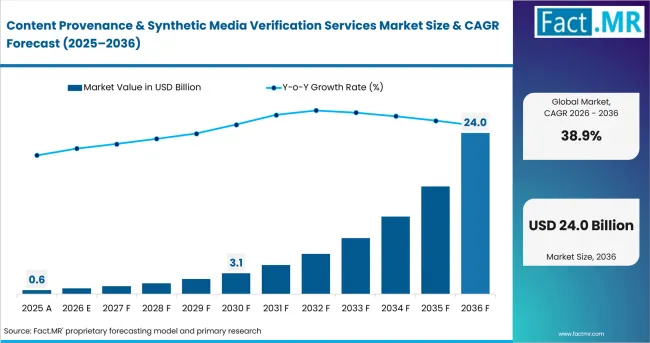
Content Provenance & Synthetic Media Verification Services Market Value Analysis | Source: Fact.MR
| Metric | Details |
|---|---|
| Market Size in 2026 | USD 0.9 billion |
| Market Forecast in 2036 | USD 24.0 billion |
| CAGR 2026 to 2036 | 38.9% |
Source: Fact.MR analysis. Updated Jun 19, 2026
Summary of Content Provenance & Synthetic Media Verification Services Market
- Demand Drivers in the Market
- EU Transparency Duties: Disclosure rules for AI-generated and manipulated content are raising the need for clear media origin checks.
- Content Credentials Adoption: Content credential standards support verification of media origin and editing history.
- Verification Demand: Provenance and synthetic media detection services are becoming important as organizations manage deepfake and manipulated content risk.
- Key Segments Analyzed
- By Service Type: Content Credential Implementation is expected to hold 35.0% share in 2026 because publishers and brands need C2PA-ready workflows.
- By Technology: C2PA Content Credentials lead because organizations need a standard way to carry provenance information. The technology segment is expected to hold 38.0% share in 2026 because credentialing creates a verifiable record of origin and edits.
- By Media Type: Images are projected to capture 42.0% share in 2026 because news, advertising and fraud workflows use image verification first.
- By Customer Type: Digital platforms lead as synthetic media risk grows across user-generated content. The customer group is anticipated to hold 33.0% share in 2026 because platforms need scalable tools for labelling and verification.
- By End Use: News & publishing is expected to represent 29.0% share in 2026 because editorial teams need proof of origin before publication.
- By Geography: The United States is projected to grow at 41.2% CAGR through 2036 as platforms and brands invest in media authenticity controls.
- Analyst Opinion at Fact.MR
- Shambhu Nath Jha, Senior Analyst at Fact.MR, states, “Content provenance services will become a trust layer for digital publishing and brand communication. Organizations will not rely only on detection after a deepfake spreads. They will need origin records and verification workflows before content moves across platforms.”
- Strategic Implications
- Credential Readiness: Publishers should prepare C2PA-compatible workflows before AI transparency duties take effect.
- Verification Operations: Platforms need media verification pipelines that combine credentials and human review.
- Brand Protection: Brands should verify campaign assets and executive media before public release.
The EU AI Act creates a strong compliance catalyst as organizations prepare for clearer transparency duties around AI-generated and manipulated content. The European Commission stated on May 8, 2026 that AI providers will need to add machine-readable marks to enable detection of AI-generated or manipulated content, while deployers must inform people when they are exposed to deepfakes and certain AI-generated publications [1]. This will push brands and publishers to verify media origin before content is shared publicly.
The United States is projected to record 41.2% CAGR from 2026 to 2036 as platforms and media organizations invest in provenance workflows. The United Kingdom is likely to post 40.4% CAGR as newsrooms and public-sector teams adopt media verification services. Germany is set to advance at 39.6% CAGR because EU AI Act compliance supports labelling and marking demand. South Korea is forecast at 38.8% CAGR as platforms and entertainment groups confront synthetic media risk. Japan is expected to register 37.9% CAGR as trusted media workflows expand across publishers and brands.
How does the content provenance & synthetic media verification services market break down by segment?
Content Provenance & Synthetic Media Verification Services Market Analysis by Service Type
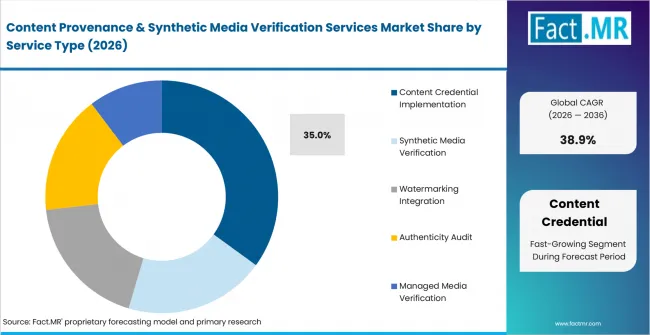
Content Provenance & Synthetic Media Verification Services Market Analysis By Service Type | Source: Fact.MR
Content Credential Implementation is expected to hold 35.0% share in 2026 because organizations need C2PA-ready media workflows before publishing. Synthetic media verification supports deepfake review and manipulated content screening. Watermarking integration helps make origin signals more durable. Authenticity audits support legal and newsroom review. Managed verification services support platforms that need daily review at scale.
- Credential Setup: C2PA setup helps publishers attach origin and editing information to media.
- Verification Review: Synthetic media verification detects altered images and audio.
- Managed Control: Managed services help platforms review content at higher volume.
Content Provenance & Synthetic Media Verification Services Market Analysis by Technology
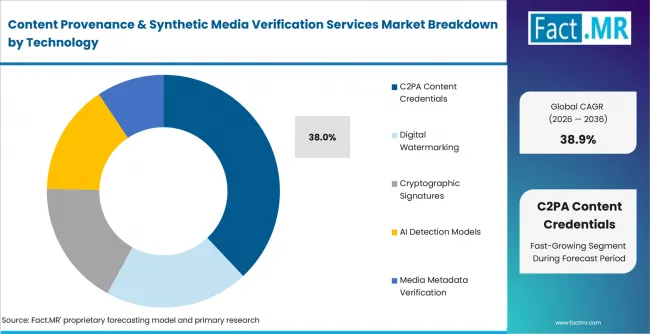
Content Provenance & Synthetic Media Verification Services Market Analysis By Technology | Source: Fact.MR
C2PA Content Credentials lead because they provide a standard way to carry provenance information. Digital watermarking strengthens the connection between an asset and its origin record. The technology is expected to hold 38.0% share in 2026 because organizations need portable evidence across publishing and platform workflows. Cryptographic signatures support trust. AI detection models support verification if credentials are absent.
- C2PA Credentials: Content Credentials carry origin and editing history for digital media.
- Watermarking Layer: Digital watermarks improve durability when metadata is removed.
- AI Detection: Detection models help review media without credential records.
Content Provenance & Synthetic Media Verification Services Market Analysis by Media Type
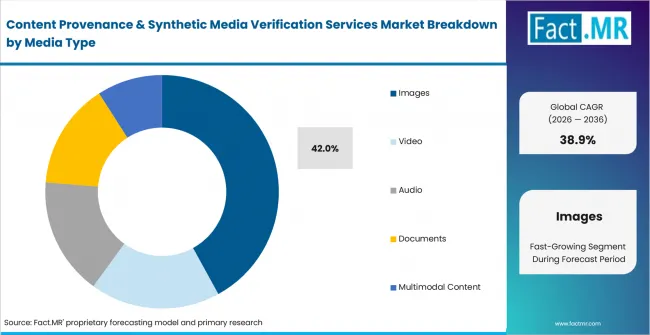
Content Provenance & Synthetic Media Verification Services Market Analysis By Media Type | Source: Fact.MR
Images are projected to capture 42.0% share in 2026 because news and fraud workflows use image verification first. Video verification follows as deepfake risk rises across public figures and brand communication. Audio verification gains demand through voice fraud and executive impersonation. Document verification supports legal and financial evidence workflows. Multimodal content will grow as synthetic campaigns combine media formats.
- Image Verification: Image workflows lead because photos are widely used in publishing and claims.
- Video Review: Video verification supports election and brand safety teams.
- Audio Screening: Audio checks help detect synthetic voice and impersonation attempts.
Content Provenance & Synthetic Media Verification Services Market Analysis by Customer Type
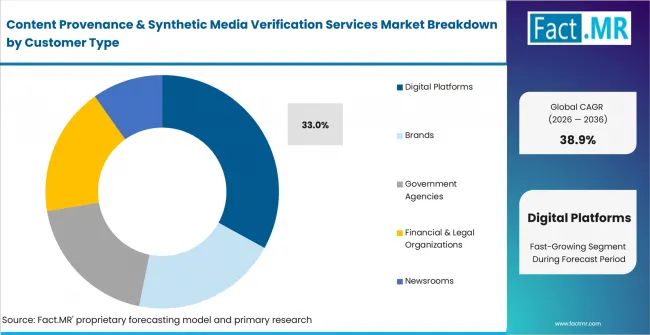
Content Provenance & Synthetic Media Verification Services Market Analysis By Customer Type | Source: Fact.MR
Digital platforms lead as synthetic media risk grows across user-generated content. Newsrooms use provenance tools to confirm media origin before publication. The customer group is anticipated to hold 33.0% share in 2026 because platforms need scalable verification and labelling systems. Brands use services to protect campaigns and executives. Government agencies use verification to protect public communication.
- Platform Need: Digital platforms need scalable checks for user-generated synthetic media.
- Newsroom Trust: Newsrooms use origin records before publishing sensitive images or video.
- Brand Safety: Brands verify campaign assets and executive media against impersonation risk.
Content Provenance & Synthetic Media Verification Services Market Analysis by End Use
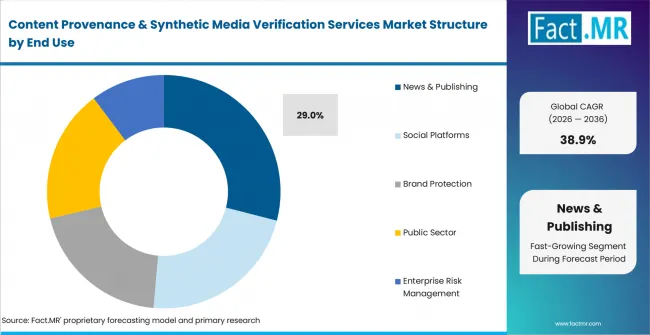
Content Provenance & Synthetic Media Verification Services Market Analysis By End Use | Source: Fact.MR
News & publishing is expected to represent 29.0% share in 2026 because editorial teams need proof of origin before publication. Social platforms use verification to label or remove manipulated media. Brand protection use grows through fake ads and synthetic executive media. Public-sector demand rises due to disinformation and election-cycle risk. Enterprise risk teams use verification for claims and internal investigations.
- Publishing Proof: Newsrooms need source records before using sensitive media.
- Platform Safety: Platforms need labelling and verification for synthetic content.
- Public Sector: Agencies use media verification to protect official communication.
What is accelerating content provenance & synthetic media verification services adoption, and what is holding it back?
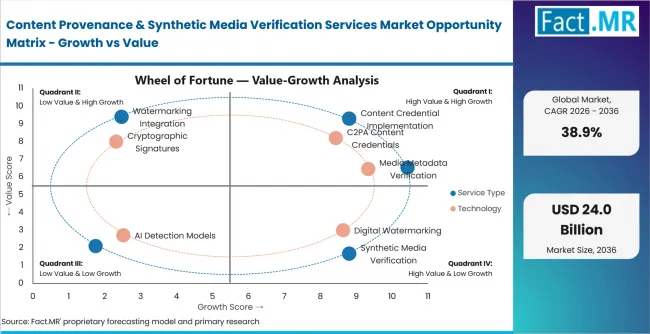
Content Provenance & Synthetic Media Verification Services Market Opportunity Matrix Growth Vs Value | Source: Fact.MR
Synthetic media transparency is becoming a stronger market driver as organizations face higher pressure to prove whether content is real or AI-generated. NIST stated on November 20, 2024 that synthetic content risk reduction includes authenticating content and tracking provenance, labeling synthetic content, detecting synthetic content, testing software and auditing synthetic content [2]. This creates demand for services that can verify images and audio before they reach customers or public audiences.
The main restraint is incomplete ecosystem adoption. Credentials and watermarks lose value if platforms strip metadata or do not show labels to users. Deepfake detection can also fail when media is compressed or recaptured. Organizations may need both provenance and detection because not all synthetic media will arrive with credentials. Service providers must connect publishing tools and platform review workflows before the market scales.
Opportunities in the Content Provenance & Synthetic Media Verification Services Market
- C2PA Readiness: Providers can help publishers and brands implement Content Credentials workflows.
- Managed Verification: Platforms can outsource media review and synthetic content checks.
- Election Risk Services: Public agencies and media groups need rapid verification during election cycles.
Which countries are scaling content provenance & synthetic media verification services demand fastest?
Based on regional analysis, the content provenance and synthetic media verification services market is segmented into North America, Western Europe, East Asia and other regions.
.webp "Top Country Growth Comparison Content Provenance & Synthetic Media Verification Services Market Cagr (2026 2036)")
Top Country Growth Comparison Content Provenance & Synthetic Media Verification Services Market Cagr (2026 2036) | Source: Fact.MR
| Country | CAGR 2026 to 2036 |
|---|---|
| United States | 41.2% |
| United Kingdom | 40.4% |
| Germany | 39.6% |
| South Korea | 38.8% |
| Japan | 37.9% |
Source: Fact.MR analysis. Updated Jun 19, 2026
Source: Fact.MR directional estimate and primary research model
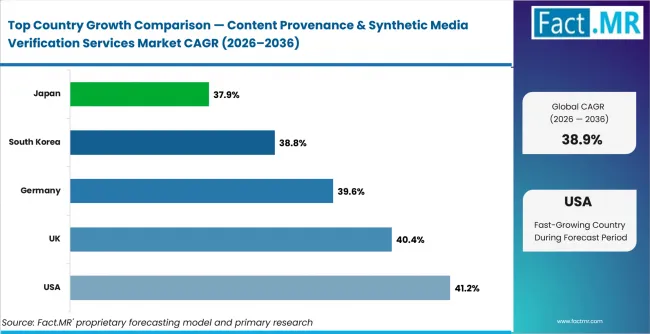
Content Provenance & Synthetic Media Verification Services Market Cagr Analysis By Country | Source: Fact.MR
North America Content Provenance & Synthetic Media Verification Services Market Analysis
North America demand is led by the United States. Platform activity and brand-safety spending make the region an early market for provenance services. Newsrooms and public agencies are also reviewing credential workflows before synthetic media risk expands.
- United States: The United States is projected to record 41.2% CAGR through 2036 as platforms and publishers invest in content authenticity. The Content Authenticity Initiative stated on January 17, 2026 that Content Authenticity for Enterprise addresses brands, publishers and institutions working with large-scale production workflows, while Content Credentials support standardized and durable provenance [3].
Western Europe Content Provenance & Synthetic Media Verification Services Market Analysis
Western Europe demand is led by the United Kingdom and Germany. EU AI Act transparency rules support adoption across publishers and brands. Media organizations will need stronger labelling and verification workflows.
- United Kingdom: UK newsrooms and brands are expanding synthetic media review as AI-generated content becomes harder to separate from authentic media. Publishers need credential workflows that support source proof and edit history. The United Kingdom is likely to post 40.4% CAGR through 2036 because broadcasters and public-sector teams need trusted media verification.
- Germany: Germany is set to advance at 39.6% CAGR over the forecast period because EU AI Act transparency duties support labelling and marking demand. German publishers and public institutions will need C2PA-ready processes before AI-generated content rules are fully applied. The European Commission states that transparency obligations cover marking, detection and labelling of AI-generated content and deepfakes [4].
East Asia Content Provenance & Synthetic Media Verification Services Market Analysis
East Asia demand is supported by South Korea and Japan. Entertainment and brand communication create strong synthetic media exposure. Adoption will be influenced by public trust and platform policy pressure.
- South Korea: South Korea is forecast at 38.8% CAGR by 2036 as entertainment firms and brands confront synthetic media risk. K-pop and digital advertising create high-volume media environments that need verification. Deepfake risk also affects public figures and corporate communication. Service providers can support watermarking and AI-generated content detection.
- Japan: Japanese publishers and brands are expected to adopt provenance tools through careful workflow review. Media firms will focus on trust and quality control before deploying full-scale credentials. Japan is expected to register 37.9% CAGR from 2026 to 2036 as trusted media workflows expand across publishing and brand communication. Image and video verification will lead early adoption. Public-sector and corporate communications teams will use provenance services to reduce impersonation and misinformation risk.
Who leads the content provenance & synthetic media verification services market landscape?
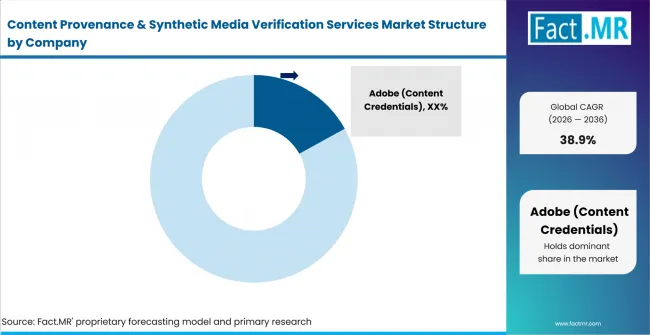
Content Provenance & Synthetic Media Verification Services Market Analysis By Company | Source: Fact.MR
The content provenance and synthetic media verification services market is built around media trust infrastructure. Adobe supports the market through Content Credentials and the wider Content Authenticity ecosystem. Truepic focuses on visual authentication and manipulation detection for business evidence workflows. Digimarc Corporation supports C2PA Content Credentials and digital watermarking. [5] Reality Defender supports enterprise deepfake detection across image and audio channels. Hive provides AI-generated content and deepfake detection APIs for platforms and organizations.
Competition is moving toward proof of origin and fast verification. Creator-led platforms need provenance signals that travel with content. Enterprises need detection tools for media that arrives without credentials. Public-sector and platform users also need scalable checks across images and audio files. This makes workflow integration as important as detection accuracy.
Supplier strength through 2036 will come from combining provenance with detection. Credentials can show how content was made or edited. Detection becomes important when credentials are missing or unreliable. Providers that support multiple media types and fit into existing review workflows will gain stronger demand as organizations build formal media trust policies.
Which companies are the key players?
- Adobe (Content Credentials)
- Truepic
- Digimarc Corporation
- Reality Defender
- Hive
Bibliography
- [1] European Commission. (2026, May 8). Commission opens consultation on draft guidelines for AI transparency obligations. Shaping Europe’s Digital Future.
- [2] Chandra, B., Dunietz, J., Roberts, K., Lee, Y., Fontana, P., & Awad, G. (2024, November 20). Reducing risks posed by synthetic content: An overview of technical approaches to digital content transparency (NIST AI 100-4). National Institute of Standards and Technology.
- [3] Content Authenticity Initiative. (2026, January 17). The state of content authenticity in 2026.
- [4] European Commission. (2026, June 10). Code of Practice on Transparency of AI-Generated Content. Shaping Europe’s Digital Future.
- [5] Digimarc Corporation. (n.d.). Provenance & Authenticity Solution.
This Report Addresses
- Strategic intelligence on content provenance and synthetic media verification services across service type, technology and media type.
- Forecast mapping from USD 0.9 billion in 2026 to USD 24.0 billion by 2036.
- Segment analysis covering Content Credential Implementation, C2PA Content Credentials, images and digital platforms.
- Regional outlook covering the United States, United Kingdom, Germany, South Korea and Japan.
- Competitive analysis of Adobe, Truepic, Digimarc Corporation, Reality Defender and Hive.
- Service opportunity review across C2PA readiness, managed verification and brand protection.
- Adoption review across publishing, platforms, public sector and enterprise risk management.
- Verified catalyst review based on EU AI Act Article 50 and C2PA Content Credentials adoption.
What does the content provenance & synthetic media verification services market cover?
The content provenance and synthetic media verification services market covers services that label and audit the origin of images and documents. These services use C2PA Content Credentials and AI detection tools. The scope focuses on service delivery that helps organizations separate authentic media from AI-generated or manipulated content.
Content Provenance & Synthetic Media Verification Services Market Inclusions
The scope includes C2PA implementation support and managed verification services. It includes services for newsrooms and enterprise risk teams.
Content Provenance & Synthetic Media Verification Services Market Exclusions
The scope excludes general cybersecurity tools with no media verification function. It excludes standalone AI image generators unless they provide provenance or credentialing services. It excludes basic content moderation services that do not verify origin.
Content Provenance & Synthetic Media Verification Services Market Research Methodology
- Primary Research: Primary research includes discussions with newsroom technology teams and media verification specialists. Public-sector and enterprise risk teams were reviewed separately.
- Desk Research: Desk research reviews EU transparency rules and synthetic media verification announcements. Official sources from listed providers support validation.
- Market-Sizing and Forecasting: Market estimates are developed through synthetic media risk signals and regional validation.
- Data Validation and Update Cycle: Forecasts are checked through provider activity and official catalyst tracking.
Segmentation
What is the report’s scope and coverage?
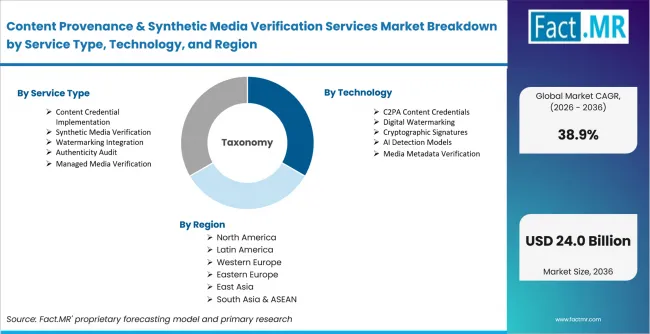
Content Provenance & Synthetic Media Verification Services Market Breakdown By Service Type, Technology, And Region | Source: Fact.MR
| Attribute | Details |
|---|---|
| Quantitative Units | USD 0.9 billion in 2026 to USD 24.0 billion by 2036 at 38.9% CAGR |
| Market Definition | Services that label, watermark and verify the origin of images, video and audio to separate authentic media from synthetic content |
| Service Type | Content Credential Implementation, Synthetic Media Verification, Watermarking Integration, Authenticity Audit, Managed Media Verification |
| Technology | C2PA Content Credentials, Digital Watermarking, Cryptographic Signatures, AI Detection Models, Media Metadata Verification |
| Media Type | Images, Video, Audio, Documents, Multimodal Content |
| Customer Type | Newsrooms, Digital Platforms, Brands, Government Agencies, Financial & Legal Organizations |
| End Use | News & Publishing, Social Platforms, Brand Protection, Public Sector, Enterprise Risk Management |
| Regions Covered | North America, Western Europe, East Asia, Other Regions |
| Countries Covered | United States, United Kingdom, Germany, South Korea, Japan |
| Key Companies Profiled | Adobe (Content Credentials), Truepic, Digimarc Corporation, Reality Defender and Hive |
| Forecast Period | 2026 to 2036 |
| Approach | Hybrid top-down and bottom-up approach using synthetic media risk, C2PA adoption, compliance demand, service activity and regional validation |
Source: Fact.MR analysis. Updated Jun 19, 2026
How is the market segmented?
-
By Service Type:
- Content Credential Implementation
- Synthetic Media Verification
- Watermarking Integration
- Authenticity Audit
- Managed Media Verification
-
By Technology:
- C2PA Content Credentials
- Digital Watermarking
- Cryptographic Signatures
- AI Detection Models
- Media Metadata Verification
-
By Media Type:
- Images
- Video
- Audio
- Documents
- Multimodal Content
-
By Customer Type:
- Newsrooms
- Digital Platforms
- Brands
- Government Agencies
- Financial & Legal Organizations
-
By End Use:
- News & Publishing
- Social Platforms
- Brand Protection
- Public Sector
- Enterprise Risk Management
-
By Region:
- North America
- United States
- Canada
- Western Europe
- United Kingdom
- Germany
- France
- Netherlands
- Spain
- East Asia
- Japan
- South Korea
- China
- Other Regions
- Latin America
- Middle East and Africa
- GCC Countries
- South Africa
- UAE
- Rest of Middle East & Africa
- North America
Frequently Asked Questions
What is the Content Provenance & Synthetic Media Verification Services Market size in 2026?
What will the Content Provenance & Synthetic Media Verification Services Market be worth by 2036?
What CAGR is projected for the Content Provenance & Synthetic Media Verification Services Market?
Which service type leads the market?
Which country grows fastest in the market?
How does the United Kingdom perform in this market?
How does Germany perform in this market?
How does South Korea perform in this market?
How does Japan perform in this market?
What are content provenance and synthetic media verification services?
Why do organizations need content provenance services?
What restrains the market?
What is the main opportunity in this market?
Who worked on this report


Preview the report firsthand - request a free sample
Free SampleGet the brochure for pricing and purchase details
Download PDF