- Base Value(2024): 950 Bn
- Forecast Value (2036): 4.1 Bn
- CAGR (2036): 21.2%
What is the contrast therapy suites market forecast to be worth by 2036?
USD 0.6 billion in 2026 to USD 4.1 billion by 2036, at 21.2% CAGR.
- The contrast therapy suites market crossed a valuation of USD 0.5 billion in 2025. Demand is expected to increase from USD 0.6 billion in 2026 to USD 4.1 billion by 2036.
- The market is forecast to record 21.2% CAGR during 2026 to 2036 as premium gyms, hotel spas and recovery studios add managed hot-cold rooms for repeat sessions.
- Retrofit installations are likely to support early scale because clubs can convert underused wet areas before funding new builds. Membership access also improves payback because operators can place contrast therapy inside higher-priced club tiers instead of relying only on single-session bookings.
- Commercial hot-cold rooms that combine heat exposure with cold immersion form the core of this market. Life Time said in January 2025 that it was adding cold plunges to more than 70 athletic country clubs by summer 2025.
- This supports demand for suite suppliers that can provide water-care routines, chiller service, booking workflows and staff-led safety protocols for high-traffic wellness spaces.
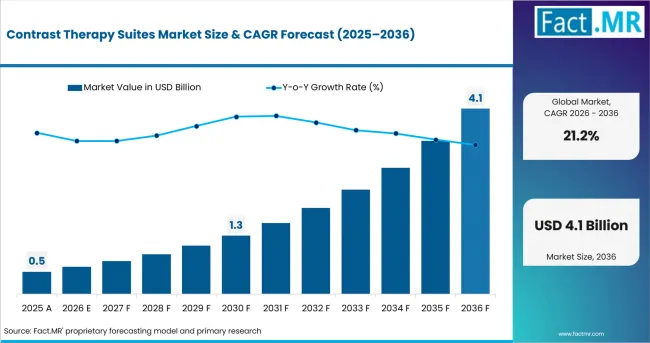
Contrast Therapy Suites Market Value Analysis | Source: Fact.MR
What are the defining numbers behind contrast therapy suites growth?
USD 3.5 billion absolute opportunity by 2036. India, the United States and the United Kingdom lead the country view.
- Demand Drivers in the Market
- Premium fitness clubs use contrast suites to keep members inside the facility after training sessions.
- Hotel spas add hot-cold rooms where wellness travelers expect a fuller recovery menu before booking a stay.
- Recovery studios sell guided group sessions as an alcohol-free social format for younger urban consumers.
- Water-care planning matters since cold plunges need temperature control and frequent sanitation checks.
- Key Segments Analyzed
- By Capacity Tier: Mid-Scale Suites are projected to account for 47.0% of the market in 2026, reflecting the fit between group throughput and space cost.
- By Installation Model: Retrofit Installations are expected to capture 46.0% share in 2026, since many clubs convert underused wet areas before funding new buildings.
- By Revenue Model: Membership Access is forecast to hold 44.0% share in 2026, with operators folding recovery access into higher club tiers.
- By Suite Type: Sauna-Plunge Suites are anticipated to represent 42.0% share in 2026, owing to simple user flow and clear staff oversight.
- By Equipment Mix: Electric Sauna Systems are estimated to secure 41.0% share in 2026, as predictable heat cycles fit commercial schedules.
- By Session Format: Guided Circuits are projected to hold 40.0% share in 2026, as staff-led classes make hot-cold use safer and easier to price.
- By Buyer Type: Premium Fitness Clubs are projected to account for 38.0% share in 2026, reflecting their recurring member base and amenity budgets.
- By Geography: India is expected to post 24.2% CAGR through 2036, backed by low paid-fitness penetration and new urban studio formats.
- Analyst Opinion
- Shambhu Nath Jha, Principal Analyst at Fact.MR states, "Contrast therapy is becoming the recovery room that operators can actually price. I see buyers asking how many sessions a suite can handle, who maintains the water and whether members return every week."
- Strategic Implications
- Gym operators should design the user path before ordering equipment since wet-room flow decides capacity.
- Hotel owners need to connect contrast suites with room packages and spa booking systems.
- Equipment suppliers should prove sanitation uptime and chiller service before selling large orders.
- Recovery brands can use guided sessions to defend pricing against basic sauna access.
India is projected to record 24.2% CAGR through 2036 as low paid-fitness penetration and boutique studio build-outs support premium recovery formats. The United States is expected to expand at 23.5% CAGR because high club usage and national recovery amenity rollouts support suite utilization. The United Kingdom is forecast to grow at 22.9% CAGR as bathhouse revival and city-based wellness resort planning support social bathing formats. Australia is expected to advance at 22.3% CAGR as outdoor wellness habits and coastal recovery culture support cold immersion use. China is projected to rise at 21.9% CAGR as large wellness spending and thermal bathing infrastructure support commercial suite demand. Germany is forecast to expand at 21.4% CAGR as spa culture and premium wellness spending support sauna-plunge retrofits. Japan is expected to record 20.6% CAGR as onsen familiarity and urban recovery formats support steady adoption.
How does the contrast therapy suites market break down by segment?
Mid-Scale Suites lead at 47.0%. Retrofit Installations follow with 46.0% share in 2026.
Which capacity tier is preferred?
Mid-Scale Suites hold 47.0% share in 2026.
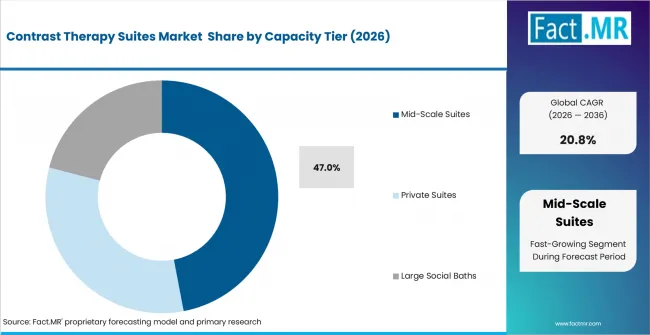
Contrast Therapy Suites Market Analysis By Capacity Tier | Source: Fact.MR
Mid-scale suites are expected to hold 47.0% share in 2026 since operators need enough stations to serve groups without building a full bathhouse. Premium health and fitness club operators usually test capacity through member bookings before funding larger circuits. This keeps designs focused on two to four plunge points and one shared heat room.
Which installation model is preferred?
Retrofit Installations hold 46.0% share in 2026.
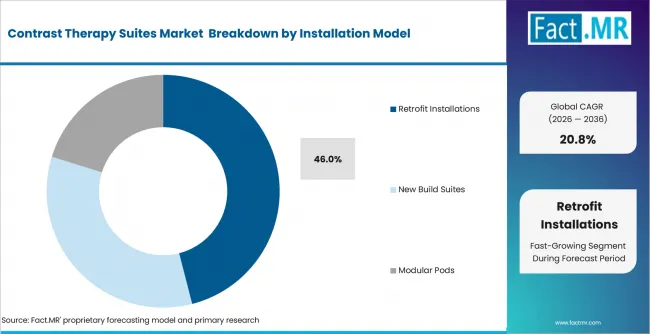
Contrast Therapy Suites Market Analysis By Installation Model | Source: Fact.MR
Retrofit installations are projected to account for 46.0% share in 2026 as clubs convert unused wet zones into recovery rooms. Hotel spa facilities follow the same path when an older steam area no longer matches guest expectations. The retrofit route shortens payback but limits suite size and drainage options.
Which revenue model is preferred?
Membership Access holds 44.0% share in 2026.
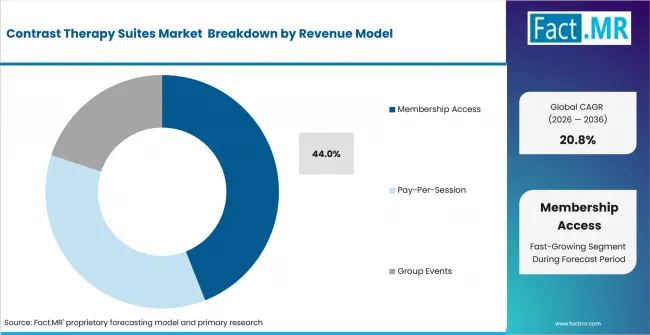
Contrast Therapy Suites Market Analysis By Revenue Model | Source: Fact.MR
Membership access is anticipated to hold 44.0% share in 2026 because operators prefer recurring revenue over single-session volatility. The model sits close to fitness recovery services where repeat use matters more than one premium booking. Pay-per-session formats still work in destination spas where travelers buy a time-limited package.
Hotel wellness teams also link contrast rooms with wellness tourism packages when guests want a recovery itinerary rather than a single massage. That package logic raises the value of staff-led circuits and private bookings. Operators can then sell a clearer outcome to both local members and travelers.
Which suite type is preferred?
Sauna-Plunge Suites hold 42.0% share in 2026.
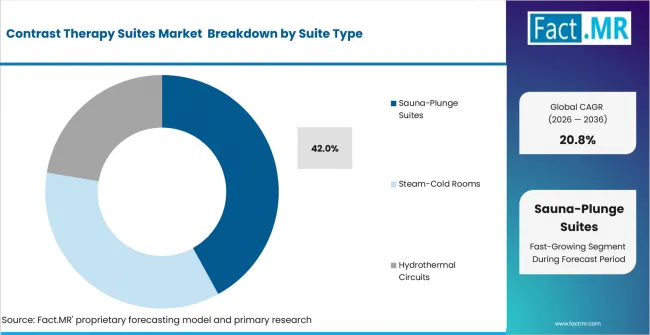
Contrast Therapy Suites Market Analysis By Suite Type | Source: Fact.MR
Sauna-plunge suites are estimated to account for 42.0% share in 2026 since the user journey is simple and easy to explain. Commercial buyers compare the offer with body recovery tools but suite spending depends on shared space use. The format also fits guided breathwork classes where groups move together under staff direction.
Pool-adjacent layouts can borrow design lessons from aqua gym equipment when slip resistance and drainage matter. This link is practical for sports clubs that already manage wet training areas. The main limit is higher staff supervision during cold immersion sessions.
Which equipment mix is preferred?
Electric Sauna Systems hold 41.0% share in 2026.
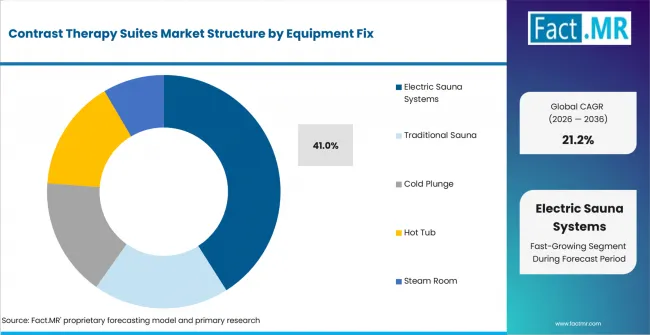
Contrast Therapy Suites Market Analysis By Equipment Fix | Source: Fact.MR
Electric sauna systems are forecast to secure 41.0% share in 2026 because they support predictable temperature cycles and easier facility integration. Clubs that already buy functional fitness equipment often prefer equipment that fits planned operating hours. Traditional wood systems remain important in bathhouse settings where ritual and room feel carry pricing power.
Steam rooms and aromatherapy suites use inputs such as eucalyptus oil where operators want a stronger sensory cue. That choice can support higher session pricing when the experience feels guided and clean. Equipment mix still depends on ventilation and local wet-area rules.
Which session format is preferred?
Guided Circuits hold 40.0% share in 2026.
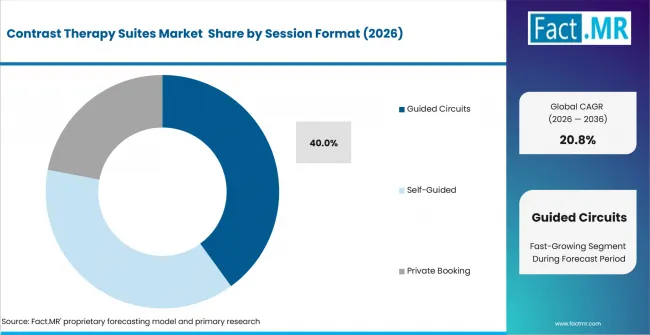
Contrast Therapy Suites Market Analysis By Session Format | Source: Fact.MR
Guided circuits are expected to hold 40.0% share in 2026 because operators can supervise exposure time and water entry. The format also works for social wellness sessions where a host sets the pace and recovery breaks. Self-guided use remains useful in hotels where privacy matters more than group flow.
Which buyer type is preferred?
Premium Fitness Clubs hold 38.0% share in 2026.
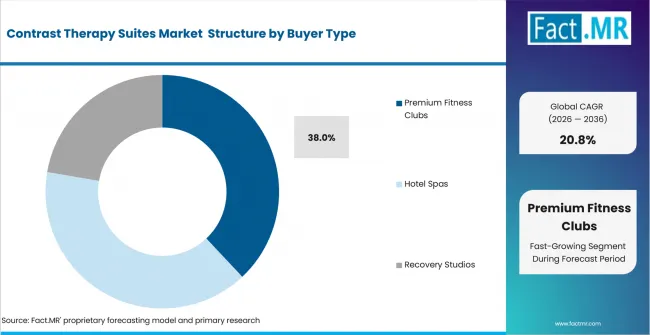
Contrast Therapy Suites Market Analysis By Buyer Type | Source: Fact.MR
Premium fitness clubs are projected to account for 38.0% share in 2026 as members expect recovery beside training. Hotel spas follow with stronger private-suite pricing but less weekly repeat use.
What is accelerating contrast therapy suites demand, and what is holding it back?
Premium amenity upgrades support demand. Water maintenance and build-out cost restrain wider use.
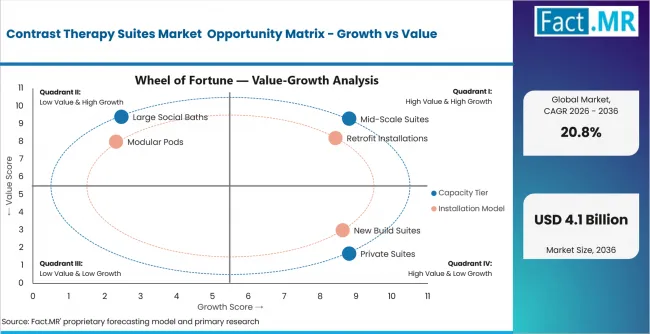
Contrast Therapy Suites Market Opportunity Matrix Growth Vs Value | Source: Fact.MR
Commercial recovery is moving from a side room into the main membership offer. Premium clubs use hot-cold access to justify higher tiers and longer visits. The Health and Fitness Association reported in April 2026 that the United States had 81 million fitness facility members in 2025. That member base gives operators a direct path to recurring usage when the suite is placed near training floors.
Expansion is constrained by wet-room cost and operating discipline. Cold plunges need filtration and chiller servicing that basic sauna rooms do not require. Operators also face local pool rules and staff training needs when users move through heat exposure and cold immersion. Smaller gyms may delay projects until modular suites reduce plumbing work and maintenance risk.
Where do the biggest contrast therapy suites opportunities sit?
Premium club retrofits, hotel wellness floors and guided social bathing formats offer the clearest routes.
- Premium Club Retrofits:
- Operators can place hot-cold rooms beside strength areas where members already recover after training.
- Hotel Wellness Floors:
- Hotels can package sauna-plunge access with rooms when guests want a shorter wellness stay near home. The sales path works best where staff can manage booking times and clean turnover.
- Guided Social Bathing:
- Recovery brands can price group sauna and cold plunge sessions as alcohol-free social events. This format gives operators a service layer beyond hardware and ties back to sports medicine recovery language for active members.
Which countries are scaling contrast therapy suites fastest?
India 24.2% CAGR, United States 23.5% CAGR, United Kingdom 22.9% CAGR, Australia 22.3% CAGR, China 21.9% CAGR, Germany 21.4% CAGR, Japan 20.6% CAGR.
Based on regional analysis, the contrast therapy suites market is segmented into North America and Western Europe. East Asia and South Asia and Pacific are also covered. Latin America and Middle East and Africa complete the regional scope.
.webp "Top Country Growth Comparison Contrast Therapy Suites Market Cagr (2026 2036)")
Top Country Growth Comparison Contrast Therapy Suites Market Cagr (2026 2036) | Source: Fact.MR
| Country | CAGR |
|---|---|
| India | 24.2% |
| United States | 23.5% |
| United Kingdom | 22.9% |
| Australia | 22.3% |
| China | 21.9% |
| Germany | 21.4% |
| Japan | 20.6% |
Source: Fact.MR analysis. Updated Jun 24, 2026
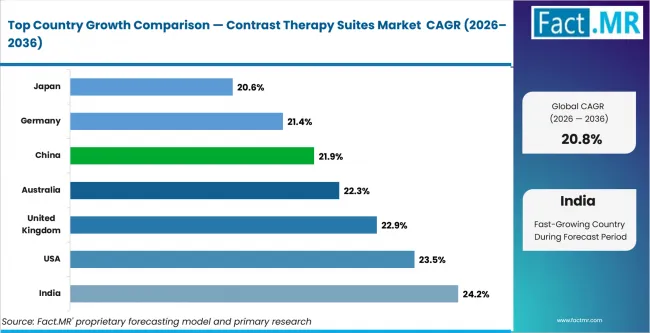
Contrast Therapy Suites Market Cagr Analysis By Country | Source: Fact.MR
What powers India’s lead?
24.2% CAGR, backed by low paid-fitness penetration and boutique studio build-outs.
India is starting from a smaller paid fitness base but premium urban clubs are adding wellness areas to separate themselves from value gyms. The Health and Fitness Association reported in September 2025 that India had about 12.3 million fitness facility members in 2024. That low base leaves room for boutique recovery studios and club retrofits. Suppliers that package smaller suites with water-care training should gain earlier orders in top cities.
What supports the United States outlook?
23.5% CAGR, supported by high club usage and national recovery amenity rollouts.
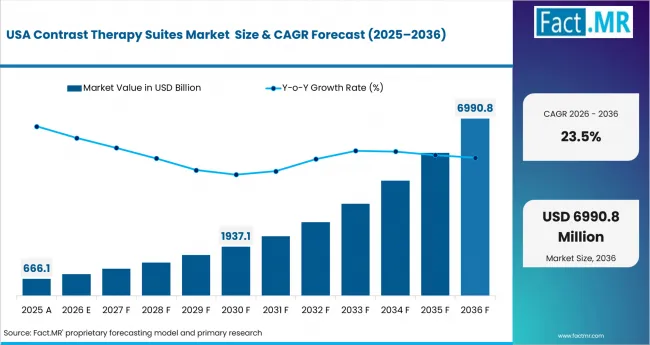
Contrast Therapy Suites Market Country Value Analysis | Source: Fact.MR
The United States has the deepest near-term buyer base because gyms and social wellness clubs already sell recurring recovery access. The Health and Fitness Association reported in April 2026 that fitness facilities recorded nearly 7 billion visits in 2025. That traffic makes suite utilization easier to prove to owners. Suppliers need strong service networks since chiller downtime can quickly hurt member trust.
Why does the United Kingdom matter?
22.9% CAGR, driven by bathhouse revival and city-based wellness resort planning.
The United Kingdom market is shaped by a revival of thermal bathing and a premium gym base in dense cities. Global Wellness Institute notes that Therme Group has a 90/90 goal for the United Kingdom. That goal seeks a destination within a 90-minute travel time for 90% of the population. Operators that make social bathing feel accessible should benefit from this broader cultural reset.
How is Australia scaling demand?
22.3% CAGR, attributable to outdoor wellness habits and coastal recovery culture.
Australia has a strong outdoor wellness culture that makes cold exposure easier to explain to consumers. Global Wellness Institute reported in July 2025 that Australia has 35,000 kilometers of coastline. That physical setting supports ocean swimming and heat-cold rituals in both gyms and hotels. Commercial suites can work well where clubs serve members who already value outdoor recovery.
What makes China a significant market?
21.9% CAGR, backed by large wellness spending and thermal bathing infrastructure.
China has a large wellness economy and a deep base of hot springs activity. The Global Wellness Institute reported in January 2026 that China’s wellness economy was valued at USD 950 billion in 2024. That scale helps consumers understand paid bathing experiences. The constraint is that commercial contrast suites need city-level operating permissions and clear water-quality controls.
Why is Germany relevant?
21.4% CAGR, supported by spa culture and premium wellness spending.
Germany brings an established sauna culture and a large wellness economy into the suite category. Global Wellness Institute reported in January 2026 that Germany’s wellness economy was valued at USD 281 billion in 2024. That scale gives hotel spas and fitness clubs a familiar buyer base. Faster adoption depends on retrofits that respect existing sauna norms and local wet-area standards.
How does Japan create a steady market?
20.6% CAGR, led by onsen familiarity and urban recovery formats.
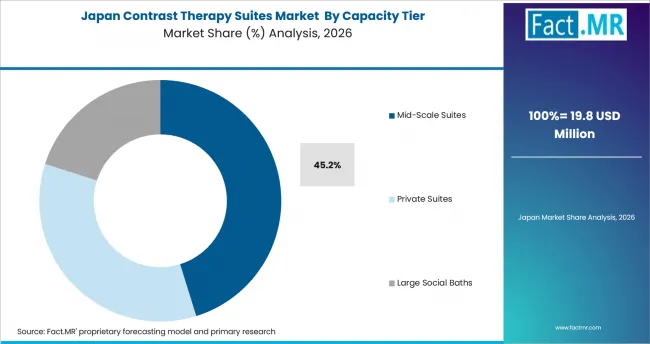
Contrast Therapy Suites Market Japan Market Share Analysis By Capacity Tier | Source: Fact.MR
Japan is not starting from a cold market because bathing culture is already a national habit. The Global Wellness Institute reported in January 2026 that Japan’s wellness economy was valued at USD 262 billion in 2024. Commercial contrast suites can borrow from that familiarity when targeting hotels and wellness clubs. Growth is lower than India since many consumers already have access to traditional bathing formats.
Who leads the contrast therapy suites landscape?
Remedy Place, Othership and Life Time lead through branded programming. WorldSprings and Banya No.1 add social bathing depth.
Contrast Therapy Suites Market Analysis By Company | Source: Fact.MR
Competition is split between branded operators and equipment suppliers that support commercial wet rooms. Buyers compare providers on session throughput and sanitation routines. Premium design matters but the contract often turns on maintenance and staff training. This keeps the market open to both wellness brands and specialist builders.
Remedy Place uses private and guided hot-cold experiences to price recovery as a social club service. Othership focuses on sauna and ice bath classes where music and group facilitation shape the customer reason to return. Life Time brings scale through its club network and its January 2025 cold plunge rollout. These models show that programming can matter as much as the room itself.
WorldSprings and Banya No.1 compete through larger bathing formats and longer dwell time. Their advantage is that guests treat the site as a destination rather than a short recovery stop. Sauna House and similar studios show a smaller format route for cities where real estate is tight. Operators with simple booking flows and visible water care should be better placed through 2036.
Specialist suppliers also matter because pumps and filtration decide whether a suite works during peak hours. Buyers often compare the service with broader fitness recovery services before selecting a wet-room partner. Providers that can prove clean turnover and fast maintenance should convert more premium gym and hotel contracts.
Which companies are the key players?
Remedy Place, Othership and Life Time are key players. WorldSprings, Banya No.1 and Sauna House are also profiled. WellnessSpace Brands completes the company set.
- Remedy Place
- Othership
- Life Time
- WorldSprings
- Banya No.1
- Sauna House
- WellnessSpace Brands
Bibliography
- [1] Global Wellness Institute. (2025, November 19). The global wellness economy hits a record USD 6.8 trillion and is forecast to reach USD 9.8 trillion by 2029. Global Wellness Institute.
- [2] Global Wellness Institute. (2026, April 6). Hot Springs Initiative trends for 2026. Global Wellness Institute.
- [3] Global Wellness Institute. (2025, July). The global wellness economy: Australia. Global Wellness Institute.
- [4] Global Wellness Institute. (2026, January). Global wellness economy country rankings 2019 to 2024 data. Global Wellness Institute.
- [5] Global Wellness Institute. (2026, June). Thermal and mineral springs. Global Wellness Institute.
- [6] Global Wellness Institute. (2025, March 31). Hydrothermal Initiative trends for 2025. Global Wellness Institute.
- [7] Health & Fitness Association. (2026, April 9). 81 million Americans were members of a fitness facility in 2025. Health & Fitness Association.
- [8] Health & Fitness Association. (2025, September 9). India’s fitness market set to double by 2030. Health & Fitness Association.
- [9] Health & Fitness Association. (2025, October 30). New HFA data shows how 77 million U.S. fitness facility members work out. Health & Fitness Association.
- [10] Life Time Group Holdings, Inc. (2025, January 31). Cool down, power up: Life Time adding cold plunges to 70+ clubs. Life Time Group Holdings, Inc.
- [11] WellnessSpace Brands. (2025, December 11). WellnessSpace Brands introduces PolarWave dry cold plunge. WellnessSpace Brands.
- [12] WellnessSpace Brands. (2025, November 20). WellnessSpace Brands unveils the RedZone Sauna. WellnessSpace Brands.
This Report Addresses
Strategic intelligence on contrast therapy suites across suite type, installation model, buyer type and session format.
- Segment analysis covering Mid-Scale Suites, Retrofit Installations, Membership Access, Sauna-Plunge Suites and Guided Circuits.
- Regional outlook covering India, United States, United Kingdom, Australia, China, Germany and Japan.
- Competitive analysis of Remedy Place, Othership and Life Time. WorldSprings, Banya No.1 and Sauna House are also profiled.
- Service assessment covering guided sessions, private suites, social bathing formats and commercial water-care needs.
- Source-led market sizing using venue evidence, operator rollouts, wellness economy data and official company disclosures.
What does the contrast therapy suites market cover?
Commercial hot-cold rooms that combine sauna or heat exposure with plunge pools and managed recovery programming.
The contrast therapy suites market covers paid rooms and circuits where users move between heat and cold under a managed session plan. It includes suite design and commercial equipment sold to gyms. It also includes operators that sell guided contrast sessions. The boundary is the combined hot-cold experience rather than a standalone sauna or tub.
What is included in the scope?
Sauna-plunge suites and hydrothermal circuits are included. Operations software and water-care systems are also covered.
The scope includes indoor and outdoor suites that pair saunas with cold plunge pools. Steam rooms and hot tubs are included when they are sold as part of a contrast circuit. The scope also includes chiller systems and filtration controls. Staff training and booking workflows are included when bundled with the suite operation.
What is excluded from the scope?
Home cold tubs and standalone sauna rooms sold without a commercial suite package are excluded from scope.
The scope excludes single home plunges and residential sauna kits. It also excludes ordinary pool construction when no heat-cold sequence is sold. Medical cryotherapy chambers are excluded unless they sit inside a commercial contrast suite. General spa revenue is excluded when the facility has no dedicated contrast circuit.
How was the analysis built?
95+ sources and 40+ company or regulator pages. 22 countries were checked with 18 interviews.
- Primary Research:
- Interviews covered premium gym operators and hotel spa buyers. Recovery studio founders and hydrothermal suite suppliers were also included.
- Desk Research:
- Research reviewed wellness association releases and fitness association data. Company pages and public health guidance were checked for adoption signals.
- Market-Sizing and Forecasting:
- Forecasting used provider counts and suite pricing. Venue density and retrofit timing were used to size annual installations.
- Data Validation and Update Cycle:
- Estimates were checked against Life Time cold plunge rollout. Remedy Place and Othership service formats were also reviewed.
Segmentation
What is the report’s scope and coverage?
Contrast Therapy Suites Market Breakdown By Capacity Tier, Installation Model, And Region | Source: Fact.MR
| Attribute | Details |
|---|---|
| Quantitative Units | USD Billion in 2026 to USD Billion by 2036 at CAGR |
| Market Definition | Commercial hot-cold therapy rooms that pair heat exposure with cold immersion for gyms and wellness venues. |
| Suite Type | Sauna-Plunge Suites, Steam-Cold Rooms, Hydrothermal Circuits, Infrared-Cold Rooms, Mobile Suites |
| Installation Model | Retrofit Installations, New Build Suites, Modular Pods, Outdoor Courtyards, Hotel Conversions |
| Revenue Model | Membership Access, Pay-Per-Session, Group Events, Corporate Wellness, Athlete Packages |
| Equipment Mix | Electric Sauna Systems, Traditional Sauna, Cold Plunge, Hot Tub, Steam Room |
| Capacity Tier | Mid-Scale Suites, Private Suites, Large Social Baths, Outdoor Complexes, Mobile Rooms |
| Buyer Type | Premium Fitness Clubs, Hotel Spas, Recovery Studios, Bathhouse Operators, Sports Clubs |
| Session Format | Guided Circuits, Self-Guided, Private Booking, Group Classes, Athlete Blocks |
| Regions Covered | North America, Western Europe, East Asia, South Asia and Pacific, Latin America, Middle East and Africa |
| Countries Covered | India, United States, United Kingdom, Australia, China, Germany and Japan |
| Key Companies Profiled | Remedy Place, Othership, Life Time, WorldSprings, Banya No.1, Sauna House and WellnessSpace Brands |
| Forecast Period | 2026 to 2036 |
| Approach | Hybrid top-down and bottom-up approach using venue counts, suite pricing, operator rollouts and company validation |
Source: Fact.MR analysis. Updated Jun 24, 2026
How is the market segmented?
-
By Suite Type:
- Sauna-Plunge Suites
- Steam-Cold Rooms
- Hydrothermal Circuits
- Infrared-Cold Rooms
- Mobile Suites
-
By Installation Model:
- Retrofit Installations
- New Build Suites
- Modular Pods
- Outdoor Courtyards
- Hotel Conversions
-
By Revenue Model:
- Membership Access
- Pay-Per-Session
- Group Events
- Corporate Wellness
- Athlete Packages
-
By Equipment Mix:
- Electric Sauna Systems
- Traditional Sauna
- Cold Plunge
- Hot Tub
- Steam Room
-
By Capacity Tier:
- Mid-Scale Suites
- Private Suites
- Large Social Baths
- Outdoor Complexes
- Mobile Rooms
-
By Buyer Type:
- Premium Fitness Clubs
- Hotel Spas
- Recovery Studios
- Bathhouse Operators
- Sports Clubs
-
By Session Format:
- Guided Circuits
- Self-Guided
- Private Booking
- Group Classes
- Athlete Blocks
-
By Region:
- North America
- United States
- Canada
- Mexico
- Latin America
- Brazil
- Argentina
- Rest of Latin America
- Europe
- Germany
- United Kingdom
- France
- Italy
- Rest of Europe
- Asia Pacific
- China
- India
- Japan
- Australia
- ASEAN
- Middle East & Africa
- GCC Countries
- South Africa
- UAE
- Rest of Middle East & Africa
- North America
Frequently Asked Questions
How large is the Contrast Therapy Suites Market expected to be in the near term?
What is the long term outlook for the Contrast Therapy Suites Market?
How fast is the Contrast Therapy Suites Market expected to grow?
What is the main driver of contrast therapy suite demand?
Which capacity tier is most commonly preferred?
Which buyer type generates the highest demand?
Which regions show strong adoption of contrast therapy suites?
Which countries are key markets for contrast therapy suites?
What supports India’s strong growth momentum?
Why is the United States an important market?
What makes the United Kingdom a relevant market?
What restrains wider adoption of contrast therapy suites?
Who are the leading companies in the Contrast Therapy Suites Market?
How do operators differentiate contrast therapy suites?
Where do future opportunities in this market lie?
Who worked on this report


Preview the report firsthand - request a free sample
Free SampleGet the brochure for pricing and purchase details
Download PDF