- Base Value(2026): 5.2 Bn
- Estimated Value(2026): 5.2 Bn
- Forecast Value (2036): 8.0 Bn
- CAGR (2026 - 2036): 4.4%
AWD Coupling System Market Forecast Outlook 2026 to 2036
The global AWD coupling system market is forecasted to reach USD 5.2 billion in 2026 and USD 8 billion by 2036, with a compound annual growth rate (CAGR) of 4.4%.
Key Takeaways from AWD Coupling System Market
- AWD Coupling System Market Value (2026): USD 5.2 billion
- AWD Coupling System Market Forecast Value (2036): USD 8 billion
- AWD Coupling System Market Forecast CAGR 2026 to 2036: 4.4%
- Leading Segment in AWD Coupling System Market: First Fit (OEM) Sales Channel (84%)
- Key Growth Region in AWD Coupling System Market: Asia Pacific
- Key Players in AWD Coupling System Market: ZF Friedrichshafen AG, BorgWarner Inc., GKN Automotive, Magna International Inc., Haldex AB, Aisin Corporation (Aisin AW/Toyota Group), Schaeffler AG, JTEKT Corporation, Dana Incorporated, Nidec Corporation
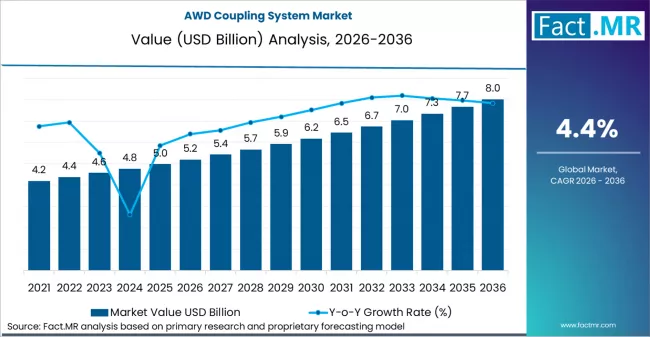
Awd Coupling System Market Market Value Analysis | Source: Fact.MR
This market holds significant commercial importance as the automotive industry moves towards greater drivetrain flexibility and efficiency. Buyers, particularly in the passenger and commercial vehicle sectors, are increasingly prioritizing systems that enhance traction, fuel economy, and driving performance.
Between 2026 and 2036, these systems will play a pivotal role in supporting the transition to electrified and all-wheel-drive (AWD) platforms, addressing consumer demand for safer, more fuel-efficient vehicles. Decision-making within OEMs and tier-one suppliers will be influenced by shifting regulatory standards, cost control, and the need for integration with next-gen powertrains. This growth trajectory presents opportunities for market players to capitalize on the evolving needs of both conventional and electric vehicle markets.
AWD Coupling System Market
| Metric | Value |
|---|---|
| Estimated Value in (2026E) | USD 5.2 billion |
| Forecast Value in (2036F) | USD 8 billion |
| Forecast CAGR (2026 to 2036) | 4.4% |
Source: Fact.MR analysis. Updated Feb 2, 2026
Category
| Category | Segments |
|---|---|
| Sales Channel | First Fit (OEM); Aftermarket |
| Coupling Type | On-demand (Haldex-like); Viscous; Electromechanical |
| Vehicle Type | SUV or CUV; Passenger Cars; LCV |
| Powertrain | ICE or HEV; BEV |
| Axle | Rear Coupling; Front Coupling |
| Region | North America; Europe; Asia Pacific; Latin America; Middle East & Africa |
Source: Fact.MR analysis. Updated Feb 2, 2026
Segmental Analysis
What is the Analysis of the Leading Sales Channel Segment in the AWD Coupling System Market?
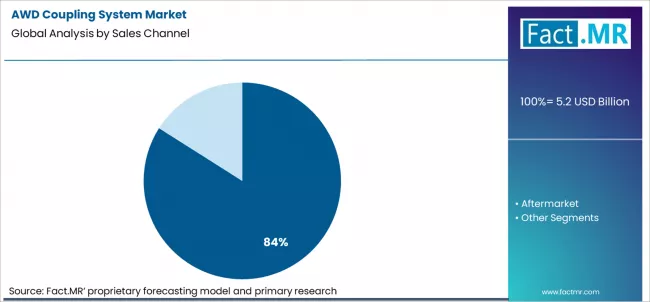
Awd Coupling System Market Analysis By Sales Channel | Source: Fact.MR
The First Fit (OEM) segment dominates the AWD coupling system market, holding 84% of the market share in 2026. This dominance is driven by the need for advanced hardware-software integration within the vehicle's chassis control network to optimize performance. BorgWarner secured multiple contracts in late 2025 to supply its "Gen VI Cross Wheel Drive" (XWD) coupling system for 2026-2027 SUV programs. This next-generation system incorporates an integrated brushless DC motor and controller, minimizing weight and complexity. Leading manufacturers like ZF, Magna, and JTEKT are focusing on "on-demand" couplings, which engage in less than 100 milliseconds to optimize fuel efficiency in 2026 model year passenger cars. A key technological driver in this segment is the shift towards "predictive" coupling systems, where sensors monitor environmental conditions (such as ambient temperature and incline) to engage the secondary axle before wheel slip occurs, enhancing overall traction and efficiency.
What is the Analysis of the Leading Powertrain Segment in the AWD Coupling System Market?
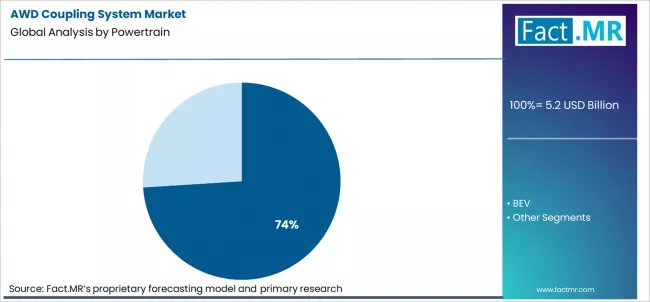
Awd Coupling System Market Analysis By Powertrain | Source: Fact.MR
The ICE or HEV (Internal Combustion Engine or Hybrid Electric Vehicle) powertrain segment holds 74% of the market share in 2026 for traditional AWD coupling systems. While Battery Electric Vehicles (BEVs) typically use dual-motor setups for AWD, ICE and HEV platforms rely on mechanical or electro-hydraulic couplings, such as the Haldex or Magna Flex4 systems, to transfer power from the primary engine-driven axle. Demand within this segment is further boosted by the increasing adoption of Hybrid Electric Vehicles (HEVs), where the coupling system must manage torque blending between the internal combustion engine and the electric motor. Magna's "Flex4" preemptive disconnect system, introduced in early 2026, allows ICE-based AWD vehicles to operate in 2WD mode under stable conditions, reducing parasitic drag and improving fuel efficiency. Regional demand is strongest in North America and Europe, where over 40% of new ICE/HEV registrations in 2025 were equipped with AWD coupling systems, emphasizing the need for all-weather performance in SUVs.
Country
| Country | Drivers | Restraints | Trends |
|---|---|---|---|
| USA | High SUV and crossover sales with AWD configurations drive demand for AWD coupling systems. | EV adoption with integrated e axle systems reduces long term demand for traditional AWD couplings. | Growth in performance and off road segment sustaining AWD system integration. |
| China | Strong passenger vehicle production and rising AWD penetration in mid premium segments increase AWD coupling demand. | Rapid transition to electric vehicles and local hybrid systems may limit long term traditional AWD growth. | Localization of AWD system production aligned with expanding SUV portfolio. |
| India | SUV market expansion and rising consumer preference for AWD in premium models support market growth. | Price sensitivity and lower AWD penetration versus FWD in mass segments constrain market scale. | Aftermarket and retrofit AWD coupling uptake for utility vehicles. |
| Germany | Premium OEMs and performance vehicle demand with sophisticated AWD systems drive coupling system adoption. | Electrification focus reduces future volumes for conventional AWD components. | Use of high precision, torque vectoring AWD couplings to enhance dynamic performance. |
| Japan | Automotive OEM emphasis on reliability and fuel economy supports AWD systems in selected segments. | Slow overall ICE growth and strong hybrid focus limit traditional AWD adoption. | AWD systems integrated with hybrid powertrains to balance efficiency and traction. |
| South Korea | Robust SUV and AWD equipped vehicle production supports AWD coupling demand. | EV transition and alternative e drive systems reduce future traditional AWD parts. | Increased use of lightweight materials and electronically controlled AWD couplings. |
| Mexico | Expanding local auto assembly with AWD equipped export models drives some demand for AWD couplings. | Cost sensitive market segments limit high end AWD adoption. | Aftermarket growth as vehicles equipped with AWD age and require component replacement. |
Source: Fact.MR analysis. Updated Feb 2, 2026
Analysis of the AWD Coupling System Market by Key Country
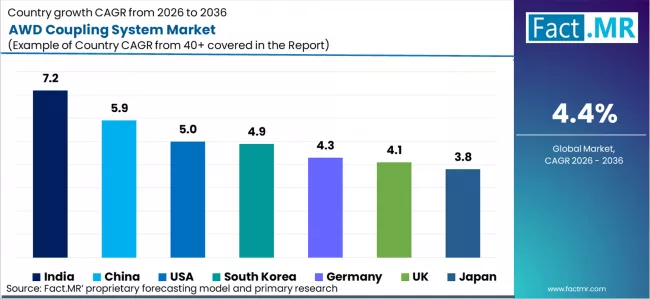
Awd Coupling System Market Cagr Analysis By Country | Source: Fact.MR
| Country | CAGR (Forecast Period) |
|---|---|
| USA | 5.0% |
| China | 5.9% |
| India | 7.2% |
| Germany | 4.3% |
| Japan | 3.8% |
| South Korea | 4.9% |
| UK | 4.1% |
Source: Fact.MR analysis. Updated Feb 2, 2026
The report covers an in-depth analysis of 40+ countries; top-performing countries are highlighted below.
What Drives Growth in the USA AWD Coupling System Market?
The 5.0% growth in the USA is primarily driven by the increasing consumer demand for SUVs and Crossovers (CUVs), where AWD has transitioned from a premium feature to a standard safety option. As per the NHTSA’s 2026 CAFE standards, the adoption of "Disconnecting AWD" coupling systems is rising. These systems help vehicles achieve higher fuel efficiency by decoupling the secondary axle during highway cruising. Additionally, the growing popularity of "Adventure-Ready" trims in brands like Ford and Subaru has increased demand for high-thermal-capacity couplings, which are designed for off-road torque management and enhanced durability, particularly in rugged driving conditions.
What Influences Growth in the China AWD Coupling System Market?
China’s 5.9% growth is driven by the Ministry of Industry and Information Technology (MIIT), which has focused on Extended Range Electric Vehicles (EREVs) and Plug-in Hybrid Electric Vehicles (PHEVs). These vehicles require advanced e-AWD coupling systems for smooth engine-motor synchronization. The Intelligent Connected Vehicle (ICV) roadmap by MIIT also encourages the integration of AWD coupling units with advanced driver assistance systems (ADAS), enabling proactive torque distribution based on real-time sensor data. As China maintains its position as a global leader in BEV production, the demand for high-torque, compact coupling systems continues to rise, particularly for PHEVs and hybrid vehicles.
How Does India Achieve Growth in the AWD Coupling System Market?
India’s 7.2% growth rate, the highest in the group, is driven by the "SUV-ization" of the domestic market and the government’s Production Linked Incentive (PLI) Scheme. As mid-size SUVs become increasingly popular, demand for AWD coupling systems is surging. The government has incentivized the localization of electronic AWD controllers, making them Advanced Automotive Technology (AAT) products. The enforcement of BS6 Phase 2 (RDE) norms encourages manufacturers to adopt lighter, software-controlled AWD couplings, which provide better real-world fuel efficiency compared to traditional mechanical 4WD systems. Additionally, India’s growing position as a global export hub for Tier-1 suppliers like BorgWarner and GKN is bolstering market growth.
What Drives Growth in the Germany AWD Coupling System Market?
Germany’s 4.3% growth is driven by the preparation for Euro 7 regulations, which focus on efficiency across all driving conditions. To comply with these regulations, German manufacturers are integrating intelligent AWD coupling systems that employ Torque Vectoring Braking, improving stability and reducing reliance on traditional friction brakes. The premium hybrid and high-performance SUV segments in Germany are a significant driver of demand for advanced AWD systems. Companies like ZF Friedrichshafen and Magna are focusing on the development of "Modular e-Drive" units, combining motors, inverters, and couplings into efficient, high-performance packages to meet stringent Euro 7 emissions and driving standards.
How Does Japan Achieve Growth in the AWD Coupling System Market?
Japan’s 3.8% growth is influenced by the METI Green Transformation (GX) 2040 Vision, which prioritizes energy efficiency and carbon-neutral vehicle technologies. The shift to "Intelligent AWD" systems, particularly e-Four technology, has led Japanese automakers to adopt small electric motors on rear axles, eliminating the need for heavy prop shafts and mechanical couplings. This technology enables AWD performance with minimal impact on fuel economy. Additionally, Japan’s Emissions Trading System (GX-ETS) is pushing manufacturers to develop ultra-low-loss AWD couplings, enhancing overall vehicle efficiency, particularly in hybrid and subcompact vehicles.
Why Does South Korea Exhibit Growth in the AWD Coupling System Market?
South Korea’s 4.9% growth is bolstered by the K-Mobility Strategy, which focuses on the development of "Electronic-AWD" (e-AWD) systems that can react in less than 100 milliseconds to wheel slip. This technology is becoming standard in Hyundai and Kia’s high-performance "N" and "GT" series. The Ministry of Trade, Industry and Energy (MOTIE) is also supporting the development of integrated AWD modules for autonomous urban delivery pods, requiring precise torque management for tight turns. South Korea’s focus on AI-assisted manufacturing for these advanced driveline components ensures its competitiveness in the global market for premium and high-tech AWD systems.
What Drives Growth in the UK AWD Coupling System Market?
The UK’s 4.1% growth is driven by the resilience of the luxury and specialist vehicle sectors, such as Land Rover and Bentley, where AWD systems are essential for maintaining off-road capability and meeting carbon reduction targets. The rise of Active Torque-Vectoring coupling systems has further bolstered demand, especially for British SUVs that require improved handling and stability. Additionally, the Advanced Propulsion Centre (APC) is funding projects to develop "next-gen traction controllers" that use AI to predict surface friction, enabling AWD couplings to engage proactively rather than reactively, improving safety in the UK’s wet and icy conditions.
How Are Participants Competing in the AWD Coupling Systems Market?
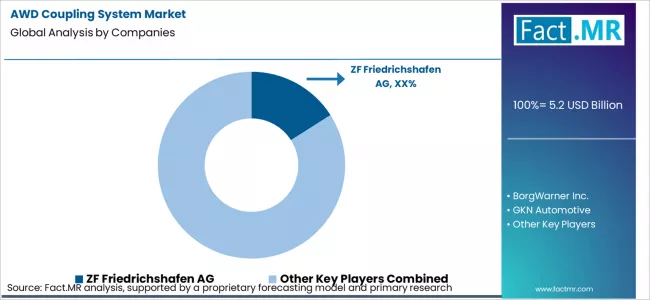
Awd Coupling System Market Analysis By Company | Source: Fact.MR
The AWD coupling systems market is shifting from traditional mechanical friction devices to software-defined, on-demand traction solutions. Companies like ZF and BorgWarner are embracing Zonal Architecture, where AWD couplings are integrated as software-orchestrated nodes within the vehicle's central control system. This move aligns with the shift to hybrid and electric vehicles (EVs), as seen in Toyota's transition to 100% electrified RAV4 models in the U.S., eliminating traditional mechanical AWD systems. GKN Automotive and Magna focus on modular, selective eDrive platforms, allowing OEMs to "plug in" AWD capability via independent rear electric drive units (eRDU), reducing reliance on central transfer cases. Circular economy models are becoming prominent, with companies like GKN and Schaeffler moving toward remanufacturing and recycling to cut CO2 emissions by up to 30%. CXOs who fail to transition from component-centric approaches to system orchestration will lose competitive edge to those who integrate traction logic into ADAS and brake-by-wire systems, controlling traction as a service.
Key Players of the AWD Coupling Systems Market
- ZF Friedrichshafen AG
- BorgWarner Inc.
- GKN Automotive
- Magna International Inc.
- Haldex AB
- Aisin Corporation (Aisin AW/Toyota Group)
- Schaeffler AG
- JTEKT Corporation
- Dana Incorporated
- Nidec Corporation
Bibliographies
- European Commission. (2023). Euro 7 emission standards and implications for driveline efficiency, torque distribution, and all-wheel-drive systems. European Union.
- International Council on Clean Transportation. (2024). Vehicle efficiency pathways and the role of advanced driveline systems in reducing fuel consumption and emissions. ICCT.
- International Organization for Standardization. (2023). Road vehicles-Driveline and all-wheel-drive coupling systems: Performance, durability, and environmental requirements. ISO.
- Journal of Automobile Engineering. (2024). Control strategies and performance characteristics of electronically controlled all-wheel-drive coupling systems. Proceedings of the Institution of Mechanical Engineers, Part D, 238(11), 2475-2489.
- SAE International. (2024). Design and calibration of viscous, electro-hydraulic, and electromagnetic AWD coupling systems. SAE International.
Segmentation
Scope of the Report
| Items | Values |
|---|---|
| Quantitative Units (2026) | USD Billion |
| Sales Channel | First Fit (OEM), Aftermarket |
| Coupling Type | On-demand (Haldex-like), Viscous, Electromechanical |
| Vehicle Type | SUV or CUV, Passenger Cars, LCV |
| Powertrain | ICE or HEV, BEV |
| Axle | Rear Coupling, Front Coupling |
| Regions Covered | North America, Europe, Asia Pacific, Latin America, Middle East & Africa |
| Countries Covered | United States, Canada, Mexico, Germany, United Kingdom, France, Japan, South Korea, China, India, Brazil, and other countries |
| Key Companies Profiled | ZF Friedrichshafen AG, BorgWarner Inc., GKN Automotive, Magna International Inc., Haldex AB, Aisin Corporation (Aisin AW/Toyota Group), Schaeffler AG, JTEKT Corporation, Dana Incorporated, Nidec Corporation |
| Additional Attributes | Dollar revenue by sales channel, coupling type, vehicle type, powertrain, axle, and region; regional demand trends, competitive landscape, technological advancements in AWD coupling systems, operational performance optimization initiatives, and product development strategies |
Source: Fact.MR analysis. Updated Feb 2, 2026
AWD Coupling System Market Key Segments
-
Sales Channel :
- First Fit (OEM)
- Aftermarket
-
Coupling Type :
- On-demand (Haldex-like)
- Viscous
- Electromechanical
-
Vehicle Type :
- SUV or CUV
- Passenger Cars
- LCV (Light Commercial Vehicle)
-
Powertrain :
- ICE or HEV
- BEV
-
Axle :
- Rear Coupling
- Front Coupling
-
Region :
- North America
- USA
- Canada
- Mexico
- Europe
- Germany
- UK
- France
- Italy
- Spain
- Nordic Countries
- BENELUX
- Rest of Europe
- Asia Pacific
- China
- Japan
- South Korea
- India
- Australia
- Rest of Asia Pacific
- Latin America
- Brazil
- Argentina
- Rest of Latin America
- Middle East and Africa
- Kingdom of Saudi Arabia
- United Arab Emirates
- South Africa
- Rest of Middle East and Africa
- Other Regions
- Oceania
- Central Asia
- Other Markets
- North America
Frequently Asked Questions
How big is the awd coupling system market in 2026?
What will be the size of awd coupling system market in 2036?
How much will be the awd coupling system market growth between 2026 and 2036?
What are the key product types in the awd coupling system market?
Which coupling type segment to contribute significant share in the awd coupling system market in 2026?
Who worked on this report


Preview the report firsthand - request a free sample
Free SampleGet the brochure for pricing and purchase details
Download PDF