- Base Value(2025): 646.9 Mn
- Estimated Value(2026): 681.1 Mn
- Forecast Value (2036): 1096.4 Mn
- CAGR (2026 - 2036): 5.2%
Cordless Pop Rivet Gun Market Forecast 2026 to 2036
In 2025, the cordless pop rivet gun market was valued at USD 646.9 million. Based on Fact MR analysis, demand for cordless pop rivet guns is estimated to grow to USD 681.1 million in 2026 and USD 1,096.4 million by 2036. FMR projects a CAGR of 5.2% during the forecast period.
The absolute dollar growth from 2026 to 2036 is USD 415.3 million. This growth is driven by increasing demand for portable, efficient fastening tools in construction, automotive, aerospace, and manufacturing industries. Cordless pop rivet guns improve operational efficiency and safety while reducing labor requirements. However, challenges such as high equipment costs and competition from manual or pneumatic rivet tools may limit growth in certain regions.
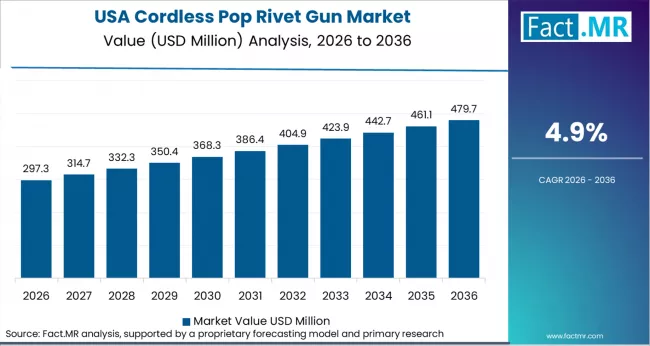
China leads with a CAGR of 7.0%, driven by growing industrial manufacturing and infrastructure development. India follows with 6.5%, supported by rising demand from automotive and construction sectors. Germany grows at 6.0%, benefiting from advanced manufacturing and industrial automation. Brazil shows growth at 5.5%, fueled by demand in construction and industrial projects. The USA grows at 4.9%, reflecting steady adoption in automotive, aerospace, and manufacturing industries.
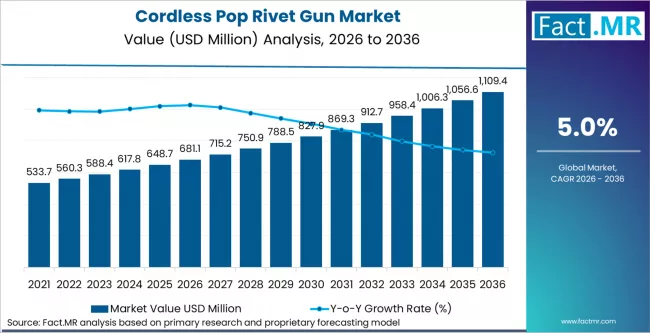
Cordless Pop Rivet Gun Market Market Value Analysis | Source: Fact.MR
Cordless Pop Rivet Gun Market
| Metric | Value |
|---|---|
| Estimated Value in (2026E) | USD 681.1 million |
| Forecast Value in (2036F) | USD 1,096.4 million |
| Forecast CAGR (2026 to 2036) | 5.2% |
Source: Fact.MR analysis. Updated Mar 7, 2026
Cordless Pop Rivet Gun Market Definition
The cordless pop rivet gun market involves the manufacture and sale of battery‑powered rivet fastening tools used to install blind rivets without the need for cords or external power sources in assembly, maintenance, and construction applications.
Market Inclusions
This report covers global and regional market sizes for cordless pop rivet guns over a defined forecast period, including tool types (compact, high‑force), battery technologies, application segments (automotive, aerospace, construction, metal fabrication), and distribution channels.
Market Exclusions
The scope excludes manual and corded rivet tools, unrelated fastening equipment not classified as cordless pop rivet guns, and complete rivet kits where the tool data is not separately quantified.
Research Methodology
- Primary Research: Interviews were conducted with tool designers, manufacturing engineers, and procurement specialists.
- Desk Research: Data was sourced from industry reports, manufacturing publications, and trade association statistics.
- Market‑Sizing and Forecasting: A hybrid model combining top‑down industrial fastening demand forecasts with bottom‑up shipment and revenue data was used.
- Data Validation and Update Cycle: Findings were validated through expert review and aligned with recent production, adoption, and trade figures.
Summary of the Cordless Pop Rivet Gun Market
- Market Definition
- The Cordless Pop Rivet Gun Market comprises battery-operated rivet guns used in construction, automotive, aerospace, and industrial fabrication applications for fastening metal, plastic, and composite sheets. The market covers compact and high-force rivet guns, including various rivet sizes, distributed via online and offline channels, designed to enhance operational efficiency, mobility, and worker ergonomics.
- Demand Drivers
- Industrial Efficiency and Mobility: Cordless rivet guns enable faster, more flexible fastening, reducing labor requirements in construction, automotive, and manufacturing.
- E-Commerce Growth: Online sales provide convenience, broader product access, and faster delivery, driving adoption across industrial and DIY buyers.
- Rising Industrial and Construction Activity: Infrastructure, automotive, and aerospace projects increase demand for portable and reliable fastening tools.
- Key Segments Analyzed
- Rivet Gun Type: 1/4″ guns projected to hold 45% of market share by 2026, favored for standard rivet compatibility and ease of use.
- Distribution Channel: Online sales dominate with 73% of market share, driven by convenience, competitive pricing, and accessibility.
- Geography: China leads with 7.0% CAGR, India 6.5%, Germany 6.0%, Brazil 5.5%, and the USA 4.9%, reflecting strong adoption across key industrial sectors.
- Analyst Opinion at Fact MR
- Shambhu Nath Jha, Principal Consultant at Fact MR, stated, "The cordless pop rivet gun market is expanding steadily as industries adopt portable, battery-operated tools that improve productivity, ergonomics, and access for assembly and construction applications, with online sales driving broader availability."
- Strategic Implications / Executive Takeaways
- Focus on high-volume online channels to reach industrial buyers and DIY users efficiently.
- Develop ergonomic, high-performance tools with brushless motors and long battery life to differentiate products.
- Target high-growth regions such as China, India, and Germany to capture demand in construction, manufacturing, and aerospace.
- Methodology
- Primary Research: Interviews with tool designers, manufacturers, and procurement specialists.
- Desk Research: Data from industrial publications, trade associations, and market reports.
- Market Sizing & Forecasting: Hybrid top-down and bottom-up approach combining historical adoption trends, shipment data, and revenue forecasts.
Segmental Analysis
Cordless Pop Rivet Gun Market Analysis by Rivet Gun Type
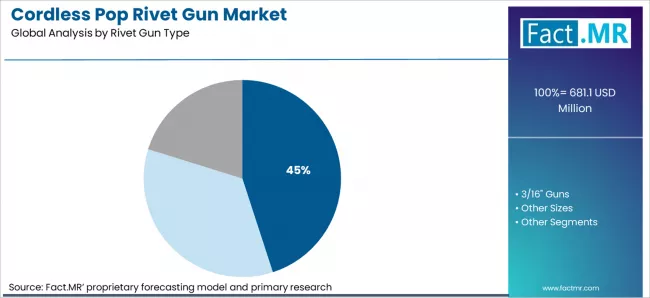
Cordless Pop Rivet Gun Market Analysis By Rivet Gun Type | Source: Fact.MR
- Market Overview: 1/4″ guns are expected to capture 45% of the market share by 2026. These rivet guns are commonly used in light-to-medium industrial and DIY applications due to their compatibility with standard rivets, ease of handling, and efficiency in assembly operations. Their versatility makes them the preferred choice for many workshops and small-scale manufacturing setups.
- Demand Drivers:
- Wide Compatibility with Standard Rivets: 1/4″ guns can handle a broad range of rivet sizes, making them suitable for general industrial, automotive, and construction applications.
- Ease of Use: Lightweight and cordless design improves maneuverability, allowing operators to work efficiently in tight or elevated spaces.
- Popularity in DIY and Industrial Applications: Their versatility, combined with reliability for small- to medium-scale riveting tasks, drives consistent demand in both commercial and personal use sectors.
Cordless Pop Rivet Gun Market Analysis by Distribution Channel
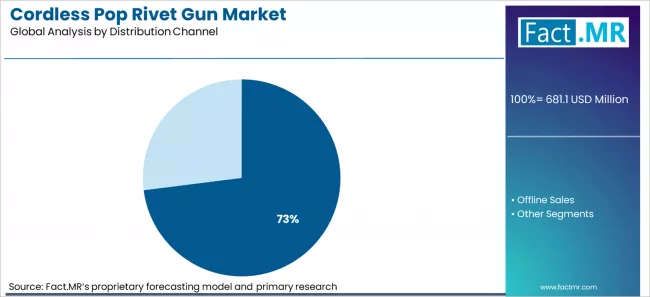
Cordless Pop Rivet Gun Market Analysis By Distribution Channel | Source: Fact.MR
- Market Overview: Online sales are projected to hold 73% of the market share by 2026. E-commerce platforms are becoming the primary channel for cordless pop rivet gun distribution due to convenience, wider selection, and competitive pricing.
- Demand Drivers:
- Convenience and Accessibility: Online platforms allow buyers to compare models, prices, and specifications before purchase, supporting informed decision-making.
- Expansion of E-Commerce in Industrial Tools: The growing trend of purchasing tools online, including for DIY enthusiasts and small workshops, drives the dominance of online sales channels.
- Faster Delivery and Wider Reach: Online sales provide access to products in remote or under-served regions, improving availability and boosting adoption for cordless pop rivet guns.
Cordless Pop Rivet Gun Market Drivers, Restraints, and Opportunities
FMR analysts observe that the cordless pop rivet gun market is a growth‑aligned, productivity‑driven segment fueled by increased use of portable fastening tools in automotive, aerospace, construction, and industrial maintenance. Historically, manual and corded rivet tools dominated; as operators demanded mobility, ease of use, and reduced physical strain, structural demand emerged for battery‑powered rivet guns that improve efficiency and access in field and assembly environments. The 2026 market valuation reflects this shift, with adoption linked to broader automation trends and ergonomic workplace standards rather than basic hand tools alone.
While basic manual rivet tools remain common in low‑volume or cost‑sensitive settings, advanced cordless models with brushless motors, adjustable torque, and long battery life are gaining share. These higher‑value tools command premium pricing, contributing to net market value growth even as unit volumes grow with industrial and trade activity. The market exists because cordless solutions deliver tangible gains in speed, consistency, and operator comfort that basic tools cannot match.
- Mobility & Productivity Demand: Trades and manufacturers adopt cordless rivet guns to replace manual or corded tools for faster, more flexible fastening on complex assemblies.
- Workplace Safety Standards: Ergonomics and safety guidelines push uptake of battery‑powered tools that reduce fatigue and improve compliance versus manual alternatives.
- Regional Industrial Trends: In North America and Europe, strong industrial and construction activity drives higher adoption of cordless rivet tools, while Asia‑Pacific shows rapid growth with expanding manufacturing sectors.
Regional Analysis
The market analysis covers key global regions, including East Asia, South Asia, Europe, Latin America, and North America. It is segmented geographically, with specific market dynamics for each region. The full report provides a detailed market attractiveness analysis.
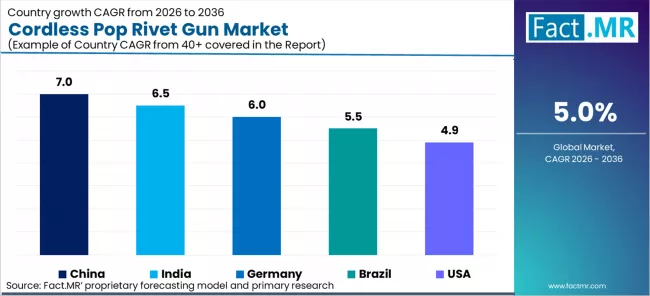
Cordless Pop Rivet Gun Market Cagr Analysis By Country | Source: Fact.MR
| Country | CAGR (2026-2036) |
|---|---|
| China | 7.0% |
| India | 6.5% |
| Germany | 6.0% |
| Brazil | 5.5% |
| USA | 4.9% |
Source: Fact.MR analysis. Updated Mar 7, 2026
Source: Fact MR (FMR) analysis, based on proprietary forecasting model and primary research
East Asia:
China is the largest market for cordless pop rivet guns, supported by industrial manufacturing growth, increased construction activity, and rising adoption in automotive and electronics assembly.
- China: Demand for cordless pop rivet guns in China is projected to rise at 7.0% CAGR through 2036. Growth is driven by government infrastructure projects (03-2025) and Makita Corporation’s regional manufacturing expansion (08-2025).
South Asia:
India is a significant market, fueled by industrial fabrication growth, government manufacturing initiatives, and increasing small and medium enterprise adoption.
- India: Demand for cordless pop rivet guns in India is projected to rise at 6.5% CAGR through 2036. Growth is supported by public sector procurement programs (05-2025) and Metabowerke GmbH’s local distribution network expansion (09-2025).
Europe:
Germany is a key market, driven by automotive manufacturing, aerospace assembly, and stringent industrial standards. Leading regional players include GESIPA Blindniettechnik GmbH, Robert Bosch GmbH, and Würth Group.
- Germany: Demand for cordless pop rivet guns in Germany is projected to rise at 6.0% CAGR through 2036. Growth is supported by automotive sector investment programs (02-2025) and Würth Group’s industrial sales expansion (10-2025).
Latin America:
Brazil is a major market, supported by industrial and construction sector demand, particularly in automotive and manufacturing plants.
- Brazil: Demand for cordless pop rivet guns in Brazil is projected to rise at 5.5% CAGR through 2036. Growth is influenced by government infrastructure projects (04-2025) and Stanley Black & Decker, Inc.’s regional sales initiatives (08-2025).
North America:
Cordless Pop Rivet Gun Market Country Value Analysis | Source: Fact.MR
The USA represents a stable market, with demand driven by construction, automotive, and manufacturing applications.
- USA: Demand for cordless pop rivet guns in the U.S. is projected to rise at 4.9% CAGR through 2036. Growth is supported by industrial procurement programs (06-2025) and Milwaukee Electric Tool Corporation’s expansion of sales channels (09-2025).
Fact MR's analysis of the cordless pop rivet gun market in East Asia, South Asia, Europe, Latin America, and North America consists of country-wise assessments that include China, India, Germany, Brazil, and the USA. Readers can find detailed trends, regulatory updates, and company-specific investments shaping market growth in these countries.
What is the Competitive Structure and Buyer Behavior in the Cordless Pop Rivet Gun Market?
Cordless Pop Rivet Gun Market Analysis By Company | Source: Fact.MR
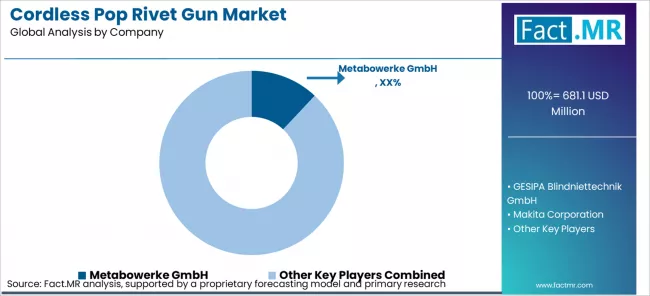
The cordless pop rivet gun market is moderately concentrated, with established industrial tool manufacturers such as Metabowerke GmbH, GESIPA Blindniettechnik GmbH, Makita Corporation, Robert Bosch GmbH, Stanley Black & Decker, Inc., Milwaukee Electric Tool Corporation, Festool GmbH, and Hilti Corporation holding significant share alongside specialist and regional participants like JRP Tooling Ltd., Howmet Aerospace Inc., Würth Group, GOEBEL GmbH, Pro Spot International, Inc., and GAGE BILT, Inc. The primary competitive variables are tool performance, battery efficiency, ergonomic design, durability under heavy use, and compatibility with a range of fastener sizes, all of which influence purchasing decisions by professional contractors and industrial buyers. Companies with broad product portfolios, strong R&D capabilities, and extensive distribution and service networks hold structural advantages because they can support diverse application needs and provide reliable after‑sales support. Large industrial and construction buyers exert notable leverage by qualifying multiple suppliers, negotiating volume pricing and service contracts, and standardizing technical requirements across sites to manage cost and performance risk. To manage dependency, these buyers maintain diversified vendor lists, which limits individual suppliers’ pricing power. Competition therefore focuses on performance, reliability, and support rather than on price alone.
Recent Industry Developments
- Strategic Aerospace Divestiture: In early 2026, Stanley Black & Decker is finalized the $1.8 billion sale of its Consolidated Aerospace Manufacturing (CAM) business to Howmet Aerospace. This move allows Stanley to refocus its "engineered fastening" R&D specifically on high-volume automotive and construction cordless tools under the DEWALT brand.
- High-Force Brushless Launch: Makita has expanded its 18V LXT lineup in early 2026 with the XVR02Z, a heavy-duty brushless rivet tool capable of delivering 20 kN (4,500 lbs.) of pulling force. This specific model targets the 1/4" (6.4 mm) stainless steel rivet market, a segment previously dominated by pneumatic tools due to the high torque required for one-stroke setting.
- Ultra-Lightweight "Birdie" Expansion: In late 2025 and moving into the 2026 cycle, GESIPA (part of the SFS Group) scaled the production of its Birdie® tool. Weighing only 900g (without battery), it is the lightest tool in its performance class. It has been integrated into the Cordless Alliance System (CAS), allowing it to share 18V battery platforms with over 30 other tool brands, specifically targeting MRO (Maintenance, Repair, and Operations) workers.
Key Players of the Cordless Pop Rivet Gun Market
- Metabowerke GmbH
- GESIPA Blindniettechnik GmbH
- Makita Corporation
- Robert Bosch GmbH
- JRP Tooling Ltd.
- Stanley Black & Decker, Inc.
- Howmet Aerospace Inc.
- Würth Group
- Milwaukee Electric Tool Corporation
- GOEBEL GmbH
- Pro Spot International, Inc.
- GAGE BILT, Inc.
- Stanley Black & Decker, Inc.
- Festool GmbH
- Hilti Corporation
Report Scope
| Metric | Value |
|---|---|
| Quantitative Units | USD 681.1 million (2026) to USD 1,096.4 million (2036), at a CAGR of 5.2% |
| Market Definition | The Cordless Pop Rivet Gun Market comprises battery-operated rivet guns used in construction, automotive, aerospace, and industrial fabrication applications for fastening metal and composite materials. |
| Rivet Gun Type | 1/4″ Guns, 3/16″ Guns, Other Sizes |
| Distribution Channel | Online Sales, Offline Sales |
| End‑Use Industry | Construction, Automotive, Aerospace, Manufacturing & Fabrication, Other Industrial Uses |
| Regions Covered | North America, Latin America, Europe, East Asia, South Asia, Oceania, Middle East and Africa |
| Countries Covered | United States, Canada, Mexico, Brazil, Argentina, Germany, France, United Kingdom, Italy, Spain, China, India, Japan, South Korea, Indonesia, Australia, and 40+ countries |
| Key Companies Profiled | Metabowerke GmbH, GESIPA Blindniettechnik GmbH, Makita Corporation, Robert Bosch GmbH, JRP Tooling Ltd., Stanley Black & Decker, Inc., Howmet Aerospace Inc., Würth Group, Milwaukee Electric Tool Corporation, GOEBEL GmbH, Pro Spot International, Inc., GAGE BILT, Inc., Festool GmbH, Hilti Corporation |
| Forecast Period | 2026 to 2036 |
| Approach | Hybrid top-down and bottom-up market modeling validated through primary interviews with manufacturers and supported by trade data benchmarking and plant-level capacity verification. |
Source: Fact.MR analysis. Updated Mar 7, 2026
Bibliographies
- International Organization for Standardization. (2023). ISO 14589: Blind rivets — Mechanical testing and performance requirements. International Organization for Standardization.
- European Committee for Standardization. (2023). EN ISO standards for blind rivets and fastening systems used in mechanical assemblies. European Committee for Standardization.
- Occupational Safety and Health Administration. (2023). Hand and power tools safety standards for industrial fastening equipment. U.S. Department of Labor.
- National Institute for Occupational Safety and Health. (2024). Ergonomic considerations for handheld power tools in manufacturing and construction. Centers for Disease Control and Prevention.
- Stanley Black & Decker. (2026). Stanley Black & Decker to sell Consolidated Aerospace Manufacturing to Howmet Aerospace. Stanley Black & Decker.
- Makita Corporation. (2026). 18V LXT brushless cordless rivet tool (XVR02Z) product specifications and applications. Makita Corporation.
- SFS Group AG (GESIPA). (2026). Birdie cordless blind rivet tool: Compact design for industrial fastening applications. SFS Group AG.
This report addresses
- Market intelligence enabling comprehensive assessment of leading countries and product segments across the Cordless Pop Rivet Gun Market globally.
- Market volume (sales units) estimates and 10-year revenue forecasts from 2026 to 2036, validated through manufacturer shipment data, channel partner surveys, and country-level demand modeling.
- Growth opportunity mapping across rivet gun types (1/4″ Guns, 3/16″ Guns, Other Sizes), distribution channels (Online Sales, Offline Sales), and end-use industries (Construction, Automotive, Aerospace, Manufacturing & Fabrication, Other Industrial Uses).
- Segment and regional revenue forecasts by rivet gun type, distribution channel, industry, and geography across 40+ countries.
- Competition strategy analysis covering tool performance, battery efficiency, ergonomic design, durability, and compatibility with fastener sizes, including major players like Stanley Black & Decker, Inc., Metabowerke GmbH, Makita Corporation, and Robert Bosch GmbH.
- Product and regulatory compliance tracking aligned with industrial safety standards, battery and electrical regulations, and fastening tool quality certifications.
- Regulatory impact analysis addressing construction, automotive, aerospace, and industrial manufacturing standards, workplace safety regulations, and ergonomics guidelines across key markets.
- Report delivery in PDF, Excel, PowerPoint, and interactive dashboard formats for executive, procurement, and operational planning use.
Segmentation
Cordless Pop Rivet Gun Market Key Segments
-
Rivet Gun Type :
- 1/4″ Guns
- 3/16″ Guns
- Other Sizes
-
Distribution Channel :
- Online Sales
- Offline Sales
-
End-Use Industry :
- Construction
- Automotive
- Aerospace
- Manufacturing & Fabrication
- Other Industrial Uses
-
Region :
- North America
- USA
- Canada
- Mexico
- Europe
- Germany
- UK
- France
- Italy
- Spain
- Nordic Countries
- BENELUX
- Rest of Europe
- Asia Pacific
- China
- Japan
- South Korea
- India
- Australia
- Rest of Asia Pacific
- Latin America
- Brazil
- Argentina
- Rest of Latin America
- Middle East and Africa
- Kingdom of Saudi Arabia
- United Arab Emirates
- South Africa
- Rest of Middle East and Africa
- Other Regions
- Oceania
- Central Asia
- Other Markets
- North America
Frequently Asked Questions
How large is the demand for Cordless Pop Rivet Guns in the global market in 2026?
What will be the market size of Cordless Pop Rivet Guns in the global market by 2036?
What is the expected demand growth for Cordless Pop Rivet Guns in the global market between 2026 and 2036?
Which distribution channel is expected to dominate the market?
Which region is expected to show the highest growth rate for Cordless Pop Rivet Guns?
How significant is the growth outlook for India in this market?
What is the growth outlook for Germany in the Cordless Pop Rivet Gun market?
What is the growth forecast for Brazil in the Cordless Pop Rivet Gun market?
What is the growth forecast for the United States in the Cordless Pop Rivet Gun market?
Which company is identified as a leading player in the Cordless Pop Rivet Gun market?
What are Cordless Pop Rivet Guns used for?
What does the Cordless Pop Rivet Gun market include in this report?
How is the market forecast developed in this report?
What is meant by the Cordless Pop Rivet Gun market in this report?
Who worked on this report


Preview the report firsthand - request a free sample
Free SampleGet the brochure for pricing and purchase details
Download PDF