- Base Value(2025): 23.9 Bn
- Forecast Value (2035): 44 Bn
- CAGR (2035): 7.3%
Sunflower Oil Market Outlook (2025 to 2035)
The global sunflower oil market is expected to reach USD 44 billion by 2035, up from USD 22.5 billion in 2024. During the forecast period 2025 to 2035, the industry is projected to expand at a CAGR of 6.3%, driven by evolving consumer preferences for cooking oil that is rich in unsaturated fats and vitamin E. Its use in both raw and prepared foods add value to its adoption, as it offers versatility in culinary applications, snack foods and processed items.
The emerging concept of clean-label and non-GMO oil awareness characterizes high-quality product demand. Furthermore, the growing applications of sunflower oil in biodiesel, and personal care and cosmeceuticals are also stimulating the growth of the industry due to sustainability considerations and processing innovations.
-2025-to-2035.webp "Sunflower Oil Market Cagr Analysis Value (usd Million) 2025 To 2035")
Sunflower Oil Market Cagr Analysis Value (usd Million) 2025 To 2035 | Source: Fact.MR
Quick Stats for Sunflower Oil Market
- Industry Value (2025): USD 23.9 Billion
- Projected Value (2035): USD 44 Billion
- Forecast CAGR (2025 to 2035): 6.3%
- Leading Segment (2025): Refined Sunflower Oil (39.5% Market Share)
- Fastest Growing Country (2025-35): India (7.6% CAGR)
- Top Key Players: Cargill, Archer Daniels Midland Company, Bunge Ltd., Rusagro, Conagra Brands Inc., Mainland Group, Adani Wilmar Limited, and American Vegetable Oils Inc.
What are the drivers of the sunflower oil market?
Increasing focus on heart-friendly and clean-label edible oils is supporting the global expansion of the sunflower oil market. Due to the shift in consumer diets towards a healthier and more productive diet, sunflower oil is being used in precision food formulation to streamline nutritional balance, minimize the trans-fat intake and promote cardiovascular well-being.
Increased regulatory attention to artificial additions has triggered the establishment of non-GMO and sustainably produced oils as a favorable alternative. This trend is reinforced by studies highlighting sunflower oil’s vitamin E content, oxidative stability, and versatility in cooking and food manufacturing.
The product differentiation is being fueled by the use of species-specific hybrid seeds and the diversification of cultivation cycles. Strategic alliances among the oilseed farmers, processors and food processing companies are contributing to increased availability of high-quality sunflower oil, sustaining the commercialization efforts of sunflower oil across various regions.
What are the regional trends of the sunflower oil market?
The local environment of the sunflower oil industry reflects a variety of consumption patterns, regulatory frameworks, and production capabilities. The North American market is shifting towards non-GMO, cold-pressed and high-oleic varieties of sunflower oil under the influence of health-conscious consumers in the United States and Canada.
Europe focuses on sustainable input and traceability, with Ukraine and Russia remaining key production centers. High levels of EU food standards promote the demand for refined edible oil.
Asia-Pacific is expanding steadily with broader culinary application in India, China and Southeast Asia, along with the integration into biodiesel production.
South America and Latin America also utilize the production of export-oriented sunflower oil, and the Middle East and Africa are witnessing the expanded demand due to food security initiatives and the growing reliance on fortified edible oil.
What are the challenges and restraining factors of the Sunflower Oil market?
Fluctuation of the availability of raw materials, driven by climate variability, geopolitical tensions, and reliance on key producers such as Ukraine and Russia is one of the central issues in the sunflower oil market. The instability in pricing brought about by fluctuations in supply chains tends to affect the profitability and the long-term contracts in food and industrial uses.
Another limitation is quality standardization, as differences in processing methods, hybrid seed types, and storage conditions create inconsistencies across production. The regulatory framework on oilseed cultivation and processing emissions is being made stringent, resulting in pressure on producers to align with sustainability. Also, the presence of substitutes offered at comparatively lower prices, e.g., palm and soybean oil, restricts market growth in price-conscious economies.
Country-Wise Insights
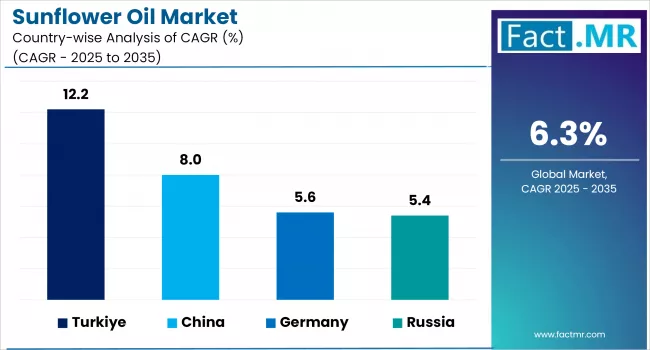
Sunflower Oil Market Cagr Analysis By Country | Source: Fact.MR
Ukraine leads sunflower oil exports with advanced farming and processing
Ukraine is expected to remain the leading producer of sunflower oil due to extensive cultivation areas under oilseed production and a high level of processing facilities. The export-oriented policy is being influenced by demand for high-oleic and cold-pressed varieties of sunflower oil.
Besides geopolitical issues, producers are also investing in precision farming, hybrid seed production, and sustainable farming methods in order to stabilize production and adhere to the existing quality standards. The country’s Black Sea ports continue to serve as critical points in global supply chains.
Ukrainian companies are developing production capacity, supported by stable government policy in the oilseed cultivation and refining, while also complying with non-GMO and residue-free regulations in international trade.
Russia expands sunflower oil output through modernized agriculture systems
Russia is among the leading producers of sunflower oil, supported by extensive arable land and government-sanctioned agricultural intensification. The domestic demand for refined and bottled sunflower oil is increasing, whereas exports to Asia, the Middle East and Africa continue to expand. Producers are focusing on improved efficiency by the use of contemporary oil mining plants and digitalized supply lines.
It aims to reduce reliance on imports of processing equipment and improve both the quality and the storage life of the oil. Russia, with trade partners and stable agricultural policies, is increasing high-value varieties of sunflower oil and consolidating its position in the world market.
Türkiye grows as a key regional sunflower oil trade hub
Türkiye is one of the key producers and consumers of sunflower oils, balancing between domestic production and high importation of raw sunflower seeds. The market of the country is strengthened by the developed food culture and soaring industrial production of food and snacks.
In Türkiye, increasing facilities for refining and packaging are also established to encourage local consumption as well as exports. Policy incentives are given to oilseed production in the country to limit the use of foreign raw materials. Türkiye is strategically located between the Middle East and Europe, and it is investing in cold-pressed high-quality sunflower oil and logistics to become a major trading hub for sunflower oil.
Category-Wise Analysis
Stable, versatile, and cost-efficient oil for cooking and processing
The culinary use of refined sunflower oil (as food additives in household and commercial applications) has remained a foundation of the non-vegetable oil, based on its oxidative stability, neutral flavor, and prolonged shelf life.
The current sophisticated refining processes alleviate the level of free fatty acids to the optimum with retention of required vitamin E, in accordance with the emerging health-conscious trends. This is linked to the consistency of the product at high-temperature frying conditions, which makes it a necessary component in snack and bakery formulations.
Emulsifying stability and cost-effectiveness advantages of using margarine and processed foods within formulation science continue to be utilized as the industry grows steadily. Its high supply on both retail and industrial market, as well as reliable resource channels, strengthens its gains over time despite gradual progress in specialty high-oleic alternatives.
Core edible oil for frying, baking, and processed food production
The sunflower oil usage is anchored in the food and beverages sector, which favors its flexible application in fried, baked food and packaged snacks. Its enhanced thermal characteristics prevent high degrees of polymerization and off-flavor development, ensuring consistent quality in regular-use industrial kitchens that use repeated frying cycles.
The perception that polyunsaturated fatty acids are a healthy ingredient is reinforced by nutritional messages, which promote their use in salad dressing, sauce, and bakery shortening. The usage is further scaled by the growing demand for minimally processed convenience foods in the emerging markets.
The segment is also maintaining oil standardization in the HoReCa networks and the quick-service restaurants, where its procurement is focused on cost-efficient sourcing without compromising on the organoleptic properties, reinforcing its established role in the modern diet.
Dominant sales channel driven by bulk household and brand loyalty
The primary channel of demand is through retailing, where supermarkets and hypermarkets manage the distribution of sunflower oil through organized commercial shelf space, use of bundling promotions and consumer brand loyalty. Innovations in packaging, such as eco-friendly refill pouches and tamper-proof PET bottles, help build strong competition in the market. The retail environment is favored by the growing demand for bulk household goods, especially in urban centres. Price-sensitive adoption is further supported by competitive pricing in comparison to olive oil or avocado oil.
In addition, the growth of retail through regional brand development and private-label strategies strengthens retail sales volume since inflation affects edible oil purchasing, with value-added products, such as fortified or cold-pressed oils, emerging in retail channels to provide diversified revenue opportunities.
Competitive Analysis
Key players in the sunflower oil industry include Cargill, Archer Daniels Midland Company, Bunge Ltd., Conagra Brands Inc., Rusagro, Adani Wilmar Limited, Patanjali Foods Ltd., Mainland Group, Gemini Edibles & Fats India Limited, American Vegetable Oils Inc., Marico Limited and Fuji Oil Holdings Inc.
The growing demand for edible oils that support heart health and sustainability, with the multi-purpose use of sunflower oil in food, biofuels, and personal uses, is contributing to market growth. Differentiation based on quality is becoming increasingly relevant as manufacturers respond to evolving consumer preferences for non-GMO, cold-pressed, and organic options.
Supply continuity is influenced by geopolitical conditions and trade regulations in key production areas such as Ukraine and Russia. Firms are engaging in purchasing high-oleic hybrid seed, state-of-the-art refining techniques, and environmentally friendly production procedures.
The market direction is shifting towards value-added sunflower oil categories, visual branding, long shelf-life, and clean-label certification. Competitive dynamics remain concentrated through strategic alliances, export-oriented processing centers and regional logistics integration.
Recent Development
- In March 2025, Russian agribusiness Rusagro began exporting sunflower oil in the newly leased terminal in the Baltic Sea in St. Petersburg to India. The step will help dilute the Black Sea ports as the location of exports, as well as the aspirations of Russia, which targets 50 percent increases in agricultural exports by 2030.
- In July 2024, a Chinese-based agribusiness organization known as Mainland Group is erecting an up-to-date sunflower oil and animal feed plant in Dodoma, Tanzania. This investment improves the local production, processing capacity and employment.
Fact.MR has provided detailed information about the price points of key manufacturers of the Sunflower Oil Market positioned across regions, sales growth, production capacity, and speculative technological expansion in the recently published report.
Methodology and Industry Tracking Approach
Fact.MR has surveyed more than 11,000 stakeholders in 30 countries of the global sunflower oil market, including the minimum 300 respondents in a market. Around 60 per cent of those had been end users and distributors (e. g. food manufacturers, retail buyers, HoReCa operators) and 40 per cent industry professionals (e. g. oilseed farmers, processors, supply chain managers, and trade analysts).
Market trends, patterns of consumption, trade flows, investments opportunities, sustainability plans and risk throughout the chain were conducted through the collection of data between July 2024 and June 2025. Reactions were weighed so as to match current regional production and consumptions segments.
Connected to 250+ reliable sources, such as trade publications, patents, regulatory filing, and financial reports, and using superior statistical techniques, such as regression and time-series forecasting, the study provided accurate and actionable data.
With Fact.MR monitoring consumer behavior, product efficacy, industry trends, and market opportunities since 2018, this report is becoming an authoritative source of information that stakeholders can rely on.
Segmentation
Segmentation of Sunflower Oil market
-
By Product Type :
- Crude Sunflower Oil
- Refined Sunflower Oil
- High-Oleic Sunflower Oil
- Mid-Oleic Sunflower Oil
- Linoleic Sunflower Oil
- Cold-Pressed Sunflower Oil
- Organic Sunflower Oil
-
By Application :
- Food & Beverages
- Cooking/Frying
- Salad Dressings & Sauces
- Margarine & Bakery Products
- Snack Manufacturing
- Biofuel/Biodiesel Production
- Cosmetics & Personal Care
- Skincare Oils & Creams
- Hair Care Products
- Pharmaceuticals & Nutraceuticals
- Industrial Applications
- Food & Beverages
-
By Packaging Type :
- Bottles
- Cans & Tins
- Bulk Packaging
- Pouches & Sachets
-
By Distribution Channel :
- Retail
- Foodservice & HoReCa
- Online/E-commerce Platforms
- Wholesale/Direct Sales
-
By End Use :
- Household/Residential Consumption
- Commercial Food Processing
- Industrial Manufacturing
-
By Region :
- North America
- Latin America
- Western Europe
- Eastern Europe
- East Asia
- South Asia & Pacific
- Middle East & Africa
Frequently Asked Questions
What was the Global Sunflower Oil Market Size Reported by Fact.MR for 2025?
Who are the Major Players Operating in the Sunflower Oil market?
What is the Estimated Valuation of the Sunflower Oil Market in 2035?
What Value CAGR did the Sunflower Oil Market Exhibit Over the Last Five Years?
Who worked on this report


Preview the report firsthand - request a free sample
Free SampleGet the brochure for pricing and purchase details
Download PDF