Cricket Protein Powder Market Size, Share, Growth and Forecast (2026 - 2036)

Cricket Protein Powder Market is segmented by Product (Cricket Protein Powder, Full Fat Cricket Protein, Protein Isolate, Protein Concentrate), Application (Sports Nutrition, Functional Foods, Beverages, Animal Nutrition, Dietary Supplements), Distribution Channel (Direct Sales, Retail Stores, Online Sales), and Region, with forecasts covering the period from 2026 to 2036.

According to Fact.MR estimates, the global cricket protein powder market market was valued at USD 420.0 million in 2025. The market is projected to reach USD 454.4 million in 2026 and is expected to grow to USD 999.4 million by 2036, expanding at a CAGR of 8.2%. Cricket Protein Powder is anticipated to account for 45.0% of the product segment in 2026, while Sports Nutrition is expected to remain the leading application with around 35.0% share.

Cricket Protein Powder Market Analysis and Forecast by Fact.MR

The global market for cricket protein powder is estimated to be around USD 420.0 million in 2025 and has been forecast to expand at a CAGR of 8.2% to end up at USD 999.4 million by 2036. Cricket protein powder is produced from farmed crickets dried and milled into a fine powder delivering complete amino acid profile, high bioavailability, and lower environmental footprint compared to conventional protein sources. The product serves sports nutrition, food manufacturing, baking, and pet food applications. Growth is shaped by alternative protein acceptance, regulatory framework development, sustainability-driven sourcing, and expanding distribution in health food and fitness retail channels.
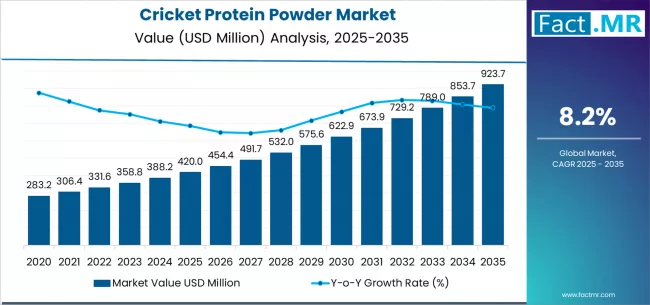
Cricket Protein Powder Market Market Value Analysis

Summary of Cricket Protein Powder Market

  • Market Snapshot
    • In 2025, the global Cricket Protein Powder Market was valued at approximately USD 420.0 million.
    • The market is estimated to reach USD 454.4 million in 2026 and is projected to attain USD 999.4 million by 2036.
    • The cricket protein powder market is likely to expand at a CAGR of 8.2% during the forecast period.
    • The market is anticipated to create an absolute dollar opportunity of USD 545.0 million between 2026 and 2036.
    • Cricket protein powder accounts for 45% of the product segment in 2026.
    • China (10.5%) and India (9.8%) are the key growth markets during the forecast period.
  • Demand and Growth Drivers
    • Growing consumer acceptance of insect-based protein is expanding the addressable market beyond early adopters into mainstream health and fitness segments.
    • Regulatory approvals for cricket-based food ingredients across the EU, North America, and parts of Asia Pacific are formalizing commercial demand.
    • Rising demand for sustainable, low-environmental-footprint protein sources is positioning cricket powder as a preferred alternative in sports nutrition and food manufacturing.
    • Expanding distribution through health food retail, e-commerce, and fitness-focused channels is improving product accessibility.
    • Complete amino acid profile and high protein density per serving are supporting positioning in sports nutrition and functional food applications.
  • Product and Segment View
    • Cricket protein powder holds 45% of market value in 2026, serving as the primary product form for sports nutrition, baking, and food manufacturing applications.
    • Sports nutrition accounts for 35% of the application segment, supported by growing consumer demand for sustainable, high-protein supplements.
    • Key segmentation includes:
      • Product Type: Cricket Protein Powder, Cricket Protein Bars, Whole Roasted Crickets, Cricket Flour Blends
      • Application: Sports Nutrition, Food Manufacturing, Baking, Pet Food, Others
      • Distribution Channel: Direct Sales, Online Retail, Health Food Stores, Supermarkets
    • These systems enable:
      • Complete amino acid protein delivery from sustainable insect farming
      • High protein density per serving for sports nutrition and functional food use
      • Versatile powder format for incorporation into bars, baked goods, and protein blends
  • Geography and Competitive Outlook
    • North America and Europe lead commercial development, supported by regulatory approvals, established health food retail, and growing consumer acceptance.
    • Asia Pacific is the fastest-growing region, with China (10.5%) and India (9.8%) expanding through emerging alternative protein interest and growing health awareness.
    • China (10.5%) and India (9.8%) are the key growth markets, with Germany (9.0%), Brazil (8.2%), and USA (7.4%) also recording steady growth.
    • Some of the major players are Aspire Food Group, Entomo Farms, All Things Bugs, JR Unique Foods, Cricket One, Exo Protein, Chapul, Hargol FoodTech, Protifarm, and Sens Foods.
  • Analyst Opinion
    • The cricket protein powder market is at an early commercial growth stage where regulatory acceptance and consumer awareness are converging to create meaningful demand. Growth is strongest in sports nutrition and fitness-focused channels where protein performance matters more than ingredient novelty. The next phase of expansion will be shaped by cost reduction through farming scale, taste improvement in powder formulations, and the ability to integrate cricket protein into mainstream food products without consumer resistance.

Key Growth Drivers, Constraints, and Opportunities
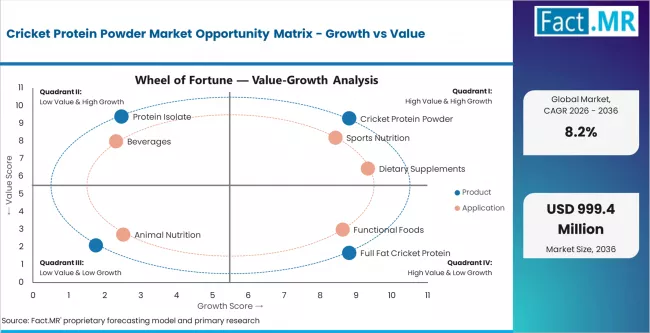
Cricket Protein Powder Market Opportunity Matrix Growth Vs Value

Key Factors Driving Growth

  • Consumer acceptance of insect-based protein is expanding beyond early adopters into mainstream health and fitness segments.
  • Regulatory approvals across major markets are formalizing commercial demand for cricket-based food ingredients.
  • Sustainability-driven protein sourcing positions cricket powder as an environmentally preferred alternative.

Key Market Constraints

  • Consumer acceptance barriers related to the insect origin of the protein limit mainstream food product adoption in many Western markets.
  • Higher production costs compared to conventional protein powders such as whey and plant-based alternatives limit price competitiveness.
  • Limited farming scale restricts supply availability and prevents the cost reductions needed for mass-market pricing.

Key Opportunity Areas

  • Sports nutrition channel expansion provides a high-value demand pathway where protein performance outweighs ingredient novelty concerns.
  • Food manufacturing integration as a protein additive in bars, baked goods, and snacks creates consumption-embedded demand channels.
  • Pet food and aquaculture feed applications represent growing alternative demand channels with lower consumer acceptance barriers.

Segment-wise Analysis of the Cricket Protein Powder Market

  • Cricket protein powder holds 45% of the product segment in 2026, serving as the primary product form for nutrition and food manufacturing applications.
  • Sports nutrition accounts for 35% of the application segment, with protein supplements and fitness products as primary demand channels.
  • Direct sales hold 65.3% of the distribution segment, reflecting the concentration of cricket protein sales through D2C and B2B channels.

The cricket protein powder market is segmented by product type, application, distribution channel, deployment, pricing tier, and region. By product type, the market covers protein powder, protein bars, whole roasted crickets, and flour blends. By application, coverage includes sports nutrition, food manufacturing, baking, pet food, and others. Powder leads by share through versatility in nutrition and manufacturing applications.

Which Product Type Dominates the Cricket Protein Powder Market?
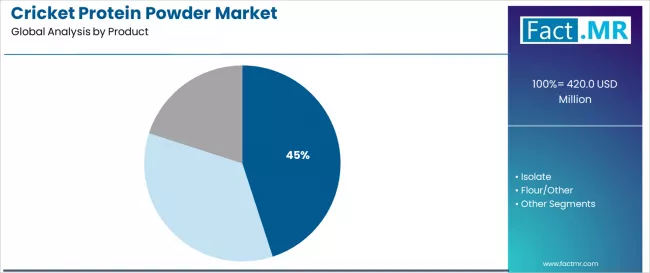
Cricket Protein Powder Market Analysis By Product

Cricket protein powder accounts for 45% of the product segment in 2026, serving as the most versatile product form for sports nutrition supplementation, food manufacturing ingredient use, and home baking applications. Powder format enables easy integration into smoothies, shakes, bars, and baked goods.

The powder segment benefits from growing consumer familiarity with protein powder supplementation in fitness channels, where the format is already established and cricket protein can compete on nutritional profile rather than novelty factor.

Which Application Dominates the Cricket Protein Powder Market?
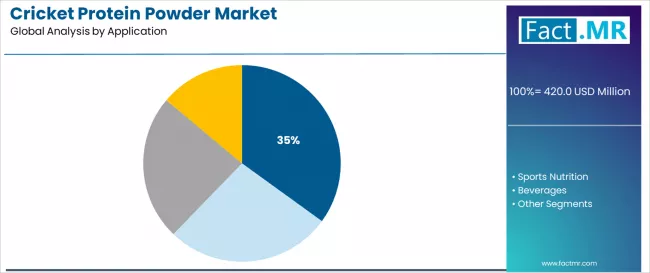
Cricket Protein Powder Market Analysis By Application

Sports nutrition accounts for 35% of the application segment in 2026, with protein supplements, post-workout products, and fitness nutrition serving as the primary demand channels. Cricket protein's complete amino acid profile and high protein density per serving support competitive positioning against whey and plant-based alternatives.

Food manufacturing represents a growing application, with cricket protein used as an ingredient in protein bars, fortified snacks, and baked goods. Pet food applications are also expanding as an alternative protein source with lower consumer acceptance barriers.

Which Distribution Channel Dominates the Cricket Protein Powder Market?
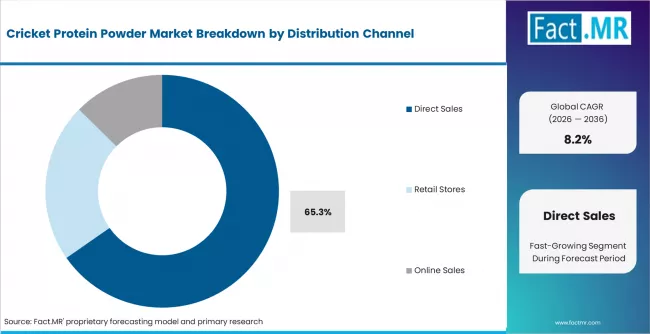
Cricket Protein Powder Market Analysis By Distribution Channel

Direct sales hold 65.3% of the distribution segment in 2026, reflecting the concentration of cricket protein distribution through D2C e-commerce, brand websites, and B2B supply agreements with food manufacturers and sports nutrition brands.

Health food stores and online retail platforms serve as secondary channels, with growing mainstream grocery availability as consumer acceptance expands and regulatory frameworks mature.

Which Product Trend is Shaping the Next Phase of Growth in the Cricket Protein Powder Market?

Cricket protein integration into mainstream food products such as protein bars, baked goods, and snack foods is not yet the largest application, but it is emerging as the fastest-growing demand channel. Its share is projected to rise as food manufacturers seek sustainable protein ingredients that can be incorporated without altering product taste or texture. This is especially relevant in the protein bar and fortified snack categories where cricket protein can serve as a partial or complete protein source.

The shift toward food manufacturing integration reflects a broader change in alternative protein commercialization. Cricket protein producers increasingly recognize that consumer acceptance is faster when the protein is embedded in familiar food formats rather than marketed as a standalone insect product. As a result, B2B ingredient supply to food manufacturers is moving from a secondary channel into a primary growth strategy.

Regional Outlook Across Key Markets

Top Country Growth Comparison Cricket Protein Powder Market Cagr (2026 2036)

  • China leads growth at 10.5%, supported by emerging alternative protein interest, growing health awareness, and expanding regulatory framework for insect-based food ingredients.
  • India records growth at 9.8%, supported by growing protein demand, early-stage cricket farming development, and increasing health-conscious consumer segments.
  • Europe shows strong growth, with Germany at 9.0% supported by EU novel food approvals and established health food retail distribution.

CAGR Table

Country CAGR (%)
China 10.5%
India 9.8%
Germany 9.0%
Brazil 8.2%
USA 7.4%
UK 6.6%
Japan 5.9%

Source: Fact.MR (FMR) analysis, based on proprietary forecasting model and primary research.
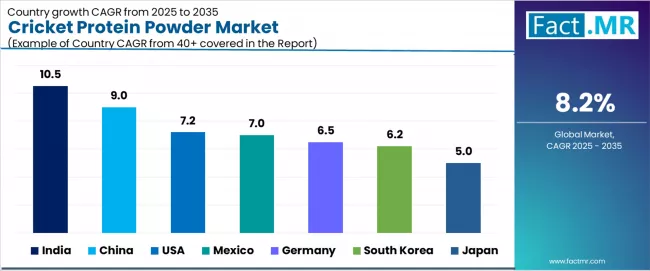
Cricket Protein Powder Market Cagr Analysis By Country

China Cricket Protein Powder Market Growth Assessment

The China Cricket Protein Powder market is projected to grow at a CAGR of 10.5% through 2036. Demand is shaped by emerging alternative protein interest, growing health and fitness awareness, and developing regulatory framework for insect-based food products.

  • Alternative protein interest is growing among health-conscious consumers.
  • Health and fitness trends support protein supplement demand.
  • Regulatory development is enabling commercial insect protein product sales.

India Cricket Protein Powder Market Opportunity Outlook

The India Cricket Protein Powder market is projected to grow at a CAGR of 9.8% through 2036. Demand is supported by growing protein demand, early-stage cricket farming development, and increasing health and fitness awareness among urban consumers.

  • Protein demand growth supports alternative protein source adoption.
  • Cricket farming development is building domestic production capacity.
  • Urban health awareness creates consumer receptivity.

USA Cricket Protein Powder Market Growth Outlook
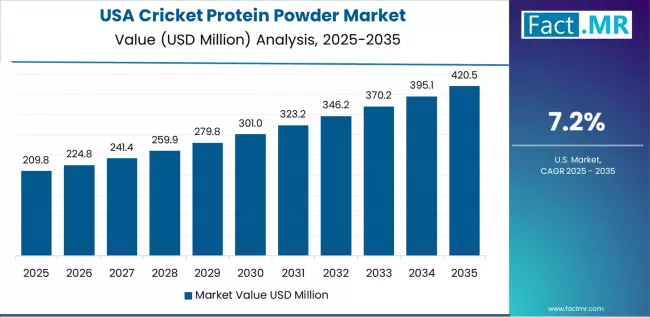
Cricket Protein Powder Market Country Value Analysis

The USA Cricket Protein Powder market is projected to grow at a CAGR of 7.4% through 2036. Demand is sustained by established alternative protein interest, strong sports nutrition market, and growing availability through health food retail and e-commerce channels.

  • Alternative protein interest supports consumer trial and adoption.
  • Sports nutrition market provides a high-value demand channel.
  • Health food retail and e-commerce distribution is expanding.

Germany Cricket Protein Powder Market Demand Analysis

The Germany Cricket Protein Powder market is projected to grow at a CAGR of 9.0% through 2036. Demand is supported by EU novel food regulatory approval, established health food retail infrastructure, and growing consumer interest in sustainable protein alternatives.

  • EU novel food approval enables commercial product sales.
  • Health food retail provides established distribution channels.
  • Sustainability interest supports consumer trial.

Brazil Cricket Protein Powder Market Demand Trends

The Brazil Cricket Protein Powder market is projected to grow at a CAGR of 8.2% through 2036. Demand is shaped by growing fitness culture, emerging alternative protein awareness, and developing regulatory framework for insect-based food products.

  • Growing fitness culture supports protein supplement demand.
  • Alternative protein awareness is emerging among health-conscious consumers.
  • Regulatory development is enabling market formalization.

Competitive Benchmarking and Company Positioning
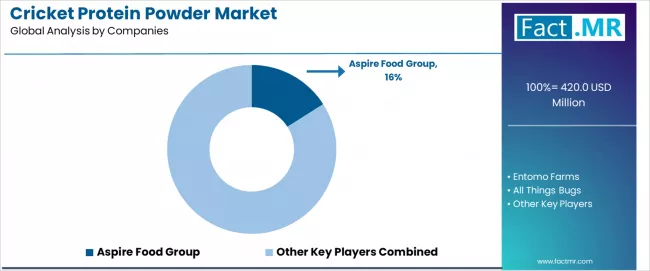
Cricket Protein Powder Market Analysis By Company

Cricket Protein Powder Market Analysis By Company

  • Aspire Food Group holds the leading position through large-scale cricket farming, integrated powder processing, and established distribution across North American health food and sports nutrition channels.
  • Entomo Farms, Cricket One, and Exo Protein participate meaningfully through focused production, brand development, and targeted distribution in health food and D2C channels.
  • Cricket farming scale, powder processing capability, and brand trust in health and fitness channels create important competitive advantages in a market where consumer confidence defines purchase decisions.

The competitive landscape is moderately concentrated, with Aspire Food Group holding a leading position at approximately 16% market share. Aspire's advantage is built on large-scale automated cricket farming, integrated processing capability, and established B2B and D2C distribution in North American markets.

Entomo Farms and Cricket One maintain positions through focused farming operations, quality control, and brand development in health food and sports nutrition channels. Exo Protein and Chapul compete through consumer-facing brand positioning in protein bar and supplement formats.

International producers including JR Unique Foods (Thailand), Hargol FoodTech (Israel), and Protifarm serve specific regional markets and B2B ingredient supply channels.

Strategic priorities include scaling farming operations to reduce unit costs, improving powder taste and solubility for mainstream food integration, expanding regulatory approvals across new markets, and building B2B relationships with sports nutrition and food manufacturing brands.

Key Companies in the Cricket Protein Powder Market

  • Aspire Food Group and Entomo Farms are among the leading global players.
  • Cricket One, Exo Protein, and Chapul hold established positions through brand development and D2C distribution.
  • All Things Bugs, JR Unique Foods, Hargol FoodTech, Protifarm, Bugsolutely, Micronutris, Sens Foods, and other specialist producers compete through regional strength and application focus.

Recent Industry Developments

  • Aspire Food Group - Capacity Expansion / Automated Farming Growth (2025)
    • Aspire Food Group expanded its automated cricket farming capacity to increase powder production volume and reduce unit costs. The expansion supports growing demand from sports nutrition brands and food manufacturers.
  • Entomo Farms - Product Launch / Sports Nutrition Powder (2025)
    • Entomo Farms launched a new sports nutrition-grade cricket protein powder with improved taste profile and solubility, targeting mainstream fitness consumers and sports nutrition brand partnerships.
  • Cricket One - Market Expansion / Asian Distribution Growth (2026)
    • Cricket One expanded its cricket protein distribution across Southeast Asian health food and e-commerce channels, leveraging regulatory acceptance in the region and growing alternative protein awareness among consumers.

Leading Companies Shaping the Cricket Protein Powder Market

  • Global Players

    • Aspire Food Group
    • Entomo Farms
    • Cricket One
    • Exo Protein
  • Regional Players

    • JR Unique Foods
    • Hargol FoodTech
    • Protifarm
    • Chapul
  • Emerging / Start-up Players

    • All Things Bugs
    • Bugsolutely
    • Micronutris
    • Sens Foods

Scope of Analysis

Parameter Details
Quantitative Units USD 454.4 million to USD 999.4 million, at a CAGR of 8.2%
Market Definition The Cricket Protein Powder market covers protein powder from farmed crickets for sports nutrition, food manufacturing, baking, and pet food applications.
Regions Covered North America, Latin America, Europe, East Asia, South Asia and Pacific, Middle East and Africa
Countries Covered China, India, Germany, Brazil, USA, UK, Japan, 30 plus countries
Key Companies Aspire Food Group, Entomo Farms, All Things Bugs, JR Unique Foods, Cricket One, Exo Protein, Chapul, Hargol FoodTech, Protifarm, Sens Foods
Forecast Period 2026 to 2036
Approach Hybrid demand-side and top-down methodology built on alternative protein demand, cricket farming capacity, regulatory approvals, consumer acceptance, and primary interviews across farmers, processors, food manufacturers, and sports nutrition brands

Market Segmentation Analysis

  • Cricket Protein Powder Market Market Segmented by Product:

    • Cricket Protein Powder
      • Defatted Cricket Protein
      • High Protein Concentration
      • Low Fat Content
    • Full Fat Cricket Protein
      • Whole Insect Powder
      • Nutrient Rich Powder
    • Protein Isolate
      • Ultra High Purity
      • Refined Protein Powder
    • Protein Concentrate
      • Moderate Purity
      • Cost Effective Protein
  • Cricket Protein Powder Market Market Segmented by Application:

    • Sports Nutrition
      • Muscle Building
      • Pre Workout Nutrition
      • Post Workout Recovery
    • Functional Foods
      • Fortified Foods
      • Protein Bars
      • Protein Snacks
    • Beverages
      • Protein Drinks
      • Ready to Drink Beverages
      • Protein Shakes
    • Animal Nutrition
      • Pet Food
      • Dog Food
      • Cat Food
    • Dietary Supplements
      • Nutritional Supplements
      • Capsules
      • Powder Mixes
  • Cricket Protein Powder Market Market Segmented by Distribution Channel:

    • Direct Sales
      • Business Buyers
      • Bulk Supply Agreements
      • Long Term Contracts
    • Retail Stores
      • Health Stores
      • Organic Stores
      • Specialty Nutrition Stores
    • Online Sales
      • E Commerce Platforms
      • Brand Websites
      • Marketplace Platforms
  • Cricket Protein Powder Market Market Segmented by Deployment:

    • Bulk Packaging
      • Industrial Supply
      • Large Bags
      • Bulk Containers
    • Retail Packaging
      • Consumer Packs
      • Pouches
      • Jars
    • Single Serve Packaging
      • On The Go Packs
      • Sachets
      • Single Use Packs
  • Cricket Protein Powder Market Market Segmented by Pricing Tier:

    • Premium Products
      • Organic Certified
      • High Purity Protein
      • Sustainably Sourced
    • Mid Range Products
      • Standard Quality
      • Balanced Nutrition
      • Mass Market Products
    • Economy Products
      • Basic Protein
      • Lower Cost Options
      • Bulk Consumption
  • Cricket Protein Powder Market Market by Region:

    • North America
      • USA
      • Canada
      • Mexico
    • Latin America
      • Brazil
      • Chile
      • Rest of Latin America
    • Western Europe
      • Germany
      • UK
      • Italy
      • Spain
      • France
      • Nordic
      • BENELUX
      • Rest of Western Europe
    • Eastern Europe
      • Russia
      • Poland
      • Hungary
      • Balkan & Baltic
      • Rest of Eastern Europe
    • East Asia
      • China
      • Japan
      • South Korea
    • South Asia and Pacific
      • India
      • ASEAN
      • Australia & New Zealand
      • Rest of South Asia and Pacific
    • Middle East & Africa
      • Kingdom of Saudi Arabia
      • Other GCC Countries
      • Turkiye
      • South Africa
      • Other African Union
      • Rest of Middle East & Africa

Sources and Research References

  • European Food Safety Authority (EFSA). Novel food regulations for insect-based products.
  • Food and Agriculture Organization of the United Nations (FAO). Edible insects and sustainable protein reports.
  • International Platform of Insects for Food and Feed (IPIFF). Industry data and regulatory updates.
  • National Institutes of Health (NIH). Insect protein nutritional analysis.
  • Primary interviews with cricket farmers, powder processors, food manufacturers, and sports nutrition brands.
  • This bibliography is provided for reader reference and is not exhaustive. The full report contains the complete reference list and detailed citations.

Key Questions This Report Addresses

  • What is the current and future size of the Cricket Protein Powder market?
  • How fast is the market expected to grow between 2026 and 2036?
  • Which product type leads?
  • Which application holds the largest share?
  • What factors are fueling demand?
  • How is sports nutrition driving growth?
  • Why are China and India the fastest-growing markets?
  • How is food manufacturing integration shaping demand?
  • Which countries show the fastest growth through 2036?
  • Who are the key companies?
  • How does Fact.MR validate the market forecast?

Cricket Protein Powder Definition

The cricket protein powder market covers commercially produced protein powder derived from farmed crickets, used in sports nutrition, food manufacturing, baking, and pet food applications across retail, e-commerce, and food service channels.

Cricket Protein Powder Inclusions

  • The scope covers global and regional market size and forecasts for 2026 to 2036 across product type, application, distribution channel, deployment, pricing tier, and region.
  • It includes pricing analysis, farming capacity assessment, regulatory approval tracking, and consumer acceptance evaluation.
  • The report includes demand analysis across sports nutrition, food manufacturing, baking, and pet food applications.
  • It covers production technology trends, market drivers and constraints, and competitive benchmarking.

Cricket Protein Powder Exclusions

  • The scope excludes whole cricket food products not processed into powder form.
  • It excludes other insect protein powders such as mealworm and BSF-based products.
  • The report excludes cricket farming equipment and technology platforms.
  • It also excludes wild-harvested crickets not commercially farmed.

Cricket Protein Powder Research Methodology

  • The methodology combines secondary research, primary interviews, and forecast modelling.
  • It draws on 60+ secondary sources and benchmarks 25+ company profiles.
  • Market sizing covers 30+ countries through a demand-side model, supported by top-down validation.
  • Key inputs include alternative protein market growth, cricket farming capacity, regulatory approval timelines, and consumer acceptance data.
  • The model cross-checks demand with production capacity, pricing, and distribution data.
  • Primary validation includes 15+ interviews across cricket farmers, powder processors, food manufacturers, and sports nutrition brands.
  • Final estimates go through trade-flow checks, sales-pattern review, and sensitivity testing.

- Frequently Asked Questions -

How big is the cricket protein powder market in 2025?

The global market is estimated at USD 420.0 million in 2025.

What will be the size in 2036?

The market is projected to reach USD 999.4 million by 2036.

How much will it grow between 2026 and 2036?

The market is expected to grow at an 8.2% CAGR.

Which product type leads?

Cricket protein powder leads with 45% share in 2026.

Which application is most significant?

Sports nutrition accounts for 35% of the application segment in 2026.

Table of Content

  1. Executive Summary
    • Global Market Outlook
    • Demand to side Trends
    • Supply to side Trends
    • Technology Roadmap Analysis
    • Analysis and Recommendations
  2. Market Overview
    • Market Coverage / Taxonomy
    • Market Definition / Scope / Limitations
  3. Research Methodology
    • Chapter Orientation
    • Analytical Lens and Working Hypotheses
      • Market Structure, Signals, and Trend Drivers
      • Benchmarking and Cross-market Comparability
      • Market Sizing, Forecasting, and Opportunity Mapping
    • Research Design and Evidence Framework
      • Desk Research Programme (Secondary Evidence)
        • Company Annual and Sustainability Reports
        • Peer-reviewed Journals and Academic Literature
        • Corporate Websites, Product Literature, and Technical Notes
        • Earnings Decks and Investor Briefings
        • Statutory Filings and Regulatory Disclosures
        • Technical White Papers and Standards Notes
        • Trade Journals, Industry Magazines, and Analyst Briefs
        • Conference Proceedings, Webinars, and Seminar Materials
        • Government Statistics Portals and Public Data Releases
        • Press Releases and Reputable Media Coverage
        • Specialist Newsletters and Curated Briefings
        • Sector Databases and Reference Repositories
        • Fact.MR Internal Proprietary Databases and Historical Market Datasets
        • Subscription Datasets and Paid Sources
        • Social Channels, Communities, and Digital Listening Inputs
        • Additional Desk Sources
      • Expert Input and Fieldwork (Primary Evidence)
        • Primary Modes
          • Qualitative Interviews and Expert Elicitation
          • Quantitative Surveys and Structured Data Capture
          • Blended Approach
        • Why Primary Evidence is Used
        • Field Techniques
          • Interviews
          • Surveys
          • Focus Groups
          • Observational and In-context Research
          • Social and Community Interactions
        • Stakeholder Universe Engaged
          • C-suite Leaders
          • Board Members
          • Presidents and Vice Presidents
          • R&D and Innovation Heads
          • Technical Specialists
          • Domain Subject-matter Experts
          • Scientists
          • Physicians and Other Healthcare Professionals
        • Governance, Ethics, and Data Stewardship
          • Research Ethics
          • Data Integrity and Handling
      • Tooling, Models, and Reference Databases
    • Data Engineering and Model Build
      • Data Acquisition and Ingestion
      • Cleaning, Normalisation, and Verification
      • Synthesis, Triangulation, and Analysis
    • Quality Assurance and Audit Trail
  4. Market Background
    • Market Dynamics
      • Drivers
      • Restraints
      • Opportunity
      • Trends
    • Scenario Forecast
      • Demand in Optimistic Scenario
      • Demand in Likely Scenario
      • Demand in Conservative Scenario
    • Opportunity Map Analysis
    • Product Life Cycle Analysis
    • Supply Chain Analysis
    • Investment Feasibility Matrix
    • Value Chain Analysis
    • PESTLE and Porter’s Analysis
    • Regulatory Landscape
    • Regional Parent Market Outlook
    • Production and Consumption Statistics
    • Import and Export Statistics
  5. Global Market Analysis 2021 to 2025 and Forecast, 2026 to 2036
    • Historical Market Size Value (USD Million) Analysis, 2021 to 2025
    • Current and Future Market Size Value (USD Million) Projections, 2026 to 2036
      • Y to o to Y Growth Trend Analysis
      • Absolute $ Opportunity Analysis
  6. Global Market Pricing Analysis 2021 to 2025 and Forecast 2026 to 2036
  7. Global Market Analysis 2021 to 2025 and Forecast 2026 to 2036, By Product
    • Introduction / Key Findings
    • Historical Market Size Value (USD Million) Analysis By Product , 2021 to 2025
    • Current and Future Market Size Value (USD Million) Analysis and Forecast By Product , 2026 to 2036
      • Cricket Protein Powder
        • Defatted Cricket Protein
        • High Protein Concentration
        • Low Fat Content
      • Full Fat Cricket Protein
        • Whole Insect Powder
        • Nutrient Rich Powder
      • Protein Isolate
        • Ultra High Purity
        • Refined Protein Powder
      • Protein Concentrate
        • Moderate Purity
        • Cost Effective Protein
    • Y to o to Y Growth Trend Analysis By Product , 2021 to 2025
    • Absolute $ Opportunity Analysis By Product , 2026 to 2036
  8. Global Market Analysis 2021 to 2025 and Forecast 2026 to 2036, By Application
    • Introduction / Key Findings
    • Historical Market Size Value (USD Million) Analysis By Application, 2021 to 2025
    • Current and Future Market Size Value (USD Million) Analysis and Forecast By Application, 2026 to 2036
      • Sports Nutrition
        • Muscle Building
        • Pre Workout Nutrition
        • Post Workout Recovery
      • Functional Foods
        • Fortified Foods
        • Protein Bars
        • Protein Snacks
      • Beverages
        • Protein Drinks
        • Ready to Drink Beverages
        • Protein Shakes
      • Animal Nutrition
        • Pet Food
        • Dog Food
        • Cat Food
      • Dietary Supplements
        • Nutritional Supplements
        • Capsules
        • Powder Mixes
    • Y to o to Y Growth Trend Analysis By Application, 2021 to 2025
    • Absolute $ Opportunity Analysis By Application, 2026 to 2036
  9. Global Market Analysis 2021 to 2025 and Forecast 2026 to 2036, By Distribution Channel
    • Introduction / Key Findings
    • Historical Market Size Value (USD Million) Analysis By Distribution Channel, 2021 to 2025
    • Current and Future Market Size Value (USD Million) Analysis and Forecast By Distribution Channel, 2026 to 2036
      • Direct Sales
        • Business Buyers
        • Bulk Supply Agreements
        • Long Term Contracts
      • Retail Stores
        • Health Stores
        • Organic Stores
        • Specialty Nutrition Stores
      • Online Sales
        • E Commerce Platforms
        • Brand Websites
        • Marketplace Platforms
    • Y to o to Y Growth Trend Analysis By Distribution Channel, 2021 to 2025
    • Absolute $ Opportunity Analysis By Distribution Channel, 2026 to 2036
  10. Global Market Analysis 2021 to 2025 and Forecast 2026 to 2036, By Deployment
    • Introduction / Key Findings
    • Historical Market Size Value (USD Million) Analysis By Deployment, 2021 to 2025
    • Current and Future Market Size Value (USD Million) Analysis and Forecast By Deployment, 2026 to 2036
      • Bulk Packaging
        • Industrial Supply
        • Large Bags
        • Bulk Containers
      • Retail Packaging
        • Consumer Packs
        • Pouches
        • Jars
      • Single Serve Packaging
        • On The Go Packs
        • Sachets
        • Single Use Packs
    • Y to o to Y Growth Trend Analysis By Deployment, 2021 to 2025
    • Absolute $ Opportunity Analysis By Deployment, 2026 to 2036
  11. Global Market Analysis 2021 to 2025 and Forecast 2026 to 2036, By Pricing Tier
    • Introduction / Key Findings
    • Historical Market Size Value (USD Million) Analysis By Pricing Tier, 2021 to 2025
    • Current and Future Market Size Value (USD Million) Analysis and Forecast By Pricing Tier, 2026 to 2036
      • Premium Products
        • Organic Certified
        • High Purity Protein
        • Sustainably Sourced
      • Mid Range Products
        • Standard Quality
        • Balanced Nutrition
        • Mass Market Products
      • Economy Products
        • Basic Protein
        • Lower Cost Options
        • Bulk Consumption
    • Y to o to Y Growth Trend Analysis By Pricing Tier, 2021 to 2025
    • Absolute $ Opportunity Analysis By Pricing Tier, 2026 to 2036
  12. Global Market Analysis 2021 to 2025 and Forecast 2026 to 2036, By Region
    • Introduction
    • Historical Market Size Value (USD Million) Analysis By Region, 2021 to 2025
    • Current Market Size Value (USD Million) Analysis and Forecast By Region, 2026 to 2036
      • North America
      • Latin America
      • Western Europe
      • Eastern Europe
      • East Asia
      • South Asia and Pacific
      • Middle East & Africa
    • Market Attractiveness Analysis By Region
  13. North America Market Analysis 2021 to 2025 and Forecast 2026 to 2036, By Country
    • Historical Market Size Value (USD Million) Trend Analysis By Market Taxonomy, 2021 to 2025
    • Market Size Value (USD Million) Forecast By Market Taxonomy, 2026 to 2036
      • By Country
        • USA
        • Canada
        • Mexico
      • By Product
      • By Application
      • By Distribution Channel
      • By Deployment
      • By Pricing Tier
    • Market Attractiveness Analysis
      • By Country
      • By Product
      • By Application
      • By Distribution Channel
      • By Deployment
      • By Pricing Tier
    • Key Takeaways
  14. Latin America Market Analysis 2021 to 2025 and Forecast 2026 to 2036, By Country
    • Historical Market Size Value (USD Million) Trend Analysis By Market Taxonomy, 2021 to 2025
    • Market Size Value (USD Million) Forecast By Market Taxonomy, 2026 to 2036
      • By Country
        • Brazil
        • Chile
        • Rest of Latin America
      • By Product
      • By Application
      • By Distribution Channel
      • By Deployment
      • By Pricing Tier
    • Market Attractiveness Analysis
      • By Country
      • By Product
      • By Application
      • By Distribution Channel
      • By Deployment
      • By Pricing Tier
    • Key Takeaways
  15. Western Europe Market Analysis 2021 to 2025 and Forecast 2026 to 2036, By Country
    • Historical Market Size Value (USD Million) Trend Analysis By Market Taxonomy, 2021 to 2025
    • Market Size Value (USD Million) Forecast By Market Taxonomy, 2026 to 2036
      • By Country
        • Germany
        • UK
        • Italy
        • Spain
        • France
        • Nordic
        • BENELUX
        • Rest of Western Europe
      • By Product
      • By Application
      • By Distribution Channel
      • By Deployment
      • By Pricing Tier
    • Market Attractiveness Analysis
      • By Country
      • By Product
      • By Application
      • By Distribution Channel
      • By Deployment
      • By Pricing Tier
    • Key Takeaways
  16. Eastern Europe Market Analysis 2021 to 2025 and Forecast 2026 to 2036, By Country
    • Historical Market Size Value (USD Million) Trend Analysis By Market Taxonomy, 2021 to 2025
    • Market Size Value (USD Million) Forecast By Market Taxonomy, 2026 to 2036
      • By Country
        • Russia
        • Poland
        • Hungary
        • Balkan & Baltic
        • Rest of Eastern Europe
      • By Product
      • By Application
      • By Distribution Channel
      • By Deployment
      • By Pricing Tier
    • Market Attractiveness Analysis
      • By Country
      • By Product
      • By Application
      • By Distribution Channel
      • By Deployment
      • By Pricing Tier
    • Key Takeaways
  17. East Asia Market Analysis 2021 to 2025 and Forecast 2026 to 2036, By Country
    • Historical Market Size Value (USD Million) Trend Analysis By Market Taxonomy, 2021 to 2025
    • Market Size Value (USD Million) Forecast By Market Taxonomy, 2026 to 2036
      • By Country
        • China
        • Japan
        • South Korea
      • By Product
      • By Application
      • By Distribution Channel
      • By Deployment
      • By Pricing Tier
    • Market Attractiveness Analysis
      • By Country
      • By Product
      • By Application
      • By Distribution Channel
      • By Deployment
      • By Pricing Tier
    • Key Takeaways
  18. South Asia and Pacific Market Analysis 2021 to 2025 and Forecast 2026 to 2036, By Country
    • Historical Market Size Value (USD Million) Trend Analysis By Market Taxonomy, 2021 to 2025
    • Market Size Value (USD Million) Forecast By Market Taxonomy, 2026 to 2036
      • By Country
        • India
        • ASEAN
        • Australia & New Zealand
        • Rest of South Asia and Pacific
      • By Product
      • By Application
      • By Distribution Channel
      • By Deployment
      • By Pricing Tier
    • Market Attractiveness Analysis
      • By Country
      • By Product
      • By Application
      • By Distribution Channel
      • By Deployment
      • By Pricing Tier
    • Key Takeaways
  19. Middle East & Africa Market Analysis 2021 to 2025 and Forecast 2026 to 2036, By Country
    • Historical Market Size Value (USD Million) Trend Analysis By Market Taxonomy, 2021 to 2025
    • Market Size Value (USD Million) Forecast By Market Taxonomy, 2026 to 2036
      • By Country
        • Kingdom of Saudi Arabia
        • Other GCC Countries
        • Turkiye
        • South Africa
        • Other African Union
        • Rest of Middle East & Africa
      • By Product
      • By Application
      • By Distribution Channel
      • By Deployment
      • By Pricing Tier
    • Market Attractiveness Analysis
      • By Country
      • By Product
      • By Application
      • By Distribution Channel
      • By Deployment
      • By Pricing Tier
    • Key Takeaways
  20. Key Countries Market Analysis
    • USA
      • Pricing Analysis
      • Market Share Analysis, 2025
        • By Product
        • By Application
        • By Distribution Channel
        • By Deployment
        • By Pricing Tier
    • Canada
      • Pricing Analysis
      • Market Share Analysis, 2025
        • By Product
        • By Application
        • By Distribution Channel
        • By Deployment
        • By Pricing Tier
    • Mexico
      • Pricing Analysis
      • Market Share Analysis, 2025
        • By Product
        • By Application
        • By Distribution Channel
        • By Deployment
        • By Pricing Tier
    • Brazil
      • Pricing Analysis
      • Market Share Analysis, 2025
        • By Product
        • By Application
        • By Distribution Channel
        • By Deployment
        • By Pricing Tier
    • Chile
      • Pricing Analysis
      • Market Share Analysis, 2025
        • By Product
        • By Application
        • By Distribution Channel
        • By Deployment
        • By Pricing Tier
    • Germany
      • Pricing Analysis
      • Market Share Analysis, 2025
        • By Product
        • By Application
        • By Distribution Channel
        • By Deployment
        • By Pricing Tier
    • UK
      • Pricing Analysis
      • Market Share Analysis, 2025
        • By Product
        • By Application
        • By Distribution Channel
        • By Deployment
        • By Pricing Tier
    • Italy
      • Pricing Analysis
      • Market Share Analysis, 2025
        • By Product
        • By Application
        • By Distribution Channel
        • By Deployment
        • By Pricing Tier
    • Spain
      • Pricing Analysis
      • Market Share Analysis, 2025
        • By Product
        • By Application
        • By Distribution Channel
        • By Deployment
        • By Pricing Tier
    • France
      • Pricing Analysis
      • Market Share Analysis, 2025
        • By Product
        • By Application
        • By Distribution Channel
        • By Deployment
        • By Pricing Tier
    • India
      • Pricing Analysis
      • Market Share Analysis, 2025
        • By Product
        • By Application
        • By Distribution Channel
        • By Deployment
        • By Pricing Tier
    • ASEAN
      • Pricing Analysis
      • Market Share Analysis, 2025
        • By Product
        • By Application
        • By Distribution Channel
        • By Deployment
        • By Pricing Tier
    • Australia & New Zealand
      • Pricing Analysis
      • Market Share Analysis, 2025
        • By Product
        • By Application
        • By Distribution Channel
        • By Deployment
        • By Pricing Tier
    • China
      • Pricing Analysis
      • Market Share Analysis, 2025
        • By Product
        • By Application
        • By Distribution Channel
        • By Deployment
        • By Pricing Tier
    • Japan
      • Pricing Analysis
      • Market Share Analysis, 2025
        • By Product
        • By Application
        • By Distribution Channel
        • By Deployment
        • By Pricing Tier
    • South Korea
      • Pricing Analysis
      • Market Share Analysis, 2025
        • By Product
        • By Application
        • By Distribution Channel
        • By Deployment
        • By Pricing Tier
    • Russia
      • Pricing Analysis
      • Market Share Analysis, 2025
        • By Product
        • By Application
        • By Distribution Channel
        • By Deployment
        • By Pricing Tier
    • Poland
      • Pricing Analysis
      • Market Share Analysis, 2025
        • By Product
        • By Application
        • By Distribution Channel
        • By Deployment
        • By Pricing Tier
    • Hungary
      • Pricing Analysis
      • Market Share Analysis, 2025
        • By Product
        • By Application
        • By Distribution Channel
        • By Deployment
        • By Pricing Tier
    • Kingdom of Saudi Arabia
      • Pricing Analysis
      • Market Share Analysis, 2025
        • By Product
        • By Application
        • By Distribution Channel
        • By Deployment
        • By Pricing Tier
    • Turkiye
      • Pricing Analysis
      • Market Share Analysis, 2025
        • By Product
        • By Application
        • By Distribution Channel
        • By Deployment
        • By Pricing Tier
    • South Africa
      • Pricing Analysis
      • Market Share Analysis, 2025
        • By Product
        • By Application
        • By Distribution Channel
        • By Deployment
        • By Pricing Tier
  21. Market Structure Analysis
    • Competition Dashboard
    • Competition Benchmarking
    • Market Share Analysis of Top Players
      • By Regional
      • By Product
      • By Application
      • By Distribution Channel
      • By Deployment
      • By Pricing Tier
  22. Competition Analysis
    • Competition Deep Dive
      • Aspire Food Group
        • Overview
        • Product Portfolio
        • Profitability by Market Segments (Product/Age /Sales Channel/Region)
        • Sales Footprint
        • Strategy Overview
          • Marketing Strategy
          • Product Strategy
          • Channel Strategy
      • Entomo Farms
      • All Things Bugs
      • JR Unique Foods
      • Cricket One
      • Exo Protein
      • Chapul
      • Hargol FoodTech
      • Protifarm
      • Bugsolutely
      • Micronutris
      • Gryö
      • Innovafeed (alt protein)
      • Ynsect (alt protein)
      • Sens Foods
  23. Assumptions & Acronyms Used

List Of Table

  • Table 1: Global Market Value (USD Million) Forecast by Region, 2021 to 2036
  • Table 2: Global Market Value (USD Million) Forecast by Product , 2021 to 2036
  • Table 3: Global Market Value (USD Million) Forecast by Application, 2021 to 2036
  • Table 4: Global Market Value (USD Million) Forecast by Distribution Channel, 2021 to 2036
  • Table 5: Global Market Value (USD Million) Forecast by Deployment, 2021 to 2036
  • Table 6: Global Market Value (USD Million) Forecast by Pricing Tier, 2021 to 2036
  • Table 7: North America Market Value (USD Million) Forecast by Country, 2021 to 2036
  • Table 8: North America Market Value (USD Million) Forecast by Product , 2021 to 2036
  • Table 9: North America Market Value (USD Million) Forecast by Application, 2021 to 2036
  • Table 10: North America Market Value (USD Million) Forecast by Distribution Channel, 2021 to 2036
  • Table 11: North America Market Value (USD Million) Forecast by Deployment, 2021 to 2036
  • Table 12: North America Market Value (USD Million) Forecast by Pricing Tier, 2021 to 2036
  • Table 13: Latin America Market Value (USD Million) Forecast by Country, 2021 to 2036
  • Table 14: Latin America Market Value (USD Million) Forecast by Product , 2021 to 2036
  • Table 15: Latin America Market Value (USD Million) Forecast by Application, 2021 to 2036
  • Table 16: Latin America Market Value (USD Million) Forecast by Distribution Channel, 2021 to 2036
  • Table 17: Latin America Market Value (USD Million) Forecast by Deployment, 2021 to 2036
  • Table 18: Latin America Market Value (USD Million) Forecast by Pricing Tier, 2021 to 2036
  • Table 19: Western Europe Market Value (USD Million) Forecast by Country, 2021 to 2036
  • Table 20: Western Europe Market Value (USD Million) Forecast by Product , 2021 to 2036
  • Table 21: Western Europe Market Value (USD Million) Forecast by Application, 2021 to 2036
  • Table 22: Western Europe Market Value (USD Million) Forecast by Distribution Channel, 2021 to 2036
  • Table 23: Western Europe Market Value (USD Million) Forecast by Deployment, 2021 to 2036
  • Table 24: Western Europe Market Value (USD Million) Forecast by Pricing Tier, 2021 to 2036
  • Table 25: Eastern Europe Market Value (USD Million) Forecast by Country, 2021 to 2036
  • Table 26: Eastern Europe Market Value (USD Million) Forecast by Product , 2021 to 2036
  • Table 27: Eastern Europe Market Value (USD Million) Forecast by Application, 2021 to 2036
  • Table 28: Eastern Europe Market Value (USD Million) Forecast by Distribution Channel, 2021 to 2036
  • Table 29: Eastern Europe Market Value (USD Million) Forecast by Deployment, 2021 to 2036
  • Table 30: Eastern Europe Market Value (USD Million) Forecast by Pricing Tier, 2021 to 2036
  • Table 31: East Asia Market Value (USD Million) Forecast by Country, 2021 to 2036
  • Table 32: East Asia Market Value (USD Million) Forecast by Product , 2021 to 2036
  • Table 33: East Asia Market Value (USD Million) Forecast by Application, 2021 to 2036
  • Table 34: East Asia Market Value (USD Million) Forecast by Distribution Channel, 2021 to 2036
  • Table 35: East Asia Market Value (USD Million) Forecast by Deployment, 2021 to 2036
  • Table 36: East Asia Market Value (USD Million) Forecast by Pricing Tier, 2021 to 2036
  • Table 37: South Asia and Pacific Market Value (USD Million) Forecast by Country, 2021 to 2036
  • Table 38: South Asia and Pacific Market Value (USD Million) Forecast by Product , 2021 to 2036
  • Table 39: South Asia and Pacific Market Value (USD Million) Forecast by Application, 2021 to 2036
  • Table 40: South Asia and Pacific Market Value (USD Million) Forecast by Distribution Channel, 2021 to 2036
  • Table 41: South Asia and Pacific Market Value (USD Million) Forecast by Deployment, 2021 to 2036
  • Table 42: South Asia and Pacific Market Value (USD Million) Forecast by Pricing Tier, 2021 to 2036
  • Table 43: Middle East & Africa Market Value (USD Million) Forecast by Country, 2021 to 2036
  • Table 44: Middle East & Africa Market Value (USD Million) Forecast by Product , 2021 to 2036
  • Table 45: Middle East & Africa Market Value (USD Million) Forecast by Application, 2021 to 2036
  • Table 46: Middle East & Africa Market Value (USD Million) Forecast by Distribution Channel, 2021 to 2036
  • Table 47: Middle East & Africa Market Value (USD Million) Forecast by Deployment, 2021 to 2036
  • Table 48: Middle East & Africa Market Value (USD Million) Forecast by Pricing Tier, 2021 to 2036

List Of Figures

  • Figure 1: Global Market Pricing Analysis
  • Figure 2: Global Market Value (USD Million) Forecast 2021-2036
  • Figure 3: Global Market Value Share and BPS Analysis by Product, 2026 and 2036
  • Figure 4: Global Market Y-o-Y Growth Comparison by Product, 2026 to 2036
  • Figure 5: Global Market Attractiveness Analysis by Product
  • Figure 6: Global Market Value Share and BPS Analysis by Application, 2026 and 2036
  • Figure 7: Global Market Y-o-Y Growth Comparison by Application, 2026 to 2036
  • Figure 8: Global Market Attractiveness Analysis by Application
  • Figure 9: Global Market Value Share and BPS Analysis by Distribution Channel, 2026 and 2036
  • Figure 10: Global Market Y-o-Y Growth Comparison by Distribution Channel, 2026 to 2036
  • Figure 11: Global Market Attractiveness Analysis by Distribution Channel
  • Figure 12: Global Market Value Share and BPS Analysis by Deployment, 2026 and 2036
  • Figure 13: Global Market Y-o-Y Growth Comparison by Deployment, 2026 to 2036
  • Figure 14: Global Market Attractiveness Analysis by Deployment
  • Figure 15: Global Market Value Share and BPS Analysis by Pricing Tier, 2026 and 2036
  • Figure 16: Global Market Y-o-Y Growth Comparison by Pricing Tier, 2026 to 2036
  • Figure 17: Global Market Attractiveness Analysis by Pricing Tier
  • Figure 18: Global Market Value (USD Million) Share and BPS Analysis by Region, 2026 and 2036
  • Figure 19: Global Market Y-o-Y Growth Comparison by Region, 2026 to 2036
  • Figure 20: Global Market Attractiveness Analysis by Region
  • Figure 21: North America Market Incremental Dollar Opportunity, 2026 to 2036
  • Figure 22: Latin America Market Incremental Dollar Opportunity, 2026 to 2036
  • Figure 23: Western Europe Market Incremental Dollar Opportunity, 2026 to 2036
  • Figure 24: Eastern Europe Market Incremental Dollar Opportunity, 2026 to 2036
  • Figure 25: East Asia Market Incremental Dollar Opportunity, 2026 to 2036
  • Figure 26: South Asia and Pacific Market Incremental Dollar Opportunity, 2026 to 2036
  • Figure 27: Middle East & Africa Market Incremental Dollar Opportunity, 2026 to 2036
  • Figure 28: North America Market Value Share and BPS Analysis by Country, 2026 and 2036
  • Figure 29: North America Market Value Share and BPS Analysis by Product, 2026 and 2036
  • Figure 30: North America Market Y-o-Y Growth Comparison by Product, 2026 to 2036
  • Figure 31: North America Market Attractiveness Analysis by Product
  • Figure 32: North America Market Value Share and BPS Analysis by Application, 2026 and 2036
  • Figure 33: North America Market Y-o-Y Growth Comparison by Application, 2026 to 2036
  • Figure 34: North America Market Attractiveness Analysis by Application
  • Figure 35: North America Market Value Share and BPS Analysis by Distribution Channel, 2026 and 2036
  • Figure 36: North America Market Y-o-Y Growth Comparison by Distribution Channel, 2026 to 2036
  • Figure 37: North America Market Attractiveness Analysis by Distribution Channel
  • Figure 38: North America Market Value Share and BPS Analysis by Deployment, 2026 and 2036
  • Figure 39: North America Market Y-o-Y Growth Comparison by Deployment, 2026 to 2036
  • Figure 40: North America Market Attractiveness Analysis by Deployment
  • Figure 41: North America Market Value Share and BPS Analysis by Pricing Tier, 2026 and 2036
  • Figure 42: North America Market Y-o-Y Growth Comparison by Pricing Tier, 2026 to 2036
  • Figure 43: North America Market Attractiveness Analysis by Pricing Tier
  • Figure 44: Latin America Market Value Share and BPS Analysis by Country, 2026 and 2036
  • Figure 45: Latin America Market Value Share and BPS Analysis by Product, 2026 and 2036
  • Figure 46: Latin America Market Y-o-Y Growth Comparison by Product, 2026 to 2036
  • Figure 47: Latin America Market Attractiveness Analysis by Product
  • Figure 48: Latin America Market Value Share and BPS Analysis by Application, 2026 and 2036
  • Figure 49: Latin America Market Y-o-Y Growth Comparison by Application, 2026 to 2036
  • Figure 50: Latin America Market Attractiveness Analysis by Application
  • Figure 51: Latin America Market Value Share and BPS Analysis by Distribution Channel, 2026 and 2036
  • Figure 52: Latin America Market Y-o-Y Growth Comparison by Distribution Channel, 2026 to 2036
  • Figure 53: Latin America Market Attractiveness Analysis by Distribution Channel
  • Figure 54: Latin America Market Value Share and BPS Analysis by Deployment, 2026 and 2036
  • Figure 55: Latin America Market Y-o-Y Growth Comparison by Deployment, 2026 to 2036
  • Figure 56: Latin America Market Attractiveness Analysis by Deployment
  • Figure 57: Latin America Market Value Share and BPS Analysis by Pricing Tier, 2026 and 2036
  • Figure 58: Latin America Market Y-o-Y Growth Comparison by Pricing Tier, 2026 to 2036
  • Figure 59: Latin America Market Attractiveness Analysis by Pricing Tier
  • Figure 60: Western Europe Market Value Share and BPS Analysis by Country, 2026 and 2036
  • Figure 61: Western Europe Market Value Share and BPS Analysis by Product, 2026 and 2036
  • Figure 62: Western Europe Market Y-o-Y Growth Comparison by Product, 2026 to 2036
  • Figure 63: Western Europe Market Attractiveness Analysis by Product
  • Figure 64: Western Europe Market Value Share and BPS Analysis by Application, 2026 and 2036
  • Figure 65: Western Europe Market Y-o-Y Growth Comparison by Application, 2026 to 2036
  • Figure 66: Western Europe Market Attractiveness Analysis by Application
  • Figure 67: Western Europe Market Value Share and BPS Analysis by Distribution Channel, 2026 and 2036
  • Figure 68: Western Europe Market Y-o-Y Growth Comparison by Distribution Channel, 2026 to 2036
  • Figure 69: Western Europe Market Attractiveness Analysis by Distribution Channel
  • Figure 70: Western Europe Market Value Share and BPS Analysis by Deployment, 2026 and 2036
  • Figure 71: Western Europe Market Y-o-Y Growth Comparison by Deployment, 2026 to 2036
  • Figure 72: Western Europe Market Attractiveness Analysis by Deployment
  • Figure 73: Western Europe Market Value Share and BPS Analysis by Pricing Tier, 2026 and 2036
  • Figure 74: Western Europe Market Y-o-Y Growth Comparison by Pricing Tier, 2026 to 2036
  • Figure 75: Western Europe Market Attractiveness Analysis by Pricing Tier
  • Figure 76: Eastern Europe Market Value Share and BPS Analysis by Country, 2026 and 2036
  • Figure 77: Eastern Europe Market Value Share and BPS Analysis by Product, 2026 and 2036
  • Figure 78: Eastern Europe Market Y-o-Y Growth Comparison by Product, 2026 to 2036
  • Figure 79: Eastern Europe Market Attractiveness Analysis by Product
  • Figure 80: Eastern Europe Market Value Share and BPS Analysis by Application, 2026 and 2036
  • Figure 81: Eastern Europe Market Y-o-Y Growth Comparison by Application, 2026 to 2036
  • Figure 82: Eastern Europe Market Attractiveness Analysis by Application
  • Figure 83: Eastern Europe Market Value Share and BPS Analysis by Distribution Channel, 2026 and 2036
  • Figure 84: Eastern Europe Market Y-o-Y Growth Comparison by Distribution Channel, 2026 to 2036
  • Figure 85: Eastern Europe Market Attractiveness Analysis by Distribution Channel
  • Figure 86: Eastern Europe Market Value Share and BPS Analysis by Deployment, 2026 and 2036
  • Figure 87: Eastern Europe Market Y-o-Y Growth Comparison by Deployment, 2026 to 2036
  • Figure 88: Eastern Europe Market Attractiveness Analysis by Deployment
  • Figure 89: Eastern Europe Market Value Share and BPS Analysis by Pricing Tier, 2026 and 2036
  • Figure 90: Eastern Europe Market Y-o-Y Growth Comparison by Pricing Tier, 2026 to 2036
  • Figure 91: Eastern Europe Market Attractiveness Analysis by Pricing Tier
  • Figure 92: East Asia Market Value Share and BPS Analysis by Country, 2026 and 2036
  • Figure 93: East Asia Market Value Share and BPS Analysis by Product, 2026 and 2036
  • Figure 94: East Asia Market Y-o-Y Growth Comparison by Product, 2026 to 2036
  • Figure 95: East Asia Market Attractiveness Analysis by Product
  • Figure 96: East Asia Market Value Share and BPS Analysis by Application, 2026 and 2036
  • Figure 97: East Asia Market Y-o-Y Growth Comparison by Application, 2026 to 2036
  • Figure 98: East Asia Market Attractiveness Analysis by Application
  • Figure 99: East Asia Market Value Share and BPS Analysis by Distribution Channel, 2026 and 2036
  • Figure 100: East Asia Market Y-o-Y Growth Comparison by Distribution Channel, 2026 to 2036
  • Figure 101: East Asia Market Attractiveness Analysis by Distribution Channel
  • Figure 102: East Asia Market Value Share and BPS Analysis by Deployment, 2026 and 2036
  • Figure 103: East Asia Market Y-o-Y Growth Comparison by Deployment, 2026 to 2036
  • Figure 104: East Asia Market Attractiveness Analysis by Deployment
  • Figure 105: East Asia Market Value Share and BPS Analysis by Pricing Tier, 2026 and 2036
  • Figure 106: East Asia Market Y-o-Y Growth Comparison by Pricing Tier, 2026 to 2036
  • Figure 107: East Asia Market Attractiveness Analysis by Pricing Tier
  • Figure 108: South Asia and Pacific Market Value Share and BPS Analysis by Country, 2026 and 2036
  • Figure 109: South Asia and Pacific Market Value Share and BPS Analysis by Product, 2026 and 2036
  • Figure 110: South Asia and Pacific Market Y-o-Y Growth Comparison by Product, 2026 to 2036
  • Figure 111: South Asia and Pacific Market Attractiveness Analysis by Product
  • Figure 112: South Asia and Pacific Market Value Share and BPS Analysis by Application, 2026 and 2036
  • Figure 113: South Asia and Pacific Market Y-o-Y Growth Comparison by Application, 2026 to 2036
  • Figure 114: South Asia and Pacific Market Attractiveness Analysis by Application
  • Figure 115: South Asia and Pacific Market Value Share and BPS Analysis by Distribution Channel, 2026 and 2036
  • Figure 116: South Asia and Pacific Market Y-o-Y Growth Comparison by Distribution Channel, 2026 to 2036
  • Figure 117: South Asia and Pacific Market Attractiveness Analysis by Distribution Channel
  • Figure 118: South Asia and Pacific Market Value Share and BPS Analysis by Deployment, 2026 and 2036
  • Figure 119: South Asia and Pacific Market Y-o-Y Growth Comparison by Deployment, 2026 to 2036
  • Figure 120: South Asia and Pacific Market Attractiveness Analysis by Deployment
  • Figure 121: South Asia and Pacific Market Value Share and BPS Analysis by Pricing Tier, 2026 and 2036
  • Figure 122: South Asia and Pacific Market Y-o-Y Growth Comparison by Pricing Tier, 2026 to 2036
  • Figure 123: South Asia and Pacific Market Attractiveness Analysis by Pricing Tier
  • Figure 124: Middle East & Africa Market Value Share and BPS Analysis by Country, 2026 and 2036
  • Figure 125: Middle East & Africa Market Value Share and BPS Analysis by Product, 2026 and 2036
  • Figure 126: Middle East & Africa Market Y-o-Y Growth Comparison by Product, 2026 to 2036
  • Figure 127: Middle East & Africa Market Attractiveness Analysis by Product
  • Figure 128: Middle East & Africa Market Value Share and BPS Analysis by Application, 2026 and 2036
  • Figure 129: Middle East & Africa Market Y-o-Y Growth Comparison by Application, 2026 to 2036
  • Figure 130: Middle East & Africa Market Attractiveness Analysis by Application
  • Figure 131: Middle East & Africa Market Value Share and BPS Analysis by Distribution Channel, 2026 and 2036
  • Figure 132: Middle East & Africa Market Y-o-Y Growth Comparison by Distribution Channel, 2026 to 2036
  • Figure 133: Middle East & Africa Market Attractiveness Analysis by Distribution Channel
  • Figure 134: Middle East & Africa Market Value Share and BPS Analysis by Deployment, 2026 and 2036
  • Figure 135: Middle East & Africa Market Y-o-Y Growth Comparison by Deployment, 2026 to 2036
  • Figure 136: Middle East & Africa Market Attractiveness Analysis by Deployment
  • Figure 137: Middle East & Africa Market Value Share and BPS Analysis by Pricing Tier, 2026 and 2036
  • Figure 138: Middle East & Africa Market Y-o-Y Growth Comparison by Pricing Tier, 2026 to 2036
  • Figure 139: Middle East & Africa Market Attractiveness Analysis by Pricing Tier
  • Figure 140: Global Market - Tier Structure Analysis
  • Figure 141: Global Market - Company Share Analysis

Cricket Protein Powder Market