- Market Value (2025): USD 1.0 Bn
- Estimated Value (2026): USD 1.1 Bn
- Forecast Value (2036): USD 3.7 Bn
- CAGR (2026-2036): 12.9%
What is the Cuffless BP Monitor Market forecast to be worth by 2036?
USD 1,100.0 million in 2026 to USD 3,700.0 million by 2036 at 12.9% CAGR.
- The cuffless BP monitor market reached USD 974.3 million in 2025 as device makers, clinicians, home-monitoring users and digital health platforms increased spending on devices that support easier home monitoring and continuous wearable data.
- Demand is projected to increase from USD 1,100.0 million in 2026 to USD 3,700.0 million by 2036.
- The market is forecast to record a 12.9% CAGR from 2026 to 2036.
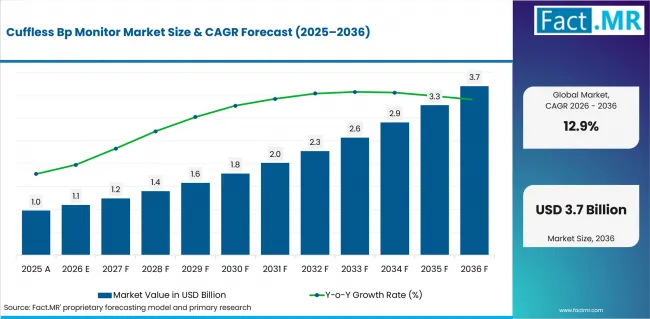
Cuffless Bp Monitor Market Value Analysis | Source: Fact.MR
What are the defining numbers behind Cuffless BP Monitor Market growth?
USD 2,600.0 million absolute opportunity is expected by 2036.
- Demand Drivers in the Market
- PPG leads because optical sensors are already common in wearable devices. The technology gives device makers a practical route to cuffless readings when paired with calibration and algorithms.
- Wearable blood pressure monitors gain share because users want readings without interrupting daily activity for a cuff measurement.
- Hospitals and clinics remain important because clinical acceptance depends on validation, calibration guidance and confidence in the data.
- Online sales lead as consumers compare wearable devices, app features and reviews before purchase.
- Key Segments Analyzed
- By Technology: Photoplethysmography (PPG) is expected to hold 43.8% share in 2026 because optical sensing is already used in wearable health devices and can support cuffless measurement workflows.
- By Device Type: Wearable Blood Pressure Monitors are expected to hold 38.7% share in 2026 because wearables fit daily monitoring better than occasional cuff-based checks.
- By End User: Hospitals & Clinics are expected to hold 35.3% share in 2026 because clinical users influence validation, follow-up and patient trust.
- By Distribution Channel: Online Sales is expected to hold 35.1% share in 2026 because consumers often research and buy connected health devices online.
- By Application: Hypertension Monitoring is expected to hold 35.0% share in 2026 because blood pressure tracking is the clearest clinical and consumer use case.
- Analyst Opinion at Fact.MR
- Shambhu Nath Jha, Sr. Consultant at Fact.MR, states, "Cuffless monitoring will be judged on confidence, not convenience alone. Device makers need to show how readings are calibrated, when users should confirm with a cuff and how clinicians can interpret the data."
- Strategic Implications
- Manufacturers should keep validation evidence and calibration instructions visible because these decide clinical trust.
- Digital health platforms can build value by turning frequent readings into simple trends and alerts rather than raw data overload.
- Retailers and online sellers should separate cuffless BP claims from general wellness features to reduce buyer confusion.
- USA is projected at 16.7%; South Korea is projected at 13.8%; UK is projected at 12.9%; Germany is projected at 12.5%; Canada is projected at 12.3%; Australia is projected at 12.2%; Japan is projected at 12.0% during 2026 to 2036. Country analysis is shaped by hypertension burden, wearable adoption and clinical validation requirements.
How does the Cuffless BP Monitor Market break down by segment?
Photoplethysmography (PPG) leads Technology at 43.8% share in 2026, while Wearable Blood Pressure Monitors leads Device Type at 38.7% share.
Why does Photoplethysmography (PPG) lead Technology?
Photoplethysmography (PPG) is expected to account for 43.8% share in 2026.
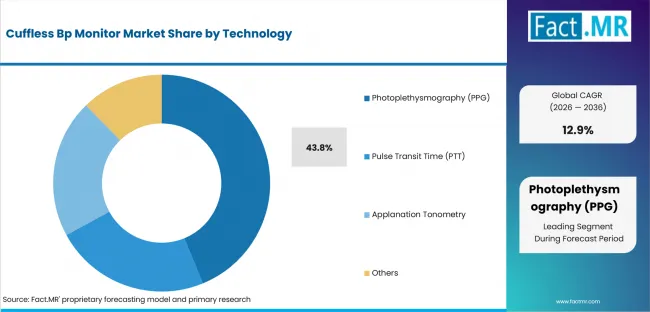
Cuffless Bp Monitor Market Analysis By Technology | Source: Fact.MR
Photoplethysmography (PPG) leads the technology segment because optical sensing is already used in wearable health devices and can support cuffless measurement workflows.
Why do Wearable Blood Pressure Monitors lead the Device Type segment?
Wearable Blood Pressure Monitors are expected to account for 38.7% share in 2026.
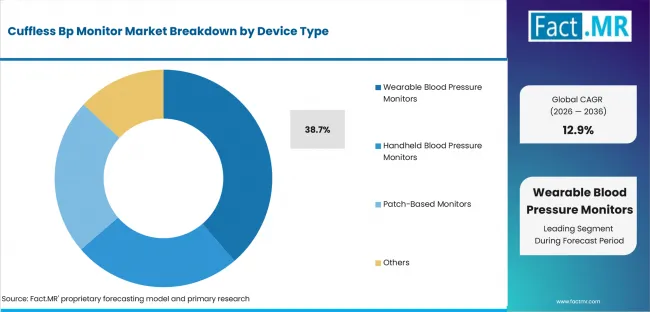
Cuffless Bp Monitor Market Analysis By Device Type | Source: Fact.MR
Wearable Blood Pressure Monitors lead the device type segment because wearables fit daily monitoring better than occasional cuff-based checks.
Why do Hospitals & Clinics lead the End User segment?
Hospitals & Clinics are expected to account for 35.3% share in 2026.
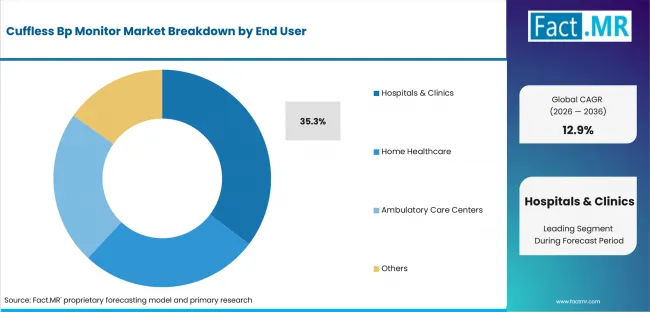
Cuffless Bp Monitor Market Analysis By End User | Source: Fact.MR
Hospitals & Clinics lead the end user segment because clinical users influence validation, follow-up and patient trust.
Why does Online Sales lead Distribution Channel?
Online Sales is expected to account for 35.1% share in 2026.
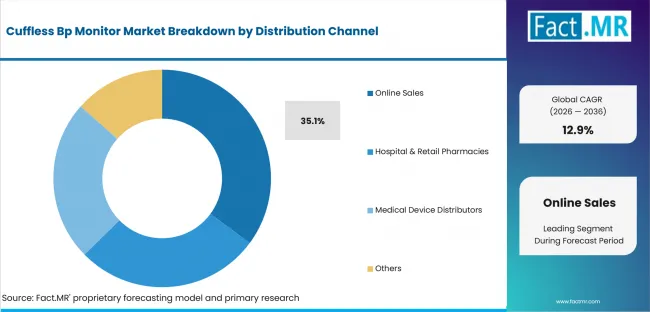
Cuffless Bp Monitor Market Analysis By Distribution Channel | Source: Fact.MR
Online Sales leads the distribution channel segment because consumers often research and buy connected health devices online.
Why does Hypertension Monitoring lead Application?
Hypertension Monitoring is expected to account for 35.0% share in 2026.
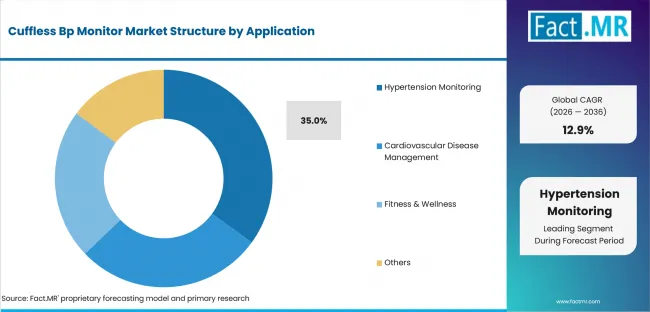
Cuffless Bp Monitor Market Analysis By Application | Source: Fact.MR
Hypertension Monitoring leads the application segment because blood pressure tracking is the clearest clinical and consumer use case.
What is accelerating Cuffless BP Monitor Market adoption, and what is holding it back?
Demand is supported by hypertension monitoring, wearable health adoption and easier online access. Growth is held back by validation concerns, calibration needs and clinician caution around consumer-grade readings.
| DRIVER | QUALITATIVE RELEVANCE | GEOGRAPHIC RELEVANCE | IMPACT TIMELINE |
|---|---|---|---|
| PPG sensor adoption | High | South Korea | Short term (<=2 years) |
| Wearable monitoring | High | USA | Short term (<=2 years) |
| Clinical acceptance | Moderate | UK | Medium term (2-4 years) |
| Online purchasing | Selective | Germany | Medium term (2-4 years) |
Source: Fact.MR analysis. Updated Jul 29, 2026
- PPG sensor adoption: Optical sensors give wearable manufacturers a scalable base for cuffless BP features.
- Wearable monitoring: Users want blood pressure trends without stopping for repeated cuff measurements.
- Clinical acceptance: Hospitals and clinics influence which devices are trusted for care decisions.
- Online purchasing: Connected health buyers compare features, reviews and app compatibility before purchase.
Opportunity Impact Analysis
| OPPORTUNITY | QUALITATIVE RELEVANCE | GEOGRAPHIC RELEVANCE | IMPACT TIMELINE |
|---|---|---|---|
| Clinically validated wearable models | High | South Korea | Medium term (2-4 years) |
| Remote patient monitoring programs | Moderate | USA | Medium term (2-4 years) |
| App-based coaching and alerts | Selective | UK | Medium term (2-4 years) |
Source: Fact.MR analysis. Updated Jul 29, 2026
- Clinically validated wearable models can separate serious devices from wellness-only products.
- Remote patient monitoring programs can use cuffless readings for trend review when workflows are clearly defined.
- App-based coaching and alerts can make frequent BP data easier for users to act on.
Restraints Impact Analysis
| RESTRAINT | QUALITATIVE RELEVANCE | GEOGRAPHIC RELEVANCE | IMPACT TIMELINE |
|---|---|---|---|
| Accuracy validation concerns | High | South Korea | Short term (<=2 years) |
| Calibration requirements | Moderate | USA | Medium term (2-4 years) |
| Regulatory and clinical-review expectations | Selective | UK | Medium term (2-4 years) |
Source: Fact.MR analysis. Updated Jul 29, 2026
- Accuracy concerns slow adoption when cuffless readings are not validated for the intended user group.
- Calibration requirements can create friction for users expecting a fully passive device.
- Regulatory and clinical-review expectations raise development cost for medical-grade claims.
Which countries are scaling Cuffless BP Monitor Market fastest?
The global CAGR is 12.9%. Country rates show how hypertension burden, wearable adoption and clinical validation requirements change the adoption route by market.
- USA records the highest listed CAGR at 16.7% from 2026 to 2036.
- South Korea and the UK also sit near the upper end of the comparison.
- Germany, Canada, Australia, and Japan grow more steadily as buyers weigh cost, availability and adoption risk.
The full regional view covers North America, Latin America, Europe, East Asia, South Asia and Oceania, and the Middle East and Africa.
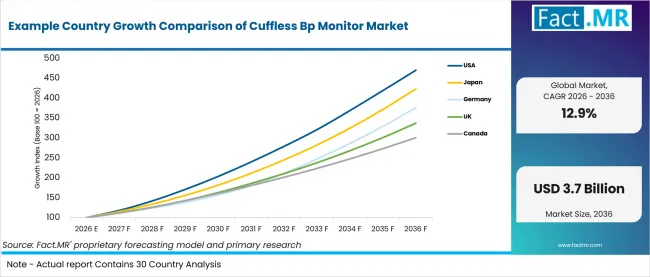
Example Country Growth Comparison Of Cuffless Bp Monitor Market | Source: Fact.MR
| COUNTRY | CAGR, 2026 to 2036 |
|---|---|
| South Korea | 13.8% |
| USA | 16.7% |
| UK | 12.9% |
| Germany | 12.5% |
| Canada | 12.3% |
| Australia | 12.2% |
| Japan | 12.0% |
Source: Fact.MR analysis. Updated Jul 29, 2026
What is shaping South Korea's outlook through 2036?
South Korea is projected at 13.8% CAGR during 2026 to 2036, above the global 12.9% trajectory. Strong consumer electronics adoption and digital health interest support faster cuffless-monitor uptake.
What is shaping USA's outlook through 2036?
USA is projected at 16.7% CAGR during 2026 to 2036, above the global 12.9% trajectory. Remote patient monitoring, hypertension prevalence and online device sales support demand.
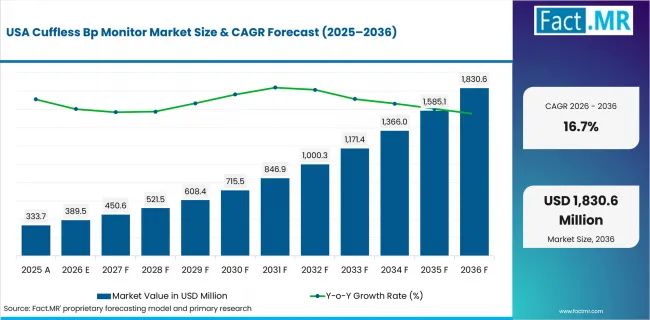
Cuffless Bp Monitor Market Country Value Analysis | Source: Fact.MR
What is shaping UK's outlook through 2036?
UK is projected at 12.9% CAGR during 2026 to 2036, in line with the global 12.9% trajectory. Clinical pathway discipline keeps validation and care integration central to adoption.
What is shaping Germany's outlook through 2036?
Germany is projected at 12.5% CAGR during 2026 to 2036, below the global 12.9% trajectory. Buyers scrutinize device accuracy, data privacy and reimbursement fit before scaling.
What is shaping Canada's outlook through 2036?
Canada is projected at 12.3% CAGR during 2026 to 2036, below the global 12.9% trajectory. Remote-care needs support monitoring tools, while clinical validation still shapes uptake.
What is shaping Australia's outlook through 2036?
Australia is projected at 12.2% CAGR during 2026 to 2036, below the global 12.9% trajectory. Distance from clinics increases interest in home monitoring and connected care.
What is shaping Japan's outlook through 2036?
Japan is projected at 12.0% CAGR during 2026 to 2036, below the global 12.9% trajectory. Aging population needs and wearable quality expectations support measured adoption.
Who leads the Cuffless BP Monitor Market?
Aktiia SA (Hilo) and Biobeat Technologies Ltd. offer dedicated cuffless blood pressure monitoring systems. Samsung Electronics Co., Ltd. offers a Galaxy Watch blood pressure feature that performs cuffless measurements after calibration with an upper-arm monitor.
Competition is shaped by measurement accuracy, calibration, clinical validation, wearable design and app usability.
Through 2036, competitive gains are expected to come from clearer positioning around Photoplethysmography (PPG) and stronger execution in the highest-growth country markets.
Which companies are the key providers?
Key companies include Aktiia SA (Hilo); Samsung Electronics Co., Ltd.; Biobeat Technologies Ltd.
- Aktiia SA (Hilo)
- Samsung Electronics Co., Ltd.
- Biobeat Technologies Ltd.
Bibliography
- U.S. Food and Drug Administration: Cuffless non-invasive blood pressure measuring devices - clinical performance testing and evaluation.
- U.S. Food and Drug Administration: IEEE Std 1708-2014 for wearable, cuffless blood pressure measuring devices.
- U.S. Food and Drug Administration: Do not use unauthorized devices for measuring blood pressure.
This Report Addresses
- The report evaluates the Cuffless BP Monitor Market through Technology and Device Type choices that define the 2026 market structure.
- Segment analysis covers Photoplethysmography (PPG) and Wearable Blood Pressure Monitors as the leading 2026 positions.
- Country outlook compares the listed markets by CAGR and explains how hypertension burden, wearable adoption and clinical validation requirements shape local demand.
- Competitive analysis profiles the named providers and evaluates competition around measurement accuracy, calibration, clinical validation, wearable design and app usability.
What does the Cuffless BP Monitor Market cover?
The Cuffless BP Monitor Market covers cuffless blood pressure monitoring devices and related digital tools used for hypertension tracking, home monitoring, clinical follow-up and wearable health use.
The market includes authorized medical devices and clearly identified monitoring features intended to estimate blood pressure without an inflatable arm cuff.
What is included in the scope?
The scope includes technology, device type, end user, distribution channel, application and regional demand for cuffless BP monitors.
Coverage also includes adjacent segment options when they are purchased for the same defined market use.
What is excluded from the scope?
The scope excludes standard cuff-based monitors, general fitness trackers without blood pressure capability and unrelated cardiovascular devices.
How Was the Analysis Built?
The analysis combines primary research with desk research focused on the cuffless BP monitor market, its segment structure and country-level demand.
- Primary Research: Interviews and validation discussions test buyer priorities, adoption barriers, pricing logic and operating requirements.
- Desk Research: The assessment reviews company disclosures, public datasets, regulatory material, technical literature and industry records relevant to the market.
- Market Sizing and Forecasting: Estimates combine top-down and bottom-up checks across demand signals, segment shares, country activity, company participation and adoption constraints.
Segmentation
What is the report's scope and coverage?
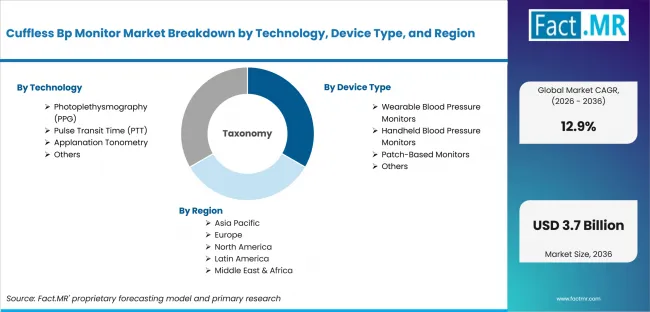
Cuffless Bp Monitor Market Breakdown By Technology, Device Type, And Region | Source: Fact.MR
| Attribute | Details |
|---|---|
| Quantitative Units | USD 1,100.0 million in 2026 to USD 3,700.0 million by 2036 at 12.9% CAGR |
| Market Definition | The Cuffless BP Monitor Market covers devices and related digital tools that estimate or monitor blood pressure without an inflatable arm cuff, including wearable, patch-based and sensor-fusion systems for clinical and home use. |
| Technology | Photoplethysmography (PPG); Optical PPG Sensors; Multi-Wavelength PPG; Pulse Transit Time (PTT); ECG-PPG Based; Dual Sensor PTT; Applanation Tonometry; Radial Artery Tonometry; Wrist-Based Tonometry; Others; Ballistocardiography; AI-Based Sensor Fusion |
| Device Type | Wearable Blood Pressure Monitors; Smartwatches; Fitness Bands; Handheld Blood Pressure Monitors; Portable Digital Monitors; Pocket-Sized Devices; Patch-Based Monitors; Disposable Patches; Reusable Patches; Others; Smart Rings; Ear-Worn Devices |
| End User | Hospitals & Clinics; Hospitals; Specialty Clinics; Home Healthcare; Chronic Disease Monitoring; Elderly Care; Ambulatory Care Centers; Outpatient Centers; Diagnostic Centers; Others; Research Institutes; Sports & Fitness Centers |
| Distribution Channel | Online Sales; E-commerce Platforms; Manufacturer Websites; Hospital & Retail Pharmacies; Hospital Pharmacies; Retail Pharmacy Chains; Medical Device Distributors; National Distributors; Regional Distributors; Others; Specialty Stores; Direct Sales |
| Application | Hypertension Monitoring; Continuous Blood Pressure Monitoring; Remote Patient Monitoring; Cardiovascular Disease Management; Heart Failure Monitoring; Post-Operative Monitoring; Fitness & Wellness; Personal Health Tracking; Athlete Monitoring; Others; Clinical Research; Occupational Health Monitoring |
| Regions Covered | North America; Latin America; Europe; East Asia; South Asia and Oceania; Middle East and Africa |
| Countries Covered | 30+ countries, including South Korea, USA, UK, Germany, Canada, Australia, and Japan |
| Key Companies Profiled | Aktiia SA (Hilo); Samsung Electronics Co., Ltd.; Biobeat Technologies Ltd. |
| Forecast Period | 2026 to 2036 |
| Approach | Hybrid top-down and bottom-up assessment using demand indicators, segment mix, country growth, company participation and public evidence relevant to the category. |
Source: Fact.MR analysis. Updated Jul 29, 2026
How is the market segmented?
-
By Technology:
- Photoplethysmography (PPG)
- Optical PPG Sensors
- Multi-Wavelength PPG
- Pulse Transit Time (PTT)
- ECG-PPG Based
- Dual Sensor PTT
- Applanation Tonometry
- Radial Artery Tonometry
- Wrist-Based Tonometry
- Others
- Ballistocardiography
- AI-Based Sensor Fusion
-
By Device Type:
- Wearable Blood Pressure Monitors
- Smartwatches
- Fitness Bands
- Handheld Blood Pressure Monitors
- Portable Digital Monitors
- Pocket-Sized Devices
- Patch-Based Monitors
- Disposable Patches
- Reusable Patches
- Others
- Smart Rings
- Ear-Worn Devices
-
By End User:
- Hospitals & Clinics
- Hospitals
- Specialty Clinics
- Home Healthcare
- Chronic Disease Monitoring
- Elderly Care
- Ambulatory Care Centers
- Outpatient Centers
- Diagnostic Centers
- Others
- Research Institutes
- Sports & Fitness Centers
-
By Distribution Channel:
- Online Sales
- E-commerce Platforms
- Manufacturer Websites
- Hospital & Retail Pharmacies
- Hospital Pharmacies
- Retail Pharmacy Chains
- Medical Device Distributors
- National Distributors
- Regional Distributors
- Others
- Specialty Stores
- Direct Sales
-
By Application:
- Hypertension Monitoring
- Continuous Blood Pressure Monitoring
- Remote Patient Monitoring
- Cardiovascular Disease Management
- Heart Failure Monitoring
- Post-Operative Monitoring
- Fitness & Wellness
- Personal Health Tracking
- Athlete Monitoring
- Others
- Clinical Research
- Occupational Health Monitoring
-
By Region:
- North America
- Latin America
- Europe
- East Asia
- South Asia and Oceania
- Middle East and Africa
Frequently Asked Questions
Which Technology leads the Cuffless BP Monitor Market?
Which Device Type leads the Cuffless BP Monitor Market?
Which End User leads the Cuffless BP Monitor Market?
Which Distribution Channel leads the Cuffless BP Monitor Market?
Which Application leads the Cuffless BP Monitor Market?
How does South Korea perform in the Cuffless BP Monitor Market?
How does USA perform in the Cuffless BP Monitor Market?
How does UK perform in the Cuffless BP Monitor Market?
What is the primary driver in the Cuffless BP Monitor Market?
What is the main restraint in the Cuffless BP Monitor Market?
Who worked on this report


Preview the report firsthand - request a free sample
Free SampleGet the brochure for pricing and purchase details
Download PDF