- Market Value (2025): USD 461.3 Mn
- Estimated Value (2026): USD 560.0 Mn
- Forecast Value (2036): USD 3893.8 Mn
- CAGR (2026-2036): 21.4%
What is the Cultivated Cell Culture Media Market forecast to be worth by 2036?
USD 560.0 million in 2026 to USD 3,893.8 million by 2036 at a 21.4% CAGR.
- The Cultivated Cell Culture Media Market reached USD 461.3 million in 2025.
- Demand is projected to increase from USD 560.0 million in 2026 to USD 3,893.8 million by 2036.
- The market is forecast to record 21.4% CAGR from 2026 to 2036 as cultivated meat developers and ingredient companies shift toward defined media that can support repeatable production runs.
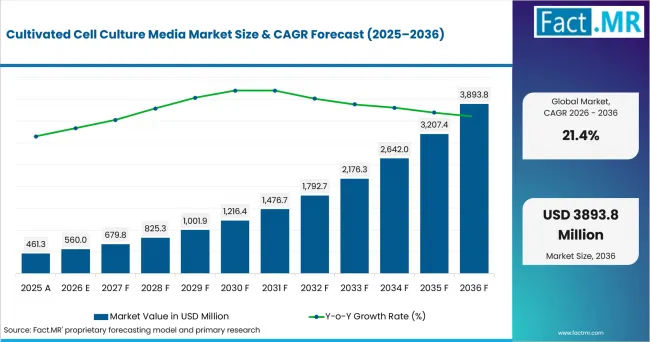
Cultivated Cell Culture Media Market Value Analysis | Source: Fact.MR
What are the defining numbers behind Cultivated Cell Culture Media Market growth?
An absolute opportunity of USD 3,333.8 million is expected between 2026 and 2036.
- Demand Drivers in the Market
- Cultivated meat producers are evaluating serum-free media to reduce reliance on animal-derived inputs.
- Media formulators need lower-cost growth factors and cytokines because these inputs shape proliferation economics.
- Scale-up teams need feed concentrates and basal blends that behave consistently across seed train and pilot stages.
- Cell-line developers need bovine, poultry and porcine formulations tuned to different cell behaviors. Media choice affects attachment and proliferation, so application support gains value when customers test more than one species platform.
- Key Segments Analyzed
- By Media Component: Basal media is expected to hold 35.0% share in 2026 because every cultivated-cell workflow needs a nutrient base before supplements are optimized.
- By Serum Strategy: Serum-free defined is projected to account for 49.0% share in 2026 owing to documentation needs and lower animal-component exposure.
- By Production Stage: Cell proliferation is anticipated to capture 46.0% share in 2026 supported by repeated cell expansion before differentiation and harvest.
- By Cell and Species Focus: Bovine is estimated to represent 34.0% share in 2026 due to early cultivated beef and fat programs that require tuned growth media.
- Analyst Opinion at Fact.MR
- Shambhu Nath Jha, Principal Consultant at Fact.MR, states, “The commercial test for cultivated media is moving beyond whether cells grow in a flask. Producers are expected to ask whether the same formula supports food-grade documentation, stable yields and lower input cost at pilot scale. Media providers should combine serum-free design, growth-factor cost control and species-specific validation.”
- Strategic Implications
- Media suppliers should build formulation files that show component origin, concentration ranges and change-control history for regulatory review.
- Growth-factor producers should lower cost per gram through recombinant expression routes and provide activity data for cultivated meat cell lines.
- Cultivated meat developers should qualify basal media and supplements early so scale-up work avoids repeated reformulation delays.
- Contract manufacturers should align media handling with food-grade quality systems and batch records used during pre-market consultation work.
The USA is projected to record 24.2% CAGR through 2036 due to FDA consultation activity and food R&D scale. The Netherlands is expected to post 22.9% CAGR owing to cellular-agriculture funding and open scale-up infrastructure. Israel is anticipated to advance at 21.4% CAGR supported by bio-convergence programs that include cultivated meat technologies. Singapore is estimated to hold 20.3% CAGR shaped by novel-food research funding and safety review capability. South Korea is forecast to reach 19.3% CAGR reinforced by food-tech policy and cell-culture food standard setting.
How does the Cultivated Cell Culture Media Market break down by segment?
Basal media leads Media Component at 35.0% share in 2026; Serum-free defined leads Serum Strategy at 49.0% share.
Which Media Component dominates?
Basal media holds 35.0% share in 2026.
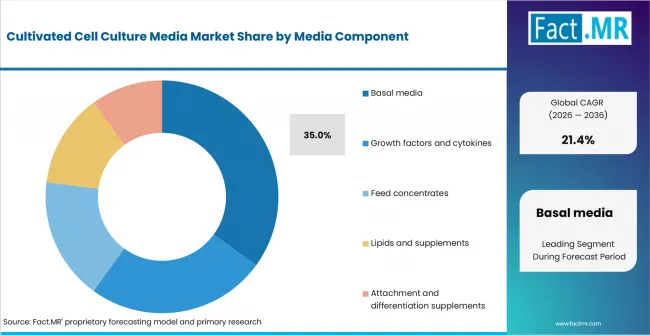
Cultivated Cell Culture Media Market Analysis By Media Component | Source: Fact.MR
Basal media is expected to hold 35.0% share in 2026 because it provides the nutrient base for every cultivated-cell workflow. Growth factors and cytokines carry higher unit value, yet their use depends on the basal formula. Feed concentrates gain relevance during longer proliferation runs. Lipids and attachment supplements help harder-to-grow lines move from plates to stirred systems.
What leads the Serum Strategy segment?
Serum-free defined accounts for 49.0% share in 2026.
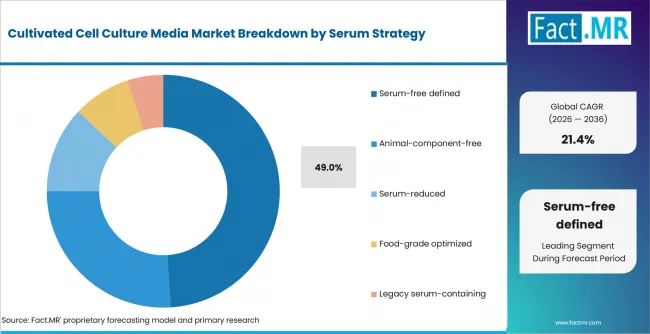
Cultivated Cell Culture Media Market Analysis By Serum Strategy | Source: Fact.MR
Serum-free defined media is projected to account for 49.0% share in 2026 due to traceability and batch consistency needs. Animal-component-free formulas attract food developers seeking cleaner component files. Multus introduced Proliferum P in June 2025 for porcine adipose-derived stem cells, giving developers a commercial animal-component-free formulation.
How does Production Stage shape demand?
Cell proliferation holds 46.0% share in 2026.
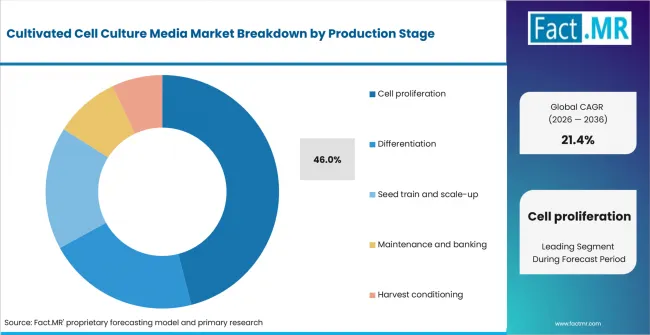
Cultivated Cell Culture Media Market Analysis By Production Stage | Source: Fact.MR
Cell proliferation is anticipated to capture 46.0% share in 2026 supported by repeated expansion before differentiation. Differentiation media shapes texture and fat development. Seed train media gains attention when developers move from flasks to bioreactors. Maintenance media supports cell banks across product programs.
What supports Bovine within Cell and Species Focus?
Bovine leads with 34.0% share in 2026.
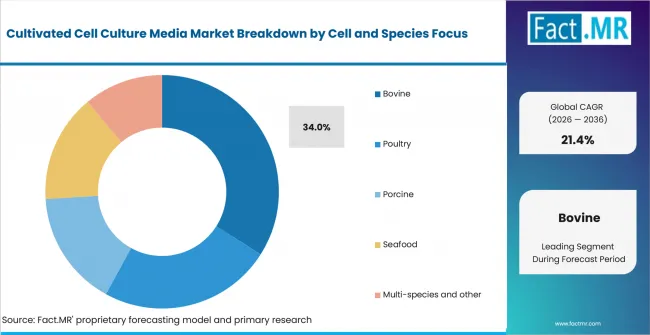
Cultivated Cell Culture Media Market Analysis By Cell And Species Focus | Source: Fact.MR
Bovine media is estimated to represent 34.0% share in 2026 owing to cultivated beef and fat programs that need muscle and adipose support. Poultry media benefits from chicken biomass work. Porcine programs need lower-cost adipose performance. Seafood media rises from salmon and specialty fish programs.
What is accelerating Cultivated Cell Culture Media Market adoption, and what is holding it back?
Serum-free qualification drives it; growth-factor cost restrains it.
Drivers Impact Analysis
| DRIVER | (~) % IMPACT ON CAGR | GEOGRAPHIC RELEVANCE | IMPACT TIMELINE |
|---|---|---|---|
| Serum-free media qualification for cultivated meat producers | +2.4% | Global | Short term (<= 2 years) |
| Growth factor and cytokine cost reduction | +1.8% | USA, Israel, Netherlands | Medium term (2-4 years) |
| Food-grade basal media scale-up | +1.4% | Western Europe, Singapore | Medium term (2-4 years) |
| Species-specific media for bovine, poultry and seafood | +1.0% | Global | Long term (>= 4 years) |
Source: Fact.MR analysis. Updated Sep 3, 2026
- Serum-free media qualification: Producers are expected to favor defined formulas that reduce animal-origin variability and support cleaner ingredient documentation. Serum-free systems can improve consistency and simplify qualification as cultivated-protein developers move toward more controlled production workflows.
- Growth factor and cytokine cost reduction: Cost pressure is shifting attention toward recombinant proteins, optimized supplementation, and lower-dose formulations. Media suppliers that reduce dependence on expensive growth factors can improve scalability and strengthen the commercial viability of cultivated-cell production.
- Food-grade basal media scale-up: Basal media gain importance as developers move from research workflows toward food-grade production systems. Scalable formulations with consistent nutrient delivery, documented ingredients, and manufacturing compatibility can support the transition from laboratory development to larger cultivation volumes.
- Species-specific media design: Bovine, poultry, porcine, and seafood cells respond differently to nutrients, attachment conditions, and growth signals. Media portfolios are therefore expanding as developers optimize formulations for different cell types, tissue targets, texture requirements, and production yields.
Opportunity Impact Analysis
| OPPORTUNITY | (~) % IMPACT ON CAGR | GEOGRAPHIC RELEVANCE | IMPACT TIMELINE |
|---|---|---|---|
| Food-grade defined media outsourcing | +1.5% | Global | Medium term (2-4 years) |
| Growth-factor replacement through plant-derived inputs | +1.1% | Asia, North America | Short term (<= 2 years) |
| Open scale-up facilities for pilot testing | +0.8% | Netherlands, Singapore | Long term (>= 4 years) |
Source: Fact.MR analysis. Updated Sep 3, 2026
- Food-grade defined media outsourcing: Cultivated meat developers are expected to rely on external media specialists when internal teams focus on cell-line performance and scale-up biology. Defined-media vendors can support formulation documentation, batch consistency, and manufacturing records needed for commercial production.
- Growth-factor replacement: Plant-derived and recombinant alternatives can reduce reliance on expensive animal-derived growth inputs. Ingredient suppliers that develop lower-cost signaling and supplementation systems can help improve media economics while supporting more consistent and scalable cultivated-cell production.
- Open scale-up facilities: Shared pilot and demonstration infrastructure can help smaller cultivated-meat developers test media beyond laboratory scale. Access to larger cultivation systems supports process validation, formulation adjustment, and scale-up learning without requiring every developer to build dedicated facilities.
Restraints Impact Analysis
| RESTRAINT | (~) % IMPACT ON CAGR | GEOGRAPHIC RELEVANCE | IMPACT TIMELINE |
|---|---|---|---|
| High growth-factor input cost | -0.8% | Global | Short term (<= 2 years) |
| Regulatory review of media inputs | -0.6% | USA, Singapore, Europe | Medium term (2-4 years) |
| Cell-line specific performance variability | -0.4% | Global | Long term (>= 4 years) |
Source: Fact.MR analysis. Updated Sep 3, 2026
- High growth-factor input cost: Growth factors remain a major cost component in many serum-free media formulations. Cost reduction depends on recombinant production, alternative signaling molecules, and lower-dose media design that preserves cell growth and productivity.
- Regulatory review of media inputs: Food agencies assess how cultured animal cells are produced and which media ingredients are used during cultivation. Developers therefore need clear documentation on ingredient identity, safety, sourcing, and process use before commercial approval.
- Cell-line specific performance variability: A media formulation that performs well for one cell type may require adjustment for another. This variability increases the need for custom optimization, species-specific formulation work, and application support during scale-up.
Which countries are scaling the Cultivated Cell Culture Media Market through 2036?
- The country comparison spans 4.92 percentage points and forms three practical growth bands across the forecast period.
- The USA remains 1.28 percentage points above the Netherlands through FDA consultation activity and a large food R&D base.
- The Netherlands remains 1.50 percentage points above Israel owing to cellular-agriculture funding and open scale-up infrastructure.
- Israel remains 1.07 percentage points above Singapore supported by bio-convergence programs that include cultivated meat technology.
- Singapore remains 1.07 percentage points above South Korea through future-food funding and novel-food safety capability.
- South Korea closes the displayed range through food-tech policy and cell-culture food standard development.
Comparable CAGRs create different entry conditions due to regulator engagement, scale-up access, media input cost and species focus. Full report coverage includes North America, Latin America, Western Europe, Eastern Europe, East Asia, South Asia & Pacific, Middle East & Africa.
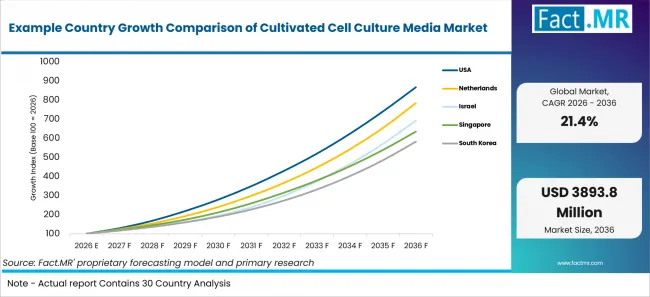
Example Country Growth Comparison Of Cultivated Cell Culture Media Market | Source: Fact.MR
| Country | CAGR (2026-2036) |
|---|---|
| United States | 24.2% |
| Netherlands | 22.9% |
| Israel | 21.4% |
| Singapore | 20.3% |
| South Korea | 19.3% |
Source: Fact.MR analysis. Updated Sep 3, 2026
What supports USA adoption?
24.2% CAGR, supported by FDA consultation activity and food R&D scale.
U.S. developers operate in a market where food spending supports interest in new protein systems. The USA is projected to record 24.2% CAGR through 2036. USDA Economic Research Service reported in June 2026 that inflation-adjusted U.S. food spending by consumers, businesses and government entities reached USD 2.51 trillion in 2025.
How is the Netherlands scaling demand?
22.9% CAGR, driven by cellular-agriculture funding and open scale-up facilities.
The Netherlands is building a public cellular-agriculture base around research and scale-up access. Growth is expected to post 22.9% CAGR through 2036. Government.nl published the Dutch vision on biotechnology in April 2025 and stated that the country is investing in cellular agriculture, including precision fermentation and cultured meat.
What supports Israel growth?
21.4% CAGR, backed by bio-convergence investment and growth-factor work.
Israel connects cultivated meat with a wider bio-convergence program that links engineering and biology. The market is anticipated to advance at 21.4% CAGR through 2036. Israel Innovation Authority reported in April 2026 that direct investment in bio-convergence startups reached approximately NIS 350 million. The same programme separately reports cultivated-meat R&D involving high-rate cell growth, lower-cost media and cost-effective growth factors.
How is Singapore developing demand?
20.3% CAGR, shaped by alternative-protein funding and safety review capacity.
Singapore uses public food-security programs to support cultivated meat and lab-grown seafood research. Demand is estimated to hold 20.3% CAGR through 2036. The Ministry of Sustainability and the Environment said in February 2026 that SFA had awarded SGD 64 million to 21 multi-year projects since 2024 under RIE2025 to support alternative-protein R&D and capability development.
What underpins South Korea performance?
19.3% CAGR, supported by food-tech policy and cell-culture food standards.
South Korea is connecting food-tech policy with technology training and regulatory development. The market is forecast to reach 19.3% CAGR through 2036. MAFRA reported in July 2026 that cumulative government food-tech policy funds would rise from KRW 51 billion in 2024 to KRW 81 billion in 2026. This demonstrates broader food-tech policy support rather than a cell-culture-media-specific funding programme.
Who leads the Cultivated Cell Culture Media Market?
Thermo Fisher Scientific and Merck KGaA lead broad media coverage, while Sartorius and Cytiva strengthen process support.
Thermo Fisher Scientific is active through Gibco™ cell-culture media, supplements and recombinant growth-factor tools used across cell-culture and bioprocess workflows. Merck KGaA participates through its Life Science portfolio, providing cell-culture media, scale-up and process-development support for cultured meat and broader biotechnology applications.
Sartorius expanded its Illkirch site in September 2025 to more than 8,000 square meters across production, laboratory and office space, adding GMP manufacturing capacity for components used in cell and gene therapies. The announcement demonstrates broader bioprocess manufacturing capacity rather than cultivated-meat media production.
Cytiva provides HyClone™ cell-culture media, supplements and broader bioprocess media capabilities. Its first-party materials establish general cell-culture and large-scale bioprocessing capability, so Cytiva can be profiled as an adjacent supplier where these capabilities overlap with cultivated-food media requirements.
Multus Biotechnology specializes in animal-component-free media relevant to cultivated meat and introduced Proliferum® P in June 2025 for porcine adipose-derived stem cells. Competitive differentiation can be assessed through factors such as media cost, food-grade and regulatory readiness, scalable supply, and cell-specific performance.
Which companies are the key providers?
Key companies include Thermo Fisher Scientific, Merck KGaA, Sartorius, Cytiva, and Multus Biotechnology.
- Thermo Fisher Scientific
- Merck KGaA
- Sartorius
- Cytiva
- Multus Biotechnology
Bibliography
- Ajinomoto Co., Inc. (2026, April 16). Ajinomoto Co. develops new technology to reduce culture media costs for cultivated meat production utilizing plant-derived components: Toward the practical adoption of safe, reliable, and affordable cultivated meat.
- Government of the Netherlands. (2025, April 11). Dutch vision on biotechnology 2025-2040. Government.nl.
- Israel Innovation Authority. (2026, April 13). Investment in National Bio-Convergence Program surges.
- Merck KGaA. (2024, August). Insights into scale-up collaboration for Cultured Meat companies & Merck.
- Ministry of Agriculture, Food and Rural Affairs. (2026, July 20). S. Korea unveils master plan to integrate advanced technologies into the food sector.
- Ministry of Sustainability and the Environment. (2026, February 26). Written reply to parliamentary question on lab-grown seafood and cultured meat sector.
- Multus Biotechnology. (2025, June 30). Multus introduces Proliferum® P: First commercial serum replacement for porcine adipose-derived stem cells.
- Sartorius AG. (2025, September 18). Sartorius expands production of key components for cell and gene therapies in France.
- Singapore Food Agency. (2025, November 4). SFA commits $42 million to drive breakthroughs in future foods and food safety.
- U.S. Food and Drug Administration. (2025, March 7). FDA completes pre-market consultation for human food made with cultured pork fat cells.
- Zeballos, E., & Sinclair, W. (2026, June 11). Total U.S. food spending reached $2.51 trillion in 2025. Economic Research Service, U.S. Department of Agriculture.
This Report Answers
- The report explains cultivated cell culture media use across media component and serum strategy. It covers production stage, species focus and region.
- Segment analysis identifies the leading subsegments and the reasons producers prioritize them during cell growth and scale-up.
- Country analysis examines the listed markets and the policy mechanisms supporting media qualification.
- Competitive analysis reviews providers across basal media, supplements, growth factors and animal-free media design.
- Application analysis assesses how proliferation needs and species-specific performance influence supplier selection.
What does the Cultivated Cell Culture Media Market cover?
The Cultivated Cell Culture Media Market covers commercial media, supplements and media inputs used to grow animal cells for cultivated meat and seafood. It includes basal media, feed concentrates, growth factors, cytokines, lipids and attachment or differentiation supplements used in food-oriented cell culture.
The assessment separates cultivated food media from broader biopharma media by focusing on food-grade suitability, input cost and cell growth at pilot scale. Research-only media remains within scope when suppliers position it for cultivated meat formulation and scale-up testing.
What is included in the scope?
The scope includes cultivated food media and related formulations that overlap with broader cell culture media when the product is used for animal-cell growth in food applications. Cultivated media grades coverage helps define the boundary between research recipes and documented food-grade inputs used in pilot production.
The scope includes basal media, serum-free systems, animal-component-free formulations and recombinant inputs such as growth factors when they are sold for cultivated-cell production. It covers media components for bovine, poultry, porcine and seafood cells, including related cell culture supplements used to support proliferation and differentiation.
What is excluded from the scope?
The scope excludes complete cultivated meat products, bioreactors, scaffolds, cell lines sold independently and finished food brands. General biopharma media is outside scope unless the product is positioned for cultivated meat, seafood or cellular agriculture formulation work.
Fermentation media for microbes and plant-cell media are outside scope unless they are bundled with a cultivated animal-cell program. Diagnostic cell culture reagents and clinical cell therapy media remain separate categories when sold for medical use.
How Was the Analysis Built?
The analysis draws on 120+ sources, 35+ company portfolios, 25+ countries, and more than 20 industry interviews.
- Primary Research: Primary research includes discussions with manufacturers, service providers, technology developers, distributors, end users, and subject-matter experts. These conversations examine purchasing priorities, product adoption, operational challenges, approval requirements, competitive positioning, and the factors that influence wider market acceptance.
- Desk Research: Desk research covers government statistics, regulatory publications, company filings, trade data, technical studies, industry associations, standards, public policy, and other authoritative sources. Every source used in the analysis is documented in the bibliography.
- Market Sizing and Forecasting: Market estimates combine historical performance, demand indicators, pricing and volume trends, segment shares, company participation, country-level growth, adoption patterns, investment activity, and barriers to market expansion.
- Data Validation and Update Cycle: Findings are validated by comparing primary interviews with public data, company activity, regulatory changes, trade patterns, and industry developments. Regular updates review new product launches, capacity changes, partnerships, approvals, and shifts in commercial adoption.
Segmentation
What is the report’s scope and coverage?
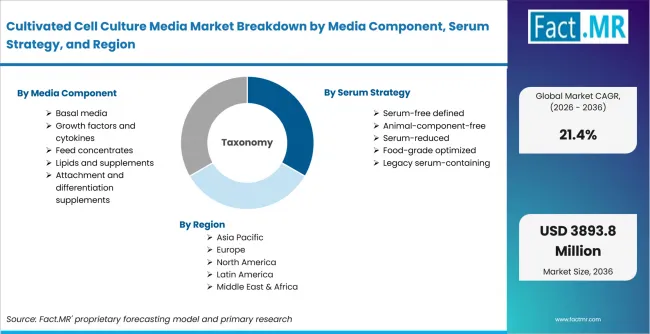
Cultivated Cell Culture Media Market Breakdown By Media Component, Serum Strategy, And Region | Source: Fact.MR
| Attribute | Details |
|---|---|
| Quantitative Units | USD million |
| Market Definition | Food-oriented cell culture media and media components used to grow animal cells for cultivated meat, seafood and related cellular agriculture applications. |
| Media Component | Basal media; Growth factors and cytokines; Feed concentrates; Lipids and supplements; Attachment and differentiation supplements |
| Serum Strategy | Serum-free defined; Animal-component-free; Serum-reduced; Food-grade optimized; Legacy serum-containing |
| Production Stage | Cell proliferation; Differentiation; Seed train and scale-up; Maintenance and banking; Harvest conditioning |
| Cell and Species Focus | Bovine; Poultry; Porcine; Seafood; Multi-species and other |
| Regions Covered | North America; Latin America; Western Europe; Eastern Europe; East Asia; South Asia & Pacific; Middle East & Africa |
| Countries Covered | United States; Netherlands; Israel; Singapore; South Korea |
| Key Companies Profiled | Thermo Fisher Scientific; Merck KGaA; Sartorius; Cytiva; Multus Biotechnology |
| Forecast Period | 2026 to 2036 |
| Approach | Hybrid top-down and bottom-up approach using cultivated meat pilot activity, media component mix, species focus, country regulation and provider portfolio review. |
Source: Fact.MR analysis. Updated Sep 3, 2026
How is the market segmented?
-
By Media Component
- Basal media
- Growth factors and cytokines
- Feed concentrates
- Lipids and supplements
- Attachment and differentiation supplements
-
By Serum Strategy
- Serum-free defined
- Animal-component-free
- Serum-reduced
- Food-grade optimized
- Legacy serum-containing
-
By Production Stage
- Cell proliferation
- Differentiation
- Seed train and scale-up
- Maintenance and banking
- Harvest conditioning
-
By Cell and Species Focus
- Bovine
- Poultry
- Porcine
- Seafood
- Multi-species and other
-
By Region
- North America
- Latin America
- Western Europe
- Eastern Europe
- East Asia
- South Asia & Pacific
- Middle East & Africa
Frequently Asked Questions
How big is the cultivated cell culture media market in 2026?
What is the CAGR of the cultivated cell culture media market from 2026 to 2036?
Which media component leads the cultivated cell culture media market?
Which serum strategy leads the cultivated cell culture media market?
Who are the leading companies in the cultivated cell culture media market?
Who worked on this report


Preview the report firsthand - request a free sample
Free SampleGet the brochure for pricing and purchase details
Download PDF