- Market Value (2025): USD 1.0 Bn
- Estimated Value (2026): USD 1.1 Bn
- Forecast Value (2036): USD 2.5 Bn
- CAGR (2026-2036): 9.1%
What is the Cultured Wheat Mold Inhibitors Market forecast to be worth by 2036?
USD 1.1 Billion in 2026 to USD 2.5 Billion by 2036, at 9.1% CAGR.
- The cultured wheat mold inhibitors market crossed USD 1.0 Billion in 2025.
- Demand is projected to rise from USD 1.1 Billion in 2026 to USD 2.5 Billion by 2036.
- The market is forecast to record 9.1% CAGR from 2026 to 2036 as bakeries use fermentation-derived inputs.
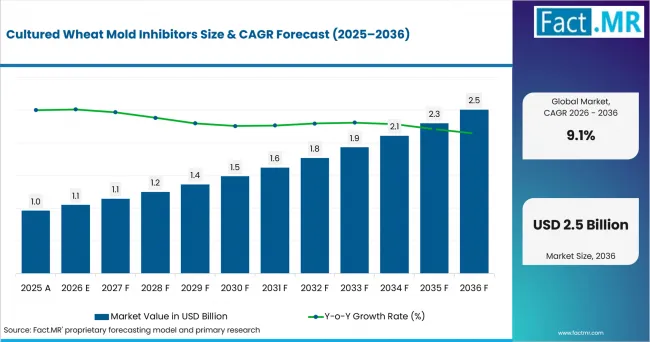
Cultured Wheat Mold Inhibitors Value Analysis | Source: Fact.MR
What are the defining numbers behind Cultured Wheat Mold Inhibitors Market growth?
USD 1.5 Billion absolute opportunity by 2036, led by cultured wheat flour, molds and bread applications.
- Demand Drivers in the Market
- Industrial bakeries need mold inhibition that protects packaged bread across longer delivery routes and store-level shelf windows.
- In June 2026, USDA ERS reported that inflation-adjusted U.S. food spending reached USD 2.51 trillion in 2025, measured in 2025 dollars, highlighting the scale of overall U.S. food expenditures.
- Private-label bakery teams need propionate alternatives that hold taste, dough handling and mold delay within retailer targets.
- Tortilla manufacturers need low-dosage fermentates since moisture and ambient distribution raise spoilage risk.
- Prepared-food brands need support where bakery carriers create mixed spoilage conditions.
- Key Segments Analyzed
- By Fermentate Type: Cultured wheat flour is expected to hold 37.0% share in 2026 because it fits flour-based labeling.
- By Target Organism: Molds are projected to account for 33.0% share in 2026, supported by visible spoilage risk.
- By Application: Bread is anticipated to capture 34.0% share in 2026, owing to repeat volumes and shelf-life needs.
- By Positioning: Clean-label preservative is estimated to represent 31.0% share in 2026, shaped by reformulation briefs.
- Analyst Opinion at Fact.MR
- Shambhu Nath Jha, Principal Consultant at Fact.MR, states, “Bakery shelf life is now tied to label language and preservative performance. The market is expected to expand where fermentates are tested as functional preservation systems. Suppliers should combine mold-strain validation, bakery trials and clean-label documentation.”
- Strategic Implications
- Ingredient vendors should document mold-strain coverage, dosage ranges and sensory impact for bread and tortillas.
- Industrial bakeries should test cultured wheat inhibitors against recipe pH, plant humidity and pack format.
- Ingredient vendors serving East Asia should align wheat-fermentate documentation with the scale of regional cereal supply. In December 2025, China’s National Bureau of Statistics reported that wheat production reached 140.07 million tons in 2025, while total cereal production reached 660.21 million tons.
- Retail bakery brands should align claim language with food-label rules before launching cleaner preservative claims.
- Formulation teams should compare wheat flour, starch and dextrose-wheat blends by gluten status and flavor carryover.
China is expected to record 10.8% CAGR through 2036, supported by bakery retail expansion. Japan is projected to post 9.2% CAGR as processed-food makers focus on shelf stability. France is anticipated to advance at 8.8% CAGR owing to cereal depth. The USA is estimated to hold 8.4% CAGR. Germany is forecast to reach 8.2% CAGR as prepared meals lift shelf-life needs.
How does the Cultured Wheat Mold Inhibitors Market break down by segment?
Cultured wheat flour leads at 37.0%; bread leads at 34.0%.
Which Fermentate Type dominates?
Cultured wheat flour holds 37.0% share in 2026.
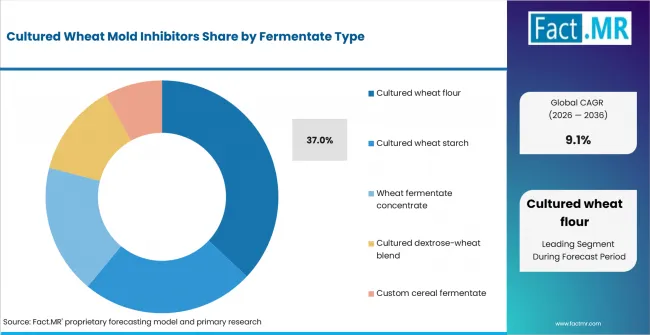
Cultured Wheat Mold Inhibitors Analysis By Fermentate Type | Source: Fact.MR
Cultured wheat flour is expected to account for 37.0% share in 2026 because it gives bakeries a familiar cereal-derived label. Cultured wheat starch supports different handling needs in dough systems. Wheat fermentate concentrate suits higher-dose applications where mold pressure is more difficult to manage.
Corbion’s April 2025 launch of VERDAD® Essence WH100 demonstrates direct cultured-wheat positioning for natural mold inhibition. The fermentation-derived solution is designed for breads, buns, tortillas and flatbreads while helping bakers extend shelf life without compromising taste or texture.
What leads the Target Organism segment?
Molds account for 33.0% share in 2026.
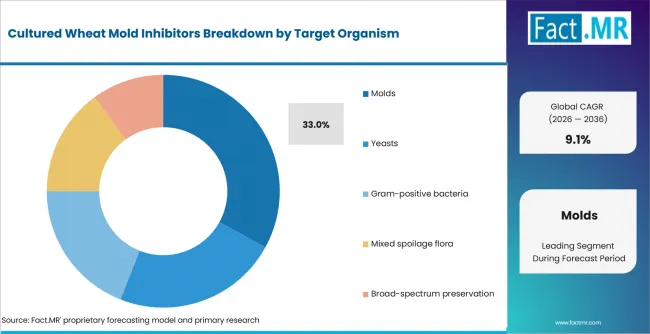
Cultured Wheat Mold Inhibitors Analysis By Target Organism | Source: Fact.MR
Molds are projected to account for 33.0% share in 2026, supported by visible spoilage risk in bread and tortillas. Yeasts remain relevant in filled bakery and prepared foods. Mixed spoilage flora requires broader testing where fillings, sauces or cheese carriers sit near bakery bases.
In its 2025 Annual Report, Kerry stated that its Bakery Shelf-Life Model, launched in 2025, predicts mould-free shelf life for bakery products. Kerry said the model helps streamline recipe formulation and reduce validation time, supporting faster evaluation of preservation approaches.
How does Application shape demand?
Bread captures 34.0% share in 2026.
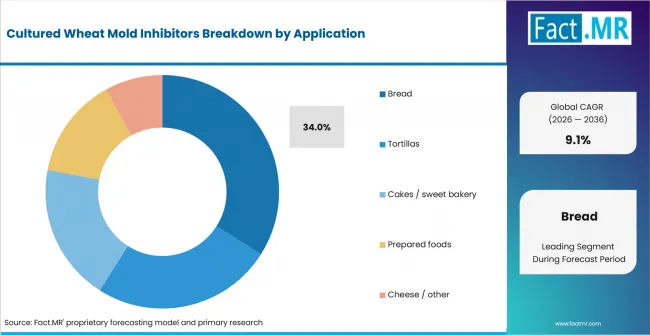
Cultured Wheat Mold Inhibitors Analysis By Application | Source: Fact.MR
Bread is anticipated to capture 34.0% share in 2026 due to repeat production and tight store-level acceptance windows. Tortillas need ambient mold control across high-moisture formats. Cakes and sweet bakery require careful flavor management because fermentates carry acidic notes.
Bread lines face costly waste when mold appears before the printed date. A validated mold-control system helps protect store-level freshness while avoiding repeated plant trials.
What supports Clean-label preservative within Positioning?
Clean-label preservative represents 31.0% share in 2026.
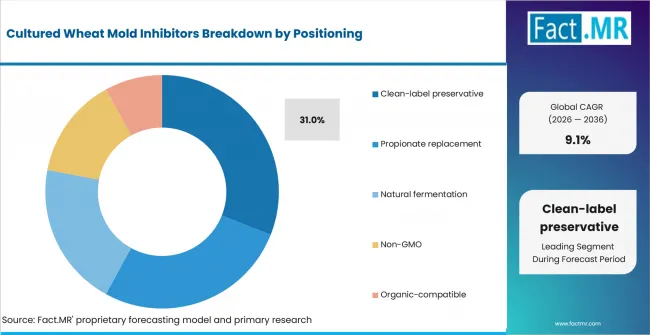
Cultured Wheat Mold Inhibitors Analysis By Positioning | Source: Fact.MR
Clean-label preservative is estimated to represent 31.0% share in 2026 because brands want mold control with familiar ingredient language. Propionate replacement remains practical when performance is close enough for distribution targets. Organic-compatible positioning depends on documentation around substrate source and processing method.
Kemin positions SHIELD® Pure as a fermentation-derived, clean-label mold inhibitor for baked goods, tortillas, and flatbreads. Its positioning highlights efficacy, minimal sensory impact, and label-friendly formulation as important considerations when evaluating fermentate-based mold-inhibition solutions.
What is accelerating Cultured Wheat Mold Inhibitors Market adoption, and what is holding it back?
Bread shelf-life needs drive it; dosage cost and gluten-linked limits restrain it.
Drivers Impact Analysis
| DRIVER | (~) % IMPACT ON CAGR | GEOGRAPHIC RELEVANCE | IMPACT TIMELINE |
|---|---|---|---|
| Clean-label preservative reformulation | +2.0% | North America, Europe, East Asia | Short term (<= 2 years) |
| Retail bread and tortilla waste control | +1.6% | Global | Medium term (2-4 years) |
| Fermentation-derived ingredient acceptance | +1.3% | North America, Western Europe | Medium term (2-4 years) |
| Prepared-food and sweet bakery shelf-life needs | +0.9% | Europe, East Asia | Long term (>= 4 years) |
Opportunity Impact Analysis
| OPPORTUNITY | (~) % IMPACT ON CAGR | GEOGRAPHIC RELEVANCE | IMPACT TIMELINE |
|---|---|---|---|
| Propionate replacement in industrial bread | +1.4% | North America, Western Europe | Short term (<= 2 years) |
| Organic-compatible and non-GMO bakery lines | +1.1% | USA, France, Germany | Medium term (2-4 years) |
| Tortilla and flatbread preservation programs | +0.9% | USA, China, Japan | Medium term (2-4 years) |
Restraints Impact Analysis
| RESTRAINT | (~) % IMPACT ON CAGR | GEOGRAPHIC RELEVANCE | IMPACT TIMELINE |
|---|---|---|---|
| Higher dosage cost versus calcium propionate | -0.7% | Global | Short term (<= 2 years) |
| Flavor and dough-process sensitivity | -0.5% | North America, Europe | Medium term (2-4 years) |
| Gluten-linked limits in free-from bakery | -0.4% | North America, Japan, Europe | Long term (>= 4 years) |
Which countries are scaling the Cultured Wheat Mold Inhibitors Market fastest?
- The country comparison spans 2.6 percentage points and forms two practical growth bands across the forecast period.
- China remains 1.6 percentage points above Japan through bakery retail expansion and packaged-food scale.
- Japan remains 0.4 percentage point above France as processed-food makers focus on stable quality and compact retail formats.
- France remains 0.4 percentage point above the USA through cereal supply and industrial bakery depth.
- The USA remains 0.2 percentage point above Germany through packaged bakery scale and wheat-linked ingredient use.
- Germany closes the displayed range through prepared-food output and retailer-led shelf-life expectations.
Comparable CAGRs create different entry conditions due to cereal supply, bakery plant scale, retailer specifications and ingredient-label expectations. Full report coverage includes North America, Latin America, Western Europe, Eastern Europe, East Asia, South Asia and Pacific, Middle East and Africa.
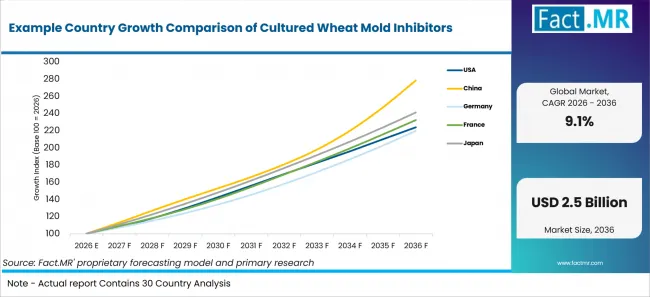
Example Country Growth Comparison Of Cultured Wheat Mold Inhibitors | Source: Fact.MR
| Country | CAGR |
|---|---|
| China | 10.8% |
| Japan | 9.2% |
| France | 8.8% |
| USA | 8.4% |
| Germany | 8.2% |
How is China scaling cultured wheat mold inhibitor demand?
10.8% CAGR through 2036, driven by bakery scale and food-retail expansion.
China is expected to record 10.8% CAGR through 2036 as packaged bakery reaches wider retail channels. In February 2026, the National Bureau of Statistics reported grain, oil and food retail sales by enterprises above designated size rose 9.3% in 2025. That retail base gives cultured wheat suppliers a wider path into bread, buns and tortilla-style bakery lines.
What supports Japan’s outlook?
9.2% CAGR through 2036, supported by processed-food scale and shelf-stable formats.
Japan is projected to post 9.2% CAGR through 2036 as processed-food makers focus on stable quality. In April 2026, USDA FAS reported Japan’s food processing sector was valued at USD 174 Billion in 2025. Shelf-stable and convenience bakery formats are expected to favor mold inhibitors that preserve mild taste profiles.
What underpins France’s growth?
8.8% CAGR through 2036, driven by cereal output and bakery manufacturing depth.
France is anticipated to advance at 8.8% CAGR through 2036 as cereal supply supports wheat fermentates. On July 21, 2026, INSEE reported that the production value of food, beverage and tobacco manufacturing was EUR 207 billion in 2025. Industrial bread and sweet bakery producers are expected to test cultured wheat systems where fermentation fits product identity.
What supports USA adoption?
8.4% CAGR through 2036, supported by packaged bakery scale and wheat use.
The USA is estimated to hold 8.4% CAGR through 2036 as industrial bakeries link mold control with label goals. In April 2026, USDA ERS estimated per capita wheat flour use at 126.6 pounds in 2025. That wheat base supports cultured flour and starch fermentates in bread, buns and tortilla applications.
How is Germany developing demand?
8.2% CAGR through 2036, driven by prepared meals and packaged bakery reformulation.
Germany is forecast to reach 8.2% CAGR through 2036 as prepared foods support shelf-life ingredients. In January 2026, Destatis reported Germany produced 1.7 million tons of prepared meals in 2024. Centralized bakery and ready-food production are expected to favor fermentates that protect freshness across store distribution.
Who leads the Cultured Wheat Mold Inhibitors Market?
Corbion and Kerry Group lead direct cultured-wheat coverage, while Bakels strengthen fermentate-based preservation.
Corbion is an active provider through VERDAD® Essence WH100 and related natural mold-inhibition solutions for breads, buns, tortillas and flatbreads. Kerry participates through UpGrade™ W2 fermented wheat flour and UpGrade™ WS cultured wheat starch for bakery mold control. These portfolios directly address cultured wheat flour and cultured wheat starch applications in bakery preservation.
Lallemand Baking is active through natural mold-inhibition solutions including Freshold, a fermented wheat system designed to extend mold-free freshness in bread. Competitive differentiation includes dosage efficiency, sensory performance, mold-strain coverage, shelf-life validation and technical support for commercial bakery applications.
Which companies are the key providers?
Corbion and Kerry Group are key providers. Bakels are also profiled. Lallemand Baking completes the company set.
- Corbion
- Kerry Group
- Bakels
- Lallemand Baking
Bibliography
- Corbion. (2025, April 21). Corbion unveils Verdad® Essence WH100: Redefining natural mold inhibition for bakers.
- Statistisches Bundesamt. (2026, January 14). Produktion von Fertiggerichten binnen fünf Jahren mengenmäßig um 25,6 % gestiegen.
- Institut national de la statistique et des études économiques. (2026, July 21). Indicateurs macroéconomiques de l’industrie manufacturière : Données annuelles de 2010 à 2025.
- Kerry Group plc. (2026, March 19). Annual report 2025.
- National Bureau of Statistics of China. (2025, December 12). Bulletin on the national grain production in 2025.
- National Bureau of Statistics of China. (2026, February 28). Statistical communiqué of the People’s Republic of China on the 2025 national economic and social development.
- U.S. Department of Agriculture, Economic Research Service. (2026, April 8). Wheat - Wheat sector at a glance.
- Zeballos, E., & Sinclair, W. (2026, June 11). Total U.S. food spending reached $2.51 trillion in 2025. U.S. Department of Agriculture, Economic Research Service.
- Aoki, S. (2026, April 1). Food processing ingredients annual (GAIN Report No. JA2026-0012). U.S. Department of Agriculture, Foreign Agricultural Service.
This Report Answers
- The report explains cultured wheat mold inhibitors by fermentate type, target organism and application.
- Segment analysis identifies cultured wheat flour and bread as the leading data-bearing categories.
- Country analysis examines China, Japan, France, the USA and Germany.
- Competitive analysis reviews Corbion, Kerry Group, Bakels and Lallemand Baking.
- Application analysis assesses bread, tortillas, sweet bakery and prepared foods.
- Positioning analysis reviews clean-label preservative and propionate replacement routes.
- Research coverage combines official statistics, company portfolios and bakery-formulation interviews.
What does the Cultured Wheat Mold Inhibitors Market cover?
Cultured wheat flour, cultured wheat starch, wheat fermentate concentrate and cereal fermentates used for mold control.
The market covers wheat-based fermentates used to control mold in bakery and prepared foods. It includes cultured wheat flour, cultured wheat starch, concentrates, dextrose-wheat blends and cereal fermentates sold for shelf-life extension.
The assessment is narrower than food preservatives because it focuses on cereal-fermentation systems used in bakery. Adjacent food additives coverage is relevant only where additives support mold-control formulation. Related clean-label preservatives coverage helps frame why label wording shapes trial plans.
What is included in the scope?
Cultured wheat mold inhibitor systems used in bread, tortillas, sweet bakery and prepared foods.
The scope includes cultured wheat flour, cultured wheat starch, wheat fermentate concentrate, dextrose-wheat blends and cereal fermentates sold for mold inhibition. It covers bread, tortillas, sweet bakery, prepared foods and cheese or other uses. Broader natural food preservatives coverage separates vinegar or oil systems from wheat-fermentate systems. Downstream functional bakery ingredients coverage applies when shelf life is part of bakery reformulation.
The analysis reviews positioning claims linked with organic bakery products where cultured wheat inputs fit the finished product. Ambient ready meals are included when bakery carriers require mold control. Adjacent packaged bread mold inhibitors coverage helps compare synthetic and fermentate-based shelf-life routes.
What is excluded from the scope?
General preservatives and non-wheat preservation systems are outside the scope.
The scope excludes synthetic preservatives sold outside a cultured wheat or cereal fermentate basis. General acidulants, enzymes and bread mix categories are covered only when the product is positioned as a mold-control fermentate for bakery or prepared foods.
General flavor systems and texture improvers are outside the scope when they serve taste or crumb softness alone. Gluten-free bread inputs are adjacent when free-from formulas avoid wheat-derived inputs.
How Was the Analysis Built?
The analysis draws on 130+ sources, 30+ company portfolios, 25+ countries and 20+ industry interviews.
- Primary Research: Primary research includes bakery manufacturers, ingredient distributors, formulation specialists and retail bakery category managers. These interviews examine shelf-life targets, sensory acceptance, dosage decisions and label review steps.
- Desk Research: Desk research covers government statistics, wheat data, company portfolios, product pages, technical articles and regulatory references. Source use is documented in the bibliography.
- Market Sizing and Forecasting: Market estimates combine bakery application volumes, fermentate type mix, replacement rates, pricing, country growth indicators and company participation. Forecasts preserve the stated market values and segment shares.
- Data Validation and Update Cycle: Findings are validated against official data, provider portfolios, product launches and food preservation activity. Updates review new mold-control products, bakery trials and label changes.
What is the report’s scope and coverage?
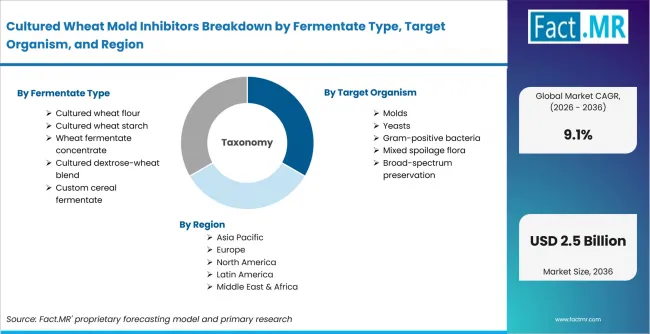
Cultured Wheat Mold Inhibitors Breakdown By Fermentate Type, Target Organism, And Region | Source: Fact.MR
| Attribute | Details |
|---|---|
| Quantitative Units | USD Billion |
| Market Definition | Wheat-based fermentate ingredients used to delay mold growth and extend shelf life in bakery and prepared foods. |
| Fermentate Type | Cultured wheat flour; Cultured wheat starch; Wheat fermentate concentrate; Cultured dextrose-wheat blend; Custom cereal fermentate |
| Target Organism | Molds; Yeasts; Gram-positive bacteria; Mixed spoilage flora; Broad-spectrum preservation |
| Application | Bread; Tortillas; Cakes and sweet bakery; Prepared foods; Cheese and other |
| Positioning | Clean-label preservative; Propionate replacement; Natural fermentation; Non-GMO; Organic-compatible |
| Regions Covered | North America; Latin America; Western Europe; Eastern Europe; East Asia; South Asia and Pacific; Middle East and Africa |
| Countries Covered | China; Japan; France; USA; Germany |
| Key Companies Profiled | Corbion; Kerry Group; Bakels; Lallemand Baking |
| Forecast Period | 2026 to 2036 |
| Approach | Hybrid top-down and bottom-up approach using bakery application volumes; fermentate type mix; mold-control need; country indicators; company portfolio review. |
How is the market segmented?
-
By Fermentate Type
- Cultured wheat flour
- Cultured wheat starch
- Wheat fermentate concentrate
- Cultured dextrose-wheat blend
- Custom cereal fermentate
-
By Target Organism
- Molds
- Yeasts
- Gram-positive bacteria
- Mixed spoilage flora
- Broad-spectrum preservation
-
By Application
- Bread
- Tortillas
- Cakes and sweet bakery
- Prepared foods
- Cheese and other
-
By Positioning
- Clean-label preservative
- Propionate replacement
- Natural fermentation
- Non-GMO
- Organic-compatible
-
By Region
- North America
- Latin America
- Western Europe
- Eastern Europe
- East Asia
- South Asia and Pacific
- Middle East and Africa