- Base Value(2025): 0.8 Bn
- Estimated Value(2026): 0.9 Bn
- Forecast Value (2036): 1.5 Bn
- CAGR (2026 - 2036): 5.2%
Sodium Diacetate as Mold Inhibitor in Packaged Bread Market Forecast and Outlook By FACT.MR
In 2025, the sodium diacetate as mold inhibitor in packaged bread market was valued at USD 0.8 billion. Based on Fact.MR analysis, demand for sodium diacetate as mold inhibitor in packaged bread is estimated to grow to USD 0.9 billion in 2026 and USD 1.5 billion by 2036. FACT.MR projects a CAGR of 5.2% during the forecast period.
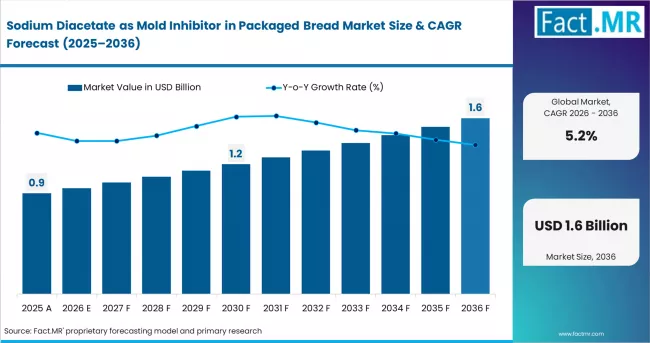
Sodium Diacetate As Mold Inhibitor In Packaged Bread Market Value Analysis | Source: Fact.MR
Summary Of Sodium Diacetate as Mold Inhibitor in Packaged Bread Market
- Market Definition
- Covers food-grade and industrial-grade sodium diacetate supplied in powder and liquid form.
- Used as a mold inhibitor and pH regulator in packaged bread and food processing.
- Demand Drivers
- India’s organised retail bread expansion and FSSAI compliance are boosting demand.
- China’s food processing growth and NMPA regulations support adoption.
- U.S. demand remains strong due to FDA GRAS approval and high bread consumption.
- Key Segments Analyzed
- By Application: Food & Beverages leads with 46% share in 2026 due to bakery demand.
- By Function: Antimicrobial use leads with 35% share driven by shelf-life needs.
- By Form: Powder dominates with 68% share due to ease of blending.
- By Grade: Food grade leads with 52% share across bakery applications.
- By Geography: India leads with 6.7% CAGR supported by retail expansion.
- Analyst Opinion at FACT.MR
- Shambhu Nath Jha notes a two-speed market dynamic. Emerging markets drive volume growth while developed markets focus on clean-label reformulation.
- Strategic Implications
- Expand food-grade powder capacity aligned with India and China demand.
- Develop blends with natural ingredients to address clean-label trends.
- Ensure compliance with FDA GRAS, EU E-262, and FSSAI standards.
- Methodology
- Market estimates based on production volumes, usage rates, and pricing benchmarks.
- Data validated through regulatory databases and corporate disclosures.
- Forecasts include bakery growth, regulatory trends, and substitution patterns.
| Metric | Value |
|---|---|
| Estimated Value in 2026 | USD 0.9 billion |
| Forecast Value in 2036 | USD 1.5 billion |
| Forecast CAGR (2026 to 2036) | 5.2% |
Source: Fact.MR analysis. Updated Apr 16, 2026
The market is projected to generate approximately USD 0.6 billion in incremental revenue over the forecast period. Growth reflects steady expansion driven by packaged bread consumption in emerging markets and stringent food safety regulations mandating shelf-life extension. However, clean-label consumer pressure and competition from natural antimicrobials such as vinegar-based acetic acid blends and cultured wheat ferments continue to moderate faster penetration of synthetic sodium diacetate in premium bread segments in North America and Europe.
Major packaged bread manufacturers including Corbion and Jungbunzlauer are expanding food-grade sodium diacetate supply in response to growing procurement from industrial bakeries in India and China. These procurement patterns reflect a shift in the market's centre of gravity toward high-volume emerging market applications, where acetic acid cost economics and regulatory GRAS or E-number status drive ingredient selection ahead of clean-label positioning concerns present in mature Western markets.
Country-level performance reflects packaged food regulatory frameworks, industrial bakery scale, and clean-label adoption rates. India leads at 6.7% CAGR through 2036, driven by bakery consumption growth and expanding organised retail bread distribution. China follows at 6.5% CAGR supported by food processing expansion and NMPA-compliant preservative adoption. The United States records 6.0% CAGR, anchored by strong packaged bread demand and FDA GRAS-backed shelf-life formulation requirements. Germany grows at 5.5%, reflecting regulated food safety standards and EU food additive compliance. The United Kingdom registers approximately 5.0% CAGR through sustained processed food demand constrained by clean-label reformulation pressure.
Segmental Analysis
Sodium Diacetate as Mold Inhibitor in Packaged Bread Market Analysis by Application
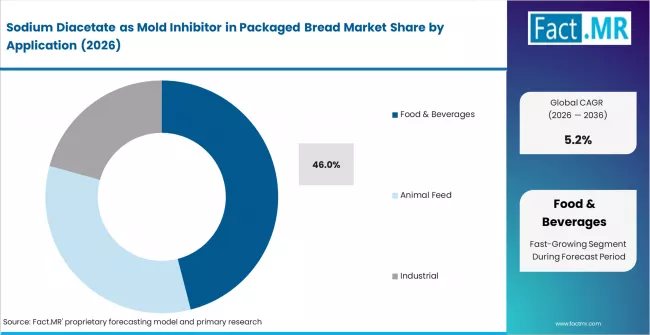
Sodium Diacetate As Mold Inhibitor In Packaged Bread Market Analysis By Application | Source: Fact.MR
Food & Beverages is expected to hold around 46% share in 2026. The segment dominates due to high-volume demand from industrial bakeries. Sodium diacetate offers cost-effective mold control with added pH regulation and mild flavour benefits.
- Corbion Expansion: The company expanded its bakery preservation portfolio in 2024. Focus remains on industrial bakery clients in North America and Europe. It provides solutions aligned with FDA GRAS and EU compliance. [4]
- Kerry Group Innovation: Kerry launched Tastesense Bread Freshness in 2024. It combines sodium diacetate systems with flavour masking. The focus is on improving sensory profiles in packaged bread. [5]
- Industrial Bakery Demand Trend: Global bread production grew steadily in 2024. Emerging markets showed the highest growth rates. This continues to support sodium diacetate demand as a primary mold inhibitor. [6]
Sodium Diacetate as Mold Inhibitor in Packaged Bread Market Analysis by Form
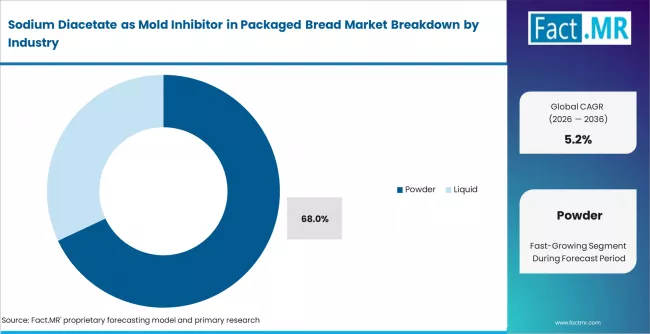
Sodium Diacetate As Mold Inhibitor In Packaged Bread Market Analysis By Form | Source: Fact.MR
Powder form is projected to hold about 68% share in 2026. It is preferred for ease of handling and blending. It also offers better storage stability and process compatibility.
- Jungbunzlauer Capacity Expansion: The company expanded powder production in 2024. This supports demand from Europe and Asia. It also strengthens supply agreements with large bakeries. [7]
- Archer Daniels Midland Liquid Innovation: ADM introduced an improved liquid solution in 2025. It targets continuous mixing systems in large bakeries. It reduces dust and improves distribution in humid environments. [8]
- Powder Trade Trend: Exports of sodium diacetate powder from China increased in 2024. Demand is rising across India, Southeast Asia, and Latin America. Cost-effective sourcing supports industrial bakery expansion. [9]
Drivers, Restraints, and Opportunities
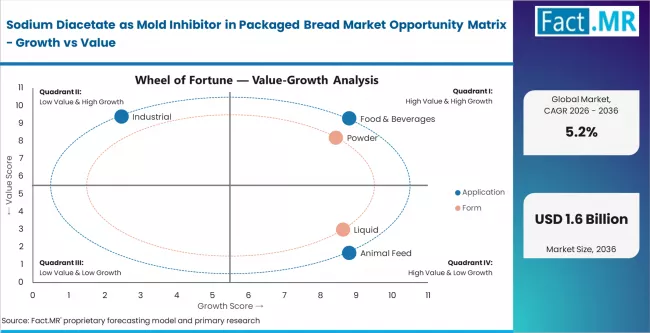
Sodium Diacetate As Mold Inhibitor In Packaged Bread Market Opportunity Matrix Growth Vs Value | Source: Fact.MR
FACT.MR analysts note that the market has shifted from a commodity preservative segment to a dual-track model. Emerging markets drive volume through regulatory compliance and industrial bakery scale.
Demand is splitting across regions and use cases. Emerging markets prefer high-volume food-grade powder based on cost and regulatory approval. Developed markets focus on blended systems balancing performance and label claims. Synthetic sodium diacetate faces competition from natural alternatives such as rosemary extract, natamycin, and cultured wheat ferment.
- EU Food Additive E-262 Re-evaluation: European regulators are tightening compliance requirements. Updated guidance is increasing documentation needs for bakery manufacturers. This is driving demand for technical validation support from ingredient suppliers. [1]
- India FSSAI Bakery Preservative Expansion: India has reaffirmed sodium diacetate approval under updated regulations. This supports higher procurement by large bakery players. Companies like Britannia Industries and ITC Foods are expanding distribution into smaller cities. [2]
- China Packaged Bread Processing Scale: China continues to support sodium diacetate under updated national standards. Industrial bakery production is expanding rapidly. Packaged bread volumes are growing strongly with organised retail penetration. [3]
Regional Analysis
The sodium diacetate as mold inhibitor in packaged bread market is assessed across North America, Europe, Asia Pacific, Latin America, and Middle East and Africa, covering 40+ countries with distinct demand profiles shaped by packaged bread regulatory frameworks, industrial bakery scale, clean-label adoption rates, and food additive approval infrastructure. The full report provides market attractiveness analysis by region and country.
.webp "Top Country Growth Comparison Sodium Diacetate As Mold Inhibitor In Packaged Bread Market Cagr (2026 2036)")
Top Country Growth Comparison Sodium Diacetate As Mold Inhibitor In Packaged Bread Market Cagr (2026 2036) | Source: Fact.MR
| Country | CAGR (2026 to 2036) |
|---|---|
| India | 6.7% |
| China | 6.5% |
| United States | 6.0% |
| Germany | 5.5% |
| United Kingdom | 5.0% |
Source: Fact.MR analysis. Updated Apr 16, 2026
Source: Fact.MR(FACT.MR) analysis, based on proprietary forecasting model and primary research
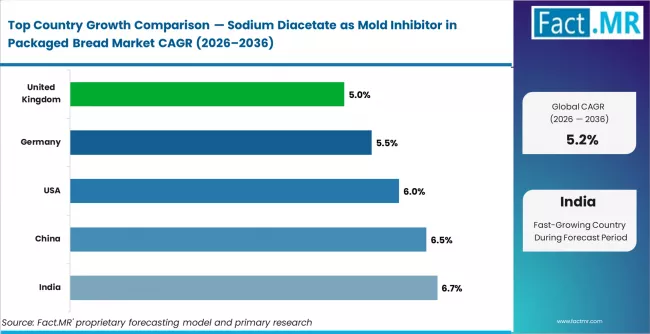
Sodium Diacetate As Mold Inhibitor In Packaged Bread Market Cagr Analysis By Country | Source: Fact.MR
Asia Pacific Sodium Diacetate as Mold Inhibitor in Packaged Bread Market Analysis
Asia Pacific leads as the fastest-growing region. Growth is driven by industrial bakery expansion in India and regulatory-backed scale in China. Suppliers such as Corbion, Jungbunzlauer, and BASF operate through regional networks aligned with FSSAI and GB 2760 frameworks.
- India: India shows strong growth supported by rising packaged bread demand. Consumption is projected to expand at 6.7% CAGR through 2036. Companies like Britannia Industries and ITC Foods are expanding into Tier 2 and Tier 3 cities. This is increasing demand for cost-effective food-grade sodium diacetate powder. FSSAI’s 2024 approval under Schedule I has enabled wider commercial use. Jungbunzlauer also strengthened local support through a technical sales office.
- China: China continues to expand through strong food processing growth. Demand is projected to rise at 6.5% CAGR through 2036. GB 2760-2024 standards confirm approved usage in bakery products. Packaged bread production is increasing with retail expansion. Companies such as Mankattan and Grupo Bimbo are scaling product ranges. Corbion has strengthened distribution partnerships to meet industrial bakery demand.
FACT.MR’s regional analysis covers China, India, Japan, South Korea, ASEAN, and Australia & New Zealand. It includes GB 2760 data, FSSAI compliance trends, and bakery procurement insights.
North America Sodium Diacetate as Mold Inhibitor in Packaged Bread Market Analysis
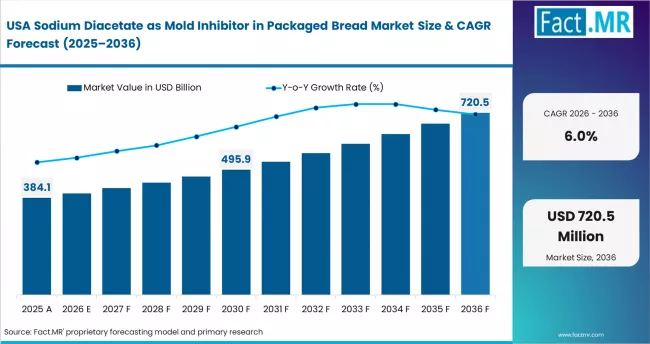
Sodium Diacetate As Mold Inhibitor In Packaged Bread Market Country Value Analysis | Source: Fact.MR
North America remains a mature and high-volume market. Demand is supported by FDA GRAS approval and strong industrial bakery scale. Key suppliers include Archer Daniels Midland, Corbion, and Seidler Chemical.
- United States: The United States shows stable growth with demand rising at 6.0% CAGR through 2036. FDA GRAS status ensures regulatory clarity for manufacturers. Companies such as Flowers Foods and Bimbo Bakeries USA rely on sodium diacetate for shelf-life extension. Packaged bread sales remain high, supporting large-scale procurement. Archer Daniels Midland expanded supply agreements in 2024 to target value and convenience segments.
FACT.MR’s regional analysis covers the United States, Canada, and Mexico. It includes FDA GRAS data, bakery procurement trends, and clean-label benchmarks.
Europe Sodium Diacetate as Mold Inhibitor in Packaged Bread Market Analysis
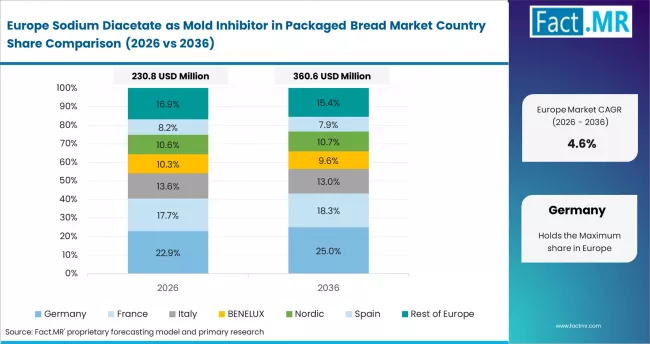
Sodium Diacetate As Mold Inhibitor In Packaged Bread Market Europe Country Market Share Analysis, 2026 & 2036 | Source: Fact.MR
Europe represents a regulatory-driven market. Demand is shaped by EU E-262 compliance and clean-label reformulation trends. Suppliers such as Jungbunzlauer and Corbion maintain strong positions through compliant production and technical support.
- Germany: Germany shows steady growth with demand rising at 5.5% CAGR through 2036. Strict EFSA-aligned regulations require documentation and controlled usage. Companies like Lieken Urkorn and Harry-Brot maintain long-term supply agreements. Jungbunzlauer supports supply through EU-certified facilities. Updated 2024 EFSA guidance continues to sustain compliant demand.
- United Kingdom: The United Kingdom shows moderate growth at around 5.0% CAGR through 2036. Regulatory continuity supports usage in bakery applications. Companies such as Allied Bakeries and Warburtons maintain stable procurement. Clean-label pressure from brands like Hovis is limiting premium segment growth. Kerry Group continues to supply preservation systems across the UK bakery sector.
FACT.MR’s regional analysis covers Germany, France, the United Kingdom, Italy, Spain, Nordic countries, BENELUX, and the rest of Europe. It includes EU E-262 data, EFSA trends, and clean-label benchmarks.
Competitive Aligners for Market Players
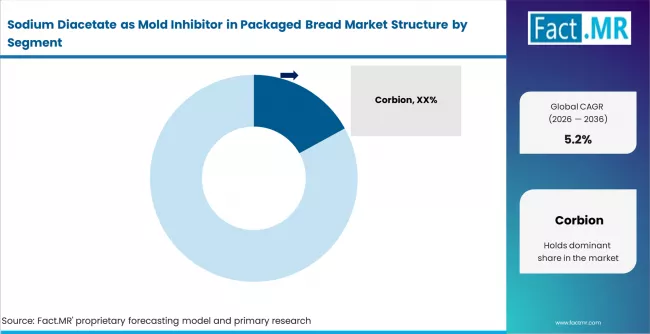
Sodium Diacetate As Mold Inhibitor In Packaged Bread Market Analysis By Company | Source: Fact.MR
The sodium diacetate market in packaged bread is moderately consolidated. A few global ingredient suppliers control large-scale production and distribution. Companies such as Corbion, Jungbunzlauer, Kerry Group, Archer Daniels Midland, and BASF dominate supply across key regions. These players compete on cost efficiency, regulatory compliance, and technical support capabilities.
Market leaders maintain strong relationships with industrial bakeries through long-term supply agreements. Their competitive advantage lies in integrated production systems and global distribution networks. Compliance with FDA GRAS, EU E-262, FSSAI, and GB 2760 standards is a critical differentiator. Suppliers increasingly provide formulation assistance and documentation support to meet evolving regulatory requirements.
Competition is intensifying in emerging markets such as India and China. Here, price competitiveness and bulk supply capability are key decision factors. Global players are expanding regional production and sales offices to capture rising demand from industrial bakeries. At the same time, local and regional manufacturers are entering with cost-competitive offerings, especially in powder form.
In mature markets such as North America and Europe, differentiation is shifting toward clean-label compatible solutions. Companies are developing blended preservative systems combining sodium diacetate with natural ingredients. Kerry Group and Corbion are actively investing in such value-added solutions to address premium bakery reformulation needs. Strategic focus across the competitive landscape includes capacity expansion, product innovation, and regulatory alignment. Suppliers that balance low-cost volume supply in emerging markets with clean-label innovation in developed regions are expected to gain a stronger market position.
Key Players in the Sodium Diacetate as Mold Inhibitor in Packaged Bread Market
- Corbion
- Jungbunzlauer
- Archer Daniels Midland
- Kerry Group
- BASF
- Seidler Chemical
- Hawkins Inc.
- Niacet Corporation
Bibliography
- [1] European Food Safety Authority. (2024). Re-evaluation of Sodium Diacetate (E-262) as a Food Additive Under Regulation (EC) No 257/2010: Updated Assessment Guidance on Functional Justification and Usage Level Documentation Requirements for Bakery Product Manufacturers. 2024. efsa.europa.eu/en/topics/topic/food-additives
- [2] Food Safety and Standards Authority of India. (2024). Food Safety and Standards (Food Products Standards and Food Additives) Regulations Amendment: Schedule I Permitted Preservatives for Bakery Products Including Sodium Diacetate Confirmation for Industrial Bread Manufacturers. 2024. fssai.gov.in/regulations
- [3] National Market Supervision Administration, China. (2024). GB 2760-2024 National Food Safety Standard: Standards for Uses of Food Additives Including Sodium Diacetate Approval Status for Baked Goods and Packaged Bread Applications. 2024. samr.gov.cn/bgt/bzgly
- [4] Corbion N.V. (2024). Annual Report 2024: Food Preservation Ingredient Portfolio Expansion Including Sodium Diacetate-Based Shelf-Life Extension Systems for Industrial Bakery Manufacturers in North America and Europe. 2024. corbion.com/investors
- [5] Kerry Group plc. (2024). Product Launch Announcement: Tastesense Bread Freshness Preservation Line Integrating Sodium Diacetate-Based Antimicrobial Systems with Natural Flavour Masking Technology for U.S. and UK Industrial Bread Manufacturers. 2024. kerrygroup.com/media
- [6] IRI Worldwide. (2024). Global Packaged Bread Retail Panel Data 2024: Production Volume Growth Analysis Including Shelf-Stable Sliced Bread Category Expansion in India and Southeast Asia and Mold Inhibitor Ingredient Procurement Trends. December 2024. iriworldwide.com/insights
- [7] Jungbunzlauer AG. (2024). Capacity Expansion Announcement: Food-Grade Sodium Diacetate Powder Production at Austrian Facilities Targeting European and Asian Industrial Bakery Demand with Consistent Purity Specifications for Automated Premix Dosing. 2024. jungbunzlauer.com/news
- [8] Archer Daniels Midland Company. (2025). Product Innovation Update: Enhanced Liquid Sodium Diacetate Solution for Continuous-Flow Industrial Bread Dough Mixing Operations in Southeast Asian Bakery Manufacturing Environments. January 2025. adm.com/solutions/food-ingredients
- [9] General Administration of Customs, China. (2024). Trade Statistics: Food-Grade Sodium Diacetate Powder Bulk Export Volume Data Including Growth by Destination Market Covering India, Southeast Asia, and Latin American Packaged Bread Manufacturing Importers. 2024. customs.gov.cn/customs/302249
This Report Addresses
- Strategic insights on sodium diacetate demand across India FSSAI-backed bakery growth, China GB 2760-compliant packaged bread expansion, U.S. FDA GRAS-anchored industrial bakery procurement, EU E-262 re-evaluation compliance, and UK clean-label reformulation dynamics.
- Market forecast from USD 0.9 billion in 2026 to USD 1.5 billion by 2036, reflecting a CAGR of 5.2%.
- Growth opportunity mapping across food-grade powder mold inhibitor adoption in emerging market industrial bakeries, blended natural-adjacent preservation systems in premium bread segments, and animal feed acidification applications.
- Segment analysis by application (food & beverages, animal feed, industrial), function (antimicrobial, flavour enhancer, pH regulator), form (powder, liquid), and grade (food grade, industrial grade).
- Regional outlook covering Asia Pacific volume-driven industrial bakery demand growth, North America FDA-compliance-backed procurement stability, and Europe EFSA re-evaluation compliance-led supplier selection.
- Competitive analysis of Corbion, Jungbunzlauer, Archer Daniels Midland, Kerry Group, BASF, Seidler Chemical, Hawkins Inc., and Niacet Corporation covering production capacity, regulatory certification, and bakery customer contract positioning.
- Regulatory impact analysis covering EU E-262 EFSA re-evaluation under Regulation (EC) No 257/2010, U.S. FDA GRAS notification framework, India FSSAI Schedule I permitted preservative status, and China GB 2760-2024 national food additive standard.
- Report available in PDF, Excel datasets, and presentation formats supported by primary bakery ingredient buyer interviews, food additive regulatory databases, trade volume data, and corporate disclosure cross-checks (2024–2025).
Sodium Diacetate as Mold Inhibitor in Packaged Bread Market Definition
The market covers sodium diacetate supplies as a dual-function additive combining sodium acetate and acetic acid. It acts as a mold inhibitor and pH regulator in packaged bread. It extends shelf life by controlling microbial growth. It is available in powder and liquid forms for industrial bakeries and food processors.
Sodium Diacetate as Mold Inhibitor in Packaged Bread Market Inclusions
Includes global and regional market sizing from 2026 to 2036 by application, function, form, and grade. Covers food-grade and industrial-grade sodium diacetate used in food, beverage, and animal feed applications.
Sodium Diacetate as Mold Inhibitor in Packaged Bread Market Exclusions
Excludes standalone acetic acid and sodium acetate not formulated as sodium diacetate. Finished packaged bread products are not included. Natural preservatives such as vinegar-based and cultured ferment antimicrobials are outside scope.
Sodium Diacetate as Mold Inhibitor in Packaged Bread Market Research Methodology
- Primary Research
- Includes interviews with producers, procurement managers, distributors, and regulatory experts. Coverage spans India, China, the United States, Germany, and the United Kingdom.
- Desk Research
- Includes analysis of FDA GRAS, EU E-number regulations, FSSAI standards, and NMPA guidelines. Also reviews disclosures from Corbion, Jungbunzlauer, and Kerry Group (2024–2025).
- Market Sizing and Forecasting
- Uses a hybrid top-down and bottom-up approach. Based on bread production volumes, usage rates, pricing, and bakery industry growth by country.
- Data Validation and Update Cycle
- Validated using trade data, regulatory databases, and expert inputs. Updated periodically to reflect market changes.
Segmentation
Scope of Report
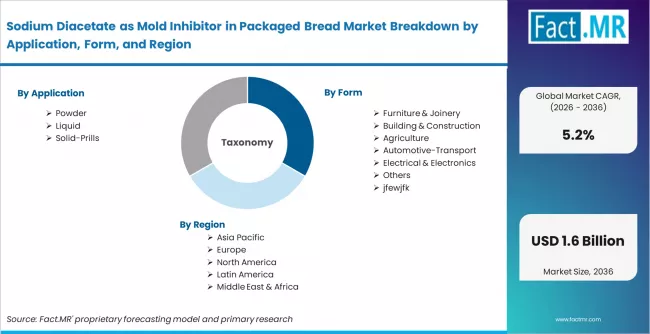
Sodium Diacetate As Mold Inhibitor In Packaged Bread Market Breakdown By Application, Form, And Region | Source: Fact.MR
| Attribute | Details |
|---|---|
| Quantitative Units | USD 0.9 billion (2026) to USD 1.5 billion (2036), at a CAGR of 5.2% |
| Market Definition | Sodium diacetate, a dual-function food additive combining sodium acetate and acetic acid, supplied in food-grade powder and liquid forms as mold inhibitor, pH regulator, and flavour enhancer to packaged bread manufacturers and food processors globally. |
| Application Segmentation | Food & Beverages, Animal Feed, Industrial |
| Function Segmentation | Antimicrobial / Mold Inhibitor, Flavor Enhancer, pH Regulator |
| Form Segmentation | Powder, Liquid |
| Grade Segmentation | Food Grade, Industrial Grade |
| Application Coverage | Packaged bread mold inhibition, bakery premix preservation, animal feed acidification, industrial food processing antimicrobial, and pH regulation in baked goods. |
| Regions Covered | North America, Europe, Asia Pacific, Latin America, Middle East and Africa |
| Countries Covered | USA, Canada, Mexico, Germany, UK, France, Italy, Spain, Nordic, BENELUX, China, Japan, South Korea, India, ASEAN, Australia and New Zealand, Brazil, Argentina, Chile, Saudi Arabia, GCC, Turkey, South Africa, Rest of MEA |
| Key Companies Profiled | Corbion, Jungbunzlauer, Archer Daniels Midland, Kerry Group, BASF, Seidler Chemical, Hawkins Inc., Niacet Corporation |
| Forecast Period | 2026 to 2036 |
| Approach | Hybrid top-down and bottom-up model using packaged bread production volumes, sodium diacetate application rates, ingredient pricing tiers, food additive regulatory databases, and primary interviews with bakery ingredient procurement managers and producers. |
Source: Fact.MR analysis. Updated Apr 16, 2026
Sodium Diacetate as Mold Inhibitor in Packaged Bread Market by Segments
-
By Application:
- Food & Beverages
- Animal Feed
- Industrial
-
By Function:
- Antimicrobial / Mold Inhibitor
- Flavor Enhancer
- pH Regulator
-
By Form:
- Powder
- Liquid
-
By Grade:
- Food Grade
- Industrial Grade
-
By Region:
- North America
- United States
- Canada
- Mexico
-
Latin America
- Brazil
- Mexico
- Argentina
- Chile
- Rest of Latin America
-
Western Europe
- Germany
- United Kingdom
- France
- Italy
- Spain
- Nordic Countries
- BENELUX
- Rest of Western Europe
-
Eastern Europe
- Russia
- Poland
- Hungary
- Balkan and Baltic
- Rest of Eastern Europe
-
East Asia
- China
- Japan
- South Korea
-
South Asia and Pacific
- India
- ASEAN
- Australia and New Zealand
- Rest of South Asia and Pacific
-
Middle East and Africa
- Kingdom of Saudi Arabia
- Other GCC Countries
- Turkey
- South Africa
- Rest of Middle East and Africa
- North America
Frequently Asked Questions
How large is the demand for sodium diacetate as mold inhibitor in packaged bread in 2025?
What will be the market size in 2026?
What is the projected market size by 2036?
What is the expected CAGR between 2026 and 2036?
What is the absolute dollar opportunity in this market?
Which application segment is poised to lead global sales in 2026?
Which form segment holds the largest share?
Which country shows the fastest growth?
Which grade segment leads the market?
What is sodium diacetate used for in packaged bread?
Why is sodium diacetate widely used in industrial bakeries?
Which regions are driving market growth?
Why is powder form preferred over liquid?
What factors are limiting market growth in developed regions?
Who are the key players in the market?
Who worked on this report


Preview the report firsthand - request a free sample
Free SampleGet the brochure for pricing and purchase details
Download PDF