- Base Value(2025): 32 Bn
- Estimated Value(2026): 37.7 Bn
- Forecast Value (2036): 46.8 Bn
- CAGR (2026 - 2036): 2.5%
Dark Tourism Market Forecast 2026 to 2036
In 2025, the dark tourism market was valued at USD 32 billion. Based on FMR's analysis, demand for dark tourism experiences is estimated to grow to USD 37.7 billion in 2026 and USD 46.8 billion by 2036. FMR projects a CAGR of 2.5% during the forecast period.
The absolute dollar growth from 2026 to 2036 is USD 9.1 billion. This growth is driven by increasing interest in unconventional tourism experiences that explore historical events, tragedies, and places with dark or tragic pasts. The rise of experiential tourism, along with greater awareness and cultural curiosity, is expected to continue supporting market growth. However, challenges such as ethical concerns, safety regulations, and the potential for sensitive content may influence growth in certain regions.
As Rikant Pittie, Chief Executive and Co-founder of EaseMyTrip, noted regarding the rising interest in dark tourism experiences, ‘Interest in dark tourism has grown steadily over the past two to three years.’
India leads with a CAGR of 5.1%, driven by a growing middle class and increasing interest in diverse, experiential travel. China follows with a 4.7% CAGR, supported by expanding international tourism and rising disposable income. Singapore grows at 3.8%, benefiting from its position as a gateway for tourists seeking unique cultural and historical experiences. Canada grows at 2.3%, reflecting steady demand for niche tourism in North America. The USA shows the slowest growth at 1.5%, due to a mature tourism market and relatively limited expansion in dark tourism segments.
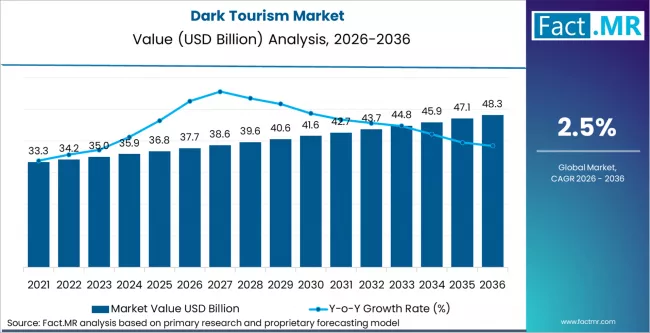
Dark Tourism Market Market Value Analysis | Source: Fact.MR
Dark Tourism Market Definition
The Dark Tourism Market involves travel to sites associated with death, tragedy, disaster, or historical suffering for educational, memorial, or experiential purposes.
Market Inclusions
This report covers global and regional market sizes for dark tourism, including key destinations, traveler demographics, and motivations, over a defined forecast period.
Market Exclusions
The scope excludes mainstream leisure tourism, unrelated travel segments such as luxury or wellness tourism, and entertainment attractions without historical tragedy context.
Research Methodology
- Primary Research: Interviews were conducted with travel industry experts, tour operators, and destination managers.
- Desk Research: Data was sourced from tourism reports, destination statistics, and travel association publications.
- Market‑Sizing and Forecasting: A hybrid approach combining top‑down tourism demand forecasts with bottom‑up traveler and destination data was used.
- Data Validation and Update Cycle: Findings were validated through expert review and aligned with recent travel and visitor statistics.
Summary of the Dark Tourism Market
-
Market Definition
- The Dark Tourism Market involves travel to sites associated with death, tragedy, disaster, or historical suffering. These sites serve as educational, memorial, or experiential destinations, allowing visitors to engage with locations that have a tragic or somber historical context.
-
Demand Drivers
- Increasing interest in unconventional tourism experiences that explore historical events, tragedies, and places with dark or tragic pasts.
- Rising popularity of experiential tourism, which seeks immersive and reflective travel experiences that offer more than just leisure.
- Greater cultural curiosity and awareness about historical events, driving demand for educational and emotional connections with past atrocities or significant disasters.
- Digital platforms and social media increasing visibility and accessibility of dark tourism destinations.
-
Key Segments Analyzed
- Type: Holocaust tourism is expected to capture 28.6% of the market share by 2026, driven by the educational value and emotional significance of Holocaust-related sites such as concentration camps and museums.
- Booking Channel: Online booking is projected to dominate, accounting for 61.3% of the market share by 2026, due to the growing trend of digital convenience for travel planning.
- Tourist Type: International tourists are expected to represent a significant portion of the market as dark tourism destinations often appeal to visitors seeking unique cultural and historical experiences.
- Age Group: Tourists aged 26-35 years are anticipated to be the largest demographic, driven by an increasing number of millennials seeking meaningful and reflective travel experiences.
-
Analyst Opinion at FactMR
- "Dark tourism has seen a steady increase in interest, driven by the growing desire for educational and emotional travel experiences. While this niche market remains relatively small, it continues to grow due to the increasing demand for deeper, more reflective travel that goes beyond traditional leisure tourism." - Shambhu Nath Jha, Principal Consultant at FactMR.
-
Strategic Implications/Executive Takeaways
- Develop and market dark tourism experiences that provide deeper educational value and emotional engagement, particularly for younger travelers.
- Invest in enhancing the online booking experience for tourists seeking easy access to dark tourism destinations, along with tour packages.
- Collaborate with heritage and memorial sites to offer curated, respectful, and educational travel experiences, particularly at historical and memorial locations.
-
Methodology
- Derived from primary research with travel industry experts, tour operators, and destination managers.
- Benchmarked against tourism reports and visitor statistics from dark tourism destinations.
- Hybrid top-down and bottom-up market modeling, validated through expert reviews and recent travel trends.
Segmental Analysis
Dark Tourism Market Analysis by Type
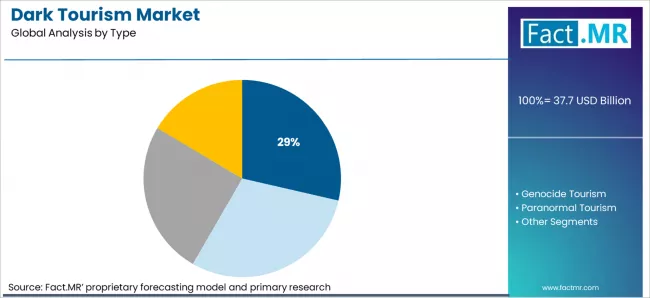
Dark Tourism Market Analysis By Type | Source: Fact.MR
- Market Overview: Holocaust tourism is expected to capture 28.6% of the market share by 2026. This segment focuses on visits to historical sites related to the Holocaust, such as concentration camps, memorials, and museums dedicated to the events of World War II. These sites serve as poignant reminders of human history and are integral to the dark tourism experience, which educates visitors about the atrocities committed during the Holocaust.
- Demand Drivers:
- Educational Value and Historical Significance: Holocaust tourism draws significant attention due to its educational value and the importance of preserving the memory of these tragic events. Visitors are often driven by a desire to understand history, pay respect to victims, and ensure that such atrocities are never forgotten.
- Cultural and Emotional Impact: Holocaust tourism offers visitors a deeply emotional and thought-provoking experience. The psychological and cultural significance of visiting Holocaust memorials and museums draws many tourists seeking to connect with and reflect on the historical impact.
- Growing Awareness and Preservation Efforts: The increase in historical awareness, coupled with efforts to preserve Holocaust-related sites, fuels the growth of this segment as more people become aware of these destinations and the need to honor historical memory.
Dark Tourism Market Analysis by Booking Channel
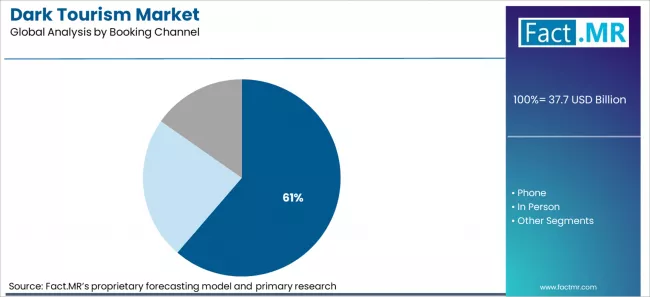
Dark Tourism Market Analysis By Booking Channel | Source: Fact.MR
- Market Overview: Online booking is projected to dominate with 61.3% of the market share by 2026. With the rise of digital platforms, online booking has become the preferred method for travelers seeking to visit dark tourism sites. Online platforms offer convenience, accessibility, and the ability to research destinations and book experiences in advance.
- Demand Drivers:
- Convenience and Accessibility: Online booking platforms provide a user-friendly experience for tourists, allowing them to research, compare, and book their dark tourism experiences from the comfort of their homes. The ability to instantly secure tickets and receive information is a key driver for the online booking segment.
- Integration with Travel Services: Many dark tourism sites offer packaged tours that combine other elements of travel, such as transportation and accommodations. These packages are often booked online, making it easier for tourists to organize their entire trip in one place.
- Increased Digital Engagement: As travelers increasingly turn to the internet for planning trips, the convenience of booking online continues to grow, making it the dominant channel for dark tourism bookings. Online platforms also offer insights, reviews, and ratings, which are helpful for tourists in making informed decisions.
Dark Tourism Market Drivers, Restraints, and Opportunities
FMR analysts observe that the dark tourism market is a mature but slowly growing niche within the global travel and tourism sector, anchored in visits to sites associated with death, tragedy, and historical suffering (war memorials, disaster sites, prisons, genocide sites). The 2026 valuation reflects steady demand from both domestic and international visitors drawn by educational, commemorative, and cultural motivations, as well as growing interest among younger travelers seeking meaningful and reflective experiences. This structural demand persists because dark tourism combines heritage, remembrance, and historical context with broader tourism trends.
While conventional leisure tourism continues to command higher volumes, demand for curated dark tourism experiences is rising due to increased digital visibility and infrastructure improvements at key sites. Advanced tour experiences, especially those integrating educational programming, carry higher per‑visitor value and contribute to measurable market growth even as overall tourist numbers grow moderately. Ethical and sustainability considerations also shape how destinations interpret tragedy and engage visitors respectfully.
- Heritage & Education Demand: Travelers are increasingly visiting historically significant dark tourism sites for learning and reflection, replacing casual sightseeing with deeper cultural engagement.
- Regulatory & Preservation Standards: Government investment in heritage preservation and frameworks such as UNESCO World Heritage criteria encourage development and management of dark tourism destinations, influencing quality and visitor experience.
- Regional Interest Growth: In regions like Europe with extensive WWII and conflict‑related sites, demand is stronger, while in Asia‑Pacific, emerging historical destinations (e.g., Hiroshima, Bhopal) expand participation among domestic and international travelers.
Regional Analysis
The market analysis covers key global regions, including North America, Asia Pacific, and South Asia. It is segmented geographically, with specific market dynamics for each region. The full report provides a detailed market attractiveness analysis.
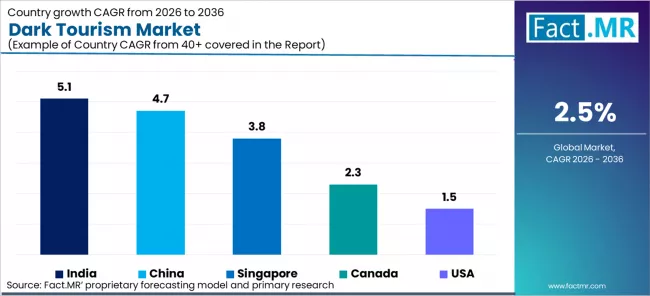
Dark Tourism Market Cagr Analysis By Country | Source: Fact.MR
| Country | CAGR (%) |
|---|---|
| USA | 1.5% |
| Canada | 2.3% |
| Singapore | 3.8% |
| China | 4.7% |
| India | 5.1% |
Source: Fact.MR analysis. Updated Feb 24, 2026
Source: Fact MR (FMR) analysis, based on proprietary forecasting model and primary research.
North America:
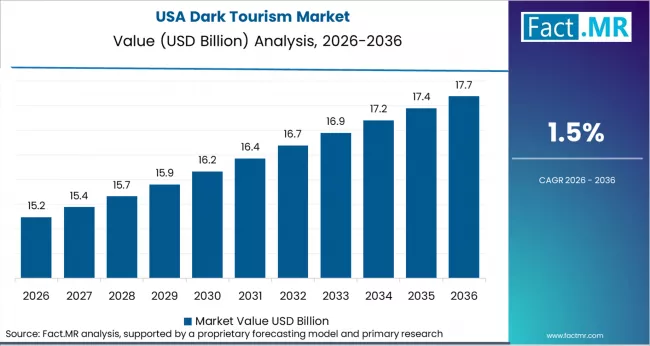
Dark Tourism Market Country Value Analysis | Source: Fact.MR
In North America, the USA and Canada are key markets for dark tourism, driven by increasing consumer interest in historical sites and experiences linked to tragedy or the macabre.
- USA: Demand for dark tourism in the U.S. is projected to rise at 1.5% CAGR through 2036. The USA’s wide range of historical and tragic sites and growing interest in alternative forms of tourism contribute to steady demand for dark tourism experiences.
- Canada: Demand for dark tourism in Canada is projected to rise at 2.3% CAGR through 2036. Canada’s expanding tourism sector and interest in historical sites with a darker narrative contribute to gradual market growth.
Asia Pacific:
In Asia Pacific, China and India are leading the demand for dark tourism, driven by a growing interest in cultural and historical experiences related to the darker aspects of history.
- China: Demand for dark tourism in China is projected to rise at 4.7% CAGR through 2036. China’s expanding tourism industry and interest in sites of historical and tragic significance continue to drive market growth.
- India: Demand for dark tourism in India is projected to rise at 5.1% CAGR through 2036. India’s rich historical and cultural heritage and increasing curiosity about sites with darker histories contribute to the rise of dark tourism.
Southeast Asia:
In Southeast Asia, Singapore is a growing market for dark tourism, driven by its rich history and diverse cultural offerings that appeal to tourists seeking unique and alternative experiences.
- Singapore: Demand for dark tourism in Singapore is projected to rise at 3.8% CAGR through 2036. Singapore’s historical and cultural sites related to colonial and wartime history continue to attract dark tourism enthusiasts.
Fact MR's analysis of the Dark Tourism Market in North America, Asia Pacific, and Southeast Asia consists of country-wise assessments that include the USA, Canada, Singapore, China, and India. Readers can find detailed trends, regulatory updates, and company-specific investments shaping the market’s growth in these countries.
How Are Key Players Competing in the Dark Tourism Market?
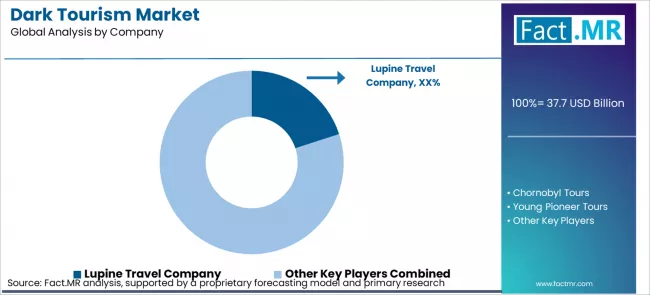
Dark Tourism Market Analysis By Company | Source: Fact.MR
In the dark tourism market, key players like Lupine Travel Company, Chornobyl Tours, and Young Pioneer Tours offer unique experiences centered around historical sites with dark or tragic histories, such as Chernobyl and former Soviet locations. These companies differentiate themselves by providing curated, immersive tours that educate visitors on significant yet somber events. Aero Travels and Atlas Obscura target niche audiences with offbeat, lesser-known destinations, while Dark Rome Tours caters to those interested in exploring the darker aspects of Roman history. Anne Frank Stichting and the State Museum at Auschwitz-Birkenau leverage their historical significance to attract tourists seeking deeper reflections on wartime atrocities. Haunted History Tours and Alcatraz Cruises build on the intrigue surrounding haunted sites and notorious prisons, combining history with a sense of mystery, contributing to the market’s diversity and growth.
Recent Industry Developments
- ICOMOS International Charter on Intangible Heritage (Regulatory): In November 2024, ICOMOS (the advisory body to UNESCO) adopted a new International Charter and Guidance on Sites with Intangible Cultural Heritage; this landmark regulation provides the first global standards for managing the "living" memory and community sensitivities at sites of tragedy, directly impacting how dark tourism destinations must be managed through 2026.
- Pompeii Archaeological Park Entry Caps (Regulatory): In November 2024, the Pompeii Archaeological Park officially introduced a daily limit of 20,000 visitors and launched "named tickets" to curb overtourism and preserve the site’s integrity; this regulatory shift follows a record-breaking year of over 4 million visitors and serves as a primary model for sustainable management at sensitive historical disaster sites in 2025-2026.
- National Park Service Grant for 9/11 Memorial (Corporate Strategic): In late 2023/2024, the U.S. National Park Service awarded a $2.5 million grant to the National September 11 Memorial & Museum to fund a strategic expansion of educational programs and facility upgrades; this investment supports the site’s transition to handling record-level footfall, which reached 11.6 million memorial visitors in 2024.
Key Players of the Dark Tourism Market
- Lupine Travel Company
- Chornobyl Tours
- Young Pioneer Tours
- Aero Travels
- Atlas Obscura
- Dark Rome Tours
- Anne Frank Stichting
- State Museum at Auschwitz-Birkenau
- Haunted History Tours
- Alcatraz Cruises
Report Scope
| Metric | Value |
|---|---|
| Quantitative Units | USD 37.7 billion (2026) to USD 46.8 billion (2036), at a CAGR of 2.5% |
| Market Definition | The Dark Tourism Market includes travel to locations associated with death, tragedy, or the macabre, providing tourists with an experience rooted in historical events, natural disasters, and more. |
| By Type | Holocaust Tourism, Genocide Tourism, Paranormal Tourism, Battlefield Tourism, Nuclear Tourism, Others |
| By Booking Channel | Phone Booking, Online Booking, In Person Booking |
| By Tourist Type | Domestic Tourist, International Tourist |
| By Tour Type | Independent Traveler, Tour Group, Package Traveller |
| By Age Group | 15-25 Years, 26-35 Years, 36-45 Years, 46-55 Years, 56-65 Years, 66-75 Years, More Than 75 Years |
| Regions Covered | North America, Latin America, Europe, East Asia, South Asia, Oceania, Middle East and Africa |
| Countries Covered | United States, Canada, Mexico, Brazil, Argentina, Germany, France, United Kingdom, Italy, Spain, China, India, Japan, South Korea, Indonesia, Australia, and 40+ countries |
| Key Companies Profiled | Lupine Travel Company, Chornobyl Tours, Young Pioneer Tours, Aero Travels, Atlas Obscura, Dark Rome Tours, Anne Frank Stichting, State Museum at Auschwitz-Birkenau, Haunted History Tours, Alcatraz Cruises |
| Forecast Period | 2026 to 2036 |
| Approach | Hybrid top-down and bottom-up market modeling validated through primary interviews with manufacturers and supported by trade data benchmarking and market research. |
Source: Fact.MR analysis. Updated Feb 24, 2026
Bibliographies
- EaseMyTrip. (2025). Rising interest in dark tourism experiences. EaseMyTrip.
- Lupine Travel Company. (2025). Dark tourism travel experiences and destinations. Lupine Travel Company.
- International Council on Monuments and Sites. (2024, November). International charter and guidance on sites with intangible cultural heritage. ICOMOS.
- Pompeii Archaeological Park. (2024, November). Introduction of daily visitor limits and named ticketing to preserve site integrity. Pompeii Archaeological Park.
- National Park Service. (2024). National Park Service awards grant funding to the National September 11 Memorial & Museum. U.S. Department of the Interior.
This report addresses
- Market intelligence enabling comprehensive assessment of leading countries and product segments across the Dark Tourism Market globally.
- Market volume (sales units) estimates and 10-year revenue forecasts from 2026 to 2036, validated through manufacturer shipment data, channel partner surveys, and country-level demand modeling.
- Growth opportunity mapping across dark tourism types (Holocaust Tourism, Genocide Tourism, Paranormal Tourism, Battlefield Tourism, Nuclear Tourism, and Others), booking channels (Phone Booking, Online Booking, In-Person Booking), tourist types (Domestic Tourist, International Tourist), tour types (Independent Traveler, Tour Group, Package Traveller), and age groups.
- Segment and regional revenue forecasts by type, booking channel, tourist type, tour type, age group, and geography across 40+ countries.
- Competition strategy analysis covering dealer network structure, recent developments, product portfolio, USPs, and market share analysis.
- Product and regulatory compliance tracking aligned with tourism standards, cultural sensitivity, and site preservation requirements.
- Regulatory impact analysis addressing travel regulations, ethical considerations, and destination management policies across key markets.
- Report delivery in PDF, Excel, PowerPoint, and interactive dashboard formats for executive, procurement, and operational planning use.
Segmentation
Dark Tourism Market Key Segments
-
By Type :
- Holocaust Tourism
- Genocide Tourism
- Paranormal Tourism
- Battlefield Tourism
- Nuclear Tourism
- Others
-
By Booking Channel :
- Phone Booking
- Online Booking
- In Person Booking
-
By Tourist Type :
- Domestic Tourist
- International Tourist
-
By Tour Type :
- Independent Traveler
- Tour Group
- Package Traveller
-
By Age Group :
- 15-25 Years
- 26-35 Years
- 36-45 Years
- 46-55 Years
- 56-65 Years
- 66-75 Years
- More Than 75 Years
-
Region :
- North America
- USA
- Canada
- Mexico
- Europe
- Germany
- UK
- France
- Italy
- Spain
- Nordic Countries
- BENELUX
- Rest of Europe
- Asia Pacific
- China
- Japan
- South Korea
- India
- Australia
- Rest of Asia Pacific
- Latin America
- Brazil
- Argentina
- Rest of Latin America
- Middle East and Africa
- Kingdom of Saudi Arabia
- United Arab Emirates
- South Africa
- Rest of Middle East and Africa
- Other Regions
- Oceania
- Central Asia
- Other Markets
- North America
Frequently Asked Questions
How large is the demand for Dark Tourism in the global market in 2026?
What will be the market size of Dark Tourism in the global market by 2036?
What is the expected demand growth for Dark Tourism in the global market between 2026 and 2036?
Which booking channel is expected to dominate the market?
Which region is expected to show the highest growth rate for Dark Tourism?
How significant is the growth outlook for China in this market?
What is the growth outlook for Singapore in this report?
What is the growth forecast for Canada in the Dark Tourism market?
What is the growth forecast for the United States in the Dark Tourism market?
Which company is identified as a leading player in the Dark Tourism market?
What is Dark Tourism?
What does the Dark Tourism market include in this report?
How is the market forecast developed in this report?
What is meant by the Dark Tourism market in this report?
Who worked on this report


Preview the report firsthand - request a free sample
Free SampleGet the brochure for pricing and purchase details
Download PDF