- Market Value (2025): USD 3.9 Bn
- Estimated Value (2026): USD 4.3 Bn
- Forecast Value (2036): USD 11.3 Bn
- CAGR (2026-2036): 10.2%
What is the DC Switching Portfolios Market forecast to be worth by 2036?
USD 4.3 billion in 2026 to USD 11.3 billion by 2036 at a 10.2% CAGR.
- 2025 market value: USD 3.9 billion.
- 2026 to 2036 value progression: USD 4.3 billion to USD 11.3 billion.
- 2026 to 2036 CAGR: 10.2%.
What are the defining numbers behind DC Switching Portfolios Market growth?
The market is expected to create an absolute opportunity of USD 7.0 billion between 2026 and 2036.
- Demand Drivers in the Market
- Electric mobility is increasing the number of high-current DC circuits that require commanded switching, isolation and fault protection. The International Energy Agency reported that global electric car sales exceeded 20 million in 2025, equal to one-quarter of new car sales, while private light-duty charging points reached more than 43 million. Each vehicle and charging installation adds DC switching points around the battery, charging path, pre-charge circuit and high-voltage distribution system.
- This expands demand around DC circuit breakers and contactors because higher-voltage battery systems need components that can interrupt or isolate current without relying on the natural current zero available in AC circuits. IEC 60947-2:2024 applies to circuit breakers up to 1,500 VDC, while IEC 60947-4-1:2023 covers electromechanical contactors for circuits up to 1,500 VDC.
- Battery storage and solar installations create a second large DC switching base. The International Energy Agency reported that global battery storage additions rose to almost 110 GW in 2025, while solar PV represented more than three-quarters of new renewable capacity additions. Storage racks, combiner paths and inverter-side DC buses require contactors, disconnectors and protection devices for normal operation, maintenance isolation and fault response.
- As storage projects scale, buyers increasingly coordinate switching devices with the wider DC distribution architecture. IEC 60947-3:2020 with its 2025 amendment covers switches and disconnectors up to 1,500 VDC and includes critical-load-current tests for DC switches, reinforcing the qualification burden on equipment used in solar and storage systems.
- Data-center expansion is adding another source of DC demand through UPS batteries, backup storage and higher-density power architectures. Lawrence Berkeley National Laboratory projected that U.S. data-center electricity use could double or triple by 2028 from 2023 levels. The International Energy Agency projects global electricity supply for data centers to rise from 460 TWh in 2024 to more than 1,000 TWh in 2030. More power concentrated in server campuses increases the value of fast isolation, selective protection and service continuity in DC battery and distribution paths.
- Key Segments Analyzed
- Product Family: DC contactors account for 31.0% in 2026 because they provide repeatable commanded make-and-break operation in battery, charging and industrial DC circuits.
- Voltage Range: 150-600 VDC represents 31.0% in 2026 because the band serves a broad installed base of vehicle, charging, industrial and stationary battery circuits that require compact DC-rated switching.
- Application: EV and charging accounts for 29.0% in 2026 as each electrified vehicle and charging installation uses multiple switching points for traction batteries, pre-charge paths and high-voltage distribution.
- Switching Duty: Load switching accounts for 32.0% in 2026 because normal energization and de-energization occur repeatedly during operation, unlike fault interruption which is primarily protective and event-driven.
- Analyst Opinion at Fact.MR
- “The procurement question in DC switching is moving from simple voltage and current rating toward how the device behaves inside the full DC protection scheme. EV charging, battery storage and data-center power systems need faster interruption, bidirectional operation and reliable isolation without creating excessive losses or thermal burden. Suppliers that can demonstrate coordination across contactors, breakers and disconnect functions will be better positioned for platform-level qualification,” says Shambhu Nath Jha, Principal Consultant, Fact.MR.
- Strategic Implications
- OEMs and system integrators should specify switching devices from the actual DC fault profile rather than from nominal current alone. Battery and capacitor-rich systems can produce steep current rise, while pre-charge, regeneration and bidirectional power flow change the duty seen by the switch. Contactors, breakers and isolators therefore need coordinated ratings for operating current, interruption capability, short-circuit withstand and isolation.
- Suppliers should align portfolio design with the move toward DC power architectures. Buyers are increasingly evaluating whether a device can combine switching, protection, isolation, metering or communication in one compact package, especially where panel space and service continuity matter.
- Procurement also overlaps with the broader switchgear supply chain, particularly for DC-rated breakers, disconnectors and integrated protection assemblies used at equipment and distribution boundaries.
- Solid-state and hybrid devices create a product-development opportunity, but thermal management and conduction losses remain part of the tradeoff. ABB notes that semiconductor-based interruption can clear faults much faster than conventional mechanisms, while also requiring careful loss and cooling management. Commercial success therefore depends on balancing interruption speed with efficiency, cost and qualification requirements.
How does the DC Switching Portfolios Market break down by segment?
The market is segmented by Product Family, Voltage Range, Application and Switching Duty.
Why do DC contactors lead Product Family?
DC contactors account for 31.0% of Product Family in 2026.
Their role is to connect and disconnect high-current DC loads repeatedly under command, which makes them central to traction-battery isolation, charging systems, pre-charge circuits, battery storage and industrial power control.
Current supplier portfolios show the breadth of this operating range. Eaton markets DC contactors from 600 V to 2,000 V for industrial applications. Sensata offers sealed GIGAVAC contactors for EV and industrial systems, with product families extending to 1,500 VDC. TE Connectivity supplies industrial DC contactors up to 1,500 VDC for EV charging infrastructure and battery energy storage systems.
Compared with a breaker used mainly for protective interruption, the contactor is cycled as part of normal operation. This repeat-use duty produces a broad unit base across battery packs, charging cabinets and DC equipment, supporting its 2026 share.
Why does 150-600 VDC lead Voltage Range?
150-600 VDC accounts for 31.0% of Voltage Range in 2026.
The band covers a broad set of established DC systems, including vehicle battery circuits, industrial power equipment, smaller charging systems, UPS batteries and stationary storage configurations where compact electromechanical switching remains practical.
The range also sits below the 1,000-1,500 VDC class now expanding in utility storage, megawatt charging and large DC distribution. That gives 150-600 VDC a wider installed equipment base, while higher-voltage categories gain demand as charging power and storage-system voltage increase.
IEC low-voltage switchgear standards extend to 1,500 VDC, so buyers across these voltage classes still work within common families of breaker, contactor and disconnect qualification. The difference is that arc control, insulation and fault-energy requirements become more demanding as voltage rises.
Why does EV and charging lead Application?
EV and charging accounts for 29.0% of Application in 2026.
Electric vehicles require contactors and related switching devices around the traction battery, pre-charge circuit, DC charging interface and auxiliary high-voltage loads. Charging equipment adds isolation and protective switching on the charger side.
The International Energy Agency reported more than 20 million electric car sales in 2025 and more than 43 million private light-duty charging points worldwide. Public charging is also moving to higher power, which raises the switching duty on DC contactors, disconnectors and breakers used inside charging cabinets and distribution equipment.
The application links directly with energy storage because EV charging sites increasingly use batteries to manage grid connection limits, peak demand and renewable generation. This creates additional DC switching points around the storage rack and charging bus.
Why does Load switching lead Switching Duty?
Load switching accounts for 32.0% of Switching Duty in 2026.
It covers the repeated opening and closing of energized DC circuits during normal equipment operation, including battery connection, charger energization, industrial load control and maintenance sequences.
This duty occurs more frequently than fault interruption because it is part of routine operation. Contactors and load-break switches are therefore selected for electrical life, contact resistance and controlled arc management across many switching cycles, while breakers are sized to interrupt abnormal current when protection logic detects a fault.
IEC 60947-3 includes specific requirements for DC switches and disconnectors, including critical-load-current testing. The standardization reflects the difficulty of interrupting DC current safely across different load conditions and reinforces buyer preference for devices qualified for the exact switching duty rather than generic isolation hardware.
What is accelerating DC Switching Portfolios Market adoption, and what is holding it back?
Adoption is being accelerated by the spread of DC-native energy systems. The main restraint is the physical difficulty of interrupting DC current.
Drivers Impact Analysis
| Factor | (~) % Impact on CAGR | Geographic Relevance | Impact Timeline |
|---|---|---|---|
| EV and high-power charging expansion | +1.8% | North America, Europe and East Asia | Near to Long term (2026-2036) |
| Battery storage and solar DC integration | +1.4% | USA, Europe and East Asia | Near to Long term (2026-2036) |
| Data-center and critical-power buildout | +0.9% | USA, Europe and Japan | Near to Mid term (2026-2032) |
Source: Fact.MR analysis. Updated Sep 7, 2026
Opportunity Impact Analysis
| Factor | (~) % Impact on CAGR | Geographic Relevance | Impact Timeline |
|---|---|---|---|
| Solid-state and hybrid DC switching | +0.8% | Global high-power DC systems | Mid to Long term (2029-2036) |
| Bidirectional switching for storage and charging | +0.6% | Europe, USA and East Asia | Near to Long term (2026-2036) |
| Integrated protection-switching modules | +0.5% | EV, charging and data-center OEMs | Mid term (2029-2032) |
Source: Fact.MR analysis. Updated Sep 7, 2026
Restraints Impact Analysis
| Factor | (~) % Impact on CAGR | Geographic Relevance | Impact Timeline |
|---|---|---|---|
| DC arc interruption and thermal-design complexity | -0.7% | Global | Near to Long term (2026-2036) |
| Qualification and protection-coordination burden | -0.5% | High-voltage DC applications | Near to Long term (2026-2036) |
| Cost premium for solid-state and hybrid devices | -0.3% | Cost-sensitive industrial applications | Near to Mid term (2026-2032) |
Source: Fact.MR analysis. Updated Sep 7, 2026
Which countries are scaling the DC Switching Portfolios Market through 2036?
- USA: Utility-scale battery storage reached nearly 52 GW by mid-2026, increasing demand for DC isolation, rack protection and switching around storage and power-conversion equipment.
- Germany: The Federal Network Agency recorded 155,264 normal charging points and 54,341 fast charging points in operation on July 1, 2026, with 9.04 GW of simultaneous charging capacity, expanding the installed base for DC switching equipment.
- Japan: Government policy targets 300,000 charging outlets by 2030, including 30,000 public fast chargers, creating demand for contactors and DC protection as charger power levels rise.
- UK: The public network reached 121,171 EV chargers on July 1, 2026, including 28,887 rated at 50 kW or above, supporting continued equipment demand in public charging installations.
- France: Public charging deployment is being paired with a national road-network electrification plan, while solar PV capacity reached 34.0 GW by June 2026, creating switching demand across mobility and renewable DC systems.
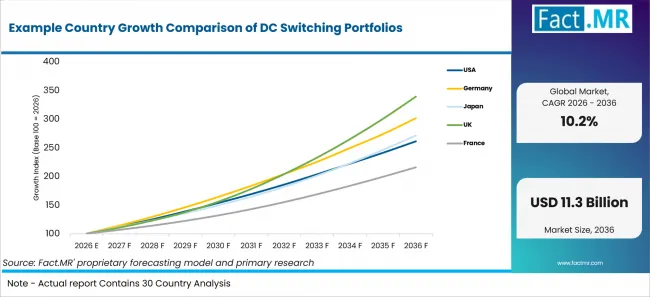
Example Country Growth Comparison Of Dc Switching Portfolios | Source: Fact.MR
| Country | CAGR (2026-2036) |
|---|---|
| USA | 10.1% |
| Germany | 11.7% |
| Japan | 10.5% |
| UK | 13.0% |
| France | 8.0% |
Source: Fact.MR analysis. Updated Sep 7, 2026
What is driving USA's growth through 2036?
The USA is projected to expand at a 10.1% CAGR through 2036.
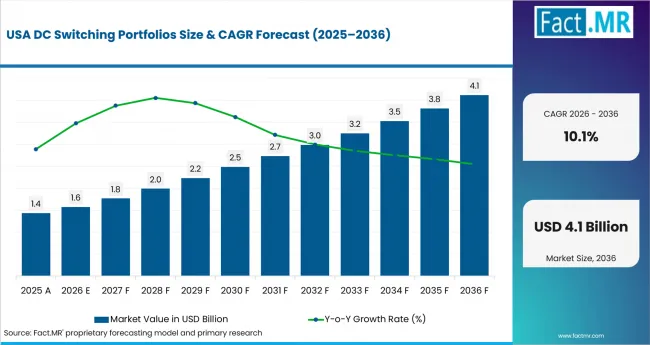
Dc Switching Portfolios Country Value Analysis | Source: Fact.MR
U.S. Energy Information Administration data show utility-scale battery storage at nearly 52 GW by June 2026 after 8.3 GW was added in the first half of the year. Operators reported plans for additional capacity through 2028, expanding the installed base of battery racks, DC collection paths and isolation equipment.
Data centers add a separate demand mechanism. Lawrence Berkeley National Laboratory estimates that U.S. data-center electricity demand could double or triple by 2028 relative to 2023. Growth in UPS batteries and high-density critical-power systems increases the value of selective DC protection, low-loss switching and serviceable isolation around backup and distribution equipment.
What is driving Germany's growth through 2036?
Germany is projected to expand at an 11.7% CAGR through 2036.
The Bundesnetzagentur reported 155,264 normal charging points and 54,341 fast charging points in service on July 1, 2026, with combined simultaneous charging capacity of 9.04 GW. The scale of the network creates recurring demand for DC-rated contactors, disconnectors and breakers inside fast-charging cabinets and associated distribution equipment.
European infrastructure rules reinforce the move toward higher-power equipment. Regulation (EU) 2023/1804 requires high-power charging pools along the TEN-T network, with individual DC charging points at 150 kW in prescribed locations and higher pool power over time. German charging operators therefore face a continued need for switching devices that can handle higher voltage, higher current and maintenance isolation under frequent use.
What is driving Japan's growth through 2036?
Japan is projected to expand at a 10.5% CAGR through 2036.
The Ministry of Economy, Trade and Industry targets 300,000 charging outlets by 2030, including 30,000 public fast chargers, and its charging-infrastructure guidance calls for higher-power equipment on expressways and other routes. Higher charger output raises the current and fault-management requirements placed on DC switching components.
Japan also revised its Battery Industry Strategy into the Battery and Power Industry Strategy in June 2026. The ministry highlighted advanced power-control needs from AI data centers along with battery-system development. This supports demand for contactors, breakers and hybrid switching modules in stationary power systems as well as transport electrification.
What is driving UK's growth through 2036?
The UK is projected to expand at a 13.0% CAGR through 2036.
Department for Transport statistics show 121,171 public EV chargers in operation on July 1, 2026, of which 28,887 were rated rapid or above at 50 kW and higher. Growth in high-power public charging increases the installed base of DC switching and protection devices used for cabinet isolation, output control and service protection.
The Public Charge Point Regulations require rapid charging networks to achieve 99% average annual reliability. That operational requirement raises the value of switching devices with predictable electrical life, clear fault isolation and maintainable architectures because downtime at a contactor, breaker or isolator can directly affect charger availability.
What is driving France's growth through 2036?
France is projected to expand at an 8.0% CAGR through 2036.
The Ministry of Transport published a national road-network electrification plan in April 2026 targeting 30,000 charging points on major routes by 2035. This creates demand for DC contactors, breakers and disconnectors in high-power charging installations as corridor coverage expands.
Renewable power adds another route. France had 34.0 GW of solar PV capacity connected by June 30, 2026, after adding 3.0 GW in the first half of the year. Solar plants and co-located storage use DC switching for array isolation, battery protection and maintenance, supporting demand beyond vehicle charging.
Who Leads the DC Switching Portfolios Market?
Key players in the DC Switching Portfolios Market include Eaton, Schneider Electric, ABB, Sensata Technologies, TE Connectivity and Mersen.
Eaton markets DC contactors across a broad industrial voltage and current range. Schneider Electric maintains DC-rated circuit-breaker offerings for direct-current applications. ABB supplies SACE Infinitus solid-state circuit breakers for DC distribution, combining breaker, contactor and isolator functions with bidirectional protection and monitoring.
Sensata Technologies supplies GIGAVAC contactors for EV and industrial applications, including bidirectional and high-voltage products. TE Connectivity offers DC contactors up to 1,500 VDC for battery energy storage and EV charging infrastructure. Mersen supplies DC disconnectors and high-power switching equipment for solar, storage, rail and industrial DC systems, alongside protection components used to coordinate fault response.
Which companies are the key providers?
Key providers include Eaton, Schneider Electric, ABB, Sensata Technologies, TE Connectivity and Mersen.
- Eaton
- Schneider Electric
- ABB
- Sensata Technologies
- TE Connectivity
- Mersen
Bibliography
- International Energy Agency. (2026). Global EV Outlook 2026. IEA.
- International Energy Agency. (2026). Electric vehicle charging, Global EV Outlook 2026. IEA.
- International Energy Agency. (2026). Global Energy Review 2026. IEA.
- International Energy Agency. (2025). Energy and AI. IEA.
- International Energy Agency. (2024). Batteries and Secure Energy Transitions. IEA.
- Lawrence Berkeley National Laboratory. (2024). 2024 United States Data Center Energy Usage Report. U.S. Department of Energy.
- U.S. Energy Information Administration. (2026, August 7). Battery storage capacity averaged 70% growth over the last three years. U.S. Department of Energy.
- International Electrotechnical Commission. (2024). IEC 60947-2:2024, Low-voltage switchgear and controlgear - Part 2: Circuit-breakers. IEC.
- International Electrotechnical Commission. (2025). IEC 60947-3:2020+AMD1:2025, Low-voltage switchgear and controlgear - Part 3: Switches, disconnectors, switch-disconnectors and fuse-combination units. IEC.
- International Electrotechnical Commission. (2026). IEC 60947-4-1:2023 corrected version, Low-voltage switchgear and controlgear - Part 4-1: Contactors and motor-starters. IEC.
- European Parliament and Council of the European Union. (2023). Regulation (EU) 2023/1804 on the deployment of alternative fuels infrastructure. European Union.
- Bundesnetzagentur. (2026). Electromobility charging infrastructure statistics. Federal Network Agency, Germany.
- Ministry of Economy, Trade and Industry. (2023). Guidelines for Promoting the Development of EV Charging Infrastructure. Government of Japan.
- Ministry of Economy, Trade and Industry. (2026, June 2). Battery Industry Strategy revised as the Battery and Power Industry Strategy. Government of Japan.
- UK Department for Transport. (2026, August 27). Public electric vehicle charging infrastructure statistics: 1 July 2026. Government of the United Kingdom.
- Office for Zero Emission Vehicles. (2024). Public Charge Point Regulations 2023 guidance. Government of the United Kingdom.
- Ministry for Ecological Transition. (2026, April 17). National road-network electrification plan to 2035. Government of France.
- Service des données et études statistiques. (2026, September 4). Solar photovoltaic dashboard, second quarter 2026. Government of France.
- Eaton. (2026). DC contactors. Eaton Corporation plc.
- Schneider Electric. (2026). Direct Current DC-rated circuit breakers. Schneider Electric SE.
- ABB. (2026). SACE Infinitus solid-state circuit breaker. ABB Ltd.
- Sensata Technologies. (2026). GIGAVAC contactors and industrial fuses. Sensata Technologies, Inc.
- TE Connectivity. (2026). High-voltage DC contactors for EV charging and battery energy storage systems. TE Connectivity Ltd.
- Mersen. (2026). High-power switching, protection and control products for DC applications. Mersen S.A.
This Report Answers
- How are EV charging and battery storage changing DC switching requirements?
- Why do DC contactors account for 31.0% of Product Family in 2026?
- Why does the 150-600 VDC range account for 31.0% of Voltage Range?
- How do solid-state and hybrid devices change fault-interruption design?
- Why does routine load switching create more unit demand than event-driven fault interruption?
- Which supplier capabilities matter when OEMs qualify DC switching portfolios?
What does the DC Switching Portfolios Market cover?
The market covers commercially sold devices and modules used to make, break, isolate, protect or redirect direct-current circuits. It includes components used in EV battery systems, charging equipment, solar and storage installations, data-center and telecom power systems, industrial DC equipment, rail systems and marine electrical architectures.
Revenue is counted for DC contactors, DC circuit breakers, solid-state DC switches, disconnects and isolators, and hybrid protection-switching modules where the switching function is a defined part of the commercial product. Devices may be sold as standalone components or as integrated switching and protection modules.
What is included in the scope?
Included products are the Product Family categories defined in the segmentation across the stated Voltage Range, Application and Switching Duty groups. The scope includes electromechanical and semiconductor-assisted products used for normal load control, protective interruption, maintenance isolation, pre-charge or inrush management and bidirectional DC switching.
What is excluded from the scope?
AC-only contactors, AC-only circuit breakers, standalone fuses, surge-protection devices, relays used only for signal control, power semiconductor modules without a complete switching function, inverters, rectifiers, converters, busbars, complete switchgear assemblies sold primarily as AC equipment and installation or maintenance services sold separately are excluded.
How Was the Analysis Built?
- Primary Research:
- Primary research focuses on DC switching manufacturers, EV and charging-system engineers, battery-pack designers, storage-system integrators, data-center power engineers, industrial electrical OEMs, rail and marine electrical specialists, distributors, procurement managers and protection-engineering teams.
- Desk Research:
- Desk research uses EV and charging statistics, battery-storage deployment data, data-center electricity studies, national infrastructure programs, IEC switching standards, regulatory requirements and current company technical literature for DC contactors, breakers, disconnectors and solid-state switching devices.
- Market Sizing and Forecasting:
- Market sizing evaluates EV and charger production, battery-storage deployment, solar DC capacity, data-center and telecom power installations, industrial DC equipment, voltage-class mix, switching-device count per system, replacement cycles, average selling price, electrical-life requirements and adoption of solid-state or hybrid modules.
- Data Validation and Update Cycle:
- Forecasts are reviewed against EV sales and charger deployment, storage additions, data-center project activity, changes in DC voltage architecture, new IEC requirements, supplier portfolio extensions and evidence of solid-state or bidirectional switching adoption.
Segmentation
What is the report's scope and coverage?
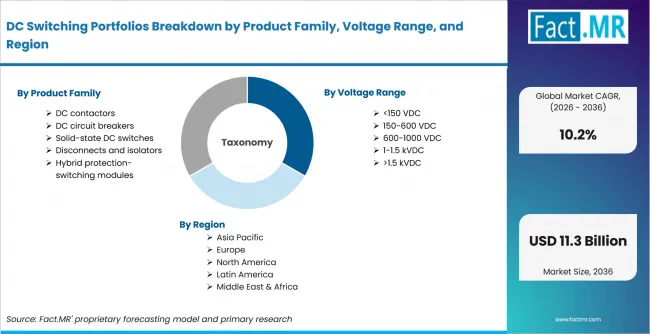
Dc Switching Portfolios Breakdown By Product Family, Voltage Range, And Region | Source: Fact.MR
| Parameter | Details |
|---|---|
| Quantitative Units | USD Billion |
| Market Definition | Devices and modules used to make, break, isolate, protect or redirect direct-current circuits |
| Segments | Product Family; Voltage Range; Application; Switching Duty |
| Regions | Global |
| Countries | USA; Germany; Japan; UK; France |
| Key Companies | Eaton; Schneider Electric; ABB; Sensata Technologies; TE Connectivity; Mersen |
| Forecast Period | 2026 to 2036 |
| Base Year | 2026 |
| Market Value, 2026 | USD 4.3 billion |
| Market Value, 2036 | USD 11.3 billion |
| CAGR, 2026-2036 | 10.2% |
| Absolute Opportunity | USD 7.0 billion |
| Approach | System deployment, switching-device count, voltage mix, replacement demand and supplier-revenue assessment |
Source: Fact.MR analysis. Updated Sep 7, 2026
How is the market segmented?
-
By Product Family:
- DC contactors
- DC circuit breakers
- Solid-state DC switches
- Disconnects and isolators
- Hybrid protection-switching modules
-
By Voltage Range:
- <150 VDC
- 150-600 VDC
- 600-1000 VDC
- 1-1.5 kVDC
- >1.5 kVDC
-
By Application:
- EV and charging
- Solar & storage
- Data centers and telecom
- Industrial DC systems
- Rail and marine
-
By Switching Duty:
- Load switching
- Fault interruption
- Isolation
- Pre-charge and inrush
- Bidirectional switching
-
By Region:
- North America
- Latin America
- Western Europe
- Eastern Europe
- East Asia
- South Asia and Pacific
- Middle East & Africa
Frequently Asked Questions
What is the DC Switching Portfolios Market value in 2026?
At what CAGR is the market projected to grow?
What is the projected market value by 2036?
Which Product Family accounts for 31.0% share in 2026?
Which Voltage Range accounts for 31.0% share in 2026?
Which Application accounts for 29.0% share in 2026?
Which Switching Duty accounts for 32.0% share in 2026?
Which countries are included in the country growth analysis?
What is a main demand driver for DC switching portfolios?
What is a main restraint on adoption?
Which companies are included among key providers?
Who worked on this report


Preview the report firsthand - request a free sample
Free SampleGet the brochure for pricing and purchase details
Download PDF