- Market Value (2025): USD 15.3 Bn
- Estimated Value (2026): USD 16.2 Bn
- Forecast Value (2036): USD 29.0 Bn
- CAGR (2026-2036): 6.0%
What is the Decks Market forecast to be worth by 2036?
USD 16.2 billion in 2026 to USD 29.0 billion by 2036 at a 6.0% CAGR.
- The decks market crossed USD 15.3 billion in 2025 as residential outdoor projects supported new installations and replacement work.
- Demand is projected to increase from USD 16.2 billion in 2026 as outdoor living investment expands across residential properties.
- The market is forecast to reach USD 29.0 billion by 2036 as renovation cycles support replacement of weathered deck surfaces.
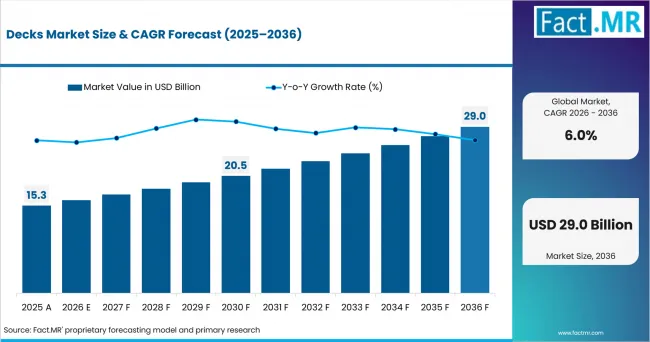
Decks Market Market Value Analysis | Source: Fact.MR
What are the defining numbers behind Decks Market growth?
USD 12.8 billion absolute opportunity through 2036 as residential projects support material and construction choices.
- Demand Drivers in the Market
- Homeowners add decks to create usable outdoor space for dining and recreation across detached and low-rise residential properties.
- Renovation contractors replace worn boards and substructures when moisture damage or surface deterioration reduces safe service life.
- Commercial property operators use decks for guest seating and circulation areas that connect indoor spaces with outdoor amenities.
- Material suppliers compete through durability and maintenance requirements because lifecycle effort influences replacement decisions after installation.
- Key Segments Analyzed
- By Material: Wood/Timber is expected to account for 44.0% share in 2026 because established supply channels support broad contractor familiarity.
- By Construction: Raised Decks are projected to capture 38.0% share in 2026 because elevated platforms extend usable space beside homes.
- By End Use: Residential is anticipated to represent 66.0% share in 2026 as homeowners fund outdoor additions and replacement projects.
- By Application: New Installation is estimated to account for 58.0% share in 2026 as housing additions create first-time deck demand.
- Analyst Opinion at Fact.MR
- Shambhu Nath Jha, Senior Analyst at Fact.MR states: “Deck demand depends on the practical value of added outdoor space and the maintenance burden accepted by property owners. Suppliers that combine material choice with clear installation guidance can support contractors through design and replacement decisions. Competitive strength will depend on channel access and dependable product availability across seasonal project cycles.”
- Strategic Implications
- Deck contractors should confirm structural support and drainage details before ordering boards so material quantities remain accurate throughout installation.
- Homeowners should compare maintenance requirements with expected service conditions before choosing timber or alternative decking materials for exposed sites.
- Distributors should align seasonal inventory with local construction cycles because delayed board availability can interrupt contractor project schedules.
- Hospitality operators should evaluate slip resistance and cleaning needs before selecting deck surfaces for outdoor guest circulation areas.
Reflecting continued investment in advanced decking materials manufacturing, UFP Industries announced a new Deckorators facility in April 2025 to expand Surestone decking production capacity. The expansion is intended to support growing demand for premium decking products while strengthening production capabilities and supply reliability. Increased Surestone output is expected to improve product availability for residential and commercial outdoor construction projects which aligns with broader demand for durable, low-maintenance decking solutions.
India is expected to record a 7.8% CAGR as urban housing activity supports outdoor additions in suitable residential formats. China is projected to post a 7.1% CAGR as construction scale sustains material demand despite property-sector pressure. Australia is anticipated to advance at a 5.8% CAGR as detached housing and renovation activity support outdoor living projects. The United Kingdom is estimated to expand at a 5.5% CAGR as repair spending supports replacement and refurbishment work. The United States is forecast to record a 5.3% CAGR as established deck-building channels serve new housing and remodeling demand. Germany is projected to register a 5.0% CAGR as housing permits and renovation work support selective exterior upgrades. Japan is expected to post a 4.7% CAGR as replacement demand supports compact residential outdoor platforms and weather-resistant materials.
How does the Decks Market break down by segment?
Wood/Timber is expected to hold 44.0% share, Raised Decks represent 38.0% in 2026
Why does Wood/Timber remain the preferred decking material?
Wood/Timber accounts for 44.0% share in 2026
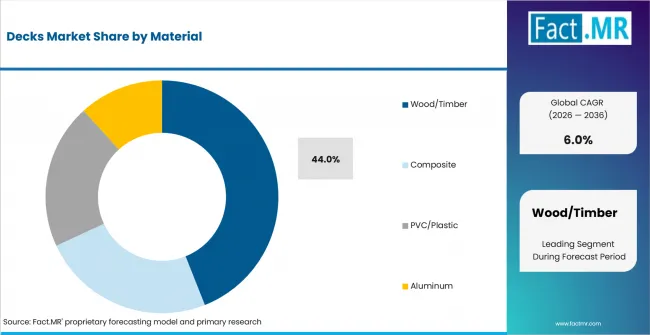
Decks Market Analysis By Material | Source: Fact.MR
Wood/Timber is projected to account for 44.0% share in 2026 because builders can source standard profiles through established dealer networks. Contractors also understand fastening methods and finishing requirements across common residential deck designs without requiring specialized installation systems. Composite materials gain preference where homeowners accept higher initial costs in exchange for reduced staining and sealing requirements. PVC or plastic products fit moisture-exposed settings where rot resistance and easier surface cleaning matter throughout regular outdoor use. Aluminum serves narrower applications where structural weight limits and corrosion exposure justify higher material costs during project specification.
Why do Raised Decks capture the largest construction share?
Raised Decks capture 38.0% share in 2026
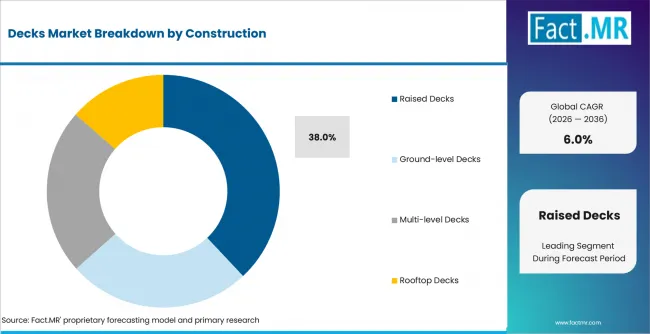
Decks Market Analysis By Construction | Source: Fact.MR
Raised Decks are anticipated to represent 38.0% of construction demand in 2026 because many homes require outdoor platforms above sloped ground. They also create direct transitions from upper living areas into usable exterior space without extensive site leveling before construction. Multi-level decks serve larger properties where separate elevations create distinct dining and recreation zones across uneven terrain. Rooftop decks remain selective because waterproofing systems and structural load checks require greater coordination before the finished surface is installed.
Why does Residential remain the largest End Use category?
Residential demand represents 66.0% share in 2026
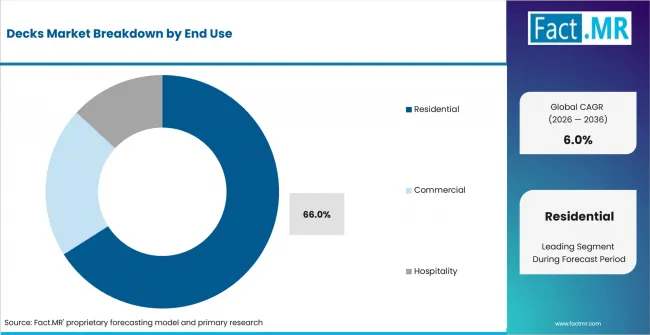
Decks Market Analysis By End Use | Source: Fact.MR
Residential is expected to capture 66.0% share in 2026 because detached homes provide the largest addressable base for new deck construction. Homeowners also use decking to extend dining and recreation space without undertaking full building extensions or major internal remodeling. Hospitality operators specify decking for terraces and poolside areas where cleaning frequency and surface durability influence lifecycle costs. End-use selection therefore depends on expected traffic and maintenance capacity alongside the visual role of the finished outdoor area.
Why does New Installation command the leading Application share?
New Installation commands 58.0% share in 2026
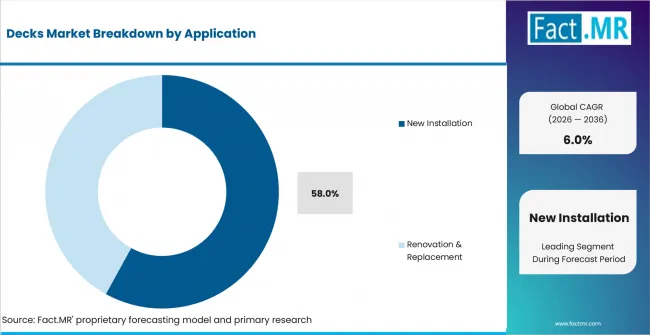
Decks Market Analysis By Application | Source: Fact.MR
New Installation is estimated to record 58.0% share in 2026 because new deck projects still exceed complete replacement activity across the market. Homeowners frequently add decks to properties that previously lacked usable outdoor platforms or adequate entertainment space beside the building. Renovation and Replacement demand follows where structural aging and surface deterioration make partial repair less economical than broader reconstruction.
What is accelerating Decks Market adoption and what is holding it back?
Residential outdoor investment supports adoption while material volatility and installation constraints can delay project decisions across seasonal construction cycles.
| Driver | (~) % Impact on CAGR | Geographic Relevance | Impact Timeline |
|---|---|---|---|
| Residential outdoor living investment | +0.7% | North America and Australia | Medium term (2-4 years) |
| Renovation cycles sustain replacement | +0.6% | North America and Europe | Medium term (2-4 years) |
| Material substitution supports composite and polymer demand | +0.5% | North America and Europe | Long term (>= 4 years) |
| Hospitality and commercial outdoor areas | +0.4% | Global urban markets | Medium term (2-4 years) |
| Installation labor efficiency | +0.3% | North America and Australia | Short term (<= 2 years) |
Source: Fact.MR analysis. Updated Jul 10, 2026
- Residential outdoor living investment: Housing additions and property upgrades create direct demand for decks that extend usable living space beyond interior rooms. Homeowners increasingly treat decks as functional dining and recreation areas that support regular seasonal use. Contractors gain opportunities when project planning combines deck layout with access requirements and material selection from the beginning.
- Renovation cycles sustain replacement: Existing decks require periodic inspection because exposed boards and framing deteriorate under moisture and ultraviolet exposure. Replacement activity often begins with worn surface boards before inspections identify broader structural repairs or connection problems. Contractors can increase project value by separating cosmetic resurfacing from framing repairs during the first site assessment.
- Material substitution supports composite and polymer demand: Composite and polymer boards gain consideration where property owners want lower routine maintenance without giving up a wood-like appearance. Material conversion is strongest where contractors clearly explain fastening requirements and thermal movement before installation begins. Suppliers improve adoption when warranty conditions remain easy to understand and installation guidance reduces avoidable callbacks.
- Hospitality and commercial outdoor areas create specification demand: Restaurants and lodging properties use decks to expand guest seating and circulation across terraces and poolside areas. Commercial buyers evaluate cleaning access and surface durability because maintenance downtime can interrupt customer-facing operations. Specification decisions therefore depend on traffic intensity and replacement planning alongside appearance.
- Installation labor efficiency influences product selection: Deck installation remains labor-intensive because framing accuracy and fastening quality directly affect visible finish consistency. Contractors compare board handling and fastening systems when seasonal schedules leave little room for rework or delayed completion. Products with straightforward installation methods gain preference where experienced deck-building labor remains difficult to secure.
Opportunity Impact Analysis
| Opportunity | (~) % Impact on CAGR | Geographic Relevance | Impact Timeline |
|---|---|---|---|
| Composite and PVC premiumization | +0.6% | North America and Europe | Medium term (2-4 years) |
| Rooftop and multi-level decks | +0.5% | Urban Asia and Europe | Long term (>= 4 years) |
| Renovation package services | +0.4% | North America, UK and Australia | Medium term (2-4 years) |
| Alternative material systems | +0.3% | Global | Medium term (2-4 years) |
Source: Fact.MR analysis. Updated Jul 10, 2026
- Composite and PVC premiumization creates higher-value opportunities: Property owners increasingly compare initial material costs with staining and sealing requirements over the expected service period. Premium systems gain acceptance where contractors explain maintenance differences before homeowners finalize material choices. Suppliers improve conversion when installation guidance covers expansion spacing and compatible fastening systems clearly.
- Rooftop and multi-level deck projects support higher project values: Dense urban properties create selective demand for rooftop platforms that convert unused areas into controlled outdoor spaces. These projects require close coordination between structural design and waterproofing before finished deck surfaces are installed. Contractors with experience managing these interfaces can reduce callback risks and protect occupied areas below the deck.
- Renovation packages create recurring revenue opportunities: Aging decks support bundled projects that address worn boards and access components during one scheduled intervention. Contractors can combine inspections with resurfacing and stair upgrades when structural conditions allow broader work. Project value improves when inspection findings distinguish cosmetic replacement from load-bearing repairs before pricing is finalized.
- Alternative material systems widen the specification base: Material choice is expanding as producers introduce composite formulations using recovered polymer streams and fiber-based reinforcement. These systems create opportunities where buyers seek longer replacement intervals and reduced reliance on conventional treated lumber. Adoption depends on verified exterior performance because deck surfaces remain directly exposed throughout long service periods.
Restraints Impact Analysis
| Restraint | (~) % Impact on CAGR | Geographic Relevance | Impact Timeline |
|---|---|---|---|
| Lumber and resin price volatility | -0.5% | Global | Short term (<= 2 years) |
| Permit and structural requirements | -0.4% | Raised and multi-level projects | Medium term (2-4 years) |
| Skilled labor constraints | -0.4% | North America and Australia | Medium term (2-4 years) |
| Housing slowdown | -0.3% | China and selected Europe | Short term (<= 2 years) |
Source: Fact.MR analysis. Updated Jul 10, 2026
- Lumber and resin price volatility weakens quotation certainty: Deck projects use material-intensive board packages that expose contractor margins to changing lumber and polymer input costs. Price uncertainty becomes more difficult when projects are quoted months before installation work begins. Contractors may shorten quote validity periods or delay procurement decisions when supplier pricing remains unstable.
- Permit and structural requirements can delay elevated projects: Raised and multi-level decks may require engineered connections and guard systems that increase documentation before construction starts. Approval delays become more likely when structural requirements are identified after design work has already progressed. Contractors reduce disruption by resolving load paths and access constraints before final material orders are placed.
- Skilled labor constraints raise installation costs: Complex deck layouts require accurate framing and fastening because visible errors can reduce finish quality and disrupt drainage. Crew shortages extend schedules when contractors cannot sequence structural work and finishing activities efficiently. Labor pressure also increases rework risk when inexperienced installers handle complex transitions or concealed fastening systems.
- Housing slowdowns weaken first-time installation demand: New deck construction depends partly on housing turnover and residential development across markets with substantial detached-home ownership. Slower property activity can reduce the number of households considering large outdoor improvement projects. Suppliers face uneven regional orders when weaker housing activity combines with cautious discretionary renovation spending.
Which countries are scaling Decks Market fastest?
India 7.8%, China 7.1%, Australia 5.8%, United Kingdom 5.5%, United States 5.3%.
.webp "Top Country Growth Comparison Decks Market Cagr (2026 2036)")
Top Country Growth Comparison Decks Market Cagr (2026 2036) | Source: Fact.MR
Decks Market regional analysis covers North America and Europe alongside East Asia plus South Asia and Oceania during the forecast period.
| Country | CAGR |
|---|---|
| India | 7.8% |
| China | 7.1% |
| Australia | 5.8% |
| United Kingdom | 5.5% |
| United States | 5.3% |
Source: Fact.MR analysis. Updated Jul 10, 2026
Why is housing delivery widening India’s deck market base?
7.8% CAGR, driven by housing programs and urban development across expanding residential markets.
New housing delivery is gradually enlarging the pool of urban properties that can support later outdoor additions and upgrades. In February 2026, the Press Information Bureau reported total PMAY-U 2.0 sanctions above 13.61 lakh homes. Deck demand remains selective across housing formats because dense developments provide less exterior space than detached properties. Contractors gain stronger opportunities where compact systems and alternative materials fit phased improvement budgets across expanding urban housing clusters.
How does China’s property scale sustain selective deck demand?
7.1% CAGR, supported by construction scale and selective demand across residential and hospitality projects.
Despite continuing property-market adjustment, China retains enough construction scale to sustain deck demand across villas and hospitality properties. In January 2026, the National Bureau of Statistics reported 881.01 million square meters of newly built commercial building floor space sold during 2025. The market is projected to post a 7.1% CAGR during the forecast period as renovation and hospitality projects sustain selective material demand. Suppliers need disciplined regional inventory planning because construction conditions remain uneven across local distribution markets.
Why does Australia offer a strong outdoor living opportunity?
5.8% CAGR, owing to detached housing and renovation activity across outdoor living projects.
Detached housing and established suburban outdoor spaces give Australian contractors several routes into new installation and replacement work. The Australian Bureau of Statistics reported 53,567 dwelling commencements during the December 2025 quarter. The market is expected to expand at a 5.8% CAGR from 2026 to 2036, supported by residential construction and renovation activity. Contractors can build repeat business by serving new deck projects alongside resurfacing work across established suburban housing stocks.
What keeps deck replacement active in the United Kingdom?
5.5% CAGR, supported by repair and refurbishment activity and recurring garden upgrades across established housing stocks.
Repair activity provides a recurring route for decking demand because weather-exposed surfaces often enter broader garden and property improvement programs. In June 2026, the Office for National Statistics reported repair and maintenance growth of 3.4% during the three months to April 2026. The market is estimated to expand at a 5.5% CAGR by 2036 as refurbishment cycles sustain replacement demand. Suppliers gain an advantage when board dimensions and finishes support partial upgrades without forcing complete structural reconstruction.
What supports sustained deck demand in the United States?
5.3% CAGR, reinforced by new construction and remodeling activity through established contractor channels.
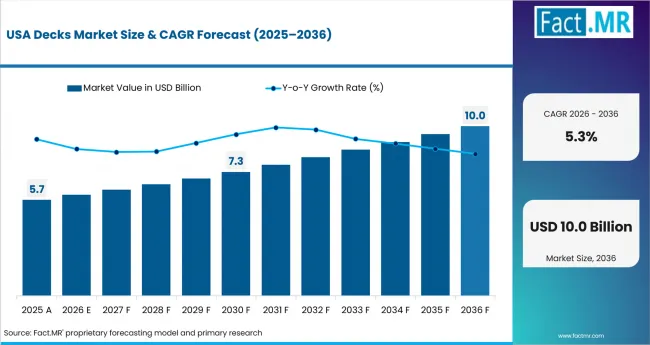
Decks Market Country Value Analysis | Source: Fact.MR
Established contractor and retail networks connect new housing activity with a large aftermarket for additions and replacement projects across regional markets. In June 2026, the United States Census Bureau reported housing starts at an annualized rate of 1.177 million during May 2026. The market is forecast to record a 5.3% CAGR across the forecast horizon as new construction and remodeling sustain varied project requirements. Material suppliers strengthen account access through regional availability that supports scheduled construction and time-sensitive renovation work.
How are residential permits supporting Germany’s deck market outlook?
5.0% CAGR, supported by residential permits and selective renovation-led outdoor improvement projects.
Residential permitting provides a measurable project pipeline while renovation creates additional opportunities across suitable existing properties. The Federal Statistical Office reported 238,063 dwellings permitted during 2025 across new and existing building work. Germany is projected to record a 5.0% CAGR during the forecast period as outdoor improvements remain concentrated in appropriate housing formats. Suppliers are better placed when stable product ranges and replenishment planning support phased work across regional contractor networks.
Why is replacement demand central to Japan’s decks outlook?
4.7% CAGR, driven by replacement activity and demand for compact weather-resistant decking systems.
Space constraints and moisture exposure promote the demand for compact deck formats that can be installed within restricted residential sites. In January 2026, Japan’s MLIT reported 740,667 new housing starts during 2025. The market is expected to post a 4.7% CAGR over the assessment period as replacement work sustains selective residential demand. Suppliers gain relevance through compact order programs and installation systems designed for constrained access conditions.
Which companies shape competition in the Decks Market?
Players such as Trex Company, TimberTech, and Fiberon compete across composite and PVC decking categories.
Competition in the decking market is expected to intensify as leading manufacturers prioritize product differentiation and stronger channel partnerships. Established brands such as Trex and TimberTech are likely to focus on investments in premium product portfolios, sustainability-focused offerings, and broader market penetration strategies. The competitive landscape is expected to favor companies with strong brand equity and the ability to scale production in response to evolving demand patterns.
Increasing competition is also expected to encourage greater emphasis on product innovation and portfolio diversification, particularly in premium and performance-oriented decking categories. Market participants are likely to pursue strategic partnerships and capacity optimization initiatives to strengthen their competitive positions and expand geographic reach.
Which companies are the key providers?
- Trex Company
- AZEK Building Products (TimberTech)
- Fiberon (Fortune Brands Innovations)
- UFP Industries (Deckorators)
- West Fraser Timber
- Barrette Outdoor Living
Bibliography
- Australian Bureau of Statistics. (2026, April 8). Building Activity, Australia, December 2025. Australian Bureau of Statistics.
- Federal Statistical Office of Germany. (2026, February 18). Building permits for building construction in Germany. Destatis.
- Fortune Brands Innovations. (2026, May 27). Fortune Brands Innovations Initiates Strategic Review of Fiberon to Sharpen Portfolio Focus. Fortune Brands Innovations.
- Japan Ministry of Land, Infrastructure, Transport and Tourism. (2026, January 30). Building Starts Statistics Survey Report for Calendar Year 2025. Government of Japan.
- National Bureau of Statistics of China. (2026, January 20). Investment in Real Estate Development for 2025. National Bureau of Statistics of China.
- Office for National Statistics. (2026, June 12). Construction output in Great Britain: April 2026. Office for National Statistics.
- Press Information Bureau. (2026, February 23). Additional houses approved under PMAY-Urban 2.0 during the sixth sanctioning committee meeting. Government of India.
- The AZEK Company. (2025, June 4). AZEK highlights fire resistance of TimberTech Advanced PVC decking in comparison testing. The AZEK Company.
- Trex Company. (2026, February 18). Freestanding deck plans and design guidance for outdoor residential spaces. Trex Company.
- UFP Industries. (2025, April 1). UFP Industries acquires site for first Northeast Deckorators facility. UFP Industries.
- UFP Industries. (2026, April 6). UFP Industries expands Deckorators composite decking capacity through acquisition. UFP Industries.
- U.S. Census Bureau. (2026, June 16). New Residential Construction, May 2026. U.S. Census Bureau.
This Report Addresses
- The report provides strategic intelligence on the Decks Market across material and construction choices that shape outdoor living and replacement project decisions.
- Segment analysis covers Wood/Timber and Raised Decks as the principal share leaders in the 2026 structure.
- Regional outlook evaluates India and China alongside Australia. The comparison also covers the United Kingdom and the United States alongside Germany and Japan.
- Competitive analysis profiles Trex Company and AZEK Building Products through TimberTech alongside Fiberon under Fortune Brands Innovations.
- Material assessment covers Wood/Timber and Composite alongside PVC/Plastic and Aluminum decking materials.
- Construction assessment covers Raised Decks and Ground-level Decks alongside Multi-level Decks and Rooftop Decks.
- End Use assessment covers Residential and Commercial demand alongside Hospitality projects. Application assessment also covers New Installation and Renovation & Replacement work.
What does the Decks Market cover?
Outdoor deck platforms and surface systems used across residential and commercial properties plus hospitality facilities.
The Decks Market covers outdoor platforms built with timber and composite materials alongside PVC or plastic and aluminum systems. Coverage includes raised and ground-level configurations plus multi-level and rooftop decks when the primary function is usable outdoor space.
The boundary includes new deck installation and renovation or replacement work across complete surface and supporting construction packages. Structural floor slabs and roof deck panels used inside building framing systems remain outside this outdoor decking market definition.
What is included in the scope?
Outdoor deck systems used for residential and commercial properties plus hospitality facilities across new and replacement projects.
The scope includes Wood/Timber and Composite products alongside PVC/Plastic and Aluminum materials used for exposed deck applications. Construction coverage spans Raised Decks and Ground-level Decks alongside Multi-level Decks and Rooftop Decks across varied property formats. End-use analysis covers Residential and Commercial demand plus Hospitality projects with different traffic and maintenance requirements. Application coverage includes New Installation and Renovation & Replacement work across the forecast period for both new and existing properties.
What is excluded from the scope?
Structural floor and roof deck assemblies are excluded because this study covers outdoor decking platforms and surfaces.
The scope excludes internal flooring finishes and structural steel deck profiles used beneath concrete slabs or roof assemblies. Standalone railing systems remain outside the market unless they are included within a broader deck installation package. Marine vessel decks and trailer flooring also remain outside this market boundary because their operating requirements differ materially.
How was the analysis built?
120+ sources, 40+ company portfolios, 25+ countries, 20+ interviews.
- Primary Research
- Primary research includes interviews with decking material manufacturers, distributors, contractors and construction professionals. It also includes input from architects, project developers, building material procurement teams and installation specialists involved in residential and commercial decking projects.
- Desk Research
- Desk research reviews construction industry statistics, housing activity reports, renovation trends, building material regulations and company product portfolios. Supplier catalogs, industry publications, sustainability initiatives and corporate announcements are also assessed to evaluate market trends and competitive positioning.
- Market-Sizing and Forecasting
- Forecasting uses residential construction activity, outdoor renovation spending, decking replacement cycles, material adoption trends and average product pricing across major regions. Models consider demand for wood and composite decking, infrastructure development, consumer preferences and distribution channel dynamics influencing market growth.
- Data Validation and Update Cycle
- Forecasts are validated through manufacturer checks and industry interviews that test assumptions on product demand, pricing trends and adoption patterns. Portfolio mapping, regional construction assessment and distributor feedback help confirm market direction, while ongoing reviews of product launches, regulatory developments and investment activity support forecast updates.
Segmentation
What is the report’s scope and coverage?
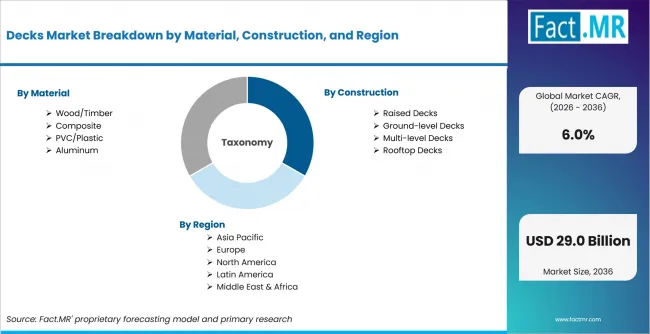
Decks Market Breakdown By Material, Construction, And Region | Source: Fact.MR
| Attribute | Details |
|---|---|
| Quantitative Units | USD billion |
| Market Definition | Outdoor deck platforms and surface systems used across residential and commercial properties plus hospitality facilities |
| Material | Wood/Timber; Composite; PVC/Plastic; Aluminum |
| Construction | Raised Decks; Ground-level Decks; Multi-level Decks; Rooftop Decks |
| End Use | Residential; Commercial; Hospitality |
| Application | New Installation; Renovation & Replacement |
| Regions Covered | North America; Europe; East Asia; South Asia and Oceania |
| Countries Covered | India; China; Australia; United Kingdom; United States; Germany; Japan |
| Key Companies Profiled | Trex Company; AZEK Building Products; Fiberon under Fortune Brands Innovations; UFP Industries; West Fraser Timber |
| Forecast Period | 2026 to 2036 |
| Approach | Hybrid top-down and bottom-up approach using housing activity; renovation demand; material mix; deck construction type; end-use exposure; installation application; company portfolio validation |
Source: Fact.MR analysis. Updated Jul 10, 2026
How is the market segmented?
-
By Material:
- Wood/Timber
- Composite
- PVC/Plastic
- Aluminum
-
By Construction:
- Raised Decks
- Ground-level Decks
- Multi-level Decks
- Rooftop Decks
-
By End Use:
- Residential
- Commercial
- Hospitality
-
By Application:
- New Installation
- Renovation & Replacement
-
By Region:
- North America
- United States
- Canada
- Europe
- Germany
- United Kingdom
- France
- Italy
- Spain
- Asia Pacific
- India
- China
- Japan
- South Korea
- Australia
- Latin America
- Brazil
- Argentina
- Mexico
- Chile
- Middle East & Africa
- UAE
- Saudi Arabia
- South Africa
- North America
Frequently Asked Questions
How is Wood/Timber positioned within the Decks Market?
What role do Raised Decks play in the Decks Market?
How prominent is Residential end use in the Decks Market?
What contribution does New Installation make to Decks demand?
Which country shows notable growth potential in the Decks Market?
How is the Decks Market expected to develop in China?
What outlook is anticipated for Australia in the Decks Market?
How is demand projected to evolve in the United Kingdom?
What trend characterizes the United States Decks Market?
How does Germany perform in the Decks Market?
What growth pattern is anticipated for Japan?
What factor primarily supports Decks Market demand?
Which challenge continues to influence Decks Market purchasing decisions?
Why does Wood/Timber remain important in the Decks Market?
What supports demand for Residential deck projects?
Who worked on this report


Preview the report firsthand - request a free sample
Free SampleGet the brochure for pricing and purchase details
Download PDF