- Market Value (2025): USD 260.9 Mn
- Estimated Value (2026): 285.0 Mn
- Forecast Value (2036): USD 690.0 Mn
- CAGR (2026-2036): 9.2%
What is the Deinkable Label Adhesives Market forecast to be worth by 2036?
USD 285.0 million in 2026 to USD 690.0 million by 2036, at 9.2% CAGR.
- The deinkable label adhesives market crossed USD 260.9 million in 2025 as converters and packaging owners advanced approval work for recycling-compatible label constructions.
- Demand is projected to increase from 285.0 million in 2026 to USD 690.0 million by 2036.
- The market is forecast to record 9.2% CAGR from 2026 to 2036 as bottle-wash qualification becomes part of packaging approval.
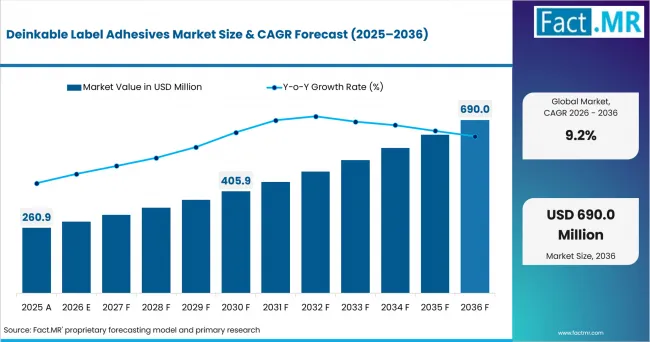
Deinkable Label Adhesives Market Market Value Analysis | Source: Fact.MR
What are the defining numbers behind Deinkable Label Adhesives Market growth?
USD 405.0 million absolute opportunity by 2036, led by Pressure-sensitive adhesives and PET bottles alongside Beverage applications.
- Demand Drivers in the Market
- Pressure-sensitive grades can move faster through procurement when trials demonstrate cleaner PET flakes and fewer residue-related rejections.
- Packaging laboratories are prioritizing PET bottles, where label stock and adhesive behavior directly influence separation during hot washing.
- Beverage programs are creating early conversion opportunities as brand owners seek recycling-compatible labels that preserve shelf appearance and high-speed application performance.
- Recyclers favor label constructions that remain stable during use and separate cleanly during washing without reducing recovered PET quality.
- Key Segments Analyzed
- By Adhesive Type: Pressure-sensitive is expected to hold 32% share in 2026. Familiar converting workflows reduce disruption during recycling-compatible trials and support adoption without a full change in label format.
- By Substrate: PET bottles are projected to account for 41% share in 2026. Bottle recycling turns adhesive release into a measurable technical outcome, keeping flake cleanliness under close review during qualification.
- By End Use: Beverage is anticipated to capture 30% share in 2026. High bottle volumes create repeatable commercial conditions for wash testing and specification approval.
- By Recycling Route: PET bottle wash is estimated to represent 33% share in 2026. Defined trials connect adhesive behavior with separation efficiency and recovered-material quality.
- By Certification: APR-recognized is forecast to account for 40% share in 2026. Recognition narrows the first stage of technical review before plant qualification and customer specification work.
- Analyst Opinion at Fact.MR
- Shambhu Nath Jha, Senior Analyst at Fact.MR, states, "Deinkable label adhesive adoption will depend on evidence that links label retention during use with clean release during recycling. Adhesive manufacturers that document coat weight and line performance can shorten customer qualification while reducing the risk of specification changes."
- Strategic Implications
- Adhesive manufacturers should validate Pressure-sensitive grades under customer conditions covering label application and PET bottle wash performance. Residue review and recyclate inspection should complete the qualification sequence before broader portfolio approval.
- Brand owners should run side-by-side trials before changing approved adhesive grades across high-volume Beverage bottle programs. A small formulation shift can alter line speed and wash behavior.
- Distributors should prepare safety files, application guidance, and certification evidence before the first customer trial enters formal review. Clear operating limits reduce delays when technical teams compare adhesion and release claims.
- Regional teams should prioritize technical trial support in China, where the market is projected to record 12.5% CAGR through 2036.
China is expected to record 12.5% CAGR through 2036, supported by export-facing packaging production and local PET trials. India is projected at 11.6% as EPR implementation strengthens documentation needs. Germany is anticipated at 10.6% amid structured recyclability review, while Brazil is estimated at 9.7% as local plant trials expand. The USA is forecast at 8.8% as PET recovery conditions keep compatible package design on procurement agendas.
How does the Deinkable Label Adhesives Market break down by segment?
Pressure-sensitive leads with 32%, while PET bottles hold 41%.
What supports Adhesive Type adoption?
Pressure-sensitive leads with 32% share in 2026.
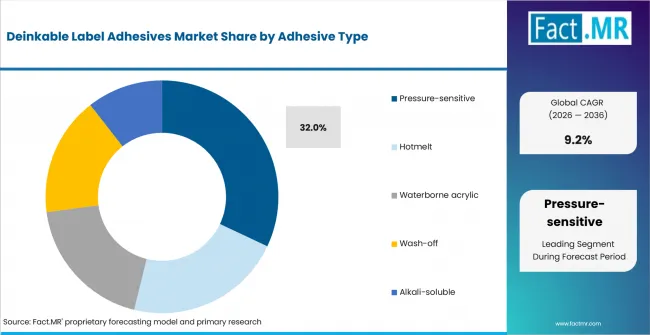
Deinkable Label Adhesives Market Analysis By Adhesive Type | Source: Fact.MR
Pressure-sensitive is expected to lead adhesive type with 32% share in 2026 as converters can retain familiar coating and application workflows during recyclability upgrades. Wash-off and Alkali-soluble grades gain relevance where clean release under alkaline washing is the main approval criterion, while Waterborne acrylic systems remain important when balanced adhesion and lower-emission processing are required. Hotmelt serves applications that prioritize rapid bond formation, although release behavior must be checked across the intended temperature range. In June 2025, Avery Dennison announced that a CleanFlake-based RFID label had received APR Design for Recyclability recognition for the PET stream.
Which Substrate dominates?
PET bottles hold 41% share in 2026.
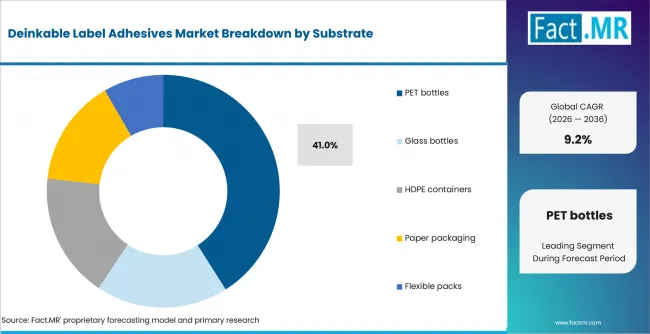
Deinkable Label Adhesives Market Analysis By Substrate | Source: Fact.MR
PET bottles are projected to lead substrate with 41% share in 2026 because bottle-to-bottle recycling places direct commercial value on adhesive release and flake purity. Glass bottles favor systems that remain secure in use and detach during caustic washing, while HDPE containers need label constructions that separate without interfering with polymer recovery. Paper packaging requires deinkable or dispersible behavior, whereas Flexible packs remain more selective as collection and washing routes are less uniform. PET bottle qualification therefore combines secure adhesion during filling and distribution with controlled release under defined wash conditions. In June 2025, HERMA GmbH introduced wash-off self-adhesive materials for HDPE recycling after establishing solutions for PET bottles.
What leads the End Use segment?
Beverage accounts for 30% share in 2026.
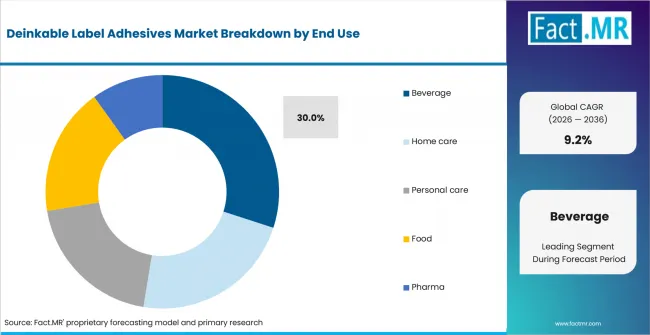
Deinkable Label Adhesives Market Analysis By End Use | Source: Fact.MR
Beverage is anticipated to lead End Use with 30% share in 2026 as high bottle throughput makes line performance and wash results easier to measure at commercial scale. Home care and Personal care programs need labels that tolerate moisture, surfactants, and varied container shapes before controlled release during recycling. Food and Pharma applications add food-contact and traceability checks that can lengthen approval work. Beverage programs remain an early conversion point since repeated bottle formats give technical teams stable conditions for comparing application performance and flake cleanliness.
How does Recycling Route shape demand?
PET bottle wash leads with 33% share in 2026.
PET bottle wash is estimated to lead Recycling Route with 33% share in 2026 since the route exposes label release and residue behavior under defined operating conditions. Glass wash places greater weight on caustic resistance during use and clean detachment during returnable-bottle cleaning. Paper recycling depends on deinking and screening performance, while Film recycling and Closed-loop programs require application-specific evidence since collection and wash conditions vary more widely. In February 2025, UPM Adhesive Materials reported a 99.94% removal rate for RW85C labels during a commercial PET recycling trial.
Where is Certification demand strongest?
APR-recognized holds 40% share in 2026.
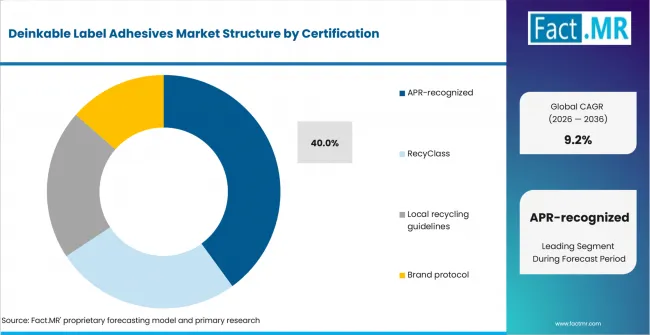
Deinkable Label Adhesives Market Analysis By Certification | Source: Fact.MR
APR-recognized is forecast to lead Certification with 40% share in 2026 because recognition narrows the first stage of technical review in North America. RecyClass provides a comparable route for European recycling streams, while Local recycling guidelines remain important where national collection and washing practices differ. Brand protocol requirements add customer-specific checks for label appearance, line performance, and documented recycling behavior. In September 2025, UPM Adhesive Materials received RecyClass recognitions for RW85C label materials used in HDPE container and PET bottle recycling.
What is accelerating Deinkable Label Adhesives Market adoption, and what is holding it back?
Flake quality control is anticipated to drive adoption, while qualification cost and application fit are expected to restrain conversion speed.
Drivers Impact Analysis
| DRIVER | (~) % IMPACT ON CAGR | GEOGRAPHIC RELEVANCE | IMPACT TIMELINE |
|---|---|---|---|
| Flake quality control in pressure-sensitive labels | +0.8% | East Asia | Medium term (2-4 years) |
| Label release testing | +0.6% | Western Europe and North America | Short term (<= 2 years) |
| PET beverage approval programs | +0.5% | East Asia and South Asia and Pacific | Medium term (2-4 years) |
| Local support near label converters | +0.4% | Long term (>= 4 years) | Long term (>= 4 years) |
Source: Fact.MR analysis. Updated Jul 13, 2026
- Flake quality control: Recyclers track adhesive residue and the quality of recovered PET during routine processing. Low-residue adhesives support cleaner flakes and reduce concerns about contamination during later production stages. These measurable benefits give packaging teams a clearer reason to approve an adhesive change.
- Label release testing: Standard tests show how well labels separate during the recycling process. Packaging teams compare label release and adhesive residue before expanding use across similar bottle formats. Trials also show how temperature and washing conditions affect recycling performance.
- PET beverage approvals: An adhesive approved for high-volume beverage bottles can support repeat supply across similar packaging formats. Comparable bottle designs reduce the need to repeat every qualification test from the beginning. Brand owners can reuse approved test results across compatible product lines.
- Local technical support: Nearby technical teams can adjust coat weight and process settings during customer trials. On-site support helps solve application issues before customers reject the adhesive system. Faster troubleshooting increases the chance that successful trials move into regular commercial supply.
Opportunity Impact Analysis
| OPPORTUNITY | (~) % IMPACT ON CAGR | GEOGRAPHIC RELEVANCE | IMPACT TIMELINE |
|---|---|---|---|
| Grades tuned for PET beverage bottles | +0.5% | All regions | Medium term (2-4 years) |
| Application labs for PET bottles | +0.4% | East Asia, South Asia and Pacific, and Western Europe | Short term (<= 2 years) |
| Regulatory documentation | +0.4% | Western Europe and Eastern Europe | Medium term (2-4 years) |
| Local trials with bottle washers | +0.3% | India and Brazil | Long term (>= 4 years) |
Source: Fact.MR analysis. Updated Jul 13, 2026
- PET-specific grades: Converters need adhesives that support recycling without disrupting existing filling and labeling operations. Plant trials confirm whether a grade maintains application strength and releases cleanly during bottle washing. Successful grades protect production continuity while improving the quality of recovered PET flakes.
- Application laboratories: Local laboratories provide comparable data on adhesion performance and label release under controlled wash conditions. Shared test methods help customers evaluate different label constructions before expanding production commitments. Faster sample testing reduces handoffs between laboratory assessment and commercial plant trials.
- Regulatory documentation: In February 2025, the European Commission confirmed that Regulation (EU) 2025/40 entered into force on February 11, 2025. Most requirements will generally apply from August 12, 2026 across covered packaging applications. Clear technical files connect test results with the intended substrate and recycling route. This documentation reduces uncertainty during reviews conducted by customers and recycling partners.
- Local bottle-wash trials: Local trials show how labels perform under actual recycling conditions in different facilities. These tests identify changes in temperature and chemicals before wider commercial use begins. Practical wash results provide stronger approval evidence than broad recycling claims without plant validation.
Restraints Impact Analysis
| RESTRAINT | (~) % IMPACT ON CAGR | GEOGRAPHIC RELEVANCE | IMPACT TIMELINE |
|---|---|---|---|
| Qualification cost | -0.4% | All regions | Medium term (2-4 years) |
| Application fit in PET bottle lines | -0.3% | All regions | Short term (<= 2 years) |
| Documentation burden | -0.3% | Western Europe and North America | Medium term (2-4 years) |
| Scale-up risk | -0.2% | All regions | Long term (>= 4 years) |
Source: Fact.MR analysis. Updated Jul 13, 2026
- Qualification cost: Changing an approved label recipe requires coating trials and packaging samples before wider customer adoption. Smaller programs often remain under review until expected order volumes justify the full testing cost.
- Application fit: New adhesives must improve recycling performance without disrupting labeling operations during commercial production. Approval depends on stable performance across label materials and filling conditions throughout storage and bottle washing.
- Documentation burden: Packaging claims require clear evidence that customers and recycling partners can verify during approval reviews. Adhesive manufacturers must define test methods and approved use conditions to prevent unsuitable product claims.
- Scale-up risk: Adhesives that perform well during pilot trials may behave differently on full commercial lines. Wider coating equipment and faster line speeds often require further adjustments before large-scale conversion begins.
Which countries are scaling Deinkable Label Adhesives Market fastest?
China 12.5%, India 11.6%, Germany 10.6%, Brazil 9.7%, USA 8.8%.
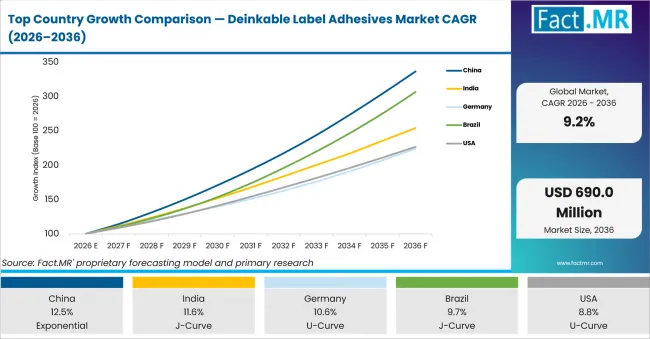
Top Country Growth Comparison Deinkable Label Adhesives Market Cagr 2026 2036 | Source: Fact.MR
Regional analysis covers North America, Latin America, Western Europe, Eastern Europe, East Asia, South Asia and Pacific, and Middle East & Africa.
| COUNTRY | CAGR |
|---|---|
| China | 12.5% |
| India | 11.6% |
| Germany | 10.6% |
| Brazil | 9.7% |
| USA | 8.8% |
Source: Fact.MR analysis. Updated Jul 13, 2026
What underpins growth in China?
12.5% CAGR, driven by export-facing packaging production and local PET trials.
China combines export-facing packaging production with a large domestic Beverage-converting base. In March 2025, the National Bureau of Statistics reported industrial export delivery value of CNY 2,275.1 billion for January and February 2025, up 6.2% year over year. Export programs require label documentation that can travel across customer specifications and recycling protocols. Local PET trials allow adhesive manufacturers to demonstrate release temperature, residue control, and line stability. The market is projected to record 12.5% CAGR through 2036 as nearby technical service shortens qualification cycles.
How is India scaling Deinkable Label Adhesives demand?
11.6% CAGR, supported by EPR implementation and expanding Beverage-converting capacity.
In March 2026, the Press Information Bureau reported that around 207 lakh tonnes of plastic packaging waste had been recycled after the EPR Guidelines took effect in 2022. That compliance base is raising the value of traceable label specifications and documented recycling performance. Beverage converters also need grades that remain reliable during humid storage and high-speed application. Demand is projected to advance at 11.6% CAGR through 2036 as domestic packaging capacity expands. Local application teams remain important for translating laboratory release data into repeatable plant conditions.
What supports demand in Germany?
10.6% CAGR, backed by structured recycling requirements and detailed design guidance.
Germany operates within a packaging system where recyclability evidence is tied closely to formal design review. In August 2025, the Central Agency Packaging Register published the 2025 minimum standard for determining packaging recyclability, with a category-based structure and revised calculation guidance. This framework keeps adhesive release and recovered-material quality visible during specification work. The market is anticipated to record 10.6% CAGR through 2036.
How is Brazil developing demand?
9.7% CAGR, supported by local plant trials and Beverage-label conversion.
Industrial activity provides a broad base for packaging and label conversion in Brazil. In July 2025, IBGE reported that national industrial output was 3.3% higher in May 2025 than one year earlier, even as output declined from April. The market is estimated to record 9.7% CAGR through 2036 as beverage and erpsonal care programs require more structured recycling review. Uneven collection and washing conditions make local trials especially important. Converters are expected to favor grades that protect line stability while producing clean release under the operating conditions available at each customer site.
What supports demand in the USA?
8.8% CAGR, driven by PET recovery programs and formal recycler guidance.
PET bottle programs in the USA depend on stable recycling economics and clean recovered feedstock. In April 2026, the Association of Plastic Recyclers reported that 7 PET recycling plants had closed during the preceding 15 months, removing more than 600 million pounds of annual processing capacity. The disruption increases pressure on package design and recycled-material demand, while compatible labels help protect the quality of available PET streams. The market is forecast to record 8.8% CAGR through 2036. Commercial conversion will remain evidence-led as brand teams compare wash-off results with approved line conditions and packaging specifications.
Who leads the Deinkable Label Adhesives Market?
Avery Dennison and UPM Adhesive Materials provide label-material platforms, while Henkel and Bostik contribute adhesive formulation depth.
Avery Dennison and UPM Adhesive Materials compete through label constructions developed around PET recycling compatibility and converter qualification. Henkel and Bostik add wash-off adhesive chemistry, while H.B. Fuller supports packaging adhesive selection and HERMA GmbH combines facestock with controlled-release adhesive design. Competition centers on release performance, residue management, and practical application support.
In June 2025, Bostik described an APR-recognized, all-temperature wash-off adhesive for PET bottles and trays that emerged from its work with APR guidance. In March 2026, H.B. Fuller explained that adhesive chemistry can influence whether packaging materials process efficiently and retain recovered-material quality. Both developments reinforce the need for application evidence alongside formulation performance.
Which companies are the key players?
Avery Dennison and UPM Adhesive Materials are key players. Henkel and H.B. Fuller are also profiled. Bostik and HERMA GmbH complete the company set.
- Avery Dennison
- UPM Adhesive Materials
- Henkel
- H.B. Fuller
- Bostik
- HERMA GmbH
Bibliography
- Association of Plastic Recyclers. (2026, April 27). Informational report: Record plastic production & imports jeopardize PET recycling. Association of Plastic Recyclers.
- Avery Dennison. (2025, June 25). Avery Dennison unveils industry-first RFID label recognized by APR for compatibility with PET recycling stream. Avery Dennison.
- Bostik. (2025, June 16). Q&A: How Bostik’s APR involvement can benefit your label manufacturing. Bostik.
- European Commission. (2025, February 11). New rules for more sustainable and competitive packaging economy. European Commission.
- Press Information Bureau. (2026, March 23). Parliament question: Plastic waste management. Government of India.
-
H.B. Fuller. (2026, March 18). Adhesives and recyclability: Why they matter. H.B. Fuller.
- Henkel AG & Co. KGaA. (2025, July 30). Sustainability that sticks: Henkel showcases recyclable and CO₂-reducing adhesives at Labelexpo Europe 2025. Henkel.
-
HERMA GmbH. (2025, June 10). New wash-off self-adhesive materials for HDPE recycling. HERMA GmbH.
- Stiftung Zentrale Stelle Verpackungsregister. (2025, August 29). 2025 minimum standard published: Initial touchstone for companies preparing for the EU Packaging and Packaging Waste Regulation. ZSVR.
- UPM Adhesive Materials. (2025, September 17). UPM Adhesive Materials receives RecyClass recognitions for its label materials for HDPE container and PET bottle recycling. UPM Adhesive Materials.
This Report Addresses
- The report provides strategic intelligence across Adhesive Type, Substrate, End Use, Recycling Route, Certification, and Region.
- Regional outlook evaluates China, India, Germany, Brazil, and the USA within the seven-region structure defined in the TOC.
-
Competitive analysis profiles Avery Dennison, UPM Adhesive Materials, Henkel, H.B. Fuller, Bostik, and HERMA GmbH.
- Adhesive Type assessment covers Pressure-sensitive, Hotmelt, Waterborne acrylic, Wash-off, and Alkali-soluble systems.
- Use-case assessment covers Beverage, Home care, Personal care, Food, and Pharma across the approved End Use structure.
What does the Deinkable Label Adhesives Market cover?
Pressure-sensitive, Hotmelt, Waterborne acrylic, Wash-off, and Alkali-soluble label adhesive systems qualified for controlled release or deinking during packaging recycling.
The market covers qualified adhesive materials and application support used to maintain label performance during product use and enable controlled release during recycling. Commercial value excludes machinery and general-purpose adhesives without a defined recycling-compatible role.
What is included in the scope?
Label adhesives and related qualification support within the exact Adhesive Type, Substrate, End Use, Recycling Route, and Certification structure defined in the TOC.
The scope includes Pressure-sensitive, Hotmelt, Waterborne acrylic, Wash-off, and Alkali-soluble adhesives. Substrate coverage comprises PET bottles, Glass bottles, HDPE containers, Paper packaging, and Flexible packs. End Use includes Beverage, Home care, Personal care, Food, and Pharma. Recycling Route covers PET bottle wash, Glass wash, Paper recycling, Film recycling, and Closed-loop. Certification includes APR-recognized, RecyClass, Local recycling guidelines, and Brand protocol.
What is excluded from the scope?
General-purpose adhesives, standalone recycling machinery, and label-application equipment remain outside the market boundary.
Commodity adhesives are excluded unless they are sold and qualified for one of the approved applications. Unrelated chemical additives and equipment-only revenue are also excluded.
How was the analysis built?
120+ sources, 40+ company portfolios, 25+ countries, 20+ interviews.
- Primary Research: Interviews with adhesive manufacturers, label converters, brand packaging teams, and recyclers test assumptions about commercial qualification, line performance, wash behavior, and repeat supply.
- Desk Research: Official policy, recycling evidence, company technical releases, certification updates, and product documentation are reviewed only when they support the defined market mechanism.
- Market-Sizing and Forecasting: Historical value, segment shares, country growth, product coverage, and conversion from technical trials into recurring supply are checked across the commercial boundary.
- Data Validation and Update Cycle: Company activity, policy changes, segment shares, country growth rates, and new recycling recognitions are reviewed for internal consistency before forecasts are finalized.
Segmentation
What is the report's scope and coverage?
| Attribute | Details |
|---|---|
| Quantitative Units | USD million in 2026 to USD million by 2036 at a CAGR |
| Market Definition | Label adhesives designed to detach, wash off, or deink during PET and other packaging recycling processes. |
| Adhesive Type | Pressure-sensitive; Hotmelt; Waterborne acrylic; Wash-off; Alkali-soluble |
| Substrate | PET bottles; Glass bottles; HDPE containers; Paper packaging; Flexible packs |
| End Use | Beverage; Home care; Personal care; Food; Pharma |
| Recycling Route | PET bottle wash; Glass wash; Paper recycling; Film recycling; Closed-loop |
| Certification | APR-recognized; RecyClass; Local recycling guidelines; Brand protocol |
| Regions Covered | North America; Latin America; Western Europe; Eastern Europe; East Asia; South Asia and Pacific; Middle East & Africa |
| Countries Covered | USA; Canada; Brazil; Mexico; Chile; Rest of Latin America; Germany; UK; Italy; Spain; France; Nordic; BENELUX; Rest of Western Europe; Russia; Poland; Hungary; Balkan & Baltic; Rest of Eastern Europe; China; Japan; South Korea; India; ASEAN; Australia & New Zealand; Rest of South Asia and Pacific; Kingdom of Saudi Arabia; Other GCC Countries; Türkiye; South Africa; Other African Union; Rest of Middle East & Africa |
| Key Companies Profiled | Avery Dennison; UPM Adhesive Materials; Henkel; H.B. Fuller; Bostik; HERMA Gmb |
| Forecast Period | 2026 to 2036 |
| Approach | Hybrid top-down and bottom-up approach using historical value, segment shares, country growth, official policy and recycling evidence, product documentation, and consistency review. |
Source: Fact.MR analysis. Updated Jul 13, 2026
How is the market segmented?
-
By Adhesive Type
- Pressure-sensitive
- Hotmelt
- Waterborne acrylic
- Wash-off
- Alkali-soluble
-
By Substrate
- PET bottles
- Glass bottles
- HDPE containers
- Paper packaging
- Flexible packs
-
By End Use
- Beverage
- Home care
- Personal care
- Food
- Pharma
-
By Recycling Route
- PET bottle wash
- Glass wash
- Paper recycling
- Film recycling
- Closed-loop
- By Certification
- APR-recognized
- RecyClass
- Local recycling guidelines
- Brand protocol
-
By Region
- North America
- USA
- Canada
- Latin America
- Brazil
- Mexico
- Chile
- Rest of Latin America
- Western Europe
- Germany
- UK
- Italy
- Spain
- France
- Nordic
- BENELUX
- Rest of Western Europe
- Eastern Europe
- Russia
- Poland
- Hungary
- Balkan & Baltic
- Rest of Eastern Europe
- East Asia
- China
- Japan
- South Korea
- South Asia and Pacific
- India
- ASEAN
- Australia & New Zealand
- Rest of South Asia and Pacific
- Middle East & Africa
- Kingdom of Saudi Arabia
- Other GCC Countries
- Türkiye
- South Africa
- Other African Union
- Rest of Middle East & Africa
- North America
Frequently Asked Questions
Which Adhesive Type leads the Deinkable Label Adhesives Market?
Which Substrate leads the Deinkable Label Adhesives Market?
Which End Use leads the Deinkable Label Adhesives Market?
Which Recycling Route leads the Deinkable Label Adhesives Market?
Which Certification leads the Deinkable Label Adhesives Market?
Which country records the highest CAGR in the Deinkable Label Adhesives Market?
What is the primary driver in the Deinkable Label Adhesives Market?
What is the main restraint in the Deinkable Label Adhesives Market?
Why is Pressure-sensitive significant?
Why does qualification continue for deinkable label adhesives?
Who worked on this report


Preview the report firsthand - request a free sample
Free SampleGet the brochure for pricing and purchase details
Download PDF