- Market Value (2025): USD 39.7 Mn
- Estimated Value (2026): USD 39.7 Mn
- Forecast Value (2036): USD 69.4 Mn
- CAGR (2026-2036): 5.2%
What is the Desktop Tower Personal Computer PC Market forecast to be worth by 2036?
USD 41.8 billion in 2026 to USD 69.4 billion by 2036 at 5.2% CAGR.
- The desktop tower personal computer PC market reached USD 39.7 billion in 2026.
- Demand is projected to increase from USD 41.8 billion in 2026 to USD 69.4 billion by 2036.
- The market is forecast to record 5.2% CAGR from 2026 to 2036.
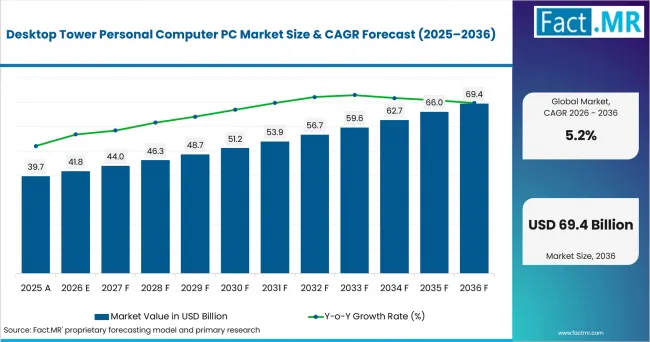
Desktop Tower Personal Computer Pc Market Value Analysis | Source: Fact.MR
What are the defining numbers behind Desktop Tower Personal Computer PC Market growth?
USD 27.9 billion absolute opportunity by 2036.
- Demand Drivers in the Market
- Tower PCs remain useful where buyers need desk-based computing with service access and room for internal components.
- Performance-led replacement overlaps with gaming hardware demand when users choose towers for graphics, cooling and future upgrades.
- Commercial buyers assess tower PCs through specification clarity, maintenance access and operating-system compatibility before approval.
- Workstation and content-creation use cases support systems with stronger processors and discrete graphics. Memory expansion and serviceable storage matter for these buyers.
- Key Segments Analyzed
- By Tower Configuration: Mid Tower PC is expected to hold 36.0% share in 2026 because it gives buyers expansion room without an oversized case.
- By Application Area: Commercial Computing is projected to account for 39.0% share in 2026 as office fleets continue to need predictable desktop performance.
- By End-use Sector: Enterprise is anticipated to capture 42.0% share in 2026 since larger organizations buy through planned refresh cycles.
- By Buyer Category: Business Organizations are estimated to represent 40.0% share in 2026 due to fleet buying, support needs and centralized procurement.
- By Processor Platform: Intel-based Systems are forecast to hold 37.0% share in 2026 as compatibility and supplier breadth support selection.
- Analyst Opinion at Fact.MR
- Shambhu Nath Jha, Principal Consultant at Fact.MR, states, “Desktop tower personal computer PC suppliers need to show why a tower fits the workload. Buyers are expected to compare performance with service access and ownership cost before they approve a system.”
- Strategic Implications
- Brand owners should position tower models across commercial productivity and engineering work. Gaming and everyday home computing need separate positioning.
- Suppliers need simple documentation that explains processor platform and graphics options. It should explain memory expansion plus security features and service terms.
- Channel partners should align inventory with share-leading configurations and keep higher-performance buyer needs visible in pricing plans.
The USA leads at 6.1% CAGR through commercial replacement and workstation use. Wider channel access supports the same lead. China follows at 5.9% as business computing demand and local supply depth support adoption. Germany reaches 5.6% through enterprise and engineering demand. Japan posts 5.3%. India records 5.0%. Canada reaches 4.8%. South Korea closes the listed group at 4.5% through business and specialist computing needs.
How does the Desktop Tower Personal Computer PC Market break down by segment?
Mid Tower PC is expected to lead Tower Configuration at 36.0% share in 2026. Commercial Computing is projected to lead Application Area at 39.0% share in 2026.
Which Tower Configuration dominates?
Mid Tower PC is projected to account for 36.0% share in 2026.
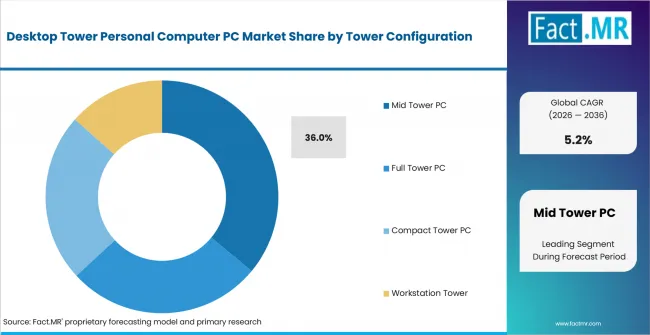
Desktop Tower Personal Computer Pc Market Analysis By Tower Configuration | Source: Fact.MR
Mid Tower PC leads because it gives buyers a practical balance between internal space and desk footprint. Full Tower PC serves buyers that need more room for graphics cards or cooling. Compact Tower PC fits offices that want service access without a large case. Workstation Tower remains important where buyers need certified performance for heavier professional work.
Why does Commercial Computing lead Application Area?
Commercial Computing is expected to hold 39.0% share in 2026.
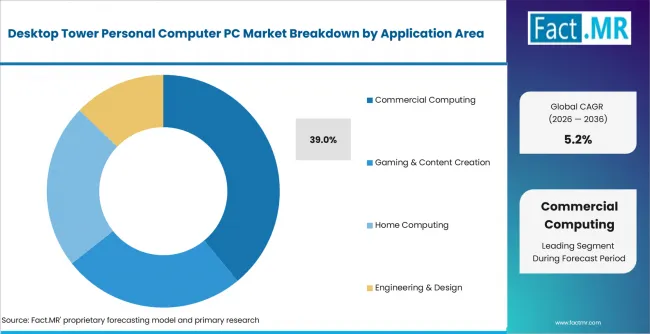
Desktop Tower Personal Computer Pc Market Analysis By Application Area | Source: Fact.MR
Commercial Computing benefits from planned refresh cycles and standard device images across office fleets. IT teams prefer systems that are easy to document and service. Home Computing follows a more price-sensitive route. Engineering and Design demand depends on workload depth, so buyers compare graphics capability and processor performance before approval.
What supports Enterprise within End-use Sector?
Enterprise is anticipated to represent 42.0% share in 2026.
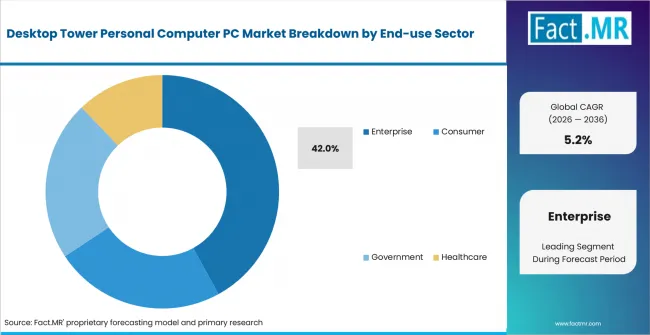
Desktop Tower Personal Computer Pc Market Analysis By End Use Sector | Source: Fact.MR
Enterprise buyers use tower PCs where desk-based roles need reliable processing and easier maintenance. Larger organizations also value repeatable specifications across departments. Consumer demand is less uniform because households compare towers with notebooks and compact PCs. Government and healthcare buyers remain selective when security review or procurement records are required.
How do Business Organizations shape Buyer Category demand?
Business Organizations are estimated to lead with 40.0% share in 2026.
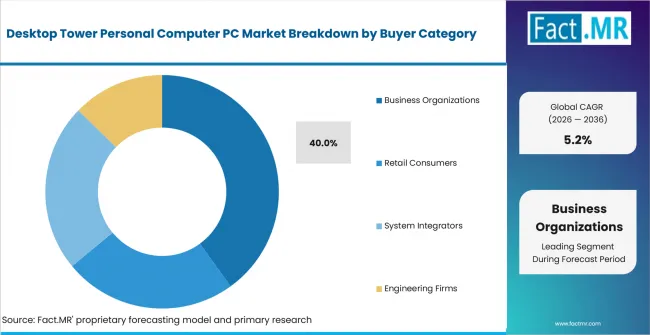
Desktop Tower Personal Computer Pc Market Analysis By Buyer Category | Source: Fact.MR
Business Organizations lead because they buy in planned batches and compare lifecycle cost before approval. Their purchases often require warranty clarity and device-management compatibility. Retail Consumers focus more on budget and gaming preference. System Integrators and Engineering Firms support smaller but more specialized demand.
Why do Intel-based Systems lead Processor Platform?
Intel-based Systems are forecast to hold 37.0% share in 2026.
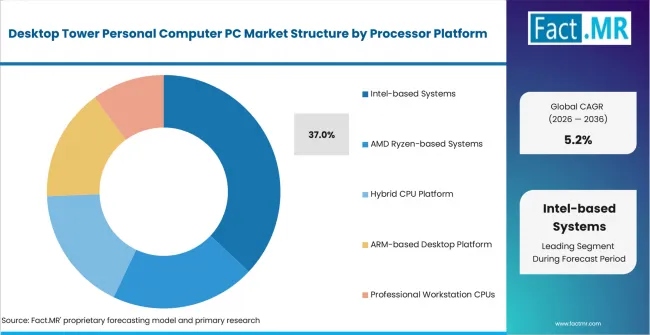
Desktop Tower Personal Computer Pc Market Analysis By Processor Platform | Source: Fact.MR
Intel-based Systems lead through broad supplier availability and familiarity across business fleets. IT teams often choose platforms that fit existing images and support tools. AMD Ryzen-based Systems compete where buyers prioritize price-performance and graphics options. Hybrid CPU Platform, ARM-based Desktop Platform and Professional Workstation CPUs serve more defined requirements.
What is accelerating Desktop Tower Personal Computer PC Market adoption, and what is holding it back?
Demand is expected to rise through business refresh cycles and graphics-intensive workloads. Continued need for serviceable desk-based systems is expected to support adoption.
Drivers Impact Analysis
| DRIVER | (~) % IMPACT ON CAGR | GEOGRAPHIC RELEVANCE | IMPACT TIMELINE |
|---|---|---|---|
| Adoption and integration | +1.6% | Global | Short term (<= 2 years) |
| Regulatory and compliance support | +1.4% | USA, Germany, UK | Short term (<= 2 years) |
| Channel and access expansion | +1.1% | Global | Medium term (2-4 years) |
| Clear specification and documentation | +0.9% | USA, UK, Canada | Medium term (2-4 years) |
| Cost and efficiency gains | +0.6% | Global | Long term (>= 4 years) |
Source: Fact.MR analysis. Updated Aug 6, 2026
- Adoption and integration: Tower PCs are expected to serve buyers that want existing monitors, peripherals and managed software images to stay in use during hardware refresh.
- Regulatory and compliance support: Large IT buyers are expected to favor documented systems when security review and procurement records decide approval.
- Channel and access expansion: Reseller coverage is expected to make configured towers easier to compare before purchase. This matters for buyers that need hardware advice and local after-sales support.
Opportunity Impact Analysis
| OPPORTUNITY | (~) % IMPACT ON CAGR | GEOGRAPHIC RELEVANCE | IMPACT TIMELINE |
|---|---|---|---|
| Emerging application expansion | +1.0% | Global | Medium term (2-4 years) |
| Premium and specialist positioning | +0.8% | USA, UK, Germany | Medium term (2-4 years) |
| Channel and partner expansion | +0.7% | Global | Long term (>= 4 years) |
| Standards and compliance alignment | +0.5% | USA, Canada, Singapore | Long term (>= 4 years) |
Source: Fact.MR analysis. Updated Aug 6, 2026
- Emerging application expansion: Local AI work, design software and content workflows are expected to raise interest in towers with graphics and memory headroom.
- Premium and specialist positioning: Workstation users are expected to pay for systems that arrive with clear processor, graphics and cooling choices.
- Channel and partner expansion: Resellers are expected to grow their role when buyers need help comparing configurations. Flexible access models in computer rental and leasing can inform refresh planning without changing the core sales scope.
Restraints Impact Analysis
| RESTRAINT | (~) % IMPACT ON CAGR | GEOGRAPHIC RELEVANCE | IMPACT TIMELINE |
|---|---|---|---|
| Cost and complexity | -1.1% | Global | Short term (<= 2 years) |
| Specification and compliance checks | -0.9% | USA, UK, Germany | Short term (<= 2 years) |
| Substitution by lower-cost alternatives | -0.7% | Import-dependent markets | Medium term (2-4 years) |
| Supply chain and pricing pressure | -0.5% | Global | Long term (>= 4 years) |
Source: Fact.MR analysis. Updated Aug 6, 2026
- Cost and complexity: Buyers can postpone refresh plans when memory, graphics and processor choices make standardization hard across teams.
- Specification and compliance checks: Large organizations are expected to slow approvals when tower PCs need security review, image testing or procurement validation.
- Supply chain and pricing pressure: Component availability and freight costs are expected to affect configuration choices in import-dependent markets. Notebook and compact PC alternatives can absorb budget when mobility or lower cost has priority.
Which countries are scaling the Desktop Tower Personal Computer PC Market fastest?
- The country comparison spans 1.6 percentage points and forms a clear growth range across the forecast period.
- The USA remains 0.2 percentage point above China through commercial replacement and wider channel access.
- Germany remains 0.3 percentage points above Japan through engineering and business requirements. Public-sector computing adds to the same demand base.
- Japan remains 0.3 percentage points above India through mature enterprise fleets and steady replacement demand.
- India remains 0.2 percentage point above Canada as business digitization and price-tier expansion support wider access.
- Canada remains 0.3 percentage points above South Korea through commercial refresh and service-led procurement.
Tower PC demand depends on fleet age and channel structure. Component pricing and buyer preference for serviceable systems can create different entry conditions. Full report coverage includes North America, Latin America, Europe, East Asia, South Asia and Pacific, Middle East and Africa.
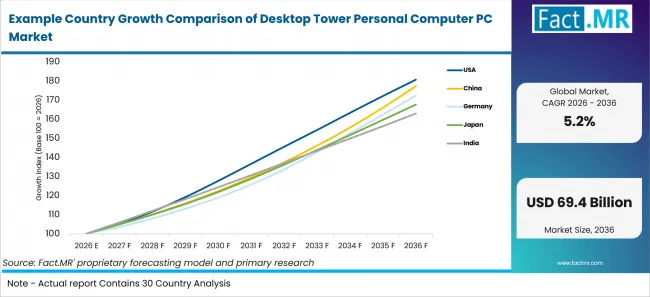
Example Country Growth Comparison Of Desktop Tower Personal Computer Pc Market | Source: Fact.MR
| Country | CAGR (2026-2036) |
|---|---|
| USA | 6.1% |
| Germany | 5.6% |
| Japan | 5.3% |
| India | 5.0% |
| Canada | 4.8% |
| South Korea | 4.5% |
Source: Fact.MR analysis. Updated Aug 6, 2026
What supports USA adoption?
6.1% CAGR, supported by commercial refresh cycles and wider channel access.
Enterprise buyers in the USA evaluate serviceability and support terms before approving new tower PC fleets. Workstation users add demand where fixed desks need dependable graphics and processing power.
What is driving Germany’s growth from 2026 to 2036?
5.6% CAGR, backed by enterprise and engineering demand. Public-sector computing contributes.
Germany’s growth reflects steady tower PC use in workplaces that need reliable processing and hardware control. Engineering users favor memory expansion and graphics capability.
How does Japan perform?
5.3% CAGR, led by mature enterprise fleets and dependable replacement demand.
Japan’s market is shaped by structured purchasing in offices and public institutions. Buyers are expected to prioritize reliability, compact deployment options and vendor support.
What supports India’s growth?
5.0% CAGR, supported by business digitization and wider device access.
India’s demand is shaped by expanding computing needs across offices and education. Retail and professional services add further device needs. Buyers often compare towers with notebooks on price and service life.
How is Canada developing demand?
4.8% CAGR, supported by steady commercial replacement and supplier support.
Canada is expected to expand through replacement demand across business, education and public-sector settings. Buyers value clear specifications and dependable distribution.
What supports South Korea’s growth?
4.5% CAGR, backed by business computing and gaming. Specialist performance needs support the same pattern.
South Korea’s tower PC demand reflects office computing and performance users that need graphics capability. Notebook competition remains firm in mobility-led purchases.
Who leads the Desktop Tower Personal Computer PC Market?
HP, Dell and Lenovo hold the strongest positions through broad desktop portfolios and business purchasing coverage, while Acer and ASUS extend competition across commercial, home and performance systems.
Apple addresses a narrower premium desktop segment. Micro-Star International Co., Ltd. and GIGABYTE add gaming and content-creation strength. Fujitsu Client Computing Limited / Fujitsu Limited – ESPRIMO and NEC Personal Computers, Ltd. reinforce enterprise and public-sector demand through established regional support and procurement relationships.
Which companies are the key providers?
Key companies include HP Inc.; Dell Technologies Inc.; Lenovo Group Limited; Acer Inc.; ASUSTeK Computer Inc.; Apple Inc.; Micro-Star International Co., Ltd.; GIGABYTE Technology Co., Ltd.; Fujitsu Client Computing Limited / Fujitsu Limited – ESPRIMO; NEC Personal Computers, Ltd.
- HP Inc.
- Dell Technologies Inc.
- Lenovo Group Limited
- Acer Inc.
- ASUSTeK Computer Inc.
- Apple Inc.
- Micro-Star International Co., Ltd.
- GIGABYTE Technology Co., Ltd.
- Fujitsu Client Computing Limited / Fujitsu Limited – ESPRIMO
- NEC Personal Computers, Ltd.
Bibliography
- U.S. Environmental Protection Agency. (2025, January 8). ENERGY STAR computers specification version 9.0.
- National Institute of Standards and Technology. (2025, February 26). Integrating cybersecurity and enterprise risk management: Initial public draft (NIST IR 8286 Rev. 1).
- General Services Administration. (2025, February 14). Provisioning of information technology devices (GSA Order CIO 2160.4C).
- Cybersecurity and Infrastructure Security Agency. (2025, August 26). CISA unveils tool to boost procurement of software supply chain security.
This Report Answers
- The report provides strategic intelligence on the Desktop Tower Personal Computer PC Market across Tower Configuration and Application Area choices that shape buyer selection.
- Segment analysis covers Mid Tower PC and Commercial Computing as share leaders within the 2026 market.
- Country outlook evaluates the USA and China alongside Germany and Japan. India, Canada and South Korea complete the profiled comparison.
- Competitive analysis profiles HP Inc. and Dell Technologies Inc. Lenovo Group Limited, Acer Inc. and ASUSTeK Computer Inc. complete the main named set.
- Processor-platform assessment covers Intel-based Systems and AMD Ryzen-based Systems. Hybrid CPU Platform, ARM-based Desktop Platform and Professional Workstation CPUs complete the platform view.
What does the Desktop Tower Personal Computer PC Market cover?
Desktop tower personal computer PC systems are sold as tower-format computing devices where serviceability, upgrade room and desk-based performance support buyer selection.
The Desktop Tower Personal Computer PC Market covers mid tower, full tower, compact tower and workstation tower systems. Coverage extends to commercial computing plus gaming and content creation. Home computing, engineering and design are included when the device is a tower PC.
What is included in the scope?
Desktop tower personal computer PC systems are assessed across tower configuration and application area. End-use sector, buyer category and processor platform complete the scope.
The scope includes business and consumer tower PCs sold through direct, retail and channel routes. Peripheral bundles are included only when sold with the desktop tower, not as separate retail packaging for computer peripherals demand.
What is excluded from the scope?
Products outside tower-format personal computer systems remain outside the scope of this market.
The scope excludes laptops and tablets. All-in-one PCs and servers are outside the market. Unrelated electronics remain outside the market. Cloud infrastructure and software-only subscriptions are excluded. Mobile devices and standalone peripherals are excluded unless bundled with a tower PC sale.
How Was the Analysis Built?
The analysis draws on 120+ sources, 35+ company portfolios, 25+ countries, and more than 20 industry interviews.
- Primary Research: Primary research includes discussions with manufacturers, service providers, technology developers, distributors, end users, procurement teams, and subject-matter experts. These conversations examine purchasing priorities, product adoption, operational challenges, approval requirements, competitive positioning, and the factors that influence wider market acceptance.
- Desk Research: Desk research covers government statistics, regulatory publications, company filings, trade data, technical studies, industry associations, standards, public policy, and other authoritative sources. Every source used in the analysis is documented in the bibliography.
- Market Sizing and Forecasting: Market estimates combine historical performance, demand indicators, pricing and volume trends, segment shares, company participation, country-level growth, adoption patterns, investment activity, and barriers to market expansion.
- Data Validation and Update Cycle: Findings are validated by comparing primary interviews with public data, company activity, regulatory changes, trade patterns, and industry developments. Regular updates review new product launches, capacity changes, partnerships, approvals, procurement trends, and shifts in commercial adoption.
Segmentation
What is the report's scope and coverage?
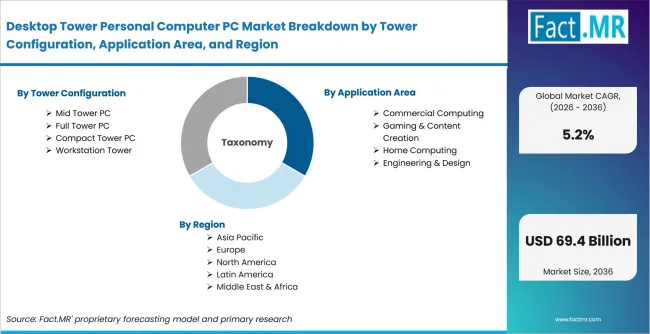
Desktop Tower Personal Computer Pc Market Breakdown By Tower Configuration, Application Area, And Region | Source: Fact.MR
| Attribute | Details |
|---|---|
| Quantitative Units | USD billion |
| Market Definition | Desktop tower personal computer PC systems sold as tower-format computers for office, home, gaming, engineering and workstation use |
| Tower Configuration | Mid Tower PC; Full Tower PC; Compact Tower PC; Workstation Tower |
| Application Area | Commercial Computing; Gaming & Content Creation; Home Computing; Engineering & Design |
| End-use Sector | Enterprise; Consumer; Government; Healthcare |
| Buyer Category | Business Organizations; Retail Consumers; System Integrators; Engineering Firms |
| Processor Platform | Intel-based Systems; AMD Ryzen-based Systems; Hybrid CPU Platform; ARM-based Desktop Platform; Professional Workstation CPUs |
| Regions Covered | North America; Latin America; Europe; East Asia; South Asia and Pacific; Middle East and Africa |
| Countries Covered | USA; China; Germany; Japan; India; Canada; South Korea |
| Key Companies Profiled | HP Inc.; Dell Technologies Inc.; Lenovo Group Limited; Acer Inc.; ASUSTeK Computer Inc.; Apple Inc.; Micro-Star International Co., Ltd.; GIGABYTE Technology Co., Ltd.; Fujitsu Client Computing Limited / Fujitsu Limited – ESPRIMO; NEC Personal Computers, Ltd. |
| Forecast Period | 2026 to 2036 |
| Approach | Hybrid top-down and bottom-up approach using desktop PC demand; tower configuration mix; business refresh cycles; gaming and workstation use; processor platform selection; channel coverage; buyer category analysis; country adoption patterns and company portfolio review |
Source: Fact.MR analysis. Updated Aug 6, 2026
How is the market segmented?
-
By Tower Configuration
- Mid Tower PC
- Micro ATX Tower
- Mini Tower
- Full Tower PC
- Extended ATX Tower
- Industrial Tower
- Compact Tower PC
- Slim Tower
- Small Form Factor Tower
- Workstation Tower
- Entry Workstation
- High-end Workstation
- Mid Tower PC
-
By Application Area
- Commercial Computing
- Office Productivity
- Business Applications
- Gaming & Content Creation
- Professional Workstations
- STEM Education
- Home Computing
- Remote Work
- Home Office
- Engineering & Design
- CAD/CAM Applications
- 3D Rendering
- Commercial Computing
-
By End-use Sector
- Enterprise
- Corporate Offices
- IT & Telecom
- Consumer
- Gaming Enthusiasts
- Educational Institutions
- Government
- Public Administration
- Defense & Security
- Healthcare
- Hospitals & Clinics
- Research Institutes
- Enterprise
-
By Buyer Category
- Business Organizations
- Large Enterprises
- Small & Medium Enterprises
- Retail Consumers
- Educational Institutions
- Government Organizations
- System Integrators
- Channel Partners
- Managed Service Providers
- Engineering Firms
- System Builders
- Value-added Resellers
- Business Organizations
-
By Processor Platform
- Intel-based Systems
- Core i5 / i7 Platform
- Xeon Platform
- AMD Ryzen-based Systems
- Ryzen 7 / Ryzen 9 Platform
- Hybrid CPU Platform
- ARM-based Desktop Platform
- Energy-efficient Processors
- AI-enabled Desktop CPUs
- Professional Workstation CPUs
- High-core-count CPUs
- Overclocking-ready CPUs
- Intel-based Systems
-
By Region
- North America
- Latin America
- Europe
- East Asia
- South Asia and Pacific
- Middle East and Africa
Frequently Asked Questions
How big is the desktop tower personal computer PC market in 2026?
The desktop tower personal computer PC market is valued at USD 41.8 billion in 2026 and is forecast to reach USD 69.4 billion by 2036.
Which tower configuration leads the desktop tower personal computer PC market?
Which application area leads the desktop tower personal computer PC market?
Who are the leading companies in the desktop tower personal computer PC market?
Who worked on this report


Preview the report firsthand - request a free sample
Free SampleGet the brochure for pricing and purchase details
Download PDF