- Market Value (2025): USD 280.1 Mn
- Estimated Value (2026): USD 305.8 Mn
- Forecast Value (2036): USD 736.7 Mn
- CAGR (2026-2036): 9.2%
What is the Ebola Treatment Market forecast to be worth by 2036?
USD 305.8 million in 2026 to USD 736.7 million by 2036 at a 9.2% CAGR.
- Fact.MR estimates that the Ebola treatment market reached USD 280.1 million in 2025, a year shaped by two outbreaks in Uganda and the Democratic Republic of the Congo.
- Revenue will climb from USD 305.8 million in 2026 to USD 736.7 million by 2036 as approved vaccines and antibody therapies claim a bigger part of national preparedness budgets.
- Stockpile replenishment and wider hospital readiness for high-consequence infections will lift revenue at a 9.2% CAGR from 2026 to 2036.
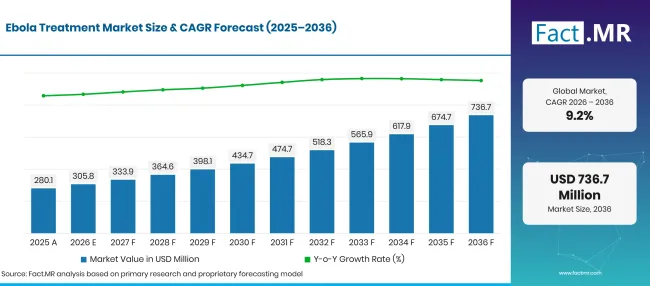
Factmr Ebola Treatment Market Forecast Global | Source: Fact.MR
| Year | Basis | Market Value (USD million) |
|---|---|---|
| 2025 | Actual | 280.1 |
| 2026 | Estimate | 305.8 |
| 2036 | Forecast | 736.7 |
| CAGR 2026 to 2036 | Forecast period | 9.2% |
Source: Fact.MR analysis. Updated Oct 21, 2026
What are the defining numbers behind Ebola Treatment Market growth?
The 2026 to 2036 period adds USD 430.9 million in new value, concentrated in outbreak vaccines and antibody therapies held in government and hospital stocks.
- Demand Drivers in the Market
- A large outbreak has reset preparedness spending. WHO declared the Bundibugyo virus epidemic in the Democratic Republic of the Congo and Uganda a public health emergency of international concern on 17 May 2026, and noted that no Bundibugyo-specific vaccine or therapeutic is approved [1]. By 4 October 2026, the DRC had reported 8,603 confirmed cases and 4,148 deaths [2]. Imported cases were treated in Germany, France and the Netherlands.
- Ring vaccination keeps vaccine orders recurring between large epidemics. During the Kasai outbreak of 2025, 47,577 people were vaccinated with Ervebo before the DRC declared the event over on 1 December 2025 [3]. Each new Zaire outbreak draws down the global stockpile, which funders then refill.
- Strain gaps keep research purchases active. Uganda’s Sudan virus outbreak ended on 26 April 2025 after 14 cases and 4 deaths, and a candidate vaccine was tested in a ring trial because no licensed product covers that species [4]. Developers will keep buying clinical supply for Sudan and Bundibugyo candidates through the forecast period.
- Supportive care remains the base of every treatment protocol. WHO states that early intensive supportive care, including rehydration and treatment of specific symptoms, can improve survival [5]. Isolation units therefore stock fluids, electrolytes and monitoring supplies alongside specific therapies.
- Antibody therapies now carry formal WHO backing for Zaire disease. WHO strongly recommends mAb114 (ansuvimab) or REGN-EB3 (Inmazeb) for confirmed patients, and treatment centers have built these products into their standard care [5].
- Key Segments Analyzed
- By Treatment Type: Vaccines will hold 42.3% share in 2026, as ring vaccination and health worker protection programs create repeat orders after each outbreak.
- By End-User: Hospitals will account for 48.7% share in 2026, since confirmed patients are treated in isolation wards and specialist units.
- By Distribution Channel: Hospital Pharmacies will capture 61.3% share in 2026, given that cold-chain products must be stored and prepared under strict controls.
- Analyst Opinion at Fact.MR
- Shambhu Nath Jha, Principal Consultant at Fact.MR, states, “The 2026 Bundibugyo epidemic showed buyers that a licensed product for one species is not cover for the next outbreak. Suppliers with ready clinical stock and regulatory standing across several ebolavirus species will win the steadiest government contracts. Hospital readiness in high-income countries will add a second, more predictable layer of demand.”
- Strategic Implications
- Vaccine and antibody makers should hold bulk drug substance in reserve so that donated or contracted doses can ship within weeks of an outbreak declaration.
- Developers of Sudan and Bundibugyo candidates should line up regulatory and ethics approvals in at-risk countries before the next outbreak, since trials that wait for an emergency can lose the window to enroll patients.
- Hospital pharmacy managers should plan cold storage capacity around the ultra-low temperatures some vaccines need, with backup power and dose tracking.
- Health ministries should fund isolation capacity and staff training in quiet years, when equipment and stock can be bought at planned prices.
Germany will lead the five countries at 11.3%, with seven special isolation units that took evacuated patients during 2026. Brazil follows at 10.3% after moving its hemorrhagic fever contingency plan into active mobilization. A national tier of special pathogen centers will carry the United States at 9.3%. In the United Kingdom, high-level isolation units and returning-worker screening support an 8.3% pace. Japan will trail at 7.4%, where a small network of designated hospitals and few imported cases keep purchases steady.
How does the Ebola Treatment Market break down by segment?
Vaccines will lead Treatment Type at 42.3%; Hospitals will head End-User at 48.7%; Hospital Pharmacies will take first place in Distribution Channel at 61.3%.
Which Treatment Type dominates?
Vaccines take 42.3% of 2026 sales.
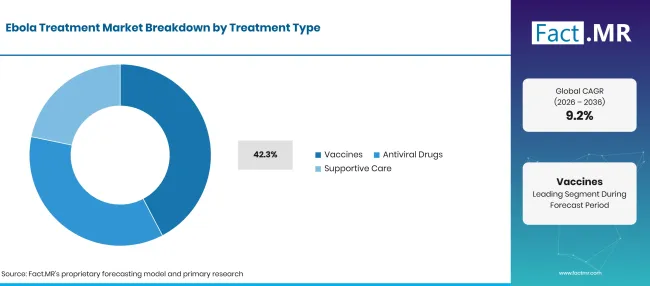
Factmr Ebola Treatment Market Breakdown Treatment Type | Source: Fact.MR
| Treatment Type | Share (2026) |
|---|---|
| Vaccines (Leading segment) | 42.3% |
| Other segments combined | 57.7%* |
| Total | 100.0% |
Source: Fact.MR analysis. Updated Oct 21, 2026
Health ministries and global agencies buy vaccine doses in bulk for ring vaccination around confirmed cases and for frontline worker protection. Ervebo is licensed by the U.S. Food and Drug Administration for people 12 months of age and older against Zaire ebolavirus [6]. Its doses come from the same vaccine plants that serve routine immunization, with filling scheduled around stockpile calls. Ervebo’s role in other strains is still being tested. In the DRC, vaccination of health workers with Ervebo began on 27 August 2026, although WHO notes that its protection against Bundibugyo virus in humans is unknown [7]. WHO experts named a single-dose rVSV Bundibugyo vaccine as the most promising candidate for that species [8].
What supports Hospitals within End-User?
Hospitals represent 48.7% of 2026 demand.
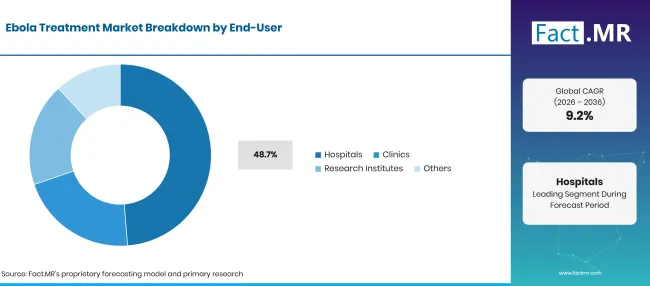
Factmr Ebola Treatment Market Breakdown End User | Source: Fact.MR
| End-User | Share (2026) |
|---|---|
| Hospitals (Leading segment) | 48.7% |
| Other segments combined | 51.3%* |
| Total | 100.0% |
Source: Fact.MR analysis. Updated Oct 21, 2026
Isolation wards treat confirmed and suspected cases with trained teams and strict infection control, so treatment products are administered there. Specialist units in developed countries hold monoclonal antibodies on site, which allows immediate care for evacuated health workers and returning travelers. Clinics manage screening and referral, and purchase mainly supportive-care items. Research institutes buy investigational products for trials. The PARTNERS platform trial opened enrollment in the DRC on 2 July 2026 to test the MBP134 antibody, remdesivir and their combination in Bundibugyo patients [9].
What leads the Distribution Channel segment?
Hospital Pharmacies handle 61.3% of 2026 sales.
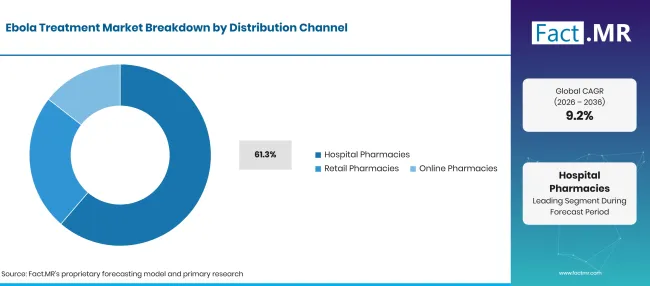
Factmr Ebola Treatment Market Breakdown Distribution Channel | Source: Fact.MR
| Distribution Channel | Share (2026) |
|---|---|
| Hospital Pharmacies (Leading segment) | 61.3% |
| Other segments combined | 38.7%* |
| Total | 100.0% |
Source: Fact.MR analysis. Updated Oct 21, 2026
Antibody infusions and live vaccines require controlled storage and trained preparation, which places them in hospital pharmacy hands. Many arrive through biopharmaceutical cold-chain logistics providers, and stockpile orders placed by governments are delivered to hospital-based supply points. Retail pharmacies contribute mainly through oral rehydration products and routine medicines used during recovery. Online pharmacies will stay a minor channel, since Ebola vaccines and antibodies are not sold to the general public. Hospital stores also keep biomedical freezers for vaccine doses that need ultra-low temperatures.
What is accelerating Ebola Treatment Market adoption, and what is holding it back?
National stockpiles will widen to include approved vaccines and antibody therapies, supported by the 2026 emergency and expanding hospital readiness programs. High product prices, short shelf life under cold-chain constraints and uneven demand between outbreaks will keep purchasing lumpy from year to year.
Drivers Impact Analysis
| DRIVER | (~) % IMPACT ON CAGR | GEOGRAPHIC RELEVANCE | IMPACT TIMELINE |
|---|---|---|---|
| Government stockpiling of approved vaccines and antibody therapies | +2.4% | Global | Short term (<= 2 years) |
| Recurring outbreaks, including the 2025 Sudan virus and 2026 Bundibugyo events | +1.8% | Middle East & Africa, Western Europe, North America | Short term (<= 2 years) |
| Hospital readiness programs for high-consequence infectious diseases | +1.4% | North America, Western Europe, East Asia | Medium term (2-4 years) |
| Preventive immunization of frontline health workers | +1.0% | Global | Medium term (2-4 years) |
| WHO treatment recommendations favoring antibody therapies | +0.8% | Global | Long term (>= 4 years) |
Source: Fact.MR analysis. Updated Oct 21, 2026
Opportunity Impact Analysis
| OPPORTUNITY | (~) % IMPACT ON CAGR | GEOGRAPHIC RELEVANCE | IMPACT TIMELINE |
|---|---|---|---|
| Vaccines and therapies for Bundibugyo and other ebolavirus species | +1.5% | Global | Long term (>= 4 years) |
| Heat-stable formulations that ease cold-chain needs | +0.9% | Middle East & Africa, South Asia & Pacific | Medium term (2-4 years) |
| Regional manufacturing and fill-finish partnerships | +0.6% | Middle East & Africa, Latin America | Medium term (2-4 years) |
Source: Fact.MR analysis. Updated Oct 21, 2026
Restraints Impact Analysis
| RESTRAINT | (~) % IMPACT ON CAGR | GEOGRAPHIC RELEVANCE | IMPACT TIMELINE |
|---|---|---|---|
| High product cost against limited budgets in affected regions | -0.6% | Middle East & Africa, South Asia & Pacific | Short term (<= 2 years) |
| Cold-chain and delivery gaps in outbreak zones | -0.4% | Middle East & Africa | Medium term (2-4 years) |
| Uneven demand between outbreaks | -0.2% | Global | Long term (>= 4 years) |
Source: Fact.MR analysis. Updated Oct 21, 2026
Which countries are scaling the Ebola Treatment Market through 2036?
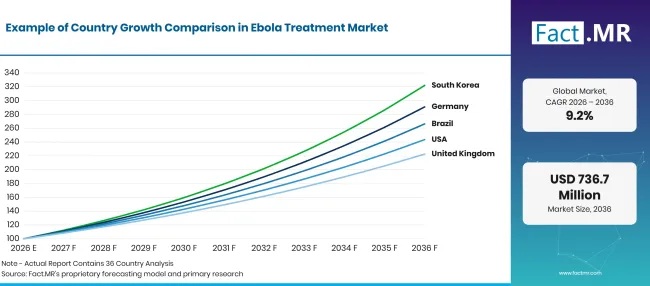
Factmr Ebola Treatment Market Growth Index | Source: Fact.MR
| Country | CAGR (2026 to 2036) |
|---|---|
| Germany | 11.3% |
| Brazil | 10.3% |
| United States | 9.3% |
| United Kingdom | 8.3% |
| Japan | 7.4% |
Source: Fact.MR analysis. Updated Oct 21, 2026
What supports Germany’s adoption?
11.3% CAGR, driven by special isolation units and their growing role in treating evacuated patients.
Germany runs seven special isolation units in major cities such as Berlin and Frankfurt. They work together through the STAKOB expert network [10]. In 2026, a U.S. citizen infected in the DRC was treated at the Charité in Berlin and discharged on 6 June, and a second patient was admitted in Frankfurt on 13 July [10]. Each admission draws on antibody therapies and supportive-care stock that must then be replaced.
How does Brazil perform?
10.3% CAGR, backed by an active contingency plan for viral hemorrhagic fevers.
Brazil’s Ministry of Health issued joint technical note 160/2026 on 1 June 2026, naming two national reference hospitals for suspected Bundibugyo cases: INI Evandro Chagas in Rio de Janeiro and Instituto Emílio Ribas in São Paulo [11]. The note also moved the national contingency plan to its mobilization phase [11]. Public procurement through the national health system will drive most demand, with hospital pharmacies managing specialist stock.
How is the United States scaling demand?
9.3% CAGR, on the back of federal stockpiles and a national tier of special pathogen centers.
CDC advised on 19 May 2026 that patients testing positive should be transferred to a Regional Emerging Special Pathogens Treatment Center, and that 13 of these centers have internal diagnostic capacity [12]. Federal programs fund stockpiles of licensed Zaire products. Hospitals and government agencies procure through controlled channels, which keeps unit prices high.
How is the United Kingdom developing demand?
8.3% CAGR, helped by its high-level isolation units for contact infections.
The UK Health Security Agency lists Ebola as a contact high-consequence infectious disease, with adult treatment at the Royal Free London and the Royal Victoria Infirmary in Newcastle [13]. UKHSA reported no imported Bundibugyo cases in the UK as of 6 October 2026 and assessed the national risk as low [2]. Research groups taking part in vaccine and therapy trials add a steady flow of research-use purchases.
What supports Japan’s adoption?
7.4% CAGR, reflecting strict infectious disease controls and hospital-led procurement.
Japan treats Ebola as a Category I infectious disease and admits patients only to designated hospitals. The Ministry of Health, Labour and Welfare counted 56 Type 1 designated medical institutions with 108 beds, and 4 specific designated institutions with 10 beds, as of 1 April 2025 [14]. Low case numbers keep demand below larger markets, so growth will rest on stock replacement and readiness for imported cases.
Who leads the Ebola Treatment Market?
Three groups shape supply. Licensed product holders compete on approval status and stockpile contracts: Merck & Co., Inc. makes Ervebo [6], Regeneron Pharmaceuticals, Inc. makes Inmazeb, and Ridgeback Biotherapeutics developed Ebanga, which Emergent BioSolutions Inc.
manufactures and distributes in the United States and Canada. Regeneron donated 500 Inmazeb doses to WHO in September 2025, and on 28 May 2026 WHO advisers prioritized its maftivimab antibody for Bundibugyo trials [15]. A second group competes on breadth across species. Mapp Biopharmaceutical, Inc. developed the MBP134 antibody tested in the PARTNERS trial [9], while Gilead Sciences, Inc. announced a donation of more than 2,000 vials of remdesivir to Uganda in June 2026 and is preparing to support planned trials of remdesivir and obeldesivir [16]. Public research groups and trial sponsors form the third group, buying investigational product at small scale. Over the forecast period, the winners will be the suppliers that can show protection against several ebolavirus species and deliver it within days of an outbreak.
Which companies are the key providers?
Key companies include Merck & Co., Inc.; Regeneron Pharmaceuticals, Inc.; Ridgeback Biotherapeutics; Emergent BioSolutions Inc.; Mapp Biopharmaceutical, Inc.; and Gilead Sciences, Inc.
- Merck & Co., Inc.
- Regeneron Pharmaceuticals, Inc.
- Ridgeback Biotherapeutics
- Emergent BioSolutions Inc.
- Mapp Biopharmaceutical, Inc.
- Gilead Sciences, Inc.
This Report Answers
- Market values for 2026 and 2036 are split by treatment type, end-user and distribution channel.
- Each segment names its 2026 leader and the buyer priorities that explain its standing.
- Stockpiling, hospital readiness and exposure to imported cases anchor the five-country comparison.
- Supplier profiles separate licensed product holders from developers working across several ebolavirus species.
- Readers can trace how the 2026 Bundibugyo emergency changed vaccine and therapy procurement.
Bibliography
- [1] World Health Organization. (2026, May 17). Epidemic of Ebola Disease caused by Bundibugyo virus in the Democratic Republic of the Congo and Uganda determined a public health emergency of international concern.
- [2] UK Health Security Agency. (2026, October 8). Outbreaks under monitoring: week 40 (week ending 4 October 2026).
- [3] World Health Organization. (2025, December 1). Ebola virus disease: Democratic Republic of the Congo.
- [4] World Health Organization. (2025, April 26). Sudan virus disease: Uganda.
- [5] World Health Organization. (2025, April 24). Ebola disease.
- [6] U.S. Food and Drug Administration. (2026, April 21). ERVEBO.
- [7] World Health Organization. (2026, August 28). Ebola disease caused by Bundibugyo virus: Democratic Republic of the Congo.
- [8] World Health Organization. (2026, May 28). Experts convened by WHO advise on candidate treatments and vaccines for Ebola disease caused by Bundibugyo virus.
- [9] World Health Organization. (2026, July 2). Patient enrolment begins in a scientific trial to identify the first effective treatments for Bundibugyo virus disease.
- [10] Bundesministerium für Gesundheit. (2026, July 20). Ebolafieber [Ebola fever].
- [11] Ministério da Saúde, Brazil. (2026, June 1). Nota Técnica Conjunta nº 160/2026/SVSA/SAES/MS [Joint Technical Note No. 160/2026 on suspected Bundibugyo virus disease].
- [12] U.S. Centers for Disease Control and Prevention. (2026, May 19). Ebola Disease Outbreak in the Democratic Republic of the Congo and Uganda (Health Alert Network, CDCHAN-00530).
- [13] UK Health Security Agency. (2026, January 15). High consequence infectious diseases (HCID).
- [14] Ministry of Health, Labour and Welfare, Japan. (2025, April 1). [Designation status of infectious disease designated medical institutions].
- [15] Regeneron Pharmaceuticals, Inc. (2026, May 28). Regeneron’s Ebola Antibody Recommended by World Health Organization for Investigational Use in Response to Current Bundibugyo Ebolavirus Outbreak.
- [16] Gilead Sciences, Inc. (2026, June 12). Gilead Mobilizes Rapid Donation of Remdesivir to Support Ebola Response, Building on Decade-Long Commitment to Outbreak Relief
What does the Ebola Treatment Market cover?
Vaccines, antiviral drugs and supportive-care products used to prevent and treat Ebola disease form the market, from preventive immunization and the treatment of confirmed cases to the care supplies used in isolation wards.
Revenue is recorded at the first sale of each product, whether to a hospital pharmacy, retail pharmacy, online pharmacy or government buyer. Government stockpile orders are counted in the channel that receives and stores them, which in most countries is the hospital pharmacy.
What is included in the scope?
Vaccines, antiviral drugs including monoclonal antibody therapies, and supportive-care products specific to Ebola treatment fall within scope, as do purchases by hospitals, clinics and research institutes. Broad-spectrum anti-infective agents count only when used for Ebola patients.
Products bought for clinical trials and research programs are counted at the product’s own value.
What is excluded from the scope?
Vaccines and treatments for other viral diseases lie outside the boundary, along with general-purpose hospital supplies, medical devices, protective equipment and diagnostic tests. Contract filling of sterile injectable drugs is counted only in the value of the finished product.
Funding for outbreak response services, health worker training and research grants is left out, and products still in early development are excluded until commercial sale begins.
How Was the Analysis Built?
The analysis draws on 120+ sources, 35+ company portfolios, 25+ countries, and more than 20 industry interviews.
- Primary Research: Primary research includes discussions with manufacturers, service providers, technology developers, distributors, end users, and subject-matter experts. These conversations examine purchasing priorities, product adoption, operational challenges, approval requirements, competitive positioning, and the factors that influence wider market acceptance.
- Desk Research: Desk research covers government statistics, regulatory publications, company filings, trade data, technical studies, industry associations, standards, public policy, and other authoritative sources. Every source used in the analysis is documented in the bibliography.
- Market Sizing and Forecasting: Market estimates combine historical performance, demand indicators, pricing and volume trends, segment shares, company participation, country-level growth, adoption patterns, investment activity, and barriers to market expansion.
- Data Validation and Update Cycle: Findings are validated by comparing primary interviews with public data, company activity, regulatory changes, trade patterns, and industry developments. Regular updates review new product launches, capacity changes, partnerships, approvals, and shifts in commercial adoption.
Segmentation
What is the report’s scope and coverage?
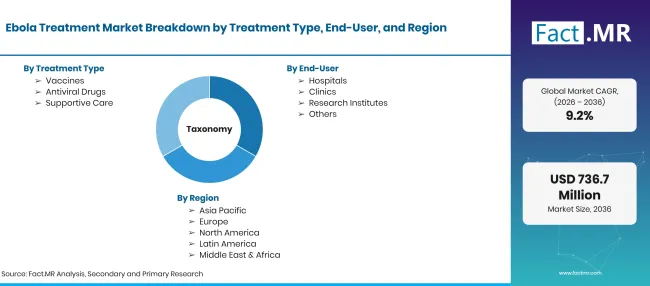
Factmr Ebola Treatment Market Taxonomy | Source: Fact.MR
| Attribute | Details |
|---|---|
| Quantitative Units | USD million in 2026 to USD million by 2036 at CAGR |
| Market Definition | Vaccines, antiviral drugs and supportive-care products used to prevent and treat Ebola disease, sold through hospital, retail and online pharmacy channels. Coverage spans hospital, clinic and research demand, including government stockpile orders. |
| Treatment Type | Vaccines; Antiviral Drugs; Supportive Care |
| End-User | Hospitals; Clinics; Research Institutes |
| Distribution Channel | Hospital Pharmacies; Retail Pharmacies; Online Pharmacies |
| Regions Covered | North America; Latin America; Western Europe; Eastern Europe; East Asia; South Asia & Pacific; Middle East & Africa |
| Countries Covered | Germany; Brazil; United States; United Kingdom; Japan |
| Companies Profiled | Merck & Co., Inc.; Regeneron Pharmaceuticals, Inc.; Ridgeback Biotherapeutics; Emergent BioSolutions Inc.; Mapp Biopharmaceutical, Inc.; Gilead Sciences, Inc. |
| Forecast Period | 2026 to 2036 |
| Approach | Hybrid top-down and bottom-up approach using outbreak and case data; product prices by treatment type; government stockpile and hospital procurement; and company portfolio review. |
Source: Fact.MR analysis. Updated Oct 21, 2026
How is the market segmented?
-
By Treatment Type
- Vaccines
- Antiviral Drugs
- Supportive Care
-
By End-User
- Hospitals
- Clinics
- Research Institutes
-
By Distribution Channel
- Hospital Pharmacies
- Retail Pharmacies
- Online Pharmacies
-
By Region
- North America
- Latin America
- Western Europe
- Eastern Europe
- East Asia
- South Asia & Pacific
- Middle East & Africa
Frequently Asked Questions
How big is the Ebola treatment market in 2026?
What is the CAGR of the Ebola treatment market from 2026 to 2036?
Which treatment type leads the Ebola treatment market?
Which end-user leads the Ebola treatment market?
Which distribution channel leads the Ebola treatment market?
Which country will grow the most in the Ebola treatment market?
Who are the main companies in the Ebola treatment market?
Who worked on this report


Preview the report firsthand - request a free sample
Free SampleGet the brochure for pricing and purchase details
Download PDF