- Market Value (2025): USD 109.4 Mn
- Estimated Value (2026): USD 145 Mn
- Forecast Value (2036): USD 2418.4 Mn
- CAGR (2026-2036): 32.50%
What is the digital replica APIs market forecast to be worth by 2036?
USD 145 million in 2026 to USD 2,418.4 million by 2036, at 32.50% CAGR.
- The digital replica APIs market crossed a valuation of USD 109.4 million in 2025.
- Demand is expected to increase from USD 145 million in 2026 to USD 2,418.4 million by 2036.
- The market is forecast to record 32.5% CAGR during 2026 to 2036 as AI avatar platforms shift from studio-only workflows toward developer APIs, enterprise SaaS and white-label video integration.
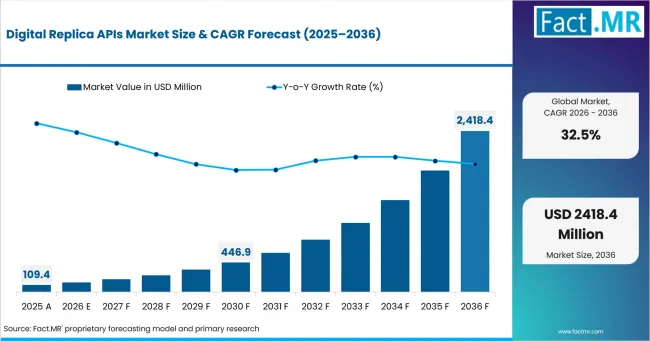
Digital Replica Apis Market Market Value Analysis | Source: Fact.MR
What are the defining numbers behind digital replica APIs market growth?
USD 2,300 million absolute opportunity by 2036, led by API-based video replicas and governed avatar infrastructure.
- Demand Drivers in the Market
- Marketing teams need personalized video at scale without filming every message.
- SaaS vendors need avatar APIs that can be embedded into product workflows.
- Contact centers need interactive digital agents for onboarding and service support.
- Health-tech firms need governed intake interfaces with clear consent and moderation controls.
- Key Segments Analyzed
- By Replica Type: Video replicas are expected to hold 38.0% share in 2026 because they are the clearest commercial format.
- By Use Case: Customer onboarding leads because guided video improves product education. The segment is projected to capture 31.0% share in 2026.
- By Delivery Model: API calls are likely to account for 40.0% share in 2026 because developer integration defines the title.
- By Buyer Type: Marketing teams lead because personalized video demand is strongest in campaign and sales workflows. The segment is expected to hold 34.0% share in 2026.
- By Governance: Consent management is projected to record 39.0% share in 2026 because identity-backed replicas need verified permission.
- Analyst Opinion at Fact.MR
- Shambhu Nath Jha, Senior Analyst at Fact.MR, states, “Digital replica APIs are turning AI avatars into product infrastructure. The market will grow where vendors can prove consent, identity control, safe deployment and workflow integration. Platforms that offer realistic output without governance will struggle as enterprise use cases become more sensitive.”
- Strategic Implications
- API providers should make consent capture and replica permissions part of the core workflow.
- SaaS vendors should embed replica APIs where video improves onboarding or support.
- Contact centers should test digital agents on high-volume low-risk service tasks first.
- Health-tech firms should pair avatar workflows with strict moderation and audit controls.
Digital replica APIs sit below the wider AI Avatar Market because the title focuses on programmable replica infrastructure. The category differs from simple AI video generators because API calls and system integration are central to the product.
Tavus’ 2024 technical guide describes video generation API calls that use a replica ID and script to create AI videos. [1] This supports the scope because digital replica APIs are developer-facing systems used to generate personalized videos and human-like digital interfaces inside other products.
The United States is projected to record 35.8% CAGR through 2036 as Tavus, NVIDIA and enterprise AI vendors scale digital human APIs. The United Kingdom is expected to post 34.1% CAGR through 2036 as Synthesia and enterprise video teams expand consent-led avatar use. Israel is likely to record 33.0% CAGR as D-ID and Hour One support interactive avatar infrastructure. Germany is forecast to advance at 31.8% CAGR as regulated enterprises adopt training, onboarding and product-demo replicas. India is set to record 30.9% CAGR as SaaS vendors, edtech firms and contact centers adopt API-based avatar workflows.
How does the digital replica APIs market break down by segment?
Video replicas lead at 38.0%; API calls lead at 40.0%.
Which replica type dominates?
Video replicas hold 38.0% share in 2026.
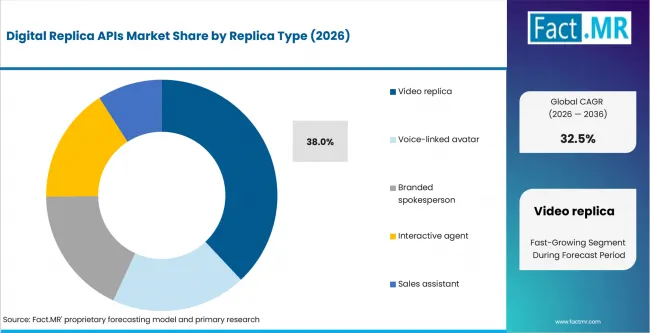
Digital Replica Apis Market Analysis By Replica Type | Source: Fact.MR
Video replicas are expected to hold 38.0% share in 2026 because they are easiest for enterprises to understand and deploy. They allow teams to generate personalized presenter-led videos from scripts, CRM fields or product prompts. Voice-linked avatars follow as companies link likeness and speech to brand spokespeople. Branded spokespersons support product demos and campaigns. Interactive agents gain faster traction where text, voice and live rendering are combined. Sales assistants support prospecting and account-based marketing. Synthesia’s 2025 research partnership note explains that avatar likeness creation uses explicit consent through a biometric-based verification flow. [2]
Which use case dominates?
Customer onboarding dominates digital replica API demand.
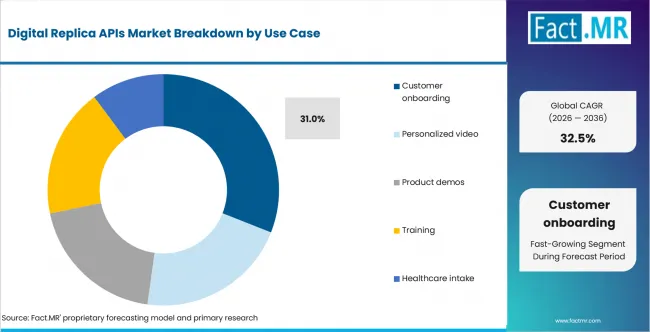
Digital Replica Apis Market Analysis By Use Case | Source: Fact.MR
Customer onboarding leads because guided video can explain a product faster than text-based flows. The segment is projected to capture 31.0% share in 2026 as SaaS vendors use replicas to welcome users, explain setup and reduce support burden. Personalized video supports marketing and lifecycle campaigns. Product demos help sales teams tailor walkthroughs. Training uses avatars for repeatable modules. Healthcare intake remains smaller but important where controlled scripts and consent are essential. HeyGen’s 2026 customer support API page describes Streaming Avatar API use for realistic virtual agents in customer applications. [5]
Which delivery model dominates?
API calls hold 40.0% share in 2026.
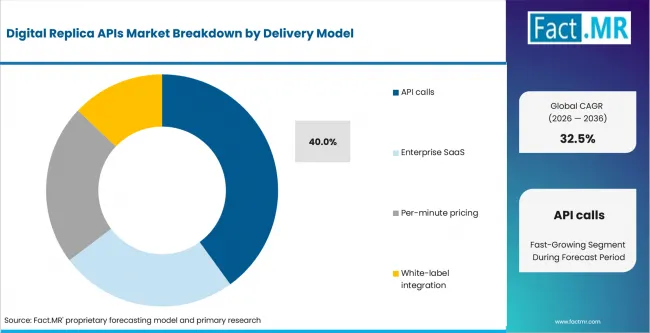
Digital Replica Apis Market Analysis By Delivery Model | Source: Fact.MR
API calls lead because the market is built around developer access and workflow integration. The delivery model segment is likely to account for 40.0% share in 2026 as teams connect replica generation to CRM tools, support portals, training systems and marketing automation platforms. Enterprise SaaS supports non-technical teams that still need governed video workflows. Per-minute pricing helps usage-based scaling. White-label integration supports SaaS vendors that want avatars inside their own products. NVIDIA ACE microservices use local and cloud resources to support end-to-end digital avatar solutions. [3]
Which buyer type dominates?
Marketing teams hold 34.0% share in 2026.
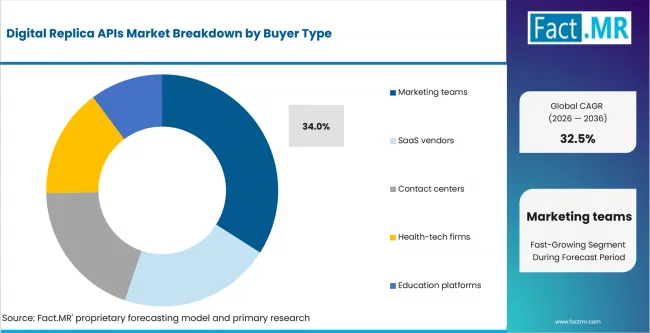
Digital Replica Apis Market Analysis By Buyer Type | Source: Fact.MR
Marketing teams lead because personalized video is a clear commercial use case. The buyer type segment is expected to hold 34.0% share in 2026 as teams generate onboarding videos, campaign explainers, product demos and sales outreach assets. SaaS vendors follow because they embed replica APIs into user journeys. Contact centers use avatars for routine support. Health-tech firms use controlled intake and education flows. Education platforms use avatars for localized learning content. D-ID’s 2025 guidance states that interactive avatars can be embedded into websites, mobile apps, customer portals and enterprise systems. [4]
Which governance area dominates?
Consent management holds 39.0% share in 2026.
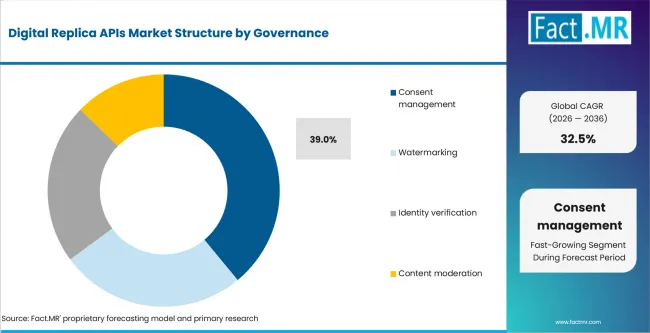
Digital Replica Apis Market Analysis By Governance | Source: Fact.MR
Consent management leads because a digital replica is tied to identity, voice and likeness. The governance segment is projected to record 39.0% share in 2026 as enterprises require permission trails, revocation controls and identity checks. Watermarking helps content origin tracing. Identity verification reduces impersonation risk. Content moderation supports enterprise safety rules before videos or agents go live. The FTC’s 2024 AI impersonation proposal highlights concern around generative AI being used to impersonate individuals. [6]
What is accelerating Digital Replica APIs Market adoption, and what is holding it back?
Personalized video and SaaS platforms driving it; impersonation risk and consent complexity restraining it.
Drivers Impact Analysis
| DRIVER | (~) % IMPACT ON CAGR | GEOGRAPHIC RELEVANCE | IMPACT TIMELINE |
|---|---|---|---|
| Personalized video moving from manual production to API generation | +3.1% | United States, United Kingdom, Israel | Short term (≤ 2 years) |
| SaaS platforms embedding avatars into onboarding and demos | +2.6% | North America, Europe, India | Medium term (2–4 years) |
| Contact centers testing interactive agents for routine service | +2.2% | United States, Germany, India, Japan | Medium term (2–4 years) |
| Consent and identity workflows improving enterprise acceptance | +1.9% | United States, Europe, Israel | Short term (≤ 2 years) |
| Per-minute pricing lowering entry barriers for developers | +1.6% | Global, strongest in startup ecosystems | Long term (≥ 4 years) |
Source: Fact.MR analysis. Updated Jul 4, 2026
- Personalized video automation: Personalized video automation is the strongest driver because teams want video outreach without repeated filming. APIs can turn scripts and variables into branded video at scale. This helps marketing, sales and customer success teams increase content volume. The driver is strongest where CRM, campaign tools and AI video platforms are already connected.
- SaaS onboarding: SaaS onboarding supports demand because users often need product explanation after sign-up. A digital replica can guide setup, explain features and answer common questions through embedded workflows. This creates value inside product-led growth teams. It also supports white-label integration where the avatar becomes part of the SaaS interface.
- Contact center automation: Contact centers are testing interactive agents because repetitive questions can be handled through guided avatar workflows. These systems can combine language models, brand scripts and visual presence. They are most useful for onboarding, FAQs and basic service flows. Human escalation still matters for sensitive issues.
- Consent and identity workflows: Consent and identity workflows improve enterprise acceptance because replica misuse is a major concern. Companies need to confirm who authorized the likeness and how it can be used. Governance tools also help legal and brand teams approve use cases. This driver will remain important as AI impersonation scrutiny grows.
- Per-minute pricing: Per-minute pricing lowers adoption barriers because teams can test small video volumes before enterprise rollout. Usage-based models help developers experiment with demos, product walkthroughs and onboarding sequences. It also supports startups that cannot buy large annual licenses early. Over time, volume discounts will shape platform competition.
Opportunity Impact Analysis
| OPPORTUNITY | (~) % IMPACT ON CAGR | GEOGRAPHIC RELEVANCE | IMPACT TIMELINE |
|---|---|---|---|
| Healthcare intake avatars with consent and moderation controls | +2.0% | United States, Germany, Japan, India | Medium term (2–4 years) |
| White-label avatar APIs for SaaS product experiences | +1.8% | North America, Europe, India | Short term (≤ 2 years) |
| Branded spokesperson replicas for product demos | +1.6% | United States, United Kingdom, Israel | Medium term (2–4 years) |
| Watermarked sales-assistant videos for governed outreach | +1.4% | North America, Europe, East Asia | Long term (≥ 4 years) |
Source: Fact.MR analysis. Updated Jul 4, 2026
- Healthcare intake avatars: Healthcare intake avatars create opportunity because patients often need guided explanations before forms, scheduling or care navigation. Digital replicas can support scripted education and multilingual intake. The opportunity needs consent, moderation and clear escalation to human teams. Health-tech adoption will favor vendors with strong governance controls.
- White-label SaaS APIs: White-label SaaS APIs create opportunity because software vendors can add human-like video experiences without building full avatar stacks. These integrations can support onboarding, tutorials and customer education. API reliability and documentation will be critical. The strongest opportunity sits in product-led SaaS and customer-success tools.
- Branded spokesperson replicas: Branded spokesperson replicas create opportunity because companies want consistent presenters across demos, announcements and training. A verified replica can speak in many versions of a message without repeated studio time. This supports campaign scale and global localization. It also requires strict identity permission rules.
- Governed sales assistants: Governed sales assistants can generate outreach videos with user-specific context. Watermarking and identity checks help reduce misuse. This opportunity is strong where sales teams already use personalization tools. Vendors that connect with CRM systems and approval workflows will gain stronger enterprise traction.
Restraints Impact Analysis
| RESTRAINT | (~) % IMPACT ON CAGR | GEOGRAPHIC RELEVANCE | IMPACT TIMELINE |
|---|---|---|---|
| Deepfake and impersonation concerns slowing enterprise approval | -2.4% | Global | Short term (≤ 2 years) |
| Likeness rights and consent complexity across regions | -2.0% | United States, Europe, Japan | Medium term (2–4 years) |
| Output quality gaps in emotion, timing and realism | -1.7% | Global | Medium term (2–4 years) |
| Integration burden across CRM, LMS and support systems | -1.3% | Global, strongest in enterprises | Long term (≥ 4 years) |
Source: Fact.MR analysis. Updated Jul 4, 2026
- Impersonation risk: Impersonation risk is the main restraint because digital replicas can be misused when consent and identity checks are weak. Enterprise legal teams may slow adoption until vendor policies are clear. This restraint affects branded spokespersons, voice-linked avatars and sales assistants most strongly. Strong watermarking and audit trails reduce the concern.
- Consent complexity: Consent complexity grows when a replica is used across countries, campaigns or employers. Permission may need to cover voice and revocation. Vendors need easy consent records and role-based access. This is especially important for agencies and white-label SaaS vendors.
- Output quality gaps: Output quality gaps can limit repeat use if avatars feel stiff, poorly timed or mismatched with the script. Enterprise use cases need believable speech, natural motion and stable brand tone. Quality concerns are stronger in product demos and healthcare intake where trust matters. Vendors must improve emotion and latency.
- Integration burden: Integration burden slows rollout because replica APIs must connect with CRM and approval systems. Enterprises may need security review and workflow mapping. Poor documentation can delay adoption. Developer tools and enterprise support reduce this friction.
Which countries are scaling digital replica APIs fastest?
United States 35.8%; United Kingdom 34.1%; Israel 33.0%; Germany 31.8%; India 30.9%.
Based on regional analysis, the digital replica APIs market is segmented into North America, Western Europe, East Asia, South Asia, Latin America, and Middle East and Africa.
Country CAGR
| Country | CAGR |
|---|---|
| United States | 35.8% |
| United Kingdom | 34.1% |
| Israel | 33.0% |
| Germany | 31.8% |
| India | 30.9% |
Source: Fact.MR analysis. Updated Jul 4, 2026
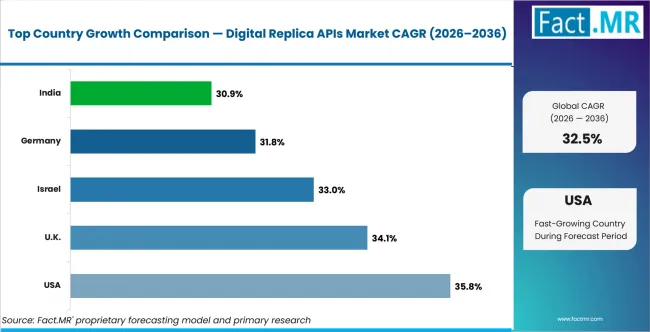
Digital Replica Apis Market Cagr Analysis By Country | Source: Fact.MR
What is powering the United States lead?
35.8% CAGR, driven by Tavus and NVIDIA digital human infrastructure.
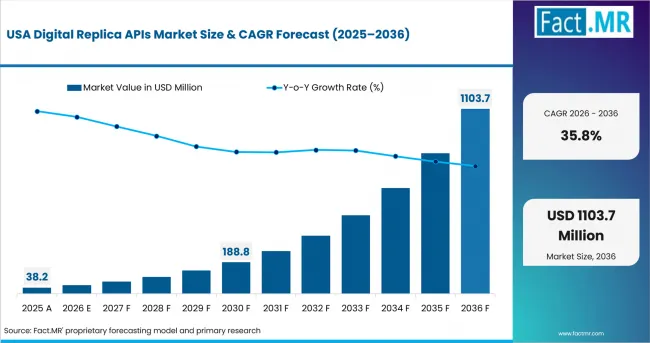
Digital Replica Apis Market Country Value Analysis | Source: Fact.MR
The United States is projected to record 35.8% CAGR from 2026 to 2036 as API-first video replica platforms, AI infrastructure vendors and enterprise software teams expand digital human workflows. Growth will favor API calls and governed spokesperson replicas.
How is the United Kingdom scaling digital replica API demand?
34.1% CAGR, driven by Synthesia and enterprise AI video adoption.
The United Kingdom is expected to post 34.1% CAGR through 2036 as enterprise video creation expands across training, internal communication and product education. Consent-led avatar workflows will support adoption. Growth will favor enterprise SaaS and branded spokesperson formats.
What supports Israel’s outlook?
33.0% CAGR, driven by D-ID and interactive avatar infrastructure.
Israel is likely to record 33.0% CAGR by 2036 as digital human platforms support interactive agents, sales assistants and customer-facing APIs. Growth will favor real-time avatars and developer integrations. Security, identity verification and content moderation will be key selection factors.
What underpins Germany’s growth?
Germany at 31.8% is scaling through regulated enterprise workflows and governed AI adoption.
Germany is forecast to advance at 31.8% CAGR through 2036 as enterprises test digital replicas for product demos, training and service workflows. Governance requirements will push demand toward consent management and moderation controls. Enterprise licenses will have stronger traction than open consumer tools.
How is India scaling digital replica API adoption?
30.9% CAGR, driven by SaaS vendors and education-platform localization.
India is set to record 30.9% CAGR through 2036 as SaaS vendors, edtech firms and contact centers use digital replicas for onboarding, product demos and multilingual support. API calls and per-minute pricing will fit fast-growing platform teams. Growth will favor lower-cost integration and strong language coverage.
Who leads the digital replica APIs market?
Tavus and Synthesia lead commercial replica workflows, while NVIDIA and D-ID strengthen digital human infrastructure.
Digital replica APIs are supplied by AI video platforms, digital human infrastructure vendors and interactive avatar companies. Tavus is directly relevant through replica and video generation APIs. Synthesia is important through enterprise AI avatar workflows and consent-led likeness creation. HeyGen supports streaming avatar and customer support API use cases. D-ID competes through interactive avatars, AI agents and developer-facing deployment.
NVIDIA ACE supports the infrastructure side through speech, animation and digital human microservices. Soul Machines is relevant through autonomous digital people and enterprise-facing digital human experiences. Hour One supports avatar-led business video and training workflows. Competition through 2036 come from watermarking workflows and integration support.
Which companies are the key providers?
Tavus and Synthesia are key providers. HeyGen and D-ID are also profiled. NVIDIA ACE, Soul Machines and Hour One complete the company set.
- Tavus
- Synthesia
- HeyGen
- NVIDIA ACE
- D-ID
- Soul Machines
- Hour One
Bibliography
- [1] Tavus. (2024, July 8). How to do text to video for AI replicas. Tavus.
- [2] Synthesia. (2025, April 10). Partnering with Shutterstock to accelerate our AI research efforts. Synthesia.
- [3] NVIDIA. (2024, January 8). Building lifelike digital avatars with NVIDIA ACE microservices. NVIDIA Technical Blog.
- [4] D-ID. (2025, August 4). How interactive AI avatars adapt in real time for immersive experiences. D-ID.
- [5] HeyGen. (2026, May 4). AI agents and streaming avatar API for better customer support. HeyGen
- [6] Federal Trade Commission. (2024, February 15). FTC proposes new protections to combat AI impersonation of individuals. Federal Trade Commission.
This Report Address
- Strategic intelligence on digital replica APIs across replica type and delivery model.
- Segment analysis covering Video Replicas and API Calls.
- Regional outlook covering the United States, United Kingdom, Israel, Germany and India.
- Competitive analysis of Tavus, Synthesia, HeyGen, NVIDIA ACE, D-ID, Soul Machines and Hour One.
- Technology assessment covering video replica generation, voice-linked avatars, API calls, real-time rendering and identity verification.
- Use case assessment covering customer onboarding, personalized video, product demos, training and healthcare intake.
- Primary interviews, provider checks and official source review support the forecast.
What does the digital replica APIs market cover?
Programmable APIs that generate or operate identity-backed video replicas and interactive avatars.
The digital replica APIs market covers video replicas and sales assistants. These systems are used for customer onboarding and healthcare intake.
The market differs from broad AI video tools because it focuses on developer access and enterprise deployment. It excludes manual video editing platforms and entertainment-only characters without replica API workflows.
What is included in the scope?
Developer-facing avatar APIs and governed digital replica workflows.
The scope includes API calls and white-label integration models. Governance coverage includes consent management and content moderation.
Buyer type coverage includes marketing teams and education platforms. The scope also includes NVIDIA ACE-style digital human infrastructure when used to build conversational avatars or human-like product interfaces.
What is excluded from the scope?
Basic avatar filters, manual studio-only tools and entertainment-only characters are outside the scope.
The scope excludes static profile avatars, non-AI video templates, ordinary deepfake apps, manual editing software and simple talking-photo tools without enterprise API access. It also excludes standalone voice cloning products unless they are linked with a video replica or avatar API.
How was the analysis built?
100+ sources, 40+ company portfolios, 25+ countries, 20+ interviews.
- Primary Research: Primary research includes interviews with AI video platform teams, SaaS product managers and customer experience leaders. It includes input from marketing automation vendors, health-tech firms, contact-center technology teams and enterprise security stakeholders.
- Desk Research: Desk research reviews official product pages, developer documentation, AI avatar policies, consent workflows, pricing structures and platform integration models.
- Market-Sizing and Forecasting: Forecasting uses API usage growth, enterprise SaaS adoption, avatar-video generation volume, per-minute pricing and white-label deployment signals.
- Data Validation and Update Cycle: Forecasts are validated through provider checks and technical interviews. Developer API access, consent infrastructure and enterprise customer demand help confirm market direction.
Segmentation
What is the report’s scope and coverage?
| Attribute | Details |
|---|---|
| Market Definition | Programmable APIs that generate or operate identity-backed video replicas and interactive avatars |
| Replica Type | Video replica; voice-linked avatar; branded spokesperson; interactive agent; sales assistant |
| Use Case | Customer onboarding; personalized video; product demos; training; healthcare intake |
| Delivery Model | API calls; enterprise SaaS; per-minute pricing; white-label integration |
| Buyer Type | Marketing teams; SaaS vendors; contact centers; health-tech firms; education platforms |
| Governance | Consent management; watermarking; identity verification; content moderation |
| Regions Covered | North America; Western Europe; East Asia; South Asia; Latin America; Middle East and Africa |
| Countries Covered | United States; United Kingdom; Israel; Germany; India |
| Key Companies Profiled | Tavus; Synthesia; HeyGen; NVIDIA ACE; D-ID; Soul Machines; Hour One |
| Forecast Period | 2026 to 2036 |
| Approach | Hybrid top-down and bottom-up approach using API adoption, avatar-video usage, enterprise SaaS demand and provider validation |
Source: Fact.MR analysis. Updated Jul 4, 2026
How is the market segmented?
-
By Replica Type:
- Videreplica
- Voice-linked avatar
- Branded spokesperson
- Interactive agent
- Sales assistant
-
By Use Case:
- Customer onboarding
- Personalized video
- Product demos
- Training
- Healthcare intake
-
By Delivery Model:
- API calls
- Enterprise SaaS
- Per-minute pricing
- White-label integration
-
By Buyer Type:
- Marketing teams
- SaaS vendors
- Contact centers
- Health-tech firms
- Education platforms
-
By Governance:
- Consent management
- Watermarking
- Identity verification
- Content moderation
-
Region:
- North America
- United States
- Canada
- Mexico
- Western Europe
- United Kingdom
- Germany
- France
- Netherlands
- Sweden
- East Asia
- Japan
- China
- South Korea
- South Asia
- India
- Singapore
- Thailand
- Latin America
- Brazil
- Chile
- Middle East & Africa
- Israel
- UAE
- Saudi Arabia
- South Africa
- North America
Frequently Asked Questions
Which replica type leads the Digital Replica APIs Market?
Which use case leads the Digital Replica APIs Market?
Which delivery model leads the Digital Replica APIs Market?
Which buyer type leads the Digital Replica APIs Market?
Which governance area leads the Digital Replica APIs Market?
Which country expands fastest in the Digital Replica APIs Market?
How does the United Kingdom perform in the Digital Replica APIs Market?
How does Israel perform in the Digital Replica APIs Market?
How does Germany perform in the Digital Replica APIs Market?
How does India perform in the Digital Replica APIs Market?
What is the primary driver in the Digital Replica APIs Market?
What is the main restraint in the Digital Replica APIs Market?
Why are video replicas important?
Why do API calls dominate demand?
Who worked on this report


Preview the report firsthand - request a free sample
Free SampleGet the brochure for pricing and purchase details
Download PDF