- Market Value (2025): USD 1.4 Bn
- Estimated Value (2026): USD 1.6 Bn
- Forecast Value (2036): USD 4.9 Bn
- CAGR (2026-2036): 11.8%
What is the Digital Shipyard Blueprints Market forecast to be worth by 2036?
USD 1.6 billion in 2026 to USD 4.9 billion by 2036 at an 11.8% CAGR.
- 2025 Market Value: USD 1.4 billion.
- 2026 to 2036 Market Progression: USD 1.6 billion to USD 4.9 billion.
- Forecast CAGR (2026-2036): 11.8%.
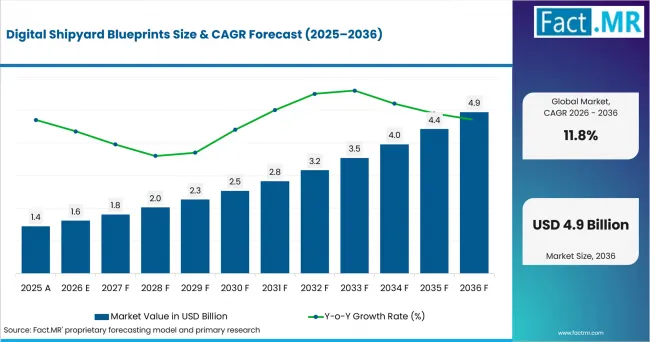
Digital Shipyard Blueprints Value Analysis | Source: Fact.MR
What are the defining numbers behind Digital Shipyard Blueprints Market growth?
The market creates an absolute opportunity of USD 3.3 billion between 2026 and 2036.
- Demand Drivers in the Market
- Shipyards are moving engineering information closer to production execution. Dassault Systèmes describes a digital shipyard around a common 3D ship master model and continuous information flow from design into manufacturing, while Siemens shows shipbuilders using NX and Teamcenter to maintain one managed source of product data across engineering, procurement, and manufacturing. This converts the digital model from a design deliverable into production infrastructure within the wider shipbuilding market.
- Automation and AI increase the value of structured shipbuilding data. South Korea's Ministry of Trade, Industry and Energy set a 2040 target of 50% process automation under its K-Shipbuilding Super Gap Vision, while a 2026 government initiative for shipbuilding industrial complexes called for shared data, knowledge, and AI models across design, production, and quality control. Robots and AI systems need current geometry, work packages, bills of material, sequence logic, and configuration state, creating demand for blueprints that can feed machines and production planning rather than remain isolated CAD files.
- Complex vessel programs require tighter configuration traceability. SSI describes shipbuilding-specific PLM around evolving vessel designs, hull effectivity, change workflows, and long program lifecycles. Naval and specialized vessel programs extend this requirement because design baselines have to remain usable through build, refit, sustainment, and class changes, which increases the commercial value of governed digital threads and configuration baselines.
- Public maritime policy is reinforcing digital continuity. The European Commission's 2026 Industrial Maritime Strategy identifies digital transition as part of the competitiveness agenda for maritime manufacturing, and the International Maritime Organization's 2026 digitalization strategy emphasizes interoperability, system standardization, data sharing, and data governance. Shipyards that hand over structured vessel information are better placed to connect production records with connected-vessel and lifecycle systems after delivery.
- Workforce and schedule pressure also support model-based work. Japan's Ministry of Land, Infrastructure, Transport and Tourism is funding AI shipbuilding robotics, simulation, and DX automation to reduce labor intensity and production hours. Digital blueprints give less-experienced teams clearer visual work information and allow design changes to propagate into production outputs with less manual translation.
- Key Segments Analyzed
- 3D product model and digital thread accounts for 35.0% of Digital Asset in 2026 because one governed product definition can support design coordination, production planning, fabrication outputs, and downstream change control.
- Design & engineering represents 31.0% of Shipbuilding Stage in 2026 because geometry, system arrangement, classification inputs, and bills of material originate here and determine the data available to every later build stage.
- PLM-centric holds 34.0% of Platform Architecture in 2026 because shipbuilders need revision, configuration, approval, and effectivity control around the 3D model before information is released to procurement and production.
- Naval vessels account for 27.0% of Vessel Type in 2026 because long service lives, controlled configurations, sustainment requirements, and repeated upgrades make persistent digital baselines commercially valuable.
- Analyst Opinion at Fact.MR
- Shambhu Nath Jha, Principal Consultant, Fact.MR, states, "The value of a digital shipyard blueprint depends on whether production teams can trust it when steel is cut, systems are installed, and configuration changes occur. Shipyards therefore buy more than 3D visualization. They need governed product structures, release workflows, production-ready outputs, and interfaces that keep engineering, planning, procurement, and the shop floor synchronized across a vessel program."
- Strategic Implications
- Software suppliers should make the governed product model the center of the commercial offer. A useful digital twin for shipbuilding must preserve part identity, configuration, relationships, and revision state so that downstream teams can act on the model rather than merely view it.
- Shipyards should connect blueprint investment to specific production decisions such as panel nesting, block sequence, outfitting release, material readiness, clash resolution, or inspection. This keeps model-based manufacturing tied to reduced rework and shorter information handoffs rather than a broad digital-transformation program without measurable shop-floor use.
- Platform selection should account for multi-vendor reality. Shipyards often have existing CAD, PLM, ERP, MES, class, supplier, and owner systems. Open interfaces and controlled data exchange reduce the cost of replacing every application at once and help buyers protect vessel data that must remain accessible for decades.
- Naval and long-life vessel programs should define digital handover requirements during design rather than after construction. Configuration identifiers, approved drawings, equipment relationships, maintenance data, and change history become more expensive to reconstruct after delivery.
How does the Digital Shipyard Blueprints Market break down by segment?
The market is segmented by Digital Asset, Shipbuilding Stage, Platform Architecture, and Vessel Type.
Why does 3D product model and digital thread lead Digital Asset?
3D product model and digital thread accounts for 35.0% of Digital Asset in 2026.
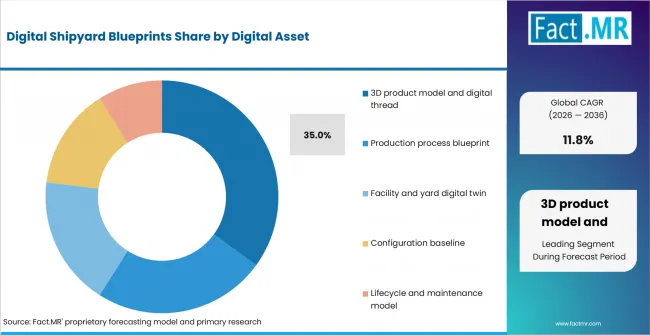
Digital Shipyard Blueprints Analysis By Digital Asset | Source: Fact.MR
The product model is the common reference from which later shipbuilding information is generated. Dassault Systèmes describes a single 3D ship master model that carries asset information from concept through delivery and maintenance, while Siemens positions centralized ship lifecycle data as a backbone connecting design, product management, procurement, and manufacturing.
This breadth changes purchasing behavior. A shipyard can use the same governed geometry and product structure to coordinate disciplines, create production drawings, generate material information, review changes, and support handover. Separate process or facility twins remain valuable, but they depend on reliable product and configuration data to remain aligned with the vessel being built.
Why does Design & engineering lead Shipbuilding Stage?
Design & engineering represents 31.0% of Shipbuilding Stage in 2026.
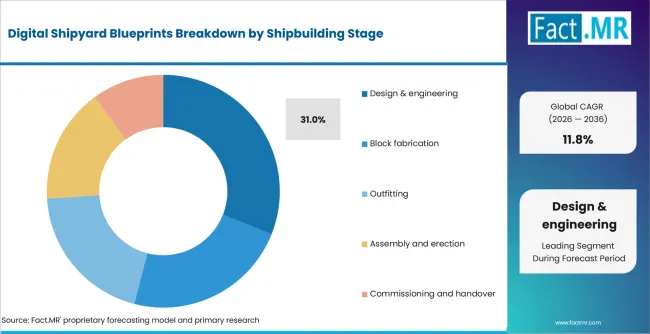
Digital Shipyard Blueprints Analysis By Shipbuilding Stage | Source: Fact.MR
Ship construction begins with a dense engineering definition covering hull structure, piping, electrical systems, outfitting, equipment interfaces, access, weight, and class constraints. AVEVA Hull and Outfitting uses a unified data model across design and production, while Siemens FORAN and NX generate manufacturing and production-planning outputs from detailed ship design models.
Errors found at this stage can be resolved before they reach steel, piping, or assembly work. The same logic supports virtual commissioning where teams test downstream behavior in a model before physical execution. Buyers therefore place blueprint spending early in the lifecycle because later stages consume engineering information created here.
Why does PLM-centric lead Platform Architecture?
PLM-centric holds 34.0% of Platform Architecture in 2026.
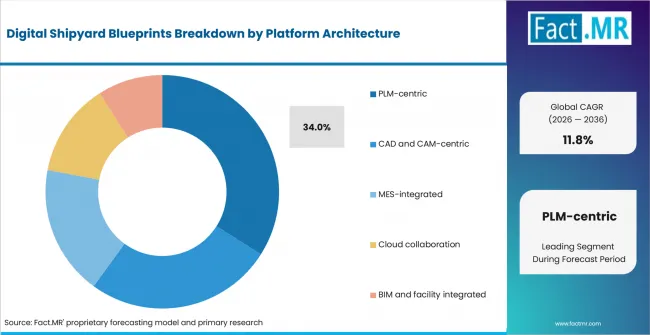
Digital Shipyard Blueprints Analysis By Platform Architecture | Source: Fact.MR
A shipyard has to know which version of a part, drawing, assembly, or system is approved for a particular vessel or hull. SSI ShipbuildingPLM is built around configuration, hull effectivity, approvals, and controlled release of engineering information. Siemens Teamcenter performs a similar governance role around product data, status, and versioning.
This makes PLM the control layer between live engineering work and downstream execution. CAD-centric architectures remain important for geometry, and MES integration is required for production, but buyers still need a governed system of record before a design can be released to procurement or the shop floor. That requirement supports PLM-centric architecture as the current lead configuration.
Why do Naval vessels lead Vessel Type?
Naval vessels account for 27.0% of Vessel Type in 2026.
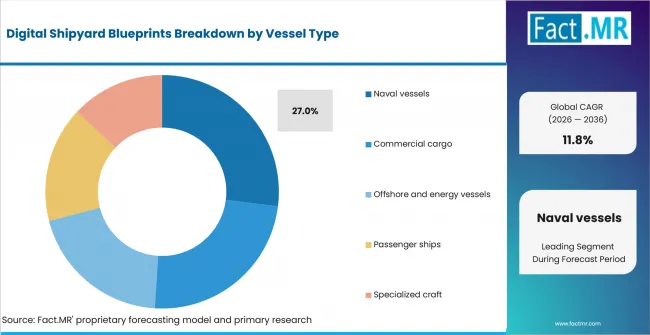
Digital Shipyard Blueprints Analysis By Vessel Type | Source: Fact.MR
Naval programs combine complex systems with controlled baselines and long sustainment periods. The U.S. Navy's 2025 Ship OS investment is intended to aggregate shipbuilding data from enterprise systems and operational sources to identify bottlenecks and improve engineering workflows. SSI likewise treats long program lifecycles and hull effectivity as shipbuilding-specific configuration problems.
The procurement effect is persistent demand for models that remain useful after launch. Naval buyers and prime shipyards need traceability through design changes, equipment substitutions, refits, and maintenance periods. Commercial cargo and offshore vessels also use digital threads, but the configuration and sustainment burden gives naval programs a strong reason to retain richer blueprint data across the asset life.
What is accelerating Digital Shipyard Blueprints Market adoption, and what is holding it back?
Adoption is being accelerated by model-based engineering, shipyard automation, AI-assisted production planning, and the need to maintain one controlled vessel definition across multiple disciplines and sites. Public shipbuilding programs in South Korea, the USA, Japan, Germany, and the UK are also directing investment toward digital engineering, smart manufacturing, data infrastructure, or advanced shipyard technology.
The main constraints are legacy-data migration, integration across CAD/PLM/MES/ERP environments, cybersecurity and intellectual-property controls, and the effort required to keep models synchronized with physical construction. A blueprint loses operational value when production changes are not reflected in the governed digital baseline, so buyers have to fund process change and data ownership alongside software.
Drivers Impact Analysis
| Factor | (~) % Impact on CAGR | Geographic Relevance | Impact Timeline |
|---|---|---|---|
| Model-based design-to-production continuity | +2.1% | South Korea; USA; Japan; Germany; UK | Near term |
| AI and shipyard automation requiring structured data | +1.7% | South Korea; USA; Japan | Near to mid term |
| Configuration control for complex vessel programs | +1.3% | USA; UK; Germany; Japan | Near to mid term |
| Multi-site and supplier collaboration | +0.9% | Global shipbuilding programs | Mid term |
Opportunity Impact Analysis
| Factor | (~) % Impact on CAGR | Geographic Relevance | Impact Timeline |
|---|---|---|---|
| Shipyard and production digital twins linked to MES | +1.4% | South Korea; Germany; Japan | Mid term |
| Cloud collaboration for distributed engineering teams | +1.0% | USA; UK; Europe; East Asia | Near to mid term |
| Lifecycle digital handover and sustainment data | +0.9% | Naval; offshore; specialized vessels | Mid to long term |
| AI simulation and production-sequence optimization | +0.7% | South Korea; USA; Japan | Mid term |
Restraints Impact Analysis
| Factor | (~) % Impact on CAGR | Geographic Relevance | Impact Timeline |
|---|---|---|---|
| Legacy CAD and enterprise-system integration | -1.1% | Established shipyards globally | Near term |
| Implementation and workflow-change burden | -0.9% | Global | Near to mid term |
| Cybersecurity and vessel-data access controls | -0.6% | Naval and multi-partner programs | Near to mid term |
| Model maintenance and as-built synchronization gaps | -0.5% | Global | Mid term |
Which countries are scaling the Digital Shipyard Blueprints Market through 2036?
- South Korea: A June 2026 government shipbuilding initiative called for shared data, knowledge, and AI models across design, production, and quality control in major industrial complexes. This creates demand for common digital structures that can supply AI tools and coordinate work across shipyards and suppliers.
- USA: MARAD's FY2026 Small Shipyard Grant awards include a Digital Engineering Ship Infrastructure System based on ShipConstructor, engineering workstations, mobile devices, and laser scanning. The funding connects digital engineering directly with shipyard inspection and production use.
- Japan: MLIT selected seven DX automation development and demonstration projects in 2025 to reduce labor and production hours in shipbuilding. Several projects combine production data, automation, and digital platforms, increasing the need for production-ready vessel models and process information.
- Germany: The federal Innovative Shipbuilding support framework funds technically new or materially improved products and processes for shipbuilding, repair, and conversion. Digital process innovation gives shipyards a route to modernize design-to-production workflows while competing in specialized vessel programs.
- UK: The UK Maritime Innovation Hub explicitly supports digital twins, interoperable data platforms, advanced analytics, and cybersecure digital architectures across the maritime sector. Shipbuilders can use the same capabilities to connect vessel design, yard execution, and downstream operational data.
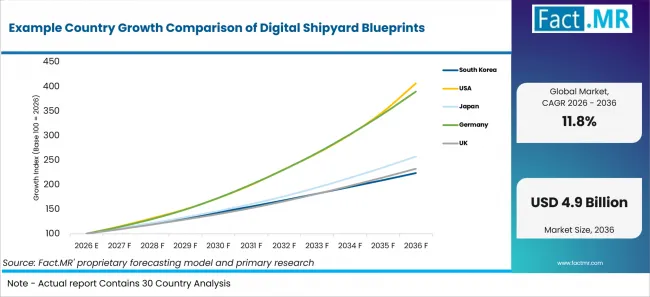
Example Country Growth Comparison Of Digital Shipyard Blueprints | Source: Fact.MR
Country CAGR (2026-2036)
| Country | CAGR (2026-2036) |
|---|---|
| South Korea | 8.4% |
| USA | 15.1% |
| Japan | 9.9% |
| Germany | 14.6% |
| UK | 8.8% |
What is driving South Korea's growth through 2036?
South Korea is forecast to expand at an 8.4% CAGR from 2026 to 2036.
The Ministry of Trade, Industry and Energy's K-Shipbuilding Super Gap Vision 2040 targets automation across design, production, and shipyard management, with a goal of reaching 50% process automation by 2040. It also includes technologies for high-risk work, automated block construction, and a shipyard-contractor joint production platform.
Those systems require a consistent digital definition of the vessel and the work being performed. As major yards connect AI, robotics, scheduling, and supplier platforms, demand shifts toward blueprints that can preserve geometry, product structure, process status, and controlled changes across the construction program.
What is driving USA's growth through 2036?
The USA is forecast to expand at a 15.1% CAGR from 2026 to 2036.
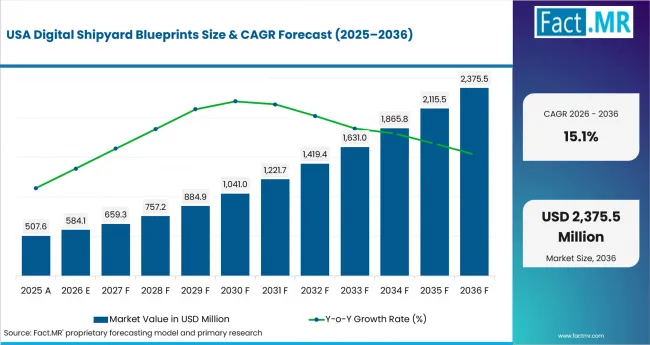
Digital Shipyard Blueprints Country Value Analysis | Source: Fact.MR
The U.S. Navy announced a USD 448 million investment in December 2025 for AI and autonomy tools intended to accelerate shipbuilding. Ship OS is designed to aggregate data from ERP systems, legacy databases, and operational sources so shipbuilders can identify bottlenecks, streamline engineering workflows, and support production decisions.
This creates demand for governed vessel and production models that can supply reliable context to analytics and AI. The requirement also connects with the connected ship lifecycle because structured design and configuration information becomes more useful when it can continue into sustainment, upgrades, and fleet operations.
What is driving Japan's growth through 2036?
Japan is forecast to expand at a 9.9% CAGR from 2026 to 2036.
In July 2026, MLIT launched Japan-U.S. joint research on AI shipbuilding technologies, including AI robotics for plate bending and welding and an AI simulation platform intended to improve the effectiveness of those systems. The program builds on Japan's effort to raise shipbuilding productivity through advanced digital technology.
Simulation and robotic execution increase the value of machine-readable engineering and process data. Shipyards need digital blueprints that connect design geometry with production constraints, fabrication sequence, and updated construction status so automated tools operate on the current vessel definition.
What is driving Germany's growth through 2036?
Germany is forecast to expand at a 14.6% CAGR from 2026 to 2036.
Germany's federal maritime policy treats digitization of the value chain and Industry/Maritime 4.0 as technology priorities, while current innovation support covers new shipbuilding products and processes. German yards are concentrated in specialized and technically complex vessel categories where engineering integration and production coordination have high value.
For these builders, blueprint investment supports multidisciplinary design, supplier coordination, production planning, and controlled change without requiring a yard to replace every existing application simultaneously. Interoperable data models can therefore become a practical modernization layer across specialized shipbuilding programs.
What is driving UK's growth through 2036?
The UK is forecast to expand at an 8.8% CAGR from 2026 to 2036.
The UK government published an agreed digital twin definition in October 2025 and, in 2026, established the UK Maritime Innovation Hub with support for maritime digital twins, data platforms, advanced analytics, and cybersecure digital architectures. This gives maritime organizations a clearer framework for interoperable digital systems rather than isolated project models.
Naval shipbuilding programs also keep digital configuration and production capability commercially relevant. Long-life defense vessels require controlled engineering data across build and sustainment, so shipyards have a direct reason to invest in blueprints that preserve approved configuration, production history, and later change information.
Who Leads the Digital Shipyard Blueprints Market?
Key players in the Digital Shipyard Blueprints Market include Dassault Systèmes, Siemens Digital Industries Software, AVEVA, Hexagon, Cadmatic, and SSI.
Competition centers on digital continuity from design to production, configuration governance, shipbuilding-specific modeling depth, integration with MES and ERP environments, and the ability to preserve vessel information through handover and sustainment. Dassault Systèmes positions 3DEXPERIENCE around a shared ship master model and smart-shipyard execution, while Siemens combines FORAN or NX design with Teamcenter product-data governance and manufacturing integration.
AVEVA competes through Hull and Outfitting, Unified Engineering, Assembly Planning, and marine operations software that connect design, production, and project information. Hexagon combines Smart 3D with production and lifecycle tools for digital shipbuilding. Cadmatic provides shipbuilding CAD, PLM, production information, and eShare digital-twin capabilities. SSI combines ShipConstructor with ShipbuildingPLM to connect 3D design, production outputs, configuration, hull effectivity, and change control.
Which companies are the key providers?
Key providers include Dassault Systèmes, Siemens Digital Industries Software, AVEVA, Hexagon, Cadmatic, and SSI.
- Dassault Systèmes
- Siemens Digital Industries Software
- AVEVA
- Hexagon
- Cadmatic
- SSI
Bibliography
- International Maritime Organization. (2026). Facilitation Committee approves digitalization strategy and cyber security measures. IMO.
- European Commission. (2026). Industrial Maritime Strategy for a competitive, sustainable and resilient EU maritime sector. European Commission.
- Ministry of Trade, Industry and Energy, Republic of Korea. (2024). K-Shipbuilding Super Gap Vision 2040. Government of the Republic of Korea.
- Ministry of Trade, Industry and Resources, Republic of Korea. (2026). M.AX to Link Shipbuilding Industrial Complexes as Key Hubs for 5+3 Regional Growth. Government of the Republic of Korea.
- U.S. Department of the Navy. (2025). Navy Invests USD 448 Million in AI and Autonomy to Accelerate Shipbuilding. U.S. Navy.
- U.S. Maritime Administration. (2026). FY 2026 Small Shipyard Grant Awardees. U.S. Department of Transportation.
- Ministry of Land, Infrastructure, Transport and Tourism, Japan. (2026). Japan-U.S. Joint R&D on AI Shipbuilding Technologies Launches. Government of Japan.
- Ministry of Land, Infrastructure, Transport and Tourism, Japan. (2025). Development and Demonstration Projects for DX Automation Technologies in the Ship Industry. Government of Japan.
- Federal Ministry for Economic Affairs and Climate Action, Germany. (2025). Innovative Shipbuilding Secures Competitive Jobs. Federal Government of Germany.
- Federal Ministry for Economic Affairs and Climate Action, Germany. (2025). Maritime Industry: Digitisation of the Value Chain and Maritime 4.0. Federal Government of Germany.
- UK Maritime Innovation Hub. (2026). Digital systems and digitalisation technologies. UK Government.
- Defence Science and Technology Laboratory. (2025). Digital Twin - Official Definition. UK Government.
- Dassault Systèmes. (2022). Digital Shipyard. Dassault Systèmes.
- Dassault Systèmes. (2024). Model-Based Approach for Smart Shipyards. Dassault Systèmes.
- Siemens Digital Industries Software. (2026). Ship Lifecycle Management. Siemens.
- Siemens Digital Industries Software. (2026). Ship Design CAD for Marine Industry with FORAN. Siemens.
- AVEVA. (2026). Synchronizing Marine Design and Production. AVEVA.
- AVEVA. (2026). Hull and Outfitting for Shipbuilding. AVEVA.
- Hexagon. (2026). Transforming Shipbuilding with Hexagon Solutions. Hexagon Asset Lifecycle Intelligence.
- Cadmatic. (2026). Shipbuilding Design Software and Digital Platform. Cadmatic.
- SSI. (2026). ShipConstructor 2027 and ShipbuildingPLM 4.0 Solution Update. SSI.
- SSI. (2026). ShipbuildingPLM: Product Lifecycle Management Built for Shipbuilding. SSI.
This Report Answers
- How the market progresses from USD 1.6 billion in 2026 to USD 4.9 billion by 2036.
- Why 3D product model and digital thread accounts for 35.0% of Digital Asset in 2026.
- Why Design & engineering represents 31.0% of Shipbuilding Stage and how early engineering data flows into production.
- Why PLM-centric architecture holds 34.0% and how configuration governance affects downstream execution.
- Why Naval vessels account for 27.0% of Vessel Type and how lifecycle configuration supports sustainment.
- How South Korea, USA, Japan, Germany, and UK develop through 2036.
- Which current software providers support digital vessel, shipyard, production, and lifecycle information workflows.
What does the Digital Shipyard Blueprints Market cover?
The Digital Shipyard Blueprints Market covers commercial software, platform modules, and associated implementation or configuration services used to create, govern, connect, and maintain digital vessel or shipyard information across the defined assets, shipbuilding stages, platform architectures, and vessel types. Revenue is counted when the offering supports a persistent digital definition used by engineering, planning, production, configuration, handover, or lifecycle teams.
The market includes 3D product and digital-thread environments, production process blueprints, facility and yard digital twins, configuration baselines, and lifecycle models when these are deployed as part of the shipbuilding information environment. The market boundary excludes generic CAD, enterprise software, and industrial automation when they are sold independently of a shipbuilding blueprint environment.
What is included in the scope?
Included Digital Assets are 3D product model and digital thread, Production process blueprint, Facility and yard digital twin, Configuration baseline, and Lifecycle and maintenance model. Shipbuilding Stage coverage includes Design & engineering, Block fabrication, Outfitting, Assembly and erection, and Commissioning and handover.
Platform Architecture coverage includes PLM-centric, CAD and CAM-centric, MES-integrated, Cloud collaboration, and BIM and facility integrated. Vessel Type coverage includes Naval vessels, Commercial cargo, Offshore and energy vessels, Passenger ships, and Specialized craft.
What is excluded from the scope?
Standalone generic CAD seats are excluded when they are used only for drafting without shipbuilding digital-thread, production, configuration, or lifecycle functions. ERP, MES, document management, cloud storage, cybersecurity, scanning hardware, robots, CNC machinery, and yard equipment are excluded when sold independently from the blueprint environment.
Connected-vessel operational software, fleet analytics, navigation systems, and maintenance applications are treated as adjacent markets unless their revenue forms part of the defined lifecycle blueprint or digital handover layer. Physical shipyard construction and conventional engineering services without a digital blueprint deliverable are also outside the market.
How Was the Analysis Built?
- Primary Research: Interviews with naval architects, shipyard engineering managers, PLM and CAD administrators, production planners, digital-transformation teams, fabrication managers, class and compliance specialists, naval program teams, system integrators, and software suppliers examine buying triggers, implementation scope, data governance, interoperability, and release-to-production workflows.
- Desk Research: The review covers national shipbuilding programs, maritime digitalization policy, digital-engineering initiatives, smart-shipyard funding, current shipbuilding software portfolios, product lifecycle management practices, digital-twin definitions, and public examples of design-to-production integration.
- Market Sizing and Forecasting: The analysis combines shipbuilding software and implementation spending with vessel-program intensity, shipyard digitalization, platform architecture, engineering-to-production integration, vessel complexity, lifecycle data requirements, and country adoption. The model separates blueprint revenue from generic enterprise software and independent production hardware.
- Data Validation and Update Cycle: Assumptions are checked against public shipbuilding investment, government technology roadmaps, active supplier portfolios, software releases, and evidence of digital engineering use in shipyards. Updates account for automation programs, naval and commercial build activity, platform integration, and changes in current software offerings.
What is the report's scope and coverage?
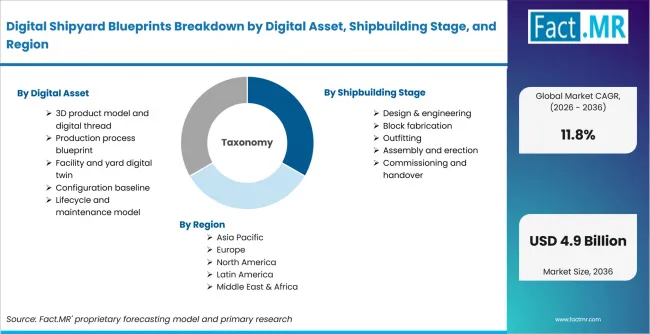
Digital Shipyard Blueprints Breakdown By Digital Asset, Shipbuilding Stage, And Region | Source: Fact.MR
| Attribute | Details |
|---|---|
| Quantitative Units | USD billion; CAGR and percentage share |
| Market Definition | Commercial digital vessel and shipyard blueprint environments that govern and connect product, process, configuration, facility, and lifecycle information across shipbuilding |
| Segments | Digital Asset; Shipbuilding Stage; Platform Architecture; Vessel Type |
| Countries | South Korea; USA; Japan; Germany; UK |
| Key Companies | Dassault Systèmes; Siemens Digital Industries Software; AVEVA; Hexagon; Cadmatic; SSI |
| Forecast Period | 2026 to 2036 |
| Base Year | 2026 |
| Market Value, 2026 | USD 1.6 billion |
| Market Value, 2036 | USD 4.9 billion |
| CAGR, 2026-2036 | 11.8% |
| Absolute Opportunity | USD 3.3 billion |
| Approach | Demand-side and software-platform analysis using shipbuilding program intensity, digital engineering adoption, architecture mix, vessel complexity, production integration, lifecycle requirements, and country growth |
How is the market segmented?
-
By Digital Asset
- 3D product model and digital thread
- Production process blueprint
- Facility and yard digital twin
- Configuration baseline
- Lifecycle and maintenance model
-
By Shipbuilding Stage
- Design & engineering
- Block fabrication
- Outfitting
- Assembly and erection
- Commissioning and handover
-
By Platform Architecture
- PLM-centric
- CAD and CAM-centric
- MES-integrated
- Cloud collaboration
- BIM and facility integrated
-
By Vessel Type
- Naval vessels
- Commercial cargo
- Offshore and energy vessels
- Passenger ships
- Specialized craft