- Market Value (2025): USD 7.9 Bn
- Estimated Value (2026): USD 8.7 Bn
- Forecast Value (2036): USD 22.8 Bn
- CAGR (2026-2036): 10.1%
What is the Digital Workplace in Legal and Professional Services Market forecast to be worth by 2036?
USD 8.7 billion in 2026 to USD 22.8 billion by 2036 at 10.1% CAGR.
- The digital workplace in legal and professional services market crossed a valuation of USD 7.9 billion in 2025.
- Demand is projected to increase from USD 8.7 billion in 2026 to USD 22.8 billion by 2036.
- The market is forecast to record 10.1% CAGR from 2026 to 2036.
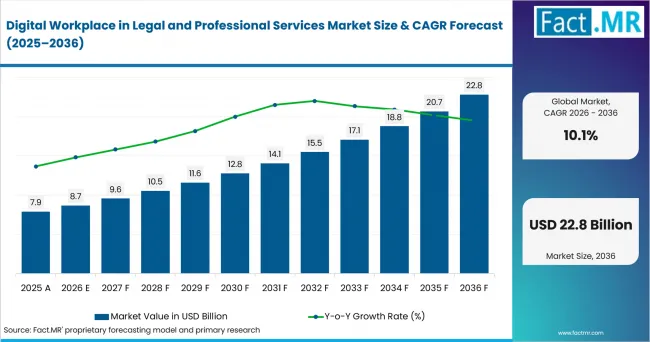
Digital Workplace In Legal And Professional Services Market Value Analysis | Source: Fact.MR
What are the defining numbers behind Digital Workplace in Legal and Professional Services Market growth?
USD 14.2 billion absolute opportunity by 2036 is led by legal collaboration platform and document & case management.
- Demand Drivers in the Market
- Legal teams need shared workspaces that keep matter files and client communication under control during hybrid work.
- Professional services firms are expected to invest in secure collaboration tools when delivery teams work across offices and external advisers.
- Cloud-based access is anticipated to support adoption where firms need faster rollout with permission controls and audit trails.
- Key Segments Analyzed
- By Workplace Solution: Legal Collaboration Platform is expected to hold 37.0% share in 2026 because matter teams need one controlled space for files and discussion.
- By Business Function: Document & Case Management is projected to account for 41.0% share in 2026 as firms rely on structured records and case workflows.
- By End-use Organization: Law Firms are anticipated to capture 43.0% share in 2026 due to their direct need for secure client workspaces.
- By User Category: Legal Professionals are estimated to represent 40.0% share in 2026 because lawyers and paralegals remain the main daily users.
- By Deployment Model: Cloud-based Digital Workplace is forecast to hold 39.0% share in 2026 as subscription platforms shorten implementation cycles.
- Analyst Opinion at Fact.MR
- Shambhu Nath Jha, Principal Consultant at Fact.MR, states, “Digital workplace providers serving legal and professional services firms must prove use-case fit without relying on broad platform claims. Repeat demand is expected to depend on secure collaboration and workflow continuity.”
- Strategic Implications
- Platform owners should position products around matter collaboration and document governance. Broad productivity language does not explain the legal use case.
- Suppliers can strengthen retention by making permissions and audit trails easy for legal operations teams to review. Compliance documentation should be easy to check.
- Pricing strategy should reflect documented workflow value. Buyers are expected to compare measurable outcomes against lower-cost collaboration alternatives.
The USA leads at 11.2% CAGR through deeper platform use and stronger vendor coverage. The UK follows at 10.7%. Germany reaches 10.2%. Canada posts 9.8%. Australia records 9.3%. Japan is estimated at 8.9%. Singapore reaches 8.4%.
How does the Digital Workplace in Legal and Professional Services Market break down by segment?
Legal Collaboration Platform is expected to lead Workplace Solution at 37.0% share in 2026. Document & Case Management is projected to lead Business Function with 41.0% share in 2026.
Which workplace solution dominates?
Legal collaboration platform is projected to account for 37.0% share in 2026.
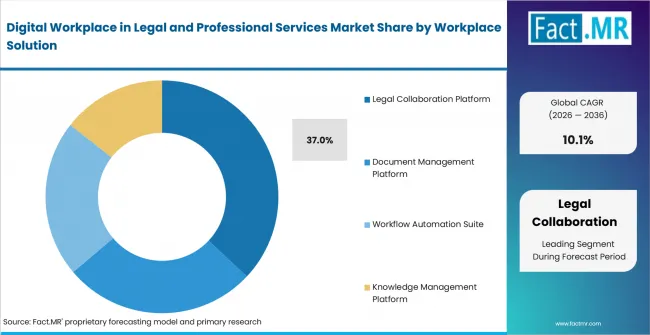
Digital Workplace In Legal And Professional Services Market Analysis By Workplace Solution | Source: Fact.MR
Its lead comes from the need to keep matter files, discussions and client communication inside one controlled workspace. Workflow automation and knowledge-management tools remain relevant where firms focus more heavily on process routing or reusable legal expertise.
What leads the business function segment?
Document and case management is expected to hold 41.0% share in 2026.
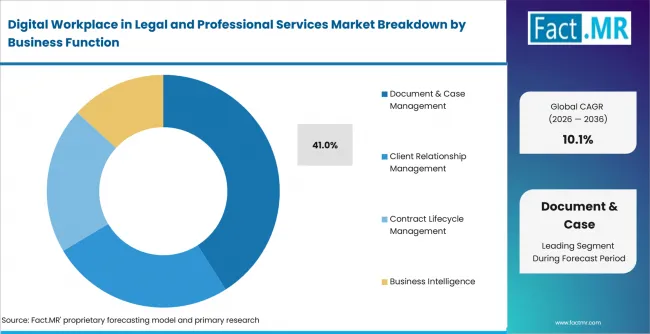
Digital Workplace In Legal And Professional Services Market Analysis By Business Function | Source: Fact.MR
Accurate records and version control sit at the center of legal work. Searchable case histories help teams review evidence, track updates and protect client information. Document imaging adds value when paper records are converted into digital case workflows.
Why do law firms lead end-use organization?
Law firms are anticipated to account for 43.0% share in 2026.
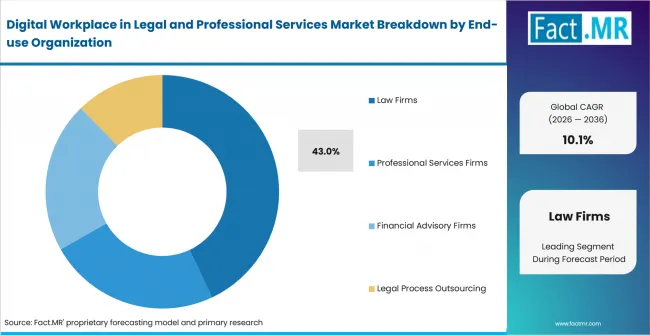
Digital Workplace In Legal And Professional Services Market Analysis By End Use Organization | Source: Fact.MR
Confidential matters require controlled access across lawyers, support teams and clients. This operating model creates steady demand for secure collaboration and document handling. Professional services firms add a separate demand base where advisory teams manage sensitive project information.
How do legal professionals shape demand?
Legal professionals are estimated to represent 40.0% share in 2026.
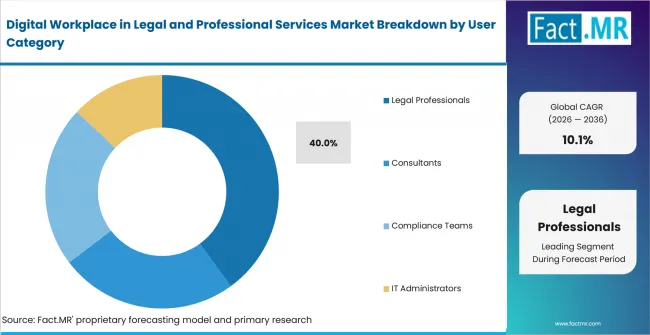
Digital Workplace In Legal And Professional Services Market Analysis By User Category | Source: Fact.MR
Daily use of document review, matter communication and research tools gives this group the strongest influence on platform demand. Consultants and compliance teams extend adoption through client engagements. IT administrators shape final selection by reviewing identity controls, mobile access and device management.
What supports cloud-based digital workplace adoption?
Cloud-based digital workplace is forecast to hold 39.0% share in 2026.
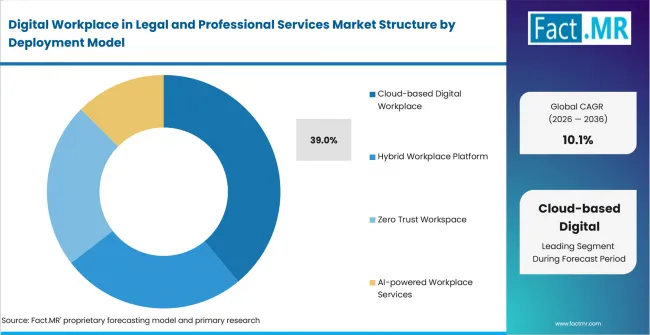
Digital Workplace In Legal And Professional Services Market Analysis By Deployment Model | Source: Fact.MR
Firms favor cloud delivery when they want faster rollout across offices and remote teams. Subscription access simplifies updates and software distribution. Zero-trust workspace models remain important where buyers require tighter authentication, restricted file access and stronger control over sensitive legal data.
What is accelerating Digital Workplace in Legal and Professional Services Market adoption, and what is holding it back?
Demand is expected to rise through secure collaboration needs and cloud migration. Better workflow visibility is expected to support adoption. Growth is expected to be limited by implementation cost and compliance review time.
Drivers Impact Analysis
| DRIVER | (~) % IMPACT ON CAGR | GEOGRAPHIC RELEVANCE | IMPACT TIMELINE |
|---|---|---|---|
| Adoption and integration | +1.6% | Global | Short term (<= 2 years) |
| Regulatory and compliance support | +1.4% | USA, Germany, UK | Short term (<= 2 years) |
| Channel and access expansion | +1.1% | Global | Medium term (2-4 years) |
| Clear specification and documentation | +0.9% | USA, UK, Canada | Medium term (2-4 years) |
| Cost and efficiency gains | +0.6% | Global | Long term (>= 4 years) |
Source: Fact.MR analysis. Updated Aug 6, 2026
- Adoption and integration: Legal teams are expected to favor platforms that connect matter files with communication and workflow tools.
- Regulatory and compliance support: Permission controls and audit trails are expected to raise demand where clients ask firms to document information governance.
- Clear specification and documentation: Suppliers that explain security scope and deployment steps are expected to reduce buyer hesitation during procurement reviews.
Opportunity Impact Analysis
| OPPORTUNITY | (~) % IMPACT ON CAGR | GEOGRAPHIC RELEVANCE | IMPACT TIMELINE |
|---|---|---|---|
| Emerging application expansion | +1.0% | Global | Medium term (2-4 years) |
| Premium and specialist positioning | +0.8% | USA, UK, Germany | Medium term (2-4 years) |
| Channel and partner expansion | +0.7% | Global | Long term (>= 4 years) |
| Standards and compliance alignment | +0.5% | USA, Canada, Singapore | Long term (>= 4 years) |
Source: Fact.MR analysis. Updated Aug 6, 2026
- Emerging application expansion: Firms are expected to extend digital workplace use into client portals and contract review workflows.
- Data catalog controls are expected to help approved users find trusted materials during governed client work.
- Premium and specialist positioning: Providers that understand legal operations are expected to gain preference when generic collaboration tools require heavy configuration.
- Channel and partner expansion: Implementation partners are expected to create openings for business process support across onboarding and migration.
Restraints Impact Analysis
| RESTRAINT | (~) % IMPACT ON CAGR | GEOGRAPHIC RELEVANCE | IMPACT TIMELINE |
|---|---|---|---|
| Cost and complexity | -1.1% | Global | Short term (<= 2 years) |
| Specification and compliance checks | -0.9% | USA, UK, Germany | Short term (<= 2 years) |
| Substitution by lower-cost alternatives | -0.7% | Import-dependent markets | Medium term (2-4 years) |
| Supply chain and pricing pressure | -0.5% | Global | Long term (>= 4 years) |
Source: Fact.MR analysis. Updated Aug 6, 2026
- Cost and complexity: Platform migration can slow purchasing when firms must train users before launch.
- Specification and compliance checks: Client confidentiality rules are expected to lengthen review cycles when security teams require proof before firmwide deployment.
- Lower-cost alternatives: Basic collaboration suites are expected to restrain premium tools when firms accept simpler features to control subscription spending.
Which countries are scaling Digital Workplace in Legal and Professional Services Market fastest?
- The country comparison spans 2.8 percentage points and forms three practical growth bands across the forecast period.
- The USA remains 0.5 percentage point above the UK through deeper platform use and stronger provider coverage.
- The UK remains 0.5 percentage point above Germany as professional services firms formalize hybrid work patterns.
- Germany remains 0.4 percentage point above Canada due to compliance-led demand and structured procurement needs.
- Canada remains 0.5 percentage point above Australia through stronger cross-border service delivery requirements.
- Australia remains 0.4 percentage point above Japan as cloud-first workplace adoption supports service-firm modernization.
- Japan remains 0.5 percentage point above Singapore because larger domestic firm networks support more gradual platform expansion.
Comparable CAGRs can create different entry conditions because client confidentiality and integration depth differ by country. Full report coverage includes North America and Latin America. Europe and East Asia are included. South Asia and Pacific and the Middle East and Africa complete the regional view.
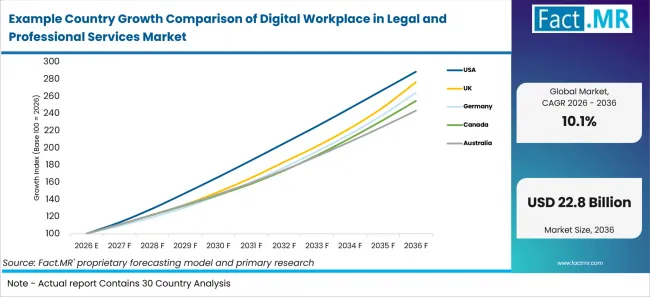
Example Country Growth Comparison Of Digital Workplace In Legal And Professional Services Market | Source: Fact.MR
| Country | CAGR (2026-2036) |
|---|---|
| USA | 11.2% |
| UK | 10.7% |
| Germany | 10.2% |
| Canada | 9.8% |
| Australia | 9.3% |
| Japan | 8.9% |
| Singapore | 8.4% |
Source: Fact.MR analysis. Updated Aug 6, 2026
What supports USA adoption?
11.2% CAGR, supported by deeper platform use and stronger provider coverage.
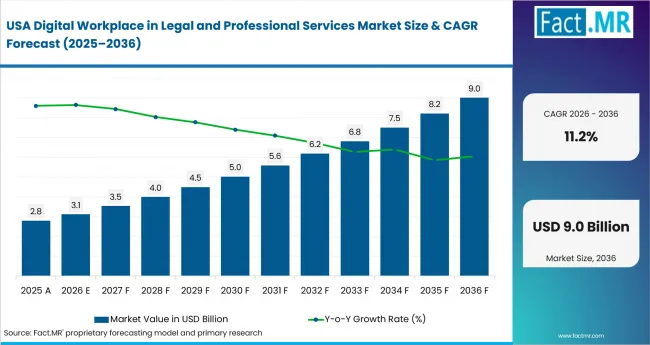
Digital Workplace In Legal And Professional Services Market Country Value Analysis | Source: Fact.MR
The USA’s growth reflects a large legal and professional services base. Firms manage complex client work across offices and remote teams. Buyers are expected to favor platforms that combine collaboration with document governance and secure access.
How is the UK scaling demand?
10.7% CAGR, backed by hybrid work normalization and service-firm modernization.
Law firms and advisory practices in the UK need structured collaboration across client teams. Procurement is expected to remain careful because data protection and client confidentiality shape platform approval.
What is driving Germany’s growth from 2026 to 2036?
10.2% CAGR, supported by compliance-led adoption and structured procurement needs.
Germany’s growth reflects a market where firms review platform security before rollout. Suppliers are expected to prove how access controls and workflow records support governance.
How is Canada developing demand?
9.8% CAGR, driven by cross-border service delivery and cloud workplace expansion.
Canada’s professional teams often coordinate with clients and partner firms across provinces. Digital workplaces are expected to reduce reliance on scattered email chains during cross-border service delivery.
How does Australia perform?
9.3% CAGR, led by cloud-first workplace adoption and professional services modernization.
Australian law firms and advisory businesses need secure access across offices and client engagements. Adoption is expected to depend on permissions and data residency expectations.
What supports Japan’s growth?
8.9% CAGR, backed by gradual platform expansion and knowledge workflow improvement.
Japan’s growth reflects demand from firms that are modernizing document handling at a measured pace. Buyers are expected to value stability and vendor support during rollout.
What supports Singapore’s growth?
8.4% CAGR, supported by regional professional services demand and secure collaboration needs.
Singapore’s growth reflects its role as a regional hub for legal and advisory activity. Firms are expected to coordinate cross-border matters through secure platforms with regional service support.
Who leads the Digital Workplace in Legal and Professional Services Market?
Microsoft Corporation and Google LLC – Google Workspace show the clearest horizontal platform relevance. Oracle Corporation and OpenText Corporation strengthen the enterprise content and business system layer.
Microsoft Corporation supports collaboration and governance requirements across large firms. Google LLC – Google Workspace brings cloud collaboration for distributed teams. Oracle Corporation and OpenText Corporation add enterprise integration and content services. IBM and Cisco extend the field through security and endpoint capabilities. ServiceNow and Salesforce add workflow depth. Atlassian and VMware add service management depth.
Which companies are the key providers?
Key companies include Microsoft Corporation, Google LLC – Google Workspace, Oracle Corporation, OpenText Corporation, International Business Machines Corporation, Cisco Systems, Inc., ServiceNow, Inc., Salesforce, Inc., Atlassian Corporation plc, and Omnissa, LLC.
- Microsoft Corporation
- Google LLC – Google Workspace
- Oracle Corporation
- OpenText Corporation
- International Business Machines Corporation
- Cisco Systems, Inc.
- ServiceNow, Inc.
- Salesforce, Inc.
- Atlassian Corporation plc
- Omnissa, LLC
Bibliography
- American Bar Association. (2025, March). ABA releases new survey on legal technology trends.
- UK Intellectual Property Office. (2025, July). Trade Mark Journal No. 2025/030: ASKELIE—Cloud software for legal, compliance, and contract-management workflows.
- Microsoft Corporation. (2025, April 28). Technology and talent: How Copilot helps Mike Morse Law Firm keep its competitive edge.
This Report Answers
- The report provides strategic intelligence on the Digital Workplace in Legal and Professional Services Market across workplace solution and business function choices.
- Segment analysis covers Legal Collaboration Platform and the Document & Case Management function as the share leaders within the 2026 market.
- Country outlook evaluates the USA and the UK alongside Germany and Canada. Australia and Japan are included. Singapore completes the growth comparison.
- Competitive analysis profiles Microsoft Corporation and Google LLC – Google Workspace alongside Oracle Corporation and OpenText Corporation. IBM and Cisco are included. ServiceNow and Salesforce are included. Atlassian and VMware complete the provider set.
- Deployment assessment covers Cloud-based Digital Workplace and Hybrid Workplace Platform alongside Zero Trust Workspace and AI-powered Workplace Services.
What does the Digital Workplace in Legal and Professional Services Market cover?
Digital workplace systems are used by legal and professional services firms to coordinate secure work and client communication. They support document access and internal knowledge sharing.
The Digital Workplace in Legal and Professional Services Market covers platforms used for legal collaboration and document management. Workflow automation and knowledge management are included when they support the covered use cases. Coverage extends to secure workspaces for lawyers and consultants. Compliance teams and IT administrators are included.
What is included in the scope?
Digital workplace systems are assessed across law firms and professional services firms. Financial advisory firms and legal process outsourcing organizations are included.
The scope includes Workplace Solution and Business Function. End-use Organization and User Category are included. Deployment Model and Region complete the segmentation view.
What is excluded from the scope?
General enterprise software that is not configured for legal or professional services workflows remains outside the scope of this market.
The scope excludes unrelated consumer collaboration apps and basic email services. General hardware is excluded. Standalone cybersecurity products are excluded unless they are sold as part of a workplace deployment model.
How Was the Analysis Built?
The analysis draws on 120+ sources, 35+ company portfolios, 25+ countries, and more than 20 industry interviews.
- Primary Research: Primary research includes discussions with manufacturers, service providers, technology developers, distributors, end users, procurement teams, and subject-matter experts. These conversations examine purchasing priorities, product adoption, operational challenges, approval requirements, competitive positioning, and the factors that influence wider market acceptance.
- Desk Research: Desk research covers government statistics, regulatory publications, company filings, trade data, technical studies, industry associations, standards, public policy, and other authoritative sources. Every source used in the analysis is documented in the bibliography.
- Market Sizing and Forecasting: Market estimates combine historical performance, demand indicators, pricing and volume trends, segment shares, company participation, country-level growth, adoption patterns, investment activity, and barriers to market expansion.
- Data Validation and Update Cycle: Findings are validated by comparing primary interviews with public data, company activity, regulatory changes, trade patterns, and industry developments. Regular updates review new product launches, capacity changes, partnerships, approvals, procurement trends, and shifts in commercial adoption.
Segmentation
What is the report’s scope and coverage?
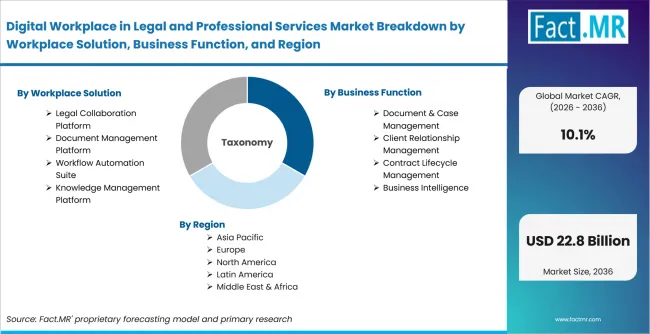
Digital Workplace In Legal And Professional Services Market Breakdown By Workplace Solution, Business Function, And Region | Source: Fact.MR
| Attribute | Details |
|---|---|
| Quantitative Units | USD billion in 2026 to USD billion by 2036 at CAGR |
| Market Definition | Digital workplace systems used by legal and professional services firms for secure collaboration, document control, workflow visibility, and remote access |
| Workplace Solution | Legal Collaboration Platform; Document Management Platform; Workflow Automation Suite; Knowledge Management Platform |
| Business Function | Document & Case Management; Client Relationship Management; Contract Lifecycle Management; Business Intelligence |
| End-use Organization | Law Firms; Professional Services Firms; Financial Advisory Firms; Legal Process Outsourcing |
| User Category | Legal Professionals; Consultants; Compliance Teams; IT Administrators |
| Deployment Model | Cloud-based Digital Workplace; Hybrid Workplace Platform; Zero Trust Workspace; AI-powered Workplace Services |
| Regions Covered | North America; Latin America; Europe; East Asia; South Asia and Pacific; Middle East and Africa |
| Countries Covered | USA; UK; Germany; Canada; Australia; Japan; Singapore |
| Key Companies Profiled | Microsoft Corporation; Google LLC – Google Workspace; Oracle Corporation; OpenText Corporation; International Business Machines Corporation; Cisco Systems, Inc.; ServiceNow, Inc.; Salesforce, Inc.; Atlassian Corporation plc; Omnissa, LLC |
| Forecast Period | 2026 to 2036 |
| Approach | Hybrid top-down and bottom-up approach using segment demand; share; country growth; channel visibility; pricing; and company portfolio review |
Source: Fact.MR analysis. Updated Aug 6, 2026
How is the market segmented?
-
By Workplace Solution
- Legal Collaboration Platform
- Secure Team Collaboration
- Virtual Meeting Workspace
- Document Management Platform
- Digital File Repository
- Record Archiving
- Workflow Automation Suite
- Document Approval Workflow
- e-Signature Workflow
- Knowledge Management Platform
- Internal Knowledge Base
- Searchable Knowledge Library
- Legal Collaboration Platform
-
By Business Function
- Document & Case Management
- Case Documentation
- Legal Research
- Client Relationship Management
- Client Engagement
- Project Collaboration
- Contract Lifecycle Management
- Contract Drafting
- Contract Review
- Business Intelligence
- Dashboard & Reporting
- Performance Analytics
- Document & Case Management
-
By End-use Organization
- Law Firms
- Corporate Legal Departments
- In-house Legal Teams
- Professional Services Firms
- Accounting Firms
- Management Consulting Firms
- Financial Advisory Firms
- Investment Advisory Firms
- Tax & Audit Firms
- Legal Process Outsourcing
- Legal Support Providers
- Compliance Service Providers
- Law Firms
-
By User Category
- Legal Professionals
- Attorneys
- Paralegals
- Consultants
- Auditors
- Advisory Professionals
- Compliance Teams
- Risk Managers
- Operations Teams
- IT Administrators
- System Administrators
- Business Analysts
- Legal Professionals
-
By Deployment Model
- Cloud-based Digital Workplace
- Multi-tenant Cloud
- Hybrid Cloud
- Hybrid Workplace Platform
- Private Cloud
- Secure Virtual Desktop
- Zero Trust Workspace
- Identity-based Access
- Access Control Framework
- AI-powered Workplace Services
- AI Document Assistance
- Intelligent Workflow Automation
- Cloud-based Digital Workplace
-
By Region
- North America
- Latin America
- Western Europe
- Eastern Europe
- East Asia
- South Asia and Pacific
- Middle East & Africa
Frequently Asked Questions
How big is the digital workplace in legal and professional services market in 2026?
What is the CAGR of the digital workplace in legal and professional services market from 2026 to 2036?
Which workplace solution leads the digital workplace in legal and professional services market?
Which business function leads the digital workplace in legal and professional services market?
Who are the leading companies in the digital workplace in legal and professional services market?
Who worked on this report


Preview the report firsthand - request a free sample
Free SampleGet the brochure for pricing and purchase details
Download PDF