- Base Value(2026): 1.7 Bn
- Estimated Value(2026): 1.7 Bn
- Forecast Value (2036): 3.4 Bn
- CAGR (2026 - 2036): 7.3%
Hygiene Station Market Forecast Outlook 2026 to 2036
The hygiene station market is likely to be valued at USD 1.7 billion in 2026 and is projected to reach USD 3.4 billion by 2036, expanding at a 7.3% compound annual growth rate (CAGR).
Key Takeaways from Hygiene Station Market
- Hygiene Station Market Value (2026): USD 1.7 billion
- Hygiene Station Market Forecast Value (2036): USD 3.4 billion
- Hygiene Station Market Forecast CAGR (2026-2036): 7.3%
- Leading Segment in Hygiene Station Market: Facility Hygiene Distributors Sales Channel (49%)
- Key Growth Region in Hygiene Station Market: Asia Pacific
- Key Players in Hygiene Station Market: Ecolab Inc., Diversey, Inc., Getinge AB, Sani-Matic Ltd., Nilfisk A/S, Kärcher SE & Co. KG (Kärcher), Meritech, LLC, Kersia Group, Rubbermaid Commercial Products LLC
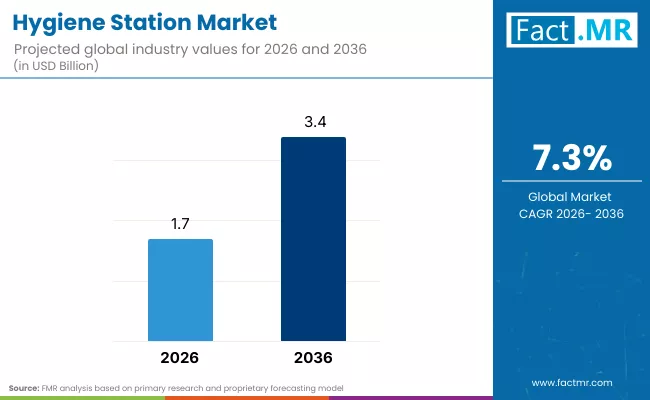
Hygiene Station Market Industry | Source: Fact.MR
Within the industrial ecosystem, these systems function as the primary physical gatekeepers for Contamination Control Strategy (CCS), transitioning from simple hardware to critical nodes of digital auditability. Strategic importance is anchored in their role as mandatory control points where personnel behavior is synchronized with mechanical compliance, ensuring that human-borne pathogens are intercepted before entering "high-care" zones.
Dependency factors have intensified as global food and pharma regulators, such as under EU GMP Annex 1, now mandate 100% adherence to sanitation protocols, making hygiene stations the bedrock of liability mitigation. Operational outcomes are shaped by a strategic trade-off between throughput velocity and the rigor of sterilization cycles. Consequently, the market is evolving toward integrated IoT "sluices" that provide real-time data for compliance reporting, effectively transforming a sanitation requirement into a high-value insurance asset for brand protection.
Hygiene Station Market
| Metric | Value |
|---|---|
| Estimated Value in (2026E) | USD 1.7 billion |
| Forecast Value in (2036F) | USD 3.4 billion |
| Forecast CAGR (2026 to 2036) | 7.3% |
Source: Fact.MR analysis. Updated Feb 3, 2026
Category
| Category | Sub-Segment |
|---|---|
| By Station Type | Handwash + Sanitizer Stations; Boot Washers & Sole Cleaners; Gowning & PPE Stations; Other |
| By End Use | Food Processing; Pharma & Biotech; Hospitals; Other |
| By Installation | Wall-Mounted; Floor Standing; Portable; Other |
| By Sales Channel | Facility Hygiene Distributors; Direct OEM Sales; Cleanroom Integrators; Other |
| Region | North America; Europe; Asia Pacific; Latin America; Middle East & Africa |
Source: Fact.MR analysis. Updated Feb 3, 2026
Segmental Analysis
What is Driving the Dominance of Handwash + Sanitizer Stations in the Hygiene Station Market?
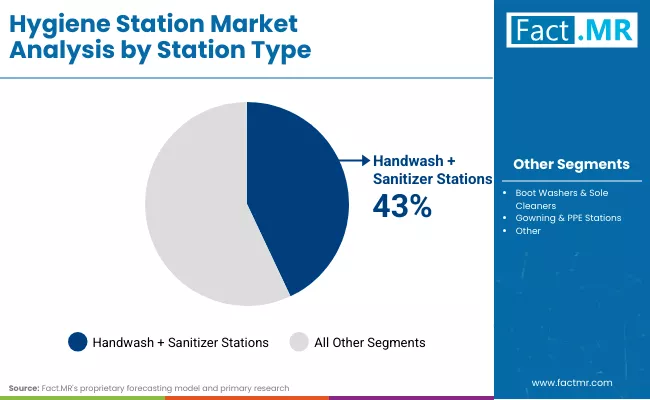
Hygiene Station Market Station Type | Source: Fact.MR
Handwash + Sanitizer Stations lead the hygiene station market with 43% of the market share in 2026. These stations are widely used across various industries to ensure hygiene standards are met, offering both handwashing and hand sanitizing solutions in a single unit. The dual functionality of these stations makes them highly efficient in promoting proper hygiene practices, particularly in high-traffic areas like healthcare facilities, offices, and public spaces, where contamination prevention is crucial.
What is the Role of Facility Hygiene Distributors in the Hygiene Station Market?
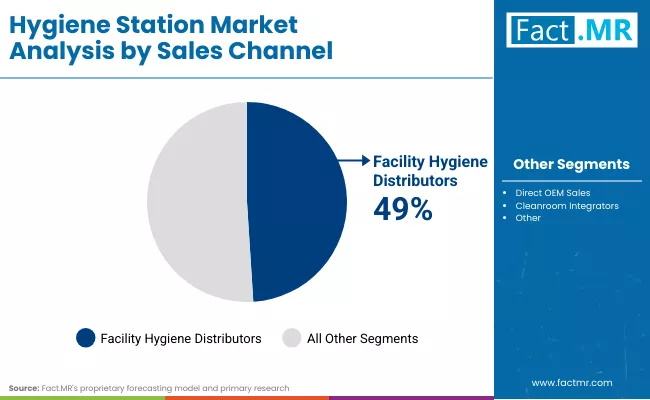
Hygiene Station Market Sales Channel | Source: Fact.MR
Facility Hygiene Distributors account for 49% of the sales channel in the hygiene station market. This dominance is due to their specialized role in providing hygiene products and solutions to large-scale facilities, including healthcare, commercial, and industrial sectors. These distributors have established supply chains and relationships with facility managers, making them key players in ensuring the availability and proper deployment of hygiene stations in various environments.
Hygiene Station Market — Drivers, Restraints & Trends
| Country | Drivers | Restraints | Trends |
|---|---|---|---|
| USA | Strong emphasis on public health, workplace standards, and institutional hygiene spurs demand for touchless hygiene stations in offices, schools, and healthcare facilities. | Higher unit and maintenance costs can limit deploy-and-maintain capacity in smaller organizations. | Shift toward automated, sensor-based dispensers and real-time usage tracking. |
| China | Government sanitation campaigns, industrial hygiene protocols, and public health events boost adoption in public spaces and factories. | Cost sensitivity in small-scale enterprises may slow uptake of advanced hygiene units. | Growing localized production and smart hygiene solutions tied to facility management systems. |
| India | Growing awareness in healthcare, food processing, and institutional settings drives demand, especially post-pandemic hygiene emphasis. | Limited budget for premium hygiene equipment in smaller facilities; inconsistent enforcement of hygiene norms. | Expansion in educational institutions and retail environments with automated units. |
| Germany | Strict workplace safety and industrial hygiene standards require comprehensive hygiene solutions in factories, labs, and public facilities. | Higher regulatory compliance and certification scope add cost to deployment. | Advanced designs with integrated sanitization, drying, and waste management features. |
| Japan | High public health awareness and strong standards in healthcare and manufacturing sustain demand. | Declining population and slower facility expansion may moderate volume growth. | Compact, multi-function hygiene stations tailored for high-density urban environments. |
| South Korea | Fast adoption of public hygiene technologies following widespread health campaigns, with strong corporate hygiene programs. | Price competition among multiple local suppliers can constrain margins. | Integration with IoT and facility management platforms for usage monitoring. |
| Mexico | Rising hygiene awareness in healthcare, food services, and commercial infrastructure supports growth. | Budget constraints and uneven regulation across regions slow market consistency. | Aftermarket refills and service models expand as installed base matures. |
Source: Fact.MR analysis. Updated Feb 3, 2026
Analysis of the Hygiene Station Market by Key Country
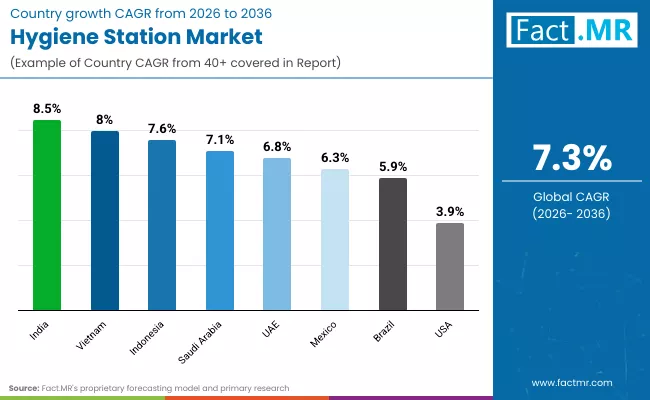
Hygiene Station Market Country | Source: Fact.MR
| Country | CAGR (Forecast Period) |
|---|---|
| India | 8.5% |
| Vietnam | 8.0% |
| Indonesia | 7.6% |
| Saudi Arabia | 7.1% |
| UAE | 6.8% |
| Mexico | 6.3% |
| Brazil | 5.9% |
| USA | 3.9% |
Source: Fact.MR analysis. Updated Feb 3, 2026
What Factors Drive the 8.5% Growth in the India Hygiene Station Market?
India's 8.5% growth in the hygiene station market is driven by the increasing awareness of hygiene in public spaces and the rise of health-consciousness post-pandemic. The government’s push for clean and safe environments in public areas, coupled with rising infrastructure development and rapid urbanization, is accelerating the adoption of hygiene stations. The expansion of retail and commercial establishments has led to heightened demand for hygiene products and stations, especially in high-footfall areas like malls, airports, and offices. India's evolving healthcare and hospitality sectors further contribute to market growth, with an increasing number of businesses focusing on customer safety and health.
Why is the Vietnam Hygiene Station Market Projected to Expand at 8.0%?
Vietnam’s 8.0% expansion is attributed to the country’s rising focus on sanitation and public health. The post-pandemic world has heightened the need for hygiene stations in public and commercial spaces. With increased investment in commercial infrastructure and urban development, the adoption of hygiene solutions is widespread, particularly in the hospitality and retail industries. Vietnam’s growing population and expanding tourism sector are also contributing to the demand for hygiene stations in public spaces, hotels, and malls.
How Does the 7.6% Growth Reflect the Indonesia Hygiene Station Market Expansion?
Indonesia’s 7.6% growth reflects the government initiatives aimed at improving public health and safety standards, particularly in high-traffic areas. The increased focus on sanitation in the wake of the pandemic has led to an accelerated demand for hygiene stations. The expansion of urban infrastructure and the development of commercial complexes in cities like Jakarta and Bali also support the growth of the market. Indonesia’s growing tourism and retail sectors are additional key factors driving demand for hygiene stations.
What Factors Support the 7.1% Growth for the Saudi Arabia Hygiene Station Market?
Saudi Arabia's 7.1% growth in the hygiene station market is primarily driven by the country’s health and safety initiatives under its Vision 2030 framework. The Saudi government has significantly invested in infrastructure development, particularly in public spaces, malls, and tourist destinations, where hygiene stations are essential for health and safety. Additionally, the rise of global events like conferences, exhibitions, and religious gatherings at locations like Mecca and Medina has further increased the demand for hygiene stations to ensure a clean and safe environment for large crowds.
Why Does the UAE Exhibit 6.8% Growth in Hygiene Stations?
The 6.8% growth in the UAE hygiene station market can be attributed to its rapid urbanization, rising tourism, and hospitality industries. The UAE has high standards of cleanliness and hygiene, which are expected to increase with the upcoming global events, including Dubai Expo. The expansion of public infrastructure and commercial real estate also boosts the demand for hygiene stations. Furthermore, the country’s push towards smart cities and advanced infrastructure solutions for health and safety is also a contributing factor to the growth.
How Does the 6.3% Growth in Mexico Hygiene Stations Reflect the Market's Expansion?
Mexico’s 6.3% growth in the hygiene station market is largely driven by the post-pandemic health consciousness and increased cleanliness standards in public and commercial spaces. The country's booming retail and hospitality industries are a primary source of demand for hygiene stations. As public awareness of sanitation and cleanliness increases, hygiene stations are becoming more prevalent in areas like airports, malls, restaurants, and offices. Additionally, the country’s growing tourism industry also supports the adoption of hygiene stations.
Why is the 5.9% Growth in the Brazil Hygiene Station Market Significant?
Brazil’s 5.9% growth in the hygiene station market is supported by the increased focus on hygiene in public spaces following the pandemic. The expansion of urban infrastructure, coupled with Brazil’s growing healthcare and tourism sectors, creates a steady demand for hygiene solutions. Commercial spaces like retailers, restaurants, and hotels have increasingly adopted hygiene stations to improve customer safety and cleanliness. Brazil’s expanding middle class and increasing public health awareness also contribute to the overall growth of the market.
What Drives the 3.9% Growth in the USA Hygiene Station Market?
The 3.9% growth in the USA hygiene station market is driven by the post-pandemic world where consumers and businesses prioritize health and hygiene in public spaces. The rising demand for hygiene stations in high-traffic areas like airports, offices, shopping malls, and restaurants is a key driver. Additionally, increasing government regulations and healthcare initiatives that emphasize hygiene safety in public spaces contribute to market growth. The retail and hospitality sectors are also major contributors to the rise in demand for hygiene stations.
How Are Key Players Competing in the Hygiene Station Market?
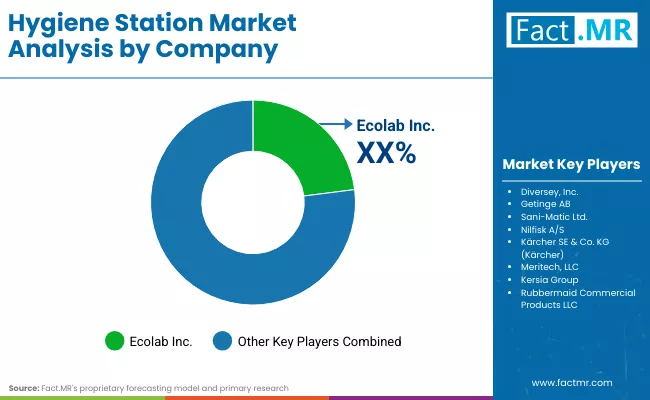
Hygiene Station Market Company | Source: Fact.MR
The hygiene station market sees Ecolab Inc. and Diversey, Inc. as leaders in providing advanced cleaning and disinfection stations for industrial and commercial environments, ensuring compliance with hygiene standards. Getinge AB and Sani-Matic Ltd. offer specialized sanitation solutions for healthcare and food production sectors, emphasizing sterilization and infection prevention. Nilfisk A/S and Kärcher SE & Co. KG focus on high-efficiency cleaning stations designed to reduce labor costs and improve operational efficiency in both indoor and outdoor settings. Meritech, LLC and Kersia Group are innovating with automated hygiene stations, while Rubbermaid Commercial Products LLC integrates user-friendly designs for high-traffic areas, all prioritizing sustainability and ease of use. The market is driven by technological advancements and increasing demand for hygiene compliance across various industries.
Recent Industry Developments
- Product Launch (Feb 2024): Meritech announced a new line of CleanTech fully automated handwashing stations featuring advanced soap and sanitizer dispensing with integrated drying and touch-free operation - aimed at raising hygiene standards in healthcare and food industries.
- Smart Hygiene Station (2024): GOassure™ Lite was introduced as India’s first smart hand hygiene station, featuring IoT connectivity, SOP-based 20-second hygiene coaching, and compliance monitoring to support WHO-aligned hand sanitation routines.
- Smart Monitoring Solution (Jul 2024): Kontakt.io launched a smart, cloud-based hand hygiene solution for hospitals that uses BLE badges, IR sensors, and real-time monitoring to improve compliance, trigger usage alerts, and assist infection-tracing efforts.
Key Players of the Hygiene Station Market
- Ecolab Inc.
- Diversey, Inc.
- Getinge AB
- Sani-Matic Ltd.
- Nilfisk A/S
- Kärcher SE & Co. KG (Kärcher)
- Meritech, LLC
- Kersia Group
- Rubbermaid Commercial Products LLC
Bibliographies
- Centers for Disease Control and Prevention. (2023). Hand hygiene in healthcare settings. CDC.
- World Health Organization. (2023). WHO guidelines on hand hygiene and infection prevention in healthcare. WHO.
- World Health Organization. (2023). Infection prevention and control in public and community settings. WHO.
- U.S. Food and Drug Administration. (2024). Safety and effectiveness of alcohol-based hand sanitizers. FDA.
- Occupational Safety and Health Administration. (2024). Workplace sanitation and hygiene standards. OSHA, U.S. Department of Labor.
Segmentation
Scope of the Report
| Items | Values |
|---|---|
| Quantitative Units (2026) | USD Billion |
| By Station Type | Handwash + Sanitizer Stations, Boot Washers & Sole Cleaners, Gowning & PPE Stations, Other |
| By End Use | Food Processing, Pharma & Biotech, Hospitals, Other |
| By Installation | Wall-Mounted, Floor Standing, Portable, Other |
| By Sales Channel | Facility Hygiene Distributors, Direct OEM Sales, Cleanroom Integrators, Other |
| Regions Covered | North America, Europe, Asia Pacific, Latin America, Middle East & Africa |
| Countries Covered | United States, Canada, Mexico, Germany, United Kingdom, France, Japan, South Korea, China, India, Brazil, and other countries |
| Key Companies Profiled | Ecolab Inc., Diversey, Inc., Getinge AB, Sani-Matic Ltd., Nilfisk A/S, Kärcher SE & Co. KG (Kärcher), Meritech, LLC, Kersia Group, Rubbermaid Commercial Products LLC |
| Additional Attributes | Dollar revenue by station type, end use, installation, sales channel, and region; regional demand trends, competitive landscape, technological advancements in hygiene stations, operational performance optimization initiatives, and product development strategies |
Source: Fact.MR analysis. Updated Feb 3, 2026
Hygiene Station Market Key Segments
-
By Station Type :
- Handwash + Sanitizer Stations
- Boot Washers & Sole Cleaners
- Gowning & PPE Stations
- Other
-
By End Use :
- Food Processing
- Pharma & Biotech
- Hospitals
- Other
-
By Installation :
- Wall-Mounted
- Floor Standing
- Portable
- Other
-
By Sales Channel :
- Facility Hygiene Distributors
- Direct OEM Sales
- Cleanroom Integrators
- Other
-
Region :
- North America
- USA
- Canada
- Mexico
- Europe
- Germany
- UK
- France
- Italy
- Spain
- Nordic Countries
- BENELUX
- Rest of Europe
- Asia Pacific
- China
- Japan
- South Korea
- India
- Australia
- Rest of Asia Pacific
- Latin America
- Brazil
- Argentina
- Rest of Latin America
- Middle East and Africa
- Kingdom of Saudi Arabia
- United Arab Emirates
- South Africa
- Rest of Middle East and Africa
- Other Regions
- Oceania
- Central Asia
- Other Markets
- North America
Frequently Asked Questions
What is the projected market size for hygiene stations in 2026?
What value is expected for hygiene stations in 2036?
At what rate will the hygiene station market progress from 2026 to 2036?
Which station type dominates demand and what share does it hold?
Which region is expected to experience the fastest growth and what rate is it projected at?
Who are the major players in the hygiene station market?
Who worked on this report


Preview the report firsthand - request a free sample
Free SampleGet the brochure for pricing and purchase details
Download PDF