Virtual Sleep Clinics Market (2026 - 2036)
Virtual Sleep Clinics Market Size and Share Forecast Outlook 2026 to 2036
Core Findings
Virtual Sleep Clinics Market Forecast and Outlook 2026 to 2036
The virtual sleep clinics market is projected to move from USD 1.5 billion in 2026 to USD 6.6 billion by 2036, reflecting a 16.0% CAGR.
Virtual Sleep Clinics Market Key Takeaways
- Virtual Sleep Clinics Market Value (2026): USD 1.5 billion
- Virtual Sleep Clinics Market Forecast Value (2036): USD 6.6 billion
- Virtual Sleep Clinics Market Forecast CAGR: 16.0%
- Leading Service Component in Virtual Sleep Clinics Market: Tele-consultation and sleep specialist visits
- Key Growth Regions in Virtual Sleep Clinics Market: North America, Europe, Asia Pacific, Latin America, Middle East & Africa
- Top Players in Virtual Sleep Clinics Market: ResMed Inc., Philips N.V., Teladoc Health, Inc.
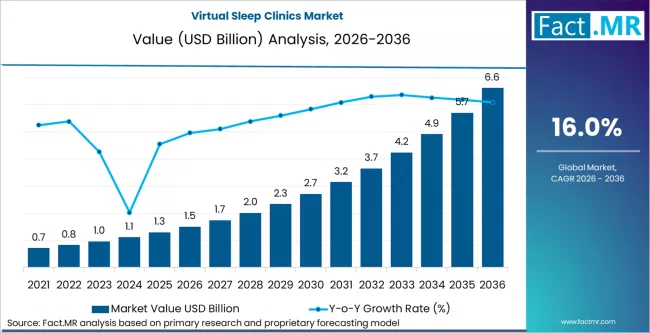
The operational change sits in delivery and clinical execution. Early programs relied on pilot cohorts and bespoke workflows. Current scale depends on fixed care pathways, standardized onboarding, and audited data flows across scheduling, assessment, therapy, and follow-up. Software release cycles, content libraries, and clinician protocols follow controlled versioning. Multi-region hosting, identity management, and device integrations support predictable throughput. Payers and employer programs assess vendors on uptime, reporting consistency, and contract continuity. Procurement cycles shorten with evidence packages that map to internal governance rules.
Capacity planning uses session slots and coach utilization, the governing limits. Reimbursement and benefit design align around repeat episodes of care. Adoption friction falls with lower integration risk and reduced operational variance. Volume shifts into this channel reflect normalized purchasing behavior and program budgeting. Summarizing this shift toward a data-driven, remote model, Mick Farrell, CEO of ResMed, notes: "ResMed is extremely well positioned to turn our over 23 billion nights of respiratory medical data into personalized insights that integrate seamlessly with virtual care."
Virtual Sleep Clinics Market
| Metric | Value |
|---|---|
| Market Value (2026) | USD 1.5 billion |
| Forecast Value (2036) | USD 6.6 billion |
| Forecast CAGR (2026-2036) | 16.0% |
Category
| Category | Segments |
|---|---|
| Service Components | Tele-consultation and sleep specialist visits; Home sleep apnea testing (HSAT) programs; Remote PAP titration and adherence monitoring; Digital insomnia care pathways (CBT-I services); Care coordination and DME integration services |
| Primary Clinical Indications | Obstructive sleep apnea; Insomnia; Circadian rhythm disorders; Restless legs or movement disorders; Hypersomnia or narcolepsy support |
| End User or Channel | Direct-to-patient virtual clinics; Hospital-affiliated virtual programs; Payers or employers; DME providers or PAP networks; Others |
| Region | North America; Europe; Asia Pacific; Latin America; Middle East & Africa |
Virtual Sleep Clinics Market Segmental Analysis
By Service Components, Why Do Tele Consultation and Sleep Specialist Visits Lead the Virtual Sleep Clinics Market?
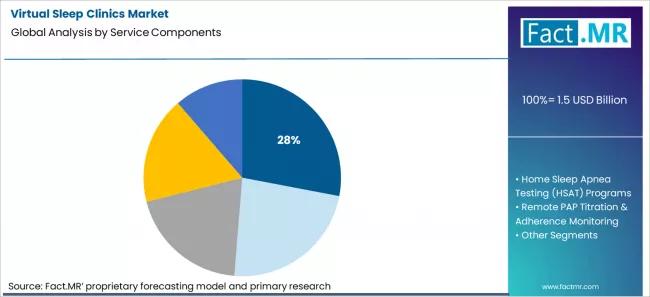
Based on Fact.MR analysis, tele consultation and sleep specialist visits represent 28% share because they remove the first barrier in sleep care, which is access to qualified evaluation. For most patients, the unmet need is not a new test or device but a timely, credible opinion that converts vague symptoms into a defined care plan. This service fits into ordinary schedules and does not require behavior change beyond attending an appointment. Its value is functional and administrative rather than reassuring. Providers treat it as the front door to all other services. The commercial logic rests on volume, repeatable workflows, and its role as the gatekeeper for downstream diagnostics and therapy decisions.
By Primary Clinical Indications, Why Does Obstructive Sleep Apnea Represent the Largest Use Case in the Virtual Sleep Clinics Market?
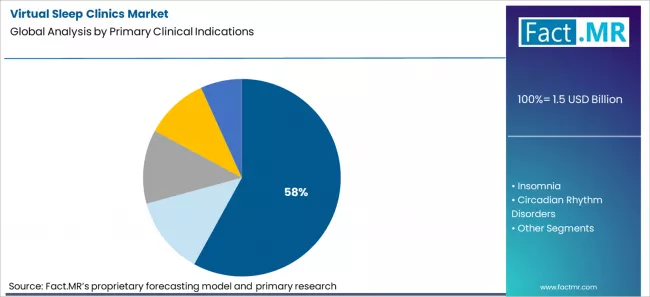
According to Fact.MR assessment, obstructive sleep apnea accounts for 58% share because it sits at the intersection of chronic risk, measurable outcomes, and ongoing management. Patients do not seek care for reassurance. They seek it because untreated symptoms affect daily function, work performance, and long term health risk. The condition turns sleep care from an occasional consultation into a recurring management process. This makes virtual delivery economically viable and operationally stable. The value to the patient is functional, centered on symptom control and risk reduction. For providers, apnea creates a steady care pathway that links diagnosis, device management, follow up, and adherence tracking into a continuous service relationship.
Country
| Country | Driver | Restraint | Trend |
|---|---|---|---|
| USA | Employer and payer telehealth programs integrating sleep services | Fragmented reimbursement and state-level rules | Consolidation around reimbursable virtual clinics |
| UK | NHS digital pathway and NICE-backed sleep services | Local commissioning and budget limits | Standardization of virtual referrals |
| Germany | Statutory reimbursement via DiGA-style pathways | High clinical evidence burden | Prescription-linked virtual care |
| China | Hospital-led telemedicine expansion in tier-1 cities | Regulatory classification uncertainty | Hospital-platform partnerships |
| India | National telemedicine and Ayushman Bharat hubs | Specialist shortages and access gaps | Regional hub-and-spoke rollout |
Analysis of the Virtual Sleep Clinics Market by Key Country
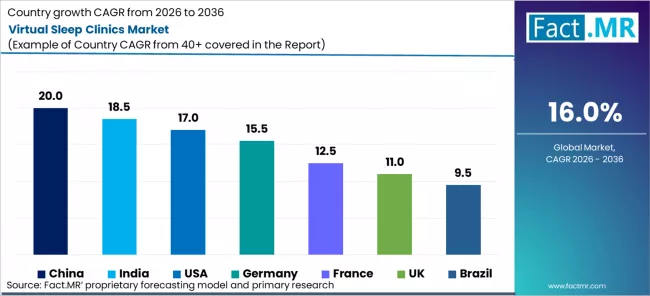
| Country | CAGR (2026-2036) |
|---|---|
| USA | 17.0% |
| China | 20.0% |
| India | 18.5% |
| Germany | 15.5% |
| France | 12.5% |
| UK | 11.0% |
| Brazil | 9.5% |
The report covers an in-depth analysis of 40+ countries; top-performing countries are highlighted below.
How Is the Virtual Sleep Clinics Sector Developing in the United States?
The United States shows a 17% annual growth rate for virtual sleep clinics through 2036, shaped by capacity management inside hospital and insurer networks. Sleep medicine faces long waiting lists in many regions, which creates pressure to move follow up and routine therapy into remote care models. Large provider groups use virtual clinics to extend specialist coverage without adding physical sites. Reimbursement acceptance for teleconsultation supports this shift. Employers add sleep programs inside benefit structures, which increases referral flow. Growth follows institutional rollout schedules and payer coverage decisions rather than direct consumer subscription behavior or short term promotional activity cycles.
What Explains the Expansion of Virtual Sleep Clinics in China?
China records a 20% growth rate for virtual sleep clinics through 2036, driven by hospital digitization programs and centralized platform deployment. Large public hospitals manage high patient volumes in respiratory, neurology, and mental health departments, which makes remote follow up economically necessary. Virtual clinics allow specialists to supervise treatment across wide catchment areas without physical expansion. Provincial health systems favor platforms that standardize data capture and monitoring. Once a system adopts a platform, patient flow scales quickly across multiple facilities. The growth rate reflects system level rollout speed rather than changes in individual clinic behavior or private practice adoption patterns.
Why Is India Adopting Virtual Sleep Clinics at a Fast Pace?
India advances at an 18.5% annual rate in virtual sleep clinics through 2036 due to limited specialist availability and high outpatient volumes. Urban hospitals and telemedicine platforms rely on remote care to manage follow up visits and long term therapy. Travel time and access barriers make virtual consultations economically practical for patients. Corporate health programs add another referral source. Clinics use digital channels to extend reach into secondary cities without opening new centers. Growth speed reflects service access gaps and the cost advantage of remote delivery in a system where demand exceeds specialist supply capacity.
What Is Driving Virtual Sleep Clinic Adoption in Germany?
Germany shows a 15.5% growth rate for virtual sleep clinics through 2036, shaped by regulated telemedicine frameworks and structured care pathways. Physicians integrate remote follow up into treatment plans once reimbursement and data protection conditions are satisfied. Patients accept virtual visits when they remain inside formal clinical supervision. Hospital outpatient departments and sickness funds influence deployment decisions. Expansion depends on compliance review and guideline alignment rather than commercial promotion. The pace reflects careful system level adoption that balances efficiency gains with procedural requirements inside a healthcare environment that values documentation and controlled changes to established care delivery models.
How Does the French Health System Influence Virtual Sleep Clinics?
France records a 12.5% annual growth rate for virtual sleep clinics through 2036, linked to public system capacity planning and regional care coordination. Sleep medicine services face long access times in several regions, which makes remote follow up attractive for stable patients. National reimbursement rules determine which services scale. Hospitals and regional health agencies control deployment across large patient groups. Clinicians use virtual visits mainly for monitoring and therapy adjustments. The expansion rate follows administrative rollout schedules and funding approvals, which produces steady adoption rather than rapid commercial diffusion across the private and public care landscape.
What Shapes the Virtual Sleep Clinics Sector in the United Kingdom?
The United Kingdom shows an 11% growth rate for virtual sleep clinics through 2036, guided by NHS commissioning priorities and waiting list management. Remote clinics help reduce pressure on limited specialist capacity in sleep and respiratory medicine. Adoption moves through pilot programs that later extend across trusts. Evidence review and budget impact assessments shape purchasing decisions. Patients access services through referral pathways rather than direct choice. Growth remains measured due to procurement cycles and governance requirements, while underlying demand stays firm because access constraints persist across many regions and hospital networks.
Why Is Brazil a Slower Growing Virtual Sleep Clinics Sector?
Brazil advances at a 9.5% annual rate in virtual sleep clinics through 2036, supported mainly by private healthcare groups and employer funded plans. Public system adoption remains uneven across regions. Large hospital networks use remote care to standardize follow up across multi city operations. Patient self-payment plays a role in some areas. Economic variability limits rapid national rollout. Growth depends on private insurance coverage decisions and corporate health programs. The pace reflects gradual integration into existing care models rather than a coordinated nationwide shift toward virtual delivery in sleep medicine services.
How are Tier-1 players using multi-brand platforms rather than single product innovation to secure share in the virtual sleep clinic segment, and why do scale and disciplined operations matter more than ingredient access?
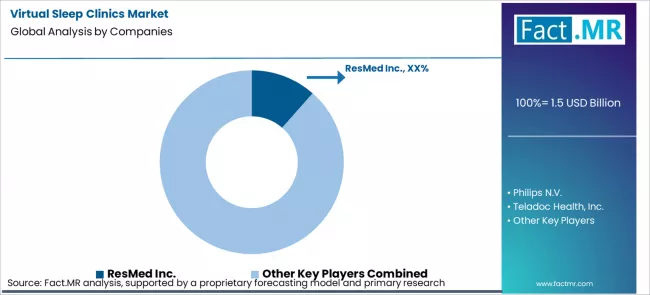
ResMed and Philips anchor their competitive positions on broad, interconnected care platforms rather than isolated offerings. ResMed’s ecosystem now spans diagnostics, device therapy, connected adherence monitoring, and remote clinical workflows, reflecting its push to capture the full continuum of sleep care rather than just sell individual machines. Industry data indicates ResMed holds a substantial proportion of the sleep care market and has expanded into diagnostics through targeted acquisitions, supporting platform breadth over standalone products.
Philips similarly integrates diagnostics with therapy devices and cloud-linked care pathways, enabling coordinated virtual services tied to its installed device base. In contrast, suppliers without integrated portfolios find it harder to secure long-term referral contracts or managed care arrangements. The broader sleep care and devices market is projected to grow strongly, driven by rising prevalence and uptake of connected and remote care technologies. Scale enables extended geographic and payer coverage, consistent quality audits, tiered service levels, and negotiated reimbursement, which act as barriers to entry. Process discipline in scheduling, titration protocols, and data continuity has become a more defensible competitive advantage than mere access to a single ingredient, device, or technology.
Key Players in Virtual Sleep Clinics Market
- ResMed Inc.
- Philips N.V.
- Teladoc Health, Inc.
- Others
Scope of the Report
| Items | Values |
|---|---|
| Quantitative Units (2026) | USD million |
| Service Components | Tele-consultation and sleep specialist visits, home sleep apnea testing (HSAT) programs, remote PAP titration and adherence monitoring, digital insomnia care pathways (CBT-I services), care coordination and DME integration services |
| Primary Clinical Indications | Obstructive sleep apnea, insomnia, circadian rhythm disorders, restless legs or movement disorders, hypersomnia or narcolepsy support |
| End User or Channel | Direct-to-patient virtual clinics, hospital-affiliated virtual programs, payers or employers, DME providers or PAP networks, others |
| Regions Covered | Asia Pacific, Europe, North America, Latin America, Middle East & Africa |
| Countries Covered | United States, Canada, Mexico, Germany, United Kingdom, France, Italy, Spain, China, Japan, South Korea, India, Australia & New Zealand, ASEAN, Brazil, Chile, Saudi Arabia, Turkey, South Africa, and other regional markets |
| Key Companies Profiled | ResMed Inc., Philips N.V., Teladoc Health, Inc. |
| Additional Attributes | Dollar by sales by service component, clinical indication, and channel; focus on virtual care pathway standardization, PAP workflow integration, and payer reimbursement alignment; demand driven by obstructive sleep apnea management, follow-up care, and specialist access constraints |
Virtual Sleep Clinics Market Segmentation
-
Service Components:
- Tele-Consultation & Sleep Specialist Visits
- Home Sleep Apnea Testing (HSAT) Programs
- Remote PAP Titration & Adherence Monitoring
- Digital Insomnia Care Pathways (CBT-I Services)
- Care Coordination & DME Integration Services
-
Primary Clinical Indications:
- Obstructive Sleep Apnea
- Insomnia
- Circadian Rhythm Disorders
- Restless Legs or Movement Disorders
- Hypersomnia or Narcolepsy Support
-
End User or Channel:
- Direct-to-Patient Virtual Clinics
- Hospital-Affiliated Virtual Programs
- Payers or Employers
- DME Providers or PAP Networks
- Others
-
Region:
- Asia Pacific
- China
- Japan
- South Korea
- India
- Australia & New Zealand
- ASEAN
- Rest of Asia Pacific
- Europe
- Germany
- United Kingdom
- France
- Italy
- Spain
- Nordic
- BENELUX
- Rest of Europe
- North America
- United States
- Canada
- Mexico
- Latin America
- Brazil
- Chile
- Rest of Latin America
- Middle East & Africa
- Kingdom of Saudi Arabia
- Other GCC Countries
- Turkey
- South Africa
- Other African Union
- Rest of Middle East & Africa
- Asia Pacific
References
- Organisation for Economic Co-operation and Development. (2023). The COVID-19 pandemic and the future of telemedicine (Policy Brief). OECD.
- World Health Organization. (2024). Support Tool to Strengthen Telemedicine Services (WHO/Europe).
- Centers for Medicare & Medicaid Services. (2025). Telehealth & Remote Monitoring MLN Booklet (MLN901705). USA Department of Health & Human Services.
- World Health Organization Regional Office for Europe. (2023). The ongoing journey to commitment and transformation: digital health in the WHO European Region. WHO Europe.
Table of Content
- Executive Summary
- Global Market Outlook
- Demand to side Trends
- Supply to side Trends
- Technology Roadmap Analysis
- Analysis and Recommendations
- Market Overview
- Market Coverage / Taxonomy
- Market Definition / Scope / Limitations
- Research Methodology
- Chapter Orientation
- Analytical Lens and Working Hypotheses
- Market Structure, Signals, and Trend Drivers
- Benchmarking and Cross-market Comparability
- Market Sizing, Forecasting, and Opportunity Mapping
- Research Design and Evidence Framework
- Desk Research Programme (Secondary Evidence)
- Company Annual and Sustainability Reports
- Peer-reviewed Journals and Academic Literature
- Corporate Websites, Product Literature, and Technical Notes
- Earnings Decks and Investor Briefings
- Statutory Filings and Regulatory Disclosures
- Technical White Papers and Standards Notes
- Trade Journals, Industry Magazines, and Analyst Briefs
- Conference Proceedings, Webinars, and Seminar Materials
- Government Statistics Portals and Public Data Releases
- Press Releases and Reputable Media Coverage
- Specialist Newsletters and Curated Briefings
- Sector Databases and Reference Repositories
- FMR Internal Proprietary Databases and Historical Market Datasets
- Subscription Datasets and Paid Sources
- Social Channels, Communities, and Digital Listening Inputs
- Additional Desk Sources
- Expert Input and Fieldwork (Primary Evidence)
- Primary Modes
- Qualitative Interviews and Expert Elicitation
- Quantitative Surveys and Structured Data Capture
- Blended A8oach
- Why Primary Evidence is Used
- Field Techniques
- Interviews
- Surveys
- Focus Groups
- Observational and In-context Research
- Social and Community Interactions
- Stakeholder Universe Engaged
- C-suite Leaders
- Board Members
- Presidents and Vice Presidents
- R&D and Innovation Heads
- Technical Specialists
- Domain Subject-matter Experts
- Scientists
- Physicians and Other Healthcare Professionals
- Governance, Ethics, and Data Stewardship
- Research Ethics
- Data Integrity and Handling
- Primary Modes
- Tooling, Models, and Reference Databases
- Desk Research Programme (Secondary Evidence)
- Data Engineering and Model Build
- Data Acquisition and Ingestion
- Cleaning, Normalisation, and Verification
- Synthesis, Triangulation, and Analysis
- Quality Assurance and Audit Trail
- Market Background
- Market Dynamics
- Drivers
- Restraints
- Opportunity
- Trends
- Scenario Forecast
- Demand in Optimistic Scenario
- Demand in Likely Scenario
- Demand in Conservative Scenario
- Opportunity Map Analysis
- Product Life Cycle Analysis
- Supply Chain Analysis
- Investment Feasibility Matrix
- Value Chain Analysis
- PESTLE and Porter’s Analysis
- Regulatory Landscape
- Regional Parent Market Outlook
- Production and Consumption Statistics
- Import and Export Statistics
- Market Dynamics
- Global Market Analysis 2021 to 2025 and Forecast, 2026 to 2036
- Historical Market Size Value (USD Million) Analysis, 2021 to 2025
- Current and Future Market Size Value (USD Million) Projections, 2026 to 2036
- Y to o to Y Growth Trend Analysis
- Absolute $ Opportunity Analysis
- Global Market Pricing Analysis 2021 to 2025 and Forecast 2026 to 2036
- Global Market Analysis 2021 to 2025 and Forecast 2026 to 2036, By Service Components
- Introduction / Key Findings
- Historical Market Size Value (USD Million) Analysis By Service Components, 2021 to 2025
- Current and Future Market Size Value (USD Million) Analysis and Forecast By Service Components, 2026 to 2036
- Tele-Consultation & Sleep Specialist Visits
- Home Sleep Apnea Testing (HSAT) Programs
- Remote PAP Titration & Adherence Monitoring
- Digital Insomnia Care Pathways (CBT-I Services)
- Care Coordination & DME Integration Services
- Tele-Consultation & Sleep Specialist Visits
- Y to o to Y Growth Trend Analysis By Service Components, 2021 to 2025
- Absolute $ Opportunity Analysis By Service Components, 2026 to 2036
- Global Market Analysis 2021 to 2025 and Forecast 2026 to 2036, By Primary Clinical Indications
- Introduction / Key Findings
- Historical Market Size Value (USD Million) Analysis By Primary Clinical Indications, 2021 to 2025
- Current and Future Market Size Value (USD Million) Analysis and Forecast By Primary Clinical Indications, 2026 to 2036
- Obstructive Sleep Apnea
- Insomnia
- Circadian Rhythm Disorders
- Restless Legs / Movement Disorders
- Hypersomnia / Narcolepsy Support
- Obstructive Sleep Apnea
- Y to o to Y Growth Trend Analysis By Primary Clinical Indications, 2021 to 2025
- Absolute $ Opportunity Analysis By Primary Clinical Indications, 2026 to 2036
- Global Market Analysis 2021 to 2025 and Forecast 2026 to 2036, By End User or Channel
- Introduction / Key Findings
- Historical Market Size Value (USD Million) Analysis By End User or Channel, 2021 to 2025
- Current and Future Market Size Value (USD Million) Analysis and Forecast By End User or Channel, 2026 to 2036
- Direct-to-Patient Virtual Clinics
- Hospital-Affiliated Virtual Programs
- Payers or Employers
- DME Providers or PAP Networks
- Others
- Direct-to-Patient Virtual Clinics
- Y to o to Y Growth Trend Analysis By End User or Channel, 2021 to 2025
- Absolute $ Opportunity Analysis By End User or Channel, 2026 to 2036
- Global Market Analysis 2021 to 2025 and Forecast 2026 to 2036, By Region
- Introduction
- Historical Market Size Value (USD Million) Analysis By Region, 2021 to 2025
- Current Market Size Value (USD Million) Analysis and Forecast By Region, 2026 to 2036
- North America
- Latin America
- Western Europe
- Eastern Europe
- East Asia
- South Asia and Pacific
- Middle East & Africa
- Market Attractiveness Analysis By Region
- North America Market Analysis 2021 to 2025 and Forecast 2026 to 2036, By Country
- Historical Market Size Value (USD Million) Trend Analysis By Market Taxonomy, 2021 to 2025
- Market Size Value (USD Million) Forecast By Market Taxonomy, 2026 to 2036
- By Country
- USA
- Canada
- Mexico
- By Service Components
- By Primary Clinical Indications
- By End User or Channel
- By Country
- Market Attractiveness Analysis
- By Country
- By Service Components
- By Primary Clinical Indications
- By End User or Channel
- Key Takeaways
- Latin America Market Analysis 2021 to 2025 and Forecast 2026 to 2036, By Country
- Historical Market Size Value (USD Million) Trend Analysis By Market Taxonomy, 2021 to 2025
- Market Size Value (USD Million) Forecast By Market Taxonomy, 2026 to 2036
- By Country
- Brazil
- Chile
- Rest of Latin America
- By Service Components
- By Primary Clinical Indications
- By End User or Channel
- By Country
- Market Attractiveness Analysis
- By Country
- By Service Components
- By Primary Clinical Indications
- By End User or Channel
- Key Takeaways
- Western Europe Market Analysis 2021 to 2025 and Forecast 2026 to 2036, By Country
- Historical Market Size Value (USD Million) Trend Analysis By Market Taxonomy, 2021 to 2025
- Market Size Value (USD Million) Forecast By Market Taxonomy, 2026 to 2036
- By Country
- Germany
- UK
- Italy
- Spain
- France
- Nordic
- BENELUX
- Rest of Western Europe
- By Service Components
- By Primary Clinical Indications
- By End User or Channel
- By Country
- Market Attractiveness Analysis
- By Country
- By Service Components
- By Primary Clinical Indications
- By End User or Channel
- Key Takeaways
- Eastern Europe Market Analysis 2021 to 2025 and Forecast 2026 to 2036, By Country
- Historical Market Size Value (USD Million) Trend Analysis By Market Taxonomy, 2021 to 2025
- Market Size Value (USD Million) Forecast By Market Taxonomy, 2026 to 2036
- By Country
- Russia
- Poland
- Hungary
- Balkan & Baltic
- Rest of Eastern Europe
- By Service Components
- By Primary Clinical Indications
- By End User or Channel
- By Country
- Market Attractiveness Analysis
- By Country
- By Service Components
- By Primary Clinical Indications
- By End User or Channel
- Key Takeaways
- East Asia Market Analysis 2021 to 2025 and Forecast 2026 to 2036, By Country
- Historical Market Size Value (USD Million) Trend Analysis By Market Taxonomy, 2021 to 2025
- Market Size Value (USD Million) Forecast By Market Taxonomy, 2026 to 2036
- By Country
- China
- Japan
- South Korea
- By Service Components
- By Primary Clinical Indications
- By End User or Channel
- By Country
- Market Attractiveness Analysis
- By Country
- By Service Components
- By Primary Clinical Indications
- By End User or Channel
- Key Takeaways
- South Asia and Pacific Market Analysis 2021 to 2025 and Forecast 2026 to 2036, By Country
- Historical Market Size Value (USD Million) Trend Analysis By Market Taxonomy, 2021 to 2025
- Market Size Value (USD Million) Forecast By Market Taxonomy, 2026 to 2036
- By Country
- India
- ASEAN
- Australia & New Zealand
- Rest of South Asia and Pacific
- By Service Components
- By Primary Clinical Indications
- By End User or Channel
- By Country
- Market Attractiveness Analysis
- By Country
- By Service Components
- By Primary Clinical Indications
- By End User or Channel
- Key Takeaways
- Middle East & Africa Market Analysis 2021 to 2025 and Forecast 2026 to 2036, By Country
- Historical Market Size Value (USD Million) Trend Analysis By Market Taxonomy, 2021 to 2025
- Market Size Value (USD Million) Forecast By Market Taxonomy, 2026 to 2036
- By Country
- Kingdom of Saudi Arabia
- Other GCC Countries
- Turkiye
- South Africa
- Other African Union
- Rest of Middle East & Africa
- By Service Components
- By Primary Clinical Indications
- By End User or Channel
- By Country
- Market Attractiveness Analysis
- By Country
- By Service Components
- By Primary Clinical Indications
- By End User or Channel
- Key Takeaways
- Key Countries Market Analysis
- USA
- Pricing Analysis
- Market Share Analysis, 2025
- By Service Components
- By Primary Clinical Indications
- By End User or Channel
- Canada
- Pricing Analysis
- Market Share Analysis, 2025
- By Service Components
- By Primary Clinical Indications
- By End User or Channel
- Mexico
- Pricing Analysis
- Market Share Analysis, 2025
- By Service Components
- By Primary Clinical Indications
- By End User or Channel
- Brazil
- Pricing Analysis
- Market Share Analysis, 2025
- By Service Components
- By Primary Clinical Indications
- By End User or Channel
- Chile
- Pricing Analysis
- Market Share Analysis, 2025
- By Service Components
- By Primary Clinical Indications
- By End User or Channel
- Germany
- Pricing Analysis
- Market Share Analysis, 2025
- By Service Components
- By Primary Clinical Indications
- By End User or Channel
- UK
- Pricing Analysis
- Market Share Analysis, 2025
- By Service Components
- By Primary Clinical Indications
- By End User or Channel
- Italy
- Pricing Analysis
- Market Share Analysis, 2025
- By Service Components
- By Primary Clinical Indications
- By End User or Channel
- Spain
- Pricing Analysis
- Market Share Analysis, 2025
- By Service Components
- By Primary Clinical Indications
- By End User or Channel
- France
- Pricing Analysis
- Market Share Analysis, 2025
- By Service Components
- By Primary Clinical Indications
- By End User or Channel
- India
- Pricing Analysis
- Market Share Analysis, 2025
- By Service Components
- By Primary Clinical Indications
- By End User or Channel
- ASEAN
- Pricing Analysis
- Market Share Analysis, 2025
- By Service Components
- By Primary Clinical Indications
- By End User or Channel
- Australia & New Zealand
- Pricing Analysis
- Market Share Analysis, 2025
- By Service Components
- By Primary Clinical Indications
- By End User or Channel
- China
- Pricing Analysis
- Market Share Analysis, 2025
- By Service Components
- By Primary Clinical Indications
- By End User or Channel
- Japan
- Pricing Analysis
- Market Share Analysis, 2025
- By Service Components
- By Primary Clinical Indications
- By End User or Channel
- South Korea
- Pricing Analysis
- Market Share Analysis, 2025
- By Service Components
- By Primary Clinical Indications
- By End User or Channel
- Russia
- Pricing Analysis
- Market Share Analysis, 2025
- By Service Components
- By Primary Clinical Indications
- By End User or Channel
- Poland
- Pricing Analysis
- Market Share Analysis, 2025
- By Service Components
- By Primary Clinical Indications
- By End User or Channel
- Hungary
- Pricing Analysis
- Market Share Analysis, 2025
- By Service Components
- By Primary Clinical Indications
- By End User or Channel
- Kingdom of Saudi Arabia
- Pricing Analysis
- Market Share Analysis, 2025
- By Service Components
- By Primary Clinical Indications
- By End User or Channel
- Turkiye
- Pricing Analysis
- Market Share Analysis, 2025
- By Service Components
- By Primary Clinical Indications
- By End User or Channel
- South Africa
- Pricing Analysis
- Market Share Analysis, 2025
- By Service Components
- By Primary Clinical Indications
- By End User or Channel
- USA
- Market Structure Analysis
- Competition Dashboard
- Competition Benchmarking
- Market Share Analysis of Top Players
- By Regional
- By Service Components
- By Primary Clinical Indications
- By End User or Channel
- Competition Analysis
- Competition Deep Dive
- ResMed Inc.
- Overview
- Product Portfolio
- Profitability by Market Segments (Product/Age /Sales Channel/Region)
- Sales Footprint
- Strategy Overview
- Marketing Strategy
- Product Strategy
- Channel Strategy
- Philips N.V.
- Teladoc Health, Inc.
- Others
- ResMed Inc.
- Competition Deep Dive
- Assumptions & Acronyms Used
List Of Table
- Table 1: Global Market Value (USD Million) Forecast by Region, 2021 to 2036
- Table 2: Global Market Value (USD Million) Forecast by Service Components, 2021 to 2036
- Table 3: Global Market Value (USD Million) Forecast by Primary Clinical Indications, 2021 to 2036
- Table 4: Global Market Value (USD Million) Forecast by End User or Channel, 2021 to 2036
- Table 5: North America Market Value (USD Million) Forecast by Country, 2021 to 2036
- Table 6: North America Market Value (USD Million) Forecast by Service Components, 2021 to 2036
- Table 7: North America Market Value (USD Million) Forecast by Primary Clinical Indications, 2021 to 2036
- Table 8: North America Market Value (USD Million) Forecast by End User or Channel, 2021 to 2036
- Table 9: Latin America Market Value (USD Million) Forecast by Country, 2021 to 2036
- Table 10: Latin America Market Value (USD Million) Forecast by Service Components, 2021 to 2036
- Table 11: Latin America Market Value (USD Million) Forecast by Primary Clinical Indications, 2021 to 2036
- Table 12: Latin America Market Value (USD Million) Forecast by End User or Channel, 2021 to 2036
- Table 13: Western Europe Market Value (USD Million) Forecast by Country, 2021 to 2036
- Table 14: Western Europe Market Value (USD Million) Forecast by Service Components, 2021 to 2036
- Table 15: Western Europe Market Value (USD Million) Forecast by Primary Clinical Indications, 2021 to 2036
- Table 16: Western Europe Market Value (USD Million) Forecast by End User or Channel, 2021 to 2036
- Table 17: Eastern Europe Market Value (USD Million) Forecast by Country, 2021 to 2036
- Table 18: Eastern Europe Market Value (USD Million) Forecast by Service Components, 2021 to 2036
- Table 19: Eastern Europe Market Value (USD Million) Forecast by Primary Clinical Indications, 2021 to 2036
- Table 20: Eastern Europe Market Value (USD Million) Forecast by End User or Channel, 2021 to 2036
- Table 21: East Asia Market Value (USD Million) Forecast by Country, 2021 to 2036
- Table 22: East Asia Market Value (USD Million) Forecast by Service Components, 2021 to 2036
- Table 23: East Asia Market Value (USD Million) Forecast by Primary Clinical Indications, 2021 to 2036
- Table 24: East Asia Market Value (USD Million) Forecast by End User or Channel, 2021 to 2036
- Table 25: South Asia and Pacific Market Value (USD Million) Forecast by Country, 2021 to 2036
- Table 26: South Asia and Pacific Market Value (USD Million) Forecast by Service Components, 2021 to 2036
- Table 27: South Asia and Pacific Market Value (USD Million) Forecast by Primary Clinical Indications, 2021 to 2036
- Table 28: South Asia and Pacific Market Value (USD Million) Forecast by End User or Channel, 2021 to 2036
- Table 29: Middle East & Africa Market Value (USD Million) Forecast by Country, 2021 to 2036
- Table 30: Middle East & Africa Market Value (USD Million) Forecast by Service Components, 2021 to 2036
- Table 31: Middle East & Africa Market Value (USD Million) Forecast by Primary Clinical Indications, 2021 to 2036
- Table 32: Middle East & Africa Market Value (USD Million) Forecast by End User or Channel, 2021 to 2036
List Of Figures
- Figure 1: Global Market Pricing Analysis
- Figure 2: Global Market Value (USD Million) Forecast 2021 to 2036
- Figure 3: Global Market Value Share and BPS Analysis by Service Components, 2026 and 2036
- Figure 4: Global Market Y to o to Y Growth Comparison by Service Components, 2026 to 2036
- Figure 5: Global Market Attractiveness Analysis by Service Components
- Figure 6: Global Market Value Share and BPS Analysis by Primary Clinical Indications, 2026 and 2036
- Figure 7: Global Market Y to o to Y Growth Comparison by Primary Clinical Indications, 2026 to 2036
- Figure 8: Global Market Attractiveness Analysis by Primary Clinical Indications
- Figure 9: Global Market Value Share and BPS Analysis by End User or Channel, 2026 and 2036
- Figure 10: Global Market Y to o to Y Growth Comparison by End User or Channel, 2026 to 2036
- Figure 11: Global Market Attractiveness Analysis by End User or Channel
- Figure 12: Global Market Value (USD Million) Share and BPS Analysis by Region, 2026 and 2036
- Figure 13: Global Market Y to o to Y Growth Comparison by Region, 2026 to 2036
- Figure 14: Global Market Attractiveness Analysis by Region
- Figure 15: North America Market Incremental Dollar Opportunity, 2026 to 2036
- Figure 16: Latin America Market Incremental Dollar Opportunity, 2026 to 2036
- Figure 17: Western Europe Market Incremental Dollar Opportunity, 2026 to 2036
- Figure 18: Eastern Europe Market Incremental Dollar Opportunity, 2026 to 2036
- Figure 19: East Asia Market Incremental Dollar Opportunity, 2026 to 2036
- Figure 20: South Asia and Pacific Market Incremental Dollar Opportunity, 2026 to 2036
- Figure 21: Middle East & Africa Market Incremental Dollar Opportunity, 2026 to 2036
- Figure 22: North America Market Value Share and BPS Analysis by Country, 2026 and 2036
- Figure 23: North America Market Value Share and BPS Analysis by Service Components, 2026 and 2036
- Figure 24: North America Market Y to o to Y Growth Comparison by Service Components, 2026 to 2036
- Figure 25: North America Market Attractiveness Analysis by Service Components
- Figure 26: North America Market Value Share and BPS Analysis by Primary Clinical Indications, 2026 and 2036
- Figure 27: North America Market Y to o to Y Growth Comparison by Primary Clinical Indications, 2026 to 2036
- Figure 28: North America Market Attractiveness Analysis by Primary Clinical Indications
- Figure 29: North America Market Value Share and BPS Analysis by End User or Channel, 2026 and 2036
- Figure 30: North America Market Y to o to Y Growth Comparison by End User or Channel, 2026 to 2036
- Figure 31: North America Market Attractiveness Analysis by End User or Channel
- Figure 32: Latin America Market Value Share and BPS Analysis by Country, 2026 and 2036
- Figure 33: Latin America Market Value Share and BPS Analysis by Service Components, 2026 and 2036
- Figure 34: Latin America Market Y to o to Y Growth Comparison by Service Components, 2026 to 2036
- Figure 35: Latin America Market Attractiveness Analysis by Service Components
- Figure 36: Latin America Market Value Share and BPS Analysis by Primary Clinical Indications, 2026 and 2036
- Figure 37: Latin America Market Y to o to Y Growth Comparison by Primary Clinical Indications, 2026 to 2036
- Figure 38: Latin America Market Attractiveness Analysis by Primary Clinical Indications
- Figure 39: Latin America Market Value Share and BPS Analysis by End User or Channel, 2026 and 2036
- Figure 40: Latin America Market Y to o to Y Growth Comparison by End User or Channel, 2026 to 2036
- Figure 41: Latin America Market Attractiveness Analysis by End User or Channel
- Figure 42: Western Europe Market Value Share and BPS Analysis by Country, 2026 and 2036
- Figure 43: Western Europe Market Value Share and BPS Analysis by Service Components, 2026 and 2036
- Figure 44: Western Europe Market Y to o to Y Growth Comparison by Service Components, 2026 to 2036
- Figure 45: Western Europe Market Attractiveness Analysis by Service Components
- Figure 46: Western Europe Market Value Share and BPS Analysis by Primary Clinical Indications, 2026 and 2036
- Figure 47: Western Europe Market Y to o to Y Growth Comparison by Primary Clinical Indications, 2026 to 2036
- Figure 48: Western Europe Market Attractiveness Analysis by Primary Clinical Indications
- Figure 49: Western Europe Market Value Share and BPS Analysis by End User or Channel, 2026 and 2036
- Figure 50: Western Europe Market Y to o to Y Growth Comparison by End User or Channel, 2026 to 2036
- Figure 51: Western Europe Market Attractiveness Analysis by End User or Channel
- Figure 52: Eastern Europe Market Value Share and BPS Analysis by Country, 2026 and 2036
- Figure 53: Eastern Europe Market Value Share and BPS Analysis by Service Components, 2026 and 2036
- Figure 54: Eastern Europe Market Y to o to Y Growth Comparison by Service Components, 2026 to 2036
- Figure 55: Eastern Europe Market Attractiveness Analysis by Service Components
- Figure 56: Eastern Europe Market Value Share and BPS Analysis by Primary Clinical Indications, 2026 and 2036
- Figure 57: Eastern Europe Market Y to o to Y Growth Comparison by Primary Clinical Indications, 2026 to 2036
- Figure 58: Eastern Europe Market Attractiveness Analysis by Primary Clinical Indications
- Figure 59: Eastern Europe Market Value Share and BPS Analysis by End User or Channel, 2026 and 2036
- Figure 60: Eastern Europe Market Y to o to Y Growth Comparison by End User or Channel, 2026 to 2036
- Figure 61: Eastern Europe Market Attractiveness Analysis by End User or Channel
- Figure 62: East Asia Market Value Share and BPS Analysis by Country, 2026 and 2036
- Figure 63: East Asia Market Value Share and BPS Analysis by Service Components, 2026 and 2036
- Figure 64: East Asia Market Y to o to Y Growth Comparison by Service Components, 2026 to 2036
- Figure 65: East Asia Market Attractiveness Analysis by Service Components
- Figure 66: East Asia Market Value Share and BPS Analysis by Primary Clinical Indications, 2026 and 2036
- Figure 67: East Asia Market Y to o to Y Growth Comparison by Primary Clinical Indications, 2026 to 2036
- Figure 68: East Asia Market Attractiveness Analysis by Primary Clinical Indications
- Figure 69: East Asia Market Value Share and BPS Analysis by End User or Channel, 2026 and 2036
- Figure 70: East Asia Market Y to o to Y Growth Comparison by End User or Channel, 2026 to 2036
- Figure 71: East Asia Market Attractiveness Analysis by End User or Channel
- Figure 72: South Asia and Pacific Market Value Share and BPS Analysis by Country, 2026 and 2036
- Figure 73: South Asia and Pacific Market Value Share and BPS Analysis by Service Components, 2026 and 2036
- Figure 74: South Asia and Pacific Market Y to o to Y Growth Comparison by Service Components, 2026 to 2036
- Figure 75: South Asia and Pacific Market Attractiveness Analysis by Service Components
- Figure 76: South Asia and Pacific Market Value Share and BPS Analysis by Primary Clinical Indications, 2026 and 2036
- Figure 77: South Asia and Pacific Market Y to o to Y Growth Comparison by Primary Clinical Indications, 2026 to 2036
- Figure 78: South Asia and Pacific Market Attractiveness Analysis by Primary Clinical Indications
- Figure 79: South Asia and Pacific Market Value Share and BPS Analysis by End User or Channel, 2026 and 2036
- Figure 80: South Asia and Pacific Market Y to o to Y Growth Comparison by End User or Channel, 2026 to 2036
- Figure 81: South Asia and Pacific Market Attractiveness Analysis by End User or Channel
- Figure 82: Middle East & Africa Market Value Share and BPS Analysis by Country, 2026 and 2036
- Figure 83: Middle East & Africa Market Value Share and BPS Analysis by Service Components, 2026 and 2036
- Figure 84: Middle East & Africa Market Y to o to Y Growth Comparison by Service Components, 2026 to 2036
- Figure 85: Middle East & Africa Market Attractiveness Analysis by Service Components
- Figure 86: Middle East & Africa Market Value Share and BPS Analysis by Primary Clinical Indications, 2026 and 2036
- Figure 87: Middle East & Africa Market Y to o to Y Growth Comparison by Primary Clinical Indications, 2026 to 2036
- Figure 88: Middle East & Africa Market Attractiveness Analysis by Primary Clinical Indications
- Figure 89: Middle East & Africa Market Value Share and BPS Analysis by End User or Channel, 2026 and 2036
- Figure 90: Middle East & Africa Market Y to o to Y Growth Comparison by End User or Channel, 2026 to 2036
- Figure 91: Middle East & Africa Market Attractiveness Analysis by End User or Channel
- Figure 92: Global Market - Tier Structure Analysis
- Figure 93: Global Market - Company Share Analysis
- FAQs -
How big is the virtual sleep clinics market in 2026?
The global virtual sleep clinics market is estimated to be valued at USD 1.5 billion in 2026.
What will be the size of virtual sleep clinics market in 2036?
The market size for the virtual sleep clinics market is projected to reach USD 6.6 billion by 2036.
How much will be the virtual sleep clinics market growth between 2026 and 2036?
The virtual sleep clinics market is expected to grow at a 16.0% CAGR between 2026 and 2036.
What are the key product types in the virtual sleep clinics market?
The key product types in virtual sleep clinics market are tele-consultation & sleep specialist visits, home sleep apnea testing (hsat) programs, remote pap titration & adherence monitoring, digital insomnia care pathways (cbt-i services) and care coordination & dme integration services.
Which primary clinical indications segment to contribute significant share in the virtual sleep clinics market in 2026?
In terms of primary clinical indications, obstructive sleep apnea segment to command 58.0% share in the virtual sleep clinics market in 2026.