DNA Based Food Traceability Tags Market (2026 - 2036)
DNA-Based Food Traceability Tags Market is segmented by Product (Synthetic DNA Taggants, DNA Barcodes / Oligo Labels, DNA-Enabled Labels & Inks, Kits & Reagents, Testing & Verification Services), Technology / Detection Method (qPCR / Endpoint PCR, Next-Generation Sequencing (NGS), Multi-Proof Integration (DNA + Isotope/Chemical Markers)), Form / Deployment (Surface-Applied Taggants, Packaging-Embedded Tags (Labels, Inks, Fibers), Ingredient-Level Tagging), Commercial Model (Product Sales (Taggants & Kits), Testing-as-a-Service (TaaS), Platform / SaaS Subscription, Integrated End-to-End Solutions), Application / Food Type (Meat & Poultry, Seafood & Fish, Fruits & Vegetables, Spices, Oils & Processed Foods, Dairy & Eggs), End-User (Farms / Primary Producers, Food Processors / Co-Packers, Retailers & Brands, Certifiers / Auditors / Regulatory Bodies) and Region. Forecast for 2026 to 2036.
Core Findings
DNA Based Food Traceability Tags Market Forecast 2026 to 2036
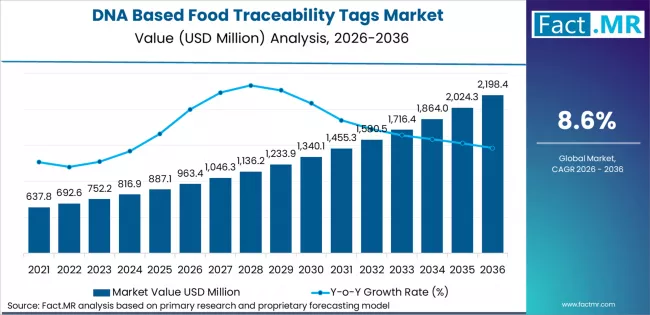
In 2026, the DNA-Based Food Traceability Tags market was valued at USD 963.4 Mn. Based on Fact.MR' analysis, demand for DNA-Based Food Traceability Tags is estimated to grow to USD 1,046.3 Mn in 2027 and USD 2,198.4 Mn by 2036. FACT.MR projects a CAGR of 8.6% during the forecast period.
This represents an absolute dollar growth of approximately USD 1,235.0 Mn between 2026 and 2036. The expansion is steady and compliance-driven rather than speculative, supported by regulatory traceability mandates, export authentication requirements, and brand protection investments in high-risk food categories. Growth remains moderated by cost sensitivity among mid-sized processors, laboratory validation costs, and substitution pressure from lower-cost digital traceability platforms such as QR- and ERP-based systems.
Industry expansion continues to follow structured commercialization cycles, with phased rollouts, pilot deployments, and long-term supply contracts tied to regulatory enforcement timelines rather than discretionary consumer demand.
Country-wise growth is led by India (10.3%), supported by export compliance upgrades and traceability modernization initiatives. China (9.0%) follows due to strengthened food safety enforcement and digital agriculture programs. The U.K. (8.4%) and Canada (8.3%) benefit from import scrutiny and regulatory alignment frameworks. Japan (8.1%) advances through premium authentication demand. Mature markets including the U.S. (7.8%), France (7.8%), and Germany (7.0%) generate structured replacement demand, constrained by established conventional traceability infrastructure and pricing discipline across mid-tier food processors.
Market Inclusions
This report covers global and regional market size analysis, historical data, and forecast projections for the DNA-Based Food Traceability Tags Market. It includes segmentation by product type (synthetic DNA taggants, DNA barcodes, DNA-enabled labels, kits, and testing services), by application (meat, seafood, dairy, processed foods, fruits and vegetables), and by end user. The study also incorporates pricing analysis, regulatory impact assessment, competitive landscape profiling, and regional trade flow considerations influencing adoption patterns.
Market Exclusions
The scope excludes conventional traceability technologies such as RFID tags, QR codes, blockchain software platforms, and non-DNA chemical or isotopic tracers unless directly integrated with DNA-based systems. It also omits finished packaged food products, general food testing equipment unrelated to DNA authentication, and medical or pharmaceutical DNA tagging applications. The analysis focuses strictly on molecular tagging materials, associated verification kits, and related authentication services within the food supply chain.
Research Methodology
- Primary Research: Publicly available company filings, regulatory publications, trade data, export statistics, and industry association reports were analyzed to support market evaluation.
- Desk Research: Data was collected from industry reports, construction statistics, and building standards publications.
- Market‑Sizing and Forecasting: A hybrid top-down and bottom-up approach was applied, combining company revenue analysis with application-level demand modeling across key regions.
Data Validation and Update Cycle
Findings were cross-verified through triangulation of primary interviews and secondary data sources, with periodic updates aligned to regulatory changes and major corporate developments.
DNA Based Food Traceability Tags Market Summary
Market Definition
The DNA-Based Food Traceability Tags Market comprises molecular authentication solutions that embed synthetic DNA markers into food products or packaging to enable tamper-proof origin verification and supply chain transparency.
Demand Drivers
- Enforcement of the U.S. FDA’s Food Safety Modernization Act (FSMA) traceability rule is compelling food processors handling high-risk categories to upgrade from documentation-based systems to verifiable authentication tools.
- Export-oriented meat, seafood, and spice suppliers in India and China are adopting forensic tagging solutions to maintain access to EU and North American markets with strict origin verification standards.
- Premium food brands are investing in molecular tagging to mitigate reputational and financial losses linked to food fraud in high-margin categories such as specialty oils and organic produce.
Key Segments Analyzed
- By Product: Synthetic DNA Taggants lead with approximately one-third revenue share due to their foundational role in batch-level authentication.
- By Application: Meat & Poultry dominates, accounting for the largest demand share given heightened origin labeling scrutiny and fraud exposure.
- By Geography: North America remains the leading regional market, driven by regulatory modernization and advanced testing infrastructure.
Analyst Opinion at FACT.MR
‘Regulatory compliance mandates and export market access requirements are fundamentally reshaping traceability investments, positioning molecular authentication as a strategic pillar of resilient and transparent food supply chains rather than a niche brand-protection tool.’
Strategic Implications / Executive Takeaways
- Invest in integrated tagging-plus-digital platforms rather than standalone authentication tools to enhance scalability and compliance reporting.
- Prioritize deployment in high-risk, high-margin categories where return on investment from fraud mitigation is measurable.
- Establish long-term laboratory partnerships to secure recurring verification revenue and strengthen switching barriers.
Methodology
- Market sizing derived from triangulation of company disclosures, regulatory impact analysis, and food export data.
- Revenue and volume estimates validated through interviews with supply chain, testing laboratory, and packaging stakeholders.
- CAGR projections modeled using regulatory timelines, export growth forecasts, and adoption curve analysis.
Segmental Analysis
DNA-Based Food Traceability Tags Market Analysis by Product

Based on FACT.MR's DNA-Based Food Traceability Tags market report, consumption of Synthetic DNA Taggants is estimated to hold 34% share in 2025. This sub-segment dominates due to its foundational role in molecular authentication, serving as the core material enabling forensic-level traceability. Synthetic DNA taggants offer tamper-resistant, batch-specific identification, making them structurally advantageous for high-risk food categories such as meat, seafood, and premium exports where authenticity assurance directly protects brand value and regulatory compliance.
- Company Investment: Applied DNA Sciences expanded commercialization of its CertainT® platform through a multi-year agreement with Indus Group in July 2024, reinforcing large-scale deployment of proprietary DNA taggants in global supply chains [1]. This move strengthened its vertical integration across tagging and verification services.
- Technology Development: In April 2023, Applied DNA’s CertainT® platform was highlighted in national media coverage discussing supply chain transparency under new U.S. regulatory requirements, emphasizing the role of synthetic DNA markers in traceability modernization [2]. The platform integrates taggants with PCR-based verification workflows.
- Logistics Modernization: The U.S. FDA issued the Food Traceability Final Rule in November 2022 under FSMA, with phased compliance beginning 2026, increasing demand for advanced traceability tools beyond traditional documentation systems [3]. This regulatory shift structurally benefits DNA taggant adoption.
DNA-Based Food Traceability Tags Market Analysis by Application / Food Type
Based on FACT.MR's DNA-Based Food Traceability Tags market report, consumption in Meat & Poultry is estimated to hold 29% share in 2025. This segment leads due to heightened fraud risk, country-of-origin verification requirements, and strict inspection standards in cross-border trade. Meat supply chains face frequent mislabeling concerns, making molecular authentication particularly valuable for exporters and retailers seeking regulatory assurance.
- Company Investment: Eurofins Scientific continued expansion of its DNA-based meat traceability services across Europe in 2023, strengthening laboratory authentication capabilities for protein supply chains [4]. This reinforces meat as a primary testing category.
- Technology Development: Oxford Nanopore Technologies expanded real-time sequencing applications for food safety and authenticity testing in 2023, supporting species-level meat verification workflows [5]. Portable sequencing enhances on-site validation.
- Trade Enforcement Trend: In March 2023, the USDA updated enforcement guidance on Country-of-Origin Labeling (COOL) for meat products, increasing scrutiny of imported beef labeling practices [6]. Such enforcement directly elevates demand for high-assurance authentication tools.
DNA Based Food Traceability Tags Market Drivers, Restraints, and Opportunities
FACT.MR analysis indicates that the DNA-Based Food Traceability Tags Market is in a structured growth phase, transitioning from niche forensic authentication toward scalable commercial deployment. Historically, food traceability relied on barcodes, paper documentation, and batch-level ERP systems. However, rising food fraud incidents, cross-border trade complexity, and premiumization of export-oriented food categories have created structural demand for tamper-proof molecular verification. The market exists at its current size primarily due to regulatory modernization and brand-protection economics. Enforcement frameworks such as the U.S. Food Safety Modernization Act (FSMA) traceability rule and EU anti-food fraud regulations have elevated compliance expectations, pushing manufacturers toward higher-assurance authentication methods. Still, adoption remains concentrated in high-value or high-risk categories due to cost sensitivity in bulk commodities.
The core transition underway is a shift from document-based traceability toward embedded, product-level authentication. Conventional QR and RFID systems remain dominant in volume but are increasingly viewed as insufficient for fraud-sensitive supply chains. DNA-based tags, while more expensive per unit, offer forensic certainty and reduce recall risk exposure, particularly for exporters and premium brands. Demand is declining for standalone documentation-based systems in high-risk categories, while integrated molecular-plus-digital solutions are expanding. Although DNA tagging carries higher upfront costs, its value proposition lies in risk mitigation and brand premium protection, which offsets lower deployment volumes with higher per-unit pricing and service-based recurring revenue models.
- Regulatory Tightening: Implementation of the U.S. FDA’s Food Safety Modernization Act (FSMA) Food Traceability Final Rule is accelerating demand for advanced traceability systems, particularly for high-risk food categories. Compliance deadlines are pushing suppliers toward more robust verification mechanisms beyond traditional barcoding.
- Export-Led Adoption: In markets such as India and China, exporters supplying EU and North American buyers are adopting advanced authentication tools to maintain trade access. Cross-border compliance requirements are creating region-specific growth pockets tied directly to international trade flows.
- Premium Brand Protection: Rising food fraud incidents in meat, seafood, spices, and specialty oils are driving premium brands to adopt DNA-level tagging as a brand insurance strategy. This shift supports higher-margin, lower-volume deployments centered on risk mitigation rather than mass-market penetration.
Regional Analysis
The market analysis covers key global regions, including South Asia and Pacific, Middle East & Africa, North America, Latin America, Western Europe, and Eastern Europe. It is segmented geographically, with specific market dynamics for each region. The full report provides a detailed market attractiveness analysis.
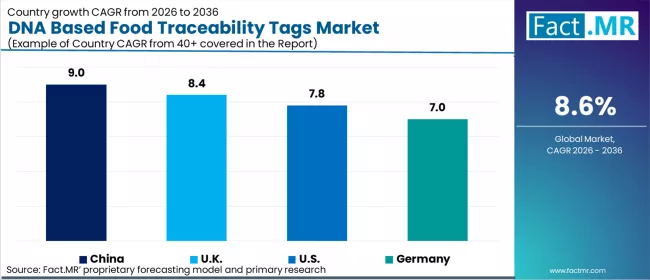
| Country | CAGR (%) |
|---|---|
| U.S. | 7.8% |
| China | 9.0% |
| Germany | 7.0% |
| U.K. | 8.4% |
| Japan | 8.1% |
| France | 7.8% |
| Canada | 8.3% |
| India | 10.3% |
Source: Fact MR (FMR) analysis, based on proprietary forecasting model and primary research.
North America - The Regulatory Commercialization Leader
North America serves as the regulatory commercialization leader, where compliance mandates translate quickly into enterprise-level deployment. Applied DNA Sciences anchors proprietary molecular tagging solutions, while Thermo Fisher Scientific and Bio-Rad Laboratories dominate detection infrastructure through extensive PCR installed bases. Strong FDA oversight, advanced laboratory accreditation systems, and retailer-driven supplier verification programs position the region at the forefront of applied DNA authentication.
- U.S.: Demand for DNA-based food traceability tags in the U.S. is projected to rise at 7.8% CAGR through 2030.
Growth is closely linked to regulatory modernization under the Food Safety Modernization Act (FSMA). In November 2022, the U.S. FDA issued the Food Traceability Final Rule, initiating phased compliance requirements through 2026 for high-risk foods, compelling enhanced recordkeeping and traceability validation. This regulatory shift strengthens the case for molecular-level authentication beyond traditional barcodes. Additionally, in March 2023, the USDA updated enforcement guidance on Country-of-Origin Labeling (COOL) for meat products, increasing scrutiny of imported beef and processed meat labeling practices. These measures have prompted exporters and retailers to explore forensic verification technologies. On the corporate front, Applied DNA Sciences expanded commercialization of its CertainT® traceability platform in July 2024, reinforcing enterprise-level adoption. The U.S. benefits from a strong network of accredited laboratories and a large PCR/NGS instrument base, reducing verification costs. However, adoption remains concentrated in premium and high-risk categories due to cost considerations in bulk commodity supply chains.
FACT.MR Callout - North America
FACT.MR's analysis of the DNA-Based Food Traceability Tags Market in North America consists of country-wise assessment that includes the U.S. and Canada. Readers can find regulatory impact evaluation, enterprise deployment trends, and competitive positioning insights.
Western Europe - The Global Authenticity Enforcement Hub
Western Europe functions as the global authenticity enforcement hub, characterized by strict anti-food fraud legislation and geographic indication protection systems. Eurofins Scientific, SGS, and Mérieux NutriSciences maintain dominant laboratory networks across the region. EU-wide regulatory harmonization and enforcement under official control regulations create fertile ground for high-assurance authentication technologies, particularly in export-oriented meat, dairy, and specialty food categories.
- Germany: Demand for DNA-based food traceability tags in Germany is projected to rise at 7.0% CAGR through 2030.
Germany’s growth is driven by enforcement of EU Regulation (EU) 2017/625 on official controls, reinforced through implementation updates in 2023 requiring stronger fraud detection measures. In April 2023, Germany’s Federal Office of Consumer Protection and Food Safety (BVL) expanded coordinated food fraud monitoring initiatives targeting imported meat and processed goods. Germany’s participation in the EU Farm to Fork Strategy implementation roadmap, updated in 2023, also prioritizes digital traceability and authenticity controls. Industrial activity further supports adoption; Eurofins announced food testing capacity enhancements in Germany in 2023 to strengthen molecular authentication services. As one of Europe’s largest food exporters, Germany faces strict compliance obligations for intra-EU and global trade, encouraging advanced traceability adoption. Nonetheless, mid-sized processors remain cost-sensitive, moderating universal deployment across all segments.
FACT.MR Callout - Western Europe
FACT.MR's analysis of the DNA-Based Food Traceability Tags Market in Western Europe consists of country-wise assessment that includes Germany, U.K., and France. Readers can find insights into authenticity enforcement, GI protection impact, and laboratory capacity trends.
East Asia - The Scale-Driven Modernization Engine
East Asia acts as the scale-driven modernization engine, combining large domestic consumption with rising export scrutiny. Illumina and Oxford Nanopore Technologies support sequencing infrastructure, while SGS and Intertek expand verification services. Regulatory strengthening and digital agriculture initiatives underpin adoption of advanced authentication technologies.
- China: Demand for DNA-based food traceability tags in China is projected to rise at 9.0% CAGR through 2030.
China’s growth trajectory reflects regulatory tightening and digital traceability integration. In 2023, the State Administration for Market Regulation (SAMR) intensified national food safety inspection campaigns targeting adulterated meat and seafood imports. Furthermore, China’s Digital Agriculture and Rural Development Plan (2023-2025) emphasizes blockchain-enabled supply chain tracking systems, creating integration opportunities for molecular authentication. Exporters supplying EU and U.S. markets must comply with stringent traceability documentation, encouraging adoption of advanced verification tools. Illumina expanded sequencing collaborations in China in 2023 to support food safety laboratory capabilities. Large state-backed enterprises lead implementation, while smaller domestic producers adopt gradually due to cost pressures.
FACT.MR Callout - East Asia
FACT.MR's analysis of the DNA-Based Food Traceability Tags Market in East Asia consists of country-wise assessment that includes China and Japan. Readers can find insights on regulatory modernization, sequencing adoption, and export-driven compliance trends.
South Asia & Pacific - The Export Compliance Accelerator
South Asia & Pacific serves as the export compliance accelerator, where international trade requirements drive traceability investment. Government-backed digital traceability systems and laboratory upgrades support authentication technology expansion.
- India: Demand for DNA-based food traceability tags in India is projected to rise at 10.3% CAGR through 2030.
India records the fastest growth among key countries, largely due to export-driven compliance mandates. In 2023, the Food Safety and Standards Authority of India (FSSAI) advanced digital compliance initiatives strengthening traceability monitoring. Additionally, the Agricultural and Processed Food Products Export Development Authority (APEDA) enhanced its TraceNet platform in June 2023 to improve organic and agricultural export traceability. Government-backed laboratory modernization programs initiated in 2023 have upgraded molecular testing infrastructure nationwide. India’s expanding seafood and spice exports to regulated markets increase demand for high-assurance authentication tools. While domestic supply chains remain fragmented, export clusters increasingly adopt advanced traceability solutions to secure global market access.
FACT.MR Callout - South Asia & Pacific
FACT.MR's analysis of the DNA-Based Food Traceability Tags Market in South Asia & Pacific consists of country-wise assessment that includes India and ASEAN markets. Readers can find export-led growth analysis, regulatory developments, and infrastructure investment trends.
Is the DNA-Based Food Traceability Tags Market Competitive or Consolidated?
The DNA-Based Food Traceability Tags Market exhibits a semi-fragmented competitive structure. While a handful of established molecular diagnostics and testing companies such as Applied DNA Sciences, Eurofins Scientific, Thermo Fisher Scientific, Bio-Rad Laboratories, QIAGEN, and Illumina anchor the technological backbone of the market, numerous niche traceability and tagging specialists such as Haelixa, Tagsmart, and SelectaDNA operate in targeted authentication applications. The top 5-6 players collectively account for a significant share of market revenues, particularly where testing services and molecular platforms dominate. However, because tagging, detection, and verification services are distributed across different layers of the value chain, the overall structure remains moderately fragmented. The primary competitive variable is technological reliability combined with verification credibility, followed by scalability and cost efficiency.
Companies with structural advantages are those possessing vertically integrated capabilities across DNA synthesis, assay development, testing infrastructure, and digital traceability platforms. Applied DNA Sciences benefits from proprietary DNA tag manufacturing and its CertainT platform integration, while Eurofins, SGS, Intertek Group, and Mérieux NutriSciences leverage extensive global laboratory networks and long-term relationships with food producers and regulators. Instrumentation leaders such as Thermo Fisher Scientific, Illumina, Oxford Nanopore Technologies, and QIAGEN maintain technological advantages through installed base dominance, reagent ecosystems, and recurring consumables revenue models. These integrated ecosystems create switching barriers and reinforce recurring demand.
Buyer behavior in this market is risk-sensitive and compliance-driven. Large food processors, exporters, and retailers typically adopt multi-supplier strategies to avoid overdependence on a single authentication provider, particularly for regulated export categories. Many buyers conduct pilot programs before scaling contracts and negotiate bundled pricing for tagging, testing, and verification services. As a result, pricing power is moderate rather than absolute; suppliers with proprietary tagging chemistry and validated regulatory acceptance retain stronger margins, while commoditized testing services face greater pricing pressure. Overall, long-term contracts and compliance requirements provide some revenue visibility, but competitive bidding remains common in large-scale deployments.
Recent Industry Developments
- Partnership - Applied DNA Sciences & Indus Group (July 25, 2024): Applied DNA Sciences signed a five-year commercialization agreement with Indus Group for large-scale implementation of its CertainT® DNA traceability platform across cotton supply chains.
- Pilot Project - Applied DNA Sciences Selected by LRQA (September 4, 2024): Applied DNA Sciences was subcontracted by LRQA to conduct an isotopic testing pilot using its CertainT® platform in Pakistan, combining DNA tagging with isotope analysis for enhanced traceability verification.
- Traceability Platform Featured in Media (April 7, 2023): Applied DNA’s CertainT® supply chain traceability platform was highlighted in a news article emphasizing its role in boosting transparency and compliance under new regulations.
Key Players of the DNA Based Food Traceability Tags Market
- Applied DNA Sciences
- Eurofins Scientific
- Thermo Fisher Scientific
- Bio-Rad Laboratories
- Neogen Corporation
- QIAGEN
- Illumina
- Oxford Nanopore Technologies
- SGS
- Intertek Group
- Mérieux NutriSciences
- Ampacet
Report Scope
| Metric | Value |
|---|---|
| Quantitative Units | USD 963.4 million (2026) to USD 2,198.4 million (2036), at a CAGR of 8.6% |
| Market Definition | The DNA-Based Food Traceability Tags Market comprises molecular tagging solutions that use synthetic DNA markers to authenticate, trace, and verify food products across supply chains, ensuring origin transparency, regulatory compliance, and anti-counterfeiting protection. |
| By Product | Synthetic DNA Taggants, DNA Barcodes / Oligo Labels, DNA-Enabled Labels & Inks, Kits & Reagents, Testing & Verification Services |
| By Technology / Detection Method | qPCR / Endpoint PCR, Next-Generation Sequencing (NGS), Multi-Proof Integration (DNA + Isotope/Chemical Markers) |
| By Form / Deployment | Surface-Applied Taggants, Packaging-Embedded Tags (Labels, Inks, Fibers), Ingredient-Level Tagging |
| By Commercial Model | Product Sales (Taggants & Kits), Testing-as-a-Service (TaaS), Platform / SaaS Subscription, Integrated End-to-End Solutions |
| By Application / Food Type | Meat & Poultry, Seafood & Fish, Fruits & Vegetables, Spices, Oils & Processed Foods, Dairy & Eggs |
| By End-User | Farms / Primary Producers, Food Processors / Co-Packers, Retailers & Brands, Certifiers / Auditors / Regulatory Bodies |
| Regions Covered | North America, Latin America, Europe, East Asia, South Asia, Oceania, Middle East and Africa |
| Countries Covered | United States, Canada, Mexico, Brazil, Argentina, Germany, France, United Kingdom, Italy, Spain, China, India, Japan, South Korea, Indonesia, Australia, and 40+ countries |
| Key Companies Profiled | Applied DNA Sciences, Eurofins Scientific, Thermo Fisher Scientific, Bio-Rad Laboratories, Neogen Corporation, QIAGEN, Illumina, Oxford Nanopore Technologies |
| Forecast Period | 2026 to 2036 |
| Approach | Hybrid top-down and bottom-up market modeling validated through primary interviews with manufacturers and supported by trade data benchmarking and market research. |
DNA Based Food Traceability Tags Market Key Segments
-
By Product :
- Synthetic DNA Taggants
- DNA Barcodes / Oligo Labels
- DNA-Enabled Labels & Inks
- Kits & Reagents
- Testing & Verification Services
-
By Technology / Detection Method :
- qPCR / Endpoint PCR
- Next-Generation Sequencing (NGS)
- Multi-Proof Integration (DNA + Isotope/Chemical Markers)
-
By Form / Deployment :
- Surface-Applied Taggants
- Packaging-Embedded Tags (Labels, Inks, Fibers)
- Ingredient-Level Tagging
-
By Commercial Model :
- Product Sales (Taggants & Kits)
- Testing-as-a-Service (TaaS)
- Platform / SaaS Subscription
- Integrated End-to-End Solutions
-
By Application / Food Type :
- Meat & Poultry
- Seafood & Fish
- Fruits & Vegetables
- Spices, Oils & Processed Foods
- Dairy & Eggs
-
By End-User :
- Farms / Primary Producers
- Food Processors / Co-Packers
- Retailers & Brands
- Certifiers / Auditors / Regulatory Bodies
-
Region :
- North America
- USA
- Canada
- Mexico
- Europe
- Germany
- UK
- France
- Italy
- Spain
- Nordic Countries
- BENELUX
- Rest of Europe
- Asia Pacific
- China
- Japan
- South Korea
- India
- Australia
- Rest of Asia Pacific
- Latin America
- Brazil
- Argentina
- Rest of Latin America
- Middle East and Africa
- Kingdom of Saudi Arabia
- United Arab Emirates
- South Africa
- Rest of Middle East and Africa
- Other Regions
- Oceania
- Central Asia
- Other Markets
- North America
Bibliographies
- [1] Applied DNA Sciences, Applied DNA and Indus Group Sign Five-Year Commercialization Agreement for CertainT® Traceability Platform, July 2024.
- [2] Business Wire, Applied DNA’s CertainT® Supply Chain Traceability Platform Featured in New York Times Article About the Need for Transparency and Compliance in Global Supply Chains Under Recently Passed U.S. Federal Regulation, April 2023.
- [3] U.S. Food and Drug Administration (FDA), FSMA Final Rule on Requirements for Additional Traceability Records for Certain Foods, November 2022.
- [4] Eurofins Scientific, Food Authenticity & Meat Traceability Services Overview, 2023.
- [5] Oxford Nanopore Technologies, Transforming Food Safety with Oxford Nanopore Sequencing, 2023.
- [6] U.S. Department of Agriculture (USDA), USDA Strengthens Country-of-Origin Labeling (COOL) Enforcement for Meat Products, March 2023.
- [7] Applied DNA Sciences, Applied DNA and Indus Group Sign Five-Year Commercialization Agreement for CertainT® Traceability Platform, July 2024.
- [8] Applied DNA Sciences, Applied DNA Selected by LRQA for Isotopic Testing Pilot Project in Pakistan Using CertainT® Platform, September 2024.
- [9] Business Wire, Applied DNA’s CertainT® Platform Featured in Supply Chain Transparency Coverage, April 2023.
Table of Content
- Executive Summary
- Global Market Outlook
- Demand-side Trends
- Supply-side Trends
- Technology Roadmap Analysis
- Analysis and Recommendations
- Market Overview
- Market Coverage / Taxonomy
- Market Definition / Scope / Limitations
- Market Background
- Market Dynamics
- Drivers
- Restraints
- Opportunity
- Trends
- Scenario Forecast
- Demand in Optimistic Scenario
- Demand in Likely Scenario
- Demand in Conservative Scenario
- Opportunity Map Analysis
- Product Life Cycle Analysis
- Supply Chain Analysis
- Investment Feasibility Matrix
- Value Chain Analysis
- PESTLE and Porter’s Analysis
- Regulatory Landscape
- Regional Parent Market Outlook
- Production and Consumption Statistics
- Import and Export Statistics
- Market Dynamics
- Global Market Analysis 2020-2024 and Forecast, 2025-2035
- Historical Market Size Value (USD Mn) & Units Analysis, 2020-2024
- Current and Future Market Size Value (USD Mn) & Units Projections, 2025-2035
- Y-o-Y Growth Trend Analysis
- Absolute $ Opportunity Analysis
- Global Market Pricing Analysis 2020-2024 and Forecast 2025-2035
- Global Market Analysis 2020-2024 and Forecast 2025-2035, By Product
- Introduction / Key Findings
- Historical Market Size Value (USD Mn) & Units Analysis By Product, 2020-2024
- Current and Future Market Size Value (USD Mn) & Units Analysis and Forecast By Product, 2025-2035
- Synthetic DNA Taggants
- DNA Barcodes / Oligo Labels
- DNA-Enabled Labels & Inks
- Kits & Reagents
- Testing & Verification Services
- Y-o-Y Growth Trend Analysis By Product, 2020-2024
- Absolute $ Opportunity Analysis By Product, 2025-2035
- Global Market Analysis 2020-2024 and Forecast 2025-2035, By Technology / Detection Method
- Introduction / Key Findings
- Historical Market Size Value (USD Mn) & Units Analysis By Technology / Detection Method, 2020-2024
- Current and Future Market Size Value (USD Mn) & Units Analysis and Forecast By Technology / Detection Method, 2025-2035
- qPCR / Endpoint PCR
- Next-Generation Sequencing (NGS)
- Multi-Proof Integration (DNA + Isotope/Chemical Markers)
- Y-o-Y Growth Trend Analysis By Technology / Detection Method, 2020-2024
- Absolute $ Opportunity Analysis By Technology / Detection Method, 2025-2035
- Global Market Analysis 2020-2024 and Forecast 2025-2035, By Form / Deployment
- Introduction / Key Findings
- Historical Market Size Value (USD Mn) & Units Analysis By Form / Deployment, 2020-2024
- Current and Future Market Size Value (USD Mn) & Units Analysis and Forecast By Form / Deployment, 2025-2035
- Surface-Applied Taggants
- Packaging-Embedded Tags (Labels, Inks, Fibers)
- Ingredient-Level Tagging
- Y-o-Y Growth Trend Analysis By Form / Deployment, 2020-2024
- Absolute $ Opportunity Analysis By Form / Deployment, 2025-2035
- Global Market Analysis 2020-2024 and Forecast 2025-2035, By Commercial Model
- Introduction / Key Findings
- Historical Market Size Value (USD Mn) & Units Analysis By Commercial Model, 2020-2024
- Current and Future Market Size Value (USD Mn) & Units Analysis and Forecast By Commercial Model, 2025-2035
- Product Sales (Taggants & Kits)
- Testing-as-a-Service (TaaS)
- Platform / SaaS Subscription
- Integrated End-to-End Solutions
- Y-o-Y Growth Trend Analysis By Commercial Model, 2020-2024
- Absolute $ Opportunity Analysis By Commercial Model, 2025-2035
- Global Market Analysis 2020-2024 and Forecast 2025-2035, By Application / Food Type
- Introduction / Key Findings
- Historical Market Size Value (USD Mn) & Units Analysis By Application / Food Type, 2020-2024
- Current and Future Market Size Value (USD Mn) & Units Analysis and Forecast By Application / Food Type, 2025-2035
- Meat & Poultry
- Seafood & Fish
- Fruits & Vegetables
- Spices, Oils & Processed Foods
- Dairy & Eggs
- Y-o-Y Growth Trend Analysis By Application / Food Type, 2020-2024
- Absolute $ Opportunity Analysis By Application / Food Type, 2025-2035
- Global Market Analysis 2020-2024 and Forecast 2025-2035, By End-User
- Introduction / Key Findings
- Historical Market Size Value (USD Mn) & Units Analysis By End-User, 2020-2024
- Current and Future Market Size Value (USD Mn) & Units Analysis and Forecast By End-User, 2025-2035
- Farms / Primary Producers
- Food Processors / Co-Packers
- Retailers & Brands
- Certifiers / Auditors / Regulatory Bodies
- Y-o-Y Growth Trend Analysis By End-User, 2020-2024
- Absolute $ Opportunity Analysis By End-User, 2025-2035
- Global Market Analysis 2020-2024 and Forecast 2025-2035, By Region
- Introduction
- Historical Market Size Value (USD Mn) & Units Analysis By Region, 2020-2024
- Current Market Size Value (USD Mn) & Units Analysis and Forecast By Region, 2025-2035
- North America
- Latin America
- Western Europe
- Eastern Europe
- East Asia
- South Asia and Pacific
- Middle East & Africa
- Market Attractiveness Analysis By Region
- North America Market Analysis 2020-2024 and Forecast 2025-2035, By Country
- Historical Market Size Value (USD Mn) & Units Trend Analysis By Market Taxonomy, 2020-2024
- Market Size Value (USD Mn) & Units Forecast By Market Taxonomy, 2025-2035
- By Country
- U.S.
- Canada
- Mexico
- By Product
- By Technology / Detection Method
- By Form / Deployment
- By Commercial Model
- By Application / Food Type
- By End-User
- By Country
- Market Attractiveness Analysis
- By Country
- By Product
- By Technology / Detection Method
- By Form / Deployment
- By Commercial Model
- By Application / Food Type
- By End-User
- Key Takeaways
- Latin America Market Analysis 2020-2024 and Forecast 2025-2035, By Country
- Historical Market Size Value (USD Mn) & Units Trend Analysis By Market Taxonomy, 2020-2024
- Market Size Value (USD Mn) & Units Forecast By Market Taxonomy, 2025-2035
- By Country
- Brazil
- Chile
- Rest of Latin America
- By Product
- By Technology / Detection Method
- By Form / Deployment
- By Commercial Model
- By Application / Food Type
- By End-User
- By Country
- Market Attractiveness Analysis
- By Country
- By Product
- By Technology / Detection Method
- By Form / Deployment
- By Commercial Model
- By Application / Food Type
- By End-User
- Key Takeaways
- Western Europe Market Analysis 2020-2024 and Forecast 2025-2035, By Country
- Historical Market Size Value (USD Mn) & Units Trend Analysis By Market Taxonomy, 2020-2024
- Market Size Value (USD Mn) & Units Forecast By Market Taxonomy, 2025-2035
- By Country
- Germany
- U.K.
- Italy
- Spain
- France
- Nordic
- BENELUX
- Rest of Western Europe
- By Product
- By Technology / Detection Method
- By Form / Deployment
- By Commercial Model
- By Application / Food Type
- By End-User
- By Country
- Market Attractiveness Analysis
- By Country
- By Product
- By Technology / Detection Method
- By Form / Deployment
- By Commercial Model
- By Application / Food Type
- By End-User
- Key Takeaways
- Eastern Europe Market Analysis 2020-2024 and Forecast 2025-2035, By Country
- Historical Market Size Value (USD Mn) & Units Trend Analysis By Market Taxonomy, 2020-2024
- Market Size Value (USD Mn) & Units Forecast By Market Taxonomy, 2025-2035
- By Country
- Russia
- Poland
- Hungary
- Balkan & Baltic
- Rest of Eastern Europe
- By Product
- By Technology / Detection Method
- By Form / Deployment
- By Commercial Model
- By Application / Food Type
- By End-User
- By Country
- Market Attractiveness Analysis
- By Country
- By Product
- By Technology / Detection Method
- By Form / Deployment
- By Commercial Model
- By Application / Food Type
- By End-User
- Key Takeaways
- East Asia Market Analysis 2020-2024 and Forecast 2025-2035, By Country
- Historical Market Size Value (USD Mn) & Units Trend Analysis By Market Taxonomy, 2020-2024
- Market Size Value (USD Mn) & Units Forecast By Market Taxonomy, 2025-2035
- By Country
- China
- Japan
- South Korea
- By Product
- By Technology / Detection Method
- By Form / Deployment
- By Commercial Model
- By Application / Food Type
- By End-User
- By Country
- Market Attractiveness Analysis
- By Country
- By Product
- By Technology / Detection Method
- By Form / Deployment
- By Commercial Model
- By Application / Food Type
- By End-User
- Key Takeaways
- South Asia and Pacific Market Analysis 2020-2024 and Forecast 2025-2035, By Country
- Historical Market Size Value (USD Mn) & Units Trend Analysis By Market Taxonomy, 2020-2024
- Market Size Value (USD Mn) & Units Forecast By Market Taxonomy, 2025-2035
- By Country
- India
- ASEAN
- Australia & New Zealand
- Rest of South Asia and Pacific
- By Product
- By Technology / Detection Method
- By Form / Deployment
- By Commercial Model
- By Application / Food Type
- By End-User
- By Country
- Market Attractiveness Analysis
- By Country
- By Product
- By Technology / Detection Method
- By Form / Deployment
- By Commercial Model
- By Application / Food Type
- By End-User
- Key Takeaways
- Middle East & Africa Market Analysis 2020-2024 and Forecast 2025-2035, By Country
- Historical Market Size Value (USD Mn) & Units Trend Analysis By Market Taxonomy, 2020-2024
- Market Size Value (USD Mn) & Units Forecast By Market Taxonomy, 2025-2035
- By Country
- Kingdom of Saudi Arabia
- Other GCC Countries
- Turkiye
- South Africa
- Other African Union
- Rest of Middle East & Africa
- By Product
- By Technology / Detection Method
- By Form / Deployment
- By Commercial Model
- By Application / Food Type
- By End-User
- By Country
- Market Attractiveness Analysis
- By Country
- By Product
- By Technology / Detection Method
- By Form / Deployment
- By Commercial Model
- By Application / Food Type
- By End-User
- Key Takeaways
- Key Countries Market Analysis
- U.S.
- Pricing Analysis
- Market Share Analysis, 2024
- By Product
- By Technology / Detection Method
- By Form / Deployment
- By Commercial Model
- By Application / Food Type
- By End-User
- Canada
- Pricing Analysis
- Market Share Analysis, 2024
- By Product
- By Technology / Detection Method
- By Form / Deployment
- By Commercial Model
- By Application / Food Type
- By End-User
- Mexico
- Pricing Analysis
- Market Share Analysis, 2024
- By Product
- By Technology / Detection Method
- By Form / Deployment
- By Commercial Model
- By Application / Food Type
- By End-User
- Brazil
- Pricing Analysis
- Market Share Analysis, 2024
- By Product
- By Technology / Detection Method
- By Form / Deployment
- By Commercial Model
- By Application / Food Type
- By End-User
- Chile
- Pricing Analysis
- Market Share Analysis, 2024
- By Product
- By Technology / Detection Method
- By Form / Deployment
- By Commercial Model
- By Application / Food Type
- By End-User
- Germany
- Pricing Analysis
- Market Share Analysis, 2024
- By Product
- By Technology / Detection Method
- By Form / Deployment
- By Commercial Model
- By Application / Food Type
- By End-User
- U.K.
- Pricing Analysis
- Market Share Analysis, 2024
- By Product
- By Technology / Detection Method
- By Form / Deployment
- By Commercial Model
- By Application / Food Type
- By End-User
- Italy
- Pricing Analysis
- Market Share Analysis, 2024
- By Product
- By Technology / Detection Method
- By Form / Deployment
- By Commercial Model
- By Application / Food Type
- By End-User
- Spain
- Pricing Analysis
- Market Share Analysis, 2024
- By Product
- By Technology / Detection Method
- By Form / Deployment
- By Commercial Model
- By Application / Food Type
- By End-User
- France
- Pricing Analysis
- Market Share Analysis, 2024
- By Product
- By Technology / Detection Method
- By Form / Deployment
- By Commercial Model
- By Application / Food Type
- By End-User
- India
- Pricing Analysis
- Market Share Analysis, 2024
- By Product
- By Technology / Detection Method
- By Form / Deployment
- By Commercial Model
- By Application / Food Type
- By End-User
- ASEAN
- Pricing Analysis
- Market Share Analysis, 2024
- By Product
- By Technology / Detection Method
- By Form / Deployment
- By Commercial Model
- By Application / Food Type
- By End-User
- Australia & New Zealand
- Pricing Analysis
- Market Share Analysis, 2024
- By Product
- By Technology / Detection Method
- By Form / Deployment
- By Commercial Model
- By Application / Food Type
- By End-User
- China
- Pricing Analysis
- Market Share Analysis, 2024
- By Product
- By Technology / Detection Method
- By Form / Deployment
- By Commercial Model
- By Application / Food Type
- By End-User
- Japan
- Pricing Analysis
- Market Share Analysis, 2024
- By Product
- By Technology / Detection Method
- By Form / Deployment
- By Commercial Model
- By Application / Food Type
- By End-User
- South Korea
- Pricing Analysis
- Market Share Analysis, 2024
- By Product
- By Technology / Detection Method
- By Form / Deployment
- By Commercial Model
- By Application / Food Type
- By End-User
- Russia
- Pricing Analysis
- Market Share Analysis, 2024
- By Product
- By Technology / Detection Method
- By Form / Deployment
- By Commercial Model
- By Application / Food Type
- By End-User
- Poland
- Pricing Analysis
- Market Share Analysis, 2024
- By Product
- By Technology / Detection Method
- By Form / Deployment
- By Commercial Model
- By Application / Food Type
- By End-User
- Hungary
- Pricing Analysis
- Market Share Analysis, 2024
- By Product
- By Technology / Detection Method
- By Form / Deployment
- By Commercial Model
- By Application / Food Type
- By End-User
- Kingdom of Saudi Arabia
- Pricing Analysis
- Market Share Analysis, 2024
- By Product
- By Technology / Detection Method
- By Form / Deployment
- By Commercial Model
- By Application / Food Type
- By End-User
- Turkiye
- Pricing Analysis
- Market Share Analysis, 2024
- By Product
- By Technology / Detection Method
- By Form / Deployment
- By Commercial Model
- By Application / Food Type
- By End-User
- South Africa
- Pricing Analysis
- Market Share Analysis, 2024
- By Product
- By Technology / Detection Method
- By Form / Deployment
- By Commercial Model
- By Application / Food Type
- By End-User
- U.S.
- Market Structure Analysis
- Competition Dashboard
- Competition Benchmarking
- Market Share Analysis of Top Players
- By Regional
- By Product
- By Technology / Detection Method
- By Form / Deployment
- By Commercial Model
- By Application / Food Type
- By End-User
- Competition Analysis
- Competition Deep Dive
- Applied DNA Sciences
- Overview
- Product Portfolio
- Profitability by Market Segments (Product/Age /Sales Channel/Region)
- Sales Footprint
- Strategy Overview
- Eurofins Scientific
- Thermo Fisher Scientific
- Bio-Rad Laboratories
- Neogen Corporation
- QIAGEN
- Illumina
- Oxford Nanopore Technologies
- SGS
- Intertek Group
- Mérieux NutriSciences
- Ampacet
- Tagsmart
- Haelixa
- SelectaDNA
- Applied DNA Sciences
- Assumptions & Acronyms Used
- Research Methodology
- Competition Deep Dive
List Of Table
- Table 1: Global Market Value (USD Mn) Forecast by Region, 2021 to 2036
- Table 2: Global Market Units Forecast by Region, 2021 to 2036
- Table 3: Global Market Value (USD Mn) Forecast by Product, 2021 to 2036
- Table 4: Global Market Units Forecast by Product, 2021 to 2036
- Table 5: Global Market Value (USD Mn) Forecast by Technology / Detection Method, 2021 to 2036
- Table 6: Global Market Units Forecast by Technology / Detection Method, 2021 to 2036
- Table 7: Global Market Value (USD Mn) Forecast by Form / Deployment, 2021 to 2036
- Table 8: Global Market Units Forecast by Form / Deployment, 2021 to 2036
- Table 9: Global Market Value (USD Mn) Forecast by Commercial Model, 2021 to 2036
- Table 10: Global Market Units Forecast by Commercial Model, 2021 to 2036
- Table 11: Global Market Value (USD Mn) Forecast by Application / Food Type, 2021 to 2036
- Table 12: Global Market Units Forecast by Application / Food Type, 2021 to 2036
- Table 13: Global Market Value (USD Mn) Forecast by End-User, 2021 to 2036
- Table 14: Global Market Units Forecast by End-User, 2021 to 2036
- Table 15: North America Market Value (USD Mn) Forecast by Country, 2021 to 2036
- Table 16: North America Market Units Forecast by Country, 2021 to 2036
- Table 17: North America Market Value (USD Mn) Forecast by Product, 2021 to 2036
- Table 18: North America Market Units Forecast by Product, 2021 to 2036
- Table 19: North America Market Value (USD Mn) Forecast by Technology / Detection Method, 2021 to 2036
- Table 20: North America Market Units Forecast by Technology / Detection Method, 2021 to 2036
- Table 21: North America Market Value (USD Mn) Forecast by Form / Deployment, 2021 to 2036
- Table 22: North America Market Units Forecast by Form / Deployment, 2021 to 2036
- Table 23: North America Market Value (USD Mn) Forecast by Commercial Model, 2021 to 2036
- Table 24: North America Market Units Forecast by Commercial Model, 2021 to 2036
- Table 25: North America Market Value (USD Mn) Forecast by Application / Food Type, 2021 to 2036
- Table 26: North America Market Units Forecast by Application / Food Type, 2021 to 2036
- Table 27: North America Market Value (USD Mn) Forecast by End-User, 2021 to 2036
- Table 28: North America Market Units Forecast by End-User, 2021 to 2036
- Table 29: Latin America Market Value (USD Mn) Forecast by Country, 2021 to 2036
- Table 30: Latin America Market Units Forecast by Country, 2021 to 2036
- Table 31: Latin America Market Value (USD Mn) Forecast by Product, 2021 to 2036
- Table 32: Latin America Market Units Forecast by Product, 2021 to 2036
- Table 33: Latin America Market Value (USD Mn) Forecast by Technology / Detection Method, 2021 to 2036
- Table 34: Latin America Market Units Forecast by Technology / Detection Method, 2021 to 2036
- Table 35: Latin America Market Value (USD Mn) Forecast by Form / Deployment, 2021 to 2036
- Table 36: Latin America Market Units Forecast by Form / Deployment, 2021 to 2036
- Table 37: Latin America Market Value (USD Mn) Forecast by Commercial Model, 2021 to 2036
- Table 38: Latin America Market Units Forecast by Commercial Model, 2021 to 2036
- Table 39: Latin America Market Value (USD Mn) Forecast by Application / Food Type, 2021 to 2036
- Table 40: Latin America Market Units Forecast by Application / Food Type, 2021 to 2036
- Table 41: Latin America Market Value (USD Mn) Forecast by End-User, 2021 to 2036
- Table 42: Latin America Market Units Forecast by End-User, 2021 to 2036
- Table 43: Western Europe Market Value (USD Mn) Forecast by Country, 2021 to 2036
- Table 44: Western Europe Market Units Forecast by Country, 2021 to 2036
- Table 45: Western Europe Market Value (USD Mn) Forecast by Product, 2021 to 2036
- Table 46: Western Europe Market Units Forecast by Product, 2021 to 2036
- Table 47: Western Europe Market Value (USD Mn) Forecast by Technology / Detection Method, 2021 to 2036
- Table 48: Western Europe Market Units Forecast by Technology / Detection Method, 2021 to 2036
- Table 49: Western Europe Market Value (USD Mn) Forecast by Form / Deployment, 2021 to 2036
- Table 50: Western Europe Market Units Forecast by Form / Deployment, 2021 to 2036
- Table 51: Western Europe Market Value (USD Mn) Forecast by Commercial Model, 2021 to 2036
- Table 52: Western Europe Market Units Forecast by Commercial Model, 2021 to 2036
- Table 53: Western Europe Market Value (USD Mn) Forecast by Application / Food Type, 2021 to 2036
- Table 54: Western Europe Market Units Forecast by Application / Food Type, 2021 to 2036
- Table 55: Western Europe Market Value (USD Mn) Forecast by End-User, 2021 to 2036
- Table 56: Western Europe Market Units Forecast by End-User, 2021 to 2036
- Table 57: Eastern Europe Market Value (USD Mn) Forecast by Country, 2021 to 2036
- Table 58: Eastern Europe Market Units Forecast by Country, 2021 to 2036
- Table 59: Eastern Europe Market Value (USD Mn) Forecast by Product, 2021 to 2036
- Table 60: Eastern Europe Market Units Forecast by Product, 2021 to 2036
- Table 61: Eastern Europe Market Value (USD Mn) Forecast by Technology / Detection Method, 2021 to 2036
- Table 62: Eastern Europe Market Units Forecast by Technology / Detection Method, 2021 to 2036
- Table 63: Eastern Europe Market Value (USD Mn) Forecast by Form / Deployment, 2021 to 2036
- Table 64: Eastern Europe Market Units Forecast by Form / Deployment, 2021 to 2036
- Table 65: Eastern Europe Market Value (USD Mn) Forecast by Commercial Model, 2021 to 2036
- Table 66: Eastern Europe Market Units Forecast by Commercial Model, 2021 to 2036
- Table 67: Eastern Europe Market Value (USD Mn) Forecast by Application / Food Type, 2021 to 2036
- Table 68: Eastern Europe Market Units Forecast by Application / Food Type, 2021 to 2036
- Table 69: Eastern Europe Market Value (USD Mn) Forecast by End-User, 2021 to 2036
- Table 70: Eastern Europe Market Units Forecast by End-User, 2021 to 2036
- Table 71: East Asia Market Value (USD Mn) Forecast by Country, 2021 to 2036
- Table 72: East Asia Market Units Forecast by Country, 2021 to 2036
- Table 73: East Asia Market Value (USD Mn) Forecast by Product, 2021 to 2036
- Table 74: East Asia Market Units Forecast by Product, 2021 to 2036
- Table 75: East Asia Market Value (USD Mn) Forecast by Technology / Detection Method, 2021 to 2036
- Table 76: East Asia Market Units Forecast by Technology / Detection Method, 2021 to 2036
- Table 77: East Asia Market Value (USD Mn) Forecast by Form / Deployment, 2021 to 2036
- Table 78: East Asia Market Units Forecast by Form / Deployment, 2021 to 2036
- Table 79: East Asia Market Value (USD Mn) Forecast by Commercial Model, 2021 to 2036
- Table 80: East Asia Market Units Forecast by Commercial Model, 2021 to 2036
- Table 81: East Asia Market Value (USD Mn) Forecast by Application / Food Type, 2021 to 2036
- Table 82: East Asia Market Units Forecast by Application / Food Type, 2021 to 2036
- Table 83: East Asia Market Value (USD Mn) Forecast by End-User, 2021 to 2036
- Table 84: East Asia Market Units Forecast by End-User, 2021 to 2036
- Table 85: South Asia and Pacific Market Value (USD Mn) Forecast by Country, 2021 to 2036
- Table 86: South Asia and Pacific Market Units Forecast by Country, 2021 to 2036
- Table 87: South Asia and Pacific Market Value (USD Mn) Forecast by Product, 2021 to 2036
- Table 88: South Asia and Pacific Market Units Forecast by Product, 2021 to 2036
- Table 89: South Asia and Pacific Market Value (USD Mn) Forecast by Technology / Detection Method, 2021 to 2036
- Table 90: South Asia and Pacific Market Units Forecast by Technology / Detection Method, 2021 to 2036
- Table 91: South Asia and Pacific Market Value (USD Mn) Forecast by Form / Deployment, 2021 to 2036
- Table 92: South Asia and Pacific Market Units Forecast by Form / Deployment, 2021 to 2036
- Table 93: South Asia and Pacific Market Value (USD Mn) Forecast by Commercial Model, 2021 to 2036
- Table 94: South Asia and Pacific Market Units Forecast by Commercial Model, 2021 to 2036
- Table 95: South Asia and Pacific Market Value (USD Mn) Forecast by Application / Food Type, 2021 to 2036
- Table 96: South Asia and Pacific Market Units Forecast by Application / Food Type, 2021 to 2036
- Table 97: South Asia and Pacific Market Value (USD Mn) Forecast by End-User, 2021 to 2036
- Table 98: South Asia and Pacific Market Units Forecast by End-User, 2021 to 2036
- Table 99: Middle East & Africa Market Value (USD Mn) Forecast by Country, 2021 to 2036
- Table 100: Middle East & Africa Market Units Forecast by Country, 2021 to 2036
- Table 101: Middle East & Africa Market Value (USD Mn) Forecast by Product, 2021 to 2036
- Table 102: Middle East & Africa Market Units Forecast by Product, 2021 to 2036
- Table 103: Middle East & Africa Market Value (USD Mn) Forecast by Technology / Detection Method, 2021 to 2036
- Table 104: Middle East & Africa Market Units Forecast by Technology / Detection Method, 2021 to 2036
- Table 105: Middle East & Africa Market Value (USD Mn) Forecast by Form / Deployment, 2021 to 2036
- Table 106: Middle East & Africa Market Units Forecast by Form / Deployment, 2021 to 2036
- Table 107: Middle East & Africa Market Value (USD Mn) Forecast by Commercial Model, 2021 to 2036
- Table 108: Middle East & Africa Market Units Forecast by Commercial Model, 2021 to 2036
- Table 109: Middle East & Africa Market Value (USD Mn) Forecast by Application / Food Type, 2021 to 2036
- Table 110: Middle East & Africa Market Units Forecast by Application / Food Type, 2021 to 2036
- Table 111: Middle East & Africa Market Value (USD Mn) Forecast by End-User, 2021 to 2036
- Table 112: Middle East & Africa Market Units Forecast by End-User, 2021 to 2036
List Of Figures
- Figure 1: Global Market Units Forecast 2021 to 2036
- Figure 2: Global Market Pricing Analysis
- Figure 3: Global Market Value (USD Mn) Forecast 2021 to 2036
- Figure 4: Global Market Value Share and BPS Analysis by Product, 2025 and 2035
- Figure 5: Global Market Y-o-Y Growth Comparison by Product, 2026 to 2036
- Figure 6: Global Market Attractiveness Analysis by Product
- Figure 7: Global Market Value Share and BPS Analysis by Technology / Detection Method, 2025 and 2035
- Figure 8: Global Market Y-o-Y Growth Comparison by Technology / Detection Method, 2026 to 2036
- Figure 9: Global Market Attractiveness Analysis by Technology / Detection Method
- Figure 10: Global Market Value Share and BPS Analysis by Form / Deployment, 2025 and 2035
- Figure 11: Global Market Y-o-Y Growth Comparison by Form / Deployment, 2026 to 2036
- Figure 12: Global Market Attractiveness Analysis by Form / Deployment
- Figure 13: Global Market Value Share and BPS Analysis by Commercial Model, 2025 and 2035
- Figure 14: Global Market Y-o-Y Growth Comparison by Commercial Model, 2026 to 2036
- Figure 15: Global Market Attractiveness Analysis by Commercial Model
- Figure 16: Global Market Value Share and BPS Analysis by Application / Food Type, 2025 and 2035
- Figure 17: Global Market Y-o-Y Growth Comparison by Application / Food Type, 2026 to 2036
- Figure 18: Global Market Attractiveness Analysis by Application / Food Type
- Figure 19: Global Market Value Share and BPS Analysis by End-User, 2025 and 2035
- Figure 20: Global Market Y-o-Y Growth Comparison by End-User, 2026 to 2036
- Figure 21: Global Market Attractiveness Analysis by End-User
- Figure 22: Global Market Value (USD Mn) Share and BPS Analysis by Region, 2025 and 2035
- Figure 23: Global Market Y-o-Y Growth Comparison by Region, 2026 to 2036
- Figure 24: Global Market Attractiveness Analysis by Region
- Figure 25: North America Market Incremental $ Opportunity, 2026 to 2036
- Figure 26: Latin America Market Incremental $ Opportunity, 2026 to 2036
- Figure 27: Western Europe Market Incremental $ Opportunity, 2026 to 2036
- Figure 28: Eastern Europe Market Incremental $ Opportunity, 2026 to 2036
- Figure 29: East Asia Market Incremental $ Opportunity, 2026 to 2036
- Figure 30: South Asia and Pacific Market Incremental $ Opportunity, 2026 to 2036
- Figure 31: Middle East & Africa Market Incremental $ Opportunity, 2026 to 2036
- Figure 32: North America Market Value Share and BPS Analysis by Country, 2025 and 2035
- Figure 33: North America Market Value Share and BPS Analysis by Product, 2025 and 2035
- Figure 34: North America Market Y-o-Y Growth Comparison by Product, 2026 to 2036
- Figure 35: North America Market Attractiveness Analysis by Product
- Figure 36: North America Market Value Share and BPS Analysis by Technology / Detection Method, 2025 and 2035
- Figure 37: North America Market Y-o-Y Growth Comparison by Technology / Detection Method, 2026 to 2036
- Figure 38: North America Market Attractiveness Analysis by Technology / Detection Method
- Figure 39: North America Market Value Share and BPS Analysis by Form / Deployment, 2025 and 2035
- Figure 40: North America Market Y-o-Y Growth Comparison by Form / Deployment, 2026 to 2036
- Figure 41: North America Market Attractiveness Analysis by Form / Deployment
- Figure 42: North America Market Value Share and BPS Analysis by Commercial Model, 2025 and 2035
- Figure 43: North America Market Y-o-Y Growth Comparison by Commercial Model, 2026 to 2036
- Figure 44: North America Market Attractiveness Analysis by Commercial Model
- Figure 45: North America Market Value Share and BPS Analysis by Application / Food Type, 2025 and 2035
- Figure 46: North America Market Y-o-Y Growth Comparison by Application / Food Type, 2026 to 2036
- Figure 47: North America Market Attractiveness Analysis by Application / Food Type
- Figure 48: North America Market Value Share and BPS Analysis by End-User, 2025 and 2035
- Figure 49: North America Market Y-o-Y Growth Comparison by End-User, 2026 to 2036
- Figure 50: North America Market Attractiveness Analysis by End-User
- Figure 51: Latin America Market Value Share and BPS Analysis by Country, 2025 and 2035
- Figure 52: Latin America Market Value Share and BPS Analysis by Product, 2025 and 2035
- Figure 53: Latin America Market Y-o-Y Growth Comparison by Product, 2026 to 2036
- Figure 54: Latin America Market Attractiveness Analysis by Product
- Figure 55: Latin America Market Value Share and BPS Analysis by Technology / Detection Method, 2025 and 2035
- Figure 56: Latin America Market Y-o-Y Growth Comparison by Technology / Detection Method, 2026 to 2036
- Figure 57: Latin America Market Attractiveness Analysis by Technology / Detection Method
- Figure 58: Latin America Market Value Share and BPS Analysis by Form / Deployment, 2025 and 2035
- Figure 59: Latin America Market Y-o-Y Growth Comparison by Form / Deployment, 2026 to 2036
- Figure 60: Latin America Market Attractiveness Analysis by Form / Deployment
- Figure 61: Latin America Market Value Share and BPS Analysis by Commercial Model, 2025 and 2035
- Figure 62: Latin America Market Y-o-Y Growth Comparison by Commercial Model, 2026 to 2036
- Figure 63: Latin America Market Attractiveness Analysis by Commercial Model
- Figure 64: Latin America Market Value Share and BPS Analysis by Application / Food Type, 2025 and 2035
- Figure 65: Latin America Market Y-o-Y Growth Comparison by Application / Food Type, 2026 to 2036
- Figure 66: Latin America Market Attractiveness Analysis by Application / Food Type
- Figure 67: Latin America Market Value Share and BPS Analysis by End-User, 2025 and 2035
- Figure 68: Latin America Market Y-o-Y Growth Comparison by End-User, 2026 to 2036
- Figure 69: Latin America Market Attractiveness Analysis by End-User
- Figure 70: Western Europe Market Value Share and BPS Analysis by Country, 2025 and 2035
- Figure 71: Western Europe Market Value Share and BPS Analysis by Product, 2025 and 2035
- Figure 72: Western Europe Market Y-o-Y Growth Comparison by Product, 2026 to 2036
- Figure 73: Western Europe Market Attractiveness Analysis by Product
- Figure 74: Western Europe Market Value Share and BPS Analysis by Technology / Detection Method, 2025 and 2035
- Figure 75: Western Europe Market Y-o-Y Growth Comparison by Technology / Detection Method, 2026 to 2036
- Figure 76: Western Europe Market Attractiveness Analysis by Technology / Detection Method
- Figure 77: Western Europe Market Value Share and BPS Analysis by Form / Deployment, 2025 and 2035
- Figure 78: Western Europe Market Y-o-Y Growth Comparison by Form / Deployment, 2026 to 2036
- Figure 79: Western Europe Market Attractiveness Analysis by Form / Deployment
- Figure 80: Western Europe Market Value Share and BPS Analysis by Commercial Model, 2025 and 2035
- Figure 81: Western Europe Market Y-o-Y Growth Comparison by Commercial Model, 2026 to 2036
- Figure 82: Western Europe Market Attractiveness Analysis by Commercial Model
- Figure 83: Western Europe Market Value Share and BPS Analysis by Application / Food Type, 2025 and 2035
- Figure 84: Western Europe Market Y-o-Y Growth Comparison by Application / Food Type, 2026 to 2036
- Figure 85: Western Europe Market Attractiveness Analysis by Application / Food Type
- Figure 86: Western Europe Market Value Share and BPS Analysis by End-User, 2025 and 2035
- Figure 87: Western Europe Market Y-o-Y Growth Comparison by End-User, 2026 to 2036
- Figure 88: Western Europe Market Attractiveness Analysis by End-User
- Figure 89: Eastern Europe Market Value Share and BPS Analysis by Country, 2025 and 2035
- Figure 90: Eastern Europe Market Value Share and BPS Analysis by Product, 2025 and 2035
- Figure 91: Eastern Europe Market Y-o-Y Growth Comparison by Product, 2026 to 2036
- Figure 92: Eastern Europe Market Attractiveness Analysis by Product
- Figure 93: Eastern Europe Market Value Share and BPS Analysis by Technology / Detection Method, 2025 and 2035
- Figure 94: Eastern Europe Market Y-o-Y Growth Comparison by Technology / Detection Method, 2026 to 2036
- Figure 95: Eastern Europe Market Attractiveness Analysis by Technology / Detection Method
- Figure 96: Eastern Europe Market Value Share and BPS Analysis by Form / Deployment, 2025 and 2035
- Figure 97: Eastern Europe Market Y-o-Y Growth Comparison by Form / Deployment, 2026 to 2036
- Figure 98: Eastern Europe Market Attractiveness Analysis by Form / Deployment
- Figure 99: Eastern Europe Market Value Share and BPS Analysis by Commercial Model, 2025 and 2035
- Figure 100: Eastern Europe Market Y-o-Y Growth Comparison by Commercial Model, 2026 to 2036
- Figure 101: Eastern Europe Market Attractiveness Analysis by Commercial Model
- Figure 102: Eastern Europe Market Value Share and BPS Analysis by Application / Food Type, 2025 and 2035
- Figure 103: Eastern Europe Market Y-o-Y Growth Comparison by Application / Food Type, 2026 to 2036
- Figure 104: Eastern Europe Market Attractiveness Analysis by Application / Food Type
- Figure 105: Eastern Europe Market Value Share and BPS Analysis by End-User, 2025 and 2035
- Figure 106: Eastern Europe Market Y-o-Y Growth Comparison by End-User, 2026 to 2036
- Figure 107: Eastern Europe Market Attractiveness Analysis by End-User
- Figure 108: East Asia Market Value Share and BPS Analysis by Country, 2025 and 2035
- Figure 109: East Asia Market Value Share and BPS Analysis by Product, 2025 and 2035
- Figure 110: East Asia Market Y-o-Y Growth Comparison by Product, 2026 to 2036
- Figure 111: East Asia Market Attractiveness Analysis by Product
- Figure 112: East Asia Market Value Share and BPS Analysis by Technology / Detection Method, 2025 and 2035
- Figure 113: East Asia Market Y-o-Y Growth Comparison by Technology / Detection Method, 2026 to 2036
- Figure 114: East Asia Market Attractiveness Analysis by Technology / Detection Method
- Figure 115: East Asia Market Value Share and BPS Analysis by Form / Deployment, 2025 and 2035
- Figure 116: East Asia Market Y-o-Y Growth Comparison by Form / Deployment, 2026 to 2036
- Figure 117: East Asia Market Attractiveness Analysis by Form / Deployment
- Figure 118: East Asia Market Value Share and BPS Analysis by Commercial Model, 2025 and 2035
- Figure 119: East Asia Market Y-o-Y Growth Comparison by Commercial Model, 2026 to 2036
- Figure 120: East Asia Market Attractiveness Analysis by Commercial Model
- Figure 121: East Asia Market Value Share and BPS Analysis by Application / Food Type, 2025 and 2035
- Figure 122: East Asia Market Y-o-Y Growth Comparison by Application / Food Type, 2026 to 2036
- Figure 123: East Asia Market Attractiveness Analysis by Application / Food Type
- Figure 124: East Asia Market Value Share and BPS Analysis by End-User, 2025 and 2035
- Figure 125: East Asia Market Y-o-Y Growth Comparison by End-User, 2026 to 2036
- Figure 126: East Asia Market Attractiveness Analysis by End-User
- Figure 127: South Asia and Pacific Market Value Share and BPS Analysis by Country, 2025 and 2035
- Figure 128: South Asia and Pacific Market Value Share and BPS Analysis by Product, 2025 and 2035
- Figure 129: South Asia and Pacific Market Y-o-Y Growth Comparison by Product, 2026 to 2036
- Figure 130: South Asia and Pacific Market Attractiveness Analysis by Product
- Figure 131: South Asia and Pacific Market Value Share and BPS Analysis by Technology / Detection Method, 2025 and 2035
- Figure 132: South Asia and Pacific Market Y-o-Y Growth Comparison by Technology / Detection Method, 2026 to 2036
- Figure 133: South Asia and Pacific Market Attractiveness Analysis by Technology / Detection Method
- Figure 134: South Asia and Pacific Market Value Share and BPS Analysis by Form / Deployment, 2025 and 2035
- Figure 135: South Asia and Pacific Market Y-o-Y Growth Comparison by Form / Deployment, 2026 to 2036
- Figure 136: South Asia and Pacific Market Attractiveness Analysis by Form / Deployment
- Figure 137: South Asia and Pacific Market Value Share and BPS Analysis by Commercial Model, 2025 and 2035
- Figure 138: South Asia and Pacific Market Y-o-Y Growth Comparison by Commercial Model, 2026 to 2036
- Figure 139: South Asia and Pacific Market Attractiveness Analysis by Commercial Model
- Figure 140: South Asia and Pacific Market Value Share and BPS Analysis by Application / Food Type, 2025 and 2035
- Figure 141: South Asia and Pacific Market Y-o-Y Growth Comparison by Application / Food Type, 2026 to 2036
- Figure 142: South Asia and Pacific Market Attractiveness Analysis by Application / Food Type
- Figure 143: South Asia and Pacific Market Value Share and BPS Analysis by End-User, 2025 and 2035
- Figure 144: South Asia and Pacific Market Y-o-Y Growth Comparison by End-User, 2026 to 2036
- Figure 145: South Asia and Pacific Market Attractiveness Analysis by End-User
- Figure 146: Middle East & Africa Market Value Share and BPS Analysis by Country, 2025 and 2035
- Figure 147: Middle East & Africa Market Value Share and BPS Analysis by Product, 2025 and 2035
- Figure 148: Middle East & Africa Market Y-o-Y Growth Comparison by Product, 2026 to 2036
- Figure 149: Middle East & Africa Market Attractiveness Analysis by Product
- Figure 150: Middle East & Africa Market Value Share and BPS Analysis by Technology / Detection Method, 2025 and 2035
- Figure 151: Middle East & Africa Market Y-o-Y Growth Comparison by Technology / Detection Method, 2026 to 2036
- Figure 152: Middle East & Africa Market Attractiveness Analysis by Technology / Detection Method
- Figure 153: Middle East & Africa Market Value Share and BPS Analysis by Form / Deployment, 2025 and 2035
- Figure 154: Middle East & Africa Market Y-o-Y Growth Comparison by Form / Deployment, 2026 to 2036
- Figure 155: Middle East & Africa Market Attractiveness Analysis by Form / Deployment
- Figure 156: Middle East & Africa Market Value Share and BPS Analysis by Commercial Model, 2025 and 2035
- Figure 157: Middle East & Africa Market Y-o-Y Growth Comparison by Commercial Model, 2026 to 2036
- Figure 158: Middle East & Africa Market Attractiveness Analysis by Commercial Model
- Figure 159: Middle East & Africa Market Value Share and BPS Analysis by Application / Food Type, 2025 and 2035
- Figure 160: Middle East & Africa Market Y-o-Y Growth Comparison by Application / Food Type, 2026 to 2036
- Figure 161: Middle East & Africa Market Attractiveness Analysis by Application / Food Type
- Figure 162: Middle East & Africa Market Value Share and BPS Analysis by End-User, 2025 and 2035
- Figure 163: Middle East & Africa Market Y-o-Y Growth Comparison by End-User, 2026 to 2036
- Figure 164: Middle East & Africa Market Attractiveness Analysis by End-User
- Figure 165: Global Market - Tier Structure Analysis
- Figure 166: Global Market - Company Share Analysis
- FAQs -
How large is the demand for DNA Based Food Traceability Tags in the global market in 2026?
Demand for DNA Based Food Traceability Tags in the global market is estimated to be valued at USD 963.4 million in 2026.
What will be the market size of DNA Based Food Traceability Tags in the global market by 2036?
The market size for DNA Based Food Traceability Tags is projected to reach USD 4,220 million by 2036.
What is the expected demand growth for DNA Based Food Traceability Tags in the global market between 2026 and 2036?
Demand for DNA Based Food Traceability Tags in the global market is expected to grow at a CAGR of 8.6% - between 2026 and 2036.
Which product type is expected to dominate the market?
DNA Barcodes / Oligo Labels are expected to dominate the market, accounting for 25% of the market share in 2026, driven by their scalability, authentication precision, and compatibility with existing supply chain verification systems.
Which region is expected to show the highest growth rate for DNA Based Food Traceability Tags?
China is projected to show the highest regional CAGR at 9.0% during the forecast period, supported by tightening food safety regulations and digital supply chain modernization.
How significant is the growth outlook for the United Kingdom in this market?
The United Kingdom is expected to grow at a CAGR of 8.4%, reflecting increased focus on food authenticity, anti-counterfeiting measures, and regulatory compliance.
What is the growth outlook for Japan in this report?
Japan is anticipated to grow at a CAGR of 8.1%, driven by strong quality control standards and adoption of advanced traceability systems in food exports.
What is the growth forecast for the United States in the DNA Based Food Traceability Tags market?
The United States is expected to grow at a CAGR of 7.8%, supported by rising demand for supply chain transparency and stricter food safety regulations.
Which European market is highlighted in this analysis?
Germany is a key European market, projected to grow at a CAGR of 7.0%, influenced by increasing implementation of traceability technologies across food manufacturing and retail sectors.
Which company is identified as a leading player in the DNA Based Food Traceability Tags market?
Applied DNA Sciences is recognized as a leading player in this market, offering molecular tagging and authentication solutions designed to enhance traceability and product verification.
What are DNA Based Food Traceability Tags used for?
DNA Based Food Traceability Tags are used to authenticate food products, verify origin, prevent counterfeiting, and enhance supply chain transparency through molecular-level identification.
What does the DNA Based Food Traceability Tags market include in this report?
The market scope includes synthetic DNA markers, oligonucleotide labels, and related tagging technologies applied across food production, processing, and distribution networks.
How is the market forecast developed in this report?
The forecast is developed using historical adoption trends, regulatory developments, food safety compliance requirements, and competitive analysis of molecular authentication technologies.
What is meant by the DNA Based Food Traceability Tags market in this report?
The market refers to the global production, commercialization, and application of DNA-based molecular tagging systems used to trace, authenticate, and secure food products across supply chains.