- Base Value(2025): 0.2 Bn
- Forecast Value (2026): 0.21 Bn
- CAGR (2026): 7.2%
Drone Arm Gaskets Market Forecast and Outlook By Fact.MR
The drone arm gaskets market was valued at USD 0.2 billion in 2025. The market is projected to reach USD 0.21 billion by 2026 and USD 0.4 billion by 2036, expanding at a CAGR of 7.2% during 2026-2036. Silicone gaskets are expected to lead material type with a 36.8% share in 2026. Arm-to-body junction sealing is projected to remain the leading application with a 34.9% share in 2026. Enterprise and inspection drones are expected to lead end-use demand with a 41.7% share in 2026. The market remains narrow, but it is gaining structural relevance as rugged, foldable, and weather-resistant drones become standard in field operations. FAA, EASA, and India’s drone-policy architecture continue to support a broader operating base for professional UAV deployment.
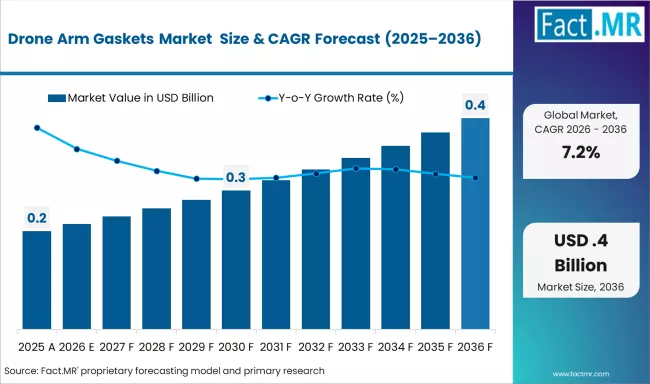
Drone Arm Gaskets Market Market Value Analysis | Source: Fact.MR
Key Drivers
- Weather-sealed airframes: Higher use of drones in rain, dust, and temperature-stressed environments is raising demand for sealing at arm interfaces and cable ingress points. DJI and Skydio both market IP55 protection in flagship enterprise drones.
- Foldable platform design: Portable enterprise drones increasingly use folding architectures, which create more sealing interfaces around hinges, arm locks, and structural joints.
- Dock-based uptime: Remote drone docks and autonomous field deployment raise the cost of seal failure, because leakage at the arm or payload interface can interrupt routine missions.
Key Segments Analyzed in the Report
- Material type: silicone gaskets, fluoroelastomer gaskets, EPDM gaskets, PTFE-based gaskets, and others
- Application: arm-to-body junction sealing, folding hinge and interface sealing, motor mount and wiring ingress sealing, payload arm interface sealing
- End use: enterprise and inspection drones, defense and public safety drones, agricultural drones, dock-based autonomous drones
- Region: North America, Latin America, Western Europe, Eastern Europe, East Asia, South Asia and Pacific, and Middle East and Africa
Analyst Opinion
Shambhu Nath Jha, Principal Analyst at Fact.MR says, "This market is less about part count and more about mission assurance. Demand is being shaped by how well gasket systems protect vulnerable arm interfaces against moisture, dust, vibration, and repeated field handling across compact drone platforms.”
Drone Arm Gaskets Market Definition
The drone arm gaskets market includes sealing components used at the structural and functional interfaces of drone arms, where protection from water, dust, vibration, and environmental stress is required. It covers molded and die-cut silicone gaskets, fluoroelastomer seals, EPDM seals, PTFE-based sealing parts, bonded interface seals, and custom profile gaskets used around arm joints, hinges, motor mounts, wire-routing passages, and arm-to-fuselage connection points. These components serve enterprise drones, agricultural UAVs, defense platforms, inspection aircraft, and autonomous dock-integrated systems that require higher environmental resilience and repeatable field performance.
Drone Arm Gaskets Market Inclusions
- Revenue from arm-interface sealing components designed for drones and unmanned aerial platforms
- OEM fitment and aftermarket replacement revenue linked to maintenance, refurbishment, and field repair
- Sales across regions with active drone manufacturing, deployment, maintenance, or subsystem integration ecosystems
Drone Arm Gaskets Market Exclusions
- Battery cells, motors, ESCs, and structural arm members sold without sealing components
- Finished drone airframe revenue except where arm gasket value is embedded in component supply
- General industrial gasket sales with no drone or aerospace application relevance
Drone Arm Gaskets Market Research Methodology
This study evaluates the drone arm gaskets market by material type, application, end use, and region, using 2025 as the base year and 2026 to 2036 as the forecast period. Market value is expressed in USD billion. The analysis is built using Fact.MR’s proprietary research methodology, which combines primary expert inputs, secondary-source validation, market triangulation, and internal forecasting models. Estimates are derived by assessing demand patterns across drone platform types, sealing requirements, material adoption trends, replacement cycles, and regional manufacturing and deployment dynamics. This approach ensures that segment-level and regional market values are grounded in a consistent analytical framework.
Key Drivers, Restraints, and Trends in Drone Arm Gaskets Market
Drivers
Drone platforms are being pushed into harder operating conditions, which raises the importance of sealing around exposed structural interfaces. DJI states that the Matrice 350 RTK carries an IP55 rating, while Skydio says the X10 is IP55 certified against dust and water and built for wind, rain, and compact one-person deployment. That operating reality increases demand for gaskets at arm joints, motor mounts, payload interfaces, and cable passages, because these are frequent ingress points on multirotor platforms. Dock-based operations deepen the requirement. DJI Dock 3 is positioned for 24/7 remote operations, and its installation notes emphasize proper sealing of the interface on mounted modules. The more a drone is expected to launch remotely and return without manual inspection, the more seal integrity moves from a minor part issue to a mission-availability issue.
Restraints
Volume concentration is a restraint as the commercial drone market is broad, but only a subset of platforms requires premium sealing around arm interfaces. Cost pressure is another limit, since smaller drone makers often try to reduce custom molded parts and rely on simpler enclosure strategies. Material qualification also slows penetration. Replacement cycles are uneven too. Some drones remain lightly used, which suppresses aftermarket gasket turnover.
Trends
The market is moving toward lighter, better-integrated sealing systems instead of simple static cut gaskets. As drones become foldable, portable, and more weather tolerant, sealing design is being built deeper into hinges, locking points, and accessory mounts. Suppliers are also leaning toward engineered aerospace sealing language. Parker highlights metal seals, gaskets, and rotary sealing solutions for aerospace and military settings, while Trelleborg and Hutchinson stress durable sealing under demanding operating conditions. Another trend is the rise of dock-compatible drone ecosystems, where uptime and remote reliability make seal performance commercially visible.
Segmental Analysis
Drone Arm Gaskets Market Analysis by Material Type
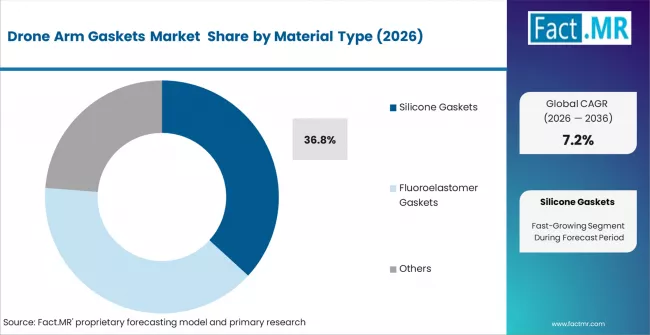
Drone Arm Gaskets Market Analysis By Material Type | Source: Fact.MR
Silicone gaskets are expected to lead the market with a 36.8% share in 2026. They lead as drone arm interfaces need low weight, geometric flexibility, and stable sealing performance across outdoor temperature swings. Silicone also fits compact multirotor layouts where repeated opening, folding, and module removal create compression-set risk. The commercial logic is strong in field drones that prioritize portability and weather protection over heavy mechanical loading. Trelleborg states that it develops aerospace sealing solutions to make aircraft lighter and more energy efficient.
Drone Arm Gaskets Market Analysis by Application
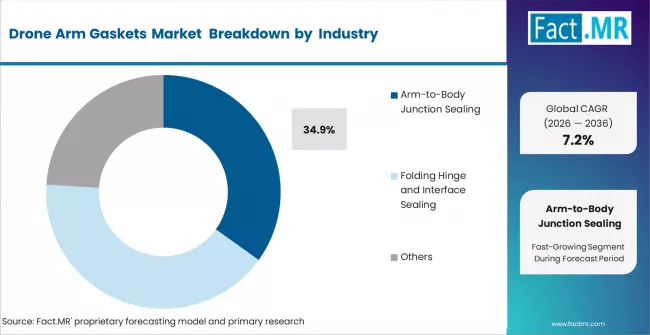
Drone Arm Gaskets Market Analysis By Application | Source: Fact.MR
Arm-to-body junction sealing is projected to account for 34.9% of the market in 2026. It holds the lead because the arm root is where structural connection, wiring transition, vibration transfer, and environmental exposure converge in one location. Failure at that interface can affect ingress protection, electronics stability, and field durability at the same time. Folding platforms make this interface even more important, since compact transport increases mechanical cycling and seal wear around structural transitions. Skydio says the X10 folds into a compact size for one-person operation, while DJI notes proper sealing of installed interfaces on dock-compatible modules, reinforcing why interface sealing remains central to reliable deployment.
Competitive Aligners for Market Players
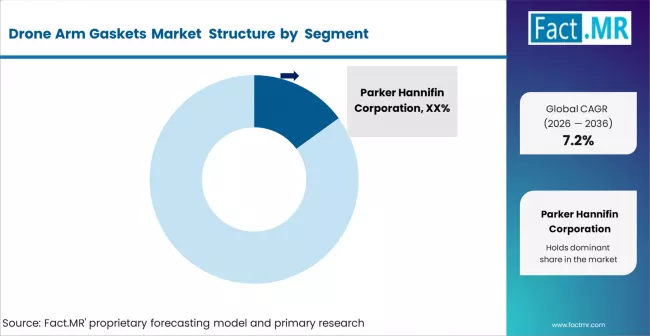
Drone Arm Gaskets Market Analysis By Company | Source: Fact.MR
Drone OEMs and subsystem integrators need precise fit and dependable consistency across repeated service cycles. The strongest suppliers combine material science and application support for aerospace or defense-grade sealing environments. Parker describes sealing solutions for aerospace and military applications across metal seals, gaskets, and rotary seals. Freudenberg positions itself as a development and service partner for aviation with durable engineered sealing solutions, while Hutchinson emphasizes resistance to temperature variation in aerospace sealing. Leadership is being built around custom interface engineering, qualification discipline, and the ability to match drone OEM ruggedization goals with scalable manufacturing support.
Key Players in Drone Arm Gaskets Market
- Parker Hannifin Corporation
- Trelleborg AB
- Freudenberg Sealing Technologies
- Hutchinson SA
- BRP-Rotax GmbH & Co KG
- DJI
- Skydio, Inc.
- Continental Aerospace Technologies
- Saint-Gobain Performance Plastics
- Greene Tweed & Co.
Strategic Outlook by Fact.MR on Drone Arm Gaskets Market
The market is shifting from low-visibility sealing spend toward design-critical interface protection in rugged drone platforms. Its next phase will be shaped by dock deployment and stronger use of drones. The companies most likely to gain brand share are those that can deliver lightweight custom sealing and application engineering that fits real drone mission profiles.
Bibliography
- Federal Aviation Administration. 2025. FAA Aerospace Forecast FY 2025 to 2045.
- European Union Aviation Safety Agency. Current. Drone Economy Dashboard.
- Ministry of Civil Aviation, Government of India. 2025. PLI Scheme Drones and Drone Components.
- DJI. Current. Matrice 350 RTK Specifications.
- Skydio. Current. X10 Technical Specifications.
- Parker Hannifin. 2016. Sealing Solutions for Aerospace and Military.
- Trelleborg Sealing Solutions. Current. Aerospace Solutions.
Segmentation
Scope of the Report
| Metric | Value |
|---|---|
| Market Value | USD 0.2 billion in 2025 to USD 0.4 billion by 2036 |
| CAGR | 7.2% from 2026 to 2036 |
| Base Year | 2025 |
| Forecast Period | 2026 to 2036 |
| Material Type Segmentation | Silicone Gaskets, Fluoroelastomer Gaskets, EPDM Gaskets, PTFE-based Gaskets, Others |
| Application Segmentation | Arm-to-Body Junction Sealing, Folding Hinge and Interface Sealing, Motor Mount and Wiring Ingress Sealing, Payload Arm Interface Sealing |
| End User Segmentation | Enterprise and Inspection Drones, Defense and Public Safety Drones, Agricultural Drones, Dock-based Autonomous Drones |
| Regions Covered | North America, Latin America, Western Europe, Eastern Europe, East Asia, South Asia and Pacific, and Middle East and Africa |
Source: Fact.MR analysis. Updated Mar 16, 2026
Frequently Asked Questions
What is the projected size of the Drone Arm Gaskets Market by 2036?
What is the CAGR of the Drone Arm Gaskets Market from 2026 to 2036?
Which material type leads the Drone Arm Gaskets Market in 2026?
Which application leads the Drone Arm Gaskets Market?
Which end-use segment dominates the Drone Arm Gaskets Market in 2026?
What is driving growth in the Drone Arm Gaskets Market?
Who worked on this report


Preview the report firsthand - request a free sample
Free SampleGet the brochure for pricing and purchase details
Download PDF