- Base Value(2025): 8.6 Bn
- Estimated Value(2026): 9.9 Bn
- Forecast Value (2036): 37.6 Bn
- CAGR (2026 - 2036): 14.3%
Drone as a Service Market Forecast and Outlook By Fact.MR
- The drone as a service market was valued at USD 8.6 billion in 2025.
- Based on Fact.MR analysis, demand is estimated to grow to USD 9.9 billion in 2026 and USD 37.6 billion by 2036.
- Fact.MR projects a CAGR of 14.3% during the forecast period.
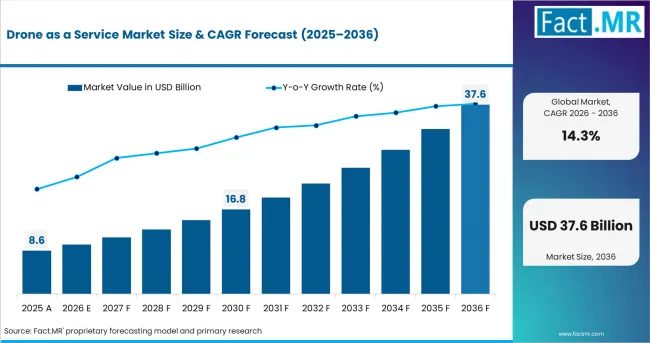
Drone As A Service Market Value Analysis | Source: Fact.MR
| Metric | Value |
|---|---|
| Estimated Value in 2026 | USD 9.9 billion |
| Forecast Value in 2036 | USD 37.6 billion |
| Forecast CAGR (2026 to 2036) | 14.3% |
Source: Fact.MR analysis. Updated Jun 4, 2026
Summary of Drone as a Service Market
- Demand Drivers
- Energy companies use contracted drone inspection to reduce downtime and limit manual checks on towers, pipelines and solar farms.
- Land agencies use aerial mapping for property records and infrastructure planning as survey work becomes more digital.
- Farm service operators use drones for spraying and crop scouting as smaller farms avoid owning drone fleets.
- Key Segments Analyzed
- By Application: Mapping & Surveying holds 35.0% share in 2026 because land surveyors and construction planners need repeat aerial site data.
- By End Use Industry: Energy accounts for 27.5% share in 2026 as powerline and solar operators need recurring inspection support.
- By Service Model: Project Based services lead with 46.0% share in 2026 because clients prefer defined mapping or inspection tasks before annual plans.
- By Drone Type: Multirotor drones capture 52.0% share in 2026 since inspection and short range mapping need stable hovering near assets.
- By Operating Mode: Pilot Operated services hold 58.0% share in 2026 as most paid missions still require certified human oversight.
- By Client Type: Commercial Enterprises account for 64.0% share in 2026 because asset owners outsource aerial work instead of buying drone fleets.
- Analyst Opinion at Fact.MR
- Shambhu Nath Jha, Principal Consultant at Fact.MR, opines, “CXOs will see drone service demand move from trial flights to repeat contracts. Clients will pay for clear flight approvals, trained pilots and usable data files. Stronger service providers will compete on safe operations, inspection proof and quick report delivery, not drone hardware alone.”
- Strategic Implications
- Providers should build energy and construction inspection packages with flight planning, data capture and report delivery in one contract.
- Companies should keep multirotor fleets ready for short-range inspection as this platform type serves a broad service base.
- Suppliers should invest in pilot training and compliance records as clients prefer partners that can prove safe flight practices.
The market is set to generate an incremental revenue opportunity of USD 27.7 billion between 2026 and 2036. Market growth is rising as companies outsource aerial mapping and inspection work. Energy operators and construction firms use paid drone services to reduce manual site checks. Flight approvals and limited pilot availability can slow adoption in regulated areas.
China is projected to record the highest CAGR at 16.2% through 2036 as low altitude economy policy pushes civil drone activity into paid services. India follows at 15.7% as land survey schemes and farm spraying networks create recurring flight work. Canada is projected to record 13.4% growth as registered pilots and drone schools support mapping and inspection service capacity. Australia advances at 13.2% as mine sites and power line operators use remote flight programs. Japan grows at 12.9% as farm automation needs service providers for smaller fields. The United States expands at 12.8% with remote pilot depth and Part 107 activity. The United Kingdom records 12.6% as registered flyer growth supports inspection and media work.
Segmental Analysis
Drone as a Service Market Analysis by Application
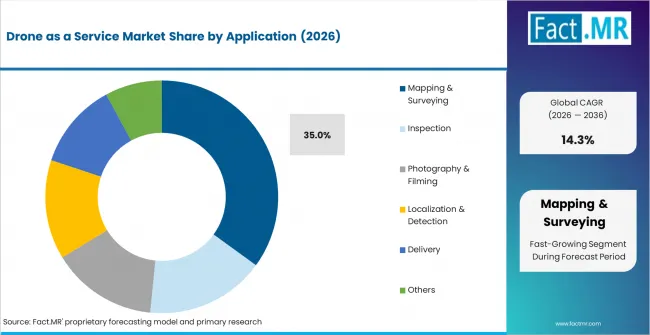
Drone As A Service Market Analysis By Application | Source: Fact.MR
Mapping & Surveying accounts for 35.0% share in 2026 as land surveyors and construction planners need repeat aerial data for site planning. Contracted drone mapping reduces manual visits and gives clients terrain models with progress views. Energy and infrastructure users also rely on aerial inspection services for safer asset checks and clearer maintenance planning.
- Mapping Contract Expansion: Land surveyors and construction planners use repeat aerial capture for property records and project tracking.
- Inspection Service Demand: Infrastructure owners use drone inspection services for safer checks and better maintenance planning.
- Filming Service Stability: Media users continue using short flight contracts for events and aerial content.
Drone as a Service Market Analysis by End Use Industry
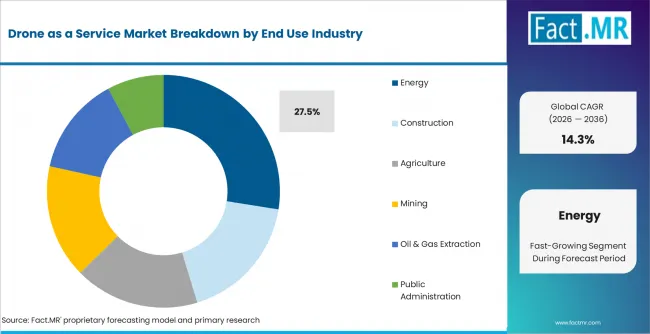
Drone As A Service Market Analysis By End Use Industry | Source: Fact.MR
Energy represents 27.5% share in 2026 as powerline and solar operators need repeat inspection support. Drone service providers help asset owners reduce manual access risks and inspect hard-to-reach infrastructure. Service quality depends on flight readiness and sensor performance across repeat inspection contracts.
- Energy Inspection Need: Utility operators use drone services to inspect towers and lines with fewer shutdown hours.
- Construction Site Tracking: Builders use monitoring flights to compare site progress with project schedules.
- Agriculture Service Uptake: Farm service providers use spraying and crop scouting contracts as farmers avoid fleet ownership.
Drone as a Service Market Analysis by Service Model
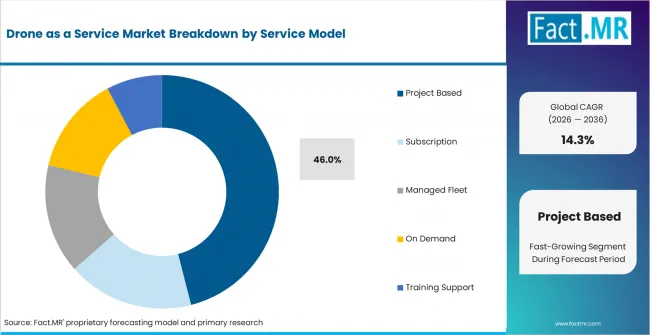
Drone As A Service Market Analysis By Service Model | Source: Fact.MR
Project Based services hold 46.0% share in 2026 because most clients first order defined mapping or inspection tasks. This model limits cost exposure and helps users test service quality before annual plans. Subscription and managed fleet models expand after repeat site demand is clear.
- Project Service Preference: Clients choose project based work as each task has a clear flight scope and report output.
- Subscription Service Buildout: Recurring inspection sites move toward monthly plans after repeat flights show cost savings.
- Managed Fleet Need: Large enterprises use managed fleet options when internal drone ownership creates training and compliance pressure.
Drone as a Service Market Analysis by Drone Type
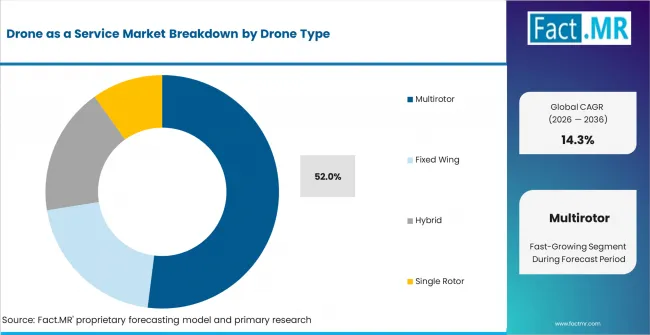
Drone As A Service Market Analysis By Drone Type | Source: Fact.MR
Multirotor drones capture 52.0% share in 2026 as inspection and short-range mapping need stable hovering. These platforms work well near buildings, plants and rooftops where controlled movement is important. Fixed wing drones serve large-area surveys, and hybrid platforms support longer missions with vertical takeoff.
- Multirotor Service Base: Multirotor fleets support plant inspection and roof survey work as they can hover near assets.
- Fixed Wing Survey Role: Fixed wing aircraft support long corridor mapping across large land parcels.
- Hybrid Mission Growth: Hybrid platforms support mining and energy surveys that need range with flexible launch points.
Drone as a Service Market Analysis by Operating Mode
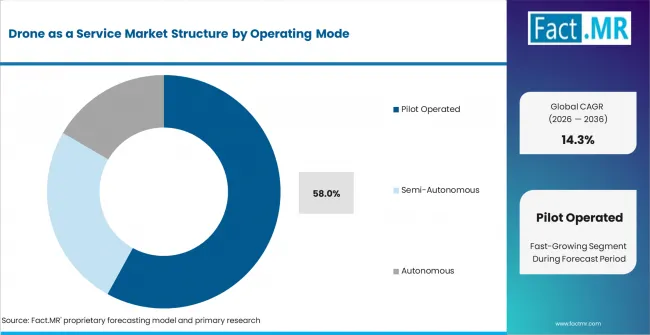
Drone As A Service Market Analysis By Operating Mode | Source: Fact.MR
Pilot Operated services account for 58.0% share in 2026 because most paid missions still need certified human oversight. Clients prefer trained operators for industrial flights since approval errors can delay project work. Semi-autonomous routes support repeat mapping, and fully autonomous services remain limited by approval needs.
- Pilot Skill Premium: Clients prefer certified operators for industrial flights as approval errors can delay fieldwork.
- Semi-Autonomous Route Use: Repeat mapping routes use software-guided paths to improve image overlap and reduce rework.
- Autonomous Service Limits: Remote flight centers expand in select regions, but approvals keep early use controlled.
Drone as a Service Market Analysis by Client Type
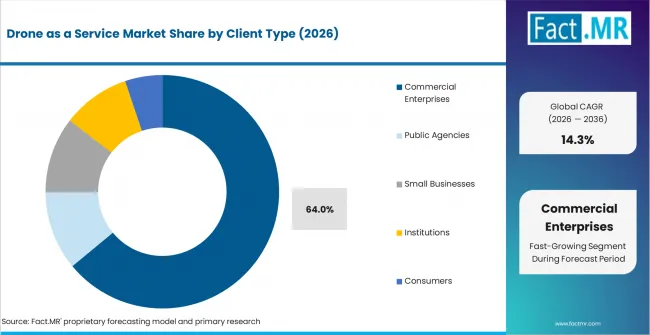
Drone As A Service Market Analysis By Client Type | Source: Fact.MR
Commercial Enterprises hold 64.0% share in 2026 as energy and construction companies need frequent asset inspections. These users outsource flight work instead of building internal aviation units. Public agencies use drone services for mapping and emergency response. Small businesses use them for filming and roof checks.
- Enterprise Service Share: Commercial enterprises use drone services for repeat inspection without building internal aviation units.
- Agency Flight Programs: Public agencies use mapping and emergency response flights when providers meet rule and training needs.
- Small Business Usage: Small businesses use drone service contracts for short filming and local site surveys.
Drivers Restraints and Opportunities
Drone service demand grows as companies move from buying aircraft to paying for flight results. In September 2024 the Federal Aviation Administration stated that the United States had more than 780000 registered drones and over 392000 certificated remote pilots [1]. This pilot base supports commercial inspection, survey work and professional drone services because clients need operators with rule knowledge and job records.
The main restraint is flight approval near people and critical assets. Service providers must include pilot time and report work in each contract. Opportunities remain strongest in drone package delivery pilots and energy inspection as regulators create clearer paths for repeat operations.
- Replacement of Manual Inspection: Industrial clients use drone service contracts as manual inspection creates safety risks and delays.
- Regulation Driven Advantage: Providers with flight records and trained pilots win repeat work as clients need proof of legal operations.
- Pricing Pressure in Basic Filming: Entry-level aerial filming faces price pressure as small providers compete for short event contracts.
Regional Analysis
The drone as a service market is assessed across North America, Europe, Asia Pacific, Latin America, and the Middle East and Africa, covering country-level demand by application, end use industry, service model, drone type, operating mode, and client type. The full report includes market attractiveness analysis by region and country.
| Country | CAGR (2026 to 2036) |
|---|---|
| China | 16.2% |
| India | 15.7% |
| Canada | 13.4% |
| Australia | 13.2% |
| Japan | 12.9% |
| United States | 12.8% |
| United Kingdom | 12.6% |
Source: Fact.MR analysis. Updated Jun 4, 2026
Source: Fact.MR analysis, based on proprietary forecasting model and primary research
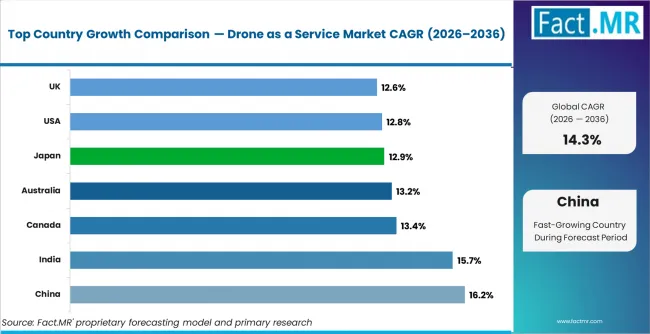
Drone As A Service Market Cagr Analysis By Country | Source: Fact.MR
Asia Pacific Drone as a Service Market Analysis
Asia Pacific records the fastest regional growth in the drone as a service market. Public land programs and industrial inspection needs are creating repeat flight work across major markets. Farm automation and low altitude economy policies support wider service use.
- China: China is projected to grow at 16.2% CAGR from 2026 to 2036. The Civil Aviation Administration of China reported in April 2026 that registered drones reached 3.287 million. Annual drone flight hours reached 45.3029 million, which supports wider use of paid drone services [2].
- India: India is expected to expand at 15.7% CAGR through 2036. The Press Information Bureau reported 38,575 registered drones and 39,890 remote pilot certificates in February 2026. Land survey schemes and farm spraying networks are creating repeat service demand [3].
- Japan: Japan is forecast to grow at 12.9% CAGR by 2036. MAFF’s October 2025 smart agriculture presentation reports that shared use of agricultural machinery reduced machinery cost by 49% per 10a, with future plans to roll out drone sharing [7].
- Australia: Australia is expected to advance at 13.2% CAGR through 2036. CASA reported more than 40,000 remote pilot licences in August 2025. The agency also recorded 18% year-on-year drone registration growth, supporting inspection and mining site service capacity [5].
North America Drone as a Service Market Analysis
North America has a deep remote pilot base and clear commercial operating routes. Utilities and construction companies use drone services for inspection and mapping work. Public safety agencies are increasing demand for compliant providers with reliable data quality.
- United States: The United States is projected to grow at 12.8% CAGR from 2026 to 2036. FAA pilot depth supports inspection and mapping across utilities and public safety uses. The country benefits from Part 107 activity and an established commercial drone operator base.
- Canada: Canada is forecast to grow at 13.4% CAGR through 2036. Transport Canada counted 114,580 registered drones and 125,340 basic pilot certificates in October 2025. Drone schools and clear registration systems support mapping and inspection service capacity [6].
Europe Drone as a Service Market Analysis
Europe is developing through regulated operations and stronger safety reviews. Infrastructure inspection and media work create steady service demand. Operators must manage airspace access and site permissions before building repeat flight contracts.
- United Kingdom: The United Kingdom is expected to post 12.6% CAGR by 2036. The Civil Aviation Authority reported about 720,000 active registered drone flyers and operators in August 2025. Inspection and media work continue to support demand for compliant drone service providers [4].
Competitive Aligners for Market Players
Drone service providers compete on pilot coverage and flight approval skill. Companies that offer mapping, inspection and data delivery in one contract can serve clients with repeat asset needs. Providers tied to drone construction monitoring benefit from project tracking demand in construction areas.
Energy and farm service providers need field staff that can respond quickly and deliver usable data files. Larger providers have an advantage through training systems and verified safety records. Service expansion into medical drone routes and inspection work supports longer contracts in regulated settings.
Regional operators can compete in local mapping and filming if they know permits and keep travel costs low. Larger providers are better placed for national clients that need the same service quality across many sites. The market favors companies with compliant flights, trained pilots and clear reports.
Key Players
- AeroDyne Group
- Terra Drone Corporation
- Cyberhawk
- SkySpecs
- Raptor Maps
- DroneDeploy
- Zipline
- Flytrex
Drone as a Service Market by Segment
-
By Application:
- Mapping & Surveying
- Inspection
- Photography & Filming
- Localization & Detection
- Delivery
- Others
-
By End Use Industry:
- Energy
- Construction
- Agriculture
- Mining
- Oil & Gas Extraction
- Public Administration
- Media
-
By Service Model:
- Project Based
- Subscription
- Managed Fleet
- On Demand
- Training Support
-
By Drone Type:
- Multirotor
- Fixed Wing
- Hybrid
- Single Rotor
-
By Operating Mode:
- Pilot Operated
- Semi-Autonomous
- Autonomous
-
By Client Type:
- Commercial Enterprises
- Public Agencies
- Small Businesses
- Institutions
- Consumers
-
Region:
- North America
- United States
- Canada
- Mexico
- Western Europe
- Netherlands
- Germany
- United Kingdom
- Belgium
- Spain
- East Asia
- China
- Japan
- South Korea
- South Asia
- Singapore
- India
- Thailand
- Latin America
- Brazil
- Chile
- Middle East & Africa
- UAE
- Saudi Arabia
- South Africa
- North America
Bibliography
- (NPIAS), 2025–2029. U.S. Department of Transportation.
- [2] Civil Aviation Administration of China. (2026, April 22). CAAC releases Statistical Bulletin of Civil Aviation Industry Development in 2025.
- [3] Press Information Bureau. (2026, February 17). India’s drone ecosystem: From policy to public service transformation. Government of India.
- [4] Civil Aviation Authority. (2025, August). CAP 3146 annual safety review 2024.
- [5] Civil Aviation Safety Authority. (2025, August 14). Licensed drone pilots hit new milestone.
- [6] Transport Canada. (2025, October 8). Drone Zone Issue 3 - October 2025. Government of Canada.
- [7] Ministry of Agriculture, Forestry and Fisheries. (2025, October). Promotion of smart agriculture.
This Report Addresses
- Strategic demand analysis for drone as a service across mapping and surveying, inspection, photography and filming, localization and detection, delivery support, and aerial data processing globally.
- Market forecast from USD 9.9 billion in 2026 to USD 37.6 billion by 2036 at 14.3% CAGR. Segment-level analysis covers application, end use industry, service model, drone type, operating mode, and client type.
- Opportunity mapping across China, India, Canada, Australia, Japan, the United States and the United Kingdom based on drone registration growth and pilot certificate depth.
- Segment analysis by application, end use industry, service model, drone type, operating mode and client type with regional and country-level forecasts through 2036.
- Competitive analysis of AeroDyne Group, Terra Drone Corporation, Cyberhawk, SkySpecs, Raptor Maps, DroneDeploy, Zipline and Flytrex covering service coverage and compliance depth.
- Regulatory impact analysis covering FAA Part 107 activity, CAAC low altitude economy policy, CASA drone licensing, Transport Canada registration and EASA unmanned aircraft safety review.
- Report delivery in PDF, Excel and presentation formats supported by drone registration records, pilot certificate data, aviation safety publications and service provider portfolio analysis.
Drone as a Service Market Definition
The drone as a service market covers commercial drone flight services delivered by third-party providers for mapping, inspection, filming, detection, delivery support and aerial data processing. These services use multirotor, fixed wing, hybrid and single rotor drones across pilot operated, semi autonomous and autonomous operating formats.
Drone as a Service Market Inclusions
Covers global and regional market forecasts from 2026 to 2036 by application, end use industry, service model, drone type, operating mode and client type. Includes project based, subscription, managed fleet, on demand and training support models serving energy, construction, agriculture, mining, oil and gas extraction, public administration and media users.
Drone as a Service Market Exclusions
Excludes direct drone hardware sales where no paid flight service or managed aerial data service is provided. Omits consumer drone purchases, hobby drone usage and standalone drone software not linked to commercial service delivery. Excludes internal enterprise drone operations unless managed by an external service provider.
Drone as a Service Market Research Methodology
- Primary Research
- Interviews with drone service operators, energy inspection managers, construction monitoring teams, public agency drone program managers and aerial data service providers across the United States, China, India, Canada, Australia, Japan and the United Kingdom.
- Desk Research
- Analysis of FAA, CAAC, PIB India, CASA, Transport Canada, EASA and UK Civil Aviation Authority publications. Supplemented by drone registration records, pilot certificate data, public safety reviews, smart agriculture documents and company service portfolio analysis.
- Market-Sizing and Forecasting
- Hybrid model combining top-down drone service revenue estimates with bottom-up service volume projections by application and client type. Average service pricing is modeled across mapping, inspection, filming, delivery support and managed fleet contracts before regional aggregation.
- Data Validation and Update Cycle
- Validated through drone registration databases, remote pilot certificate records, service provider portfolios, aviation safety updates and primary interviews. Updated annually with civil aviation rule changes, drone fleet registration trends and commercial service adoption patterns.
Segmentation
Scope of the Report
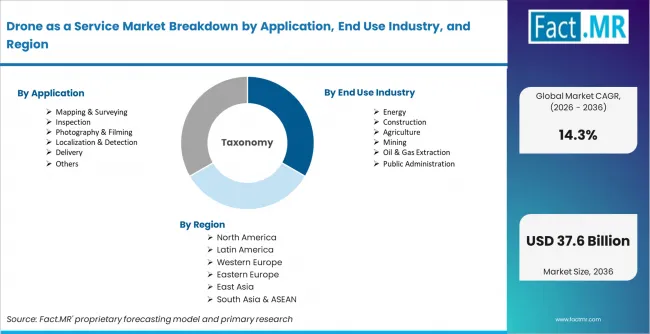
Drone As A Service Market Breakdown By Application, End Use Industry, And Region | Source: Fact.MR
| Attribute | Details |
|---|---|
| Quantitative Units | USD 9.9 billion (2026) to USD 37.6 billion (2036), at a CAGR of 14.3% |
| Market Definition | Commercial drone flight services used for mapping, inspection, filming, detection, delivery support, and aerial data processing. |
| Application Segmentation | Mapping & Surveying, Inspection, Photography & Filming, Localization & Detection, Delivery, Others |
| End Use Industry Segmentation | Energy, Construction, Agriculture, Mining, Oil & Gas Extraction, Public Administration, Media |
| Service Model Segmentation | Project Based, Subscription, Managed Fleet, On Demand, Training Support |
| Drone Type Segmentation | Multirotor, Fixed Wing, Hybrid, Single Rotor |
| Operating Mode Segmentation | Pilot Operated, Semi-Autonomous, Autonomous |
| Client Type Segmentation | Commercial Enterprises, Public Agencies, Small Businesses, Institutions, Consumers |
| Regions Covered | North America, Europe, Asia Pacific, Latin America, Middle East and Africa |
| Countries Covered | United States, Canada, United Kingdom, China, India, Japan, Australia |
| Key Companies Profiled | AeroDyne Group, Terra Drone Corporation, Cyberhawk, SkySpecs, Raptor Maps, DroneDeploy, Zipline, Flytrex |
| Forecast Period | 2026 to 2036 |
| Approach | Hybrid top-down and bottom-up model using service revenue checks, drone registration records, pilot certificate counts, and primary interviews. |
Source: Fact.MR analysis. Updated Jun 4, 2026
Frequently Asked Questions
How large is the global Drone as a Service Market in 2025?
What will the Drone as a Service Market size be in 2026?
What is the projected Drone as a Service Market size by 2036?
What is the expected CAGR for the Drone as a Service Market from 2026 to 2036?
Which application segment leads the Drone as a Service Market?
Which client type holds the largest Drone as a Service Market share?
Which country shows the fastest growth in the Drone as a Service Market?
Who worked on this report


Preview the report firsthand - request a free sample
Free SampleGet the brochure for pricing and purchase details
Download PDF