- Base Value(2025): 0.2 Bn
- Estimated Value(2026): 0.2 Bn
- Forecast Value (2036): 0.4 Bn
- CAGR (2026 - 2036): 7.2%
Drone Camshaft Gears Market Forecast and Outlook By Fact.MR
The drone camshaft gears market was valued at USD 0.2 billion in 2025. The market is projected to reach USD 0.2 billion in 2026 and USD 0.4 billion by 2036, expanding at a CAGR of 7.2% during 2026-2036. Helical camshaft gears are expected to lead product type with a 38.7% share in 2026. OEM installation is projected to remain the leading workflow with a 58.6% share in 2026. Tactical and defense UAVs are expected to lead end-use demand with a 43.9% share in 2026. The niche remains small in absolute value, but it is structurally important because it sits inside the endurance, reliability, and maintenance economics of engine-powered unmanned aircraft. FAA forecasts continue to point to a larger UAS operating base, while Europe and India are still widening the regulatory and industrial framework around drones.
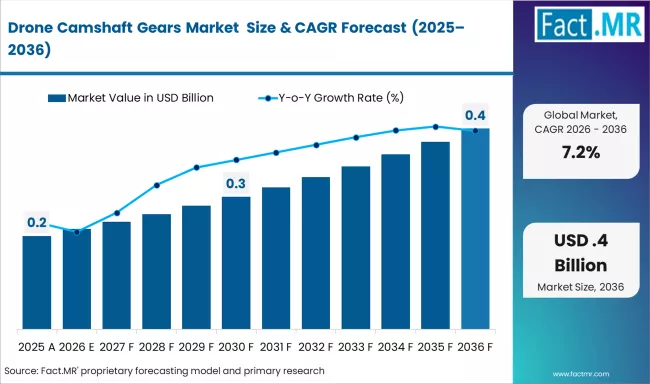
Drone Camshaft Gears Market Market Value Analysis | Source: Fact.MR
Key Drivers
- Endurance-platform demand: Longer-range UAV missions still require combustion or hybrid propulsion in many defense, surveillance, and remote logistics profiles. That keeps mechanical valvetrain demand relevant inside a drone market otherwise dominated by electric narratives.
- BVLOS normalization: Regulatory work around scalable beyond-visual-line-of-sight operations is improving planning certainty for larger and more capable UAV platforms. That supports engine programs where precision gear durability matters.
- Aftermarket replacement cycles: Camshaft gears are not bought only with new engines. They also generate recurring value through overhaul, inspection, and replacement cycles in mission fleets.
Key Segments Analyzed in the Report
- Product type: spur camshaft gears, helical camshaft gears, split gear sets, reduction-integrated camshaft gears, and others
- Workflow: OEM installation, engine overhaul and maintenance, and retrofit and platform upgrades
- End use: tactical and defense UAVs, industrial long-endurance UAVs, hybrid cargo and logistics UAVs, research and experimental platforms
- Region: North America, Latin America, Western Europe, Eastern Europe, East Asia, South Asia and Pacific, and Middle East and Africa
Analyst Opinion
Shambhu Nath Jha, Principal Consultant, Fact.MR says, "Precision metallurgy, fatigue resistance, low-batch aerospace manufacturing discipline, and the ability to support fleet availability after deployment are key factors for market players. The successful companies will be ones that sit close to UAV engine programs."
Drone Camshaft Gears Market Definition
The drone camshaft gears market includes precision gears and gear sets used to synchronize valvetrain timing in internal combustion and hybrid propulsion systems designed for unmanned aerial vehicles. It covers spur gears, helical gears, split timing gear sets, reduction-integrated camshaft gear assemblies, and associated replacement components supplied for new engine builds and overhaul cycles. These products serve tactical UAV programs, industrial long-endurance aircraft, cargo drones, and specialized unmanned platforms that still depend on piston or hybrid engines for endurance, payload stability, and rapid refueling.
Drone Camshaft Gears Market Inclusions
- Revenue from camshaft gears and timing gear sets supplied for UAV-specific internal combustion and hybrid propulsion systems
- OEM and aftermarket revenue linked to engine installation, overhaul, maintenance, and qualified replacement cycles
- Sales across all major regions where UAV manufacturing, deployment, or fleet support activity is established
Drone Camshaft Gears Market Exclusions
- Battery-electric drone propulsion systems with no mechanical camshaft architecture
- Finished UAV airframe revenue except where gear value is embedded in propulsion-component sales
- General-purpose automotive or motorcycle timing gears not qualified for drone or aerospace use
Drone Camshaft Gears Market Research Methodology
This study evaluates the drone camshaft gears market by product type, workflow, end use, and region, using 2025 as the base year and 2026 to 2036 as the forecast period. Market value is expressed in USD billion. Evidence inputs include FAA UAS forecasts and drone integration policy documents, EASA drone economy statistics, Triangulation combines platform demand, propulsion architecture mix, replacement intensity, precision-machining requirements, and aero-engine support economics to produce segment and regional market estimates.
Key Drivers, Restraints, and Trends in Drone Camshaft Gears Market
Drivers
FAA work on routine, scalable BVLOS operations is important as it supports more sustained use cases. In Europe, the drone economy now operates under a larger common-rule base, and India continues to back domestic drone manufacturing through DigitalSky-linked regulation and incentive structures. Those shifts matter as larger and more mission-critical UAVs rely more often on combustion or hybrid architectures where camshaft timing accuracy directly affects fuel efficiency, thermal control, and engine reliability.
Restraints
Electrification is the first restraint because many commercial drones do not need an engine at all. The addressable market is therefore limited to a narrower class of UAVs where endurance or heavy payload requirements justify mechanical propulsion. Qualification is another restraint, since precision gears in aero engines require tight tolerances, heat treatment control, and failure-traceability standards that raise cost. Volume is also uneven. Small production runs make unit economics less attractive than in automotive timing systems. Vendor switching remains slow because once an engine architecture is validated, creating challenges for new players.
Trends
The market is moving toward higher-value, lower-volume gear programs. Buyers are prioritizing integrated propulsion packages. Heavy-fuel and hybrid UAV programs are also strengthening the requirement for durable timing components. Another visible trend is the rise of mission assurance language in propulsion marketing, where uptime, maintainability, and support packages are becoming as important as raw engine output.
Segmental Analysis
Drone Camshaft Gears Market Analysis by Product Type
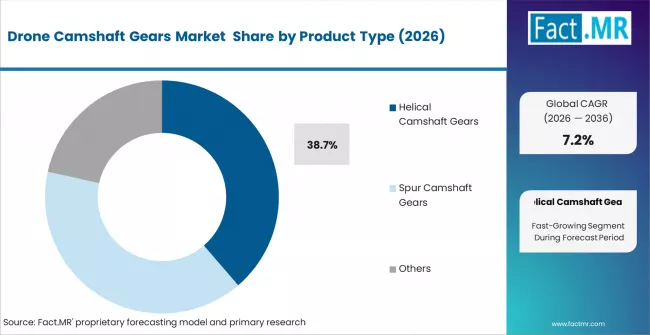
Drone Camshaft Gears Market Analysis By Product Type | Source: Fact.MR
Helical camshaft gears are expected to lead the market with a 38.7% share in 2026. They hold the lead because quieter meshing, matters in UAV engines that must preserve sensor performance. Straight spur gears remain relevant in simpler and lower-cost programs, but endurance-oriented UAV platforms increasingly favor gear formats that protect timing precision over longer duty cycles. Timken states that its aerospace drive systems use high-quality materials such as carburizing 9310, Pyrowear X-53, and nitriding steel to resist fatigue, wear, and corrosion, which fits the commercial logic behind higher-value camshaft gear demand in aerospace-grade applications.
Drone Camshaft Gears Market Analysis by Workflow
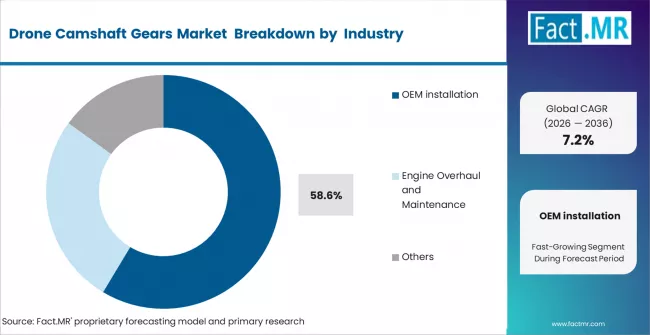
Drone Camshaft Gears Market Analysis By Workflow | Source: Fact.MR
OEM installation is projected to account for 58.6% of the market in 2026. It leads owing to the fact that gear choice is largely locked in during engine architecture selection. This workflow covers first-fit installation in new propulsion systems, prototype-to-production scaling, and integration with lubrication and reduction-drive layouts. UAV Engines states that its AR801R is a proven lightweight engine with an integrated reduction drive for UAVs requiring 35 to 55 bhp, showing how propulsion suppliers position drivetrain architecture as a design-stage decision rather than a simple replacement part purchase.
Competitive Aligners for Market Players
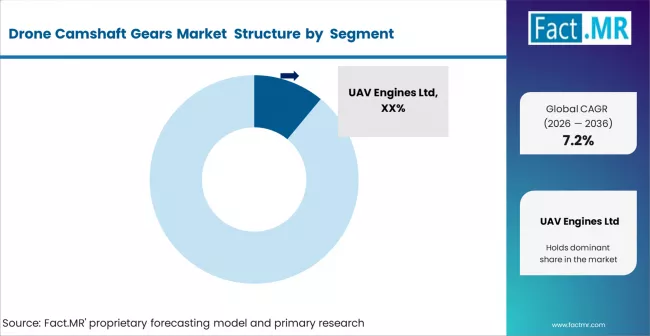
Drone Camshaft Gears Market Analysis By Company | Source: Fact.MR
Competitive advantage in this market is not built through breadth alone. Buyers need tight machining tolerances and the ability to support overhaul cycles after field deployment. The strongest firms combine precision component capability with propulsion-program intimacy and aftermarket responsiveness. Orbital markets mission-ready integrated propulsion systems around reliability, while UAV Engines emphasizes more than 30 years of experience with customers in over 25 countries and AS9100D quality systems. Timken also notes that its North American service footprint includes repair of complex gear systems, which reinforces the growing value of sustainment capability. Market leadership is therefore being built around precision, certification discipline, and fleet support.
Key Players in Drone Camshaft Gears Market
- UAV Engines Ltd
- Orbital UAV
- BRP-Rotax GmbH & Co KG
- Hirth Engines GmbH
- Austro Engine GmbH
- Continental Aerospace Technologies
- The Timken Company
- Schaeffler AG
- Gleason Corporation
- Bharat Gears Ltd
Strategic Outlook by Fact.MR on Drone Camshaft Gears Market
The market is shifting from generic small-engine component demand toward mission-specific precision gearing for endurance UAV platforms. Its next phase will be shaped by BVLOS expansion, defense procurement intensity, hybrid propulsion adoption, and the need to keep fleets serviceable without long downtime. The companies best positioned to win are those that combine aerospace-grade metallurgy, small-batch manufacturing discipline, tight integration with UAV engine programs, and a credible overhaul support model. This remains a narrow market, but it is technically sticky and commercially defensible.
Bibliography
- Federal Aviation Administration. 2025. FAA Aerospace Forecast FY 2025 to 2045.
- Federal Aviation Administration. 2025. Drone Integration: Concept of Operations.
- European Union Aviation Safety Agency. 2025. Drone Economy Dashboard.
- Ministry of Civil Aviation, Government of India. 2025. PLI Scheme for Drones and Drone Components.
- Orbital UAV. 2025. 150HFE Integrated Propulsion System.
- UAV Engines Ltd. 2025. AR801R UAV Engine.
- The Timken Company. 2020. Aerospace Drive Systems.
Segmentation
Scope of the Report
| Metric | Value |
|---|---|
| Market Value | USD 0.2 billion in 2025 to USD 0.4 billion by 2036 |
| CAGR | 7.2% from 2026 to 2036 |
| Base Year | 2025 |
| Forecast Period | 2026 to 2036 |
| Product Type Segmentation | Spur Camshaft Gears, Helical Camshaft Gears, Split Gear Sets, Reduction-Integrated Camshaft Gears, Others |
| Workflow Segmentation | OEM Installation, Engine Overhaul and Maintenance, Retrofit and Platform Upgrades |
| End User Segmentation | Tactical and Defense UAVs, Industrial Long-endurance UAVs, Hybrid Cargo and Logistics UAVs, Research and Experimental Platforms |
| Regions Covered | North America, Latin America, Western Europe, Eastern Europe, East Asia, South Asia and Pacific, Middle East and Africa |
Source: Fact.MR analysis. Updated Mar 16, 2026
Frequently Asked Questions
What is the projected size of the Drone Camshaft Gears Market by 2036?
What is the CAGR of the Drone Camshaft Gears Market from 2026 to 2036?
Which product type leads the Drone Camshaft Gears Market in 2026?
Which workflow dominates the Drone Camshaft Gears Market?
Which end-use segment leads the Drone Camshaft Gears Market in 2026?
What is driving growth in the Drone Camshaft Gears Market?
Who worked on this report


Preview the report firsthand - request a free sample
Free SampleGet the brochure for pricing and purchase details
Download PDF