- Base Value(2025): 453.2 Mn
- Forecast Value (2035): 1710 Mn
- CAGR (2035): 14.3%
Drone Pipeline Inspection Market Outlook 2025 to 2035
Global drone pipeline inspection market is expected to reach USD 1,710 million by 2035, up from USD 390 million in 2024. During the forecast period (2025 – 2035), the industry is projected to expand at a CAGR of 14.2%.
The drone pipeline inspection market is led by a shift toward real-time, condition-based monitoring and increasing regulatory requirements for verifiable data on infrastructure. Sophisticated sensing payloads and digital twin integration further increase adoption for predictive maintenance.
Quick Stats for Drone Pipeline Inspection Market
- Industry Value (2025): USD 390 Million
- Projected Value (2035): USD 1,710 Million
- Forecast CAGR (2025 to 2035): 14.2%
- Leading Segment (2025): Fixed-Wing Drones (32% Market Share)
- Fastest Growing Country (2025-2035): United States (15.1% CAGR)
- Top Key Players: SZ DJI Technology Co., Ltd., Lockheed Martin Corporation, Qualcomm Technologies Inc., and BAE Systems PLC
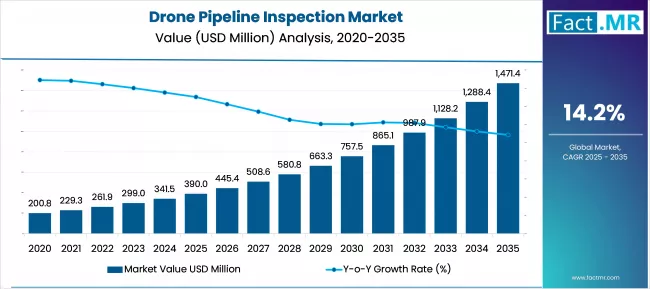
Drone Pipeline Inspection Market Market Value Analysis | Source: Fact.MR
What are the drivers of the Drone Pipeline Inspection market?
The drone pipeline inspection market is gaining momentum as operators pivot toward digitized, real-time surveillance of critical midstream assets. The change of operations from interval-based to condition-based pipeline monitoring is a chief driver among them. Drones, if integrated with smart analytics platforms, facilitate early detection of micro-level structural irregularities, providing better decision-making support than conventional inspection equipment.
In addition, international regulatory bodies are placing increased importance on compulsory reporting of pipeline condition, particularly where infrastructure is older. This has made the role of drones even more valuable in offering verifiable, time-stamped aerial insight along thousands of kilometers of pipeline. The value proposition becomes even more compelling in environmentally sensitive zones, where drones reduce ecological disruption compared to ground crews or manned aircraft.
Innovation in onboard sensing technology is also leading to adoption. Combining methane detection payloads, high-res orthomosaic cameras, and machine vision algorithms enables multi-parameter inspection in a single flight. This multi-layered visibility enables environmental compliance, operational risk avoidance, and ESG reporting needs.
Likewise, the use of drones in digital twin environments is turning them into nodes of centralized pipeline integrity management systems rather than independent tools. This change harmonizes well with worldwide efforts in infrastructure digitization, augmenting the adoption of drones as part of wider predictive maintenance and asset reliability practices.
What are the regional trends of the Drone Pipeline Inspection market?
The local geography of the drone pipeline inspection market is defined by differences in infrastructure complexity, regulatory receptivity, and country-specific energy plans. The market, in North America, especially the United States and Canada, is mature, with drones integrated into standard pipeline integrity management programs. High-profile accidents have generated rigorous compliance requirements, driving UAV-based inspection for both hydrocarbon and refined product pipelines. Even the presence of FAA waivers for BVLOS operations reinforces the dominance of the region.
Europe, propelled by diversification of energy and cross-border infrastructure, is focusing on drone standardization and automated reporting. Countries such as Germany, Norway, and the Netherlands are at the forefront with AI-driven UAVs for leak detection on hydrogen and CO₂ pipelines as part of their decarbonization strategy. Remote monitoring has also become an area of investment in pipeline safety enhancement in line with the European Green Deal.
In Asia-Pacific, China is leading in drone deployment through state-owned pipeline operators integrating UAVs into new build and inspection phases. India’s ongoing pipeline expansion, coupled with digital public infrastructure initiatives, is fostering partnerships with domestic drone manufacturers. In contrast, Australia is leveraging drones for access to remote areas in LNG as well as cross-state pipeline routes.
The Middle East is focused on using drones for corrosion tracking and flow assurance in arid, high-temperature zones. Latin America and Africa remain nascent markets but are witnessing targeted drone investments in pipeline segments vulnerable to theft, sabotage, or natural hazards.
What are the challenges and restraining factors of the Drone Pipeline Inspection market?
The drone pipeline inspection market faces structural barriers rooted in operational fragmentation and technological adaptation gaps. One of the main market-specific issues is lack of integration between data collection via inspection by drones and current asset management processes.
Even with technological advancement in drone imaging and sensing capabilities, most midstream operators do not have compatible systems to take in, process, and respond to drone-derived data in real time. This constrains the operational usefulness of drone inspections in informing asset-level interventions.
Moreover, in large-scale transmission networks that span national and transnational boundaries, regulatory inconsistency remains a bottleneck. Operators must navigate a patchwork of UAV airspace regulations, data transmission laws, and flight corridor restrictions, creating administrative delays that inhibit cross-border pipeline monitoring initiatives.
Change in environmental conditions, particularly in high altitude, desert, or high humidity settings, undermines the drone reliability and sensor-based calibration. The outputs of the sensors on the drones can also be distorted by the presence of electromagnetic interference, reducing the detection accuracy, in hydrocarbon-rich regions that are flared or have excessive methane.
Labor specialization is another underappreciated limitation. The market does not have an adequate supply of drone operators with domain expertise in pipeline risk indicators, and so scaling up operations from pilot schemes is challenging. Further, internal resistance from engineering teams, which might be skeptical of UAV-based diagnostics relative to traditional approaches, typically holds up enterprise-scale deployment. Closing these system-integration and human-capital gaps is needed to realize the full potential of the market.
Country-Wise Insights
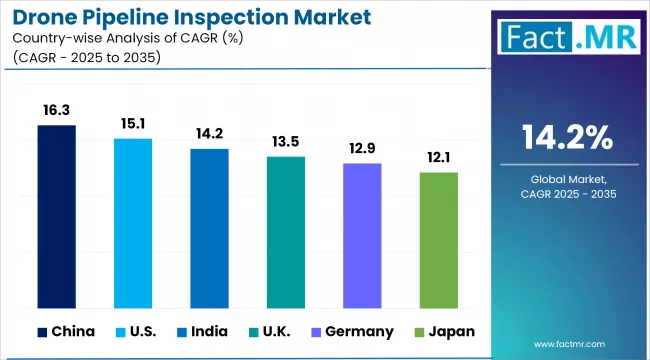
Drone Pipeline Inspection Market Cagr Analysis By Country | Source: Fact.MR
Emission Mitigation and Automation Mandates Propel U.S. Market Trajectory
The United States drone pipeline inspection market is in the process of a structural shift, spurred by increasing environmental compliance obligations and a wider industry movement toward automation. Increased regulatory focus on methane emissions and right-of-way infractions is also speeding the uptake of UAVs as a normal inspection method. From an operational standpoint, drones are increasingly viewed as cost-effective enablers of predictive maintenance, delivering high-frequency data while minimizing human exposure and inspection downtime.
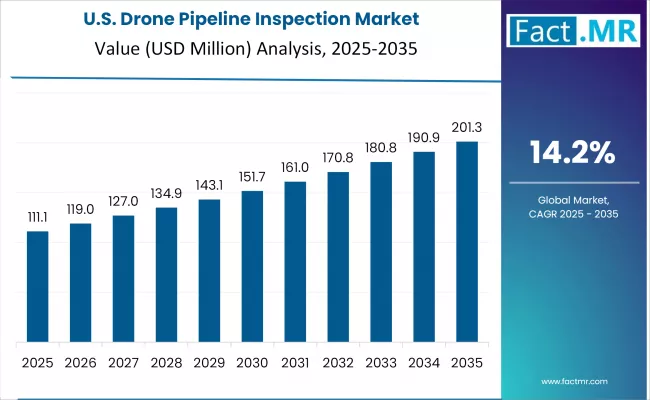
Drone Pipeline Inspection Market Country Value Analysis | Source: Fact.MR
The establishment of FAA regulations in beyond visual line of sight (BVLOS) operations is easing the regulatory barriers allowing greater scalability of deployments. At the same time, the stakeholders are coordinating the UAV integrations with business viability roadmaps, ESG scores, and digital assets lifecycle governances. The intersection of technological maturity, especially in imaging payload and AI analytics, and facilitative regulation marks the market's transition from pilot-phase adoption to strategic infrastructure implantation. The American market is poised to dominate drone-enabled energy monitoring, weighing innovation with regulatory concerns.
Technical Standardization and Sustainability Priorities Shape Germany’s Market Outlook
Germany’s drone pipeline inspection landscape reflects a methodical adoption curve shaped by rigorous engineering standards and decarbonization imperatives. As utilities and transmission operators recalibrate their networks for low-emission energy carriers, UAVs are being systematically integrated into inspection regimes to enhance detection accuracy and reduce operational footprint. The regulatory climate, characterized by clear airspace governance and strong institutional emphasis on data security, provides a conducive foundation for UAV-enabled monitoring.
German market dynamics are further supported by a cultural and policy alignment around environmental accountability and technological reliability. Drone deployments are not viewed as isolated solutions but as integral components of structured asset integrity frameworks. Technical validation, system interoperability, and automated compliance reporting are increasingly prioritized, indicating a shift toward institutionalized UAV operations. In this context, the drone inspection market in Germany is developing as a precision-led and policy-compliant segment closely aligned with the country’s energy infrastructure modernization strategy.
Digital Modernization and Safety Reforms Accelerate China’s Market Integration
China’s drone pipeline inspection market is experiencing rapid integration, supported by national initiatives focused on infrastructure digitization and industrial safety enhancement. As energy demands grow and pipeline networks expand, UAVs are being strategically deployed to support condition-based monitoring and early fault detection. Policy frameworks encouraging intelligent infrastructure and autonomous surveillance technologies are accelerating mainstream adoption.
A strong domestic emphasis on energy security, risk reduction, and operational efficiency is reshaping inspection strategies and embedding drones into long-term asset management practices. UAVs are now integral to data-driven maintenance planning, providing high-resolution insights that inform both tactical and strategic decisions. The alignment of regulatory support, increasing safety expectations, and a robust local drone manufacturing base is reinforcing China’s position as a high-growth market. The transition from traditional inspections to UAV-assisted operations highlights a decisive shift toward intelligent infrastructure management across the nation’s energy value chain.
Category-Wise Analysis
Fixed-Wing Drones Expand Long-Range Pipeline Coverage
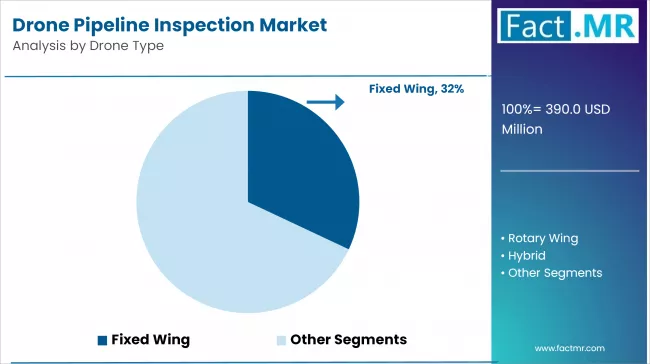
Drone Pipeline Inspection Market Analysis By Drone Type | Source: Fact.MR
Fixed-wing drones are emerging as a critical asset in long-range pipeline surveillance, offering operational efficiencies that address the limitations of conventional inspection methods. Their extended flight endurance, enabled by fixed aerodynamic structures and low energy consumption, positions them as a preferred choice for inspecting linear assets over vast and often inaccessible terrain. Advancements in lightweight composite materials and modular wing architectures have improved payload capacity and mission duration without compromising structural integrity.
Fixed-wing platforms also facilitate the integration of high-resolution imaging systems and telemetry units, enhancing real-time data acquisition across broad inspection corridors. Also, their ability to operate at higher altitudes ensures consistent data quality with fewer disruptions from ground-level interference. As asset owners seek to rationalize inspection budgets and improve maintenance planning cycles, fixed-wing drones offer a scalable, cost-effective solution. Their deployment is expected to increase in tandem with growing emphasis on risk-based asset integrity management and predictive maintenance strategies.
Thermal Imaging Cameras Enhance Leak Detection Precision
Thermal imaging sensors are gaining substantial traction within pipeline inspection frameworks, driven by their ability to provide non-intrusive, high-fidelity thermal signatures of pipeline infrastructure. These payloads are uniquely positioned to detect early-stage thermal anomalies indicative of leaks, insulation degradation, or fluid seepage, thereby enabling more proactive maintenance intervention. Recent innovations in thermal sensor miniaturization and radiometric calibration have elevated their performance and integration potential with drone platforms.
In addition, enhanced thermal resolution and frame rates now support more granular temperature differentials, improving detection accuracy under variable environmental conditions. These sensors are increasingly being deployed in midstream and downstream inspection programs, particularly where conventional visual techniques fall short. Their utility extends to continuous monitoring applications, especially in temperature-sensitive zones and aging pipeline networks. As asset operators align with stricter operational safety protocols and leak detection benchmarks, thermal imaging payloads are poised to become a core component of next-generation pipeline monitoring architectures.
Fully Autonomous Drones Transform Asset Monitoring Efficiency
The adoption of fully autonomous drones in pipeline inspection represents a paradigm shift toward automation-led asset management. These platforms integrate AI-powered navigation, machine vision, and real-time analytics to execute inspection missions with minimal human intervention. Their ability to autonomously adapt to environmental variables and mission complexities enables higher consistency in data capture, particularly for recurring survey routes. Embedded edge computing capabilities further allow preliminary data processing in-flight, reducing the latency between data collection and actionable insights.
Importantly, these drones support multi-mission scheduling and remote deployment, enhancing inspection frequency without proportional increases in manpower. With growing operational focus on reliability-centered maintenance and unplanned outage mitigation, fully autonomous systems offer significant value through standardized reporting and accelerated fault detection. Their scalability and reduced lifecycle costs make them a strategic fit for large-scale pipeline operators seeking to digitize inspection workflows and reduce dependency on traditional, labor-intensive surveillance methods.
Competitive Analysis
Key players in the drone pipeline inspection market include SZ DJI Technology Co., Ltd., Lockheed Martin Corporation, Qualcomm Technologies Inc., BAE Systems PLC, Israel Aerospace Industries, Teledyne FLIR LLC, AgEagle Aerial Systems Inc., American Robotics, Inc., Delair, Yuneec International Co. Ltd., Airobotics Ltd., Vision Aerial, Inc., and Acecore Technologies.
These companies are driving market momentum by offering autonomous UAVs equipped with thermal imaging, LiDAR, and AI-based analytics for real-time pipeline monitoring. Leading defense and aerospace firms are advancing long-range drones for remote inspections, while emerging players focus on AI integration, endurance, and modularity.
Strategic collaborations, compliance with aviation safety standards, and innovation in sensor payloads and flight automation continue to define the competitive landscape across global pipeline infrastructure applications.
Recent Development
- In February 2025, Wingcopter unveiled a BVLOS LiDAR surveying solution using the Wingcopter 198 drone, targeting long-range infrastructure and pipeline inspections. Equipped with high-precision laser scanners and imaging systems, it surveys up to 37 miles per mission with 10 mm accuracy. This innovation boosts efficiency and safety in pipeline monitoring.
- In May 2024, DroneLab unveiled the SkyQUBE V2, an AI-powered industrial drone, at Italy’s Pipeline & Gas Expo. Engineered with carbon fiber and Kevlar™, it supports up to 8 kg of sensors for high-resolution imaging, LiDAR, and thermal scans. Its AI enables real-time analytics, autonomous navigation, and predictive maintenance, enhancing pipeline inspection efficiency and safety.
Fact.MR has provided detailed information about the price points of key manufacturers of Drone Pipeline Inspection Market positioned across regions, sales growth, production capacity, and speculative technological expansion, in the recently published report.
Methodology and Industry Tracking Approach
Fact.MR’s 2025 Global Drone Pipeline Inspection Market report is based on a structured analysis of insights gathered from 9,200 industry participants across 28 countries, with no fewer than 300 responses from each market. Respondents included 54% end users (such as oil and gas operators, infrastructure supervisors, and utility firms) and 46% professionals including drone technology providers, regulatory experts, and supply chain specialists. Conducted between July 2024 and June 2025, the study examined evolving demand patterns, technology uptake, investment direction, and risk perceptions.
Collected data was weighted to mirror regional dynamics and stakeholder distribution. Also, the research integrated over 280 verified sources, including peer-reviewed journals, patent registries, policy frameworks, and financial reports, using statistical techniques such as regression analysis.
Since 2018, Fact.MR has systematically tracked developments in drone-enabled infrastructure inspection, providing actionable intelligence for both industry leaders and emerging players.
Segmentation
Segmentation of Drone Pipeline Inspection Market
-
By Drone Type :
- Fixed Wing
- Rotary Wing
- Hybrid
- Others
-
By Payload Type :
- Visual Inspection Cameras
- Thermal Imaging Cameras
- LiDAR Sensors
- Acoustic Sensors
- Gas Detectors
- Laser Scanners
-
By Operation :
- Remotely Piloted
- Optionally Piloted
- Fully Autonomous
-
By Deployment Technique :
- Manual
- Semi-Autonomous
- Fully Autonomous
-
By End Users :
- Oil & Gas
- Food & Beverages
- Mining
- Chemicals
- Pharmaceuticals
- Water Treatment & Sewage
- Others
-
By Region :
- North America
- Latin America
- Western Europe
- Eastern Europe
- East Asia
- South Asia & Pacific
- Middle East & Africa
Frequently Asked Questions
What was the Global Drone Pipeline Inspection Market Size Reported by Fact.MR for 2025?
Who are the Major Players Operating in the Drone Pipeline Inspection Market?
What is the Estimated Valuation of the Drone Pipeline Inspection Market in 2035?
What Value CAGR did the Drone Pipeline Inspection Market Exhibit Over the Last Five Years?
Who worked on this report


Preview the report firsthand - request a free sample
Free SampleGet the brochure for pricing and purchase details
Download PDF