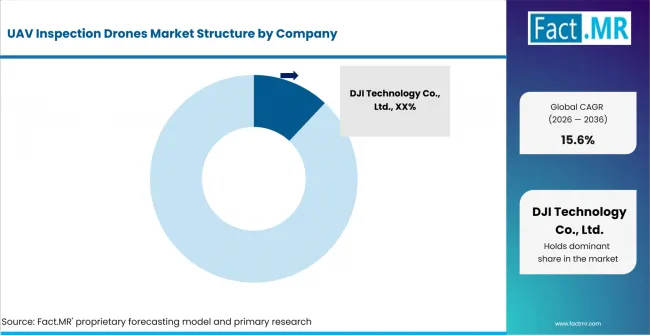
UAV Inspection Drones Market Size, Share, Growth and Forecast (2026 - 2036)
The UAV Inspection Drones Market is segmented by Type (Fixed Wing, Rotary Wing, Hybrid Wing), Operation Mode (Remotely Piloted, Optionally Piloted, Fully Autonomous), Payload (Camera Imaging, Thermal Sensing, LiDAR Mapping, Multispectral Sensors, Gas Detection), End Use (Oil and Gas, Utilities, Telecom, Construction, Mining, Renewable Energy, Public Infrastructure), Service Model (In-house Inspection, Outsourced Services, Hybrid Services), Inspection Asset (Towers, Pipelines, Roofs, Bridges, Wind Blades, Offshore Platforms, Industrial Tanks), and Region. Forecast for 2026 to 2036.
UAV Inspection Drones Market Forecast and Outlook By Fact.MR
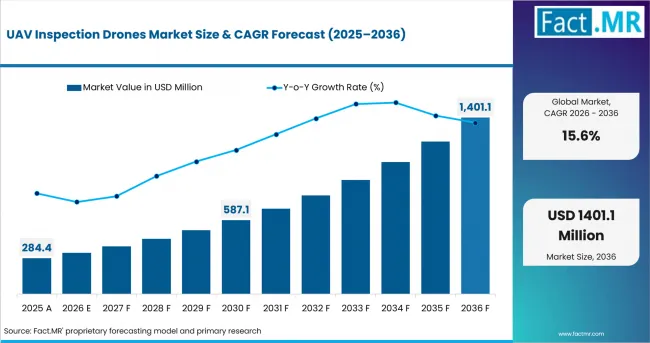
- The UAV inspection drones market was valued at USD 284.4 million in 2025.
- Based on Fact.MR analysis, demand is estimated to grow to USD 328.7 million in 2026.
- The market is forecast at USD 1,401.0 million by 2036. Fact.MR projects a 15.6% CAGR during the forecast period.
| Metric | Value |
|---|---|
| Estimated Value in 2026 | USD 328.7 million |
| Forecast Value in 2036 | USD 1,401.0 million |
| Forecast CAGR (2026 to 2036) | 15.6% |
Summary of UAV Inspection Drones Market
- Demand Drivers
- Power and telecom operators are using drone surveys to reduce work at height and cut inspection downtime.
- Oil and gas operators use UAV checks for pipelines and tanks because manual inspection can be costly in hard-to-reach areas.
- Civil infrastructure agencies use drone mapping for bridges and roofs as repair backlogs keep inspection work active.
- Regulated commercial drone use supports repeat orders because operators need certified aircraft and trained pilots.
- Key Segments Analyzed
- By Type: Rotary wing drones hold 53.7% share in 2026 as hovering control supports close inspection of towers and tanks.
- By Operation Mode: Remotely piloted systems account for 64.4% share in 2026 because direct flight control suits active industrial sites.
- By Payload: Camera imaging captures 46.2% share in 2026 with routine inspection programs depending on clear photo and video records.
- By End Use: Oil and gas holds 26.8% share in 2026 because pipelines and tanks require safer inspection methods.
- By Service Model: In-house inspection holds 58.5% share in 2026 with large asset owners keeping flight schedules and image records under direct control.
- By Inspection Asset: Towers account for 29.4% share in 2026 as telecom and utility operators need frequent height-based inspection.
- Analyst Opinion at Fact.MR
- Shambhu Nath Jha, Principal Consultant at Fact.MR, opines, “CXOs will see UAV inspection drone demand moving toward certified aircraft and repeatable image capture. Safer asset access is now a clear budget reason. Energy firms and telecom operators are shifting inspection spending from manual site checks to drone-based records that support repair planning.”
- Strategic Implications
- Manufacturers should focus on rotary wing inspection drones with stable cameras for towers and tanks. Roof assets need close-range camera control.
- Service firms should offer inspection flights with clear compliance records for energy and telecom operators.
- Suppliers should expand thermal and LiDAR payload options for assets that need more than standard images.
The market is forecast to create an incremental revenue opportunity of USD 1,072.3 million between 2026 and 2036. Utilities and energy firms are spending more on drone inspections to reduce manual work at height. Battery limits and airspace permissions can slow long-distance use.
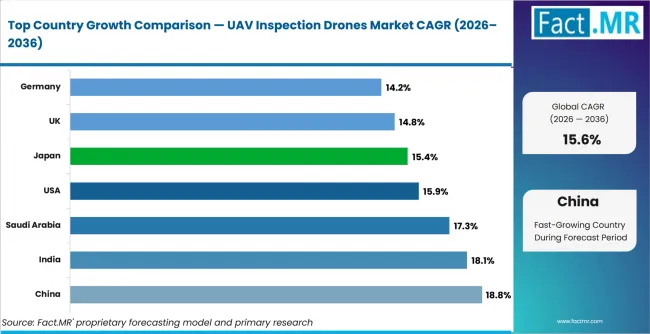
China is projected to lead with 18.8% CAGR through 2036 as civil drone activity and utility inspection use increase. India follows at 18.1% CAGR as drone registration growth supports commercial inspection work. Saudi Arabia records 17.3% CAGR because oil and gas operators expand plant and offshore inspections. The United States grows at 15.9% CAGR with support from Part 107 rules and commercial drone fleet expansion. Japan expands at 15.4% CAGR as regulated drone use supports inspection and mapping. The United Kingdom advances at 14.8% CAGR because drone trials support infrastructure inspection. Germany grows at 14.2% CAGR as power grid upgrades and factory maintenance programs create steady inspection demand.
Segmental Analysis
UAV Inspection Drones Market Analysis by Type
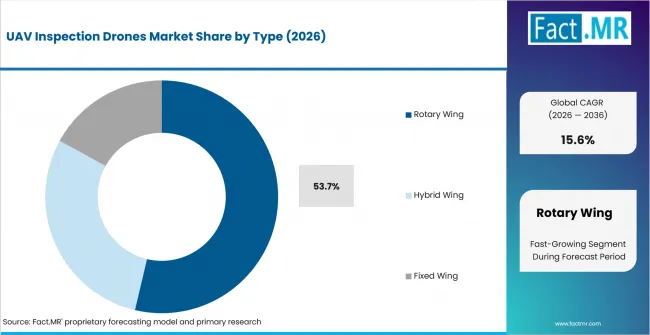
Rotary wing drones are projected to account for 53.7% share in 2026 because they can lift vertically and hover near assets. Towers and tanks need close camera checks. Roofs and industrial equipment need the same close-range control. Fixed wing drones support longer pipeline and corridor routes. Hybrid wing models are gaining attention for mixed-distance work, though approval rules and service cost limit near-term use.
- Rotary Wing Inspection Demand: Industrial operators prefer rotary drones for short inspection routes that need close camera movement around confined assets.
- Fixed Wing Route Use: Pipeline and transmission corridor surveys use fixed wing drones for longer flight coverage.
- Hybrid Wing Expansion: Hybrid wing platforms support longer-distance inspection, although maintenance training keeps adoption selective.
UAV Inspection Drones Market Analysis by Operation Mode
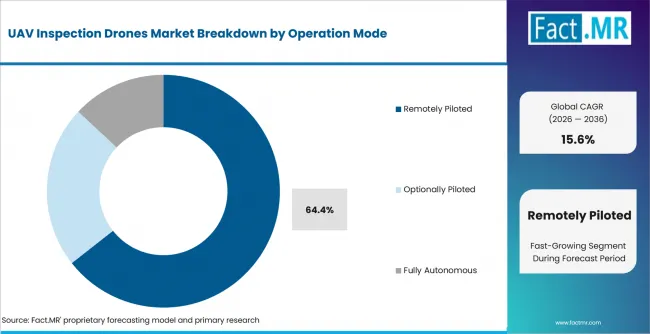
Remotely piloted drones are projected to hold 64.4% share in 2026 as site operators prefer human control near active assets. Licensed pilot rules and easier client approval support demand. Fully autonomous systems will grow once airspace rules and site safety steps become clearer.
- Remote Pilot Preference: Industrial sites prefer licensed pilots for complex routes near towers and tanks. Active operating units need careful flight control.
- Autonomous Flight Progress: Fully autonomous drones will expand in closed industrial zones after site owners approve repeat flight paths.
- Optional Pilot Use: Optionally piloted systems serve asset owners that need manual control during high-risk inspection work.
UAV Inspection Drones Market Analysis by Payload
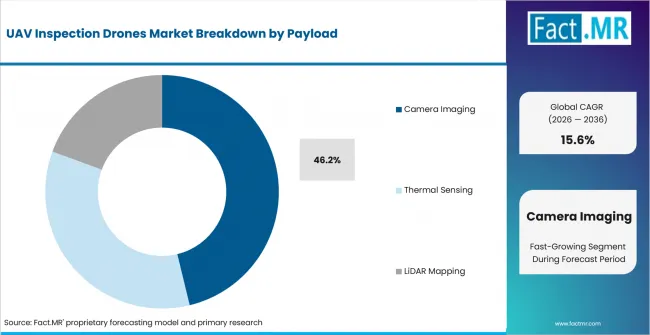
Camera imaging is set to capture 46.2% share in 2026 because most inspection programs need clear photo and video records before using thermal or LiDAR payloads. Thermal sensing supports power and solar checks. LiDAR mapping is used for terrain and structural models, although cost keeps it tied to high-value jobs.
- Camera Imaging Base: Standard camera payloads support routine inspection and damage records at lower service cost.
- Thermal Sensor Use: Utilities and solar operators use thermal payloads to find heat signatures on energized assets.
- LiDAR Mapping Need: Survey firms use LiDAR payloads for bridge and corridor mapping. Terrain mapping jobs need depth data.
UAV Inspection Drones Market Analysis by End Use
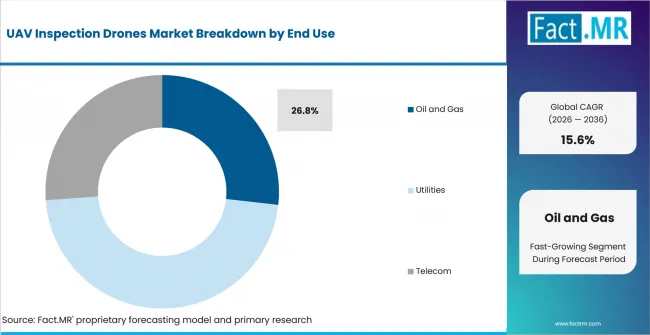
Oil and gas is estimated to hold 26.8% share in 2026 as pipelines and tanks need frequent inspection. Rigs and flare systems need checks without long shutdowns. Wind power added 117 GW of new capacity worldwide in 2024, which supports wind turbine drone inspection demand for blades and towers. Energy operators benefit when drone images reduce scaffolding work and shorten site exposure. [8]
- Oil and Gas Asset Checks: Energy firms use drones for tanks and pipeline routes because manual inspection can be costly.
- Utility Corridor Demand: Power grid operators use aerial checks to review poles and wires. Vegetation near lines creates repeat inspection work.
- Infrastructure Inspection Use: Bridge and roof inspection services use UAVs to capture site images before repair planning starts.
UAV Inspection Drones Market Analysis by Service Model
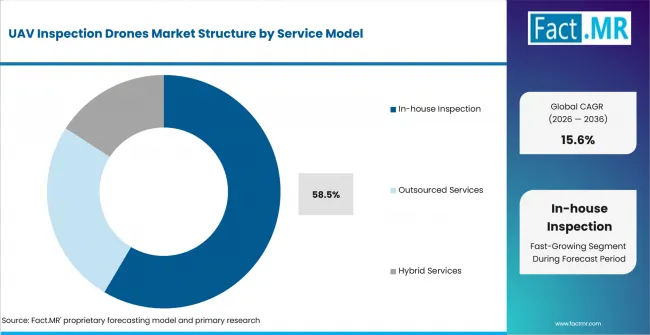
In-house inspection is projected to hold 58.5% share in 2026 because large asset owners prefer direct control over flight schedules and images. Maintenance records stay under owner control. Outsourced inspection supports smaller firms that lack pilots and equipment. Hybrid service models combine internal flight crews with specialist analysis providers.
- In-house Inspection Control: Energy and telecom operators prefer internal flight crews for repeat assets and confidential records.
- Outsourced Service Need: Smaller industrial sites use service firms for certified pilots and inspection equipment access.
- Hybrid Service Mix: Large operators use internal crews for routine work and outside specialists for thermal or LiDAR jobs.
UAV Inspection Drones Market Analysis by Inspection Asset
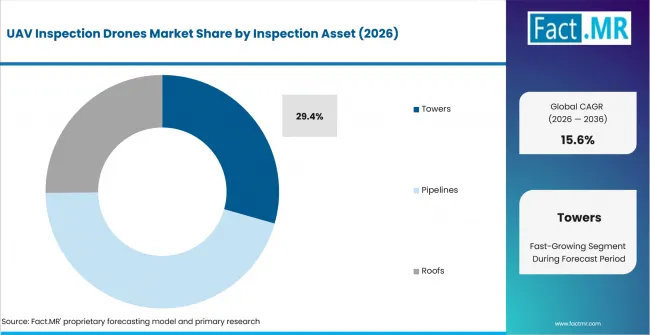
Towers are estimated to account for 29.4% share in 2026 as telecom and utility operators need frequent checks at height. Pipeline inspection uses fixed wing and hybrid drones for corridor review. Bridges and roofs create repeat demand through maintenance cycles. Wind blades need regular image records for repair planning.
- Tower Inspection Base: Telecom and power tower owners use drones to reduce climbing exposure during routine checks.
- Pipeline Route Checks: Drone pipeline inspection supports right-of-way review and leak screening along long corridors.
- Roof and Bridge Surveys: Drone roof inspection and bridge surveys help site owners document damage before repair work starts.
Drivers, Restraints, and Opportunities

UAV inspection drones are gaining use as asset owners reduce manual work at height. The FAA base forecast places the U.S. commercial small drone fleet at 1.089 million units in 2026. This shows the scale of aircraft available for business use. A deeper fleet improves service coverage for inspection work and reduces the wait for certified operators. [1]
Growth is supported by repeat inspection cycles more than one-time equipment sales. Part 107 drone registration in the United States costs USD 5 per drone and is valid for three years. This low registration cost helps operators keep more drones ready for aerial inspection services. [2]
- Safety Replacement Demand: Asset owners use drones to reduce ladder and rope work. Scaffold use falls in high-access inspection jobs.
- Energy Asset Opportunity: Pipeline and tank operators use UAV checks to reduce downtime. Offshore operators follow similar inspection schedules.
- Regulatory Constraint: BVLOS approval and local flight permissions still slow long corridor inspection in several countries.
Regional Analysis
The UAV inspection drones market is assessed across North America and Europe. Asia Pacific is also covered with Latin America and the Middle East and Africa. The review covers country-level demand by drone type and operation mode. It also covers payload mix with end use, service model and inspection asset. The full report includes market attractiveness analysis by region and country.
.webp)
| Country | CAGR (2026 to 2036) |
|---|---|
| China | 18.8% |
| India | 18.1% |
| Saudi Arabia | 17.3% |
| United States | 15.9% |
| Japan | 15.4% |
| United Kingdom | 14.8% |
| Germany | 14.2% |
Source: Fact.MR analysis, based on proprietary forecasting model and primary research
Asia Pacific UAV Inspection Drones Market Analysis
Asia Pacific is projected to expand quickly as drone rules and manufacturing capacity improve. Infrastructure inspection programs add more demand. China and India grow fast because both countries have large industrial sites. Policy support for unmanned aircraft systems helps service growth. Japan adds steady demand through regulated flight approvals. Infrastructure maintenance work supports camera-based surveys.
- China: China is projected to record 18.8% CAGR by 2036. Civil drone activity is moving from general aerial work toward industrial inspection across utilities and energy assets. CAAC reported more than 23 million civil drone flight hours in 2023. This operating base supports repeated tower and corridor checks nationwide today. [4]
- India: India is expected to expand at 18.1% CAGR from 2026 to 2036. Commercial inspection work benefits from rising drone registration and wider pilot availability. The civil aviation ministry reported 11,513 Unique Identification Numbers generated during 2024. That larger registered base supports utility surveys and plant inspection work across major industrial cities. [3]
- Japan: Japan is forecast to grow at 15.4% CAGR through 2036. Regulated drone use supports recurring inspection across infrastructure and mapping jobs. JCAB stated that more than 383,000 drones were registered by the end of February 2024. This fleet base helps service providers cover repeat asset checks more efficiently nationwide. [7]
North America UAV Inspection Drones Market Analysis

North America has a large commercial drone fleet and a deep inspection service base. Energy firms and telecom operators use drones to inspect difficult assets faster. Public infrastructure agencies use drones for similar survey work. Pilot certification systems and clear commercial UAS rules support regional demand.
- United States: The United States is expected to advance at 15.9% CAGR by 2036. Part 107 rules give commercial operators a clear path for inspection work. A large certified drone base supports tower surveys and roof checks. Energy firms use flight-based records for maintenance planning.
Europe UAV Inspection Drones Market Analysis

Europe shows steady demand for inspection drones through energy transition assets. Aligned civil aviation rules help service providers plan cross-border work. EASA issued its first U-space service provider certificate in May 2025, which supports safer access to drone traffic services for dense operating zones. The certificate improves the pathway for repeated industrial drone inspection near infrastructure assets. [6]
- United Kingdom: The United Kingdom is projected to rise at 14.8% CAGR from 2026 to 2036. Infrastructure inspection trials are widening acceptance of drone-based site checks. The Civil Aviation Authority selected six projects in August 2024 for drone deliveries and inspections. These trials support repeat surveys for utilities and public assets nationwide today. [5]
- Germany: Germany is forecast at 14.2% CAGR through 2036. Power grid upgrades and factory maintenance programs support steady drone inspection use. Industrial operators need safer tower and plant surveys with clear visual records. Service providers with certified pilots can offer repeat inspection packages to utilities and manufacturing sites.
Middle East UAV Inspection Drones Market Analysis
Middle East demand is linked to oil and gas facilities. Utility corridors and large industrial sites add inspection work. Saudi Arabia is the main growth market as energy operators use drone inspection for tanks and process assets. Flight approvals and site safety rules affect service timing.
- Saudi Arabia: Saudi Arabia is expected to post 17.3% CAGR from 2026 to 2036. Oil and gas operators are expanding drone inspection for offshore platforms and processing assets. Plant checks benefit from flight-based access because shutdown time is costly. Site safety rules will shape adoption across energy facilities and export terminals.
Competitive Aligners for Market Players

UAV inspection drone suppliers compete on aircraft stability and payload quality. Regulatory readiness and clear service records help win repeat contracts. Operators that connect drone flights with usable inspection records gain an advantage in thermal drone inspection and pipeline work. Service firms with trained pilots and sector experience are better placed for energy contracts. Utility and infrastructure contracts need the same proof.
Large inspection firms such as Applus+ and Intertek benefit from existing industrial clients. MISTRAS has a similar advantage in asset integrity work. Specialist drone firms such as Flyability and Voliro compete through aircraft capability. Skydio and DJI compete through payload quality and flight control. Terra Drone adds regional reach in energy inspection. The company supports drone pipeline inspection programs across large asset networks.
Competition is moving toward repeat asset programs over single flight jobs. Companies that provide clear reports and image archives can win recurring work. Repair-ready data helps turn inspection findings into maintenance orders. Service providers linked with drone bridge inspection services can benefit from public asset checks. Drone roof inspection supports insurance-linked site surveys.
Key Players
- DJI Technology Co., Ltd.
- Skydio, Inc.
- Flyability SA
- Voliro AG
- Terra Drone Corporation
- Applus+
- Intertek Group plc
- MISTRAS Group, Inc.
Bibliography
- [1]. Federal Aviation Administration. (2025). Compendium to FAA Aerospace Forecast FY 2025–2045: Emerging aviation entrants: Unmanned aircraft systems and advanced air mobility. U.S. Department of Transportation.
- [2]. Federal Aviation Administration. (2024, March 18). How to register your drone. U.S. Department of Transportation.
- [3]. Ministry of Civil Aviation. (2025, March). Annual report: Civil aviation for the year 2024–25. Government of India.
- [4]. State Council Information Office of the People’s Republic of China. (2024, March 20). China eyes buzzing low-altitude skies for new growth engine.
- [5]. UK Civil Aviation Authority. (2024, August 15). New trials set to help unlock drone deliveries and inspections in the UK.
- [6]. European Union Aviation Safety Agency. (2025, May 14). EASA certifies ANRA Technologies as first U-space service provider.
- [7]. Japan Civil Aviation Bureau. (2024, April 9). Measure of realizing beyond the visual line of sight flight of unmanned aircraft systems in urban area in Japan. Asia-Pacific Economic Cooperation.
- [8]. Global Wind Energy Council. (2025, April 23). Wind industry installs record capacity in 2024 despite policy instability.
This Report Addresses
- Strategic demand analysis for UAV inspection drones across oil and gas, utilities, telecom, construction, mining, renewable energy, and public infrastructure applications globally.
- Market forecast from USD 328.7 million in 2026 to USD 1,401.0 million by 2036 at 15.6% CAGR, with segment-level analysis by type, operation mode, payload, end use, service model, and inspection asset.
- Opportunity mapping across China, India, Saudi Arabia, the United States, Japan, the United Kingdom, and Germany based on drone registration growth, commercial fleet expansion, and infrastructure inspection demand.
- Segment analysis by drone type, operation mode, payload, end use, service model, and inspection asset with regional and country-level forecasts through 2036.
- Competitive analysis of DJI Technology Co., Ltd., Skydio, Inc., Flyability SA, Voliro AG, Terra Drone Corporation, Applus+, Intertek Group plc, and MISTRAS Group, Inc. covering aircraft stability, payload quality, certified pilot capability, and repeat inspection service records.
- Regulatory impact analysis covering FAA Part 107 rules, commercial drone registration, EASA U-space certification, and civil aviation authority approvals across major drone inspection markets.
- Report delivery in PDF, Excel, and presentation formats supported by commercial drone fleet data, UAV product catalogs, inspection service benchmarks, and interviews with asset integrity managers.
UAV Inspection Drones Market Definition
The UAV inspection drones market covers unmanned aerial vehicles and related inspection services used to examine industrial assets and infrastructure assets. These drones support visual imaging and advanced sensor based inspection for towers, pipelines and roofs. They also serve bridges, wind blades, offshore platforms and industrial tanks where manual inspection is costly or risky.
UAV Inspection Drones Market Inclusions
Covers global and regional market forecasts from 2026 to 2036 across type and operation mode. Payload, end use, service model and inspection asset are included. The scope includes fixed wing, rotary wing, hybrid wing, remotely piloted, optionally piloted, and fully autonomous systems. It also includes camera imaging, thermal sensing, LiDAR mapping, multispectral sensors and gas detection payloads used across oil and gas, utilities, telecom, construction, mining, renewable energy and public infrastructure end users.
UAV Inspection Drones Market Exclusions
Excludes consumer drones used for recreation or general photography. Omits drones used mainly for delivery, agriculture spraying, defense operations or entertainment filming. Excludes inspection software platforms, data analytics tools and maintenance services unless they are directly tied to UAV inspection drone revenue. General aviation equipment and non-aerial inspection systems are outside the market scope.
UAV Inspection Drones Market Research Methodology
- Primary Research
- Interviews with drone inspection service providers, industrial asset managers and utility maintenance heads across the United States, China, India, Saudi Arabia, Japan, the United Kingdom and Germany. Inputs also include discussions with UAV manufacturers, certified drone pilots, telecom tower inspection contractors and oil and gas asset integrity teams.
- Desk Research
- Analysis of DJI Technology Co. Ltd., Skydio Inc., Flyability SA, Voliro AG, Terra Drone Corporation, Applus+, Intertek Group plc and MISTRAS Group Inc. public materials. Supplemented by FAA commercial drone fleet data, EASA drone traffic service updates, civil aviation authority publications and renewable energy infrastructure reports.
- Market-Sizing and Forecasting
- Hybrid model combining top-down commercial drone market estimates with bottom-up inspection demand by asset type and end use. Installed industrial asset base, service contract frequency and average drone inspection value are modeled by region. Payload mix and service model adoption are evaluated separately before regional aggregation.
- Data Validation and Update Cycle
- Validated through UAV product catalogs, commercial drone registration data and industrial inspection service benchmarks. Cross-checks include aviation rule updates, pilot certification trends, energy infrastructure maintenance activity and company service portfolios. The model is updated annually with regulatory changes, fleet registration data and new inspection technology adoption.
Scope of the Report

| Attribute | Details |
|---|---|
| Quantitative Units | USD 328.7 million in 2026 to USD 1,401.0 million in 2036 at a 15.6% CAGR |
| Market Definition | UAV inspection drones used for industrial and infrastructure inspection across energy, telecom, utilities, roofs, bridges, tanks, wind blades, and offshore assets. |
| Type Segmentation | Fixed Wing, Rotary Wing, Hybrid Wing |
| Operation Mode Segmentation | Remotely Piloted, Optionally Piloted, Fully Autonomous |
| Payload Segmentation | Camera Imaging, Thermal Sensing, LiDAR Mapping, Multispectral Sensors, Gas Detection |
| End Use Coverage | Oil and Gas, Utilities, Telecom, Construction, Mining, Renewable Energy, Public Infrastructure |
| Service Model Segmentation | In-house Inspection, Outsourced Services, Hybrid Services |
| Inspection Asset Coverage | Towers, Pipelines, Roofs, Bridges, Wind Blades, Offshore Platforms, Industrial Tanks |
| Regions Covered | North America, Europe, Asia Pacific, Latin America, Middle East and Africa |
| Countries Covered | United States, Canada, Germany, United Kingdom, France, China, India, Japan, South Korea, Australia, Saudi Arabia, United Arab Emirates, Brazil, Mexico |
| Key Companies Profiled | DJI Technology Co. Ltd., Skydio Inc., Flyability SA, Voliro AG, Terra Drone Corporation, Applus+, Intertek Group plc, MISTRAS Group Inc. |
| Forecast Period | 2026 to 2036 |
| Approach | Hybrid top-down and bottom-up model using commercial drone fleet estimates, industrial asset inspection frequency, payload adoption patterns, service contract values and primary interviews with UAV manufacturers, certified drone pilots, utility maintenance heads and asset integrity managers. |
UAV Inspection Drones Market by Segment
-
By Type
- Fixed Wing
- Rotary Wing
- Hybrid Wing
-
By Operation Mode
- Remotely Piloted
- Optionally Piloted
- Fully Autonomous
-
By Payload
- Camera Imaging
- Thermal Sensing
- LiDAR Mapping
- Multispectral Sensors
- Gas Detection
-
By End Use
- Oil and Gas
- Utilities
- Telecom
- Construction
- Mining
- Renewable Energy
- Public Infrastructure
-
By Service Model
- In-house Inspection
- Outsourced Services
- Hybrid Services
-
By Inspection Asset
- Towers
- Pipelines
- Roofs
- Bridges
- Wind Blades
- Offshore Platforms
- Industrial Tanks
-
By Region
- North America
- United States
- Canada
- Mexico
- Western Europe
- Germany
- United Kingdom
- France
- Italy
- Spain
- Netherlands
- Nordic Countries
- BENELUX
- Rest of Western Europe
- Eastern Europe
- Poland
- Hungary
- Balkan and Baltic
- Rest of Eastern Europe
- East Asia
- China
- Japan
- South Korea
- South Asia and Pacific
- India
- ASEAN
- Australia and New Zealand
- Rest of South Asia and Pacific
- Middle East and Africa
- Kingdom of Saudi Arabia
- Other GCC Countries
- Turkey
- South Africa
- Rest of Middle East and Africa
- North America
- Frequently Asked Questions -
How large is the global UAV inspection drones market in 2025?
The global UAV inspection drones market was valued at USD 284.4 million in 2025.
What will the market size be in 2026?
Based on Fact.MR analysis, demand for UAV inspection drones is estimated to grow to USD 328.7 million in 2026.
What is the projected market size by 2036?
The market is forecast to reach USD 1,401.0 million by 2036, creating USD 1,072.3 million in incremental opportunity.
What is the expected CAGR from 2026 to 2036?
Fact.MR projects a 15.6% CAGR for the global UAV inspection drones market during the forecast period.
Which type segment leads the UAV inspection drones market?
Rotary wing drones lead with 53.7% share in 2026 because hovering control supports close inspection of towers and tanks.
Which end-use segment holds the largest UAV inspection drones market share?
Oil and gas dominates with 26.8% share in 2026 as pipelines and tanks require safer inspection across difficult operating areas.
Which country shows the fastest growth in the UAV inspection drones market?
China leads at 18.8% CAGR through 2036 as civil drone activity and utility inspection use increase across industrial assets.
Table of Content
- Executive Summary
- Global Market Outlook
- Demand to side Trends
- Supply to side Trends
- Technology Roadmap Analysis
- Analysis and Recommendations
- Market Overview
- Market Coverage / Taxonomy
- Market Definition / Scope / Limitations
- Research Methodology
- Chapter Orientation
- Analytical Lens and Working Hypotheses
- Market Structure, Signals, and Trend Drivers
- Benchmarking and Cross-market Comparability
- Market Sizing, Forecasting, and Opportunity Mapping
- Research Design and Evidence Framework
- Desk Research Programme (Secondary Evidence)
- Company Annual and Sustainability Reports
- Peer-reviewed Journals and Academic Literature
- Corporate Websites, Product Literature, and Technical Notes
- Earnings Decks and Investor Briefings
- Statutory Filings and Regulatory Disclosures
- Technical White Papers and Standards Notes
- Trade Journals, Industry Magazines, and Analyst Briefs
- Conference Proceedings, Webinars, and Seminar Materials
- Government Statistics Portals and Public Data Releases
- Press Releases and Reputable Media Coverage
- Specialist Newsletters and Curated Briefings
- Sector Databases and Reference Repositories
- Fact.MR Internal Proprietary Databases and Historical Market Datasets
- Subscription Datasets and Paid Sources
- Social Channels, Communities, and Digital Listening Inputs
- Additional Desk Sources
- Expert Input and Fieldwork (Primary Evidence)
- Primary Modes
- Qualitative Interviews and Expert Elicitation
- Quantitative Surveys and Structured Data Capture
- Blended Approach
- Why Primary Evidence is Used
- Field Techniques
- Interviews
- Surveys
- Focus Groups
- Observational and In-context Research
- Social and Community Interactions
- Stakeholder Universe Engaged
- C-suite Leaders
- Board Members
- Presidents and Vice Presidents
- R&D and Innovation Heads
- Technical Specialists
- Domain Subject-matter Experts
- Scientists
- Physicians and Other Healthcare Professionals
- Governance, Ethics, and Data Stewardship
- Research Ethics
- Data Integrity and Handling
- Primary Modes
- Tooling, Models, and Reference Databases
- Desk Research Programme (Secondary Evidence)
- Data Engineering and Model Build
- Data Acquisition and Ingestion
- Cleaning, Normalisation, and Verification
- Synthesis, Triangulation, and Analysis
- Quality Assurance and Audit Trail
- Market Background
- Market Dynamics
- Drivers
- Restraints
- Opportunity
- Trends
- Scenario Forecast
- Demand in Optimistic Scenario
- Demand in Likely Scenario
- Demand in Conservative Scenario
- Opportunity Map Analysis
- Product Life Cycle Analysis
- Supply Chain Analysis
- Investment Feasibility Matrix
- Value Chain Analysis
- PESTLE and Porter’s Analysis
- Regulatory Landscape
- Regional Parent Market Outlook
- Production and Consumption Statistics
- Import and Export Statistics
- Market Dynamics
- Global Market Analysis 2021 to 2025 and Forecast, 2026 to 2036
- Historical Market Size Value (USD Million) Analysis, 2021 to 2025
- Current and Future Market Size Value (USD Million) Projections, 2026 to 2036
- Y to o to Y Growth Trend Analysis
- Absolute $ Opportunity Analysis
- Global Market Pricing Analysis 2021 to 2025 and Forecast 2026 to 2036
- Global Market Analysis 2021 to 2025 and Forecast 2026 to 2036, By Type
- Introduction / Key Findings
- Historical Market Size Value (USD Million) Analysis By Type , 2021 to 2025
- Current and Future Market Size Value (USD Million) Analysis and Forecast By Type , 2026 to 2036
- Rotary Wing
- Hybrid Wing
- Fixed Wing
- Rotary Wing
- Y to o to Y Growth Trend Analysis By Type , 2021 to 2025
- Absolute $ Opportunity Analysis By Type , 2026 to 2036
- Global Market Analysis 2021 to 2025 and Forecast 2026 to 2036, By Operation Mode
- Introduction / Key Findings
- Historical Market Size Value (USD Million) Analysis By Operation Mode, 2021 to 2025
- Current and Future Market Size Value (USD Million) Analysis and Forecast By Operation Mode, 2026 to 2036
- Remotely Piloted
- Optionally Piloted
- Fully Autonomous
- Remotely Piloted
- Y to o to Y Growth Trend Analysis By Operation Mode, 2021 to 2025
- Absolute $ Opportunity Analysis By Operation Mode, 2026 to 2036
- Global Market Analysis 2021 to 2025 and Forecast 2026 to 2036, By Payload
- Introduction / Key Findings
- Historical Market Size Value (USD Million) Analysis By Payload, 2021 to 2025
- Current and Future Market Size Value (USD Million) Analysis and Forecast By Payload, 2026 to 2036
- Camera Imaging
- Thermal Sensing
- LiDAR Mapping
- Multispectral Sensors
- Gas Detection
- Camera Imaging
- Y to o to Y Growth Trend Analysis By Payload, 2021 to 2025
- Absolute $ Opportunity Analysis By Payload, 2026 to 2036
- Global Market Analysis 2021 to 2025 and Forecast 2026 to 2036, By End Use
- Introduction / Key Findings
- Historical Market Size Value (USD Million) Analysis By End Use, 2021 to 2025
- Current and Future Market Size Value (USD Million) Analysis and Forecast By End Use, 2026 to 2036
- Oil and Gas
- Utilities
- Telecom
- Construction
- Mining
- Renewable Energy
- Public Infrastructure
- Oil and Gas
- Y to o to Y Growth Trend Analysis By End Use, 2021 to 2025
- Absolute $ Opportunity Analysis By End Use, 2026 to 2036
- Global Market Analysis 2021 to 2025 and Forecast 2026 to 2036, By Service Model
- Introduction / Key Findings
- Historical Market Size Value (USD Million) Analysis By Service Model, 2021 to 2025
- Current and Future Market Size Value (USD Million) Analysis and Forecast By Service Model, 2026 to 2036
- In-house Inspection
- Outsourced Services
- Hybrid Services
- In-house Inspection
- Y to o to Y Growth Trend Analysis By Service Model, 2021 to 2025
- Absolute $ Opportunity Analysis By Service Model, 2026 to 2036
- Global Market Analysis 2021 to 2025 and Forecast 2026 to 2036, By Inspection Asset
- Introduction / Key Findings
- Historical Market Size Value (USD Million) Analysis By Inspection Asset, 2021 to 2025
- Current and Future Market Size Value (USD Million) Analysis and Forecast By Inspection Asset, 2026 to 2036
- Towers
- Pipelines
- Roofs
- Bridges
- Wind Blades
- Offshore Platforms
- Industrial Tanks
- Towers
- Y to o to Y Growth Trend Analysis By Inspection Asset, 2021 to 2025
- Absolute $ Opportunity Analysis By Inspection Asset, 2026 to 2036
- Global Market Analysis 2021 to 2025 and Forecast 2026 to 2036, By Region
- Introduction
- Historical Market Size Value (USD Million) Analysis By Region, 2021 to 2025
- Current Market Size Value (USD Million) Analysis and Forecast By Region, 2026 to 2036
- North America
- Latin America
- Western Europe
- Eastern Europe
- East Asia
- South Asia and Pacific
- Middle East & Africa
- Market Attractiveness Analysis By Region
- North America Market Analysis 2021 to 2025 and Forecast 2026 to 2036, By Country
- Historical Market Size Value (USD Million) Trend Analysis By Market Taxonomy, 2021 to 2025
- Market Size Value (USD Million) Forecast By Market Taxonomy, 2026 to 2036
- By Country
- USA
- Canada
- Mexico
- By Type
- By Operation Mode
- By Payload
- By End Use
- By Service Model
- By Inspection Asset
- By Country
- Market Attractiveness Analysis
- By Country
- By Type
- By Operation Mode
- By Payload
- By End Use
- By Service Model
- By Inspection Asset
- Key Takeaways
- Latin America Market Analysis 2021 to 2025 and Forecast 2026 to 2036, By Country
- Historical Market Size Value (USD Million) Trend Analysis By Market Taxonomy, 2021 to 2025
- Market Size Value (USD Million) Forecast By Market Taxonomy, 2026 to 2036
- By Country
- Brazil
- Chile
- Rest of Latin America
- By Type
- By Operation Mode
- By Payload
- By End Use
- By Service Model
- By Inspection Asset
- By Country
- Market Attractiveness Analysis
- By Country
- By Type
- By Operation Mode
- By Payload
- By End Use
- By Service Model
- By Inspection Asset
- Key Takeaways
- Western Europe Market Analysis 2021 to 2025 and Forecast 2026 to 2036, By Country
- Historical Market Size Value (USD Million) Trend Analysis By Market Taxonomy, 2021 to 2025
- Market Size Value (USD Million) Forecast By Market Taxonomy, 2026 to 2036
- By Country
- Germany
- UK
- Italy
- Spain
- France
- Nordic
- BENELUX
- Rest of Western Europe
- By Type
- By Operation Mode
- By Payload
- By End Use
- By Service Model
- By Inspection Asset
- By Country
- Market Attractiveness Analysis
- By Country
- By Type
- By Operation Mode
- By Payload
- By End Use
- By Service Model
- By Inspection Asset
- Key Takeaways
- Eastern Europe Market Analysis 2021 to 2025 and Forecast 2026 to 2036, By Country
- Historical Market Size Value (USD Million) Trend Analysis By Market Taxonomy, 2021 to 2025
- Market Size Value (USD Million) Forecast By Market Taxonomy, 2026 to 2036
- By Country
- Russia
- Poland
- Hungary
- Balkan & Baltic
- Rest of Eastern Europe
- By Type
- By Operation Mode
- By Payload
- By End Use
- By Service Model
- By Inspection Asset
- By Country
- Market Attractiveness Analysis
- By Country
- By Type
- By Operation Mode
- By Payload
- By End Use
- By Service Model
- By Inspection Asset
- Key Takeaways
- East Asia Market Analysis 2021 to 2025 and Forecast 2026 to 2036, By Country
- Historical Market Size Value (USD Million) Trend Analysis By Market Taxonomy, 2021 to 2025
- Market Size Value (USD Million) Forecast By Market Taxonomy, 2026 to 2036
- By Country
- China
- Japan
- South Korea
- By Type
- By Operation Mode
- By Payload
- By End Use
- By Service Model
- By Inspection Asset
- By Country
- Market Attractiveness Analysis
- By Country
- By Type
- By Operation Mode
- By Payload
- By End Use
- By Service Model
- By Inspection Asset
- Key Takeaways
- South Asia and Pacific Market Analysis 2021 to 2025 and Forecast 2026 to 2036, By Country
- Historical Market Size Value (USD Million) Trend Analysis By Market Taxonomy, 2021 to 2025
- Market Size Value (USD Million) Forecast By Market Taxonomy, 2026 to 2036
- By Country
- India
- ASEAN
- Australia & New Zealand
- Rest of South Asia and Pacific
- By Type
- By Operation Mode
- By Payload
- By End Use
- By Service Model
- By Inspection Asset
- By Country
- Market Attractiveness Analysis
- By Country
- By Type
- By Operation Mode
- By Payload
- By End Use
- By Service Model
- By Inspection Asset
- Key Takeaways
- Middle East & Africa Market Analysis 2021 to 2025 and Forecast 2026 to 2036, By Country
- Historical Market Size Value (USD Million) Trend Analysis By Market Taxonomy, 2021 to 2025
- Market Size Value (USD Million) Forecast By Market Taxonomy, 2026 to 2036
- By Country
- Kingdom of Saudi Arabia
- Other GCC Countries
- Turkiye
- South Africa
- Other African Union
- Rest of Middle East & Africa
- By Type
- By Operation Mode
- By Payload
- By End Use
- By Service Model
- By Inspection Asset
- By Country
- Market Attractiveness Analysis
- By Country
- By Type
- By Operation Mode
- By Payload
- By End Use
- By Service Model
- By Inspection Asset
- Key Takeaways
- Key Countries Market Analysis
- USA
- Pricing Analysis
- Market Share Analysis, 2025
- By Type
- By Operation Mode
- By Payload
- By End Use
- By Service Model
- By Inspection Asset
- Canada
- Pricing Analysis
- Market Share Analysis, 2025
- By Type
- By Operation Mode
- By Payload
- By End Use
- By Service Model
- By Inspection Asset
- Mexico
- Pricing Analysis
- Market Share Analysis, 2025
- By Type
- By Operation Mode
- By Payload
- By End Use
- By Service Model
- By Inspection Asset
- Brazil
- Pricing Analysis
- Market Share Analysis, 2025
- By Type
- By Operation Mode
- By Payload
- By End Use
- By Service Model
- By Inspection Asset
- Chile
- Pricing Analysis
- Market Share Analysis, 2025
- By Type
- By Operation Mode
- By Payload
- By End Use
- By Service Model
- By Inspection Asset
- Germany
- Pricing Analysis
- Market Share Analysis, 2025
- By Type
- By Operation Mode
- By Payload
- By End Use
- By Service Model
- By Inspection Asset
- UK
- Pricing Analysis
- Market Share Analysis, 2025
- By Type
- By Operation Mode
- By Payload
- By End Use
- By Service Model
- By Inspection Asset
- Italy
- Pricing Analysis
- Market Share Analysis, 2025
- By Type
- By Operation Mode
- By Payload
- By End Use
- By Service Model
- By Inspection Asset
- Spain
- Pricing Analysis
- Market Share Analysis, 2025
- By Type
- By Operation Mode
- By Payload
- By End Use
- By Service Model
- By Inspection Asset
- France
- Pricing Analysis
- Market Share Analysis, 2025
- By Type
- By Operation Mode
- By Payload
- By End Use
- By Service Model
- By Inspection Asset
- India
- Pricing Analysis
- Market Share Analysis, 2025
- By Type
- By Operation Mode
- By Payload
- By End Use
- By Service Model
- By Inspection Asset
- ASEAN
- Pricing Analysis
- Market Share Analysis, 2025
- By Type
- By Operation Mode
- By Payload
- By End Use
- By Service Model
- By Inspection Asset
- Australia & New Zealand
- Pricing Analysis
- Market Share Analysis, 2025
- By Type
- By Operation Mode
- By Payload
- By End Use
- By Service Model
- By Inspection Asset
- China
- Pricing Analysis
- Market Share Analysis, 2025
- By Type
- By Operation Mode
- By Payload
- By End Use
- By Service Model
- By Inspection Asset
- Japan
- Pricing Analysis
- Market Share Analysis, 2025
- By Type
- By Operation Mode
- By Payload
- By End Use
- By Service Model
- By Inspection Asset
- South Korea
- Pricing Analysis
- Market Share Analysis, 2025
- By Type
- By Operation Mode
- By Payload
- By End Use
- By Service Model
- By Inspection Asset
- Russia
- Pricing Analysis
- Market Share Analysis, 2025
- By Type
- By Operation Mode
- By Payload
- By End Use
- By Service Model
- By Inspection Asset
- Poland
- Pricing Analysis
- Market Share Analysis, 2025
- By Type
- By Operation Mode
- By Payload
- By End Use
- By Service Model
- By Inspection Asset
- Hungary
- Pricing Analysis
- Market Share Analysis, 2025
- By Type
- By Operation Mode
- By Payload
- By End Use
- By Service Model
- By Inspection Asset
- Kingdom of Saudi Arabia
- Pricing Analysis
- Market Share Analysis, 2025
- By Type
- By Operation Mode
- By Payload
- By End Use
- By Service Model
- By Inspection Asset
- Turkiye
- Pricing Analysis
- Market Share Analysis, 2025
- By Type
- By Operation Mode
- By Payload
- By End Use
- By Service Model
- By Inspection Asset
- South Africa
- Pricing Analysis
- Market Share Analysis, 2025
- By Type
- By Operation Mode
- By Payload
- By End Use
- By Service Model
- By Inspection Asset
- USA
- Market Structure Analysis
- Competition Dashboard
- Competition Benchmarking
- Market Share Analysis of Top Players
- By Regional
- By Type
- By Operation Mode
- By Payload
- By End Use
- By Service Model
- By Inspection Asset
- Competition Analysis
- Competition Deep Dive
- DJI Technology Co., Ltd.
- Overview
- Product Portfolio
- Profitability by Market Segments (Product/Age /Sales Channel/Region)
- Sales Footprint
- Strategy Overview
- Marketing Strategy
- Product Strategy
- Channel Strategy
- Skydio, Inc.
- Flyability SA
- Voliro AG
- Terra Drone Corporation
- Applus+
- Intertek Group plc
- MISTRAS Group, Inc.
- DJI Technology Co., Ltd.
- Competition Deep Dive
- Assumptions & Acronyms Used
List Of Table
- Table 1: Global Market Value (USD Million) Forecast by Region, 2021 to 2036
- Table 2: Global Market Value (USD Million) Forecast by Type, 2021 to 2036
- Table 3: Global Market Value (USD Million) Forecast by Operation Mode, 2021 to 2036
- Table 4: Global Market Value (USD Million) Forecast by Payload, 2021 to 2036
- Table 5: Global Market Value (USD Million) Forecast by End Use, 2021 to 2036
- Table 6: Global Market Value (USD Million) Forecast by Service Model, 2021 to 2036
- Table 7: Global Market Value (USD Million) Forecast by Inspection Asset, 2021 to 2036
- Table 8: North America Market Value (USD Million) Forecast by Country, 2021 to 2036
- Table 9: North America Market Value (USD Million) Forecast by Type, 2021 to 2036
- Table 10: North America Market Value (USD Million) Forecast by Operation Mode, 2021 to 2036
- Table 11: North America Market Value (USD Million) Forecast by Payload, 2021 to 2036
- Table 12: North America Market Value (USD Million) Forecast by End Use, 2021 to 2036
- Table 13: North America Market Value (USD Million) Forecast by Service Model, 2021 to 2036
- Table 14: North America Market Value (USD Million) Forecast by Inspection Asset, 2021 to 2036
- Table 15: Latin America Market Value (USD Million) Forecast by Country, 2021 to 2036
- Table 16: Latin America Market Value (USD Million) Forecast by Type, 2021 to 2036
- Table 17: Latin America Market Value (USD Million) Forecast by Operation Mode, 2021 to 2036
- Table 18: Latin America Market Value (USD Million) Forecast by Payload, 2021 to 2036
- Table 19: Latin America Market Value (USD Million) Forecast by End Use, 2021 to 2036
- Table 20: Latin America Market Value (USD Million) Forecast by Service Model, 2021 to 2036
- Table 21: Latin America Market Value (USD Million) Forecast by Inspection Asset, 2021 to 2036
- Table 22: Western Europe Market Value (USD Million) Forecast by Country, 2021 to 2036
- Table 23: Western Europe Market Value (USD Million) Forecast by Type, 2021 to 2036
- Table 24: Western Europe Market Value (USD Million) Forecast by Operation Mode, 2021 to 2036
- Table 25: Western Europe Market Value (USD Million) Forecast by Payload, 2021 to 2036
- Table 26: Western Europe Market Value (USD Million) Forecast by End Use, 2021 to 2036
- Table 27: Western Europe Market Value (USD Million) Forecast by Service Model, 2021 to 2036
- Table 28: Western Europe Market Value (USD Million) Forecast by Inspection Asset, 2021 to 2036
- Table 29: Eastern Europe Market Value (USD Million) Forecast by Country, 2021 to 2036
- Table 30: Eastern Europe Market Value (USD Million) Forecast by Type, 2021 to 2036
- Table 31: Eastern Europe Market Value (USD Million) Forecast by Operation Mode, 2021 to 2036
- Table 32: Eastern Europe Market Value (USD Million) Forecast by Payload, 2021 to 2036
- Table 33: Eastern Europe Market Value (USD Million) Forecast by End Use, 2021 to 2036
- Table 34: Eastern Europe Market Value (USD Million) Forecast by Service Model, 2021 to 2036
- Table 35: Eastern Europe Market Value (USD Million) Forecast by Inspection Asset, 2021 to 2036
- Table 36: East Asia Market Value (USD Million) Forecast by Country, 2021 to 2036
- Table 37: East Asia Market Value (USD Million) Forecast by Type, 2021 to 2036
- Table 38: East Asia Market Value (USD Million) Forecast by Operation Mode, 2021 to 2036
- Table 39: East Asia Market Value (USD Million) Forecast by Payload, 2021 to 2036
- Table 40: East Asia Market Value (USD Million) Forecast by End Use, 2021 to 2036
- Table 41: East Asia Market Value (USD Million) Forecast by Service Model, 2021 to 2036
- Table 42: East Asia Market Value (USD Million) Forecast by Inspection Asset, 2021 to 2036
- Table 43: South Asia and Pacific Market Value (USD Million) Forecast by Country, 2021 to 2036
- Table 44: South Asia and Pacific Market Value (USD Million) Forecast by Type, 2021 to 2036
- Table 45: South Asia and Pacific Market Value (USD Million) Forecast by Operation Mode, 2021 to 2036
- Table 46: South Asia and Pacific Market Value (USD Million) Forecast by Payload, 2021 to 2036
- Table 47: South Asia and Pacific Market Value (USD Million) Forecast by End Use, 2021 to 2036
- Table 48: South Asia and Pacific Market Value (USD Million) Forecast by Service Model, 2021 to 2036
- Table 49: South Asia and Pacific Market Value (USD Million) Forecast by Inspection Asset, 2021 to 2036
- Table 50: Middle East & Africa Market Value (USD Million) Forecast by Country, 2021 to 2036
- Table 51: Middle East & Africa Market Value (USD Million) Forecast by Type, 2021 to 2036
- Table 52: Middle East & Africa Market Value (USD Million) Forecast by Operation Mode, 2021 to 2036
- Table 53: Middle East & Africa Market Value (USD Million) Forecast by Payload, 2021 to 2036
- Table 54: Middle East & Africa Market Value (USD Million) Forecast by End Use, 2021 to 2036
- Table 55: Middle East & Africa Market Value (USD Million) Forecast by Service Model, 2021 to 2036
- Table 56: Middle East & Africa Market Value (USD Million) Forecast by Inspection Asset, 2021 to 2036
List Of Figures
- Figure 1: Global Market Pricing Analysis
- Figure 2: Global Market Value (USD Million) Forecast 2021-2036
- Figure 3: Global Market Value Share and BPS Analysis by Type, 2026 and 2036
- Figure 4: Global Market Y-o-Y Growth Comparison by Type, 2026 to 2036
- Figure 5: Global Market Attractiveness Analysis by Type
- Figure 6: Global Market Value Share and BPS Analysis by Operation Mode, 2026 and 2036
- Figure 7: Global Market Y-o-Y Growth Comparison by Operation Mode, 2026 to 2036
- Figure 8: Global Market Attractiveness Analysis by Operation Mode
- Figure 9: Global Market Value Share and BPS Analysis by Payload, 2026 and 2036
- Figure 10: Global Market Y-o-Y Growth Comparison by Payload, 2026 to 2036
- Figure 11: Global Market Attractiveness Analysis by Payload
- Figure 12: Global Market Value Share and BPS Analysis by End Use, 2026 and 2036
- Figure 13: Global Market Y-o-Y Growth Comparison by End Use, 2026 to 2036
- Figure 14: Global Market Attractiveness Analysis by End Use
- Figure 15: Global Market Value Share and BPS Analysis by Service Model, 2026 and 2036
- Figure 16: Global Market Y-o-Y Growth Comparison by Service Model, 2026 to 2036
- Figure 17: Global Market Attractiveness Analysis by Service Model
- Figure 18: Global Market Value Share and BPS Analysis by Inspection Asset, 2026 and 2036
- Figure 19: Global Market Y-o-Y Growth Comparison by Inspection Asset, 2026 to 2036
- Figure 20: Global Market Attractiveness Analysis by Inspection Asset
- Figure 21: Global Market Value (USD Million) Share and BPS Analysis by Region, 2026 and 2036
- Figure 22: Global Market Y-o-Y Growth Comparison by Region, 2026 to 2036
- Figure 23: Global Market Attractiveness Analysis by Region
- Figure 24: North America Market Incremental Dollar Opportunity, 2026 to 2036
- Figure 25: Latin America Market Incremental Dollar Opportunity, 2026 to 2036
- Figure 26: Western Europe Market Incremental Dollar Opportunity, 2026 to 2036
- Figure 27: Eastern Europe Market Incremental Dollar Opportunity, 2026 to 2036
- Figure 28: East Asia Market Incremental Dollar Opportunity, 2026 to 2036
- Figure 29: South Asia and Pacific Market Incremental Dollar Opportunity, 2026 to 2036
- Figure 30: Middle East & Africa Market Incremental Dollar Opportunity, 2026 to 2036
- Figure 31: North America Market Value Share and BPS Analysis by Country, 2026 and 2036
- Figure 32: North America Market Value Share and BPS Analysis by Type, 2026 and 2036
- Figure 33: North America Market Y-o-Y Growth Comparison by Type, 2026 to 2036
- Figure 34: North America Market Attractiveness Analysis by Type
- Figure 35: North America Market Value Share and BPS Analysis by Operation Mode, 2026 and 2036
- Figure 36: North America Market Y-o-Y Growth Comparison by Operation Mode, 2026 to 2036
- Figure 37: North America Market Attractiveness Analysis by Operation Mode
- Figure 38: North America Market Value Share and BPS Analysis by Payload, 2026 and 2036
- Figure 39: North America Market Y-o-Y Growth Comparison by Payload, 2026 to 2036
- Figure 40: North America Market Attractiveness Analysis by Payload
- Figure 41: North America Market Value Share and BPS Analysis by End Use, 2026 and 2036
- Figure 42: North America Market Y-o-Y Growth Comparison by End Use, 2026 to 2036
- Figure 43: North America Market Attractiveness Analysis by End Use
- Figure 44: North America Market Value Share and BPS Analysis by Service Model, 2026 and 2036
- Figure 45: North America Market Y-o-Y Growth Comparison by Service Model, 2026 to 2036
- Figure 46: North America Market Attractiveness Analysis by Service Model
- Figure 47: North America Market Value Share and BPS Analysis by Inspection Asset, 2026 and 2036
- Figure 48: North America Market Y-o-Y Growth Comparison by Inspection Asset, 2026 to 2036
- Figure 49: North America Market Attractiveness Analysis by Inspection Asset
- Figure 50: Latin America Market Value Share and BPS Analysis by Country, 2026 and 2036
- Figure 51: Latin America Market Value Share and BPS Analysis by Type, 2026 and 2036
- Figure 52: Latin America Market Y-o-Y Growth Comparison by Type, 2026 to 2036
- Figure 53: Latin America Market Attractiveness Analysis by Type
- Figure 54: Latin America Market Value Share and BPS Analysis by Operation Mode, 2026 and 2036
- Figure 55: Latin America Market Y-o-Y Growth Comparison by Operation Mode, 2026 to 2036
- Figure 56: Latin America Market Attractiveness Analysis by Operation Mode
- Figure 57: Latin America Market Value Share and BPS Analysis by Payload, 2026 and 2036
- Figure 58: Latin America Market Y-o-Y Growth Comparison by Payload, 2026 to 2036
- Figure 59: Latin America Market Attractiveness Analysis by Payload
- Figure 60: Latin America Market Value Share and BPS Analysis by End Use, 2026 and 2036
- Figure 61: Latin America Market Y-o-Y Growth Comparison by End Use, 2026 to 2036
- Figure 62: Latin America Market Attractiveness Analysis by End Use
- Figure 63: Latin America Market Value Share and BPS Analysis by Service Model, 2026 and 2036
- Figure 64: Latin America Market Y-o-Y Growth Comparison by Service Model, 2026 to 2036
- Figure 65: Latin America Market Attractiveness Analysis by Service Model
- Figure 66: Latin America Market Value Share and BPS Analysis by Inspection Asset, 2026 and 2036
- Figure 67: Latin America Market Y-o-Y Growth Comparison by Inspection Asset, 2026 to 2036
- Figure 68: Latin America Market Attractiveness Analysis by Inspection Asset
- Figure 69: Western Europe Market Value Share and BPS Analysis by Country, 2026 and 2036
- Figure 70: Western Europe Market Value Share and BPS Analysis by Type, 2026 and 2036
- Figure 71: Western Europe Market Y-o-Y Growth Comparison by Type, 2026 to 2036
- Figure 72: Western Europe Market Attractiveness Analysis by Type
- Figure 73: Western Europe Market Value Share and BPS Analysis by Operation Mode, 2026 and 2036
- Figure 74: Western Europe Market Y-o-Y Growth Comparison by Operation Mode, 2026 to 2036
- Figure 75: Western Europe Market Attractiveness Analysis by Operation Mode
- Figure 76: Western Europe Market Value Share and BPS Analysis by Payload, 2026 and 2036
- Figure 77: Western Europe Market Y-o-Y Growth Comparison by Payload, 2026 to 2036
- Figure 78: Western Europe Market Attractiveness Analysis by Payload
- Figure 79: Western Europe Market Value Share and BPS Analysis by End Use, 2026 and 2036
- Figure 80: Western Europe Market Y-o-Y Growth Comparison by End Use, 2026 to 2036
- Figure 81: Western Europe Market Attractiveness Analysis by End Use
- Figure 82: Western Europe Market Value Share and BPS Analysis by Service Model, 2026 and 2036
- Figure 83: Western Europe Market Y-o-Y Growth Comparison by Service Model, 2026 to 2036
- Figure 84: Western Europe Market Attractiveness Analysis by Service Model
- Figure 85: Western Europe Market Value Share and BPS Analysis by Inspection Asset, 2026 and 2036
- Figure 86: Western Europe Market Y-o-Y Growth Comparison by Inspection Asset, 2026 to 2036
- Figure 87: Western Europe Market Attractiveness Analysis by Inspection Asset
- Figure 88: Eastern Europe Market Value Share and BPS Analysis by Country, 2026 and 2036
- Figure 89: Eastern Europe Market Value Share and BPS Analysis by Type, 2026 and 2036
- Figure 90: Eastern Europe Market Y-o-Y Growth Comparison by Type, 2026 to 2036
- Figure 91: Eastern Europe Market Attractiveness Analysis by Type
- Figure 92: Eastern Europe Market Value Share and BPS Analysis by Operation Mode, 2026 and 2036
- Figure 93: Eastern Europe Market Y-o-Y Growth Comparison by Operation Mode, 2026 to 2036
- Figure 94: Eastern Europe Market Attractiveness Analysis by Operation Mode
- Figure 95: Eastern Europe Market Value Share and BPS Analysis by Payload, 2026 and 2036
- Figure 96: Eastern Europe Market Y-o-Y Growth Comparison by Payload, 2026 to 2036
- Figure 97: Eastern Europe Market Attractiveness Analysis by Payload
- Figure 98: Eastern Europe Market Value Share and BPS Analysis by End Use, 2026 and 2036
- Figure 99: Eastern Europe Market Y-o-Y Growth Comparison by End Use, 2026 to 2036
- Figure 100: Eastern Europe Market Attractiveness Analysis by End Use
- Figure 101: Eastern Europe Market Value Share and BPS Analysis by Service Model, 2026 and 2036
- Figure 102: Eastern Europe Market Y-o-Y Growth Comparison by Service Model, 2026 to 2036
- Figure 103: Eastern Europe Market Attractiveness Analysis by Service Model
- Figure 104: Eastern Europe Market Value Share and BPS Analysis by Inspection Asset, 2026 and 2036
- Figure 105: Eastern Europe Market Y-o-Y Growth Comparison by Inspection Asset, 2026 to 2036
- Figure 106: Eastern Europe Market Attractiveness Analysis by Inspection Asset
- Figure 107: East Asia Market Value Share and BPS Analysis by Country, 2026 and 2036
- Figure 108: East Asia Market Value Share and BPS Analysis by Type, 2026 and 2036
- Figure 109: East Asia Market Y-o-Y Growth Comparison by Type, 2026 to 2036
- Figure 110: East Asia Market Attractiveness Analysis by Type
- Figure 111: East Asia Market Value Share and BPS Analysis by Operation Mode, 2026 and 2036
- Figure 112: East Asia Market Y-o-Y Growth Comparison by Operation Mode, 2026 to 2036
- Figure 113: East Asia Market Attractiveness Analysis by Operation Mode
- Figure 114: East Asia Market Value Share and BPS Analysis by Payload, 2026 and 2036
- Figure 115: East Asia Market Y-o-Y Growth Comparison by Payload, 2026 to 2036
- Figure 116: East Asia Market Attractiveness Analysis by Payload
- Figure 117: East Asia Market Value Share and BPS Analysis by End Use, 2026 and 2036
- Figure 118: East Asia Market Y-o-Y Growth Comparison by End Use, 2026 to 2036
- Figure 119: East Asia Market Attractiveness Analysis by End Use
- Figure 120: East Asia Market Value Share and BPS Analysis by Service Model, 2026 and 2036
- Figure 121: East Asia Market Y-o-Y Growth Comparison by Service Model, 2026 to 2036
- Figure 122: East Asia Market Attractiveness Analysis by Service Model
- Figure 123: East Asia Market Value Share and BPS Analysis by Inspection Asset, 2026 and 2036
- Figure 124: East Asia Market Y-o-Y Growth Comparison by Inspection Asset, 2026 to 2036
- Figure 125: East Asia Market Attractiveness Analysis by Inspection Asset
- Figure 126: South Asia and Pacific Market Value Share and BPS Analysis by Country, 2026 and 2036
- Figure 127: South Asia and Pacific Market Value Share and BPS Analysis by Type, 2026 and 2036
- Figure 128: South Asia and Pacific Market Y-o-Y Growth Comparison by Type, 2026 to 2036
- Figure 129: South Asia and Pacific Market Attractiveness Analysis by Type
- Figure 130: South Asia and Pacific Market Value Share and BPS Analysis by Operation Mode, 2026 and 2036
- Figure 131: South Asia and Pacific Market Y-o-Y Growth Comparison by Operation Mode, 2026 to 2036
- Figure 132: South Asia and Pacific Market Attractiveness Analysis by Operation Mode
- Figure 133: South Asia and Pacific Market Value Share and BPS Analysis by Payload, 2026 and 2036
- Figure 134: South Asia and Pacific Market Y-o-Y Growth Comparison by Payload, 2026 to 2036
- Figure 135: South Asia and Pacific Market Attractiveness Analysis by Payload
- Figure 136: South Asia and Pacific Market Value Share and BPS Analysis by End Use, 2026 and 2036
- Figure 137: South Asia and Pacific Market Y-o-Y Growth Comparison by End Use, 2026 to 2036
- Figure 138: South Asia and Pacific Market Attractiveness Analysis by End Use
- Figure 139: South Asia and Pacific Market Value Share and BPS Analysis by Service Model, 2026 and 2036
- Figure 140: South Asia and Pacific Market Y-o-Y Growth Comparison by Service Model, 2026 to 2036
- Figure 141: South Asia and Pacific Market Attractiveness Analysis by Service Model
- Figure 142: South Asia and Pacific Market Value Share and BPS Analysis by Inspection Asset, 2026 and 2036
- Figure 143: South Asia and Pacific Market Y-o-Y Growth Comparison by Inspection Asset, 2026 to 2036
- Figure 144: South Asia and Pacific Market Attractiveness Analysis by Inspection Asset
- Figure 145: Middle East & Africa Market Value Share and BPS Analysis by Country, 2026 and 2036
- Figure 146: Middle East & Africa Market Value Share and BPS Analysis by Type, 2026 and 2036
- Figure 147: Middle East & Africa Market Y-o-Y Growth Comparison by Type, 2026 to 2036
- Figure 148: Middle East & Africa Market Attractiveness Analysis by Type
- Figure 149: Middle East & Africa Market Value Share and BPS Analysis by Operation Mode, 2026 and 2036
- Figure 150: Middle East & Africa Market Y-o-Y Growth Comparison by Operation Mode, 2026 to 2036
- Figure 151: Middle East & Africa Market Attractiveness Analysis by Operation Mode
- Figure 152: Middle East & Africa Market Value Share and BPS Analysis by Payload, 2026 and 2036
- Figure 153: Middle East & Africa Market Y-o-Y Growth Comparison by Payload, 2026 to 2036
- Figure 154: Middle East & Africa Market Attractiveness Analysis by Payload
- Figure 155: Middle East & Africa Market Value Share and BPS Analysis by End Use, 2026 and 2036
- Figure 156: Middle East & Africa Market Y-o-Y Growth Comparison by End Use, 2026 to 2036
- Figure 157: Middle East & Africa Market Attractiveness Analysis by End Use
- Figure 158: Middle East & Africa Market Value Share and BPS Analysis by Service Model, 2026 and 2036
- Figure 159: Middle East & Africa Market Y-o-Y Growth Comparison by Service Model, 2026 to 2036
- Figure 160: Middle East & Africa Market Attractiveness Analysis by Service Model
- Figure 161: Middle East & Africa Market Value Share and BPS Analysis by Inspection Asset, 2026 and 2036
- Figure 162: Middle East & Africa Market Y-o-Y Growth Comparison by Inspection Asset, 2026 to 2036
- Figure 163: Middle East & Africa Market Attractiveness Analysis by Inspection Asset
- Figure 164: Global Market - Tier Structure Analysis
- Figure 165: Global Market - Company Share Analysis